
EU Startup Software Stack: How to Pick GDPR-Ready Tools in 2026
A GDPR-ready EU startup software stack is a set of tools, one per job, where each vendor stores your data in a known location, operates under a jurisdiction you can live with, signs a data processing agreement, lets you export everything, and supp...
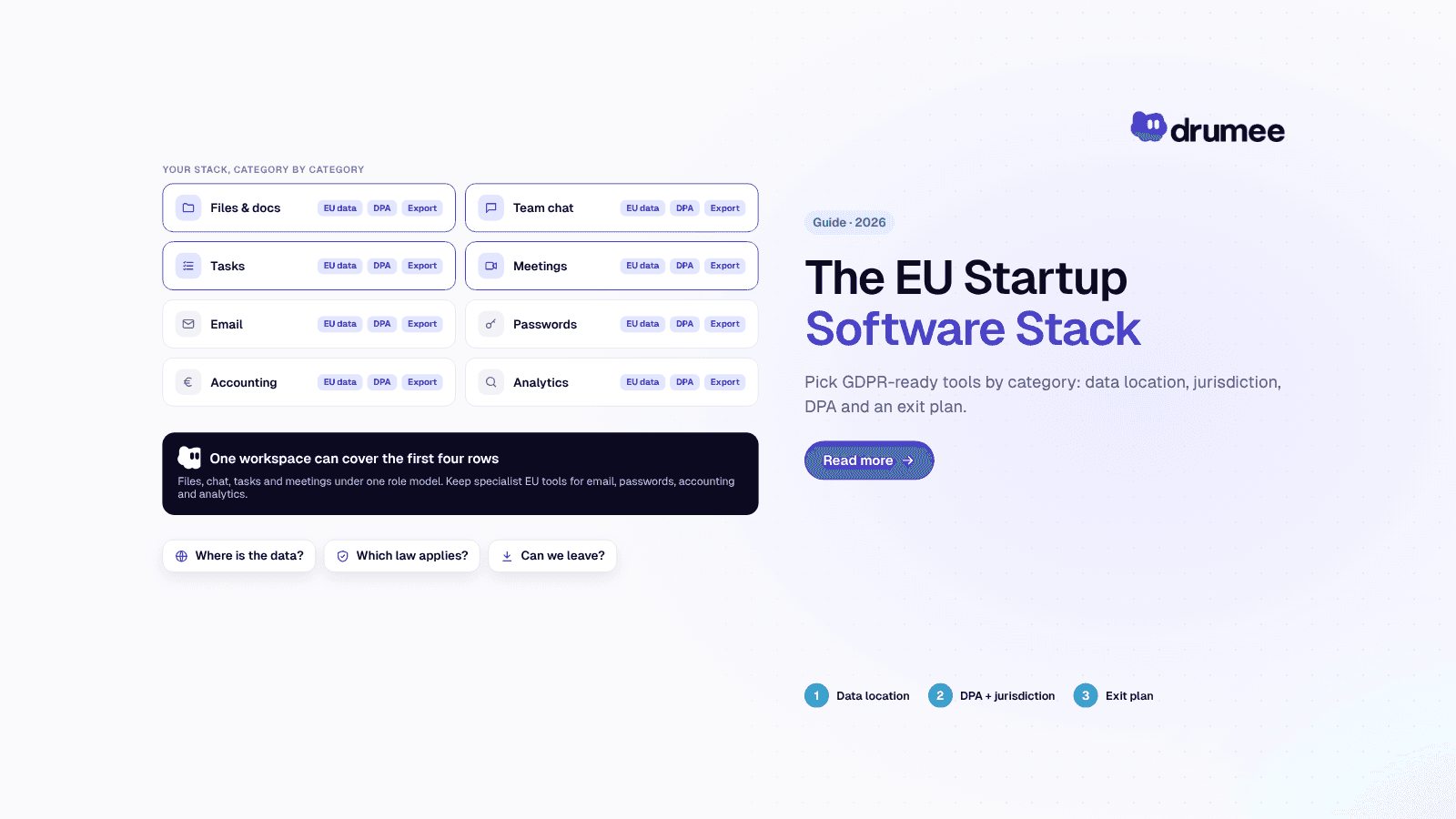
An EU startup software stack chosen category by category: workspace, chat, docs, tasks, meetings, CRM, accounting, email, passwords and analytics, each scored…
A GDPR-ready EU startup software stack is a set of tools, one per job, where each vendor stores your data in a known location, operates under a jurisdiction you can live with, signs a data processing agreement, lets you export everything, and supports single sign-on. You pick it category by category, not brand by brand.
This guide is for founders and ops leads at startups of 25 people or fewer. It covers the ten categories most teams need, gives you five criteria to score every vendor, names real European options with sources, and ends with a checklist you can run in an afternoon.
It does not repeat the cost math or the tool-count problem. If you want those, read our guides on how EU startups reduce SaaS costs and what tool sprawl is and how to fix it.
What makes a startup software stack GDPR-ready?
Answer: A startup software stack is GDPR-ready when every tool that touches personal data passes five checks: you know where the data is stored, the vendor's home jurisdiction does not expose it to foreign access orders you cannot accept, a signed Article 28 data processing agreement exists, you can export your data in open formats, and access is controlled centrally through SSO or strong admin controls.
No tool makes you compliant on its own. GDPR obligations sit with you as the controller; the tools either make those obligations easy to meet or quietly make them harder.
Where Drumee fits: Drumee is a sovereign workspace that puts files, folder-native chat, tasks, calendar and meetings in one workspace under one permission model. It runs as Drumee Cloud at app.drumee.com, or on your own infrastructure as Drumee Sovereign Node (contact sales). It can cover the workspace, chat, docs, tasks and meetings rows of your stack. It does not replace CRM, accounting, email, a password manager or analytics.
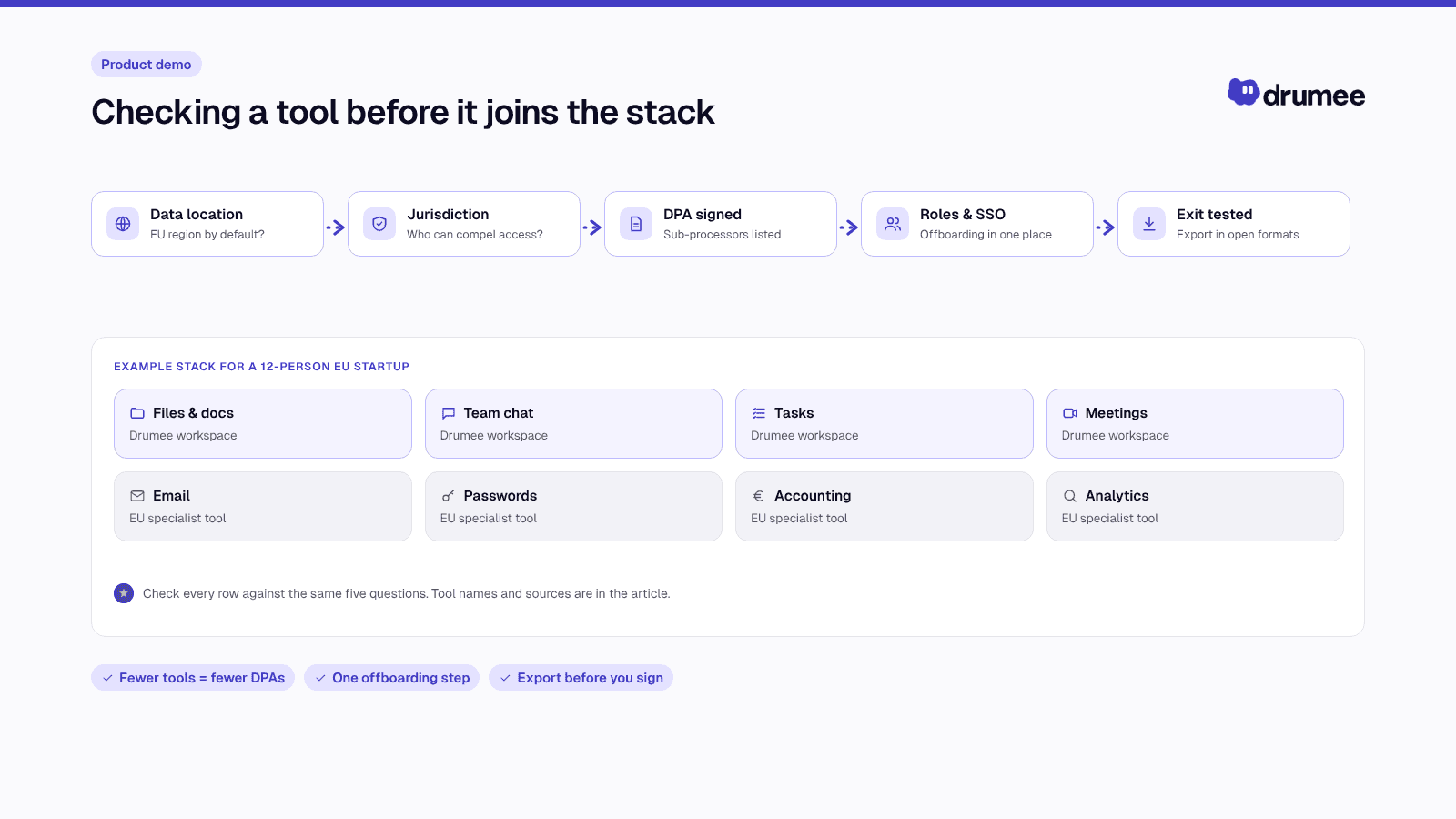
One sovereign workspace for collaboration, specialist European tools for the rest.
Why the stack decision matters more in 2026
Most startups inherit their stack from the founders' last job. That usually means US suites by default, chosen before anyone asked where the data lives. In 2026 that default is getting harder to defend.
Sentiment has shifted among established companies too. In Bitkom's Cloud Report 2026 (603 German companies with 20+ staff, published 17 June 2026), 85% said Germany is too dependent on US cloud providers, up from 78% a year earlier. t3n's coverage of the same study adds that 71% source their cloud services from the US, while only 8% would actually prefer a US provider, and 43% see no equivalent European alternative to the big hyperscalers.
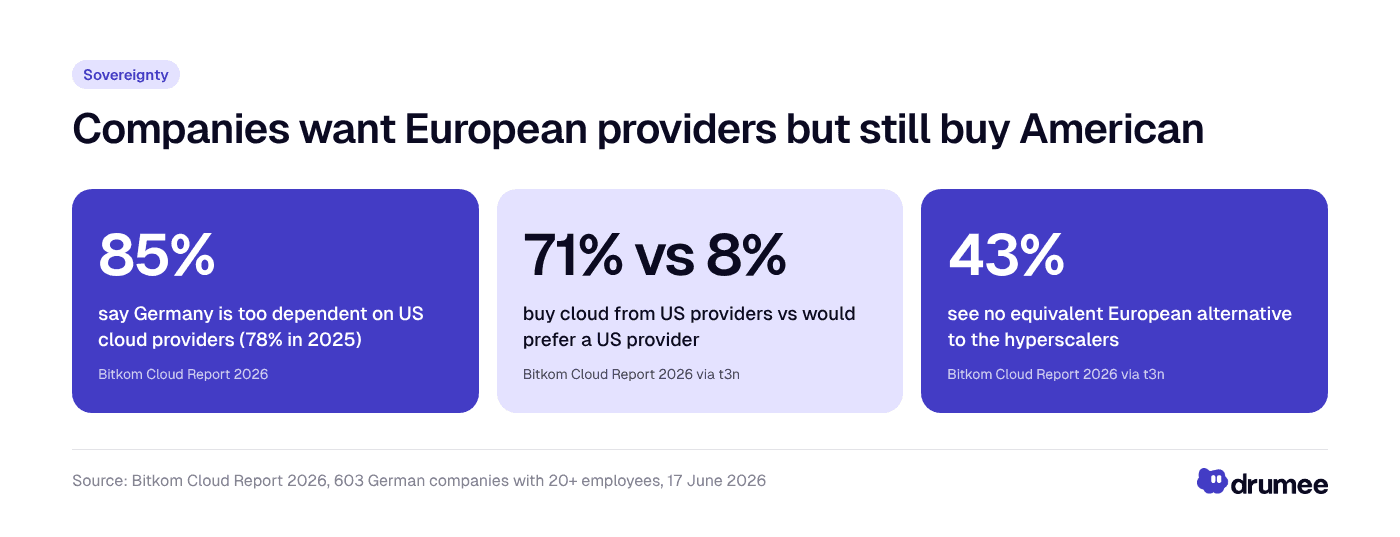
Most companies say they want European providers, but most still buy American, and many doubt the alternatives are equal.
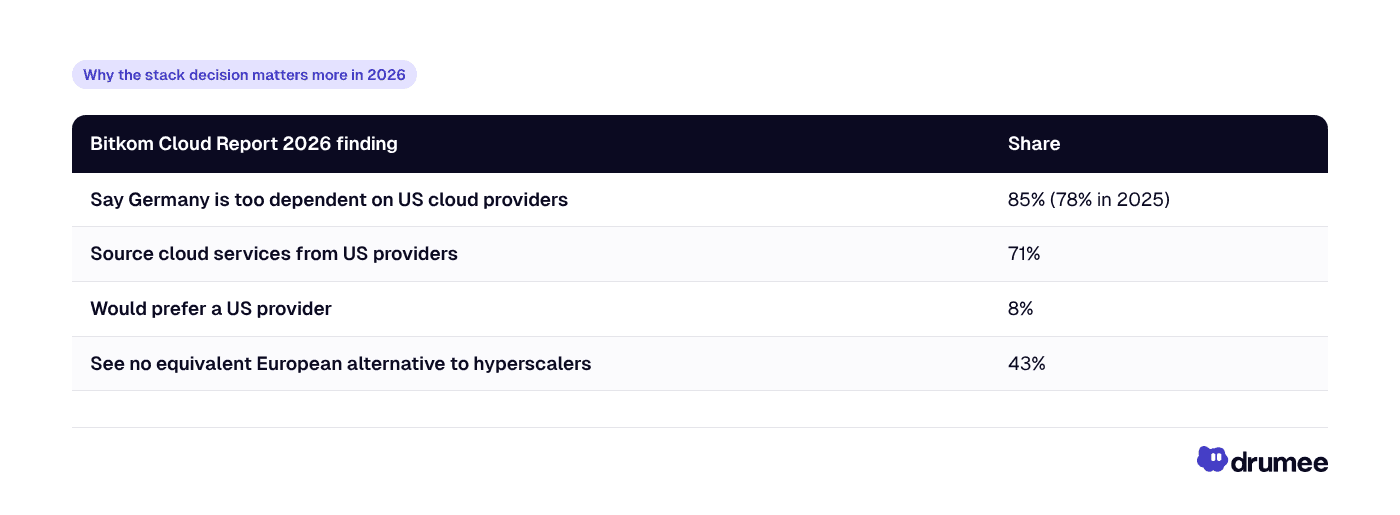
That last number matters for you. European options are real, but they are not always feature-equivalent. Picking a GDPR-ready stack means accepting trade-offs consciously, not pretending they do not exist.
The legal background is also unsettled. The EU-US Data Privacy Framework was upheld by the EU General Court in September 2025, but the ruling was appealed to the Court of Justice (Case C-703/25 P). Separately, the US CLOUD Act lets US authorities compel US providers to disclose data in their "possession, custody, or control", wherever it is stored. Neither fact makes US tools illegal. Both are reasons to know which of your tools depend on them.
The five criteria to score every tool
Score each candidate on the same five questions. Write the answers down; your future auditor, investor or enterprise customer will ask for them.
1. Data location
Where are your data and backups stored, and where do support staff access it from? Look for a named country or region in the privacy policy or sub-processor list, not just "Europe" in a marketing headline. Check the sub-processors as well: an EU vendor hosting on a US hyperscaler is a different risk profile from one running its own data centres.
2. Jurisdiction
Which country's law governs the company that holds your data? An EU or EEA headquarters keeps the vendor inside GDPR directly. Switzerland and New Zealand hold EU adequacy decisions, which the Commission reaffirmed in its January 2024 review, so transfers there need no extra transfer tool. For US-parented vendors, the CLOUD Act question applies even when servers sit in Frankfurt.
3. Data processing agreement (DPA)
Any vendor that processes personal data on your behalf is a processor, and Article 28 GDPR requires a written contract that covers instructions, confidentiality, security, sub-processors, deletion and audits. Reputable vendors publish a standard DPA you can accept online. If a vendor cannot produce one, that answers the question.
4. Exit and export
Can you get all your data out, in open or standard formats, without asking support? Under the EU Data Act, cloud switching charges, including egress fees for switching, are banned from 12 January 2027. That helps, but a free export in a proprietary format is still a trap. Test the export before you commit. Our guide on how to avoid SaaS vendor lock-in goes deeper.
5. SSO and access control
At ten people, a shared admin password feels fine. At twenty-five, with contractors coming and going, it is how data leaks. Prefer tools that support SSO (SAML or OIDC) or at least enforced two-factor authentication, role-based permissions and an audit log. Check which plan includes SSO; it is often reserved for higher tiers.
The stack by category: European options to shortlist
The tools below are real European options with a verified headquarters or hosting location. They are a shortlist, not a ranking. Run each one through the five criteria and your own feature needs.
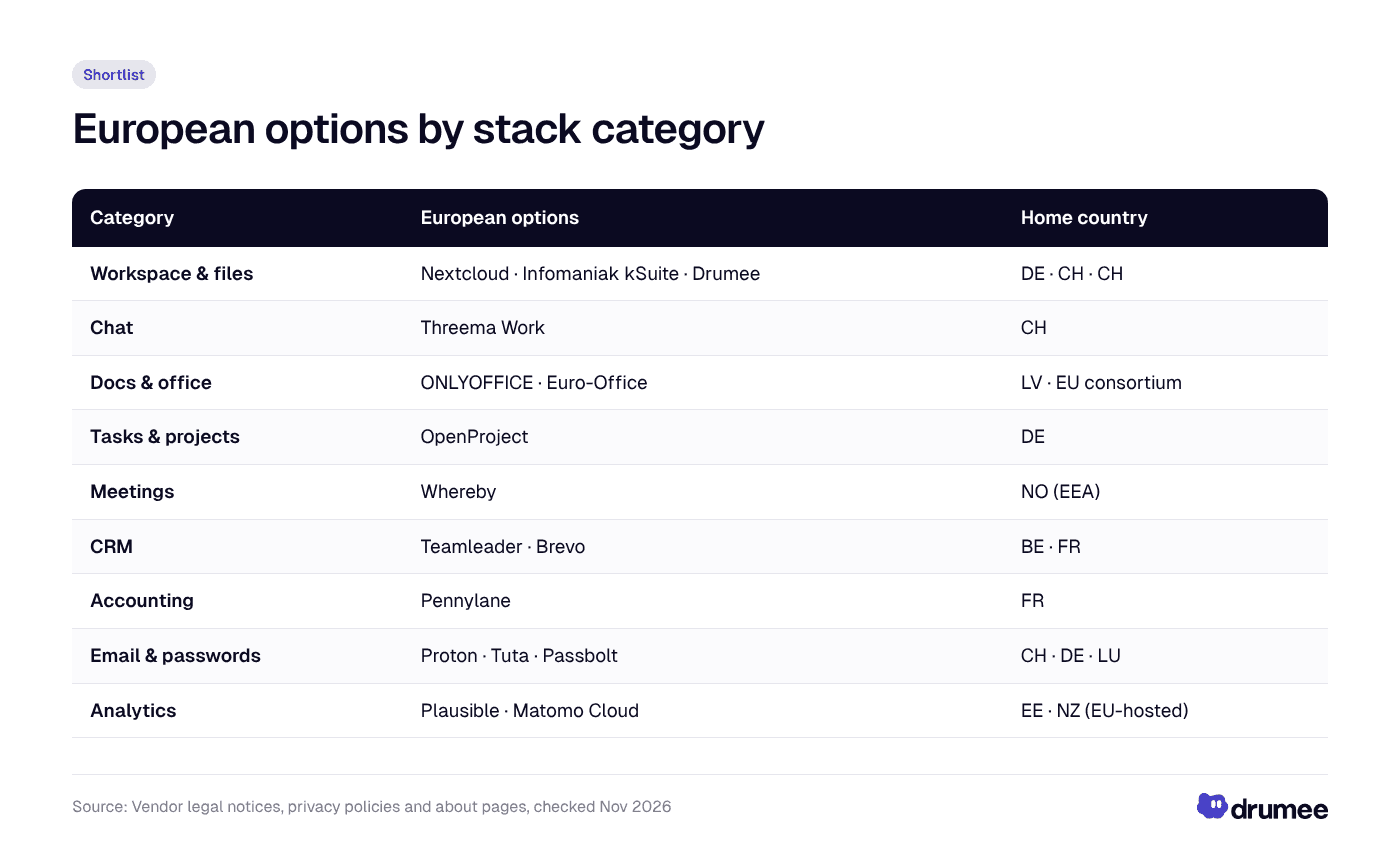
A shortlist by category, with each vendor's home country. Verify data location and DPA before you sign.
Workspace and files
This is your most sensitive layer: contracts, HR files, customer data. Nextcloud GmbH is registered in Stuttgart, Germany, and its software is open source under AGPLv3, so you can self-host it or use a hosting partner. Infomaniak, from Geneva, says its kSuite data is hosted and processed exclusively in Switzerland. Drumee is a third route, covered below. For file storage specifically, see our GDPR-compliant file storage guide.
Team chat
Threema Work is a Swiss business messenger that runs its server infrastructure in Switzerland and offers an admin console for companies. It is strong for secure messaging, lighter on the channels-and-integrations model engineering teams are used to. If you want chat tied to files and tasks, a workspace that includes chat avoids running a separate tool.
Docs and office editing
ONLYOFFICE is developed by Ascensio System SIA, headquartered in Riga, Latvia. Note the jurisdiction nuance: its parent holding company is registered in Singapore. Infomaniak's kSuite and Nextcloud's office integrations are other routes, and Euro-Office, an ONLYOFFICE fork backed by IONOS, Nextcloud and Proton, is covered in our Euro-Office desktop app post.
Tasks and projects
OpenProject GmbH is based in Berlin and licenses OpenProject under GPLv3, with a hosted cloud edition and an on-premises edition. It suits teams that need classic and agile project management with Gantt charts. Lighter boards are often enough at startup size.
Meetings
Whereby is a Norwegian company headquartered in Oslo; Norway applies GDPR through the EEA. Whereby states on its GDPR page that users in European countries connect to data centres located in the EEA and publishes a standard DPA. It is browser-based, so guests join without installing anything.
CRM
Teamleader was founded in Ghent, Belgium, in 2012 and has been part of Visma since 2022. It combines CRM with projects and invoicing for small businesses. Brevo, headquartered in Paris, includes a CRM and says it hosts customer data on EU servers, primarily with OVH in France and Germany and with Google Cloud in Belgium. That last detail is exactly what criterion 1 asks you to notice: EU location, partly on a US-parented provider.
Accounting
Pennylane is a Paris-based accounting and finance platform that grew up on the French market. Accounting is the most country-specific category in your stack: check that the tool supports your local chart of accounts, e-invoicing rules and the accountant you actually work with before you weigh anything else.
Email is the identity layer for everything else, so jurisdiction matters here. Proton, based in Geneva and majority-owned by the Proton Foundation, offers Proton Mail for business. Tuta, from Hanover, says it owns its servers in ISO 27001-certified data centres in Germany. Both encrypt heavily, which can limit third-party integrations; test your calendar and CRM sync first.
Password manager
Passbolt is an open source team password manager from Luxembourg; TechCrunch covered its open source model in January 2025. You can self-host the Community Edition or use its managed service. Proton Pass is the option if you already standardise on Proton.
Analytics
Plausible is run by Plausible Insights OÜ in Estonia and hosts visitor data on Hetzner servers in Falkenstein, Germany. Matomo Cloud stores data in Frankfurt with backups in Dublin, while the operating company, InnoCraft, is based in New Zealand, a country with an adequacy decision.
A decision checklist for founders
Use this list before you sign up for any tool that will hold personal data. It takes ten minutes per vendor.
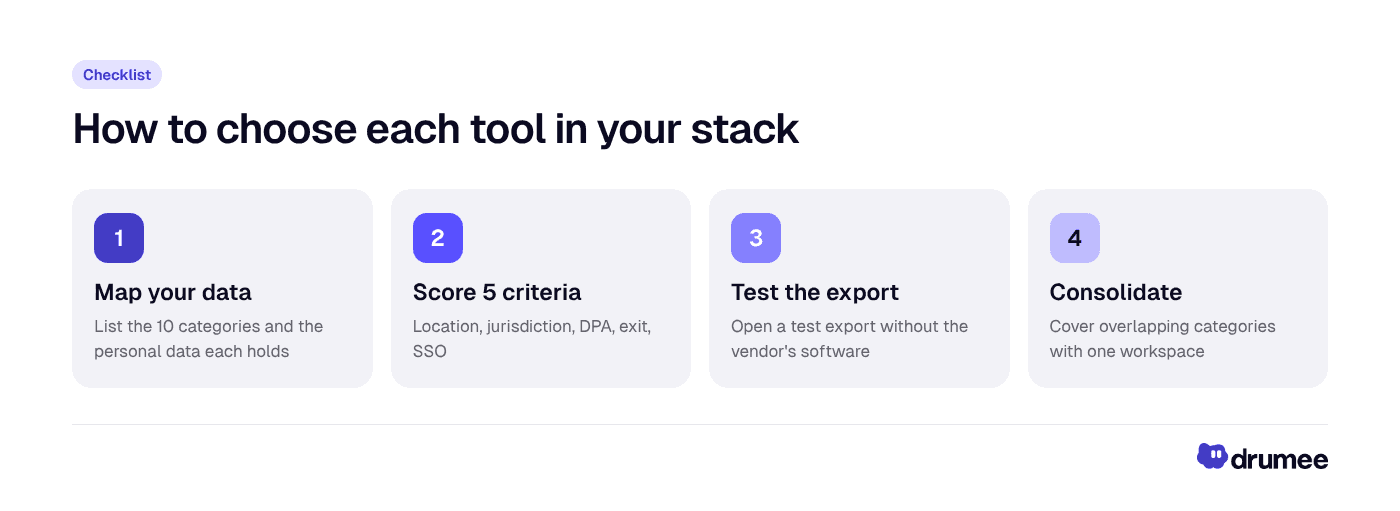
Map, score, test, consolidate: the four steps behind every tool decision.
- Map your data by category. List the ten categories and note which personal data each will hold: customer contacts, employee records, chat history, invoices.
- Rank categories by sensitivity. Workspace and files, email and accounting usually hold the most sensitive data. Start your European migration there, not with analytics.
- Find the vendor's legal entity. Read the imprint or legal notice and the privacy policy. Note the country and any parent company.
- Read the sub-processor list. Note where hosting, backups and support happen.
- Accept or sign the DPA. Save a PDF copy in your compliance folder with the date.
- Run a real export. Export a test project and open it without the vendor's software.
- Check SSO and admin controls. Confirm which plan includes SSO, two-factor enforcement and an audit log.
- Record a one-line decision. For each tool, write why you chose it and what the trade-off is. This becomes your record of processing activities input.
- Look for overlap. If three tools each hold part of the same project, consider one workspace that covers them.
- Review twice a year. Vendors change owners, sub-processors and terms. Teamleader joining Visma is a reminder that ownership moves.
Where a sovereign workspace like Drumee fits
A sovereign workspace is one option for the collaboration half of your stack: files, chat, docs, tasks and meetings. Our explainer on what a sovereign workspace is covers the concept; here is how it maps to the five criteria, honestly.
What Drumee covers today
Drumee puts files, folder-native chat with file threads, tasks with board and other views, calendar and meetings in one workspace with one set of members and roles. You can turn a chat message into a task without leaving the conversation, and share files with clients from external workspaces with access controls on each link. Office documents open in Drumee's own browser editor.
Two ways to run Drumee: Drumee Cloud is the hosted workspace at app.drumee.com: sign up and start in minutes (your team's first month is $1). Drumee Sovereign Node runs Drumee on your own infrastructure, with unlimited users, SDK access and a dedicated SLA; contact sales.
How it scores on the five criteria
- Data location: On Drumee Cloud (app.drumee.com), ask Drumee for the current hosting region and sub-processor list before you sign. On Sovereign Node, data stays on infrastructure you run.
- Jurisdiction: Drumee is built by Thidima SA, a Swiss-registered company. Switzerland holds an EU adequacy decision.
- DPA: Request it as you would from any vendor.
- Exit and export: Per the Drumee documentation, you can export your files, chat history and workspace data whenever you choose, with files stored as uploaded in standard formats. Drumee states that your content is not used for advertising or to train AI models.
- SSO and access control: Workspaces use role-based permissions, and organizations have an audit log and two-step verification for admins.
The honest trade-offs
- Self-hosting goes through sales. Drumee Sovereign Node runs on your own infrastructure via contact sales; there is no free self-serve download. If you want to self-host without a sales conversation, Nextcloud can be self-hosted now. Our self-hosted vs SaaS guide helps you decide whether you need that at all.
- No email yet. Drumail is in development. Keep Proton, Tuta or your current provider for email.
- Not a CRM, accounting, password or analytics tool. Those categories stay with specialists.
- Fewer integrations than the big US suites. An app marketplace exists on Drumee Cloud, and SDK access comes with the Sovereign Node.
The case for it is cost, control and sovereignty in one decision: one vendor and one permission model for five categories instead of five contracts, five DPAs and five exports to test. For the GDPR detail, read our Drumee GDPR explainer.
Common mistakes when building an EU stack
- Trusting "EU hosting" headlines. An EU data centre run by a US-parented company still raises the jurisdiction question. Read the legal entity, not the landing page.
- Migrating everything at once. Move the most sensitive category first, learn, then continue.
- Skipping the export test. You only discover a proprietary format when you try to leave.
- Forgetting the long tail. Form builders, scheduling links and browser extensions also process personal data. They belong on the list.
- Choosing on ideology alone. A European tool your team refuses to use pushes data back into personal accounts. Adoption is a compliance control.
FAQ
What software should an EU startup use to stay GDPR compliant?
There is no single compliant product. Choose one tool per category and check each for data location, jurisdiction, a signed Article 28 DPA, a working export and SSO or strong admin controls. European options exist in every category, from Nextcloud and Drumee for workspace and files to Plausible for analytics.
Are US tools like Google Workspace or Slack illegal for EU startups?
No. US vendors certified under the EU-US Data Privacy Framework can lawfully receive EU personal data, and the framework was upheld in September 2025. The ruling is under appeal, and the CLOUD Act still applies to US providers, so many startups keep their most sensitive data with European vendors.
What are the best European software alternatives for a small startup?
Shortlist by category: Nextcloud or Infomaniak kSuite for files, Threema Work for chat, OpenProject for projects, Whereby for meetings, Teamleader or Brevo for CRM, Pennylane for accounting in France, Proton or Tuta for email, Passbolt for passwords, Plausible for analytics. Test each against your feature needs.
Does an EU data centre make a tool GDPR-ready?
Not on its own. Data location is one of five criteria. You also need to know the vendor's jurisdiction, sign a DPA, confirm you can export your data and control access centrally. An EU data centre operated by a US-parented company can still receive US access orders.
Can one workspace replace several tools in the stack?
Partly. A sovereign workspace like Drumee covers files, chat, docs, tasks and meetings in one system with one permission model. Email, CRM, accounting, password management and analytics still need specialist tools.
Conclusion: pick the stack you can explain
A GDPR-ready EU startup software stack is not a list of approved brands. It is a set of decisions you can explain: where each tool keeps data, whose law applies, which DPA you signed, how you would leave and who has access. Run the checklist once, write down the trade-offs, and review it twice a year.
For the collaboration half of the stack, consolidating files, chat, docs, tasks and meetings into one sovereign workspace means one vendor to vet instead of five. Compare plans on the Drumee pricing page, and keep specialist European tools for the rest.
Try Drumee with your team: your first month is $1. Start your team for $1
Keep reading
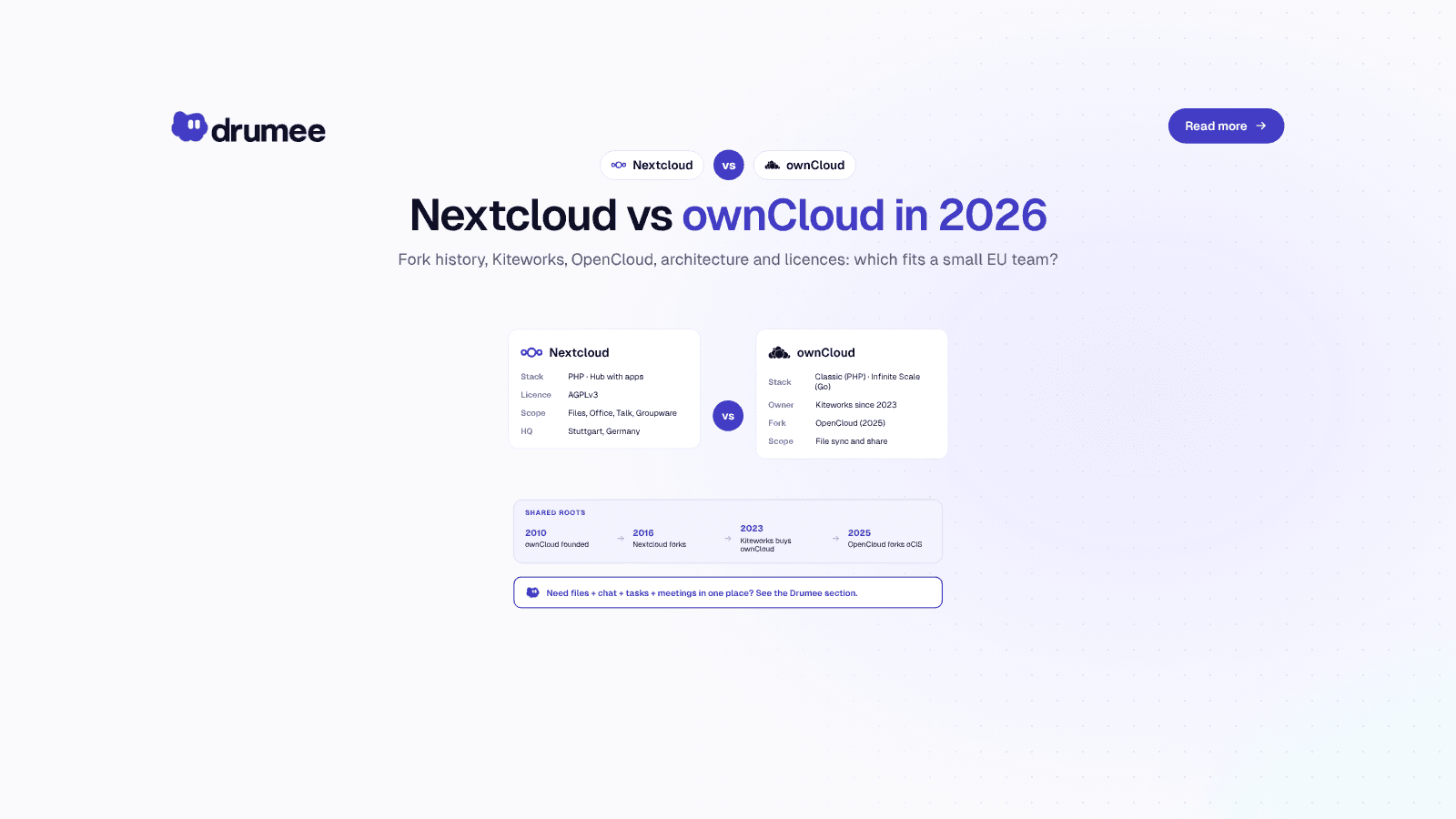
Nextcloud vs ownCloud in 2026: An Honest Head-to-Head for Small EU Teams
For most small EU teams in 2026, Nextcloud is the safer pick: one AGPLv3 suite with files, chat, calls, groupware and office, a German owner and the largest community. ownCloud Infinite Scale is the better fit if you only want a lean, fast file pl...
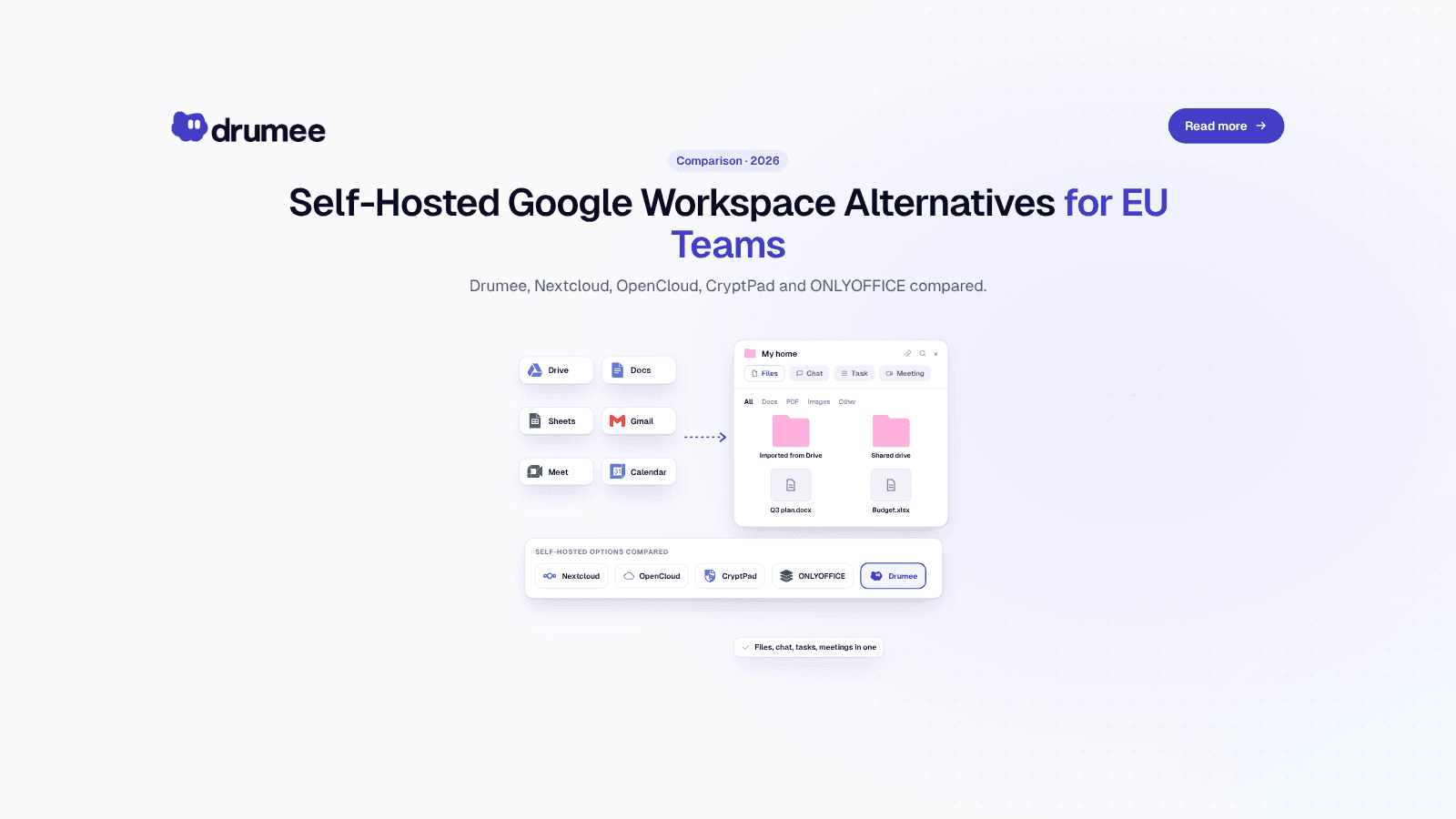
Self-Hosted Alternatives to Google Workspace: 2026 Guide for EU Teams
Google Workspace is the default office stack for most European startups. It is also a US-controlled service whose list price went up in January 2025, whose data sits under US legal reach, and whose exit path takes days of admin work. For a growing...
What Is Tool Sprawl and How to Fix It in 2026
Nobody decides to build a messy stack. A startup adds Slack on day one, Google Drive on day two, Notion when the wiki gets real and ClickUp when the roadmap stops fitting in a spreadsheet. Two years later, a simple question like "where did we deci...