
Self-Hosted Alternatives to Google Workspace: 2026 Guide for EU Teams
Google Workspace is the default office stack for most European startups. It is also a US-controlled service whose list price went up in January 2025, whose data sits under US legal reach, and whose exit path takes days of admin work. For a growing...
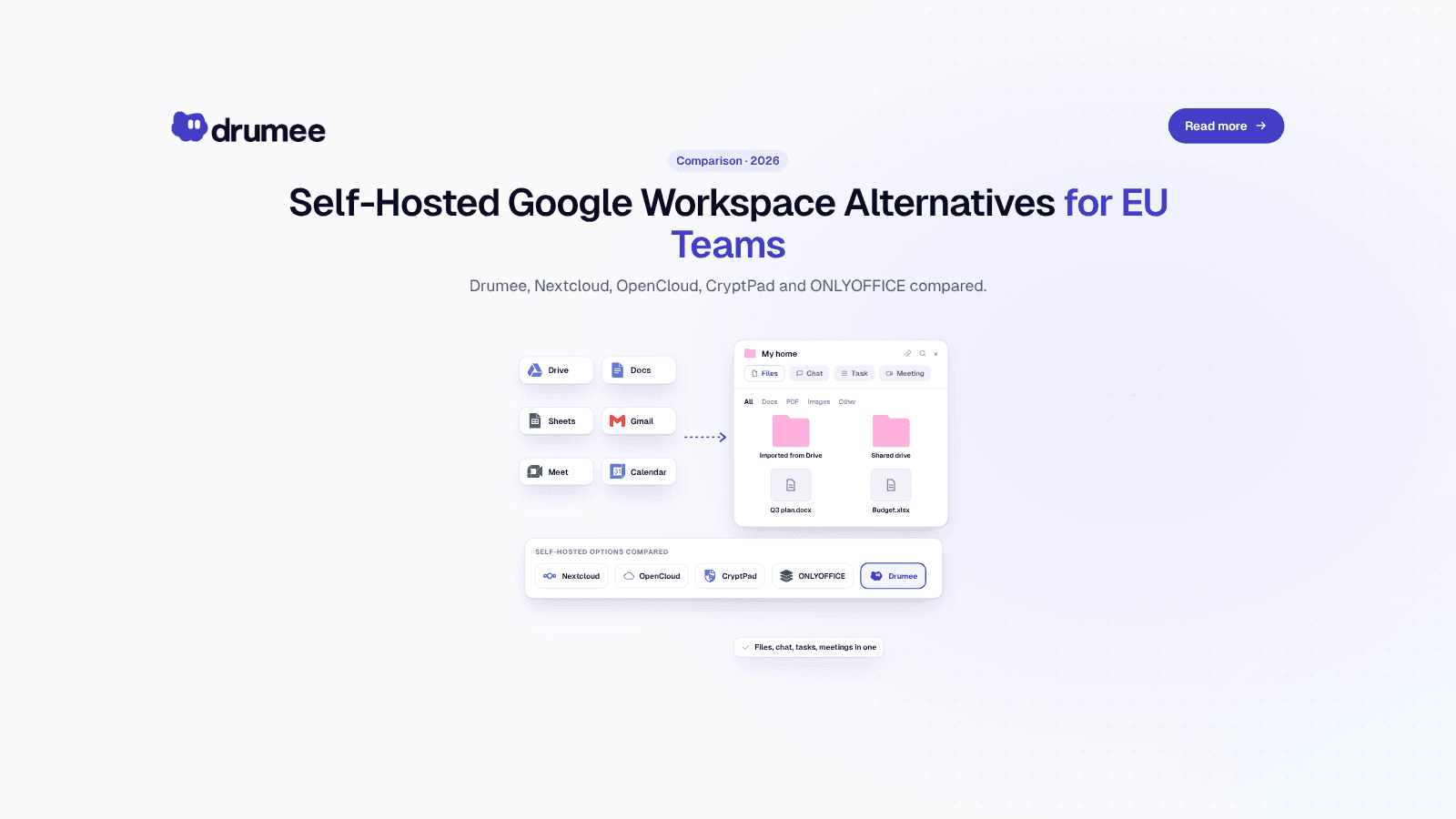
Five self-hosted Google Workspace alternatives compared for EU teams; Drumee is the full-stack pick for startups up to 25 people
Google Workspace is the default office stack for most European startups. It is also a US-controlled service whose list price went up in January 2025, whose data sits under US legal reach, and whose exit path takes days of admin work. For a growing number of EU teams, that combination is no longer acceptable.
This guide compares five credible self-hosted alternatives to Google Workspace: Drumee, Nextcloud, ownCloud/OpenCloud, CryptPad and ONLYOFFICE Workspace. You get the legal context, a feature-and-price table, honest strengths and weaknesses for each, and a verdict by team type.
We build Drumee, so read our recommendation with that in mind. We have tried to be fair to every option and we link every claim to its source so you can check it.
What is the best self-hosted alternative to Google Workspace?
Quick answer: The best self-hosted alternative to Google Workspace depends on scope. For an EU startup of up to 25 people that wants files, chat, meetings and tasks in one operator-controlled system, Drumee is the most complete fit. Nextcloud suits IT-led teams wanting a large app ecosystem; CryptPad suits end-to-end encrypted document work; ONLYOFFICE suits office-format-heavy teams.
Where Drumee fits: Drumee is a sovereign workspace that replaces the Drive + Chat + Meet + task-tool combination with one system. Teams can start on Drumee-hosted managed plans (Free → Business, $0–$99 per month flat) and move to a fully self-hosted Sovereign Node on their own infrastructure. That gives cost, control and sovereignty in a single product, rather than a stack of add-ons.
If you are still deciding whether self-hosting is right for you at all, start with our explainer on what a sovereign workspace is and our breakdown of self-hosted vs SaaS for startups.
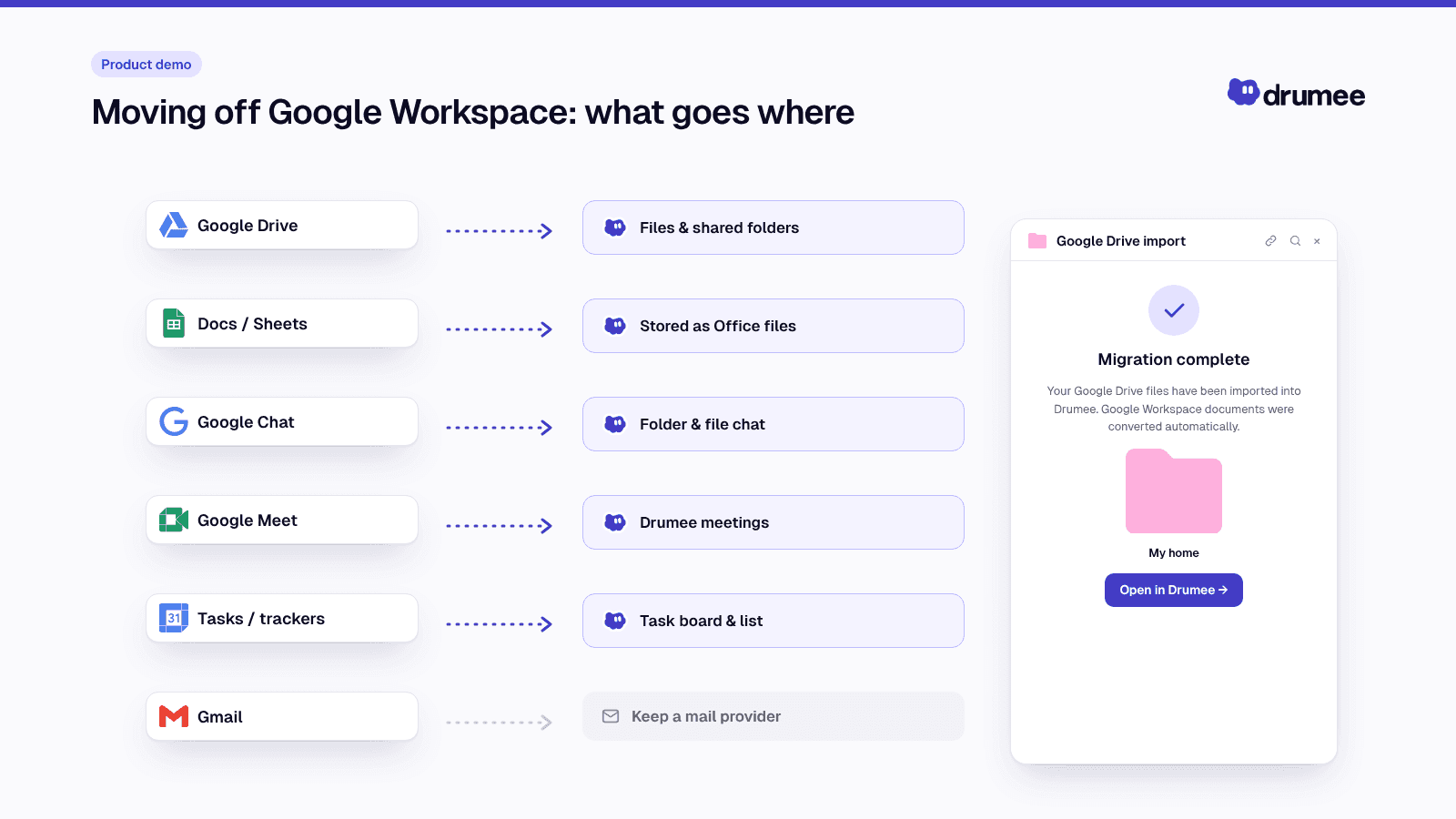
Moving off Google Workspace: what goes where.
Why EU teams are moving off Google Workspace in 2026
The shift is not ideological. It is driven by five concrete pressures that land on a founder's or CTO's desk: legal exposure, regulatory uncertainty, an industry signal, CIO sentiment and price.
1. The US CLOUD Act reaches data stored in Europe
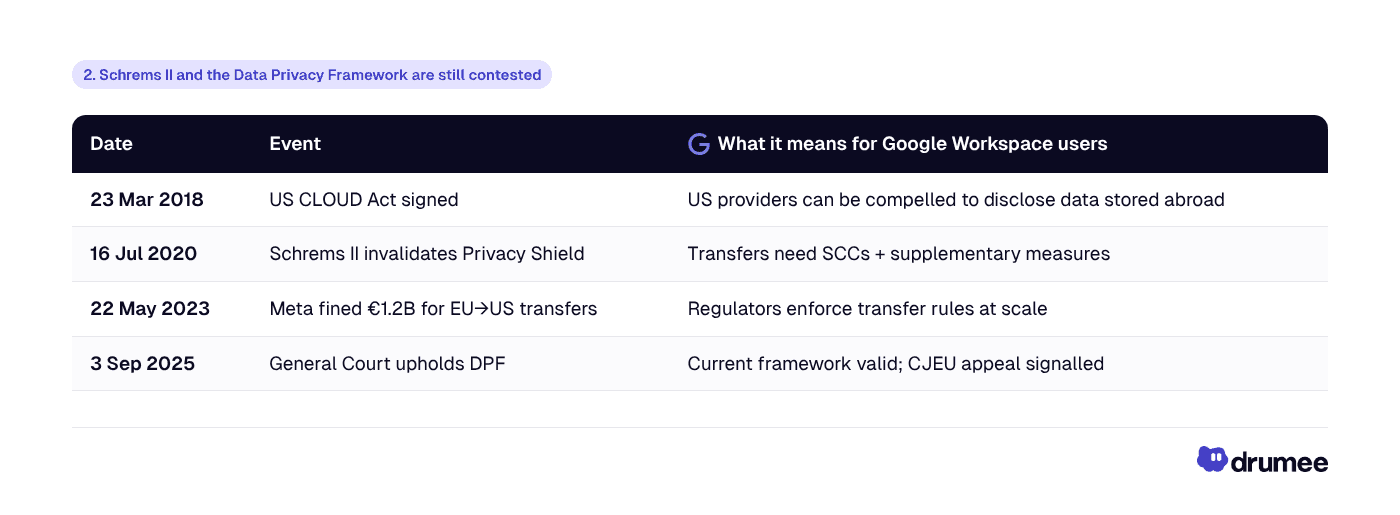
The US CLOUD Act, signed on 23 March 2018, requires US providers to disclose data in their "possession, custody, or control" regardless of where it is physically stored. Choosing an EU data region inside a US provider changes where the disks are, not who can be compelled to hand over the contents.
For GDPR purposes, that matters because Articles 44–49 govern transfers to third countries. A US authority accessing EU personal data is exactly the scenario GDPR Chapter V was written to control.
2. Schrems II and the Data Privacy Framework are still contested
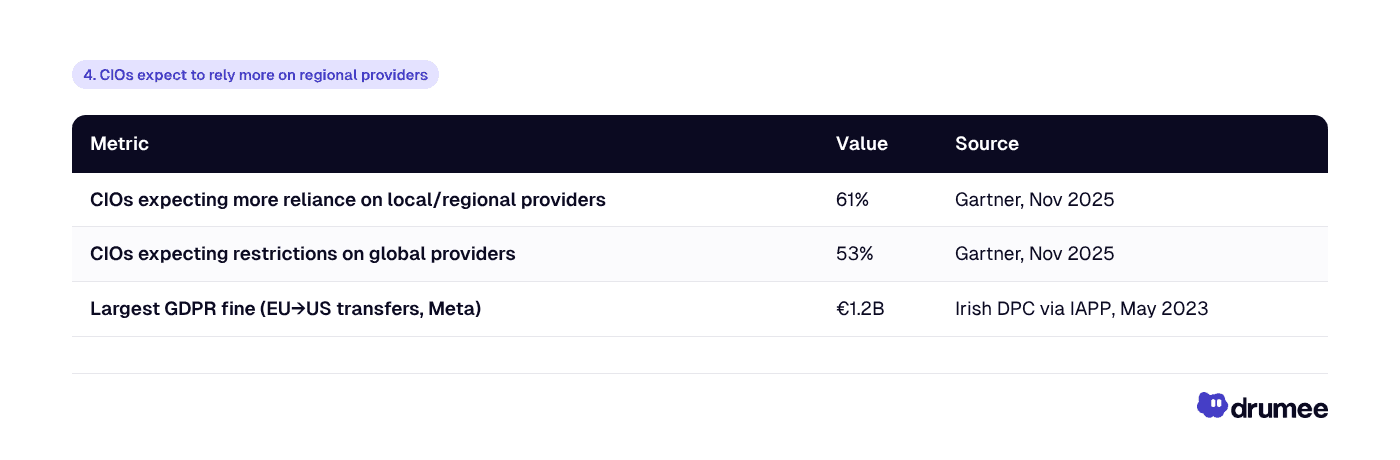
In July 2020 the Court of Justice of the EU invalidated the EU-US Privacy Shield in Schrems II (C-311/18) and required supplementary measures for Standard Contractual Clauses. The cost of getting this wrong is real: the Irish DPC fined Meta €1.2 billion in May 2023 for EU-to-US transfers.
The replacement EU-US Data Privacy Framework was upheld by the EU General Court on 3 September 2025 (Latombe, T-553/23), but an appeal to the CJEU has been signalled. Two previous frameworks fell. Building your company's core workspace on the assumption that the third one survives is a risk decision, not a neutral default.
3. Microsoft's French Senate admission is an industry signal
On 10 June 2025, Microsoft France's legal director Anton Carniaux was asked under oath before the French Senate whether he could guarantee that French citizens' data would not be transmitted to US authorities without French authorization. His answer, reported by Heise and Techzine, was: "No, I cannot guarantee it."
That statement was about Microsoft, not Google. We cite it because it is the clearest public acknowledgment from a US hyperscaler of how the CLOUD Act interacts with EU data residency. Any US-headquartered provider operates under the same law.
"No, I cannot guarantee it." — Anton Carniaux, Microsoft France, under oath before the French Senate, 10 June 2025
4. CIOs expect to rely more on regional providers
Gartner surveyed 241 Western European CIOs and IT leaders in 2025. 61% expect geopolitics to increase their reliance on local or regional providers, and 53% say geopolitics will restrict their future use of global providers. Gartner also predicts that by 2030 more than 75% of non-US enterprises will have a digital sovereignty strategy.
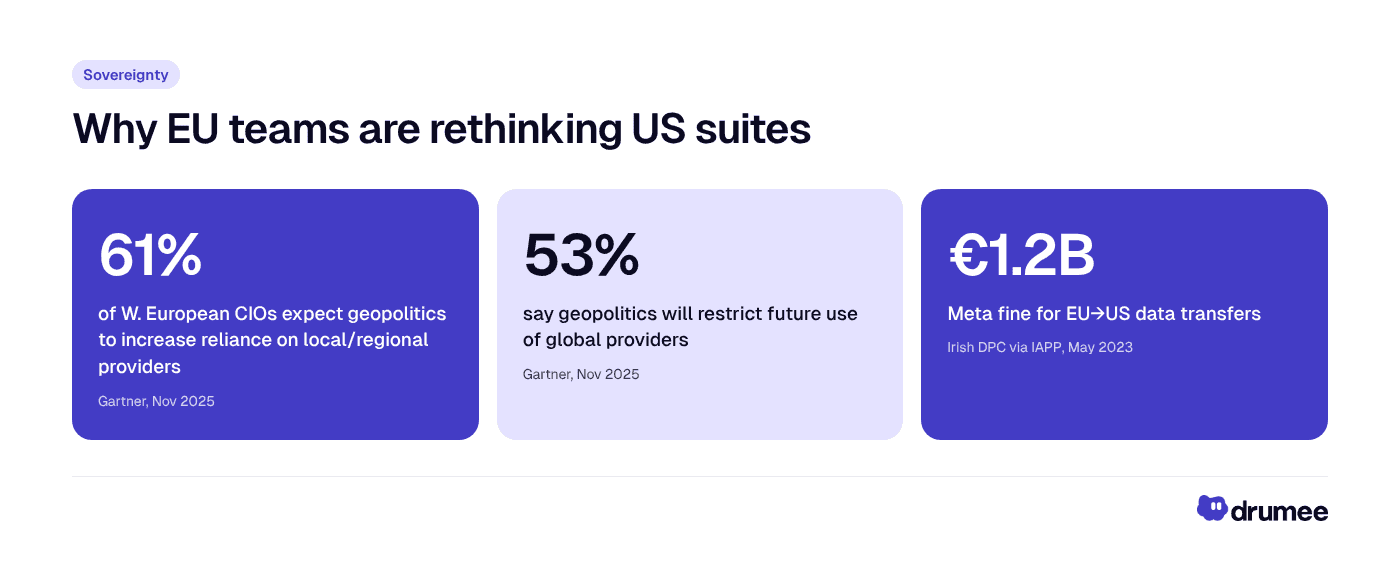
Most Western European IT leaders now treat geopolitics as a direct input into provider choice, according to Gartner's November 2025 survey.
5. The price went up — and it scales per seat
In January 2025 Google raised Workspace list prices while bundling Gemini AI. According to Google's own admin help page, Business Starter, Standard and Plus now cost $7 / $14 / $22 per user per month on annual commitment, or $8.40 / $16.80 / $26.40 on flexible monthly billing (as of November 2026 — check vendor page). Before the change they were $6 / $12 / $18.
Per-seat pricing is the structural issue. Every hire adds cost, and it compounds with the other per-seat tools in your stack. We break down that compounding effect in our guide to cutting SaaS costs for EU startups.
What are the risks of using Google Workspace for sensitive data?
Standalone answer: The main risks of using Google Workspace for sensitive data are jurisdictional and contractual. As a US provider, Google is subject to the CLOUD Act regardless of data location; EU-US transfers rely on a Data Privacy Framework that may still be challenged before the CJEU; and GDPR fines reach €20 million or 4% of global turnover. Exiting also takes admin time.
To be fair to Google: its security engineering is excellent, and for many companies the residual legal risk is acceptable. The question is whether your data — client contracts, health data, defence or legal work, unreleased product — is data you want under a foreign legal regime. Under GDPR Article 83, the controller carries that liability, not the vendor.
Key risk areas to put in your DPIA:
- Third-country access: CLOUD Act orders are served on the US provider, not on you, the controller.
- Transfer mechanism fragility: if the DPF falls like Privacy Shield did, your transfer basis changes overnight.
- Processor terms: you sign Google's Article 28 data processing terms; you cannot negotiate them as a 10-person startup.
- Lock-in and exit cost: Docs, Sheets and Slides are native Google formats that must be converted on export.
- Price exposure: vendor-set per-seat price changes apply to your whole headcount.
Our Drumee GDPR compliance guide explains how an operator-controlled deployment changes the controller/processor picture.
How we evaluated the alternatives
We scored each option on the criteria an EU startup CTO actually uses when replacing Google Workspace:
- Scope — how much of Workspace (files, docs, chat, meetings, calendar, tasks, mail) it replaces.
- Deployment — self-hosted, vendor-hosted, or both, and how hard self-hosting is to run.
- Sovereignty — who controls the infrastructure and which jurisdiction the vendor sits in.
- Cost model — flat vs per seat, and whether the free option is usable for a real team.
- Maturity and ecosystem — community size, release history, governance stability.
We only list features we could verify on vendor pages or reputable coverage. Where a capability was not documented, we say so rather than guess.
Self-hosted Google Workspace alternatives: comparison table
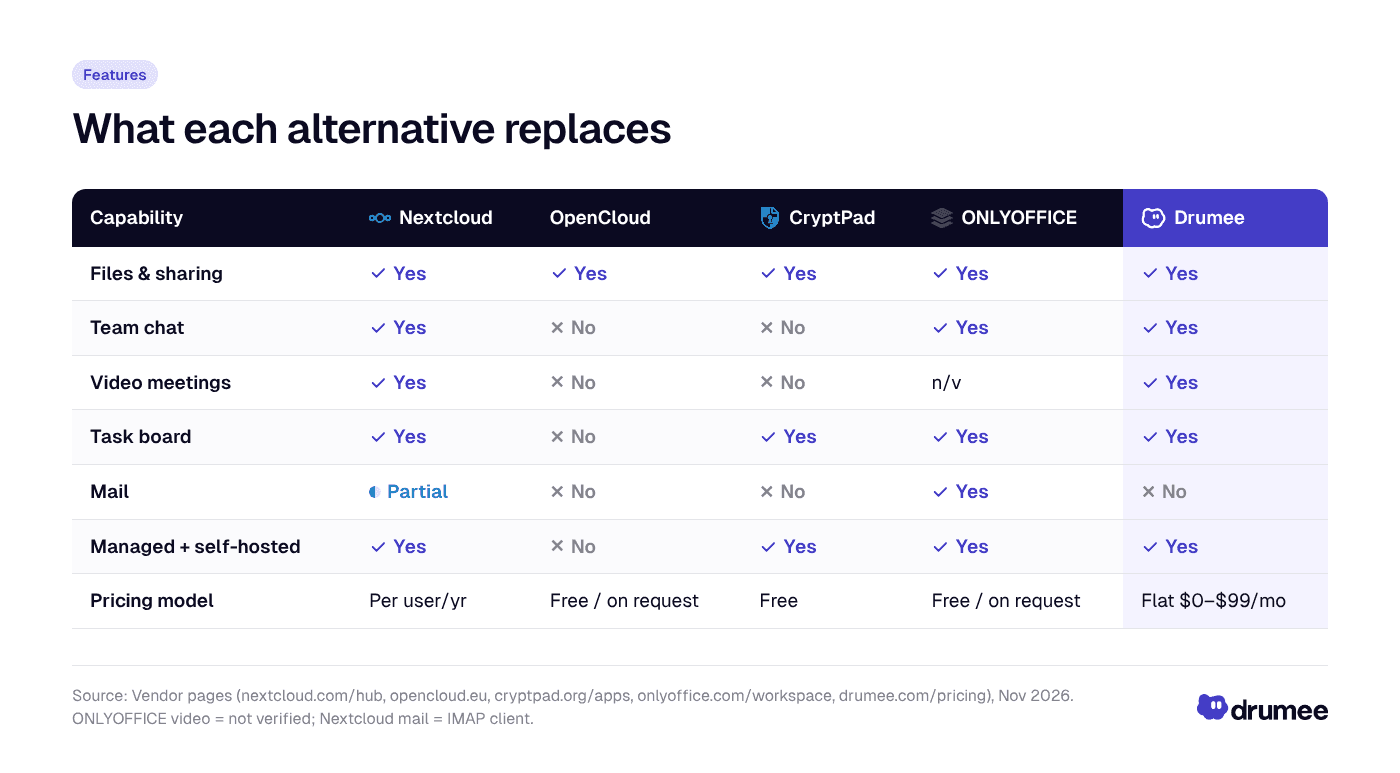
Only Drumee and Nextcloud cover files, chat, video meetings and task boards out of the box; CryptPad and OpenCloud are narrower by design.
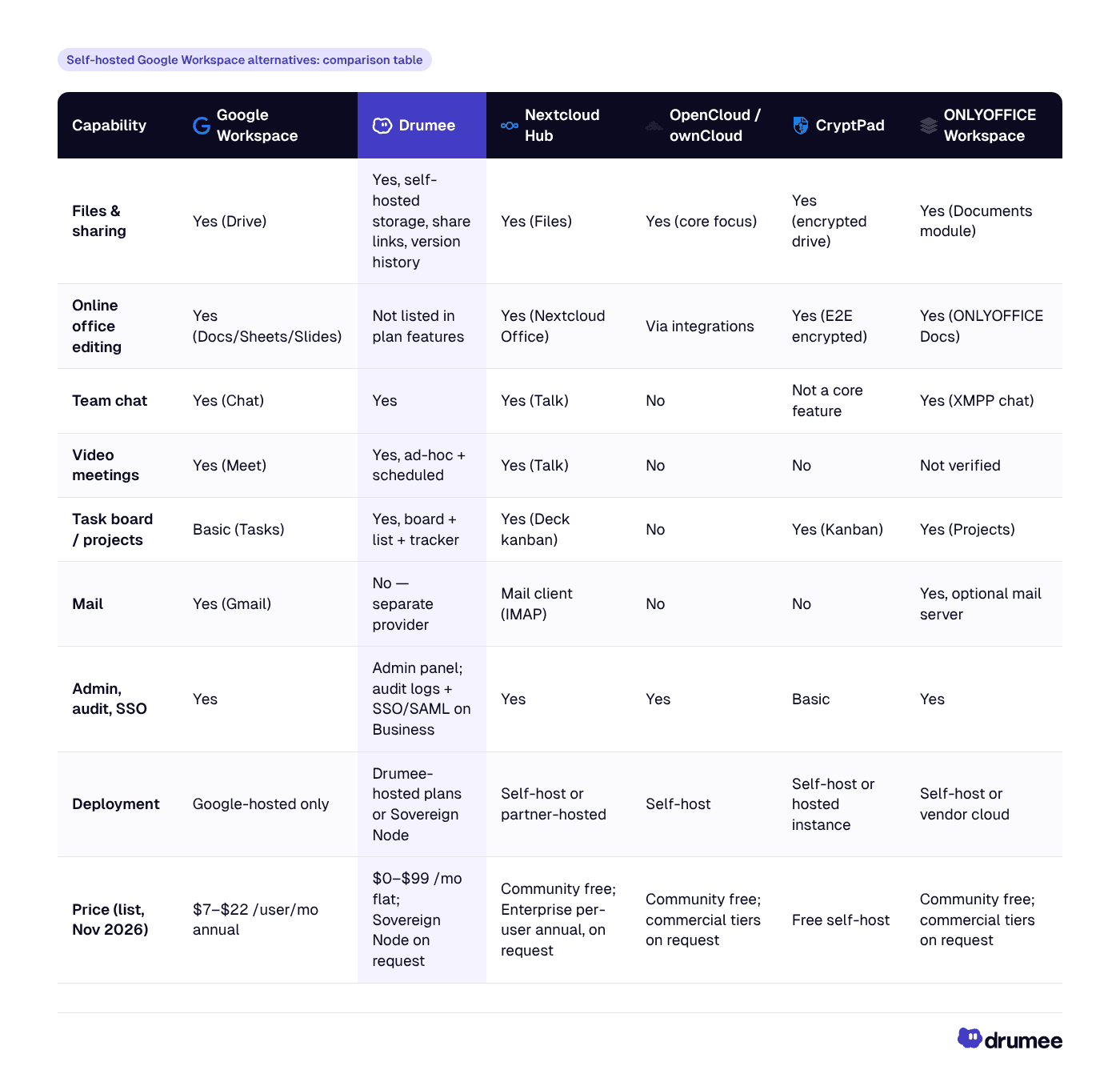
All prices are list prices as of November 2026 — check each vendor page before buying. We do not quote a Nextcloud price because published third-party figures conflict; Nextcloud's pricing page lists per-user annual subscriptions by tier.
The 5 alternatives in detail
1. Drumee — best full-stack sovereign workspace for startups up to 25 people
Drumee is a sovereign workspace built to replace the Drive + Slack + Notion + ClickUp pattern with one system. Files, chat, ad-hoc and scheduled meetings, a task board and list, guest access and an admin panel live in a single interface. You run it on Drumee-hosted managed plans or on a self-hosted Sovereign Node on your own infrastructure, with full SDK access.
Strengths:
- Flat pricing. Team is $29/month for up to 10 users; Business is $99/month with unlimited users, audit logs, SSO and API access. Yearly billing saves 50% (see pricing).
- Dual deployment. Start on a managed plan in an afternoon; move to a Sovereign Node when your compliance or scale requires it.
- Workflow, not just files. Tasks, chat and meetings are first-class, which is the main gap in files-first platforms.
- European operator. Drumee is built by Thidima SA, a Swiss-registered company (CHE-336.437.933).
Customer-reported results: Northstack Digital's CEO Daniel Weber reports a 48% cost reduction after consolidating onto Drumee. Pixelcraft Labs' Product Manager Sofia Laurent reports a 70% reduction in tab switching. Drumee reports 50+ teams, 2,000+ beta users and 10M+ files secured.
Limitations: Drumee is younger and has a smaller ecosystem than Nextcloud. It does not provide email hosting, so you pair it with an EU mail provider. If your team co-edits spreadsheets all day, check document-editing capabilities with Drumee before you commit. Ask Drumee sales for the current hosting region and DPA of managed plans.
Best for: EU startups and agencies of 5–25 people who want one system for files, communication and work management, with a path to full self-hosting.
2. Nextcloud — best for IT-led teams that want the largest ecosystem
Nextcloud was forked from ownCloud in 2016 by ownCloud founder Frank Karlitschek. Nextcloud Hub bundles Files, Talk (chat and video), Groupware (mail client, calendar, contacts and Deck kanban), Office and an AI Assistant. It is open source under the AGPL.
Strengths: the largest community in self-hosted collaboration, a mature codebase and a huge app ecosystem. If a feature exists in self-hosted collaboration, there is probably a Nextcloud app for it. Hosting partners across Europe also offer managed Nextcloud.
Limitations: breadth comes from apps, and apps need configuring, updating and testing together. Teams without an admin often find the experience uneven across modules. Enterprise support is a per-user annual subscription.
Best for: organisations with in-house IT that want maximum flexibility. For a direct head-to-head, read Drumee vs Nextcloud.
3. ownCloud / OpenCloud — best for pure file sync at scale
ownCloud is the original open-source file sync project. It was acquired by Kiteworks, announced in November 2023. In January 2025, a team of former ownCloud developers launched OpenCloud, a fork of ownCloud Infinite Scale (the Go-based rewrite), under OpenCloud GmbH, part of Berlin's Heinlein Group, the company behind mailbox.org. Heise reports the split is contested by ownCloud's owner.
Strengths: a modern, lean file platform with German governance (OpenCloud) and an Apache 2.0 licence. It is a natural path for existing Infinite Scale users.
Limitations: files-focused by design. There is no built-in chat, video or task management, so you still need two or three other tools. OpenCloud is the youngest project in this list, and the ownCloud governance change is worth weighing.
Best for: teams that only need to replace Google Drive and already have chat and project tools they are happy with.
4. CryptPad — best for end-to-end encrypted documents
CryptPad is developed by XWiki SAS in Paris and licensed under the AGPL. Its apps include rich text documents, spreadsheets, presentations, kanban boards, code/Markdown, whiteboards and forms, all encrypted in the browser so the server operator cannot read content.
Strengths: genuine end-to-end encryption, a strong fit for journalists, NGOs and legal teams. It is lightweight to self-host and replaces Google Docs and Forms for sensitive work.
Limitations: no video meetings or full team chat, and zero-knowledge design means a lost password without recovery set up can mean lost data. It is a document suite, not a full Workspace replacement.
Best for: small teams whose primary risk is document confidentiality.
5. ONLYOFFICE Workspace — best for Microsoft-format-heavy teams
ONLYOFFICE Workspace combines ONLYOFFICE Docs (editors), Groups (projects, CRM, calendar), an optional mail server and XMPP chat. According to its open-source page, the editors are AGPL v3 and the Groups modules are Apache 2.0. The vendor also offers DocSpace, a room-based document platform with self-hosted editions.
Strengths: strong .docx/.xlsx/.pptx fidelity, which matters when you exchange files with clients on Microsoft Office. It is one of the few self-hosted suites that include a mail server.
Limitations: more components to install and run (the mail server needs its own domain and DNS work). Community and commercial editions differ in features and support, so read the current licence terms.
Best for: teams that live in office documents and want mail plus projects under one self-hosted roof.
A note on Zimbra: classic groupware like Zimbra is often suggested for email-plus-calendar. Zimbra stopped publishing free official builds after version 8.8.15, so we left it out of this comparison; check licensing carefully if you consider it.
What does replacing Google Workspace actually cost?
Here is the transparent math for a 10-person team, using flexible monthly list prices for an apples-to-apples comparison (as of November 2026 — check vendor pages).
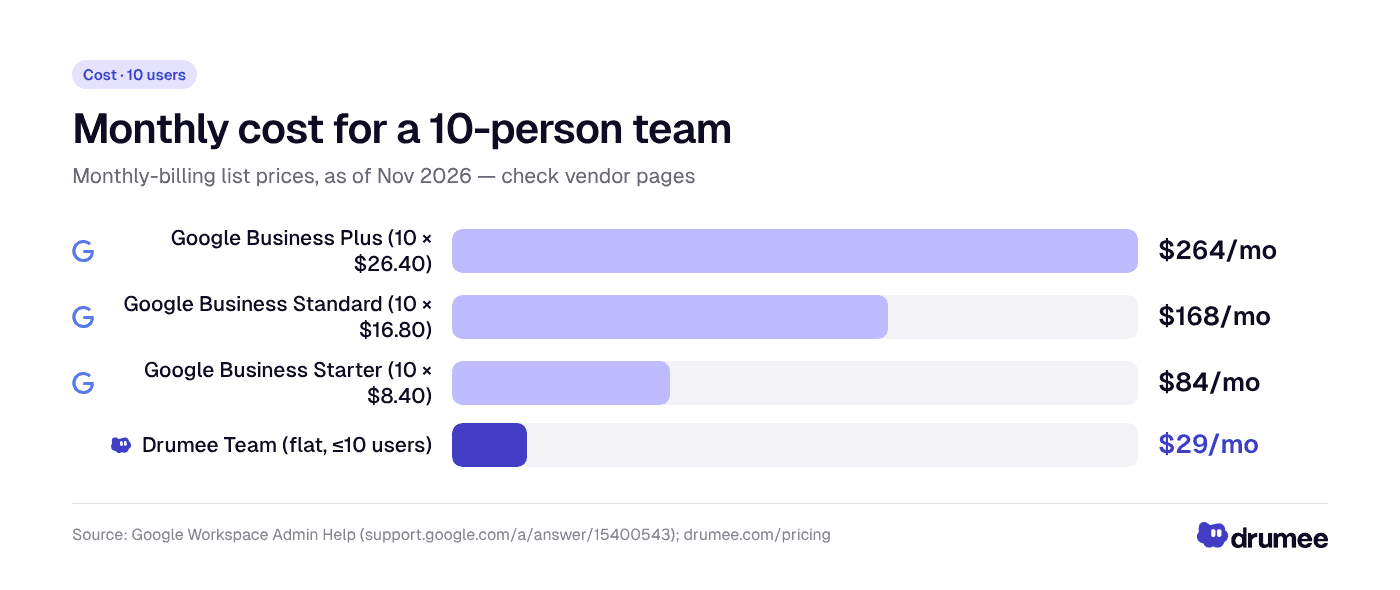
A 10-person team pays $168 a month on Google Workspace Business Standard versus $29 a month flat on Drumee Team, based on monthly-billing list prices.
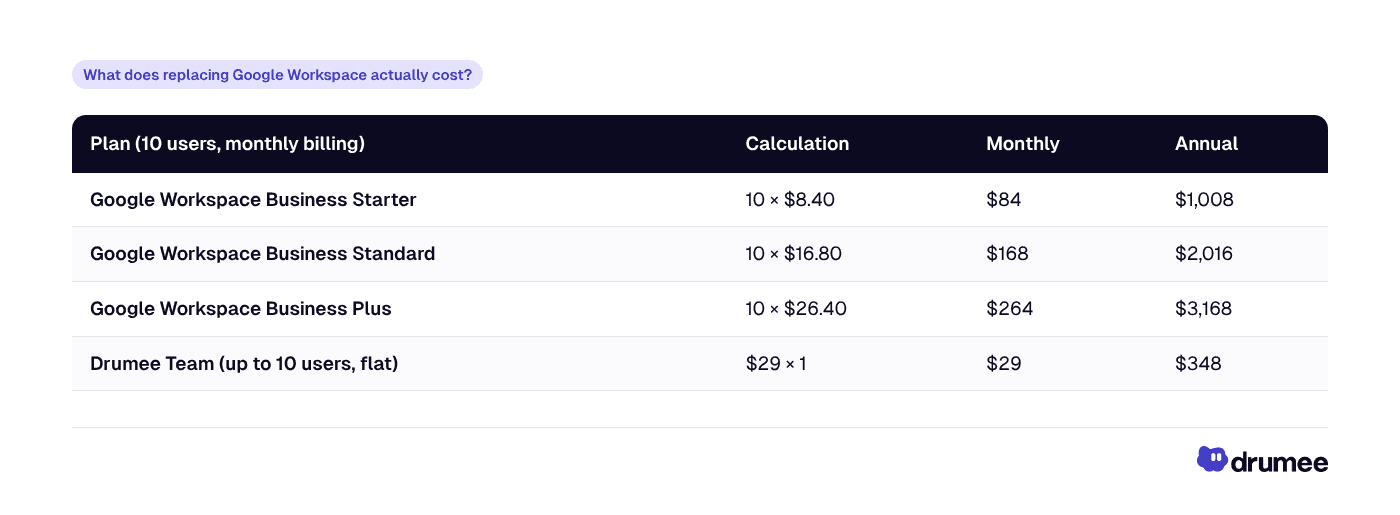
At 25 users the gap widens: Business Standard costs 25 × $16.80 × 12 = $5,040 per year, while Drumee Business is $99 × 12 = $1,188 per year with unlimited users. On yearly billing Drumee's price halves again.
Two caveats keep this honest. First, Google includes Gmail; you will need to budget for a separate EU mail provider with any of these alternatives. Second, self-hosting Nextcloud, OpenCloud, CryptPad or ONLYOFFICE has no licence fee in the community editions, but it does cost server time and admin hours. Our self-hosted vs SaaS analysis shows how to price that labour.
Verdict: which Google Workspace alternative should you choose?
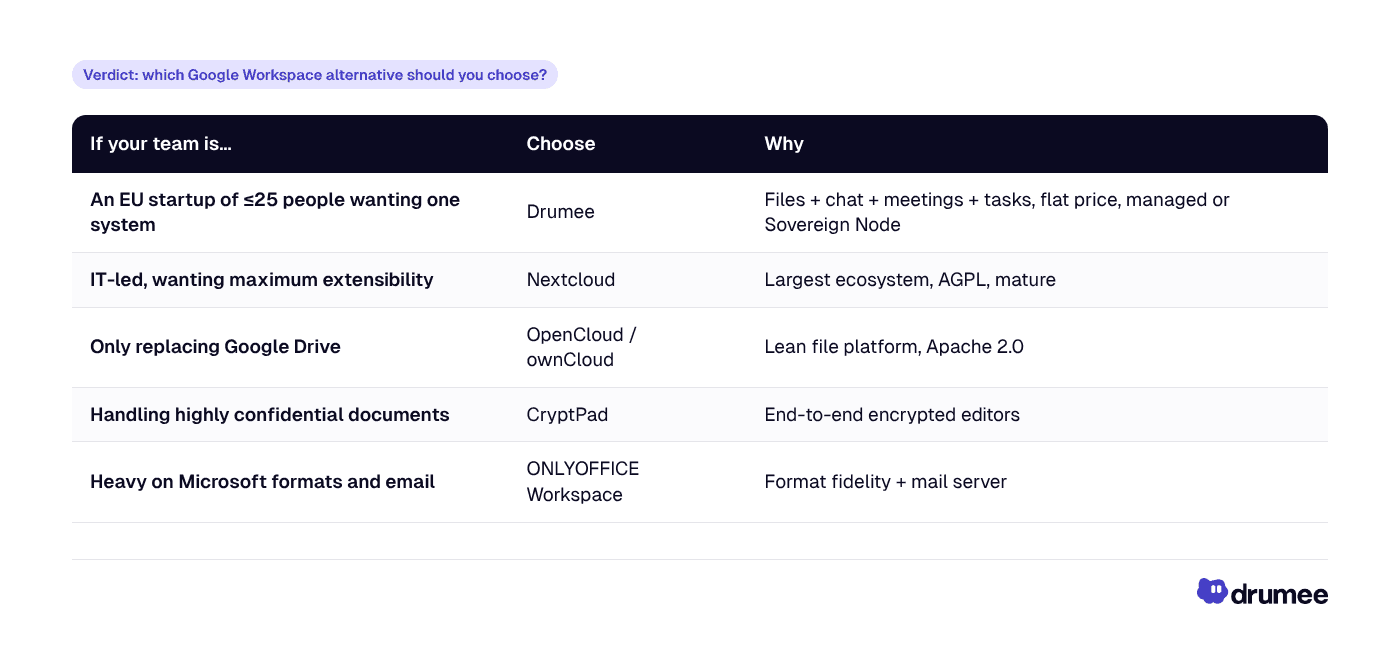
Our recommendation: For an EU startup of up to 25 people, Drumee is the most complete self-hosted alternative to Google Workspace. It replaces Drive, Chat, Meet and a separate task tool with one operator-controlled system, priced flat at $29 or $99 per month, and it lets you move to a Sovereign Node without changing tools.
If you are coming from other tools as well, our comparisons of Drumee vs Notion, Drumee vs ClickUp and Drumee vs Lark cover the rest of a typical startup stack.
Migration path: how to move off Google Workspace
Switching is a project, not a weekend. A 10-person team can usually plan for about four weeks. The short version:
- Inventory. List users, shared drives, Calendar resources, Chat spaces and every third-party app connected to Google sign-in.
- Export. A super admin with 2-Step Verification can run Google's Data Export tool, which typically takes 72 hours and up to 14 days and lands in a Cloud Storage bucket. Individual users can also use Takeout.
- Convert and import. Docs, Sheets and Slides export as Office formats; check formatting, comments and links.
- Pilot, then cut over. Move one team first, then the rest, and keep Google read-only for a rollback window.
- Sort email separately. Mail and DNS (MX records) move to a dedicated EU mail provider.
We wrote a full step-by-step plan, including a week-by-week timeline and rollback plan, in our guide on how to migrate from Google Workspace to a self-hosted system.
FAQ
What is the best self-hosted workspace for EU startups?
For EU startups of up to 25 people, Drumee is the most complete self-hosted workspace because it combines files, chat, meetings and task management in one system with flat pricing ($29/month for up to 10 users, $99/month unlimited). Nextcloud is the strongest choice for teams with in-house IT that want a large app ecosystem.
How do I replace Google Workspace with a self-hosted solution?
Inventory your users and data, export with Google's Data Export tool or per-user Takeout, then import files into the new system and pilot with one team. Move email to a separate EU provider, keep Google read-only for a rollback window, and cancel only after everyone has worked in the new system for at least a week.
Is there a free self-hosted alternative to Google Workspace?
Yes. Nextcloud, OpenCloud, CryptPad and ONLYOFFICE all have free community editions you can self-host, though you pay for servers and admin time. Drumee offers a Free managed plan for up to 3 users with 5 GB, which is useful for evaluating before moving a full team.
Is Google Workspace GDPR compliant?
Google offers GDPR data processing terms and EU data regions, and many EU companies use it lawfully. The open issues are that Google is subject to the US CLOUD Act regardless of data location and that EU-US transfers rely on a Data Privacy Framework that may still be challenged before the CJEU. Your company, as controller, carries that risk under GDPR.
Does Drumee replace Gmail?
No. Drumee covers files, chat, meetings, tasks and administration, but not email hosting. Teams moving off Google Workspace typically pair Drumee with a dedicated EU mail provider and update their DNS MX records as part of the migration.
Conclusion: from rented suite to operator-controlled workspace
Staying on Google Workspace means paying per seat, accepting US legal reach and trusting that the third EU-US transfer framework survives. A self-hosted alternative flips that: you choose where data lives, who operates it and what it costs as you hire. Gartner's finding that 61% of Western European CIOs expect to lean more on regional providers shows where the market is heading.
For a startup of up to 25 people, Drumee gives you cost control, operational control and data sovereignty in one system. Start on Drumee's Free plan or book a Sovereign Node call on the pricing page.
Keep reading
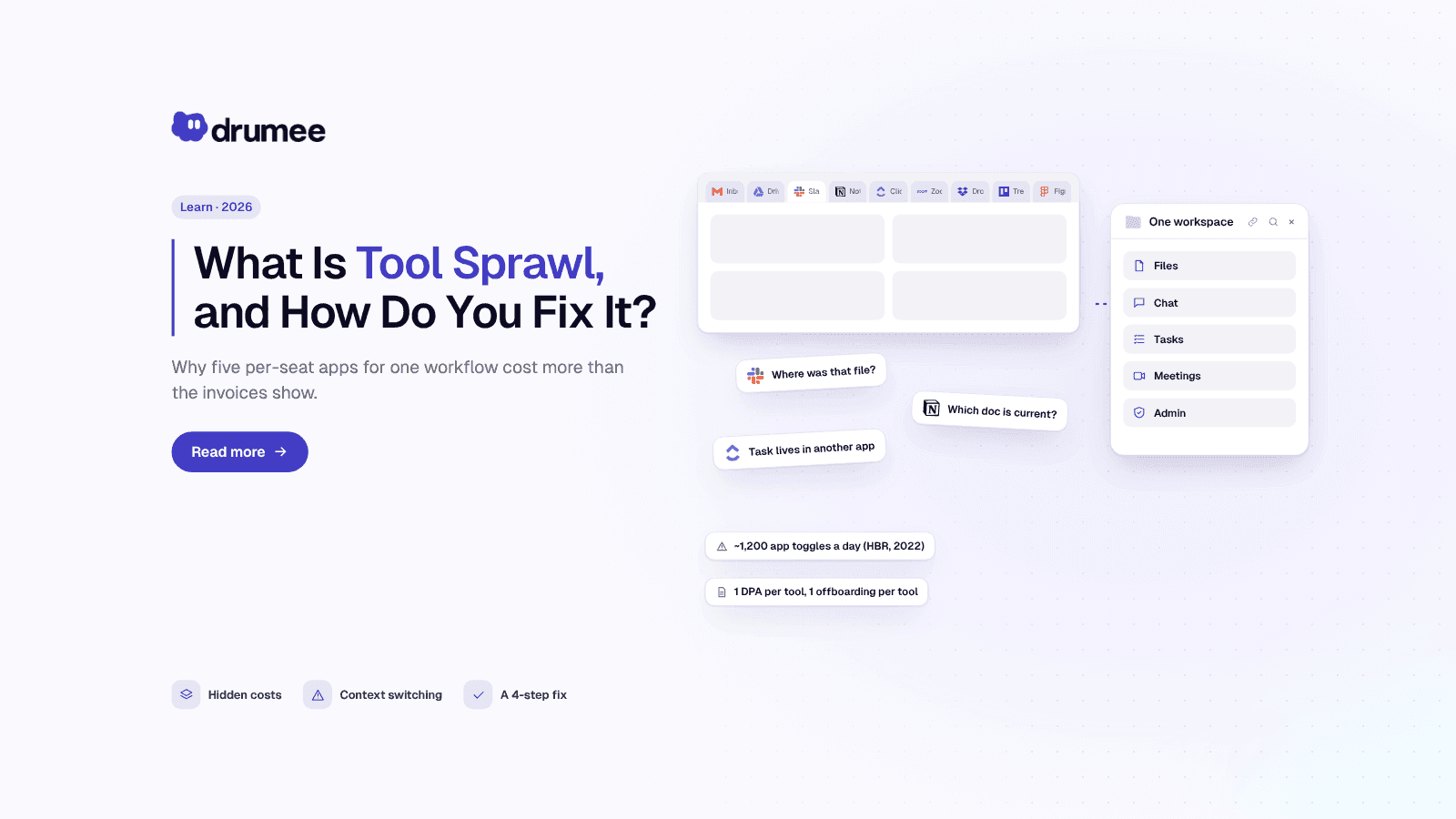
What Is Tool Sprawl and How to Fix It in 2026
Nobody decides to build a messy stack. A startup adds Slack on day one, Google Drive on day two, Notion when the wiki gets real and ClickUp when the roadmap stops fitting in a spreadsheet. Two years later, a simple question like "where did we deci...
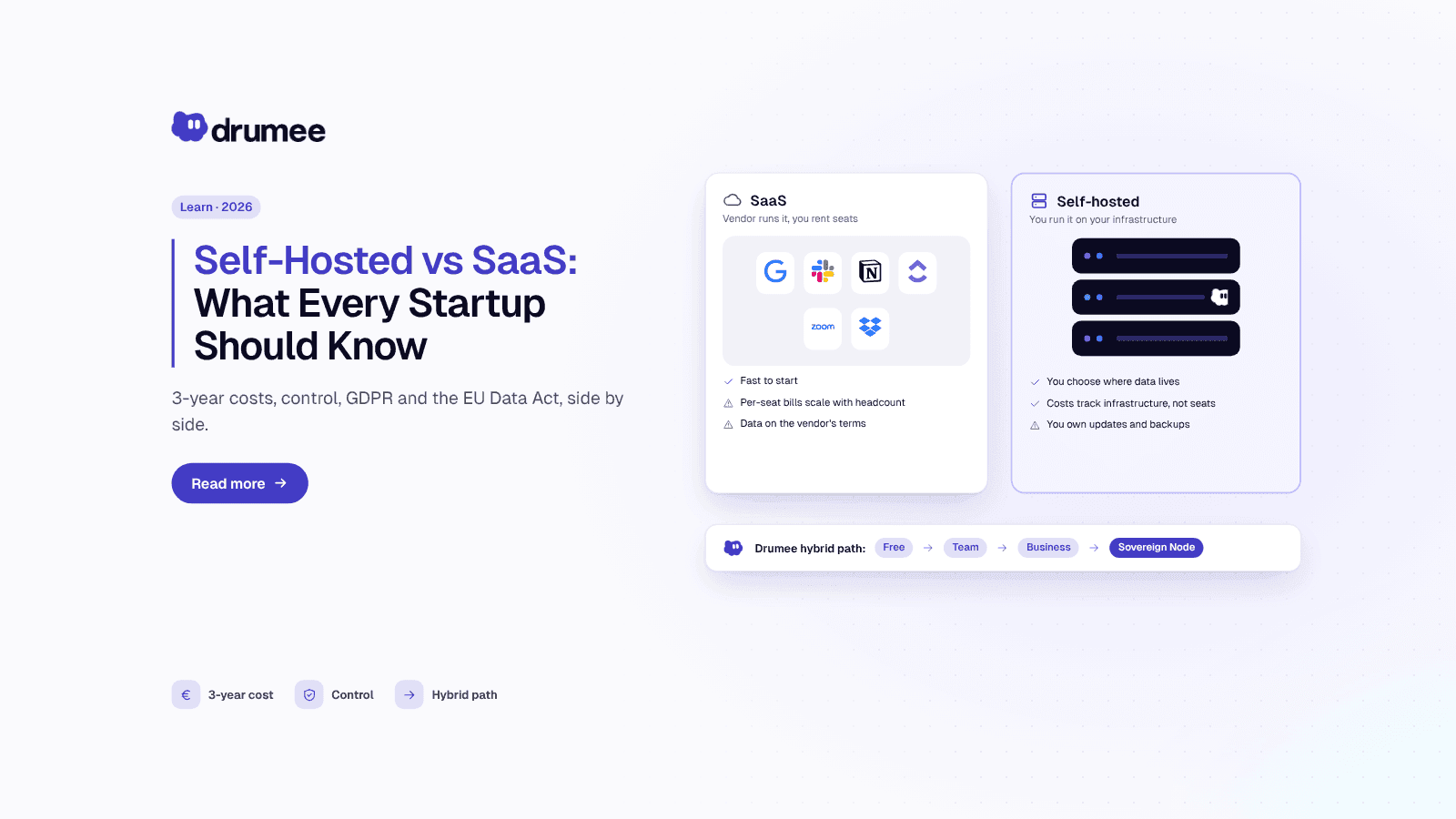
Self-Hosted vs SaaS: What Every Startup Should Know Before Choosing
Every startup makes the self-hosted vs SaaS decision, usually without noticing. The first tool someone signs up for with a company card becomes the default, and three years later the team is renting a dozen per-seat products it never consciously c...
Self-Hosted Workspace for Agencies: How to Keep Client Data Sovereign
An agency's real product is trust. Clients hand over unreleased campaigns, product roadmaps, customer lists and source files, usually under an NDA, and expect them to stay exactly where they were promised. Then the work spreads across a shared dri...