
Drumee vs Lark: Why EU Teams Are Choosing Data Sovereignty (2026)
Lark is one of the most complete collaboration suites on the market: chat, docs, spreadsheets-meets-databases, video meetings, approvals and a free tier that small teams love. It is also built by a Singapore company inside the ByteDance group, the...
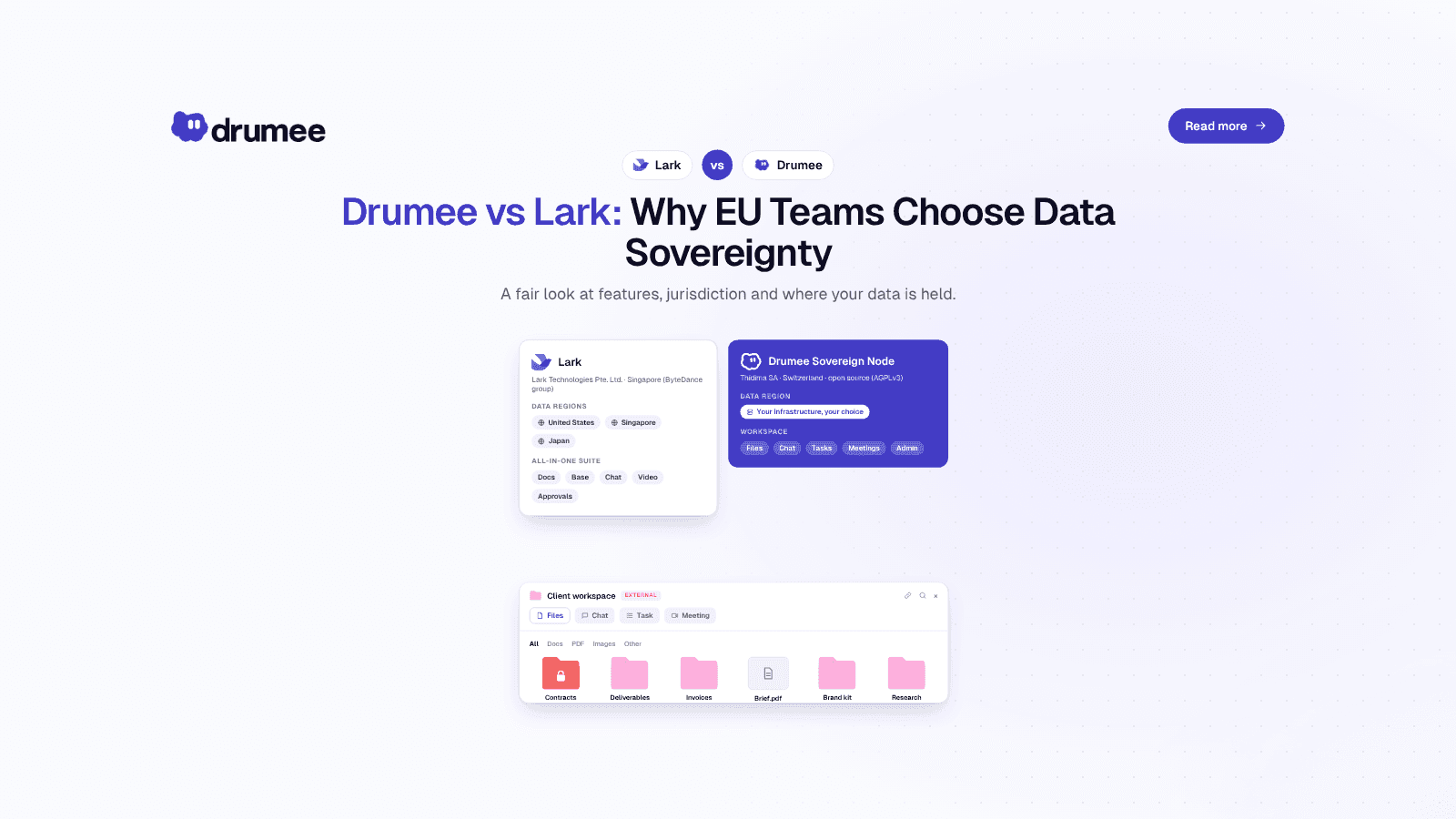
Drumee vs Lark: Lark offers a richer all-in-one suite; Drumee offers self-hosting and European, operator-controlled data
Lark is one of the most complete collaboration suites on the market: chat, docs, spreadsheets-meets-databases, video meetings, approvals and a free tier that small teams love. It is also built by a Singapore company inside the ByteDance group, the same corporate family as TikTok. For EU teams, that raises a question that has nothing to do with features: whose jurisdiction does our data fall under?
This comparison is for founders, CTOs and compliance-minded ops leads looking for a Lark alternative with a clear GDPR story. We set out what Lark itself says about GDPR, what the legitimate jurisdictional concerns are (and what they are not), and how Drumee compares as a sovereign workspace you can run on your own infrastructure.
We aim to be fair. Lark has made real compliance investments, and no EU regulator has, to our knowledge, ruled against it. The case for Drumee rests on control and jurisdiction, not on accusations.
Is Lark (Larksuite) GDPR compliant?
Quick answer: Lark says yes. Its operator, Lark Technologies Pte. Ltd., a Singapore-based ByteDance company, states it runs a GDPR compliance programme and is certified under the EU-US Data Privacy Framework. We found no public EU enforcement decision against Lark. The open question for EU teams is jurisdictional: data is held by a ByteDance group company on non-EU servers.
Where Drumee fits: Compared with Lark, Drumee is the option for EU teams that want control rather than contractual assurances. Drumee is built by Thidima SA, a Swiss-registered company, and can run as a self-hosted Sovereign Node on your own infrastructure, so you decide where data lives and who operates it. It covers files, chat, meetings and tasks at a flat price.
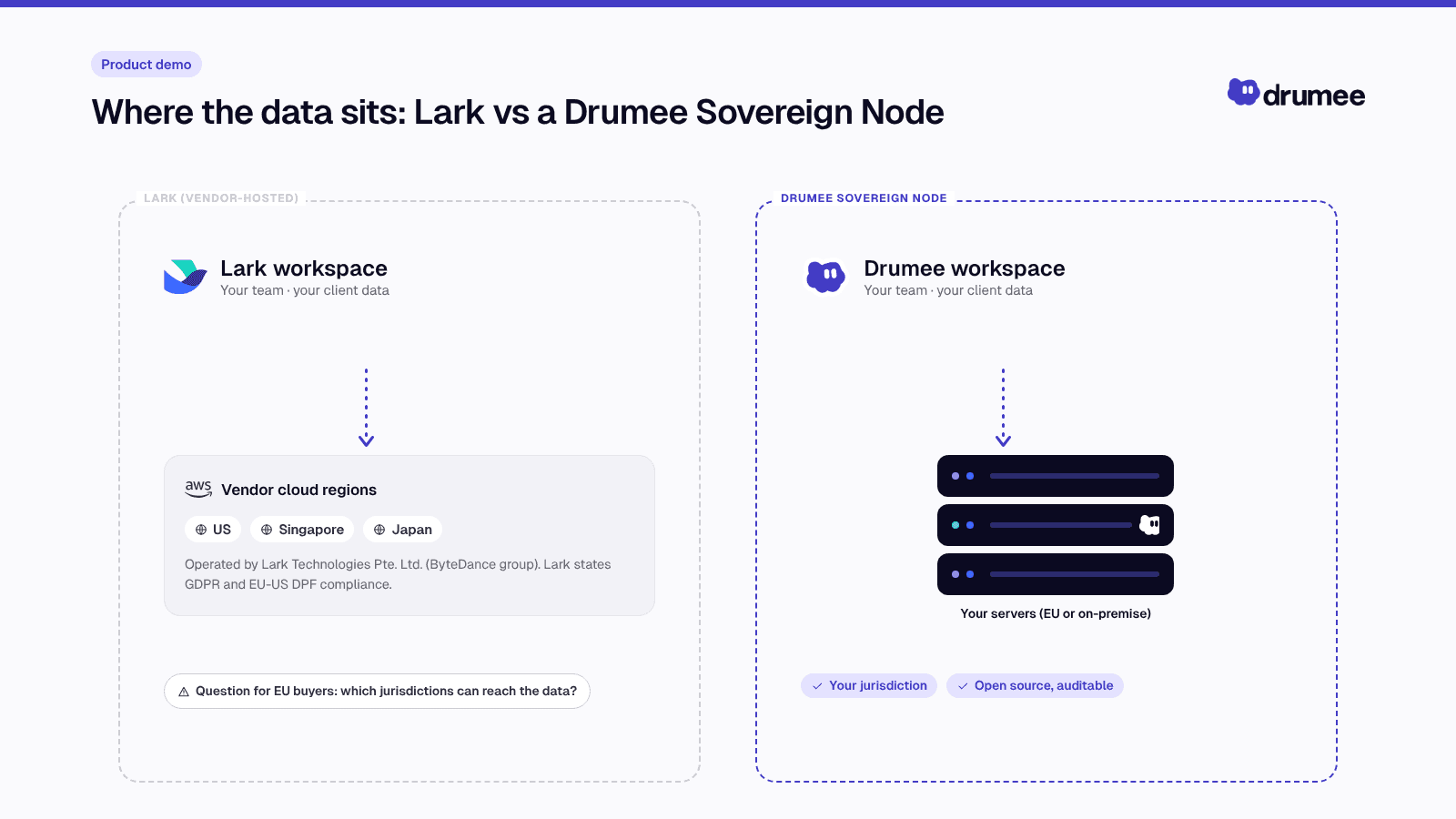
Where the data sits: Lark vs a Drumee Sovereign Node.
How we evaluated Drumee and Lark
We compared both products on criteria that matter to a 5–50 person European team. Prices are list prices as of November 2026; always check the vendor page.
- Operator and jurisdiction — which legal entity runs the service, and which corporate group it belongs to.
- Data location — where data is stored and whether you can choose.
- GDPR mechanisms — transfer tools, processor terms, stated certifications.
- Feature scope — chat, docs, databases, meetings, approvals, files, tasks.
- Pricing — per seat vs flat, at 10 and 25 people.
- Exit and control — who can switch the system off, and how hard it is to leave.
This is an editorial comparison based on vendor documentation, regulator decisions and legal sources linked inline. It is not legal advice; involve your DPO or counsel for a formal transfer impact assessment.
Drumee vs Lark at a glance
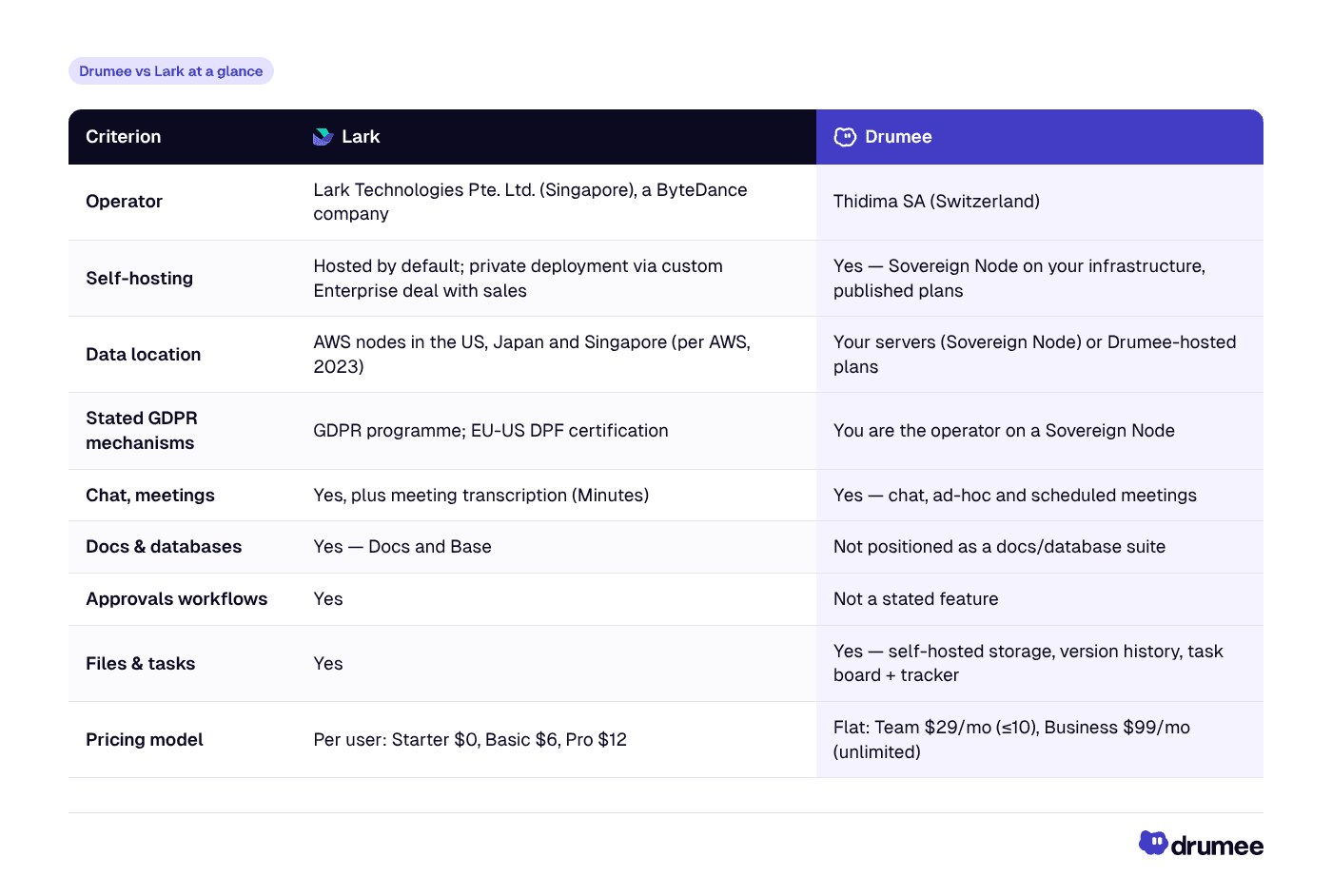
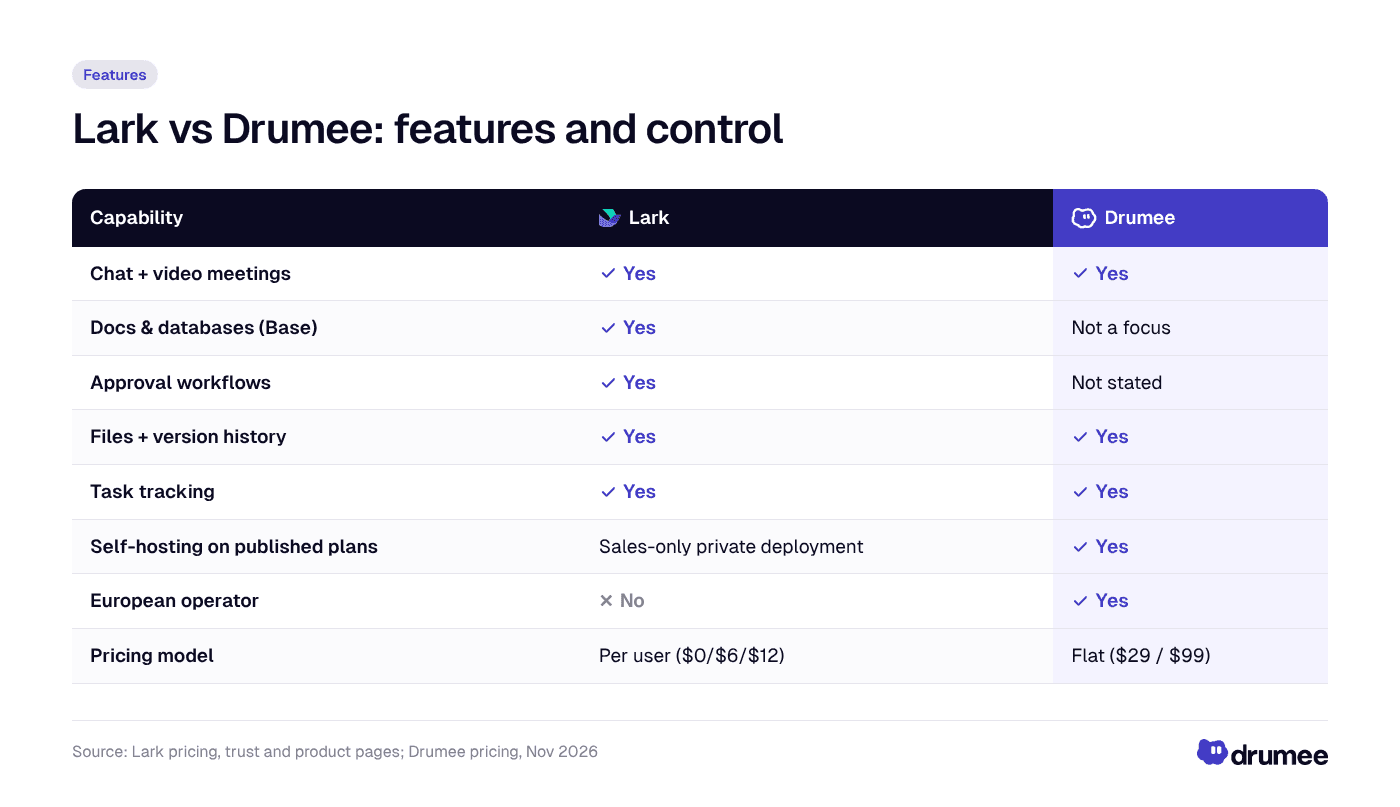
Lark is the more feature-rich suite; Drumee is the one you can run yourself, under a European operator, at a flat price.
Who runs Lark? The ByteDance jurisdiction question explained
Lark is operated by Lark Technologies Pte. Ltd., headquartered in Singapore, and its own law-enforcement request guidelines describe it as part of ByteDance. It started as an internal ByteDance tool before launching commercially, according to its Wikipedia entry.
On infrastructure, Amazon reported in 2023 that Lark runs on AWS, using AWS regions in the US, Japan and Singapore to meet customers' data-residency requirements. We did not find an EU storage region in Lark's public documentation.
So what is the concern, exactly? It has three layers, and it's worth keeping them separate:
- Corporate group. ByteDance's parent group has significant operations in China. China's 2017 National Intelligence Law (Article 7) says organisations and citizens shall "support, assist and cooperate" with state intelligence work, per the China Law Translate English translation.
- Contested reach. Legal scholars disagree on how far that article reaches, especially for companies outside mainland China. China Law Translate's editor argues it is far from clear that it was intended to require active intelligence gathering.
- Third-country transfers. Any storage outside the EEA (US, Japan, Singapore) is an international transfer under GDPR Articles 44–49 and needs a valid mechanism.
Be precise: there is no public evidence that Lark transfers EU customer data to China. The concern is a jurisdictional and corporate-group risk that EU buyers must assess, not a finding about Lark.
The TikTok €530 million decision: context, not evidence
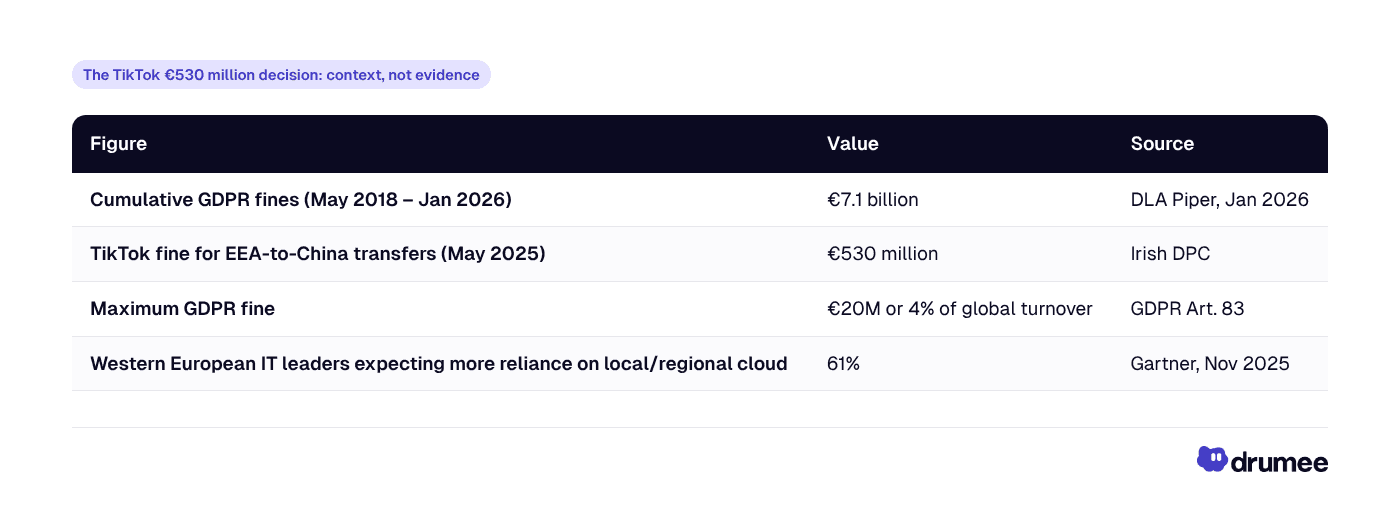
The reason EU compliance teams look closely at ByteDance products is a regulatory decision about a different one. On 2 May 2025 the Irish Data Protection Commission fined TikTok €530 million for transferring EEA users' personal data to China without guaranteeing equivalent protection (€485 million) and for transparency failures (€45 million). TikTok is appealing the decision.
That decision is about TikTok, not Lark. They are separate products run by separate entities with separate data flows. But it shows two things EU buyers care about:
- European regulators are willing to test whether data protection holds up when a group has operations in China.
- Remote access from a third country can count as a transfer, even if the data is stored elsewhere.
For a compliance officer, that is enough to put "ByteDance group company" on the risk register and ask Lark specific questions. It is not enough to say Lark is non-compliant, and we don't.
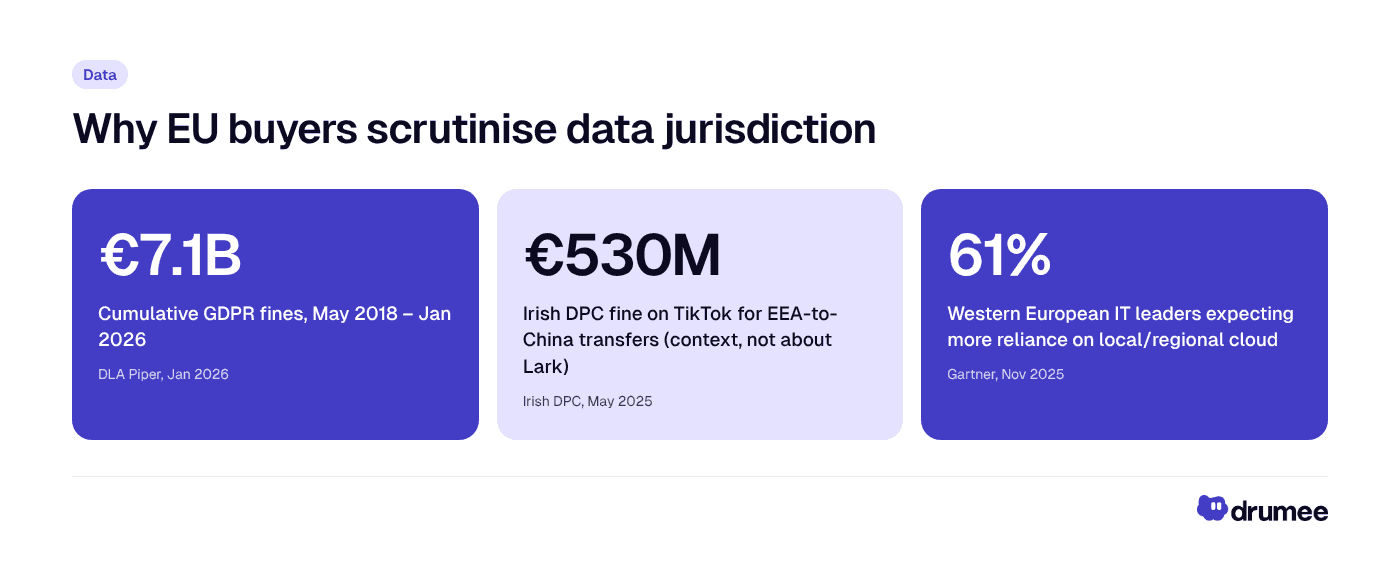
European regulators have issued €7.1 billion in GDPR fines since 2018, and the largest action involving a ByteDance company concerned China transfers, which is why buyers scrutinise the group's products.
What Lark says about its own GDPR compliance
Fairness matters here, because Lark has done real work. According to its trust center, Lark has implemented data compliance systems for the GDPR and publishes its certifications and assessments, including a TrustArc GDPR validation.
Lark also announced that it attained certification under the EU-US Data Privacy Framework, plus the UK extension and the Swiss-US framework. In that post, Lark says customers can store data in the US without conducting a transfer impact assessment on Lark, because the DPF was upheld as an adequate transfer mechanism. The EU General Court upheld the DPF in September 2025, though an appeal to the CJEU has been signalled.
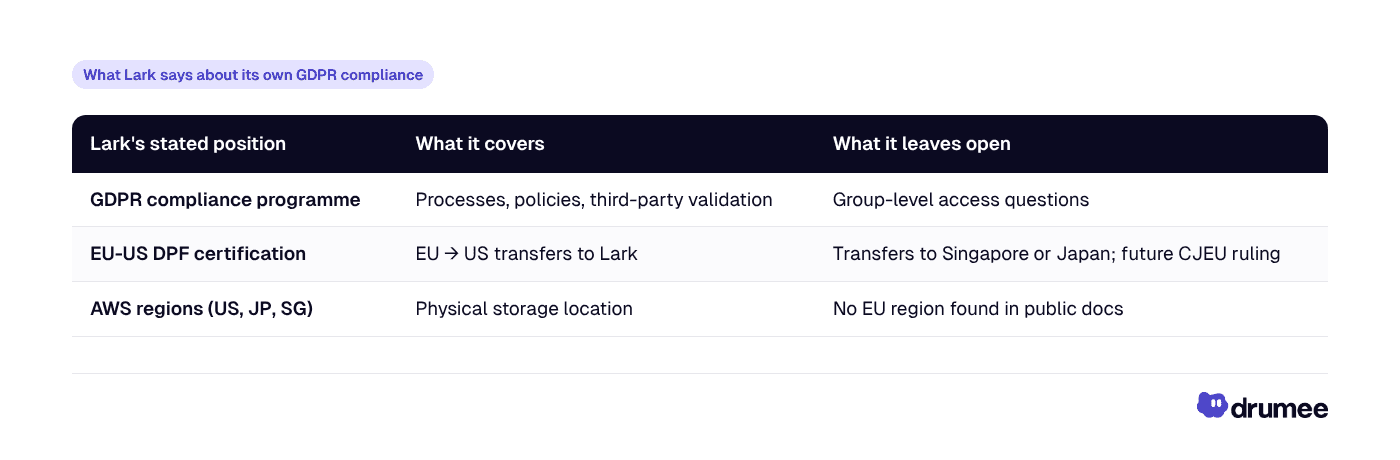
Our reading: Lark has a credible compliance programme on paper. An EU team can likely use it lawfully with the right DPA and transfer mechanisms. Whether that satisfies your risk appetite depends on how much weight you give to group-level jurisdiction, which is exactly the variable a sovereign deployment removes.
GDPR implications for EU teams using Lark
If you're running Lark today, or considering it, here is what your GDPR file should contain:
- A signed DPA under Article 28 naming Lark Technologies as processor and listing subprocessors.
- A transfer map: which data sits in which AWS region, and the mechanism for each (DPF for the US; SCCs or other tools for other countries).
- A transfer impact assessment where required, including the corporate-group access question raised above.
- A record of processing that reflects chat, docs, meeting recordings and transcripts, which often contain more personal data than teams expect.
- An exit plan: how you would export data and switch providers if a regulator or court changed the landscape.
That is a lot of paperwork for a 15-person startup. It is also why the market is moving: Gartner found 61% of Western European IT leaders expect geopolitics to increase their reliance on local or regional providers. Our Drumee GDPR compliance guide explains what changes when you operate the system yourself.
Questions to ask Lark (or any vendor) before signing
Whether you choose Lark, Drumee or anyone else, put these questions to the vendor in writing and file the answers with your record of processing. Vague answers are themselves a signal.
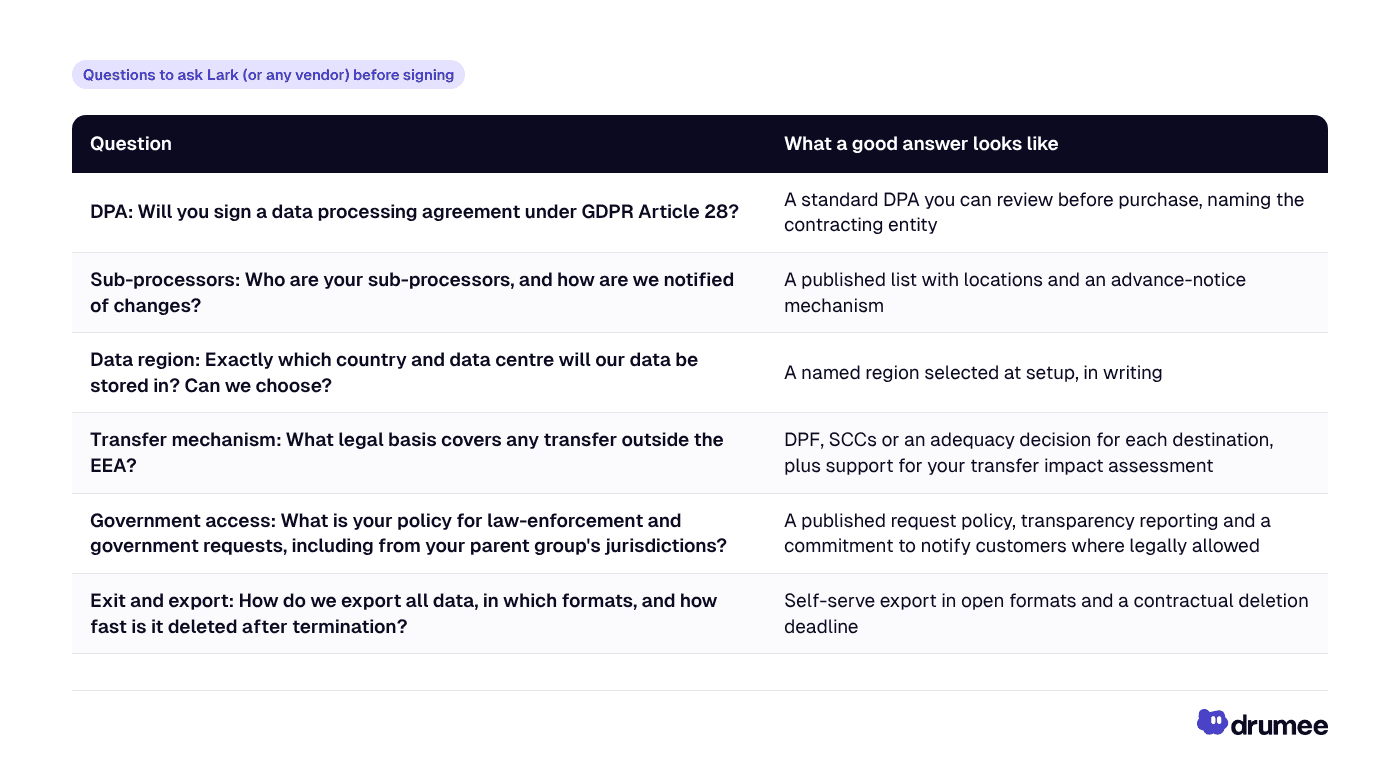
With a Drumee Sovereign Node, several of these questions answer themselves, because you choose the region and operate the servers. You still need a DPA for managed plans and for any hosting provider you use.
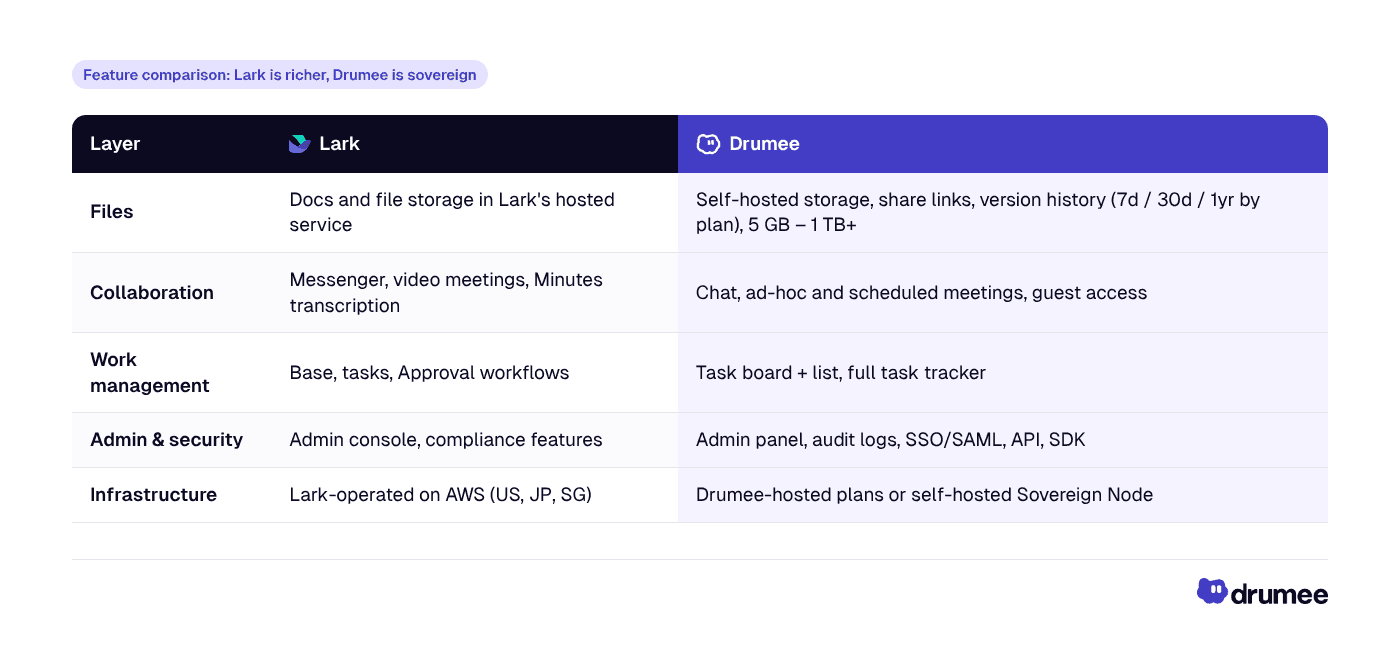
Feature comparison: Lark is richer, Drumee is sovereign
Let's be clear: on raw features, Lark is ahead. It combines messaging, Docs, Base (a lightweight database for workflows and dashboards), video meetings with Minutes transcription, calendar and Approval workflows for leave, purchase requests and other forms in one app. Few suites match that breadth, especially at its price.
Drumee is narrower but built around a different promise. It covers the core workflow layers in one system you can run yourself:
Where Lark wins
- Breadth. Docs, Base and Approvals cover jobs Drumee does not claim to cover.
- Free tier. The Starter plan costs $0, which makes Lark hard to beat for very small teams on price alone.
- AI and meeting tools. Automatic meeting transcription is built in.
Where Drumee wins
- Self-hosting as a standard option. A Sovereign Node runs on your servers. Lark's standard product is hosted; it says private or dedicated-cloud deployment is available only as a custom arrangement through its sales team (Lark).
- European operator. Thidima SA is Swiss-registered; there is no non-European parent group in the chain.
- Flat pricing. $29/month covers up to 10 users and $99/month covers unlimited users, instead of a per-seat bill.
- Unified audit trail. Audit logs across files, chat and tasks on Business and Sovereign Node.
Brightlane Studio's CTO Lucas Meyer reports a 65% reduction in audit time after moving to Drumee, thanks to data traceability (customer-reported).
Pricing: Lark per seat vs Drumee flat
Lark's pricing page lists Starter at $0, Basic at $6 and Pro at $12 per user per month, with Enterprise on request. Drumee's pricing is flat: Team at $29/month for up to 10 users and Business at $99/month for unlimited users; yearly billing saves 50%. Prices as of November 2026, check vendor pages.
The math (list prices, seats × price × 12):
- 10 people: Lark Basic = 10 × $6 × 12 = $720/year; Lark Pro = 10 × $12 × 12 = $1,440/year; Drumee Team = $29 × 12 = $348/year.
- 25 people: Lark Basic = 25 × $6 × 12 = $1,800/year; Lark Pro = 25 × $12 × 12 = $3,600/year; Drumee Business = $99 × 12 = $1,188/year.
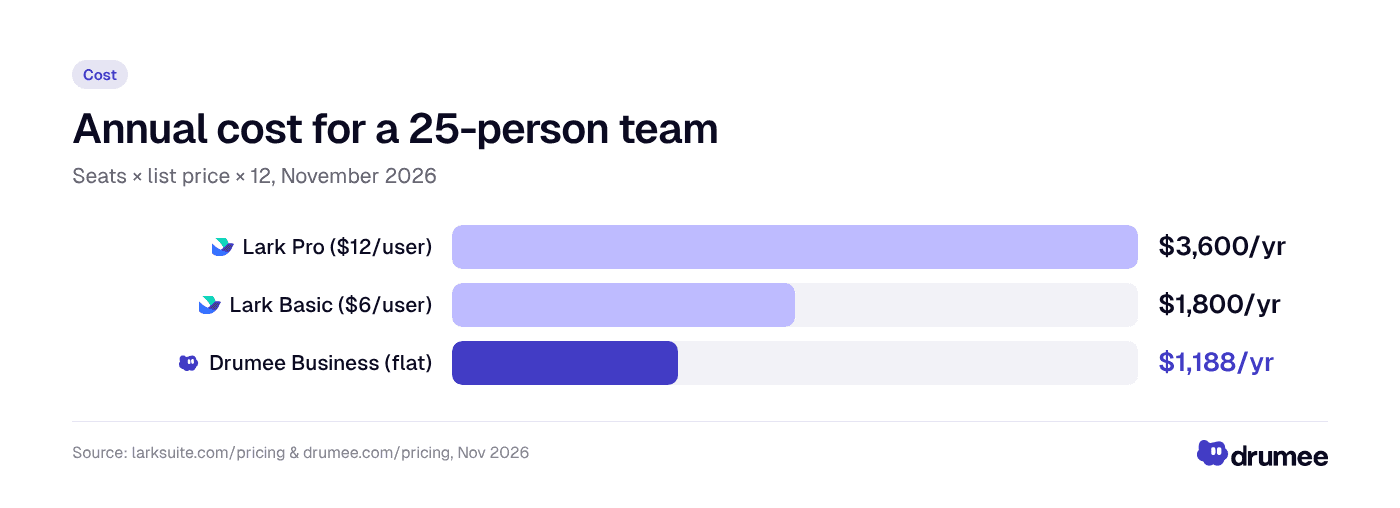
At 25 users, Drumee Business costs less per year than either paid Lark tier, and the gap grows with headcount because Drumee's price is flat.
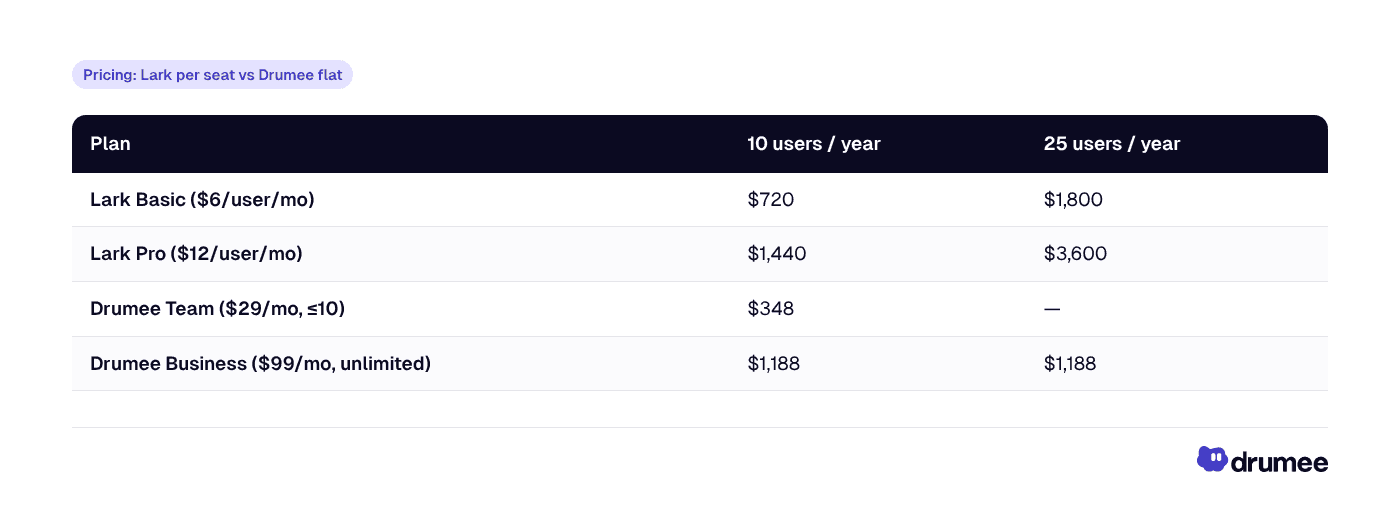
Two honest caveats. Lark's free Starter plan beats any paid plan on cash cost if its limits work for you. And a Sovereign Node is priced through sales and runs on infrastructure you pay for, so these managed-plan figures are not a self-hosting TCO.
Lark is unusually cheap per seat, so the cost argument is weaker here than against Notion or Google Workspace. The decisive factors are usually control and jurisdiction. For the wider stack math, see how EU startups reduce SaaS costs.
Drumee as the EU-native alternative to Lark
Drumee's pitch to Lark users is not "more features". It is "the same core workflow, under your control".
Answer block: The best Lark alternative for GDPR-sensitive EU teams is one where you control the operator and the data location. Drumee fits that brief: built by Swiss-registered Thidima SA, it runs as a self-hosted Sovereign Node or on managed plans, and combines files, chat, meetings and tasks with flat pricing from $29/month for up to 10 users.
What that looks like in practice:
- You pick the location. Deploy a Sovereign Node in your own data centre or with an EU hosting provider of your choice.
- You are the operator. No third-party company in a non-EU corporate group runs the servers holding your chat and files.
- You keep the logs. Audit logs, SSO/SAML and API access let you prove who accessed what.
- You keep the exit. The data already sits on your infrastructure, so leaving is a decision, not a migration project.
Northstack Digital's CEO Daniel Weber reports a 48% cost reduction after consolidating onto Drumee (customer-reported). Ask Drumee sales for current Sovereign Node requirements and the data processing agreement for managed plans.
If you are also replacing Google tools, our self-hosted Google Workspace alternative comparison covers that path, and the migration guide covers the steps.
What are the best self-hosted alternatives to Google Workspace and Lark?
Many teams evaluating Lark are really looking for an all-in-one Google Workspace replacement. If self-hosting is a requirement, the shortlist changes:
- Drumee — files, chat, meetings and tasks in one sovereign workspace, with managed plans or a self-hosted Sovereign Node.
- Nextcloud — mature open-source (AGPL) platform with a large community and app ecosystem; more IT effort to configure. See Drumee vs Nextcloud.
- Notion-style doc tools such as Outline or AppFlowy — strong for wikis, but not a full suite. See Drumee vs Notion.
Lark's standard plans are hosted. Lark says private deployment on your own servers or private cloud is possible as a custom deal through its sales team (Lark blog), but the software vendor remains a ByteDance group company, so the jurisdiction question does not fully disappear.
A note for teams in the Philippines and Southeast Asia
Lark has a strong footprint in Southeast Asia: in 2020 it made its suite free across the region, including the Philippines, according to its Wikipedia entry. Many Philippine startups and BPOs already use it.
Philippine organisations have their own framework: the Data Privacy Act of 2012 (Republic Act No. 10173), enforced by the National Privacy Commission. Teams serving EU clients often have to satisfy both RA 10173 and their clients' GDPR requirements, which is where running the workspace on infrastructure you control simplifies the answer to "where is our data?".
Who Lark is for vs who Drumee is for
Choose Lark if:
- You want the broadest feature set (Docs, Base, Approvals, Minutes) in one app at a low per-seat price.
- A free tier matters more than self-hosting.
- Your risk assessment is comfortable with Lark's GDPR programme and DPF certification.
- Your team and clients are mostly outside the EU, or your data is low-sensitivity.
Choose Drumee if:
- You need to self-host or prove exactly where data lives and who operates it.
- You work in a regulated sector (finance, legal, public sector, critical infrastructure) where corporate-group jurisdiction is a procurement question.
- You want a European operator and flat pricing that doesn't grow per seat.
- Files, chat, meetings and tasks cover your workflow, and you can pair a doc tool if you need one.
Verdict: Drumee vs Lark in 2026
Lark is an impressive, generous product, and it has invested in GDPR compliance, including DPF certification. For many teams outside the EU, or with low-sensitivity data, it is a reasonable choice.
For EU teams that must answer "who controls our data?" without caveats, Drumee is the better fit. A self-hosted Sovereign Node puts the data on your infrastructure under a European operator, the flat price undercuts both paid Lark tiers at 10 and 25 users (Team beats Lark Basic from 5 users; Business beats Lark Pro from 9 users and Lark Basic from 17 users), and the GDPR file gets shorter. Cost, control and sovereignty: that's the trade.
To go deeper, read what a sovereign workspace is or compare self-hosted vs SaaS for startups.
FAQ
Is Lark (Larksuite) GDPR compliant?
Lark states that it operates a GDPR compliance programme and is certified under the EU-US Data Privacy Framework, and we found no public EU enforcement decision against it. EU teams should still assess transfers to its US, Japan and Singapore infrastructure and the ByteDance corporate-group question in their own risk assessment.
Is Lark owned by ByteDance?
Yes. Lark is operated by Lark Technologies Pte. Ltd., a Singapore-headquartered company that is part of ByteDance, the group that also owns TikTok. Lark began as an internal ByteDance collaboration tool.
Does Lark store data in China?
Lark's published infrastructure uses AWS regions in the US, Japan and Singapore, and there is no public evidence that Lark transfers EU customer data to China. The concern EU buyers raise is jurisdictional, related to the corporate group, rather than a documented data flow.
Can Lark be self-hosted?
Not on its standard plans, which are hosted by Lark Technologies. Lark says private or dedicated-cloud deployment is available as a custom Enterprise arrangement through its sales team. If you want self-hosting with published plans and a European vendor, Drumee's Sovereign Node or Nextcloud are options to evaluate.
What is the best Lark alternative for EU teams?
For EU teams that prioritise data sovereignty, Drumee is a strong fit: built by Swiss-registered Thidima SA, it can be self-hosted and combines files, chat, meetings and tasks at a flat price from $29/month for up to 10 users. Teams that mainly need docs might pair it with a self-hosted wiki such as Outline.
Next step
If Lark's features are great but its jurisdiction is a hard sell to your clients or DPO, test the sovereign alternative on your own terms. Start on Drumee's Free plan or book a Sovereign Node call from the pricing page.
Keep reading
Self-Hosted Alternatives to Google Workspace: 2026 Guide for EU Teams
Google Workspace is the default office stack for most European startups. It is also a US-controlled service whose list price went up in January 2025, whose data sits under US legal reach, and whose exit path takes days of admin work. For a growing...
What Is Tool Sprawl and How to Fix It in 2026
Nobody decides to build a messy stack. A startup adds Slack on day one, Google Drive on day two, Notion when the wiki gets real and ClickUp when the roadmap stops fitting in a spreadsheet. Two years later, a simple question like "where did we deci...
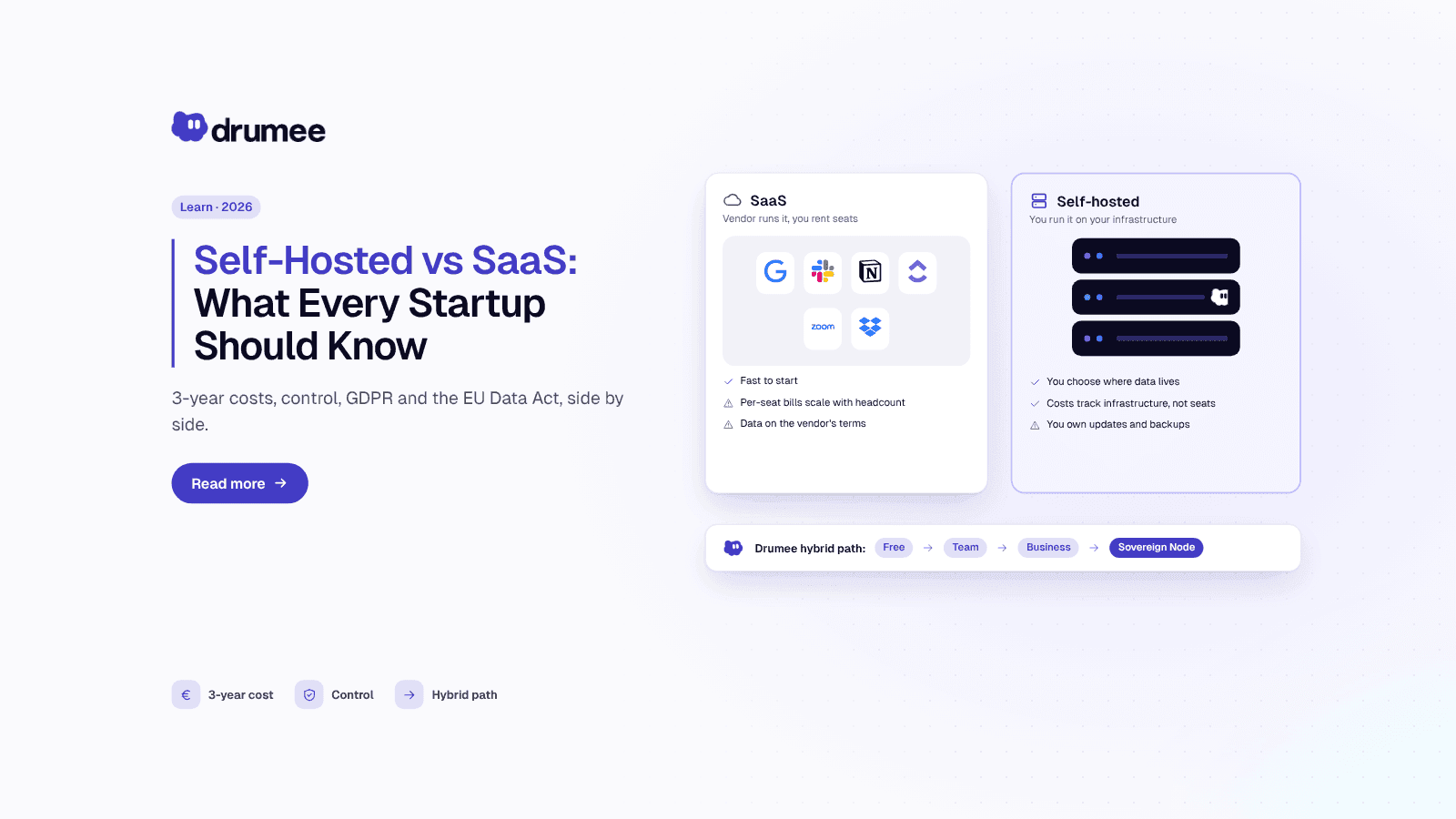
Self-Hosted vs SaaS: What Every Startup Should Know Before Choosing
Every startup makes the self-hosted vs SaaS decision, usually without noticing. The first tool someone signs up for with a company card becomes the default, and three years later the team is renting a dozen per-seat products it never consciously c...