
Drumee vs Notion: Who Owns Your Data?
Notion says you own your data but does the infrastructure agree? This comparison of Drumee vs Notion examines data governance, AI processing, self-hosting architecture, and what genuine data ownership requires in 2026.
Drumee vs Notion: Who Owns Your Data?
Notion is one of the most polished and widely adopted knowledge management platforms ever built. Its block-based editor, relational databases, flexible templates, and increasingly capable AI layer have made it the default workspace tool for hundreds of thousands of teams globally. For most of the decade during which Notion grew to that position, the question of data ownership was treated as a secondary concern, a compliance consideration for regulated industries, not a strategic question for every team. In 2026, that calculus has changed. As AI processing deepens inside Notion's product, as pricing restructures around AI-bundled tiers, and as the broader governance conversation around operational data matures, the question of who actually owns your data when you use Notion is no longer peripheral. It is central to understanding what you are accepting when you build your team's institutional knowledge inside a platform you do not control.
What Do Notion's Terms Actually Establish?
Starting from the legal layer: Notion's position on data ownership is consistent with most major SaaS providers. Notion does not claim ownership of your content. According to Notion's own AI security and privacy documentation, the platform explicitly states that it does not claim ownership of input or generated output, your content remains yours as Customer Data under their terms. On strict legal content ownership, the answer is unambiguous. You retain it.
But legal content ownership and operational data governance are not the same condition, and the gap between them is where the practical data ownership question lives. ToS Watchdog's 2026 independent analysis of Notion's Terms of Service identifies several dimensions of the platform's data practices that require more careful reading than the ownership headline suggests. Notion takes a broad license to your content for operating and improving the service. Workspace administrators on team accounts can access all pages, including those marked as private within the workspace. Third-party integrations connected to a Notion workspace can access workspace data with permissions that may exceed individual user expectations. And, Notion AI features process your content to provide suggestions, summaries, and other AI-powered responses, using subprocessors whose contractual terms prohibit model training on your data specifically, but whose operational access to that content exists as long as AI features remain active.
Taken together, these conditions establish something important about the nature of Notion's data relationship with your organization: you own the content legally, but you operate inside an environment where Notion controls the infrastructure, the AI processing layer, the permission architecture, and the governance terms governing how all of the above operates. That is a complete description of operational dependency, regardless of what the content ownership clause says.
The Infrastructure Layer Notion Can Not Offer
The structural constraint at the center of the Notion data ownership question is not addressable through better contract terms or privacy settings. It is architectural. Every word your team writes in Notion lives on Notion's servers, subject to their terms of service, their uptime record, and their pricing decisions. There is no path to self-hosting or air-gapping a Notion deployment, regardless of your security requirements. That is not a configuration option. It is a product design decision, and it reflects the reality that Notion's infrastructure is central to how the product functions and how the company generates value from its user base.
For teams whose workflows are entirely internal, whose data is not regulated, and whose primary concern is operational convenience rather than data governance, this condition is manageable. The practical risk is low enough that the operational convenience of Notion, its editor quality, its template ecosystem, its integrations, its collaborative editing, justifies accepting vendor-controlled infrastructure. This is a legitimate assessment for many teams, and Notion's product is genuinely excellent at what it is designed to do.
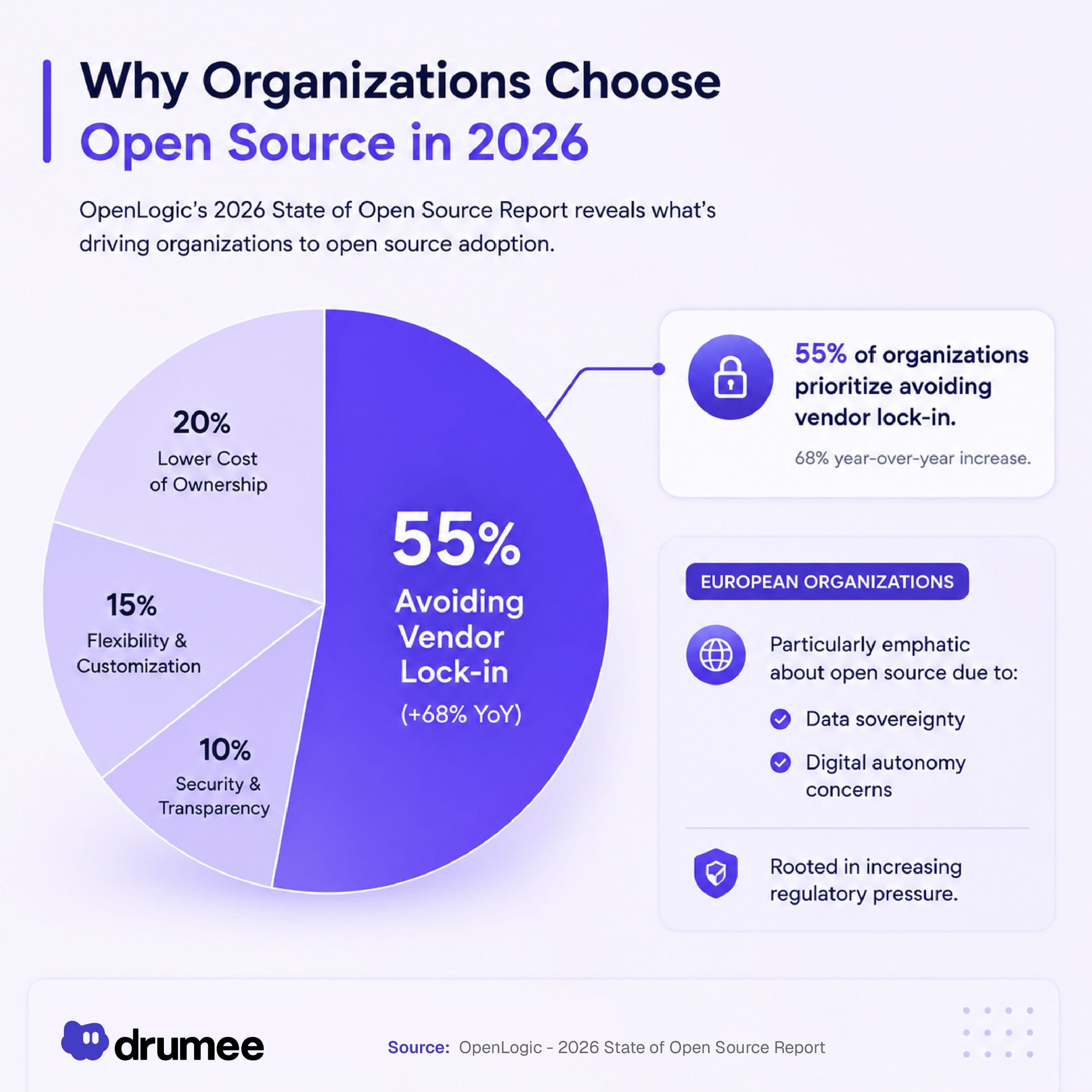
For teams that handle sensitive client data, operate under GDPR or sector-specific compliance requirements, or are becoming increasingly concerned about how AI systems embedded in collaboration tools process their operational content, the infrastructure constraint is not manageable in the same way. OpenLogic's 2026 State of Open Source Report found that avoiding vendor lock-in now drives 55% of organizations toward open source adoption, a 68% year-over-year increase with European organizations particularly emphatic, citing data sovereignty and digital autonomy concerns rooted in regulatory pressure. The teams evaluating self-hosted Notion alternatives in 2026 are not primarily motivated by cost. They are motivated by governance requirements that Notion's architecture structurally cannot satisfy.
The AI Processing Question
The arrival of Notion AI as a core product feature, now bundled into Business and Enterprise plans rather than offered as a separate add-on has added a new dimension to the data ownership conversation that was not present even two years ago. Notion AI processes workspace content to provide summaries, suggestions, drafts, and agentic task completion. According to Notion's AI product documentation, contractual agreements with AI subprocessors prohibit the use of customer data to train their models. For enterprise plans, data retention with AI providers follows zero-retention API configurations. These are meaningful protections that differentiate Notion's enterprise offering from consumer-grade AI tools.
However, the governance question extends beyond whether your data trains the model. It encompasses which AI systems access your operational content, on whose infrastructure that access occurs, under whose administrative control the AI processing layer operates, and what happens to that access when Notion's terms of service, subprocessor relationships, or product architecture change. When Notion AI is active, your documents, pages, databases, and connected applications are accessible to the AI system as workspace context. The organization does not administer the boundary of that access. Notion does.
An independent analysis of Notion's AI governance position notes that the EU's AI Act, enforced since January 2025, and the EU Data Protection Board's preliminary guidance from the same period have raised questions about whether current consent mechanisms across SaaS AI platforms are sufficient for their data processing scope. The regulatory environment is actively evolving around exactly the question of who governs AI processing of organizational content, and organizations that have already moved their operational data onto infrastructure they control are structurally better positioned to respond to that evolution than organizations whose governance posture is defined by a vendor's current policy page.
What Has Self-Hosted Notion Alternative Category Become?
The search for a self-hosted Notion alternative has moved from a niche developer preference to a mainstream evaluation category in 2026. The platforms positioned in this space, AppFlowy, Outline, AFFiNE, Docmost, and others, reflect genuine architectural progress. AppFlowy, which was explicitly launched as a direct open source response to Notion's closed infrastructure, can be self-hosted on a standard Linux server via Docker, with all data storage, access logs, and infrastructure location under the organization's control. Outline delivers polished wiki and knowledge base functionality with a clean collaborative editor, optimized for teams whose primary Notion use case is documentation rather than complex relational databases. AFFiNE combines document editing and whiteboard capability in a single self-hosted environment.
Each of these platforms addresses specific dimensions of the Notion use case, documentation, knowledge management, collaborative editing, project tracking. What most of them share with Notion's architecture, however, is a focus on the workspace-as-tool model: a single application that handles knowledge management well, but does not unify the broader operational environment where files, communications, permissions, and workflow context exist together as a coherent system.
This is the architectural gap that positions Drumee differently from every self-hosted Notion alternative currently in the market.
Where Is Drumee Built Differently?
Drumee is not a self-hosted replacement for Notion's editor. It is a sovereign data OS, a unified infrastructure layer where files, chat, tasks, permissions, and workflows exist inside a single environment running on infrastructure the organization controls. The distinction matters because the data ownership problem that motivates the search for a self-hosted Notion alternative is not, fundamentally, a documentation tool problem. It is an infrastructure problem. Your institutional knowledge does not only live in your wiki pages. It lives in the conversations that happen around those pages, the files that accompany them, the permissions that govern who sees them, and the task context that connects them to the work being done. In Notion and every other SaaS tool that handles one layer of this context, that institutional knowledge is fragmented, and each fragment exists on vendor-controlled infrastructure under vendor-defined governance.
Drumee's architecture treats these as a unified system rather than separate tools. Files, chat, tasks, and permissions share a single infrastructure layer that the organization administers. The permission model governing a file shared in a conversation is the same permission model that governs that file in storage. The task created from a document maintains its relationship to that document in the same environment. There is no API boundary between the communication layer and the file storage layer because they are not separate applications, they are different surfaces within a single governed infrastructure.
This is the condition that makes Drumee a self-hosted Notion alternative in the deepest architectural sense: not because it replicates Notion's editor experience on your own server, but because it replaces the entire assumption that your team's operational context should be fragmented across vendor-hosted tools in the first place. The comparison with Notion is not primarily about features. It is about whether your team's institutional knowledge accumulates in an environment you own and administer, or in an environment that a vendor administers on your behalf under terms you accepted at signup.
The Governance Condition That Distinguishes Them
The governance difference between Drumee and Notion is not a matter of degree of Notion being somewhat less private or somewhat more vendor-dependent. It is a structural difference at the infrastructure layer. In Notion, the governance boundary of your operational data is defined by Notion's product architecture, Notion's terms of service, and the subprocessor agreements Notion maintains with its AI and infrastructure providers. You can read those terms. You can configure settings within the options Notion exposes. You cannot change the fundamental condition that your data exists on Notion's infrastructure, processed by systems Notion administers.
In Drumee, the governance boundary is defined by the organization's own administrative decisions. The infrastructure is yours. The permission model is yours to define and enforce. The AI systems you choose to integrate with your operational content access it within a boundary you configure, on servers you control. There are no subprocessor agreements governing access to your workspace because there are no subprocessors the entire operational environment runs on infrastructure the organization owns. If Drumee's terms of service change tomorrow, your operational data is not affected, because it never lived on Drumee's servers.
This structural difference is what the self-hosted Notion alternative search is ultimately looking for. The teams conducting that search are not primarily looking for a Notion feature clone on their own server. They are looking for an environment in which their team's operational knowledge accumulates under genuine organizational authority where the answer to "who owns your data?" is not a legal clause in a vendor's terms, but an operational fact determined by which infrastructure your data runs on.
For those teams, the answer that Drumee's sovereign data OS architecture provides is the only architecturally complete one: your data is yours because it lives on servers you control, governed by permissions you define, in an environment you administer from the first day of deployment. Not because a vendor's terms say so. Because the infrastructure says so.
FAQ
1/ Does Notion own your data?
No. Notion's terms explicitly state that it does not claim ownership of your content, your pages, documents, and databases remain yours legally. However, Notion controls the infrastructure where your data is stored, the AI systems that process it, and the governance terms under which all of that operates. Legal content ownership and operational data governance are different conditions.
2/ Can you self-host Notion?
No. Notion does not offer a self-hosted deployment option. Every word your team writes in Notion exists on Notion's servers, subject to their terms of service, uptime record, and pricing decisions. There is no configuration or enterprise agreement that changes this architectural constraint.
3/ Does Notion AI use your data to train its models?
According to Notion's AI documentation, contractual agreements with AI subprocessors specifically prohibit the use of customer data to train their models. For enterprise accounts, zero-retention API configurations apply. However, Notion AI does process workspace content to provide its features accessing your documents and pages as context on Notion's infrastructure under Notion's governance terms.
4/ What is a self-hosted Notion alternative?
A self-hosted Notion alternative is a workspace or knowledge management platform that can be deployed on infrastructure the organization controls, rather than operating exclusively on vendor-hosted cloud servers. This gives organizations direct control over where data is stored, who accesses it, and which AI systems process it.
5/ How is Drumee different from other self-hosted Notion alternatives?
Most self-hosted Notion alternatives replicate specific Notion features, knowledge management, documentation, or project tracking, on your own server. Drumee is a sovereign data OS that unifies files, chat, tasks, permissions, and workflows in a single self-hosted environment. Rather than replacing Notion's editor specifically, it replaces the fragmented SaaS stack architecture entirely including the communication, file storage, and permission layers that Notion and other point-solutions leave in separate vendor-controlled systems.
Related article: Open Source Collaboration: The Only Way to Own Your Workflow
------------------------------
About Drumee
Drumee is the world’s first unified sovereign data infrastructure: a self-hosted, OS-like workspace that turns your own filesystem into a private collaborative environment.
Fully under your control, Drumee combines files, chat, tasks, and workflows with enterprise-grade permissions built directly into the infrastructure layer. No cloud vendors. No fragmented SaaS stack. No operational dependency.
Instead of renting your workspace from external providers, Drumee allows organizations to own the environment where operational knowledge lives.
Your Data. Your Workflow. One system. Built to be yours!
Follow us at: Website | X | LinkedIn | Drumee Founder X | Drumee Founder LinkedIn
Keep reading
Drumee: Your Data. Your Workspace. One System
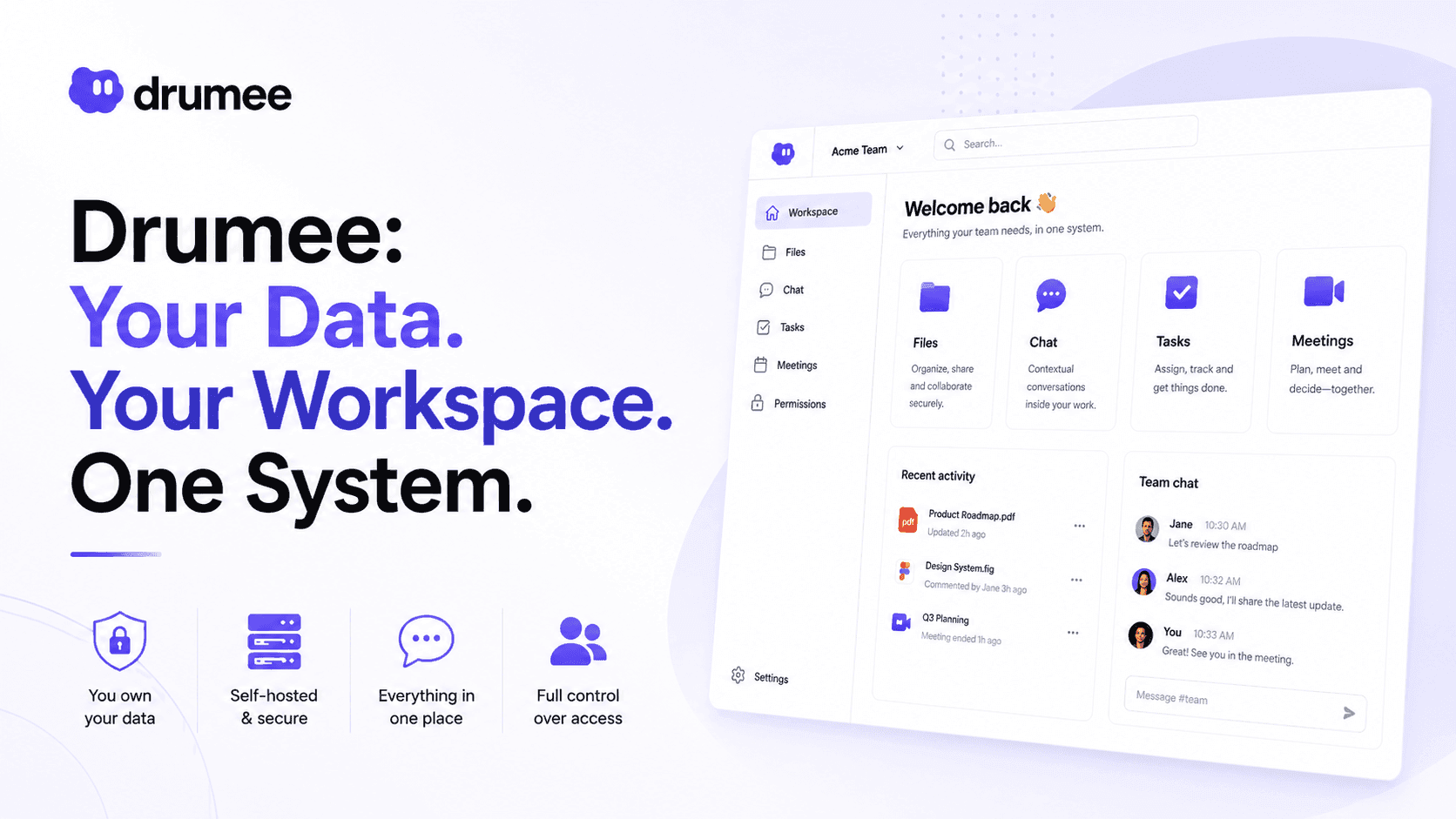
Drumee is a self-hosted, sovereign data workspace where files, chat, tasks, and permissions live in one place on infrastructure you own. Learn what Drumee is, what it stands for, and how to get started.
What Is a Sovereign Data OS? The Infrastructure Shift Teams Are Building Toward in 2026
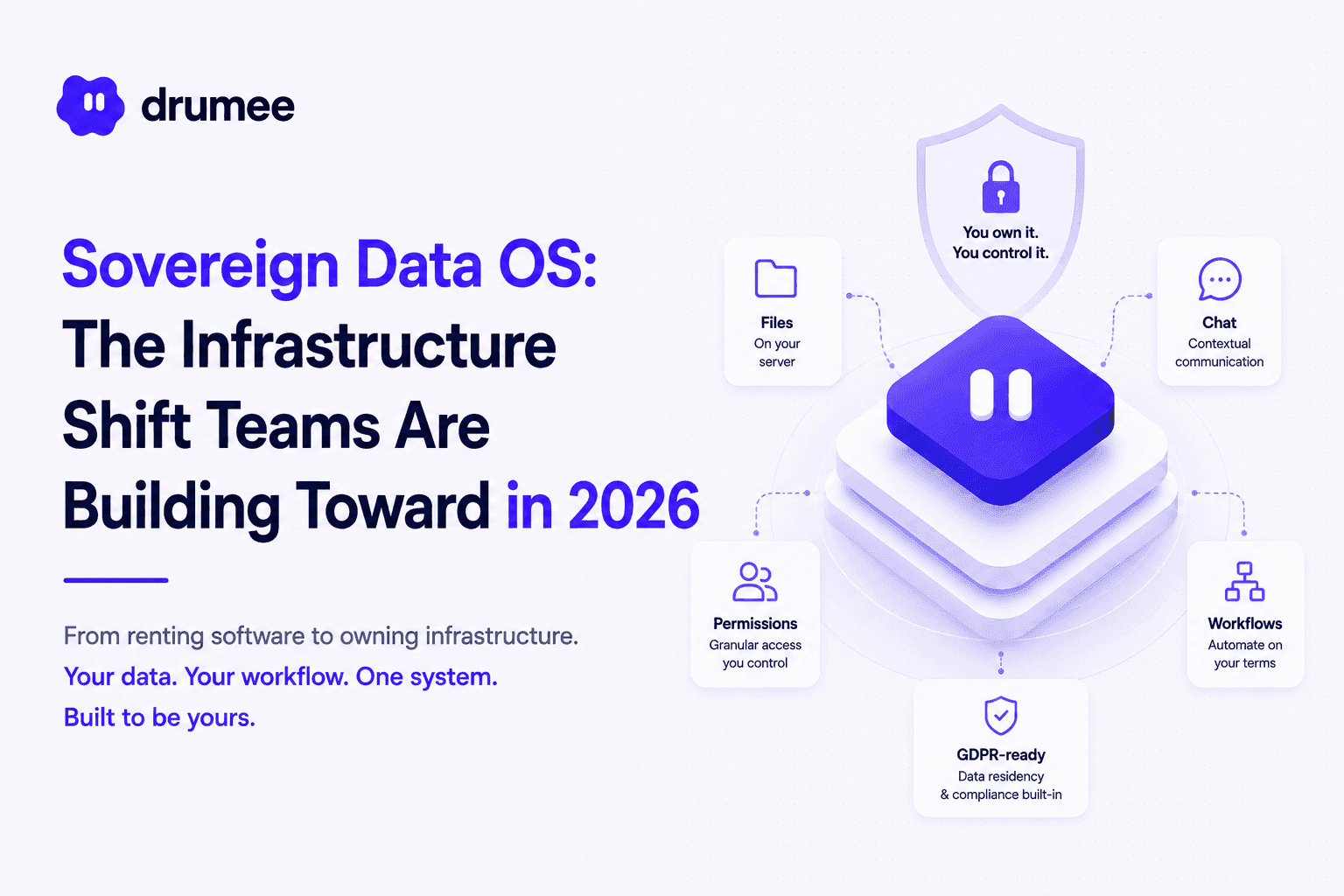
What is a sovereign data OS? Learn how Drumee's unified self-hosted infrastructure replaces fragmented SaaS stacks with a single governable environment for files, chat, permissions, and workflows in 2026.
Data Ownership: What It Means and How to Achieve It in 2026
What is data ownership and how do you actually achieve it? Learn the three layers of data control, why AI changes the stakes, and how self-hosted infrastructure gives teams genuine ownership in 2026.