
Open Source Collaboration: The Only Way to Own Your Workflow
Open source collaboration is the only model that delivers genuine workflow ownership. Learn why 55% of organizations now cite vendor lock-in as a primary motivation for open source adoption, and what sovereign infrastructure means in practice for 2026.
Open Source Collaboration: The Only Way to Own Your Workflow
Open source collaboration is the model in which the software your team uses to communicate, store files, manage tasks, and govern permissions is built on publicly available, auditable code, code that no single vendor controls, that you can run on infrastructure you own, and that your organization can adapt, fork, or migrate away from at any time without the vendor's permission or cooperation. It is the architectural opposite of the proprietary SaaS model, where the vendor controls the code, the data format, the permission layer, the pricing trajectory, and ultimately the terms under which your team's operational context exists. In 2026, the distinction between these two models is no longer academic. It is the difference between owning your workflow and renting access to it, and for a growing number of organizations, the financial, governance, and AI-related costs of the rental model have begun to outweigh its convenience by a significant margin.
The Scale of the Shift Already Underway
The movement toward open source collaboration infrastructure is not a fringe developer preference or an ideological position about software freedom. It is a mainstream organizational strategy, and the adoption numbers reflect a level of maturity that most discussions about open source alternatives understate. According to OpenLogic's 2026 State of Open Source Report, produced in collaboration with the Open Source Initiative and the Eclipse Foundation, 98% of organizations increased or maintained their use of open source software in the past 12 months, with nearly half reporting year-over-year growth. More significantly, avoiding vendor lock-in surged by 22 percentage points compared to 2025 as a stated motivation, now cited by 55% of respondents — a 68% year-over-year increase in the prominence of this concern. In Europe and the UK, nearly two-thirds of organizations now cite vendor lock-in as a primary driver for open source adoption. These are not early adopters. These are procurement-level decisions being made by organizations that have already experienced the cost of proprietary dependency and are acting on that experience.
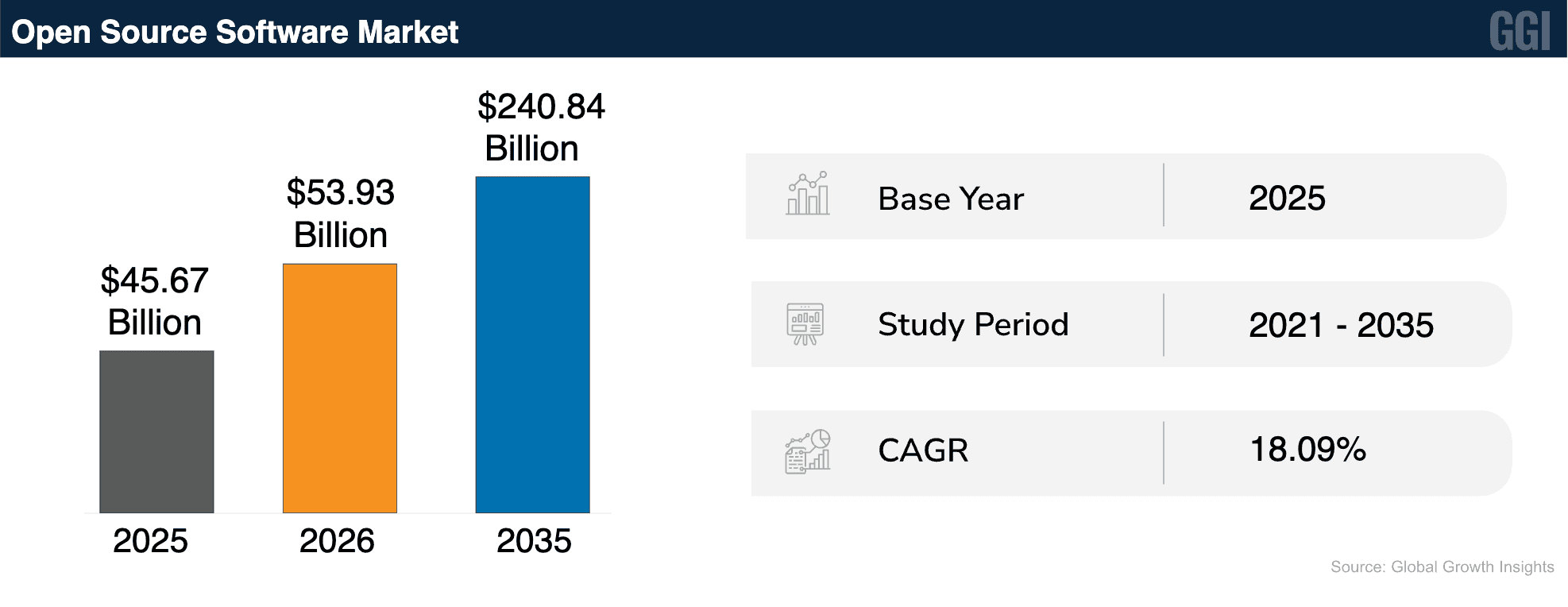
The commercial market for open source software confirms the same trajectory at scale. According to Global Growth Insights' open source software market report, the global open source software market reached $45.67 billion in 2025, surged to $53.93 billion in 2026, and is projected to reach $240.84 billion by 2035, growing at a CAGR of 18.09%. More than 61% of enterprises now rely on open source platforms for core IT operations, not as peripheral tooling, but as the foundational layer on which critical systems run. The structural shift underway is not incremental adoption of open source tooling inside a proprietary stack. It is the replacement of the proprietary stack with open infrastructure as the operational default.
Workflow Ownership Requirements
Most conversations about open source collaboration focus on the cost or customization advantages, and those advantages are real. But the more foundational argument is about workflow ownership, and understanding why open source is necessary to achieve it requires being precise about what workflow ownership actually means in practice.
Workflow ownership is not the same as content ownership. Most SaaS providers grant customers nominal ownership of their uploaded content while retaining control of the infrastructure layer through which that content is processed, governed, and made accessible. Workflow ownership goes further. It means the operational patterns your team has built, the permission structures, the integration logic, the task flows, the communication context, the institutional knowledge accumulated across months or years of daily work, exist in an environment the organization administers, not an environment a vendor administers on the organization's behalf.
Proprietary SaaS collaboration tools cannot deliver this condition by design. Their business model depends structurally on the customer's continued operational dependency. The product roadmap serves the vendor's commercial interests, not the customer's workflow requirements. The permission model is defined by the vendor's architecture, not the organization's governance preferences. The data format is proprietary, which means migration requires the vendor's cooperation and tooling. The pricing trajectory is controlled unilaterally. None of these conditions are bugs in the proprietary SaaS model, they are features, from the vendor's perspective. They are the mechanisms through which customer retention is engineered structurally rather than earned through continuous value delivery.
Open source collaboration infrastructure resolves each of these conditions simultaneously. When the codebase is public and the data formats are open standards, workflow ownership becomes structural rather than contractual. The organization can inspect how the system processes its data. It can modify the system to fit its governance requirements rather than adapting its governance requirements to fit the system. It can migrate to a different hosting environment or a forked version of the software without the original vendor's cooperation. It can integrate AI systems of its own choosing into the operational environment, rather than accepting the AI layer that the vendor decides to embed and the data governance terms that accompany it.
The Vendor Lock-In Inflection Point in 2026
The urgency behind open source collaboration adoption in 2026 is driven significantly by what the OpenLogic data describes as the maturation of organizational awareness about vendor lock-in risk. Organizations are not adopting open source collaboration infrastructure because it is ideologically preferable to proprietary tools. They are adopting it because the operational consequences of not doing so have become concretely expensive, as experience with proprietary SaaS at scale has accumulated over the past decade.
Instaclustr's 2026 open source statistics report documents that 53% of organizations now cite cost reduction as the primary reason for adopting open source software, up sharply from 37% the previous year. But cost is only the leading stated reason. Reducing vendor lock-in is cited by 33% of respondents, open standards by 28%, and lower maintenance costs by 22%. Taken together, these motivations describe a consistent organizational pattern: teams that have operated proprietary SaaS stacks for several years are confronting the accumulated cost structure of that dependency, the pricing escalation, the integration maintenance overhead, the governance exposure, and making structural changes in response.
The proprietary collaboration tools that most organizations depend on are simultaneously raising prices and deepening the AI processing layer embedded in those tools, which intensifies both the financial and governance dimensions of lock-in at the same time. When a collaboration platform's AI features access your team's documents, communications, and workflow context on vendor infrastructure under vendor governance terms, the dependency extends beyond data storage into operational intelligence. Switching away from such a platform no longer means migrating files and permissions, it means rebuilding the AI-assisted workflow context that has accumulated inside the vendor's environment over years of daily use. Open source collaboration infrastructure addresses this at the architectural level, because the AI systems that interact with your operational data run inside your own infrastructure boundary, under your governance, rather than inside the vendor's.
The Customization Dimension Proprietary Tools Cannot Match
One of the most underappreciated advantages of open source collaboration infrastructure is the ability to adapt the collaboration environment to fit the organization's actual workflows rather than adapting workflows to fit the tool's design constraints. This matters more than it might initially appear, because the hidden cost of workflow constraint inside proprietary collaboration tools is not typically line-itemed in any budget. It appears as organizational friction, as workarounds built on top of workarounds, as processes that never quite fit the tool's information architecture and require manual bridging work to maintain continuity.
The Eclipse Foundation's analysis of open source in 2026 frames this as an organizational and national infrastructure concern: open source tools provide a neutral foundation that allows organizations and nations to build digital capabilities without being locked into proprietary ecosystems or single-vendor dependencies. The customization freedom that open source provides is not just a developer convenience, it is the mechanism through which workflow ownership becomes operationally real. An organization that can modify the collaboration environment's permission model, extend its integration surface, or adapt its data governance logic has genuine control over how its operational context is structured and maintained. An organization using proprietary SaaS has only the customization options that the vendor has chosen to expose, within the constraints of the vendor's architectural decisions.
Regulated industries are experiencing this directly. Platforms like Mattermost, which explicitly targets defense, government, financial services, and critical infrastructure organizations with requirements around data sovereignty and security, reflect the same architectural requirement: organizations with stringent governance requirements cannot accept collaboration environments where the governance boundary is defined by a vendor. They need environments they can deploy in air-gapped configurations, audit at the code level, and adapt to compliance requirements that no commercial vendor's roadmap will ever prioritize in the same way. The self-hosted open source model is not merely preferable for these organizations, it is the only model that meets the governance requirements imposed by their operating context.
The AI Governance Case for Open Source
The AI dimension of open source collaboration has become one of the most significant arguments for the model in 2026, and it is one that was not central to the open source conversation even three years ago. As AI systems become embedded in collaboration platforms, summarizing documents, drafting communications, generating workflow recommendations, processing operational context, the governance question of which AI is processing your data, under whose terms, with whose retention policy becomes materially important for every organization that handles sensitive operational content.
Proprietary SaaS collaboration tools resolve this question by default in the vendor's favor. The AI systems are the vendor's AI systems, running on the vendor's infrastructure, under the vendor's data governance terms. For many organizations, the practical consequence is that the most sensitive operational data the team produces, client communications, internal strategy documents, confidential workflows, is being processed by AI systems operating under terms the organization never directly negotiated and cannot directly govern. For organizations in regulated industries, legal services, healthcare, or government-adjacent contexts, this condition is increasingly incompatible with their compliance obligations.
Open source collaboration infrastructure resolves this at the architectural layer. When the collaboration environment runs on infrastructure the organization controls, AI system integration is a choice the organization makes, selecting which models to use, configuring which data the models access, governing how outputs are retained, and auditing how the AI processing layer interacts with operational context. That governance authority is structural in open source environments. It is absent by design in proprietary ones. According to OpenLogic's 2026 report, write-in responses in the survey increasingly reference data sovereignty and digital autonomy as motivating factors for open source adoption, a pattern the report attributes to growing regulatory and geopolitical pressures on software supply chains and sourcing decisions. AI governance is a significant component of those pressures.
The practical question for teams that have arrived at the conclusion that open source collaboration infrastructure is the right architectural choice is what that infrastructure actually looks like to deploy and operate in 2026. The answer has changed substantially from the self-hosting landscape of even five years ago.
The research laboratory context offers a grounded reference point. A PMC-published LabOps workflow study from 2025 demonstrated that academic research labs could achieve collaboration capabilities comparable to commercial platforms using a self-hosted stack of free and open source tools, covering project management, document storage, collaborative editing, task management, and communication, without the associated costs, access limitations, or privacy concerns of proprietary alternatives. The study directly identified data sovereignty as the primary long-term advantage of the self-hosted open source model over commercial platforms that impose access restrictions and limit data export in ways that undermine operational continuity. That academic context is not incidental, universities and research institutions routinely operate under governance constraints that mirror those of regulated commercial organizations, and their experience with open source collaboration infrastructure is a reliable signal of the model's operational maturity.
For team collaboration specifically, where the integration of files, communication, permissions, and task context into a coherent operational environment is the core architectural challenge, the open source model in 2026 is represented most completely by platforms that treat the entire collaboration environment as a unified system rather than a collection of components. This is precisely the architectural position Drumee occupies as a sovereign data OS. Drumee's open source architecture under AGPLv3 means the codebase is auditable, the data formats are open, and the governance model is controlled entirely by the organization running the deployment. Files, chat, permissions, tasks, and workflows exist within a single self-hosted environment rather than distributed across vendor-hosted tools that connect through APIs the organization cannot govern.
The broader open source collaboration landscape in 2026 also includes more specialized platforms that demonstrate the model's depth. Nextcloud, with over 400,000 active deployments and a focus on enterprise file sync and collaboration, has established that self-hosted open source collaboration is not just technically viable but is the preferred model for organizations that have weighed the governance costs of cloud alternatives. Mattermost serves defense and government contexts where sovereignty requirements are non-negotiable. OpenProject provides project management infrastructure for complex workflows that proprietary tools cannot adapt to. Each of these platforms reflects the same architectural principle: the organization's operational context runs on infrastructure the organization controls, under code the organization can audit, in formats the organization can migrate without the vendor's cooperation.
The Ownership Condition That Only Open Source Can Deliver
The argument for open source collaboration ultimately returns to a single structural condition: genuine workflow ownership requires the organization to control the environment in which its operational knowledge accumulates, not merely the content rights to the knowledge itself. Content rights without infrastructure control is an incomplete form of ownership, one that persists only at the vendor's discretion and dissolves the moment the vendor changes pricing, governance terms, AI processing policies, or API access in ways the organization cannot control.
Open source collaboration infrastructure is the only model that delivers complete ownership because it is the only model in which the governance boundary of the collaboration environment is defined by the organization's own administrative decisions rather than the vendor's product architecture. That condition is not achievable through better SaaS contracts, more favorable data portability terms, or multi-vendor diversification strategies. It requires the organization to run the collaboration environment on its own infrastructure, under code it can audit and adapt, in a model where migration is always possible because the data formats are open and the software is not controlled by a single commercial entity whose interests diverge from the organization's.
In 2026, with open source software growing at 18% CAGR, vendor lock-in concern at a recorded high of 55% across organizations, and AI governance adding a new and significant dimension to the cost of proprietary dependency, the structural case for open source collaboration as the foundation of genuine workflow ownership has never been more clearly supported by both the data and the organizational experience that generated it.
FAQ
1/ What is open source collaboration?
Open source collaboration refers to team communication, file storage, task management, and workflow infrastructure built on publicly available, auditable code that organizations can run on their own servers, modify to fit 1/ What is open source collaboration?
Open source collaboration refers to team communication, file storage, task management, and workflow infrastructure built on publicly available, auditable code that organizations can run on their own servers, modify to fit their requirements, and migrate without vendor cooperation — in contrast to proprietary SaaS tools where the vendor controls the code, infrastructure, and governance terms.
2/ Why is open source collaboration important for workflow ownership?
Proprietary SaaS tools grant nominal content ownership while the vendor controls the infrastructure, data format, permission model, and AI processing layer. Open source collaboration gives organizations control over all of these layers simultaneously, including the ability to audit, modify, and migrate the collaboration environment without requiring the vendor's permission.
3/ Is open source collaboration software mature enough for teams in 2026?
Yes. According to OpenLogic's 2026 State of Open Source Report, 98% of organizations increased or maintained their open source usage in the past year. The global open source software market reached $45.67 billion in 2025 and is growing at a CAGR of 18.09%. Enterprise adoption is mainstream across industries including healthcare, defense, government, and financial services.
4/ What is the connection between open source collaboration and AI governance?
When collaboration platforms embed proprietary AI, the vendor controls which systems process your data, under which terms, and with which retention policies. Open source collaboration running on your own infrastructure allows your organization to control AI integration — selecting models, governing data access, and auditing how operational context is processed and retained.
5/ What is Drumee's open source model?
Drumee is an open source sovereign data OS licensed under AGPLv3. It unifies files, chat, tasks, permissions, and workflows in a single self-hosted environment. The codebase is auditable, data formats are open, and the governance layer is controlled entirely by the organization running the deployment with no vendor-controlled infrastructure, proprietary AI processing, or per-seat pricing escalation.
Related article: How to Avoid SaaS Vendor Lock-In: A Practical Guide for 2026
------------------------------
About Drumee
Drumee is the world’s first unified sovereign data infrastructure: a self-hosted, OS-like workspace that turns your own filesystem into a private collaborative environment.
Fully under your control, Drumee combines files, chat, tasks, and workflows with enterprise-grade permissions built directly into the infrastructure layer. No cloud vendors. No fragmented SaaS stack. No operational dependency.
Instead of renting your workspace from external providers, Drumee allows organizations to own the environment where operational knowledge lives.
Your Data. Your Workflow. One system. Built to be yours!
Follow us at: X | LinkedIn | Drumee Founder X | Drumee Founder LinkedIn
Keep reading
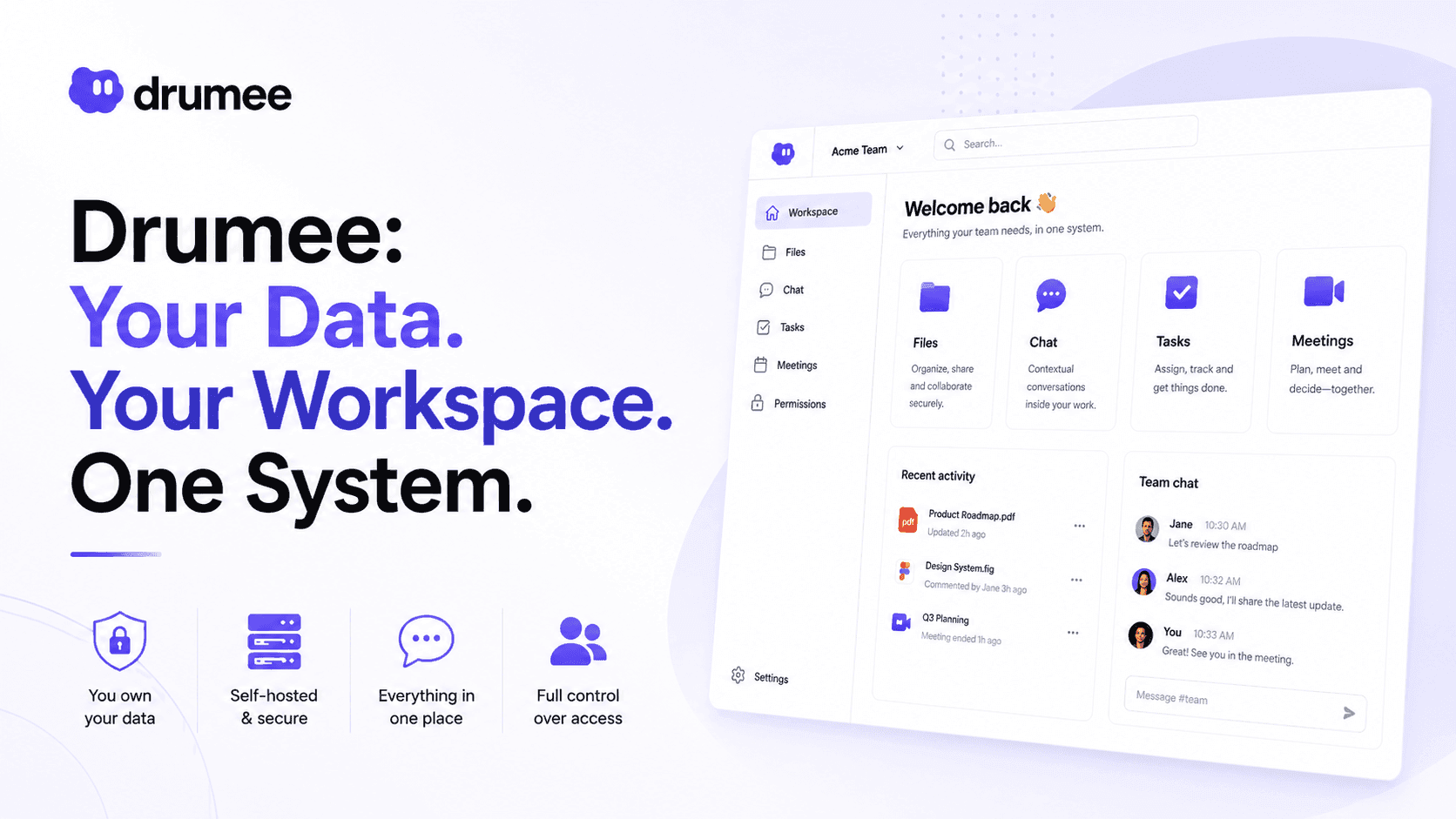
Drumee: Your Data. Your Workspace. One System
Drumee is a self-hosted, sovereign data workspace where files, chat, tasks, and permissions live in one place on infrastructure you own. Learn what Drumee is, what it stands for, and how to get started.
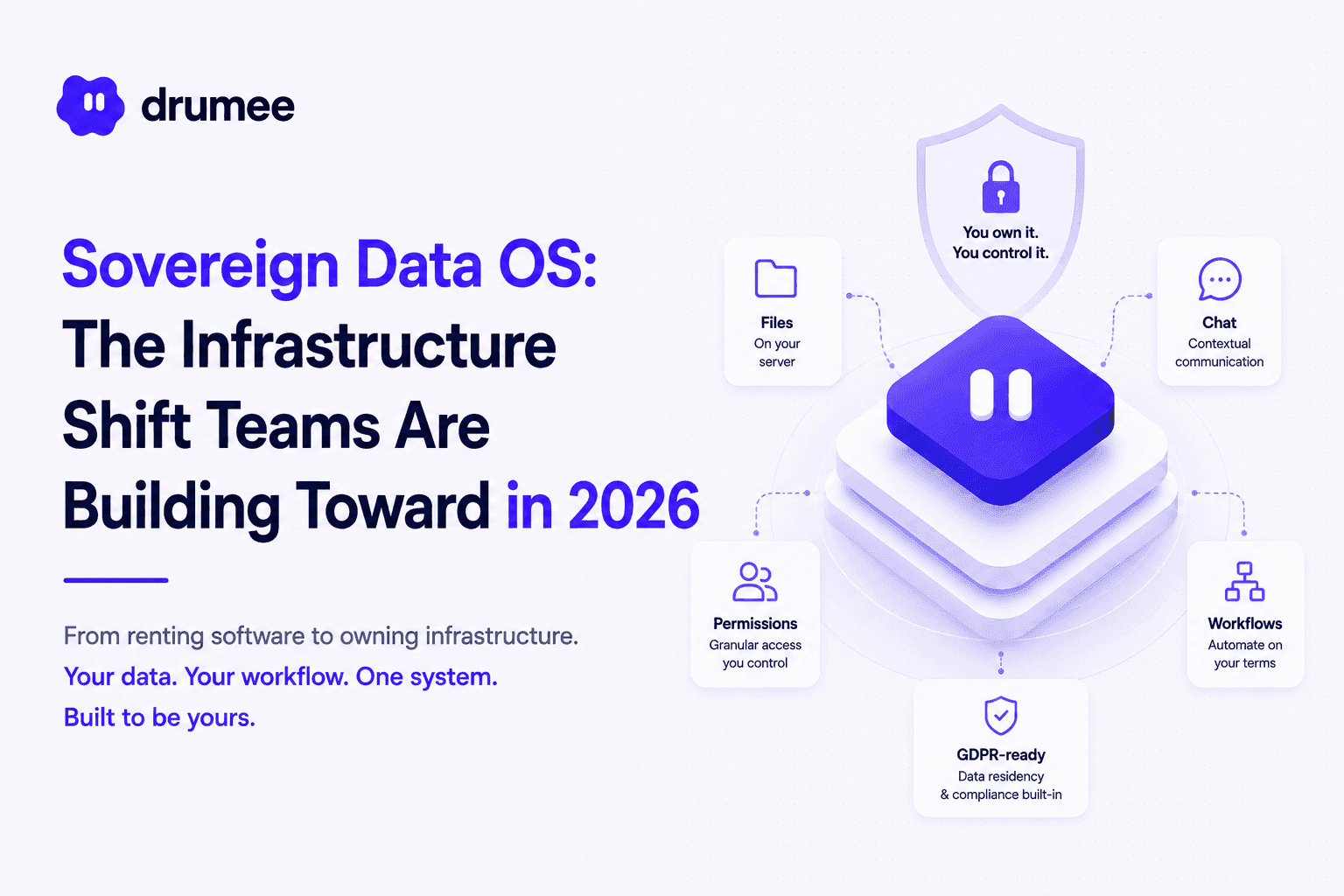
What Is a Sovereign Data OS? The Infrastructure Shift Teams Are Building Toward in 2026
What is a sovereign data OS? Learn how Drumee's unified self-hosted infrastructure replaces fragmented SaaS stacks with a single governable environment for files, chat, permissions, and workflows in 2026.
Data Ownership: What It Means and How to Achieve It in 2026
What is data ownership and how do you actually achieve it? Learn the three layers of data control, why AI changes the stakes, and how self-hosted infrastructure gives teams genuine ownership in 2026.