
How to Avoid SaaS Vendor Lock-In: A Practical Guide for 2026
SaaS vendor lock-in reduces your leverage, inflates costs, and limits your options. This practical guide covers the audit, contract negotiation, open standards strategy, and self-hosted infrastructure approach to avoiding it in 2026.
How to Avoid SaaS Vendor Lock-In: A Practical Guide for 2026
SaaS vendor lock-in does not announce itself. It accumulates quietly, one tool adoption at a time, one workflow built on a proprietary API, one year of institutional knowledge deposited into a platform your team does not own. By the time most organizations recognize the depth of their dependency, the cost of addressing it has already exceeded the cost of tolerating it. The practical question facing teams in 2026 is not whether lock-in is a problem worth solving. It is how to solve it without triggering the exact disruption that made leaving feel impossible in the first place.
This guide is written for teams that have reached that realization, builders, CTOs, and operations leads who understand the structural risk and want a roadmap for reducing dependency systematically, without abandoning the tools that are genuinely working or betting everything on a migration that could cost more than it saves.
Start With an Honest Lock-In Audit
The first step in avoiding SaaS vendor lock-in is an assessment most organizations skip: a structured audit of where dependency actually lives and how severe it is. Most teams have a rough sense that they are "too dependent on Google" or "deeply in the Slack ecosystem," but very few have mapped that dependency with enough precision to prioritize action. Without that map, lock-in mitigation tends to default to negotiation, which addresses pricing symptoms without touching structural causes.
A useful audit distinguishes between two fundamentally different types of lock-in. The first is reversible lock-in, the condition in which migration is possible with planning. Your data is exportable in a usable format including history and audit trails. Integrations can be replicated with reasonable effort. The cost of leaving is primarily internal time, not contractual penalties. Switching is measured in months. The second is restrictive lock-in, the condition in which you are effectively constrained to stay. Complete exports are unavailable or prohibitively expensive. Contract terms make leaving commercially irrational. The product is embedded deeply enough that replacement carries real service risk. Switching is measured in years.
For each tool in your stack, the audit should answer four questions: Can you export your data in a standard, usable format (CSV, JSON, SQL, open formats, not vendor-proprietary exports that require their own tooling to read)? Can you replicate the permission model and integration logic in a different environment without rebuilding from scratch? Does the vendor's pricing trajectory give you a realistic path to scaling without absorbing 9–25% annual increases? And if the vendor were acquired tomorrow and the product deprecated, what would operational continuity cost you? According to Selleo's 2026 vendor lock-in analysis, cloud budgets exceeded plan by 17% on average in 2025, and cloud waste reached 29% in 2026, both directly attributable to organizations that never asked these questions before committing to infrastructure they could not easily leave.
Negotiate Data Portability Before You Sign
The most effective time to address vendor lock-in is before it exists, during contract negotiation, before operational dependency has accumulated. Most procurement conversations focus on price, features, and implementation support. Data portability rights, export format specifications, account data access upon termination, and transition assistance clauses are either absent from the conversation or accepted as boilerplate that the vendor controls.
Atonement Licensing's 2026 SaaS lock-in analysis frames this precisely: enterprise buyers who understand their lock-in exposure and take deliberate steps to reduce it negotiate from fundamentally different positions than those who discover it only when the renewal quote lands. The specific contract terms worth negotiating upfront are not complicated. They include an explicit guarantee that full data exports are available in open, machine-readable formats at any point in the contract term, not just at termination. They include clear language specifying that export functionality will not be restricted, paywalled, or degraded as the account accumulates data. They include a transition assistance clause requiring the vendor to support data migration if the relationship ends. And they include clear terms around what happens to data if the vendor is acquired, merges, or undergoes a significant terms-of-service change.
These terms are available to organizations that ask for them. Most organizations do not ask because the procurement conversation defaults to the vendor's contract template, which contains none of them. According to SmartSaaS's data portability analysis, having a clear, structured data export process gives businesses meaningful negotiating leverage during renewals, enabling pushback on price increases and restrictive clauses. Without it, the vendor's structural position is far stronger than it needs to be. You are paying for leverage you could have claimed for free at contract inception, and are instead discovering its absence at renewal.
Prioritize Open Standards and Open-Source Infrastructure
Beyond contract terms, the most durable mitigation for SaaS vendor lock-in is an architectural decision: preferring tools built on open standards, open data formats, and where operationally feasible, open-source infrastructure. This is not an ideological preference. It is a practical observation about where the structural lock-in risk actually lives.
Proprietary SaaS platforms create lock-in through three layers simultaneously: proprietary data formats that require vendor tooling to read, proprietary API structures that require custom integration work to replicate, and proprietary permission models that do not translate cleanly to other environments. Open standards address all three layers. When your data lives in open formats, PostgreSQL databases, standard JSON exports, file systems with conventional directory structures , migration is a technical project, not a strategic crisis. When integrations are built on standard REST APIs and open protocols, replication is a development effort, not an infrastructure rebuild. When permission models follow standard RBAC conventions rather than vendor-specific access control logic, transition is planned work rather than emergency triage.
The Gurkha Technology analysis of self-hosted open-source adoption captures the structural advantage: unlike proprietary SaaS models where migrating data can be arduous and complex if a vendor ceases operations or delivers substandard service, open source offers the inherent flexibility to switch hosting providers, bring operations entirely in-house, or change support suppliers without being inextricably tied to a single entity. The software can be moved. The data travels with it in standard formats. The infrastructure is portable by design.
For collaboration infrastructure specifically, where file storage, permissions, communication, and workflow context accumulate most rapidly and become most difficult to migrate, this architectural preference translates into a practical question: is the system of record for your operational data something you could move without the vendor's cooperation? If the answer is no, that tool represents structural lock-in regardless of how favorable the contract terms appear today.
Build Abstraction Layers at Integration Boundaries
For teams that depend on SaaS tools and will continue to depend on them for parts of their stack, the most practical technical mitigation is building abstraction layers at integration boundaries rather than writing vendor-specific code throughout internal systems. When you integrate with an external service, the implementation should be contained within a defined abstraction layer, a consistent internal API surface that your systems call regardless of which vendor is behind it. If the vendor changes their API, introduces breaking changes, or becomes too expensive to continue using, you change the abstraction layer, not dozens of call sites distributed across your codebase.
Refine's 2026 analysis of vendor lock-in in modern software development identifies this as the central technical discipline: design APIs and integrations at the boundary. Building vendor-specific code throughout an application creates what the analysis calls accumulated dependencies that are individually fine but collectively difficult to change. AI tools are accelerating this problem in new ways, as AI-powered platforms become embedded into internal workflows, generating code, managing data pipelines, and running agents, the dependencies become harder to see because they are deeper in the system. Switching an AI vendor increasingly means changing not just an API call but the fundamental way team workflows operate. Abstraction layers at integration boundaries prevent this accumulation before it becomes structural.
The same principle applies to data. Even when using a SaaS tool, critical data should be regularly exported to formats the organization controls, CSV, JSON, SQL dumps, and ideally should also live in a database the organization owns, with the SaaS tool providing a UI layer on top rather than serving as the system of record. This approach preserves portability at the data layer even as the tool layer remains vendor-dependent. When migration eventually becomes necessary, the data is already in a condition that makes it possible.
Treat Pricing Pressure as a Lock-In Signal
One of the most reliable leading indicators of lock-in severity is not the contract structure or the data format, it is the vendor's behavior at renewal time. Vendors with genuinely low switching costs price competitively because they have to. Vendors with high switching costs price aggressively because they can. Gartner's research cited in SaaStr's 2025 SaaS pricing analysis found that corporate IT budgets grow at 2.8% annually while SaaS vendors are raising prices 9–25%. That gap is not coincidental, it is the quantified expression of pricing power that accumulates as organizations build deeper operational dependencies.
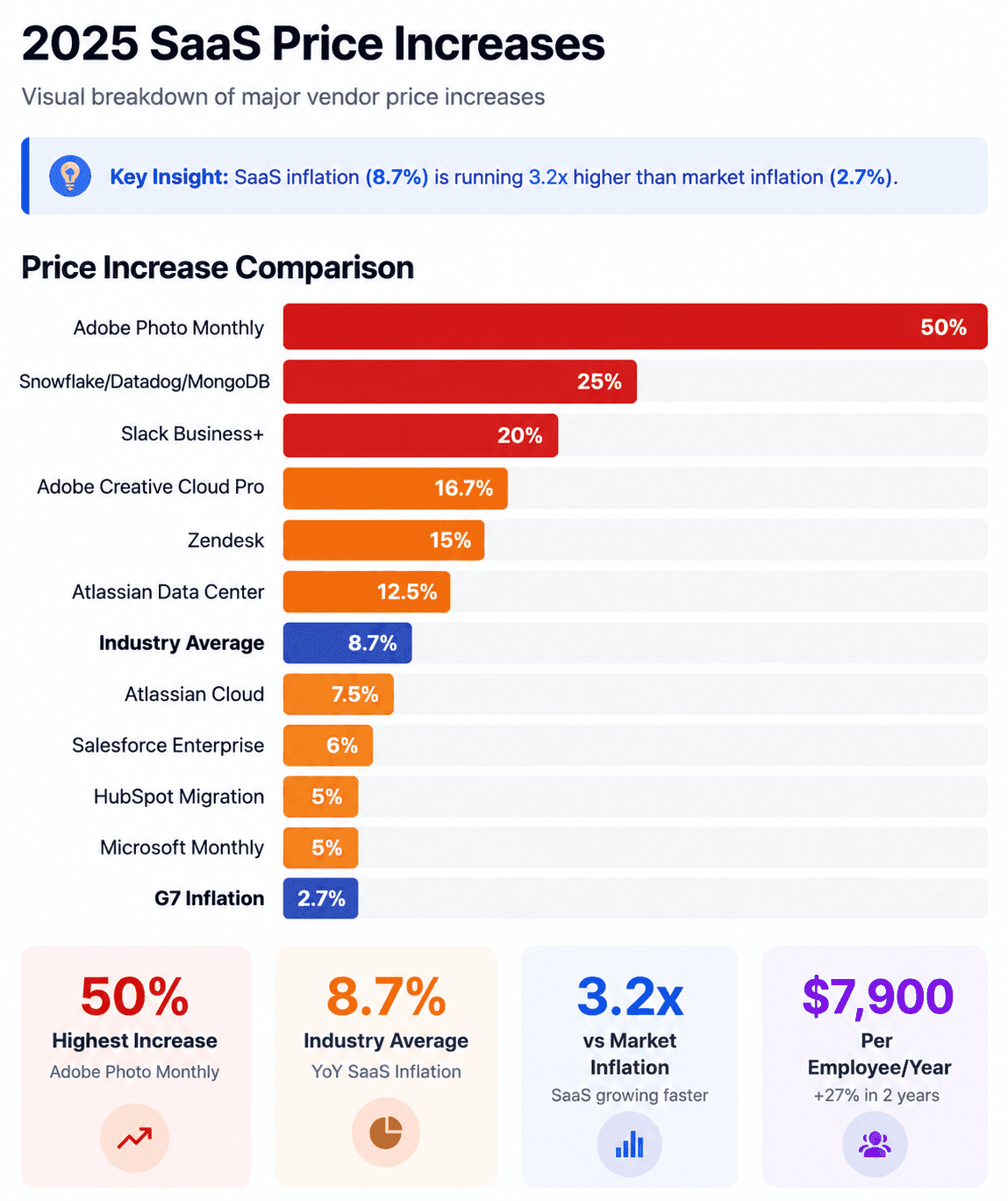
When a vendor imposes a 15% price increase at renewal and frames it as inevitable, the appropriate organizational response is not grudging acceptance. It is a rigorous reassessment of whether the switching cost that makes acceptance feel easier than migration is a legitimate operational constraint or an artifact of poor planning during adoption. Most switching costs are legitimate for a period, the data is real, the integrations are real, the institutional familiarity is real. But switching cost that was high two years ago and is still high today, despite the availability of increasingly capable alternatives, is often evidence that the portability work was never done, not that departure has become genuinely impossible.
SmartSaaS's data portability guide documents that organizations that invest in comprehensive exit strategy development, maintain robust data management practices, and regularly assess their portability capabilities are better positioned to avoid vendor lock-in, optimize costs, and adapt to changing business requirements. Organizations that do this work systematically, maintaining current data exports, testing migration scenarios on a regular cadence, documenting integration dependencies, preserve optionality that organizations in pure consumption mode lose without realizing it.
Move Your System of Record to Infrastructure You Control
Each of the mitigation strategies above, the audit, the contract terms, the open standards preference, the abstraction layers, the portability testing, operates at the margin of a fundamentally vendor-dependent architecture. They reduce lock-in severity within a model where your operational data still lives on infrastructure you do not own. For teams that have reached the inflection point where infrastructure sovereignty becomes more valuable than onboarding convenience, the most complete resolution is moving the system of record for critical operational data onto infrastructure the organization controls entirely.
This is not a theoretical option in 2026. The technical barriers that once made self-hosted infrastructure an enterprise-only consideration have largely dissolved. DEV Community's 2026 self-hosting guide documents that Docker made deployment trivial, open-source alternatives have matured to rival their commercial counterparts, and a $4–20 per month VPS provides enough compute to run a full operational stack. A typical small team might pay $200 or more per month across storage, project management, and collaboration SaaS subscriptions. Self-hosting those workloads on a single VPS with 2 vCPU and 4 GB RAM costs a fraction of that, with infrastructure costs that stay fixed regardless of headcount rather than compounding per seat.
The cost differential becomes dramatic at scale. According to research from Clawbot's 2026 SaaS vs. self-hosted cost comparison, a startup using 10 typical SaaS tools would incur approximately $111,729 annually in subscription costs, while self-hosting the equivalent stack costs approximately $1,584 per year, a savings of nearly 98.6%. Even discounted heavily for operational overhead, the infrastructure economics of self-hosting have shifted decisively in favor of organizations that have the technical maturity to run it. And the operational overhead itself has declined substantially: Docker containerization, one-click deployment tooling, and modern orchestration frameworks have made self-hosted infrastructure accessible to teams with a single technically competent lead rather than a dedicated operations team.
For collaboration infrastructure specifically, where the combination of file storage, team communication, permissions, and workflow context creates the deepest and most persistent lock-in, this architectural shift is precisely what Drumee is designed to enable. As a sovereign data OS, Drumee consolidates files, chat, tasks, permissions, and workflows inside infrastructure the organization controls and administers. There is no proprietary data format to navigate on exit, because there is no exit to plan for, the organization's operational data lives on its own servers from day one. There is no per-seat pricing model that escalates with headcount. There is no AI processing layer operating on sensitive operational data under a third party's governance terms. The lock-in architecture that defines conventional SaaS collaboration tools simply does not exist at the infrastructure layer, because the infrastructure is yours.
The Practical Sequencing
Avoiding SaaS vendor lock-in does not require a wholesale migration from every tool your team currently uses. It requires sequencing the work according to where the structural risk is highest and where the operational maturity exists to act. The practical order for most teams looks like this: conduct the lock-in audit first, assigning a reversible or restrictive classification to every tool in the stack. Identify the two or three tools that hold the highest concentration of critical operational data in the most proprietary formats, those are the highest-priority items. For those tools, either negotiate explicit data portability terms into the next renewal cycle, or begin the transition to self-hosted infrastructure that eliminates the dependency structurally. For the remainder of the stack, implement abstraction layers at integration boundaries and establish a regular export cadence that keeps critical data in formats the organization owns.
The sequencing matters because attempting to address all lock-in simultaneously is the surest path to the kind of operational disruption that makes the whole exercise feel unjustifiable. Lock-in was accumulated gradually. The most resilient organizations reverse it the same way deliberately, one structural dependency at a time, starting with the highest-risk exposure first. The organizations that are best positioned in 2026 are not the ones that never adopted SaaS. They are the ones that adopted it intentionally, understood the dependency each tool created, and built the portability practices that preserved their ability to leave before leaving became necessary.
FAQ
1/ What is SaaS vendor lock-in and why does it happen?
SaaS vendor lock-in is the condition in which operational dependency on a vendor's platform, through data accumulation, workflow integration, proprietary formats, and pricing structures makes switching to an alternative prohibitively costly or disruptive. It happens because SaaS adoption is optimized for speed of onboarding, not ease of exit.
2/ What is the most effective way to avoid vendor lock-in?
The most effective approach combines three elements: negotiating explicit data portability rights before signing, preferring tools built on open standards and open data formats, and for critical operational infrastructure, choosing self-hosted or sovereign environments where the organization controls the infrastructure layer entirely.
3/ How do you audit your current SaaS stack for lock-in risk?
For each tool, assess whether data is exportable in open, usable formats; whether integrations can be replicated without vendor tooling; whether pricing trajectory is sustainable at scale; and whether the tool classifies as reversible or restrictive lock-in. Reversible means migration is months of work. Restrictive means it is years.
4/ Is self-hosting realistic for most teams in 2026?
For teams with at least one technically competent lead, yes. Docker-based deployment has made self-hosted infrastructure accessible without a dedicated operations team. A full self-hosted collaboration stack costs approximately $4–20 per month in VPS infrastructure, compared to $200 or more monthly in equivalent SaaS subscriptions, with costs that stay flat regardless of headcount.
5/ How does Drumee help teams avoid vendor lock-in?
Drumee is a self-hosted sovereign data OS where files, chat, tasks, permissions, and workflows run on infrastructure the organization controls. There is no proprietary data format, no per-seat pricing escalation, and no vendor-controlled AI processing layer. The lock-in architecture of conventional SaaS collaboration tools does not exist because the infrastructure belongs to the organization from deployment day one.
Related article: SaaS Vendor Lock-In: The Hidden Cost of Convenience.
------------------------------
About Drumee
Drumee is the world’s first unified sovereign data infrastructure: a self-hosted, OS-like workspace that turns your own filesystem into a private collaborative environment.
Fully under your control, Drumee combines files, chat, tasks, and workflows with enterprise-grade permissions built directly into the infrastructure layer. No cloud vendors. No fragmented SaaS stack. No operational dependency.
Instead of renting your workspace from external providers, Drumee allows organizations to own the environment where operational knowledge lives.
Your Data. Your Workflow. One system. Built to be yours!
Follow us at: X | LinkedIn | Drumee Founder X | Drumee Founder LinkedIn
Keep reading
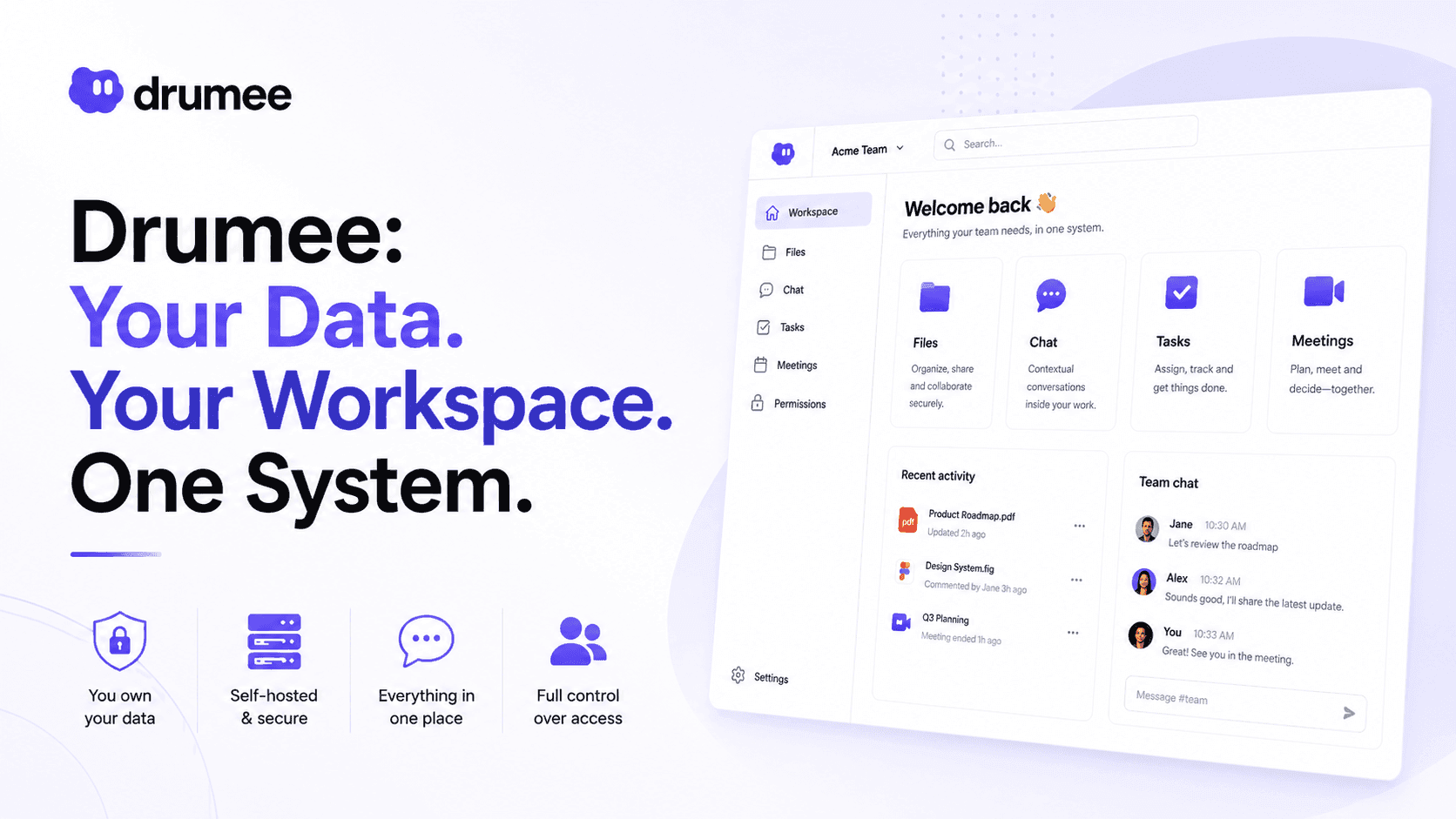
Drumee: Your Data. Your Workspace. One System
Drumee is a self-hosted, sovereign data workspace where files, chat, tasks, and permissions live in one place on infrastructure you own. Learn what Drumee is, what it stands for, and how to get started.
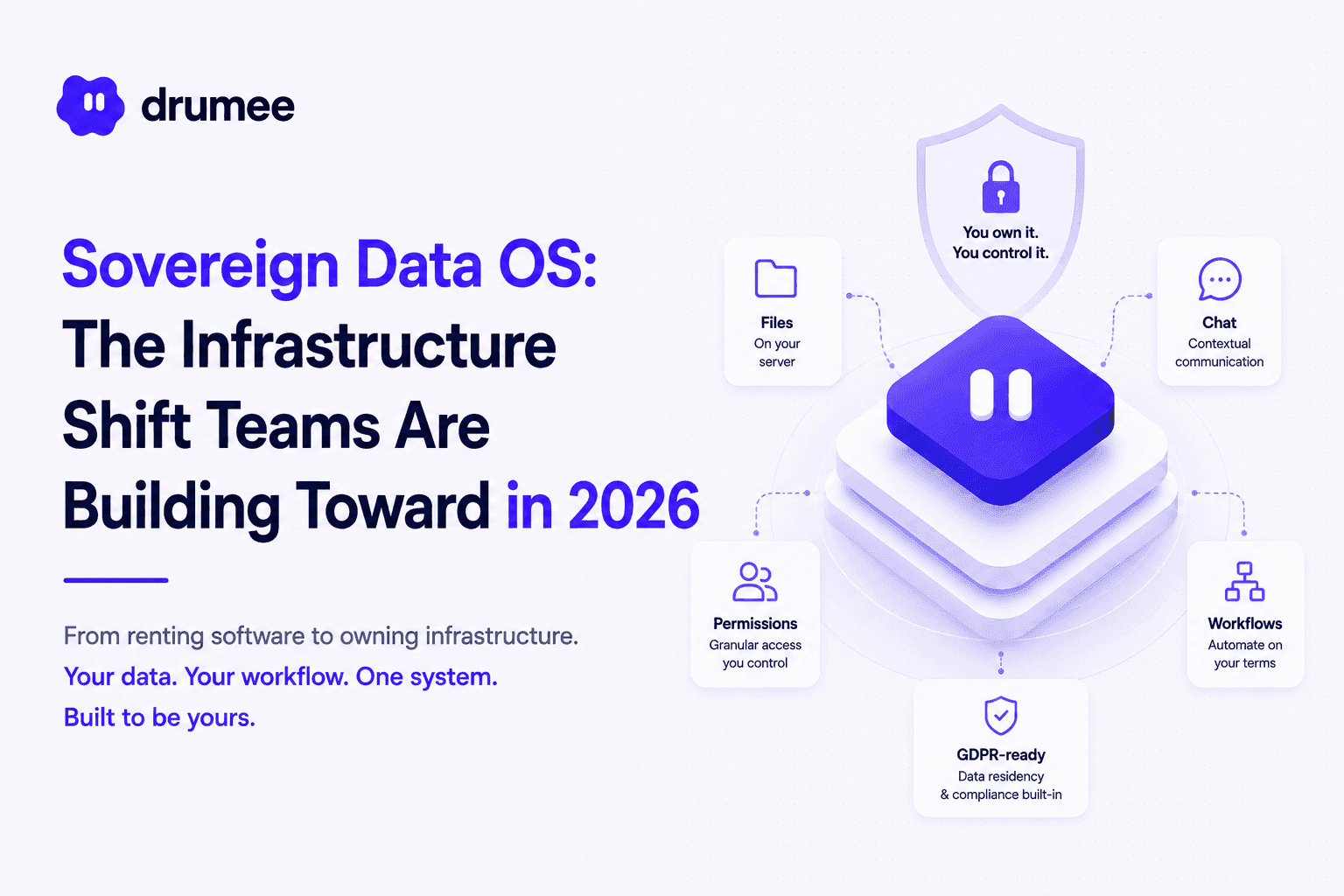
What Is a Sovereign Data OS? The Infrastructure Shift Teams Are Building Toward in 2026
What is a sovereign data OS? Learn how Drumee's unified self-hosted infrastructure replaces fragmented SaaS stacks with a single governable environment for files, chat, permissions, and workflows in 2026.
Data Ownership: What It Means and How to Achieve It in 2026
What is data ownership and how do you actually achieve it? Learn the three layers of data control, why AI changes the stakes, and how self-hosted infrastructure gives teams genuine ownership in 2026.