
SaaS Vendor Lock-In: The Hidden Cost of Convenience.
SaaS vendor lock-in is costing organizations more than they realize. Learn how integration depth, data gravity, and AI processing are making switching harder, and what sovereign infrastructure does differently in 2026.
SaaS Vendor Lock-In: The Hidden Cost of Convenience.
SaaS vendor lock-in is the condition in which a business becomes so operationally dependent on a vendor's tools, data formats, APIs, and pricing structures that switching to an alternative, even a clearly superior one, becomes too costly, too complex, or too disruptive to justify. It is not a failure of procurement. It is an almost inevitable outcome of how SaaS adoption works: gradually, tool by tool, workflow by workflow, until the accumulated weight of integration, institutional familiarity, and proprietary data format makes the idea of leaving feel structurally impossible. In 2026, as SaaS vendors escalate prices aggressively, embed AI processing into tools that touch sensitive operational data, and engineer increasingly sophisticated switching barriers, the hidden cost of that convenience is becoming one of the most significant strategic liabilities a growing organization can carry.
How Is Lock-In Built?
The first thing to understand about SaaS vendor lock-in is that it is not accidental. Vendors engineer it deliberately, through specific mechanisms that deepen dependency as usage scales. The most visible mechanism is integration depth. The more connections an organization builds between a SaaS product and the rest of its stack, through APIs, automation rules, embedded workflows, and native integrations, the more costly the act of leaving becomes. According to IDC research cited by getmonetizely.com, enterprises with 10 or more Salesforce integrations have 40% lower churn rates than those with minimal integrations. The vendor's incentive is transparent: make the tool more connected, and departure becomes structurally harder to justify on pure financial grounds alone.
Data gravity is the second mechanism, and the one that scales most dangerously with time. As an organization accumulates years of documents, permissions, conversation history, workflow configurations, and institutional knowledge inside a vendor's platform, the data itself becomes the moat. According to CloudNuro's analysis of SaaS vendor lock-in strategies, data gravity is the strongest form of lock-in because it is not contractual or technical, it is gravitational. As you accumulate terabytes of customer and operational data within a single platform, the cost and complexity of migrating that data grow exponentially. At ten employees, migration is a project. At fifty employees, it is a painful multi-month operation. At two hundred employees, it becomes a strategic risk that most organizations elect to defer indefinitely.
The third mechanism is pricing architecture itself. SaaS vendors have learned that the most effective way to extract value from an existing customer base is not to improve the product fast enough to justify renewal, it is to make renewal the path of least resistance even when pricing increases. According to SaaStr's comprehensive breakdown of the 2025 SaaS pricing surge, Gartner reports that corporate IT budgets are growing at just 2.8% annually while SaaS vendors are raising prices by 9–25%. Salesforce's 2025 price increase contributed approximately 72% of the company's total ARR growth that year, meaning the majority of their revenue growth came not from new customers, but from extracting more from locked-in existing ones. Vendors know, from hard behavioral data, that most customers will absorb 10–15% annual increases rather than face the pain of migration. The math is calculated and unambiguous.
The Pricing Escalation Reality in 2026
The abstract risk of price escalation becomes concrete very quickly when you trace the actual pricing trajectories of the tools most organizations depend on. Notion, one of the most widely adopted knowledge management and documentation tools, restructured its pricing in May 2025, effectively eliminating the incremental path from its Plus tier to AI functionality. A 50-person team that previously ran Plus with the AI add-on at $10,800 per year now faces a Business tier cost of $12,000 annually minimum, and that figure doesn't include the $2,400–$6,000 in Year 1 implementation costs, per-domain fees, or the billing exposure from guest-to-member conversions that CheckThat.ai's detailed Notion pricing analysis documents in real user complaints. Notion, Slack, and Loom all followed the same pattern: charge an AI add-on between $4 and $10 per user, then bundle it into the core pricing while raising per-seat costs by $2.50–$5. The customer gains no optionality in the process.
Slack illustrates the lock-in mechanism at its most structurally explicit. According to Cushion's 2025 Slack pricing analysis, once an organization upgrades to Enterprise Grid, there is no downgrade path. Ever. The jump to Business+ at $15 per user represents a 107% price increase from the Pro tier, and it is the only option for organizations that need single sign-on, AI features, or service-level guarantees, functionality that most scaling teams eventually require. The organizational knowledge, conversation history, and workflow integrations accumulated inside Slack over several years mean that the cost of leaving isn't just the migration itself. It's the institutional memory left behind, the retraining of every team member, and the disruption to every cross-functional workflow that has been built on Slack's proprietary threading and integration model.
These are not outlier examples. They represent the operating model of mature SaaS businesses in 2026. The data migration barrier alone is decisive for most organizations: according to Flexera's State of the Cloud research cited across multiple analyses, 47% of enterprises cite data migration as a significant barrier when considering switching providers. Nearly half of all enterprises considering a vendor switch find the prospect of moving their accumulated data to be, in itself, sufficient friction to stay regardless of whether a better or cheaper alternative exists.
The Compounding Cost Structure Nobody Audits
The financial picture of SaaS vendor lock-in is almost never reviewed in aggregate. Individual tools get approved in budget cycles as line items. The cumulative stack — and the cumulative dependency it represents — rarely appears as a single number on anyone's balance sheet until a trigger event forces the accounting. When it does get calculated, the numbers are consistently larger than organizations expected.
According to the SaaS spending trends analysis published by GlobalPublicist24, SaaS now accounts for 35–45% of total IT budgets in 2026, up from approximately 25% in 2020. Most companies concentrate 70–80% of their total SaaS spend in five to seven core tools — and those core tools are precisely the ones with the deepest lock-in architecture. The average enterprise still adds 20–30 new SaaS tools per year even while officially pursuing stack reduction, because departmental preferences, legacy integrations, and the switching cost of each existing tool make actual consolidation slow and painful. The intent to reduce stack complexity is widespread. The execution almost never follows.
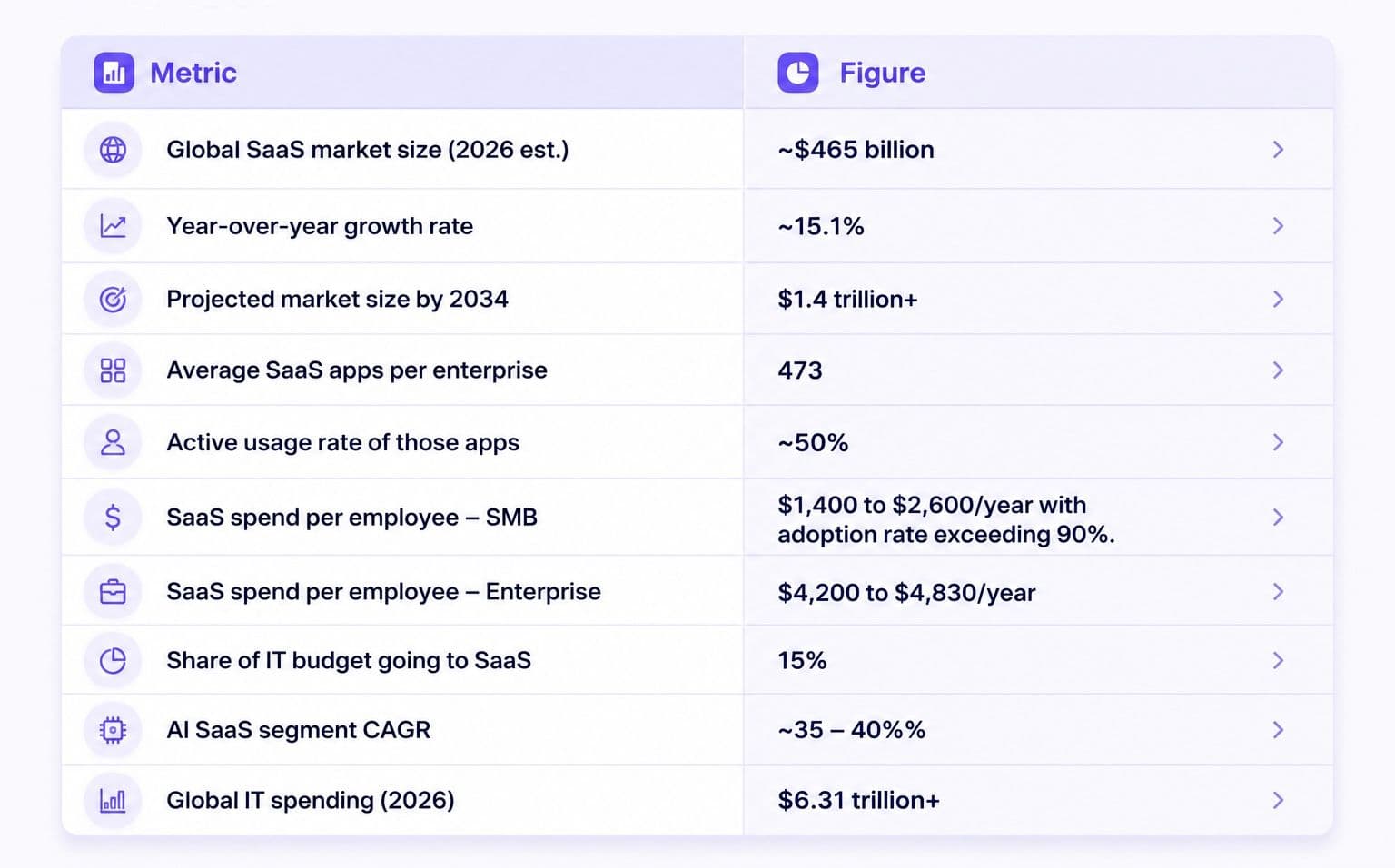
The waste figure compounds the picture further. Selleo's 2026 vendor lock-in analysis documents that cloud waste reached 29% in 2026, meaning nearly three in ten dollars spent on cloud and SaaS infrastructure is generating no measurable operational return. Simultaneously, cloud budgets exceeded plan by 17% on average in 2025. The combination, 29% waste inside budgets that are already 17% over projection, describes an environment where organizations are both overpaying and under-utilizing the tools they are locked into. They cannot cut the waste without triggering the migration cost. They cannot reduce the budget overrun without addressing the vendor dependency that caused it. Both exits require exactly the kind of operational disruption that lock-in is designed to make feel untenable.
SellersCommerce's 2025 SaaS statistics report adds another dimension: nearly 50% of SaaS licenses go unused for 90 days or more, and 48% of enterprise apps are shadow IT applications, tools employees adopt without IT oversight. Both patterns are direct consequences of lock-in. When the approved tools are too expensive, too rigid, or too difficult to adapt to specific workflows, employees route around them. When IT cannot easily reduce seat counts mid-cycle or reclaim unused licenses without triggering vendor friction, waste accumulates. The average enterprise manages 106 SaaS applications. The average organization knows, with confidence, the governance posture of perhaps a third of them.
The AI Layer Amplifies the Risk
In 2026, a new dimension of SaaS vendor lock-in has emerged that makes the conventional cost analysis insufficient: the AI processing layer. When SaaS vendors embed generative AI into their core products, as Notion, Slack, Google Workspace, and virtually every major collaboration tool has done, the dependency relationship changes in kind, not just in degree.
Before AI integration, vendor lock-in was primarily an economic and operational concern. The vendor controlled your data's storage location, your workflow's architecture, and your pricing trajectory. Those are significant risks but they are, at least in principle, quantifiable. AI integration introduces a qualitatively different dependency: the vendor now controls the AI systems that process your operational knowledge, summarizes your documents, drafts from your communication history, and generates recommendations from your workflows. Your institutional knowledge, the accumulated decisions, context, and operational intelligence your team has produced over years, becomes input material for systems operating under a third party's governance.
The ITAM Review's 2026 vendor lock-in guide captures the strategic dimension precisely: in 2026, being locked into a three-year contract with a vendor whose AI capabilities fall behind is a significant competitive handicap. The pace of AI development means that organizations whose operational data is trapped inside a single vendor's ecosystem cannot easily adopt better-fit AI tools as they emerge. The lock-in is no longer just about switching platforms. It is about whether your organization retains the architectural flexibility to govern how AI interacts with your most sensitive operational context.
The Moment Lock-In Becomes Visible
Most organizations experience SaaS vendor lock-in as an abstract risk until a trigger event makes it suddenly concrete. These triggers follow predictable patterns. A major price increase that exceeds budget growth forces a migration conversation, and the conversation reveals, for the first time, the true complexity and cost of moving. A vendor acquisition changes the product roadmap and support posture in ways that no longer serve the organization's needs, and the exit assessment reveals how thoroughly the accumulated data and integrations have made departure nearly impossible without a multi-year commitment.
Munich's seventeen-year effort to migrate 15,000 workstations away from Microsoft before reversing course in 2017, at an estimated cost of up to €100 million, is the canonical illustration. The migration itself was technically feasible. The organizational dependency, the governance lock-in, the retraining requirement, the audit and compliance infrastructure built around Microsoft's ecosystem, made it practically insurmountable at scale. Munich's experience is not a cautionary tale about open-source alternatives failing. It is a cautionary tale about what happens when lock-in is not addressed before the cost of exit exceeds the cost of staying.
The ITAM Review's framing is useful here: the clearest signal that lock-in is costing you is when a faster, cheaper, or more capable alternative loses out not because it is inferior, but because switching is simply too hard to justify. The incumbent vendor does not need to be the best option. It only needs switching to feel worse than staying. That asymmetry is the core mechanism of vendor lock-in, and it becomes more powerful, not less, as dependency compounds over time.
The Architectural Alternative
The fundamental resolution to SaaS vendor lock-in is not finding better vendors with better contracts. It is reducing architectural dependency on vendor-controlled infrastructure for the data and workflows that matter most. This is the insight behind the sovereign workspace and sovereign data OS categories that Drumee is built to occupy.
When files, conversations, permissions, tasks, and workflows exist inside infrastructure the organization controls, running on its own server, under its own permission model, the migration risk and pricing leverage that define SaaS vendor lock-in dissolve. There is no proprietary data format to navigate on exit. There is no escalating per-seat pricing model that compounds as the team grows. There is no AI processing layer operating on organizational data under a third party's governance. The operational context belongs entirely to the organization.
The infrastructure cost of this architecture in 2026 is not prohibitive. The deployment friction has largely disappeared: Docker-based deployment means a team with a basic technical lead can stand up a sovereign collaborative environment in under an hour. The technical barrier that once made self-hosted infrastructure an enterprise-only consideration is no longer a meaningful constraint for most teams that have reached the organizational maturity where lock-in risk becomes real.
The honest framing is this: SaaS vendor lock-in is not a problem that negotiation solves, or that better contracts prevent, or that multi-vendor diversification adequately mitigates. It is a structural consequence of building operational workflows on infrastructure you do not own. The organizations addressing it most effectively in 2026 are not the ones negotiating harder at renewal. They are the ones who have moved their highest-sensitivity operational data onto infrastructure they control, before the next price surge, before the next AI governance concern, and before the next trigger event makes the cost of exit visible for the first time.
FAQ
1/ What is SaaS vendor lock-in?
SaaS vendor lock-in is the condition in which an organization's operational dependency on a specific vendor's platform through data accumulation, workflow integration, proprietary formats, and pricing architecture makes switching to an alternative prohibitively costly or disruptive, even when better options exist.
2/ What are the hidden costs of SaaS vendor lock-in?
Beyond subscription fees, the hidden costs include data migration complexity, retraining expenses, workflow disruption during transitions, customization loss, integration rebuilding, and the opportunity cost of being unable to adopt better tools because switching is too expensive to justify.
3/ How do SaaS vendors engineer lock-in deliberately?
Vendors use integration depth (encouraging more connections to their ecosystem), data gravity (accumulating data that becomes expensive to move), pricing architecture (tiered models that make downgrading painful), and proprietary data formats (making exports incomplete or difficult to use elsewhere).
4/ Why does AI make SaaS vendor lock-in more dangerous in 2026?
When AI is embedded in SaaS collaboration tools, the vendor controls not only data storage but the AI processing layer that interacts with your operational knowledge. This means organizational intelligence, documents, workflows, communications, is processed under third-party governance, and switching away forfeits both the data portability and the AI context built around it.
5/ How does Drumee address vendor lock-in?
Drumee is an unified sovereign data OS that places files, chat, tasks, permissions, and workflows on infrastructure the organization controls. There is no per-seat pricing escalation, no proprietary data format on exit, and no vendor-controlled AI processing layer. Organizations own the operational environment entirely deployable via Docker in under an hour, GDPR-ready, open-source under AGPLv3.
Related article: Data Ownership: What It Means and How to Achieve It in 2026
------------------------------
About Drumee
Drumee is the world’s first unified sovereign data infrastructure: a self-hosted, OS-like workspace that turns your own filesystem into a private collaborative environment.
Fully under your control, Drumee combines files, chat, tasks, and workflows with enterprise-grade permissions built directly into the infrastructure layer. No cloud vendors. No fragmented SaaS stack. No operational dependency.
Instead of renting your workspace from external providers, Drumee allows organizations to own the environment where operational knowledge lives.
Your Data. Your Workflow. One system. Built to be yours!
Follow us at: X | LinkedIn | Drumee Founder X | Drumee Founder LinkedIn
Keep reading
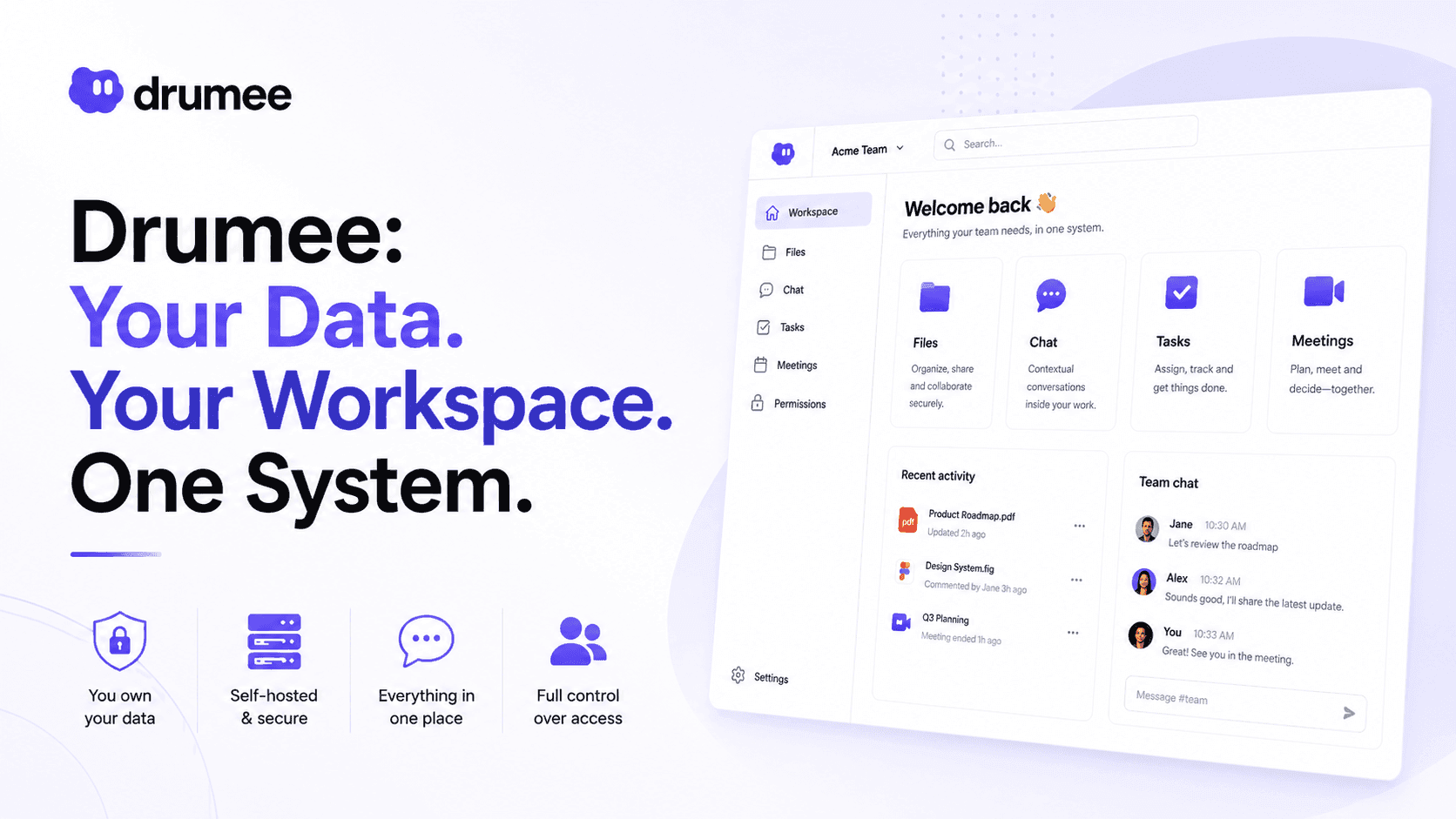
Drumee: Your Data. Your Workspace. One System
Drumee is a self-hosted, sovereign data workspace where files, chat, tasks, and permissions live in one place on infrastructure you own. Learn what Drumee is, what it stands for, and how to get started.
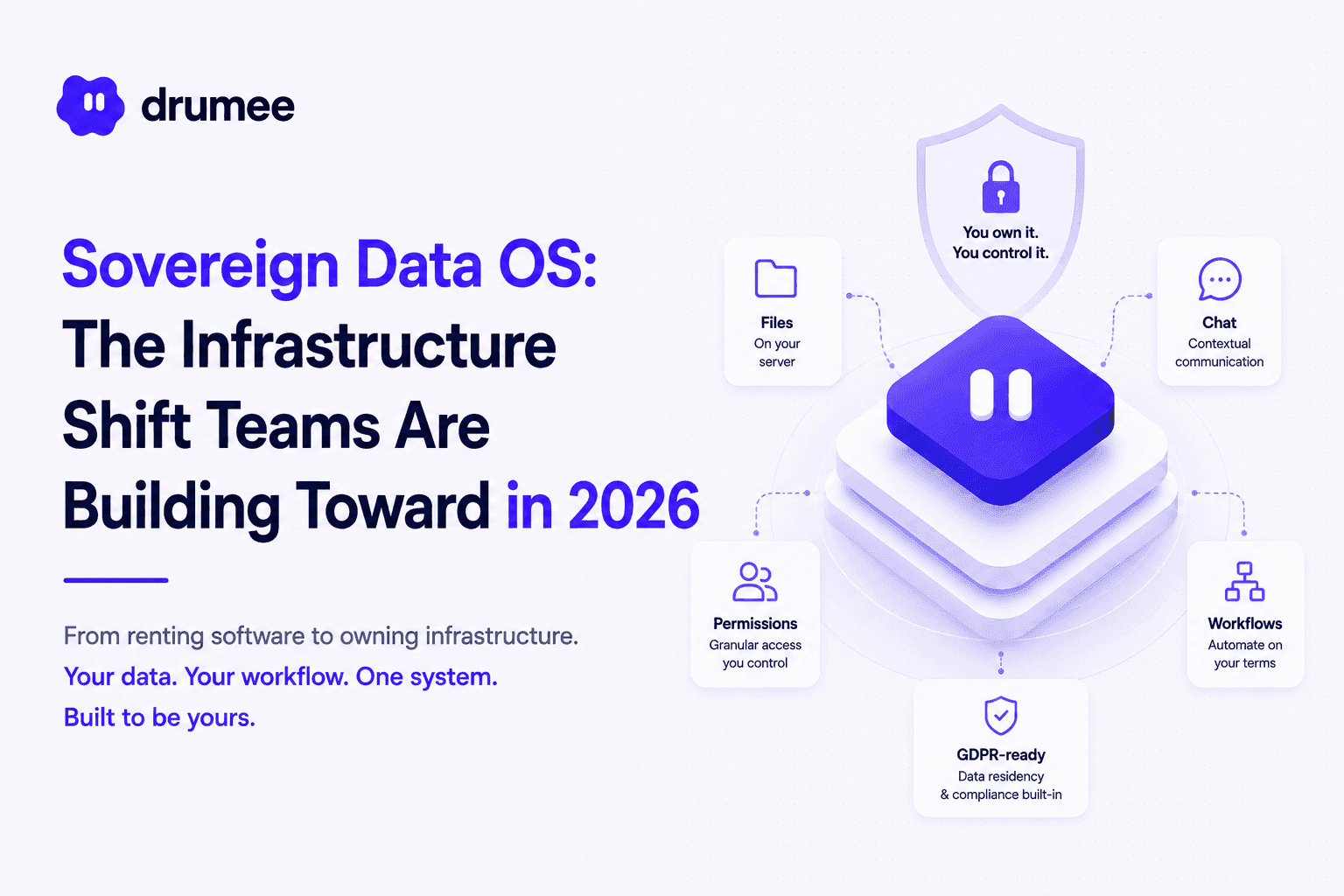
What Is a Sovereign Data OS? The Infrastructure Shift Teams Are Building Toward in 2026
What is a sovereign data OS? Learn how Drumee's unified self-hosted infrastructure replaces fragmented SaaS stacks with a single governable environment for files, chat, permissions, and workflows in 2026.
Data Ownership: What It Means and How to Achieve It in 2026
What is data ownership and how do you actually achieve it? Learn the three layers of data control, why AI changes the stakes, and how self-hosted infrastructure gives teams genuine ownership in 2026.