
Data Ownership: What It Means and How to Achieve It in 2026
What is data ownership and how do you actually achieve it? Learn the three layers of data control, why AI changes the stakes, and how self-hosted infrastructure gives teams genuine ownership in 2026.
Data Ownership: What It Means and How to Achieve It in 2026
Data ownership means an organization retains full authority over where its data is stored, how it is processed, who can access it, and how it is governed without depending on third-party infrastructure to exercise any of those rights. It is not a legal classification. It is an operational condition. Most organizations today have the legal right to their data but do not have meaningful ownership of it in practice, because the infrastructure layer through which that data lives and moves belongs entirely to someone else. In 2026, closing that gap, between nominal legal ownership and genuine operational control, is one of the most consequential architectural decisions a growing team can make.
Why Most Organizations Don't Actually Own Their Data
The first thing to understand about data ownership is that the legal framing most organizations rely on is insufficient. Most SaaS providers explicitly state in their terms of service that customers retain ownership of uploaded content. Google says it. Notion says it. Slack says it. And in a strict legal sense, they mean it, the content copyright remains with the organization that created or uploaded it.
But ownership in law is a different condition than ownership in practice. True ownership looks different from routine product access. Data resides on infrastructure you direct, engineers can query the database without going through product surfaces, exports, archives, and integrations occur on your schedule rather than the vendor's, and access persists regardless of license status. That description, from Sharp Hue's analysis of business data in SaaS environments, captures the gap precisely. Most organizations have content rights but not infrastructure rights, and infrastructure is where operational authority actually lives.
When your team's files sit on Google's servers, your conversations in Slack's infrastructure, and your documentation inside Notion's databases, what you control is a user interface into data that lives inside someone else's system. The vendor controls the hosting architecture, the backup logic, the AI processing layer, the account suspension mechanisms, the export tooling, and the terms under which all of the above operate. If the vendor changes pricing, updates its terms of service, gets acquired, or experiences a service disruption, your operational continuity is affected entirely without your input. That is not ownership. That is access.
This distinction has become harder to ignore as organizations scale. According to Usercentrics' 2026 data privacy statistics report, the most significant data privacy risks organizations face today are large data volumes that are difficult to protect, unclear data ownership creating security gaps, and evolving cyber threats targeting sensitive information. Notably, unclear data ownership ranks as a primary risk factor, not a peripheral concern. The inability to trace where data lives, who has access to it, and under which governance framework it operates is not just a compliance problem. It is a security problem and an operational one.
The Three Layers of Data Ownership
Data ownership is not a single condition. It operates across at least three distinct layers, and most organizations have addressed only the first one.
The first layer is legal ownership - the content copyright and contractual rights that establish who created the data and who has the right to use it. This is the layer most SaaS terms of service address, and it is relatively straightforward for organizations to claim. Your files are yours. Your documents are yours. Your intellectual property remains yours regardless of which tool you use to create or store it.
The second layer is operational control - the ability to access, modify, export, migrate, and govern your data independent of a vendor's product interface or policies. This is where most SaaS-dependent organizations lose meaningful ownership without realizing it. You can export a CSV from Notion today, but you cannot query its database directly. You can download a backup from Google Drive, but the permission model governing that data lives on Google's servers and is governed by Google's policy decisions. When export tooling is removed, APIs change, or accounts are suspended, operational control evaporates despite legal ownership remaining intact.
The third and most strategically significant layer is infrastructure sovereignty - the condition in which your organization administers the actual environment where data is stored, processed, and governed. This is what genuinely completes data ownership. It means the AI systems accessing your documents operate under your governance, not a vendor's. It means the permission model for your team's files is defined and enforced by systems you control. It means the backup, retention, and export logic for your operational data runs on your infrastructure. Without this layer, the first two layers exist only at the vendor's discretion.
The AI Processing Inflection Point
Before generative AI became embedded in collaboration tools, most organizations could treat data ownership primarily as a compliance and governance conversation. The practical consequences of vendor-controlled infrastructure were real but manageable, pricing risk, migration friction, API dependency. In 2026, a third category of consequence has emerged: AI data processing risk.
When AI is integrated into the tools that hold your operational data, your documents, workflows, conversations, and decision records become inputs for systems that process them on vendor infrastructure under vendor governance. The organization may retain content ownership throughout. But the processing authority, the ability to determine which AI models touch your data, what those models do with it, and how outputs are retained belongs to the vendor. Generative data management, using AI to manage data, and managing data for AI, is expected to be a top organizational theme in 2025 and beyond, with "data as an enterprise asset" now cited by approximately 75% of businesses as critical to growth. But if the AI layer processing your operational data runs on infrastructure you do not control, the "asset" you are claiming to own is being processed by systems outside your governance perimeter.
According to the 2025 State of Enterprise Data Governance Report from the Enterprise Data Strategy Board, 31% of organizations are still in the early stages of AI governance policy development, and AI governance ranked last when data leaders prioritized their governance concerns, just 7% listed it in their top focus areas. This represents a significant gap. Organizations are deploying AI tools aggressively while their governance frameworks for how those tools access and process sensitive operational data lag well behind. The organizations that will close this gap fastest are those that have already moved their operational data onto infrastructure they control, where the AI governance boundary is defined by their own architecture rather than a vendor's policy page.
What Genuine Data Ownership Requires in Practice
Achieving meaningful data ownership in 2026 is not about rejecting SaaS tools categorically. It is about being deliberate about which data lives under your control and which lives under a vendor's. The framework for making that distinction is simpler than most governance discussions suggest. If a dataset touches customers, money, operations, or IP, bias toward control. If you anticipate change over the next 24 to 36 months, a vendor switch, acquisition, or contract reset, build for portability now. Where auditability, residency, or retention are non-negotiable, place the system of record under your control.
In practical terms, genuine data ownership requires four conditions to be in place simultaneously. First, data must reside on infrastructure the organization directs, not infrastructure the vendor administers on the organization's behalf. The distinction matters because vendor-administered infrastructure is still vendor-controlled infrastructure, regardless of how it is marketed. Second, the permission model governing access to that data must be enforced by systems the organization manages. Third, the AI systems that interact with operational data must operate within the organization's governance boundary, not outside it. Fourth, export, migration, and continuity decisions must be executable by the organization independent of vendor tooling or vendor policy.
Self-hosting in 2026 is not a niche hobby, it is a practical strategy. You install and run applications on a server you control. Your files, passwords, analytics, and workflows stay on your infrastructure. Docker made deployment trivial, open-source alternatives have matured to rival their commercial counterparts, and a $4–20/month VPS gives you enough compute to run a full stack. The technical barriers that once made infrastructure control an enterprise-only proposition have largely disappeared. Modern Docker-based deployment means a team with a basic technical lead can stand up a fully self-hosted collaborative environment in under an hour. The decision to take operational data back under organizational control is increasingly a governance choice, not a technical one.
The Compounding Cost of Not Owning Your Data
Organizations that defer data ownership decisions tend to discover the cost of that deferral at the worst possible moment, during a vendor transition, an audit, a compliance review, or an AI governance inquiry. At that point, the operational dependency that accumulated gradually through years of SaaS convenience becomes a strategic problem that is expensive to unwind.
Companies solving data governance challenges, including unclear data ownership and inconsistent policies that paralyze AI initiatives, deploy AI three times faster with 60% higher success rates than those that have not addressed the underlying governance architecture. The productivity differential is not theoretical. Organizations that have established clear infrastructure control and data governance are not just better positioned for compliance. They are executing AI initiatives faster and with materially better outcomes than organizations still operating on fragmented, vendor-controlled stacks.
The financial dimension compounds over time as well. According to the integrate.io data integration statistics report, 27% of cloud spend is wasted on average while budgets are exceeded by 17%, and managing cloud costs remains the top challenge for 84% of organizations, surpassing even security concerns. The subscription model that made SaaS infrastructure feel affordable at ten employees becomes a significant and unpredictable cost structure at fifty or two hundred. Each tool that holds a fragment of your operational data comes with its own pricing escalation trajectory, its own API dependency, and its own migration cost if you decide to move.
How Drumee Operationalizes Data Ownership
The sovereign data OS model that Drumee is built around represents the most direct path to genuine data ownership for teams that have reached the inflection point where infrastructure control becomes more valuable than onboarding convenience. Drumee does not add a self-hosting option to a cloud-first architecture. It starts from the premise that files, conversations, permissions, tasks, and workflows should all exist inside infrastructure the organization administers, not distributed across vendor-hosted layers that require constant integration work to maintain operational continuity.
In a Drumee deployment, the permission model for your team's files is enforced by systems running on your own server. The AI systems you choose to integrate with your operational data access it within your infrastructure boundary, under your governance. Backup, retention, and export decisions are yours to define and execute without waiting for a vendor's tooling to permit them.
More important than the cost differential is the governance differential. Data ownership is not achieved by choosing better vendors. It is achieved by bringing operational data under organizational authority, in infrastructure you run, on permissions you define, through governance you control. That is the condition Drumee is designed to create: not a more convenient cloud tool, but the architectural foundation for genuine data ownership in a world where your operational data is increasingly the most strategically significant asset your organization produces.
FAQ
1/ What is data ownership?
Data ownership is the condition in which an organization controls where its data is stored, how it is processed, who accesses it, and under which governance framework it operates, including the infrastructure layer itself, not just the legal rights to the content.
2/ Does using SaaS mean you don't own your data?
You retain legal content ownership in most SaaS environments, but you do not have operational ownership of the infrastructure where that data lives. Vendors control the hosting, AI processing, permission enforcement, export tooling, and account governance, which means data access can be affected by vendor decisions outside your control.
3/ What is the difference between data ownership, data privacy, and data sovereignty?
Data privacy focuses on protecting personal information from unauthorized access. Data sovereignty focuses on which jurisdiction governs the infrastructure your data runs on. Data ownership focuses on who controls the full infrastructure environment, including storage, processing, permissions, and governance, where operational data lives.
4/ When should a team prioritize data ownership?
Data ownership becomes strategically important when operational data involves client information, IP, or sensitive workflows; when AI governance over how data is processed matters; when compliance requirements specify data residency or auditability; or when SaaS costs and migration risk begin to compound against the organization's growth trajectory.
5/ How does Drumee help teams achieve data ownership?
Drumee is a self-hosted sovereign data OS that unifies files, chat, tasks, and workflows on infrastructure the organization controls. The permission model, AI processing boundary, and data governance layer all run inside your server environment, not on vendor infrastructure. Deployable via Docker in under five minutes, GDPR-ready, open-source under AGPLv3.
Related article: Who Owns Your Data in Google Drive? The Answer Is More Complicated Than You Think
------------------------------
About Drumee
Drumee is the world’s first unified sovereign data infrastructure: a self-hosted, OS-like workspace that turns your own filesystem into a private collaborative environment.
Fully under your control, Drumee combines files, chat, tasks, and workflows with enterprise-grade permissions built directly into the infrastructure layer. No cloud vendors. No fragmented SaaS stack. No operational dependency.
Instead of renting your workspace from external providers, Drumee allows organizations to own the environment where operational knowledge lives.
Your Data. Your Workflow. One system. Built to be yours!
Follow us at: Website | X | LinkedIn | Drumee Founder X | Drumee Founder LinkedIn
Keep reading
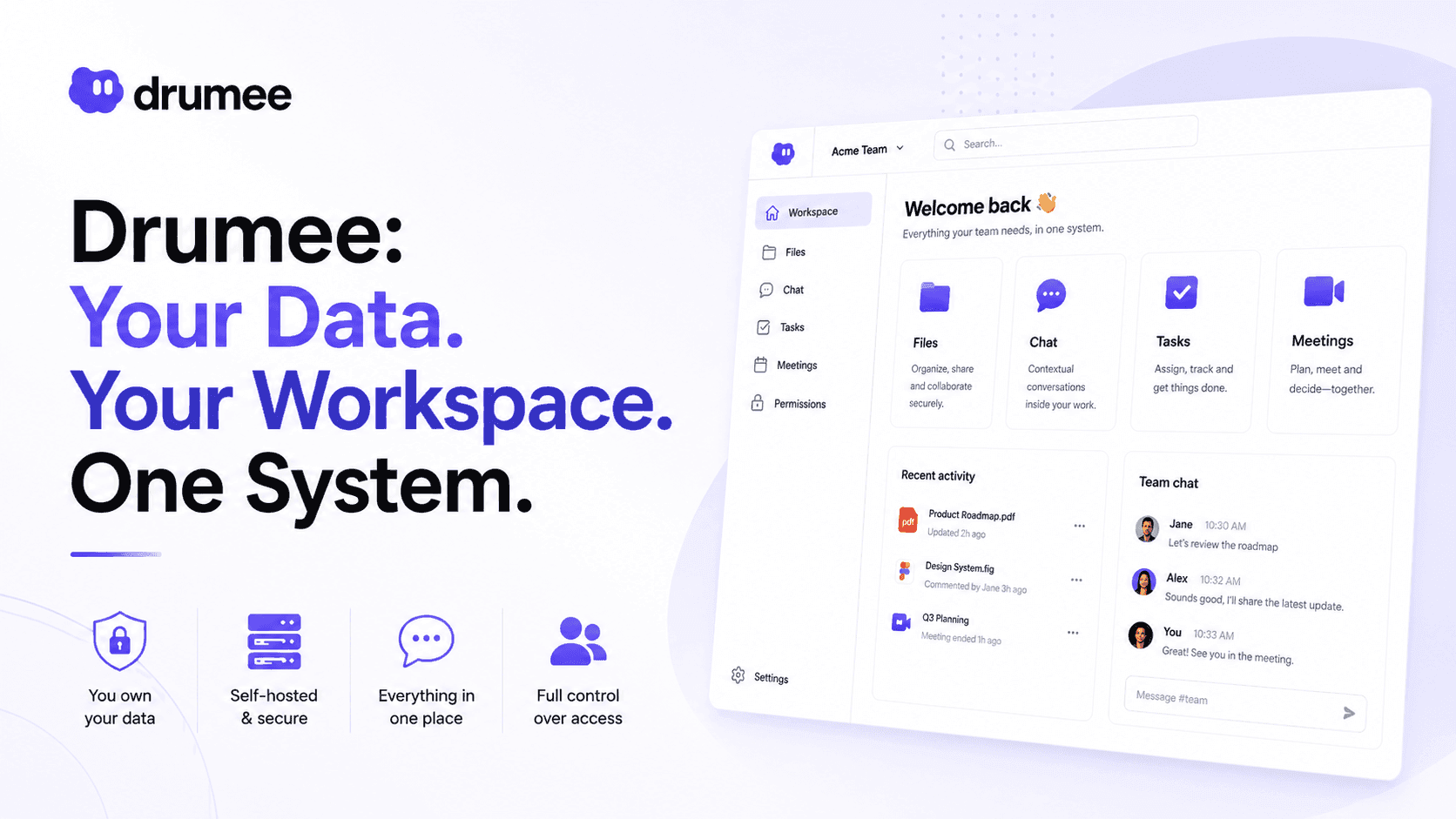
Drumee: Your Data. Your Workspace. One System
Drumee is a self-hosted, sovereign data workspace where files, chat, tasks, and permissions live in one place on infrastructure you own. Learn what Drumee is, what it stands for, and how to get started.
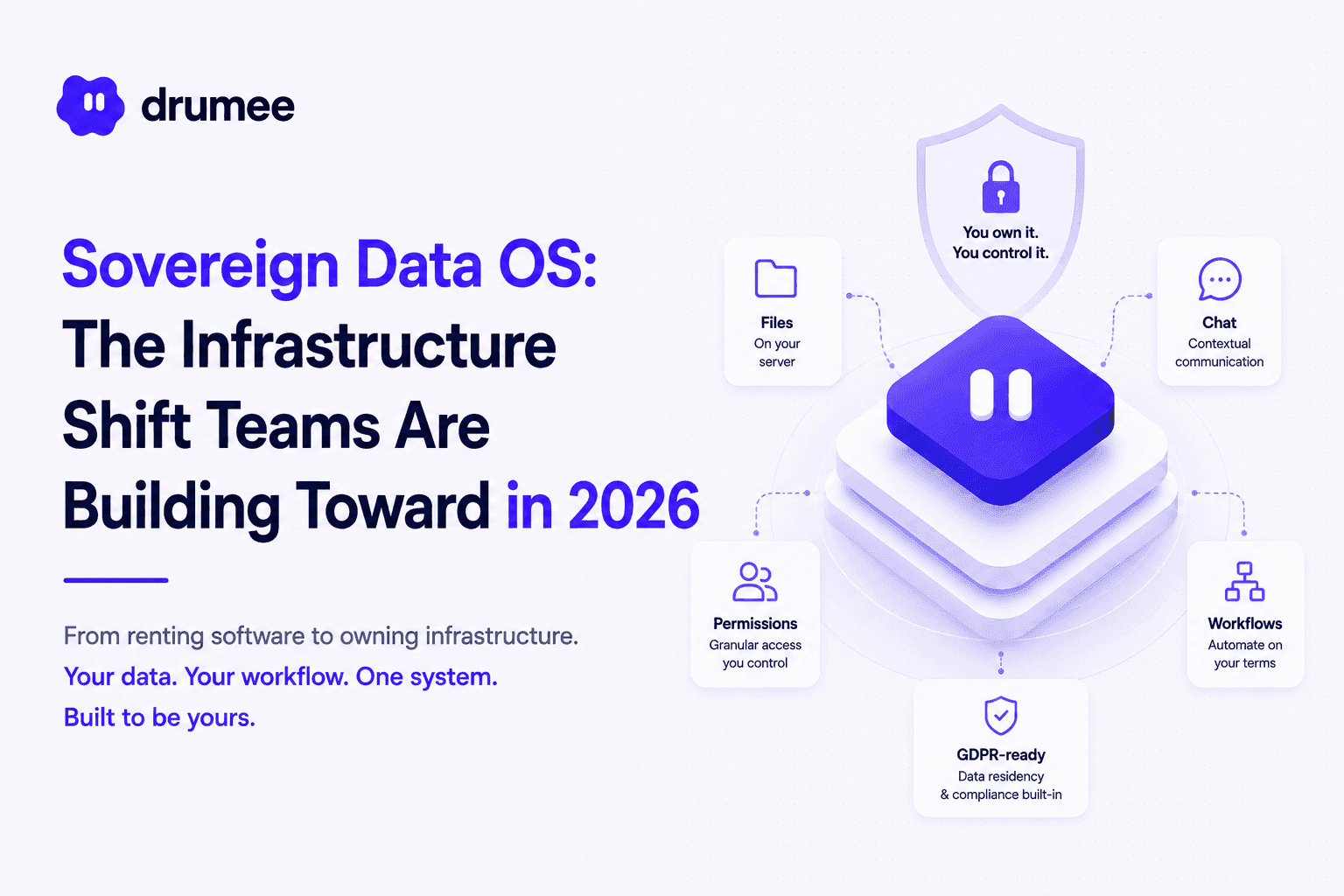
What Is a Sovereign Data OS? The Infrastructure Shift Teams Are Building Toward in 2026
What is a sovereign data OS? Learn how Drumee's unified self-hosted infrastructure replaces fragmented SaaS stacks with a single governable environment for files, chat, permissions, and workflows in 2026.
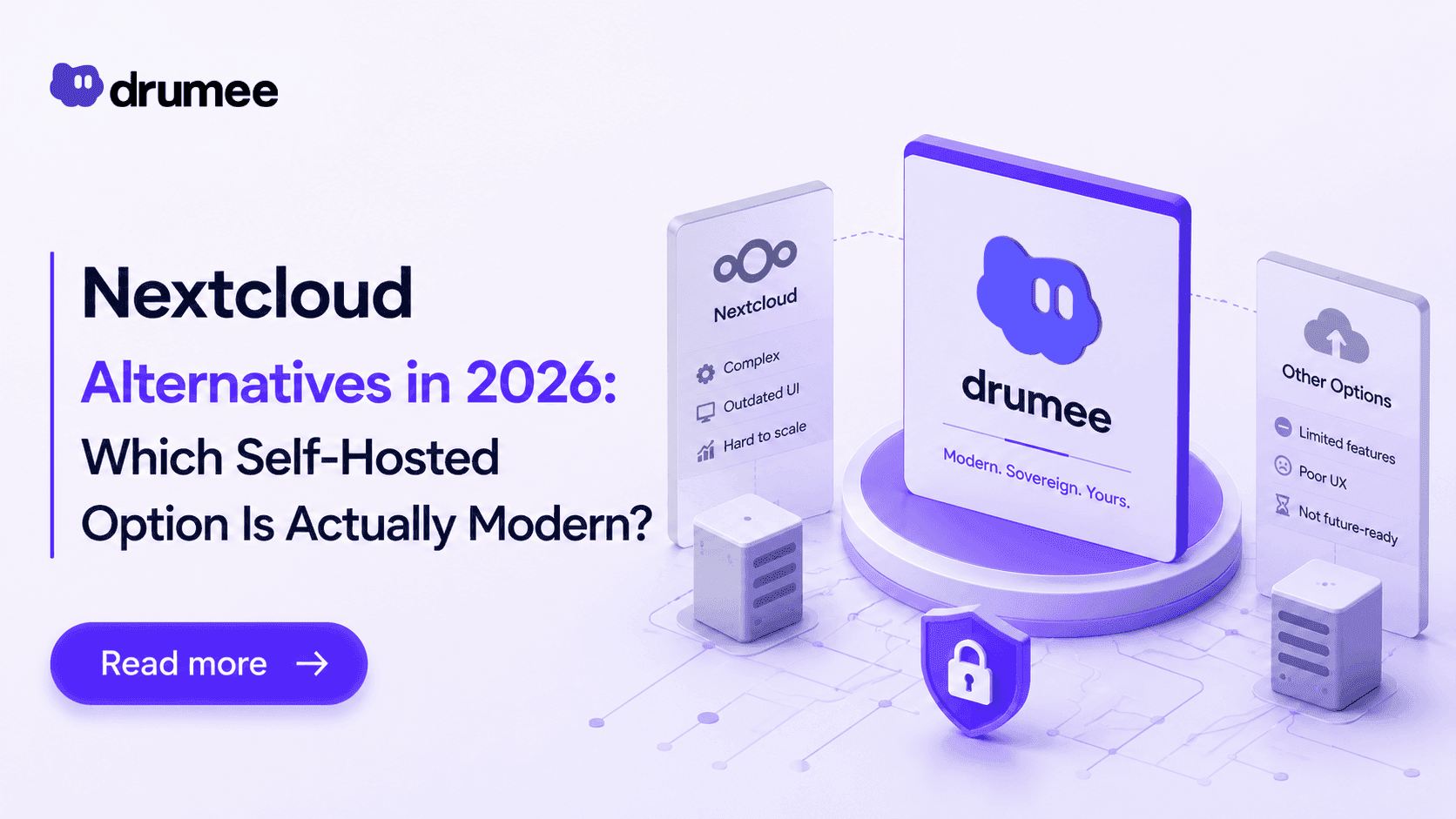
Nextcloud Alternatives in 2026: Which Self-Hosted Option Is Actually Modern?
Nextcloud is the benchmark, but it is not the only option in 2026. Here is a clear comparison of Seafile, ownCloud Infinite Scale, Syncthing, Pydio, and Drumee for teams asking which self-hosted alternative is actually modern and which fits their specific requirements.