
Who Owns Your Data in Google Drive? The Answer Is More Complicated Than You Think
Who owns your data in Google Drive? The legal answer differs from the operational reality. Learn what Google's terms, AI integration, and GDPR enforcement mean for your team's data governance in 2026.
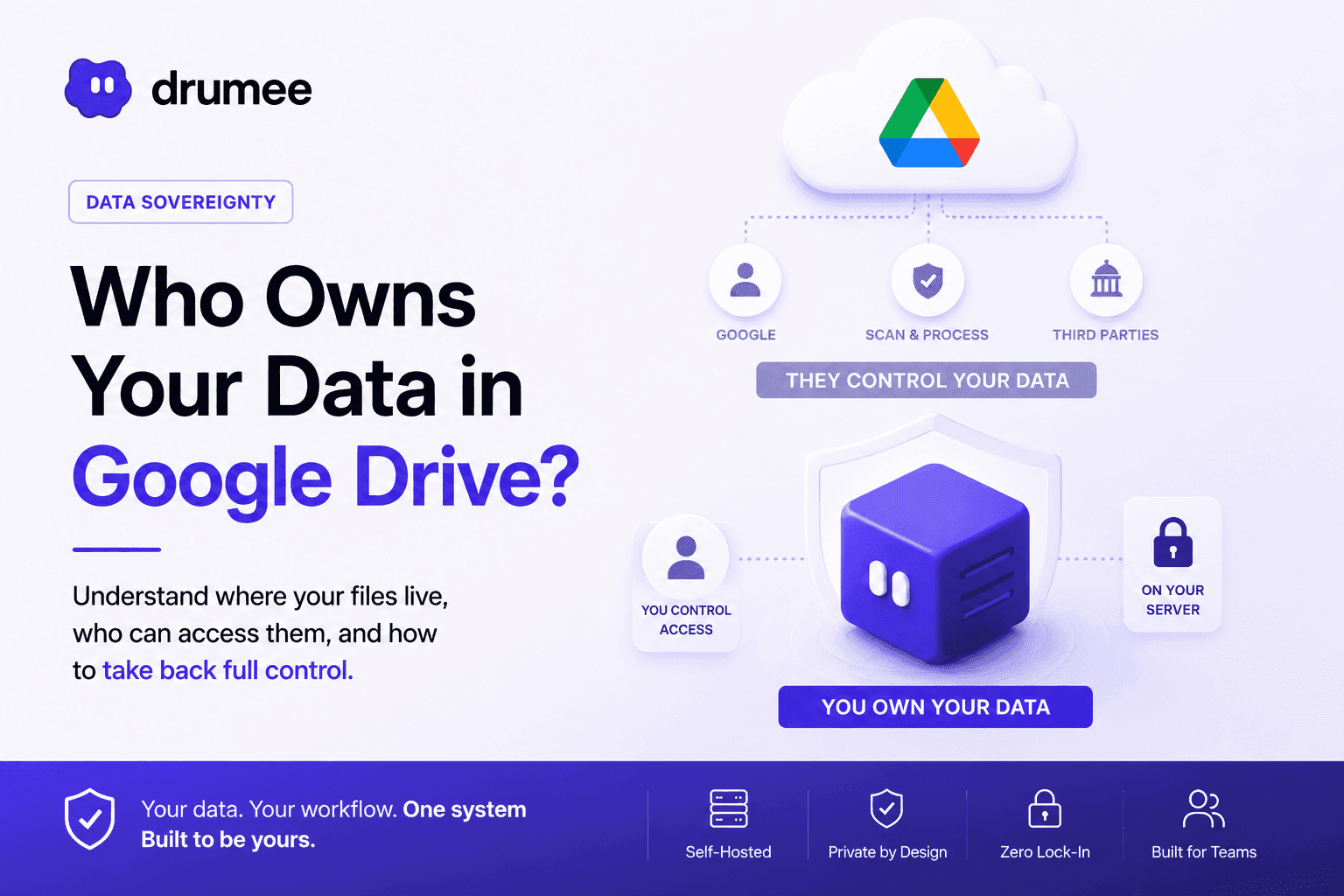
Who Owns Your Data in Google Drive? The Answer Is More Complicated Than You Think
Google Drive is straightforward on the surface. You upload a file, it appears in your storage, you share it with colleagues, and you open it on any device. The convenience is real, and for hundreds of millions of users, that is the entire experience. But for organizations making decisions about where their operational data lives, client files, internal documentation, confidential workflows, sensitive communications, the surface experience is not the complete picture. The question of who actually owns your data in Google Drive has a legal answer and an operational answer, and understanding the difference between them is increasingly the difference between a governance posture that holds under scrutiny and one that quietly does not.
What Google's Terms Actually Say
Google's position on data ownership is clearly stated in its Drive Terms of Service: your content remains yours, Google does not claim ownership of any text, data, information, or files you upload, and the platform's terms are designed to give Google a limited-purpose license to operate and improve the service. On content ownership, legally, the answer is unambiguous. You retain ownership.
But ownership in law is not the same as control in practice. And the distinction matters enormously when you are thinking about data governance, AI processing, regulatory compliance, and long-term operational risk.
What Google's terms also establish is a broad license to use your content to provide and improve services across its ecosystem. When Gemini - Google's AI layer, now deeply embedded across Gmail, Docs, Sheets, Drive, and Meet, is enabled for your account or organization, it operates with access to your files, emails, and documents to provide summarization, suggestions, drafts, and contextual responses. According to Char Blog's detailed analysis of Google Gemini's data retention policies, in late 2025 Google enabled Gemini access to Gmail, Google Chat, and Google Meet by default for US users under a feature rebranded as "Personal Intelligence." In the US, this was an opt-out, meaning the access was active unless users actively disabled it. In Europe, GDPR required an opt-in before the same cross-app access could be activated.
This is the gap that most organizations do not fully account for: the difference between who legally owns the content and who operationally governs the infrastructure layer through which that content is processed.
The Infrastructure Ownership Distinction
The more operationally significant question is not whether Google claims ownership of your files. It is who controls the environment where those files live. And the answer to that question is unambiguously Google.
Google controls the hosting architecture, the AI processing layer, the permission enforcement systems, the account suspension mechanisms, the export tooling, and the terms under which all of the above operate. If Google changes its pricing model, your operational infrastructure absorbs that change without input. If Google updates its terms of service, your organization is bound by those updates. If your account is suspended, for billing failure, a policy trigger, or administrative error, your access to your operational data is suspended with it. You retain content ownership throughout all of this. But content ownership without infrastructure control is an incomplete form of ownership, particularly for organizations whose workflows are structurally dependent on that infrastructure being available and operating under stable, predictable terms.
This is why the data governance conversation has shifted over the past few years from a narrow focus on legal ownership to a broader focus on operational sovereignty. Owning your content in a system you cannot control is meaningfully different from owning your content in the infrastructure you administer. The former gives you portability in theory. The latter gives you governance in practice.
The AI Governance Layer Changes the Risk Equation
The arrival of generative AI inside Google Workspace has introduced a qualitatively new dimension to the ownership question. Before Gemini, the data governance concern around Google Drive was primarily about data residency, regulatory compliance, and the terms under which Google could access your content. Those concerns remain valid. But AI integration has expanded the exposure surface significantly.
According to Concentric AI's updated analysis of Gemini security risks, Gemini operates with search-level access into everyday work, summarizing documents, pulling insights from Sheets, drafting emails from Drive content. Critically, Gemini does not evaluate business context or intent before treating available data as usable data. Your sensitive information is only as secure as your current Google Workspace permission settings. Overly broad sharing configurations, outdated group memberships, and legacy folder access are all inherited by Gemini the moment it activates. Google itself advises users not to enter anything into Gemini they would not want a human reviewer to see, since trained reviewers at Google can check conversations, and that reviewed content can be retained for up to three years.
For enterprise Workspace customers, Google provides stronger assurances. Google's own documentation confirms that enterprise Workspace data is not used for Gemini model training and is not reviewed by humans. That is a meaningful distinction from consumer accounts, where the same protections do not automatically apply. But it also highlights something important: the distinction itself requires active management. Organizations using a mix of personal accounts, shared drives, and workspace tiers, which is most organizations, need to understand exactly which tier each data point lives in, and which governance policy applies. Most do not have that granularity. According to the 2026 Thales Data Threat Report cited by Kiteworks, only 33% of organizations have complete knowledge of where their data is stored. Governance gaps are not exceptional. They are the baseline.
The Regulatory Enforcement Context
The compliance dimension of data governance has intensified substantially, and Google Drive sits at the center of several active enforcement categories. According to Kiteworks' comprehensive 2026 GDPR enforcement report, cumulative GDPR fines since May 2018 now exceed €7.1 billion, with approximately €1.2 billion issued in 2025 alone. European data protection authorities now receive an average of 443 personal data breach notifications per day - a 22% year-over-year increase. Enforcement has moved well beyond Big Tech toward ordinary businesses: schools, healthcare providers, financial firms, and any organization processing personal data under vendor-controlled infrastructure.
Google itself has faced repeated enforcement actions in this space. In September 2025, France's CNIL fined Google €325 million for showing promotional ads in Gmail without prior consent and for using consent design patterns that steered users toward personalized data sharing. That fine followed prior enforcement actions going back to 2019, when France initially fined Google €50 million for transparency failures around how data was collected and used. The pattern is consistent: regulators are not accepting good-faith assurances from vendors whose business model is structurally dependent on data access. They are evaluating governance architecture.
For organizations operating under GDPR, the key question is not whether Google offers a Data Processing Addendum, it does. The question is whether relying on vendor-controlled infrastructure for sensitive operational data constitutes adequate governance given the active enforcement environment. The DLA Piper GDPR Fines and Data Breach Survey (January 2025) recorded an aggregate total of €1.2 billion in fines across Europe in 2024, with regulators increasingly scrutinizing AI data processing specifically. Organizations that cannot clearly demonstrate where their data is processed, who governs that processing, and what controls exist over AI access to sensitive content are accumulating regulatory exposure that compounds over time.
The Practical Gap Between Legal and Operational Ownership
There is a real use case that illustrates the ownership gap clearly, and it happens regularly in organizations of all sizes. A team stores client contracts, financial models, and internal strategy documents in Google Drive. Google legally does not claim ownership. The data is the team's. But the organization experiences a billing dispute, an administrative error triggers an account policy review, or a Google systems change affects permissions in a shared drive. For the duration of the incident, the team may not have access to the operational data their workflows depend on. Legal ownership is intact throughout. Operational continuity is interrupted regardless.
At a larger scale, this is the dependency problem that sovereign infrastructure is designed to eliminate. The self-hosted collaboration suite market, which reached $7.82 billion in 2024 and is projected to grow at a 14.3% CAGR through 2033, is growing precisely because organizations are no longer treating vendor-controlled cloud infrastructure as a cost-neutral convenience. They are treating it as a structural risk, one that compounds with team size, data sensitivity, and AI integration depth.
The organizations moving toward self-hosted sovereign infrastructure are not abandoning cloud-based collaboration. They are becoming more deliberate about where their highest-sensitivity operational data lives, and whether that data should be processed through infrastructure whose governance terms they cannot directly control.
What Genuine Data Ownership Actually Looks Like
Genuine data ownership, not legal ownership in a vendor's terms, but operational ownership in practice, means that your organization controls the infrastructure layer where your data is stored, processed, and governed. It means that if you decide to shut down a service, migrate a workflow, or restrict AI access to sensitive documents, those decisions are yours to execute without waiting for a vendor's API, export tool, or policy change to permit them. It means that the permission model governing your files is administered by your organization, not by a third party who can modify that model with a terms of service update.
This is the architectural gap that Drumee is built to close. As a sovereign data OS, Drumee stores files, chat, tasks, and workflows on infrastructure you control, your server, your permission layer, your governance. There are no vendor access clauses to navigate. There are no AI systems processing your documents on external infrastructure under someone else's terms. There are no default-on data flows to disable. The entire operational environment, from storage to collaboration to permissions, runs under your administration. When regulators or clients ask where your data lives and who governs it, the answer is not a vendor's data processing addendum. It is your own infrastructure.
The question of who owns your data in Google Drive has a legal answer that is reassuring and an operational answer that deserves more scrutiny. In 2026, the organizations asking the operational question, and acting on what they find, are the ones building governance postures that will hold as AI integration deepens, regulatory enforcement accelerates, and the real cost of outsourced infrastructure control becomes harder to ignore.
FAQ
1/ Does Google own my files in Google Drive?
No. Google's Drive Terms of Service explicitly state that your content remains yours and Google does not claim ownership of any files you upload or store. Google holds a limited-purpose license to operate and improve the service, not ownership of your content.
2/ Can Google access my files in Google Drive?
Google may review content to check for policy violations or illegal material. For enterprise Workspace accounts, Google states that data is not reviewed by humans for AI training purposes. For consumer accounts, reviewed conversations can be retained for up to 72 hours at minimum, and up to three years for conversations reviewed in connection with improving AI responses.
3/ Is Google Drive GDPR compliant?
Google Drive offers GDPR tooling including a Data Processing Addendum and data residency configuration options. However, your organization still operates on Google-controlled infrastructure, which means governance authority remains partially with Google. GDPR compliance and data sovereignty operate at different layers of the same problem.
4/ What happens to my Google Drive data when Gemini is enabled?
Gemini can access your Drive files, Gmail, Docs, and Sheets to provide AI-powered features. For enterprise Workspace customers, Google states this data is not used for model training. For US consumer accounts, this access was enabled by default in late 2025 under Google's "Personal Intelligence" feature and requires active opt-out.
5/ What is the alternative to Google Drive for teams that want full data ownership?
Drumee is a self-hosted sovereign workspace OS that stores files, chat, permissions, and workflows on infrastructure you control. Unlike Google Drive, there are no vendor access clauses, no external AI processing of your documents, and no dependency on Google's infrastructure governance. Deployable via Docker in under five minutes, GDPR-ready, and open-source under AGPLv3.
Related articles: What Is a Sovereign Data OS? The Infrastructure Shift Teams Are Building Toward in 2026
------------------------------
About Drumee
Drumee is the world’s first unified sovereign data infrastructure: a self-hosted, OS-like workspace that turns your own filesystem into a private collaborative environment.
Fully under your control, Drumee combines files, chat, tasks, and workflows with enterprise-grade permissions built directly into the infrastructure layer. No cloud vendors. No fragmented SaaS stack. No operational dependency.
Instead of renting your workspace from external providers, Drumee allows organizations to own the environment where operational knowledge lives.
Your Data. Your Workflow. One system. Built to be yours!
Follow us at: X | LinkedIn | Drumee Founder X | Drumee Founder LinkedIn
Keep reading
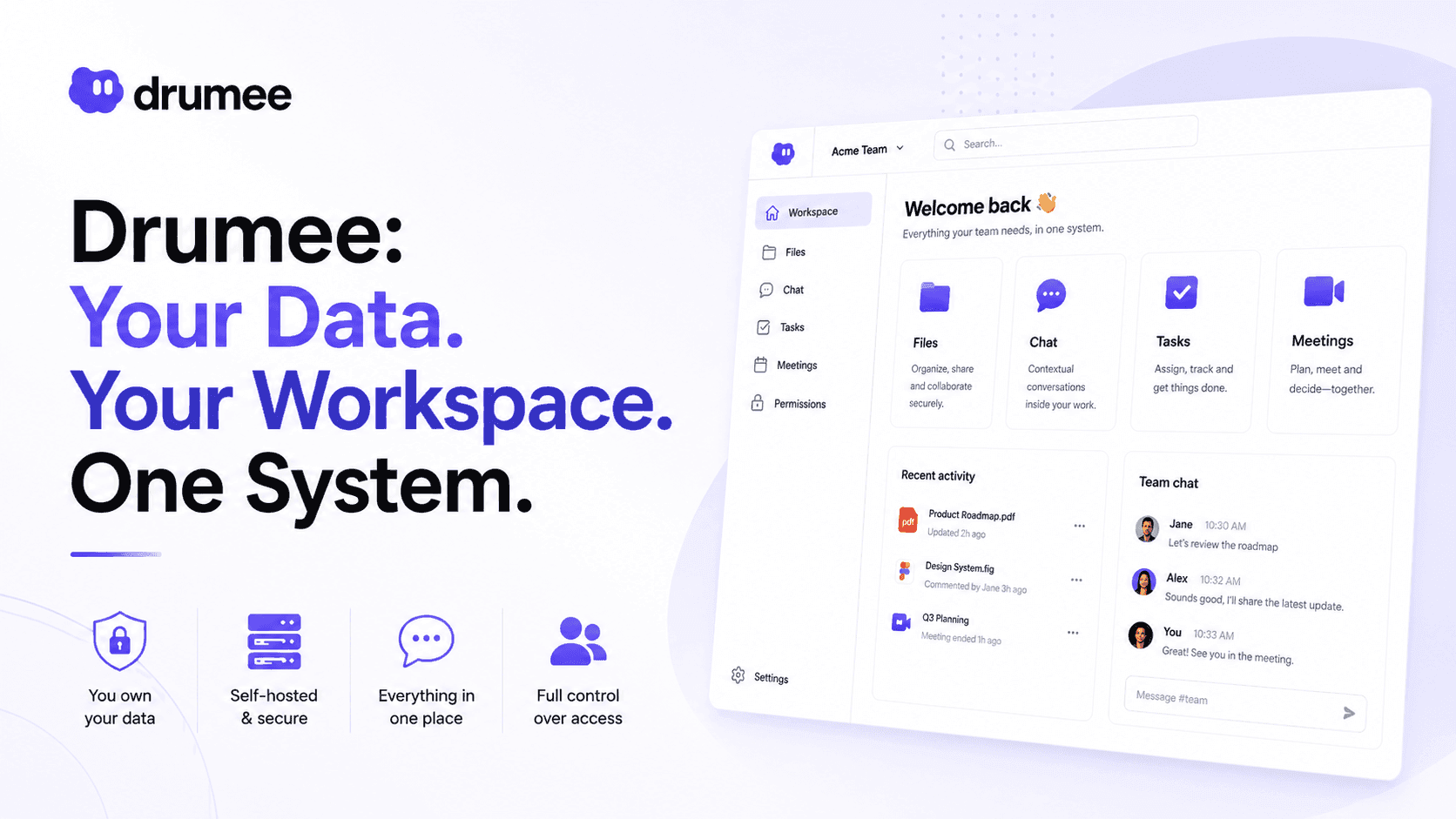
Drumee: Your Data. Your Workspace. One System
Drumee is a self-hosted, sovereign data workspace where files, chat, tasks, and permissions live in one place on infrastructure you own. Learn what Drumee is, what it stands for, and how to get started.
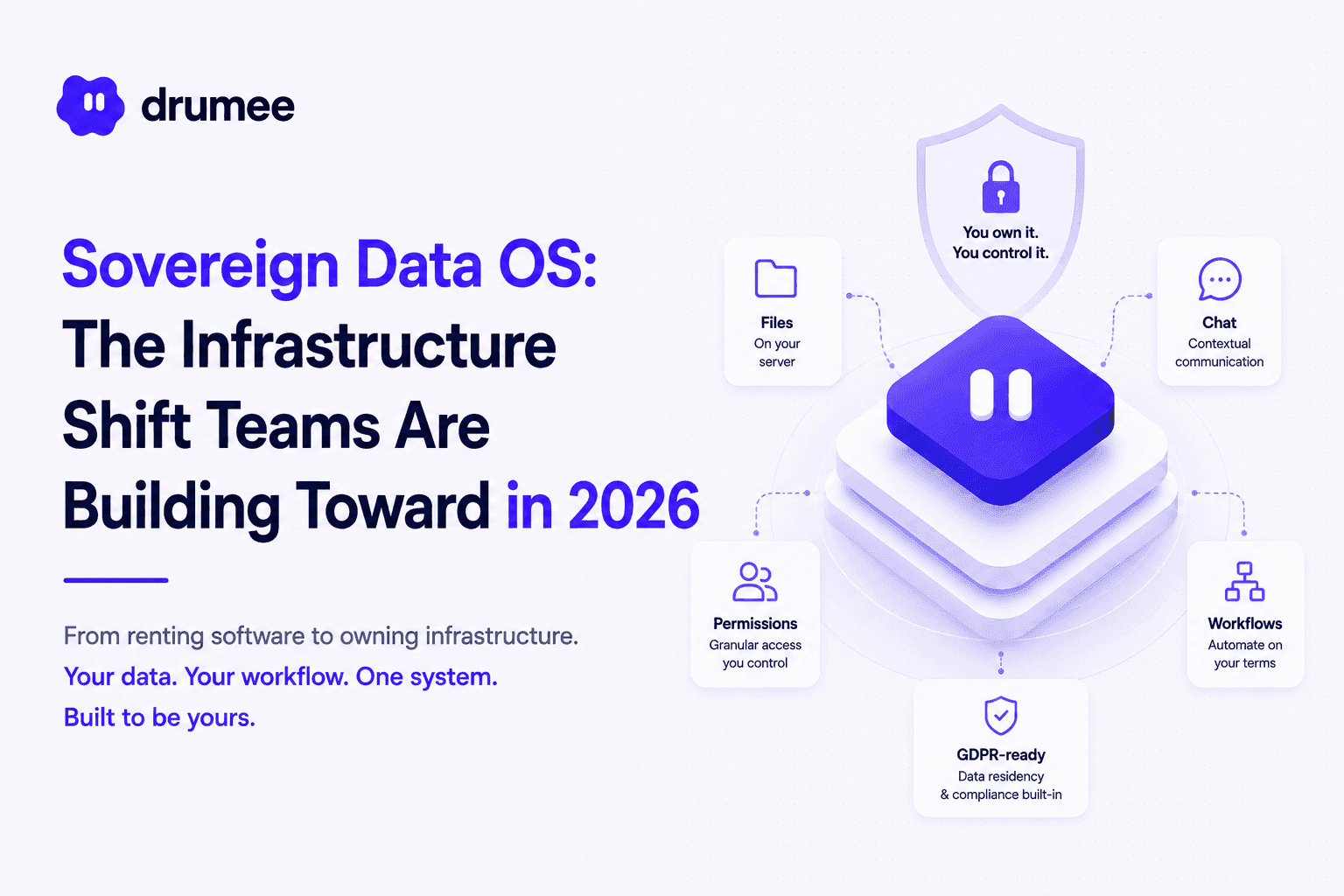
What Is a Sovereign Data OS? The Infrastructure Shift Teams Are Building Toward in 2026
What is a sovereign data OS? Learn how Drumee's unified self-hosted infrastructure replaces fragmented SaaS stacks with a single governable environment for files, chat, permissions, and workflows in 2026.
Data Ownership: What It Means and How to Achieve It in 2026
What is data ownership and how do you actually achieve it? Learn the three layers of data control, why AI changes the stakes, and how self-hosted infrastructure gives teams genuine ownership in 2026.