
What Is a Sovereign Data OS? The Infrastructure Shift Teams Are Building Toward in 2026
What is a sovereign data OS? Learn how Drumee's unified self-hosted infrastructure replaces fragmented SaaS stacks with a single governable environment for files, chat, permissions, and workflows in 2026.
What Is a Sovereign Data OS? The Infrastructure Shift Teams Are Building Toward in 2026
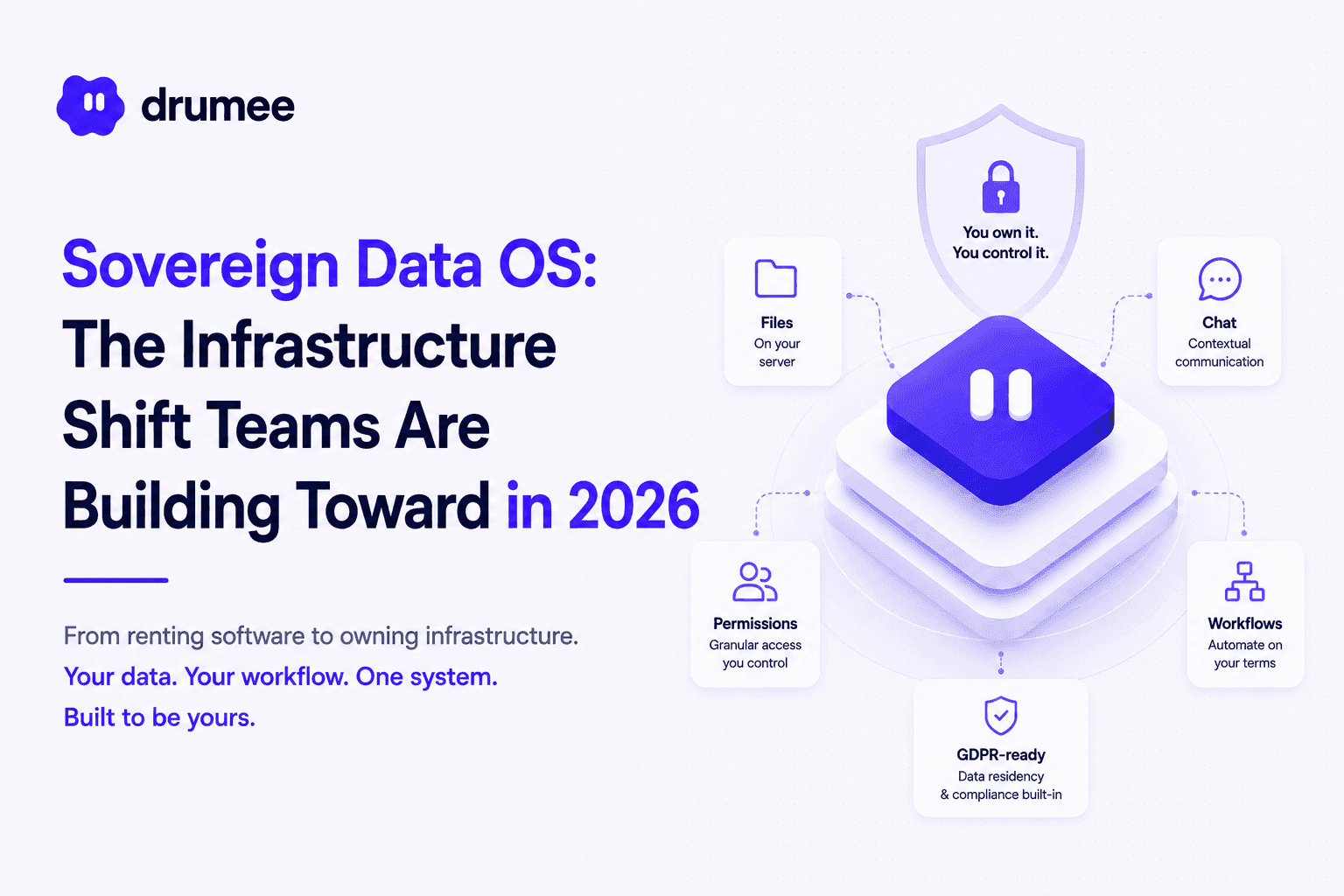
A sovereign data OS is a unified infrastructure where storage, collaboration, permissions, and workflows operate on servers you control. Unlike traditional SaaS tools that scatter operational context across disconnected vendor-hosted systems, a sovereign data OS treats the entire working environment as a single, governable system. Drumee is positioned as the world's first platform built explicitly around this architecture: self-hosted, OS-like, and designed to give teams the kind of infrastructure authority that cloud subscriptions, by design, never actually provide.
Why Does the Term "OS" Matter?
Most people understand what an operating system does for a device. It manages resources, enforces permissions, coordinates processes, and provides the foundational layer that everything else runs on. You don't rent your operating system from an external provider who can revoke access, audit your files, or change the terms of your dependency without warning. You control it. That relationship between an organization and its infrastructure is exactly what a sovereign data OS is designed to restore for teams and their operational data.
The analogy is deliberate. The problem that Drumee and the broader sovereign infrastructure movement are responding to is not simply that cloud tools cost money. It is that cloud tools function architecturally more like leased appliances than owned infrastructure. Your files exist on Google's servers. Your conversations live on Slack's infrastructure. Your documentation is stored on Notion's database. Each of these systems may technically allow you to export your content, but the environment, the permissions layer, the access controls, the processing logic, the AI integrations is entirely governed by someone else. A sovereign data OS inverts that relationship by putting the full environment under the organization's own administration.
The Infrastructure Gap That Created This Category
For the past decade, the dominant model for building a team's operational stack has been to aggregate SaaS tools. This worked because each tool optimized for a specific workflow and individual products genuinely solved real problems. But the cumulative effect of that aggregation is now measurable and significant. According to Grand View Research's 2026 self-hosted cloud platform market report, the global self-hosted cloud platform market was valued at $18.48 billion in 2025 and is projected to reach $46.10 billion by 2033, growing at a CAGR of 12.2%. The research explicitly identifies rising data sovereignty requirements and regulatory compliance mandates as the primary drivers of that growth, not cost savings or technical preference alone.
What is driving organizations toward sovereign infrastructure is not ideological. It is operational. Fivetran's Enterprise Data Infrastructure Benchmark Report 2026, based on a global survey of 500 senior data and technology leaders, found that 62% of enterprises still report low data maturity, with fragile pipelines and manual operations consuming 53% of engineering time. When operational context is scattered across disconnected systems, the teams responsible for maintaining continuity spend the majority of their capacity reconstructing connection points rather than doing actual work. This is what Drumee's positioning describes as the context fragmentation problem, and it is the exact architectural failure that a sovereign data OS is designed to solve.
The problem compounds as organizations scale. A startup operating six tools at ten employees might experience this as manageable overhead. At fifty employees, the context fragmentation begins generating real execution risk decisions made in Slack that never appear in Drive, permissions granted in one system and absent in another, workflows that depend on integrations that break silently when an API changes. At two hundred employees, the dependency on that fragmented architecture becomes a strategic liability that is genuinely difficult to unwind.
What Makes Something a "Sovereign Data OS" Rather Than Just Self-Hosted Software
Self-hosted software is not the same thing as a sovereign data OS. The distinction is architectural. A self-hosted file sharing tool gives you control over one dimension of your operational infrastructure. A self-hosted messaging application gives you another. Assembling those components yourself recreates a version of the same fragmentation problem that SaaS stacks produce just on infrastructure you own rather than infrastructure you rent.
A sovereign data OS is different because it treats the full operational environment as a unified system rather than a collection of components. Files, conversations, task context, permissions, and workflows do not exist in separate applications that communicate through APIs. They exist inside a single governed environment where the permission model is consistent, where operational context persists across functions without reconstruction, and where the data layer is common to every activity a team performs.
Drumee's architecture reflects this principle specifically. The platform does not replicate individual SaaS tools. It replaces the entire SaaS stack architecture with a single self-hosted environment where a file shared in a conversation carries the same permission context as that file in storage. A task created from a document preserves its relationship to that document. Chat happens inside the operational context where work is actually occurring, not in a disconnected application layer that has no native relationship to the files and workflows it references.
This is the OS-level insight that the name is meant to communicate. An operating system does not manage individual applications in isolation. It manages the relationship between all processes, all resources, and all permissions through a common authority layer. That is what a sovereign data OS does for team infrastructure.
The AI Governance Dimension
The sovereign data OS concept has gained urgency in 2026 specifically because of how AI has changed the risk model of cloud dependency. Before generative AI became embedded in SaaS collaboration tools, most organizations treated cloud dependency as primarily a cost and compliance concern. In 2026, it is increasingly a data governance concern of a qualitatively different kind.
When AI systems are integrated into collaboration platforms processing your documents, summarizing your conversations, generating recommendations from your workflows, your operational data becomes training input, inference material, and behavioral intelligence for systems operating on vendor infrastructure. The organization may retain nominal content ownership, but the processing authority belongs to the vendor. According to Gartner's projections cited in N-IX's 2026 data management trends analysis, through 2026 organizations will abandon 60% of AI projects due to insufficient data quality and governance maturity. The organizations that cannot govern how AI accesses and processes their operational data are the ones most exposed to this failure mode.
A sovereign data OS addresses AI governance at the architecture level. When the entire environment, files, conversations, permissions, workflows, runs on infrastructure the organization controls, the AI systems integrated into that environment operate under the organization's governance rather than a vendor's. That distinction is becoming commercially material. The Cisco 2024 Data Privacy Benchmark Study found that 48% of organizations have already limited generative AI usage specifically because of privacy and governance concerns, while 94% of organizations say customers would not buy from them if data was not properly protected. Sovereignty is no longer a preference. It is increasingly a procurement requirement.
Who Is Building Sovereign Infrastructure Right Now?
The adoption pattern for sovereign data OS architecture in 2026 is following a predictable path. Regulated industries banking, healthcare, government, and defense are leading, driven by compliance mandates that make vendor-controlled infrastructure legally untenable rather than merely inconvenient. Grand View Research's market report identifies BFSI as the largest end-use segment for self-hosted platforms, driven specifically by the need to run core banking, risk analytics, and payment processing systems in low-latency, high-availability architectures that minimize third-party exposure.
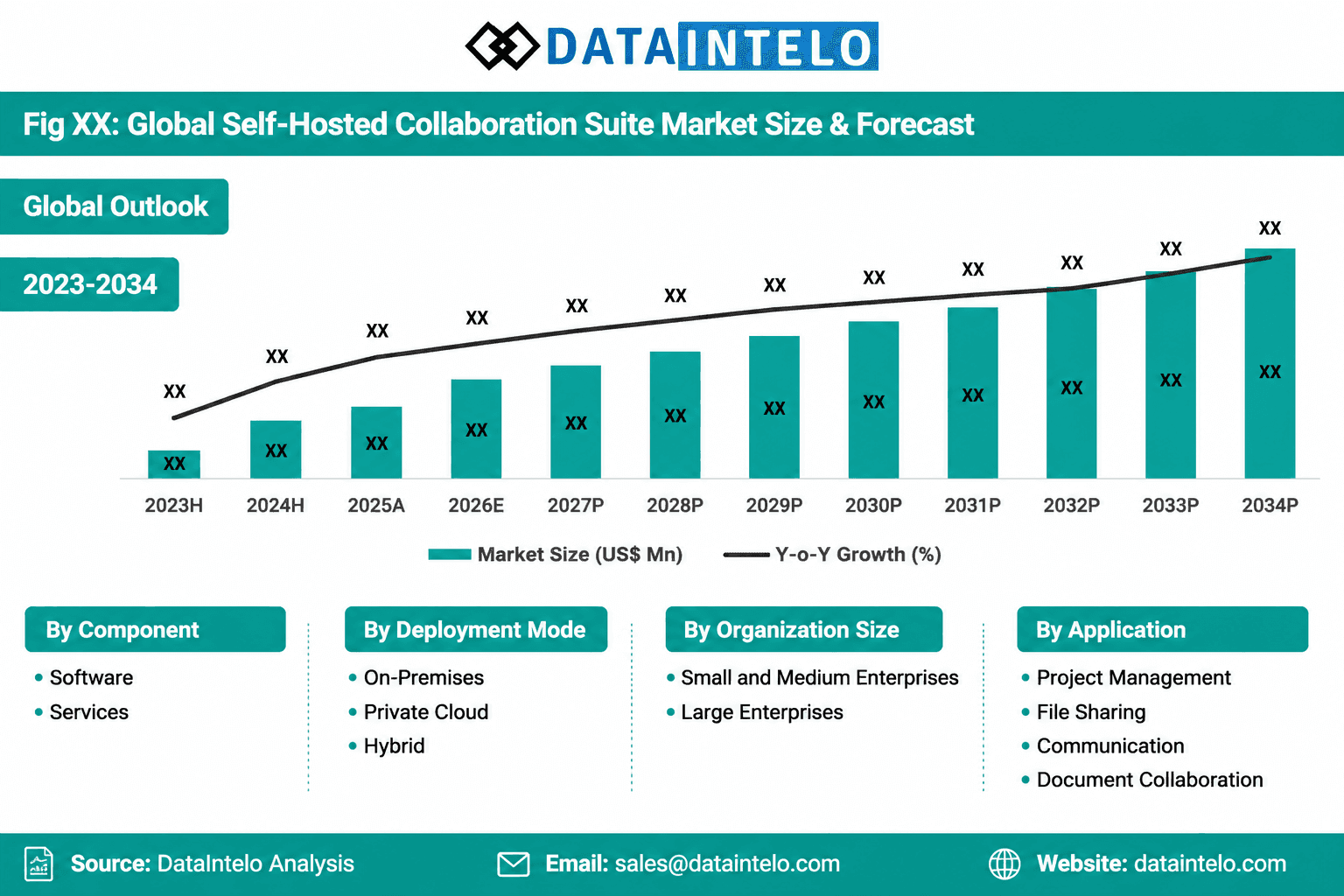
But the more strategically interesting shift in 2026 is happening in the mid-market and among developer-led teams. According to DataIntelo's Self-Hosted Collaboration Suite Market report, the global self-hosted collaboration suite market reached $7.82 billion in 2024 and is projected to grow at a CAGR of 14.3% through 2033, reaching $25.78 billion with growth driven explicitly by data sovereignty demands and rising concerns over AI data governance. The collaboration tools segment specifically is expected to grow at the highest CAGR within the broader self-hosted platform category, reflecting teams' growing recognition that collaboration infrastructure not just storage infrastructure needs to operate under organizational authority.
The European policy environment has accelerated this shift significantly. Massive GRID's 2026 analysis of European cloud migration trends documents a structural departure from US cloud providers among European organizations, driven by GDPR enforcement actions establishing that using US cloud services for personal data processing is inherently non-compliant, not merely risky. The German state of Schleswig-Holstein committed to migrating 25,000 government employees from Microsoft Office and Microsoft 365 to self-hosted open-source alternatives specifically citing digital sovereignty, vendor independence, and GDPR compliance as primary motivations. That is a government-level signal that the sovereign infrastructure category is no longer a niche developer preference.
The Operational Case Beyond Compliance
It would be a mistake to frame the sovereign data OS category purely as a compliance story. Compliance is a trigger, but it is not the only value proposition, and increasingly it is not even the primary one for teams making the shift.
The operational efficiency argument is becoming clearer as research accumulates. When teams operate inside a unified sovereign environment rather than a fragmented SaaS stack, the context reconstruction overhead that consumes so much engineering and management capacity disappears. Files, conversations, permissions, and tasks share a common environment. There is no API translation layer to maintain. There is no integration that breaks silently when a vendor changes their authentication model. The operational infrastructure behaves the way an actual operating system behaves as a coherent environment rather than a collection of loosely coupled services.
Fivetran's benchmark report found that organizations that have modernized their data integration layer moving from fragmented, maintenance-heavy systems toward unified managed environments are nearly twice as likely to exceed ROI expectations compared to those still operating with legacy fragmented approaches. The productivity gain from eliminating context reconstruction overhead is real. Teams that stop spending engineering time bridging disconnected systems can redirect that capacity toward building and executing.
Why Is Drumee Building This Category?
Drumee's specific architectural bet is that the next phase of collaboration infrastructure will not be won by the tool with the most integrations. It will be won by the platform that eliminates the need for integrations altogether by making the entire operational environment coherent by design.
This is why Drumee describes itself as a sovereign data OS rather than a self-hosted collaboration tool. The distinction signals an architectural ambition that is different in kind from adding self-hosting capability to an existing SaaS product. Drumee starts from the premise that files, chat, permissions, tasks, and workflows are not separate product categories that should be loosely connected. They are dimensions of a single operational environment that should be governed through a single infrastructure layer one the organization owns, controls, and can trust with its most sensitive operational knowledge.
As AI governance pressure compounds and SaaS pricing continues to escalate, the organizations asking "which self-hosted tool should we use for this function" will eventually arrive at the same place as the organizations asking "what if our entire operational environment ran on infrastructure we controlled?" The sovereign data OS category is the architectural answer to that second question. Drumee is the platform built to occupy that answer.
FAQ
1/ What is a sovereign data OS?
A sovereign data OS is a unified infrastructure layer where files, collaboration, permissions, and workflows operate on servers the organization controls. Unlike SaaS stacks, it treats the full operational environment as a single governable system rather than a collection of disconnected vendor-hosted tools.
2/ How is a sovereign data OS different from self-hosted software?
Self-hosted software gives you control over individual components. A sovereign data OS unifies all operational functions, files, chat, tasks, permissions, under a single consistent infrastructure layer. The difference is between controlling a tool and controlling the entire working environment.
3/ Why does AI governance make a sovereign data OS more important?
When AI is embedded in cloud collaboration tools, your documents and workflows become processing inputs for systems operating on vendor infrastructure under vendor governance. A sovereign data OS ensures AI systems integrated into your environment operate under your governance, not the vendor's.
4/ Who is Drumee built for?
Drumee is built for teams: developers, CTOs, and founders who have reached the point where SaaS fragmentation creates real operational pain: context scattered across disconnected tools, rising subscription costs, compliance pressure, and AI governance concerns they cannot address through vendor agreements alone.
Related article: Team Workspace Without SaaS Dependency: Why More Teams Are Taking Back Control in 2026.
------------------------------
About Drumee
Drumee is the world’s first unified sovereign data infrastructure: a self-hosted, OS-like workspace that turns your own filesystem into a private collaborative environment.
Fully under your control, Drumee combines files, chat, tasks, and workflows with enterprise-grade permissions built directly into the infrastructure layer. No cloud vendors. No fragmented SaaS stack. No operational dependency.
Instead of renting your workspace from external providers, Drumee allows organizations to own the environment where operational knowledge lives.
Your Data. Your Workflow. One system. Built to be yours!
Follow us at: X | LinkedIn | Drumee Founder X | Drumee Founder LinkedIn
Keep reading
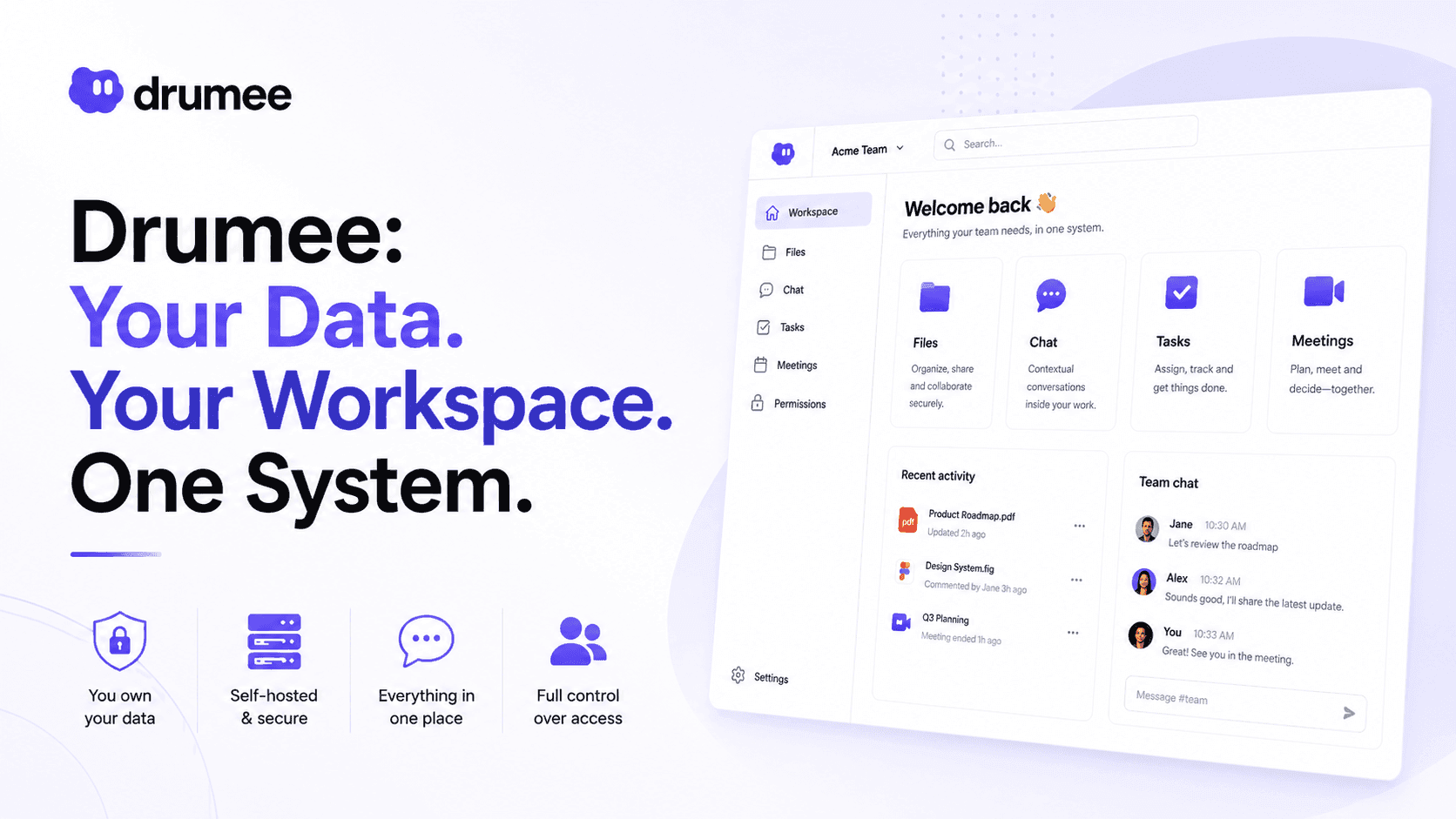
Drumee: Your Data. Your Workspace. One System
Drumee is a self-hosted, sovereign data workspace where files, chat, tasks, and permissions live in one place on infrastructure you own. Learn what Drumee is, what it stands for, and how to get started.
Data Ownership: What It Means and How to Achieve It in 2026
What is data ownership and how do you actually achieve it? Learn the three layers of data control, why AI changes the stakes, and how self-hosted infrastructure gives teams genuine ownership in 2026.
Nextcloud Alternatives in 2026: Which Self-Hosted Option Is Actually Modern?
Nextcloud is the benchmark, but it is not the only option in 2026. Here is a clear comparison of Seafile, ownCloud Infinite Scale, Syncthing, Pydio, and Drumee for teams asking which self-hosted alternative is actually modern and which fits their specific requirements.