
Team Workspace Without SaaS Dependency: Why More Teams Are Taking Back Control in 2026
What is a team workspace without SaaS dependency? Learn how sovereign self-hosted infrastructure reduces fragmentation, governance risk, and SaaS cost compounding and how teams are making the transition in 2026.
Team Workspace Without SaaS Dependency: Why More Teams Are Taking Back Control in 2026
For most teams, the SaaS dependency problem reveals itself gradually. It begins as a billing line item, one tool for files, one for chat, one for documentation, one for tasks and slowly compounds into something far more difficult to untangle. By the time most organizations recognize the extent of their dependency, they have already scattered their operational context across a dozen disconnected systems, each with its own pricing model, data residency policy, and vendor-controlled access layer.
The concept of a team workspace without SaaS dependency is not a rejection of software or collaboration. It is a recognition that the architecture underneath your team's daily work matters as much as the tools themselves. And in 2026, more builders, CTOs, and engineering teams are reaching that conclusion the hard way, after experiencing the compounding cost, fragmentation, and governance risk of renting their operational infrastructure indefinitely from providers who have no particular incentive to hand it back.
The Numbers Behind the Problem
The scale of SaaS dependency inside the average organization has grown to a point that many teams find difficult to manage consciously. According to industry research published by CloudNuro in 2026, the average enterprise now manages 291 SaaS applications, with large organizations exceeding 473. That number has grown from roughly 110 applications in 2020, representing a near-tripling of the managed software surface in less than five years.
What makes this number operationally significant is not the quantity itself. It is what happens to the data and operational context distributed across all those systems. According to Zylo's 2026 SaaS Management Index, organizations waste an average of $19.8 million annually on unused or underutilized SaaS licenses, even after a 5.3% improvement from the previous year. And notably, collaboration tools lead all categories in waste with a 58% underutilization rate, higher than analytics, HR tools, or CRM platforms. The implication here is pointed: the exact category of software designed to connect teams is also the category generating the most waste.
Beyond the waste is the fragmentation problem. Research cited across Harvard Business Review and operational productivity studies indicates that employees in large enterprises switch between applications more than 1,200 times per day, and task-switching research from the University of California, Irvine suggests a single context switch away from a primary task can cost over two hours of effective focus time. The productivity cost is not simply the moments of distraction. It is the cost of context reconstruction, the mental overhead of rebuilding operational continuity every time a person moves between a file in Google Drive, a conversation in Slack, a ticket in Linear, and a document in Notion.
This is the structural problem that a team workspace without SaaS dependency is designed to solve.
What Does SaaS Dependency Actually Cost?
Most teams underestimate the cost of SaaS dependency because the costs do not arrive in one invoice. They arrive distributed across contracts, productivity loss, migration risk, and governance gaps that only become visible under pressure.
The subscription layer alone is significant. Spendesk's 2026 SaaS statistics report found that companies spend roughly $9,600 per employee annually on SaaS software with SMEs spending even more, closer to $11,200 per employee. For a 50-person team, that is potentially over $560,000 per year allocated to software the team does not own and cannot control. And that is before accounting for duplication: industry analysis from CloudNuro estimates the average enterprise carries 4.3 duplicate tools per functional category, meaning teams are often paying for the same capability multiple times across different departments.
The deeper cost is the governance gap. When your team's files live on Google's infrastructure, your internal conversations on Slack's servers, and your documentation inside Notion's databases, no single actor has a unified view of how that operational context flows, who accesses it, and how it may be processed by AI systems your vendors deploy. IBM's 2025 insider threat report found the global average cost of an insider threat incident has reached $17.4 million - a 109% increase since 2018. The majority of those incidents do not originate from malicious actors. Fifty-five percent are caused by negligence or mistakes, often in environments where data access is poorly governed precisely because the infrastructure is controlled by a vendor, not the organization.
And then there is the migration trap. A company with ten employees can usually move tools relatively painlessly. At fifty, migration becomes a project. At two hundred, it becomes a strategic risk. The longer a team waits to address SaaS dependency, the more deeply their operational continuity becomes entangled with external architectural decisions made by vendors pursuing their own roadmap.
What Does a SaaS-Independent Workspace Look Like?
A team workspace without SaaS dependency is not a collection of disconnected open-source tools patched together with shell scripts. That was the self-hosted experience of a decade ago. In 2026, the architecture has changed substantially.
The core principle is infrastructure unification. Rather than aggregating six or seven SaaS products, each controlling a fragment of your team's operational context, a sovereign workspace places files, conversations, permissions, and workflows inside a single environment running on infrastructure the organization itself controls. This matters because operational failure rarely happens inside one tool. It happens in the gaps between tools, when a decision made in Slack never makes it into the document in Drive, or when a permission granted in one system is silently absent in another.
This is the architectural bet Drumee is built on: treating a team workspace as a unified data infrastructure rather than a bundle of disconnected applications. Files, chat, permissions, and task context coexist inside the same controlled environment. Collaboration operates against a consistent permission model. Data never leaves the organization's own server unless the organization explicitly chooses to move it.
The deployment reality in 2026 has also changed significantly. Modern Docker-based deployment means a team can stand up a self-hosted sovereign workspace in under five minutes, cloning a starter kit, running a configure script, and starting the server. What once required a dedicated operations engineer and weeks of setup is now accessible to any team with a VPS and a basic technical lead.
The AI Governance Inflection Point
One of the clearest shifts pushing teams toward SaaS-independent workspaces in 2026 is the emergence of AI governance as a real operational concern, not just a compliance checkbox. Before generative AI became embedded in collaboration tools, most organizations treated SaaS as passive storage infrastructure. Your documents sat in Drive, your messages in Slack, and while vendors had broad access to that data per their terms of service, the practical risk felt manageable.
That calculus has changed. Cisco's 2024 Data Privacy Benchmark Study found that 48% of organizations have already limited generative AI usage because of privacy and governance concerns. The reason is structural: when AI systems are integrated directly into collaboration software, your operational documents, client conversations, and internal workflows become training and inference inputs processed on vendor infrastructure. The organization nominally retains content ownership, but practically surrenders operational authority over how that content is processed, analyzed, and potentially used.
This is a qualitatively different kind of dependency than what existed five years ago. Then, the risk was primarily about pricing leverage, service continuity, and data portability. Today, it is also about whether the AI layer processing your team's institutional knowledge is operating under your governance or under someone else's.
BetterCloud's 2026 SaaS statistics report that 75% of employees are expected to acquire, modify, or create technology without IT oversight by 2027, up from 41% in 2022. Shadow IT expands the governance gap further. When team members adopt individual AI-powered SaaS tools without central oversight, operational data flows through systems the organization has no visibility into, let alone control over. A sovereign workspace addresses this at the infrastructure layer, rather than attempting to govern it tool by tool.
Who Is This Architecture For?
One of the most important misconceptions about self-hosted sovereign workspaces is the assumption that this architecture is primarily for large enterprises with dedicated infrastructure teams. In practice, the teams that benefit most immediately from SaaS independence tend to be in the 10 to 100 person range, large enough that SaaS fragmentation has become genuinely painful, but not yet so large that legacy infrastructure creates its own momentum.
Legal agencies handling confidential client workflows reach the sovereignty inflection point early, because the cost of a governance failure is asymmetric. Healthcare teams and fintech organizations face compliance pressure that makes vendor-controlled infrastructure a strategic liability. Defense contractors and government-adjacent organizations often require airgapped environments that cloud SaaS cannot legally satisfy. And increasingly, EU-based teams face procurement pressure to demonstrate GDPR data residency compliance in a way that requires genuine infrastructure control, not just a data processing agreement with an American cloud provider.
Research on self-hosted adoption trends from Plane's 2026 project management report notes a strong counter-movement driven by developer and infrastructure teams demanding self-hosted alternatives, with EU startups and regulated-industry contractors leading the adoption shift. The pattern echoes what Drumee's positioning describes as the sovereignty inflection point: the moment when infrastructure resilience becomes more operationally valuable than onboarding convenience.
The Practical Transition
Teams that decide to move toward a workspace without SaaS dependency do not need to abandon every tool overnight. The transition typically starts with the highest-risk layer where the most sensitive operational context lives and expands from there.
In practice, that usually means starting with file storage and permissions, because these are the systems where data residency, access control, and AI governance concerns are most acute. A team that moves its shared files, internal documentation, and team conversations onto self-hosted infrastructure immediately reduces its exposure to the vendor access, AI processing, and pricing compounding that SaaS dependency creates. The tools they already use for external-facing workflows, whether a project-tracking SaaS or a customer-facing CRM, can coexist alongside the sovereign workspace during the transition.
The key architectural difference is where operational context accumulates. In a SaaS-dependent stack, institutional knowledge fragments across disconnected systems that the organization cannot fully own or fully migrate. In a sovereign workspace architecture, that context builds inside infrastructure the team controls portable, governable, and not subject to pricing escalation, vendor API changes, or terms of service modifications made by a third party.
The Case for Acting Now
The window for category-first ownership of sovereign workspace infrastructure is narrowing. As AI governance pressure intensifies and SaaS costs compound, more teams are evaluating self-hosted alternatives. The organizations that move now gain two advantages: they escape the dependency before it reaches the scale where migration becomes strategic risk, and they build operational continuity on infrastructure they own before that infrastructure becomes the competitive differentiation itself.
Gartner's projections estimate that 60% of enterprise organizations will require data control for critical business systems by the end of 2025. The demand is becoming mainstream. The question is whether your team is building on infrastructure that belongs to you before the operational cost of not doing so becomes the story.
Drumee is built for this exact transition: not as another productivity layer to rent, but as sovereign data infrastructure for teams that have decided operational continuity should not depend on systems they do not control.
FAQ
1/ What is a team workspace without SaaS dependency?
A team workspace without SaaS dependency is a collaborative environment where files, conversations, permissions, and workflows run on infrastructure controlled by the organization itself, not on vendor-hosted cloud systems. Teams retain full ownership of operational data and governance authority over how it is accessed and processed.
2/ Why are teams moving away from SaaS-dependent workspaces?
The primary drivers are compounding SaaS costs, workflow fragmentation across disconnected tools, AI governance concerns about vendor-processed operational data, and the growing compliance pressure around data residency particularly in regulated industries and EU markets.
3/ Is self-hosted infrastructure only for large enterprises?
No. Modern Docker-based deployment has dramatically reduced the technical barrier. Teams with a basic technical lead can deploy a self-hosted sovereign workspace in under five minutes. The teams that benefit most immediately are typically in the 10 to 100 person range, where SaaS fragmentation has become operationally painful but migration is still manageable.
4/ How much does a self-hosted workspace cost compared to SaaS?
A typical team spending $340 per month across Notion, Slack, and Google Drive can replace that stack with a self-hosted sovereign workspace running on a VPS at approximately $6–15 per month in infrastructure cost while owning 100% of their data.
5/ What is Drumee?
Drumee is the world's first unified sovereign data infrastructure - a self-hosted workspace OS that unifies files, chat, permissions, and workflows inside infrastructure you own. GDPR-ready, open-source under AGPLv3, and deployable via Docker in under five minutes, Drumee is built for teams that no longer want operational continuity dependent on systems they do not control.
Related articles: What is Data Sovereignty?
------------------------------
About Drumee
Drumee is the world’s first unified sovereign data infrastructure: a self-hosted, OS-like workspace that turns your own filesystem into a private collaborative environment.
Fully under your control, Drumee combines files, chat, tasks, and workflows with enterprise-grade permissions built directly into the infrastructure layer. No cloud vendors. No fragmented SaaS stack. No operational dependency.
Instead of renting your workspace from external providers, Drumee allows organizations to own the environment where operational knowledge lives.
Your Data. Your Workflow. One system. Built to be yours!
Follow us at: X | LinkedIn | Drumee Founder X | Drumee Founder LinkedIn
Keep reading
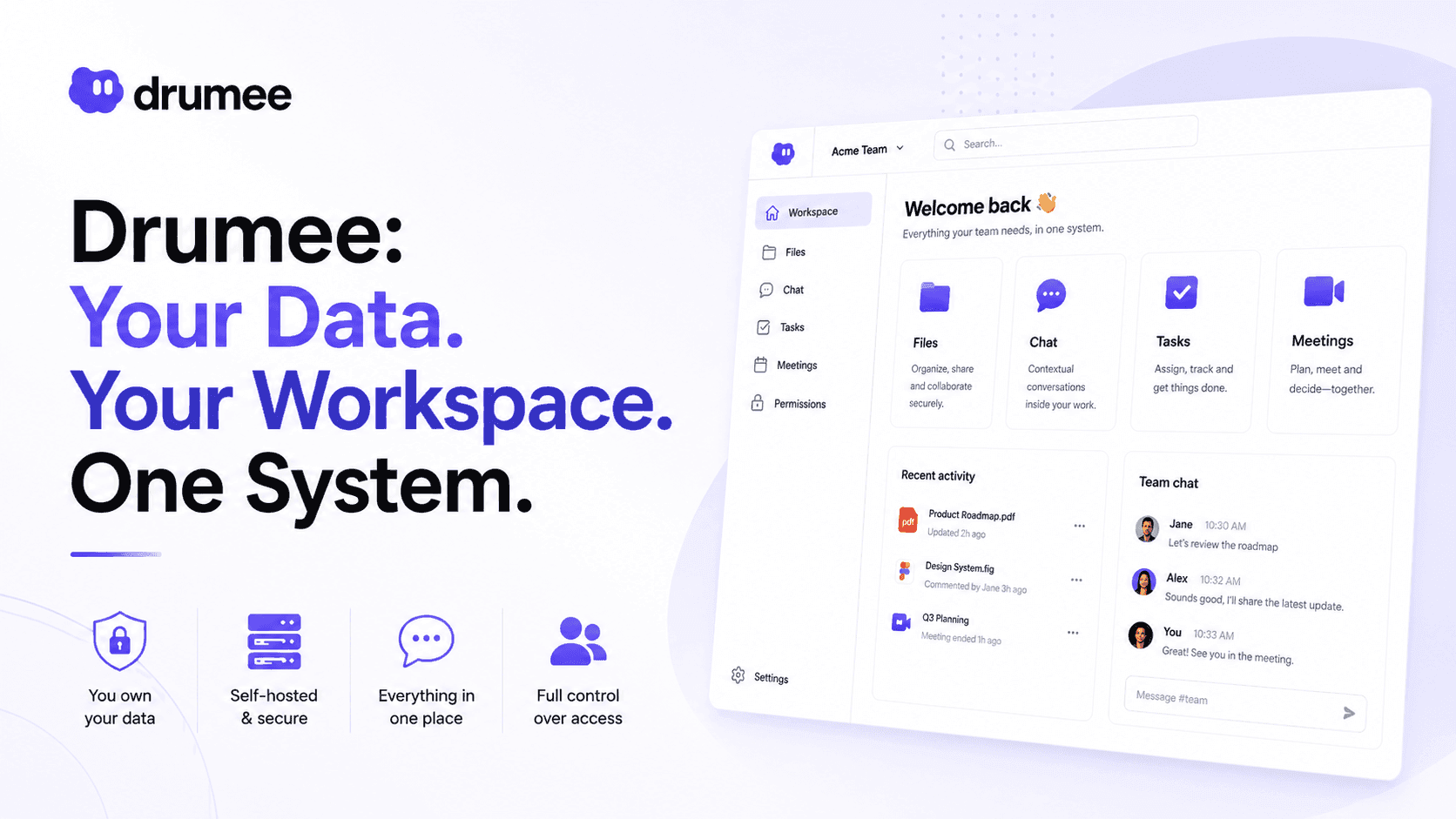
Drumee: Your Data. Your Workspace. One System
Drumee is a self-hosted, sovereign data workspace where files, chat, tasks, and permissions live in one place on infrastructure you own. Learn what Drumee is, what it stands for, and how to get started.
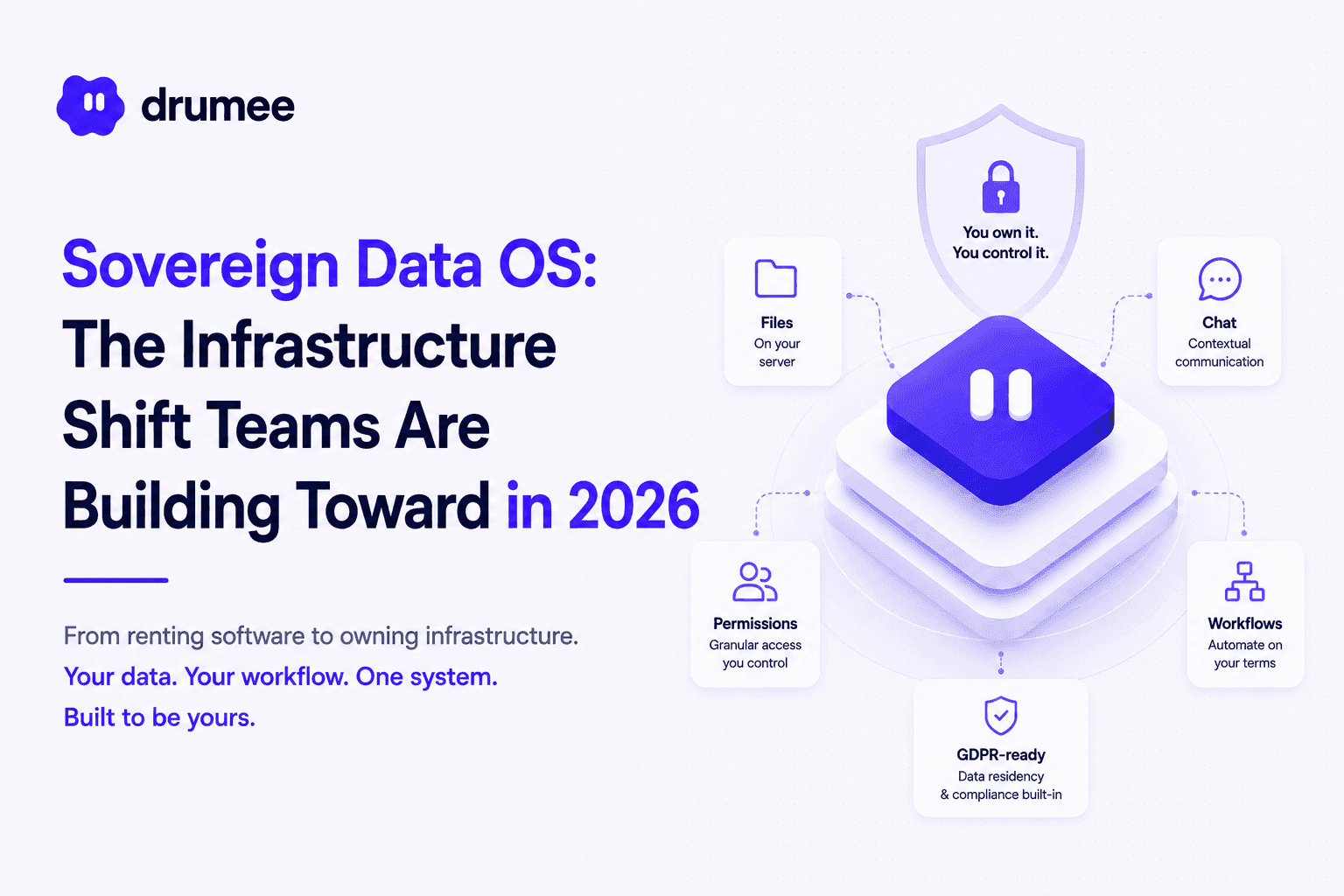
What Is a Sovereign Data OS? The Infrastructure Shift Teams Are Building Toward in 2026
What is a sovereign data OS? Learn how Drumee's unified self-hosted infrastructure replaces fragmented SaaS stacks with a single governable environment for files, chat, permissions, and workflows in 2026.
Data Ownership: What It Means and How to Achieve It in 2026
What is data ownership and how do you actually achieve it? Learn the three layers of data control, why AI changes the stakes, and how self-hosted infrastructure gives teams genuine ownership in 2026.