
The Self-Hosted Workspace for Teams: Control, Compliance, Collaboration
The self-hosted workspace for teams delivers what cloud SaaS cannot: genuine infrastructure control, unified compliance governance, and a collaboration experience your organization actually owns. A practical guide for 2026.
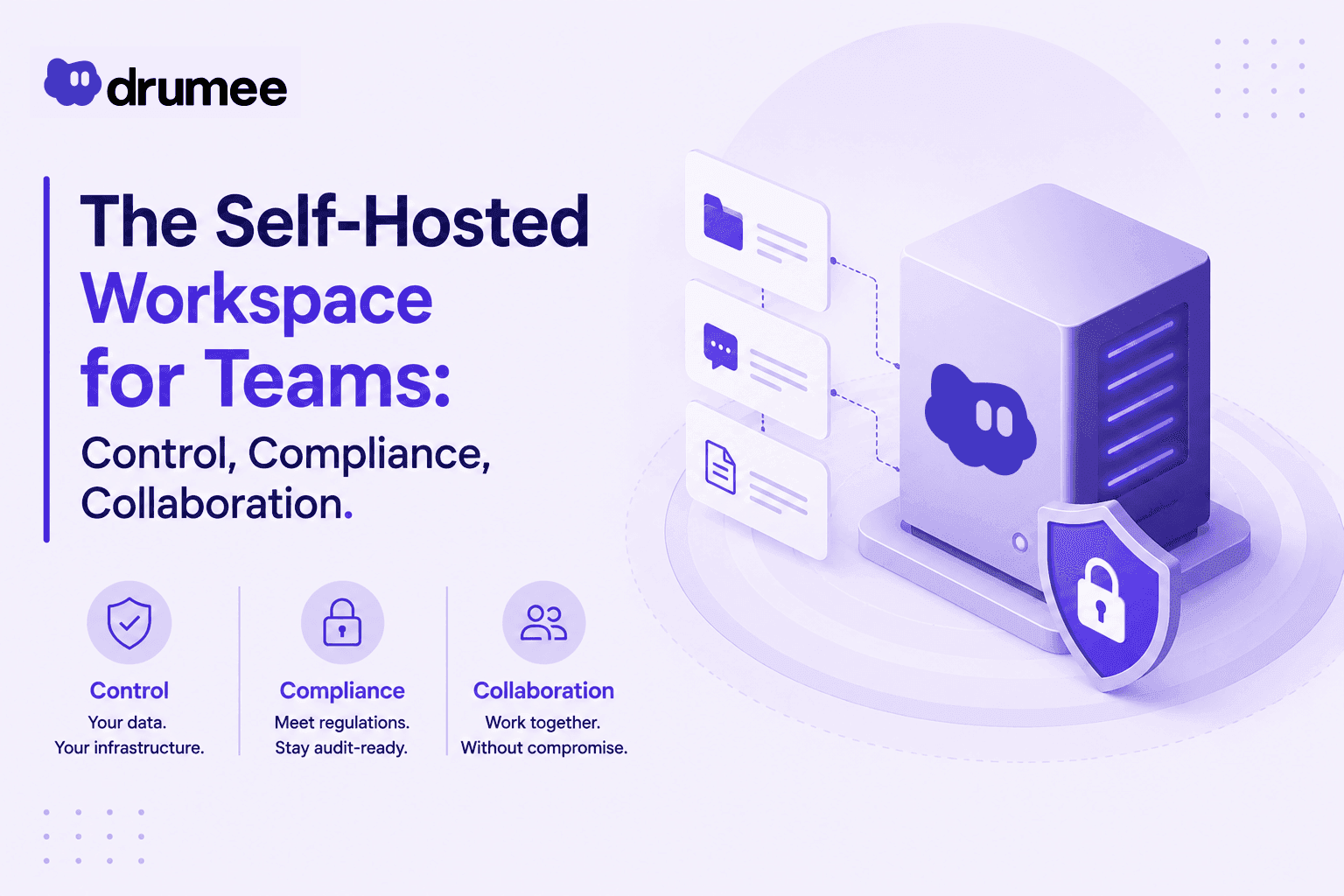
The Self-Hosted Workspace for Teams: Control, Compliance, Collaboration
A self-hosted workspace for teams is not a technical preference or a security policy decision. It is an infrastructure choice with direct consequences for three things that every growing organization cares about simultaneously: who governs the operational environment where your team's work actually happens, whether that environment meets the compliance obligations your industry or clients impose, and whether the collaboration experience inside it is good enough to sustain the daily work of a distributed, high-velocity team. In 2026, all three of these dimensions, control, compliance, and collaboration, are shifting in ways that make the case for self-hosted team infrastructure more practically compelling than it has ever been. The regulatory environment is tightening. The compliance cost of vendor-controlled infrastructure is rising. And the tooling available for self-hosted team workspaces has matured to the point where the gap in collaboration experience between self-hosted and cloud SaaS has narrowed significantly.
The Control Problem That Cloud Workspaces Cannot Solve
The fundamental issue with cloud-hosted team workspaces is not that they work poorly. It is that the control layer, the architecture governing who accesses your team's data, how it is processed, which AI systems interact with it, and what happens to it when vendor terms or pricing change, sits outside your organization's administrative authority by design. This is not a configuration gap. It is not something that can be addressed by choosing a more privacy-conscious vendor, reading the terms more carefully, or paying for a higher-tier plan with more granular settings. The control problem in cloud workspaces is structural.
When your team's files, conversations, permissions, and task context exist inside a vendor-hosted platform, the vendor controls the infrastructure layer. That means vendor decisions directly govern your organization's operational continuity. Price increases are absorbed without recourse. Terms of service changes take effect without negotiation. AI feature rollouts, including the processing of your team's operational content through AI systems you did not select and did not configure, are enabled by default or through settings that require organizational awareness to locate and disable. According to Gartner's research cited in DualMedia's 2026 analysis of encrypted cloud workspaces, by 2029 more than 50% of multinational organizations will have a formalized digital sovereignty strategy, a figure that reflects not anticipated future awareness but a response to present operational pain. Organizations are formalizing sovereignty strategies now because the cost of not having one has become measurable.
The self-hosted workspace resolves the control problem at the infrastructure layer rather than the policy layer. When your team's workspace runs on your own server, files, communication, permissions, and workflows inside a single self-hosted environment, the administrative authority belongs to your organization. The AI systems that interact with your operational data are the ones you choose and configure, not the ones a vendor has decided to bundle into a pricing tier. The permission model is the one your organization defines and enforces. The pricing trajectory is determined by your infrastructure costs, not by a roadmap decision made by a vendor whose interests diverge from yours at renewal time.
The Compliance Reality That Cloud SaaS Defers
The compliance dimension of the self-hosted workspace for teams has become the most urgent practical argument for the model in 2026, because the regulatory environment has shifted substantially while most organizations' governance postures have not. Sophos commissioned an independent survey of 5,000 IT and cybersecurity leaders across 17 countries in early 2026, and the findings are precise: 82% of leaders are concerned their organization may not be fully compliant with all necessary regulations, with 24% very concerned. Respondents report adhering to five compliance standards on average, GDPR, HIPAA, ISO 27001, SOC 2, and sector-specific frameworks layered on top. And 39% of IT and cybersecurity team time is spent on compliance-related activities. That last figure deserves emphasis: nearly four in ten hours of technical capacity in the average organization is consumed by compliance work rather than productive system building and maintenance.
The compliance burden is not going to decrease. DataStackHub's 2025–2026 cloud compliance statistics report documents the trajectory clearly: 58% of organizations report increased regulatory pressure on cloud data governance between 2024 and 2025. Data sovereignty regulations now affect more than 60% of all cloud-hosted workloads globally. Only 34% of organizations maintain unified compliance reporting across multi-cloud and hybrid systems, while 68% of compliance leaders cite managing policies across multiple cloud platforms as their biggest challenge. The organizations struggling most with compliance in 2026 are not those with weak security practices. They are organizations whose operational data is fragmented across multiple vendor-controlled systems with inconsistent audit frameworks, incompatible permission models, and separate data residency conditions that require independent governance attention.
Secureframe's 2026 compliance statistics report adds the financial dimension: data breaches with a noncompliance factor cost $174,000 more on average and $4.61 million in total in 2025. The premium for noncompliance is not abstract. It is a concrete and measurable financial exposure that compounds with the number of vendor systems through which regulated data flows without unified governance oversight.
A self-hosted workspace for teams addresses the compliance problem structurally because it collapses the fragmentation that makes cloud compliance so difficult. When files, communication, permissions, and workflows exist inside a single self-hosted environment with a consistent governance layer, compliance evidence collection is centralized, permission audits cover a single system rather than five, and data residency is determined by the organization's own hosting choices rather than negotiated separately with each vendor. The 39% of technical team time currently consumed by compliance-related activities is partly a function of the fragmentation that cloud SaaS stacks create. Organizations that have moved their operational infrastructure onto unified self-hosted environments consistently report that compliance becomes a system property rather than a perpetual audit project.
The Collaboration Dimension That Self-Hosted Has Finally Earned
The traditional objection to self-hosted team workspaces is the collaboration experience. For most of the period during which self-hosted infrastructure was technically viable, it asked teams to accept a material degradation in collaboration quality as the cost of control. The editor experience was inferior. Real-time collaboration was unreliable. Mobile access was limited. The onboarding friction for non-technical team members was significant. These were legitimate objections, and they were the reason that most organizations with genuine awareness of the governance risks of cloud SaaS continued to accept those risks rather than impose the collaboration penalty on their teams.
In 2026, those objections are substantially weaker than they were three years ago. The self-hosted collaboration landscape has matured considerably. Modern Docker-based deployment has removed most of the operational overhead that once required a dedicated infrastructure engineer to manage. Real-time collaborative editing, mobile access, and intuitive interfaces are now features of self-hosted platforms rather than features that distinguish cloud SaaS from self-hosted alternatives.
"We built Drumee because we kept seeing the same pattern: teams that were serious about their data governance ended up choosing between a workspace that worked well and infrastructure they actually controlled. We didn't think that was an honest tradeoff anymore. In 2026, you can have both. The question is whether you're building your team's institutional knowledge on infrastructure you own, or infrastructure you rent from someone who can reprice it, restructure it, or change its AI policies without asking you." - Somanos Sar, Founder, Drumee
What the collaboration dimension of a self-hosted workspace for teams requires in 2026 is not just feature parity with cloud SaaS on individual dimensions. It requires a unified operational environment where the collaboration experience is coherent across files, communication, and task context, where a conversation about a document happens in the same governed environment as the document itself, where the permission model covering a shared file is the same permission model that governs access to the communication thread referencing it, and where the task that emerges from a collaborative decision carries its operational context into execution without crossing an API boundary between vendor-controlled systems.
This is the architectural test that distinguishes a genuine self-hosted workspace for teams from a collection of self-hosted tools assembled to replace individual SaaS products. Replacing Google Drive with Nextcloud, Slack with Mattermost, and Notion with Outline produces a self-hosted stack that addresses the governance concern at each individual layer while preserving the fragmentation problem across layers. The permission model in Nextcloud does not know about the permission model in Mattermost. The conversation context in the self-hosted messaging layer has no native relationship to the files in the self-hosted storage layer. The task workflow in the self-hosted project management tool is disconnected from both. Integration is still required, and integration is still a governance gap, one that the organization now owns rather than the vendor, but a gap nonetheless.
What Unified Self-Hosted Infrastructure Actually Looks Like
The architectural resolution that makes a self-hosted workspace for teams genuinely competitive with cloud SaaS on the collaboration dimension while delivering the control and compliance properties that cloud SaaS cannot provide, is the unified environment model. Rather than a collection of self-hosted tools coordinated through integrations, a unified self-hosted workspace places all operational layers inside a single environment that the organization administers through a consistent governance and permission system.
This is the architectural position that Drumee is built to occupy. As a sovereign data OS, Drumee unifies files, chat, tasks, and permissions inside a single self-hosted environment. When a team member shares a file in a conversation, the file's permission context is governed by the same system that governs the conversation's access controls. When a task is created from a document, it carries its operational context into the same governed environment. There are no API boundaries between the collaboration layer and the file layer. There is no integration maintenance overhead connecting separate self-hosted tools with incompatible permission models. The governance boundary that compliance requirements demand covers the entire operational environment because the entire operational environment is a single system.
The deployment reality for this architecture in 2026 is accessible to any team with basic technical capability. Docker-based deployment means the entire stack stands up in a single operation. The AGPLv3 open source license means the codebase is auditable and the governance model is transparent. The operational cost is determined by infrastructure choices rather than per-seat subscription pricing that escalates with headcount. For organizations in regulated industries, legal, healthcare, finance, government-adjacent, the governance properties of this architecture are not merely preferable. They are increasingly necessary, as regulators expect organizations to demonstrate clear, direct authority over the infrastructure where operational data is processed and stored, rather than a chain of vendor agreements that approximate that authority at arm's length.
Who Is Making This Move in 2026?
The organizations that implement self-hosted workspaces for teams earliest in 2026 share a recognizable profile. They are typically between ten and one hundred employees, large enough that SaaS fragmentation has become operationally painful, small enough that the migration has not yet reached the scale where institutional inertia makes it feel untenable. They operate under compliance pressure that has moved beyond aspirational to contractually required, a client audit, a GDPR enforcement inquiry, a sector-specific regulation that requires demonstrable infrastructure control rather than contractual coverage alone. And they have at least one technically capable person on the team who understands that the friction of deploying self-hosted infrastructure is a one-time setup cost, while the friction of vendor-controlled infrastructure, the pricing escalation, the governance exposure, the AI processing of sensitive operational content, compounds indefinitely.
The second wave of adoption in 2026 is coming from professional services firms, legal agencies, healthcare-adjacent technology companies, and EU-based organizations that have found their cloud SaaS governance posture incompatible with the compliance environment they operate in. DataStackHub's cloud compliance analysis notes that approximately 49% of enterprises now store regulated data exclusively in regional data centers to meet jurisdictional laws, a condition that requires infrastructure control rather than vendor agreement to reliably achieve.
For all of these organizations, the self-hosted workspace for teams is not a preference. It is the architectural answer to a governance question that cloud SaaS raises but cannot resolve. Control, compliance, and collaboration, in 2026, these are not a tradeoff. They are what a well-architected, unified self-hosted workspace delivers simultaneously, without asking the organization to choose between the infrastructure it owns and the collaboration experience its team deserves.
FAQ
1/ What is a self-hosted workspace for teams?
A self-hosted workspace for teams is a collaborative environment, covering files, communication, tasks, and permissions, deployed on infrastructure the organization controls rather than vendor-hosted cloud servers. The organization administers the governance layer, defines the permission model, and retains full authority over where operational data is stored and how it is processed.
2/ Why are teams switching to self-hosted workspaces in 2026?
The primary drivers are compliance pressure, governance concerns around AI processing of operational data, vendor pricing escalation, and the recognition that cloud SaaS fragmentation creates compliance gaps that compound with organizational size. According to Sophos' 2026 survey of 5,000 IT leaders, 82% are concerned their organization may not be fully compliant with all required regulations, a condition that fragmented cloud SaaS stacks make structurally harder to resolve.
3/ Is self-hosted collaboration mature enough for teams in 2026?
Yes. Modern Docker-based deployment, open-source platforms with enterprise-grade feature sets, and accessible VPS infrastructure have eliminated most of the operational overhead that previously made self-hosting impractical for teams without dedicated infrastructure engineers. The collaboration experience gap between self-hosted and cloud SaaS has narrowed significantly since 2022.
4/ What is the compliance advantage of a self-hosted team workspace?
Self-hosted workspaces centralize governance across files, communication, and permissions in a single environment. This simplifies compliance evidence collection, makes permission audits tractable, and allows data residency to be set by the organization's own hosting choices. Organizations with fragmented cloud SaaS stacks spend 39% of IT team time on compliance-related activities, much of that overhead is a direct consequence of multi-vendor governance fragmentation.
5/ How does Drumee differ from other self-hosted collaboration tools?
Drumee is a sovereign data OS that unifies files, chat, tasks, and permissions in a single self-hosted environment rather than assembling separate tools connected through integrations. This unified architecture provides a coherent governance boundary across all operational layers, eliminating the permission model fragmentation and integration maintenance overhead that multi-tool self-hosted stacks inherit. Licensed under AGPLv3, deployable via Docker, and GDPR-ready by architectural design rather than vendor agreement.
Related article: Does Your Cloud Storage Mine Your Data? What Do the ToS Actually Say?
------------------------------
About Drumee
Drumee is the world’s first unified sovereign data infrastructure: a self-hosted, OS-like workspace that turns your own filesystem into a private collaborative environment.
Fully under your control, Drumee combines files, chat, tasks, and workflows with enterprise-grade permissions built directly into the infrastructure layer. No cloud vendors. No fragmented SaaS stack. No operational dependency.
Instead of renting your workspace from external providers, Drumee allows organizations to own the environment where operational knowledge lives.
Your Data. Your Workflow. One system. Built to be yours!
Follow us at: Website | X | LinkedIn | Drumee Founder X | Drumee Founder LinkedIn
Keep reading
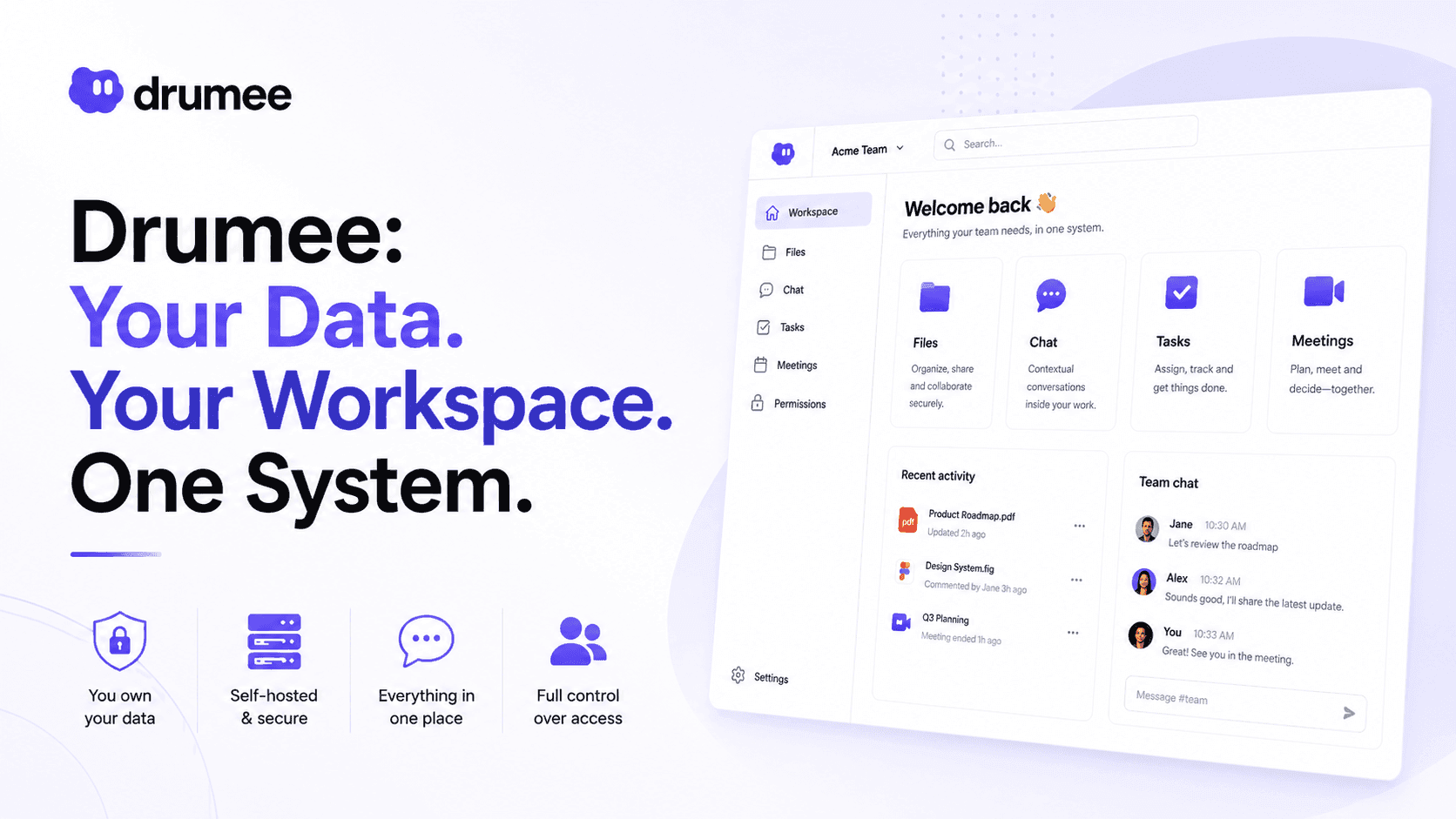
Drumee: Your Data. Your Workspace. One System
Drumee is a self-hosted, sovereign data workspace where files, chat, tasks, and permissions live in one place on infrastructure you own. Learn what Drumee is, what it stands for, and how to get started.
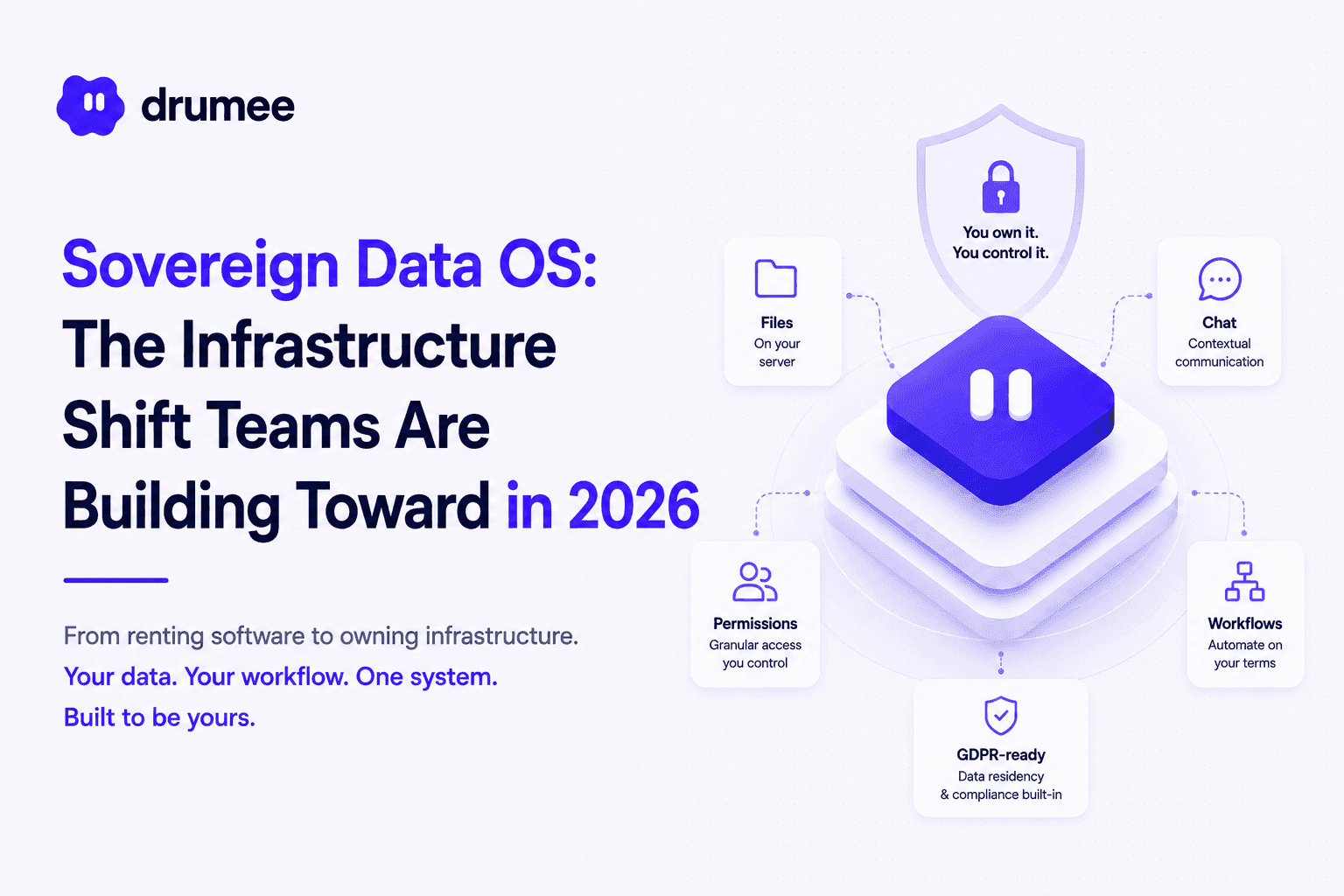
What Is a Sovereign Data OS? The Infrastructure Shift Teams Are Building Toward in 2026
What is a sovereign data OS? Learn how Drumee's unified self-hosted infrastructure replaces fragmented SaaS stacks with a single governable environment for files, chat, permissions, and workflows in 2026.
Data Ownership: What It Means and How to Achieve It in 2026
What is data ownership and how do you actually achieve it? Learn the three layers of data control, why AI changes the stakes, and how self-hosted infrastructure gives teams genuine ownership in 2026.