
Does Your Cloud Storage Mine Your Data? What Do the ToS Actually Say?
Cloud storage terms of service grant platforms broad licenses to scan, process, and AI-analyze your files. This guide breaks down what Google Drive, Dropbox, and OneDrive's terms actually permit, and what genuine data control looks like in 2026.
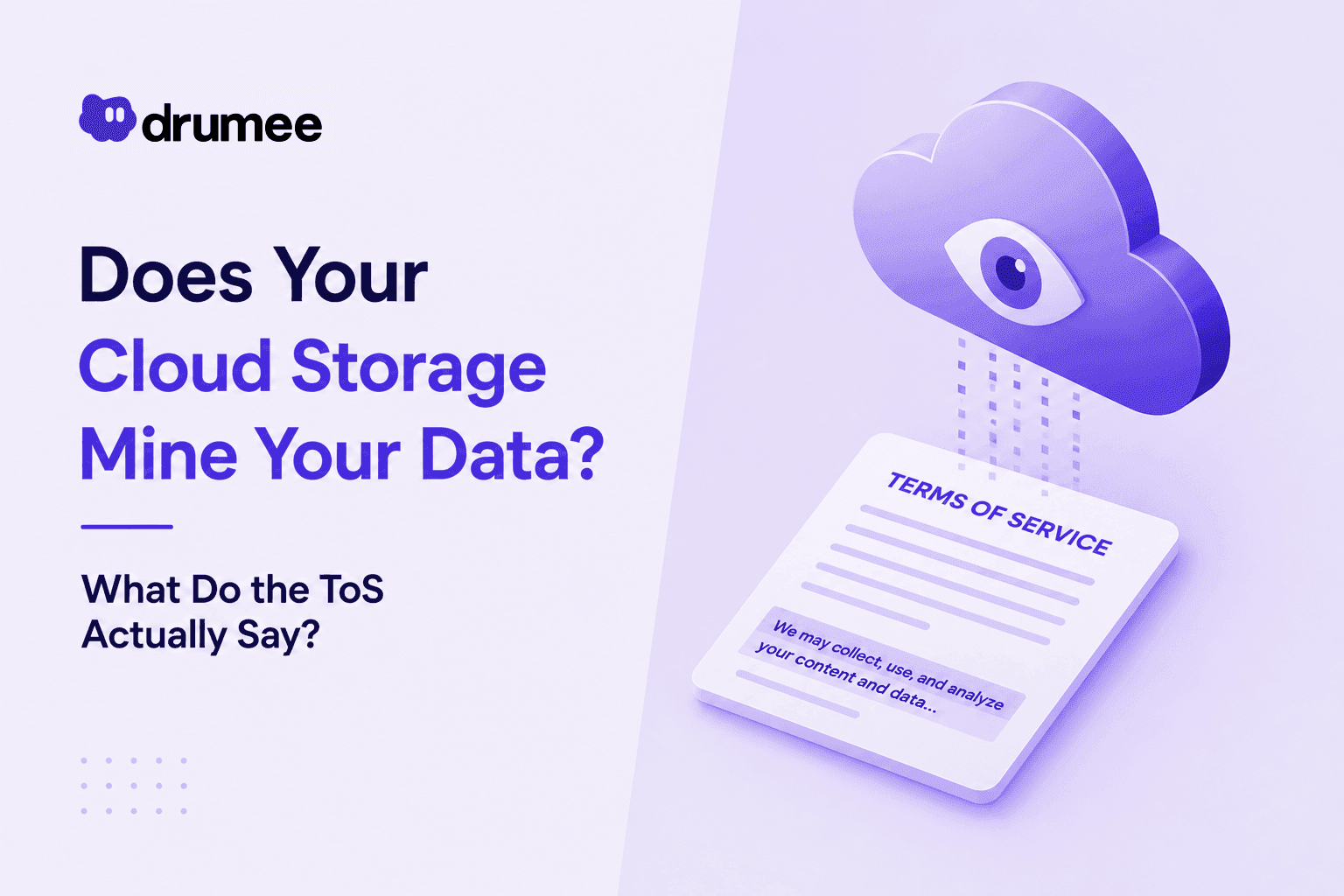
Does Your Cloud Storage Mine Your Data? What Do the ToS Actually Say?
Most people click through cloud storage terms of service the same way they skip a software update notification, fast, habitual, and without reading a word. For personal use, the consequences of that inattention are limited. For organizations that store client contracts, internal strategy documents, confidential communications, and proprietary workflows in tools like Google Drive, Dropbox, or OneDrive, the question of what the terms of service actually permit those platforms to do with uploaded content is not a privacy abstraction. It is a governance exposure that compounds quietly with every file added, every integration enabled, and every AI feature that gets bundled into a platform subscription without announcement. In 2026, as cloud storage data mining has evolved from a theoretical concern into a documented operational reality, with generative AI now embedded in virtually every major cloud storage platform, reading the terms is no longer optional for organizations that take their data governance seriously.
What Do the Major Platforms' Terms Actually Permit?
Starting from the primary sources: every major cloud storage platform, Google Drive, Dropbox, OneDrive, grants users legal ownership of their uploaded content. That is the reassuring headline that most assessments stop at. But the terms of service establish a second condition alongside content ownership, and it is operationally more significant: a broad license granted to the platform to access, process, and use that content for a range of purposes that varies meaningfully by provider and by the specific features an organization has enabled.
Google's license to user content is among the broadest in the industry. Google Drive's terms grant a worldwide license to use, host, store, reproduce, modify, create derivative works from, communicate, and distribute content, a scope that is necessary for the service to function, but that also encompasses automated scanning, indexing, classification, and AI processing of uploaded files. Cloudwards' independent 2026 analysis of Dropbox, Google Drive, and OneDrive is direct on Google's privacy posture: the main disadvantage of Google Drive and Google overall is its poor privacy policy and lack of client-side encryption. Google openly scans user files, making it a poor option for organizations that prioritize privacy. OneDrive's limitation is similar: the platform lacks client-side encryption, meaning Microsoft has the ability to scan personal and professional files stored in it. Dropbox presents a subtler version of the same condition: while its terms of service and privacy policy do not explicitly describe how the platform determines what is stored, the acceptable use policy, which prohibits illegal content, implies scanning algorithms are in place to evaluate file contents without specifying the scope or method of that evaluation.
None of these conditions represents legal wrongdoing by the platforms. They are disclosed in terms of service that users accepted at signup. The question is not whether the disclosure is present. The question is whether the organizations storing sensitive client data, regulated health information, confidential business strategy, and proprietary intellectual property in these platforms have factored those permissions into their data governance posture, and the weight of evidence suggests most have not.
The AI Layer That Changed the Risk Calculation
The cloud storage data mining concern has existed in some form since the earliest days of cloud adoption. What has fundamentally changed in 2025 and 2026 is the AI processing layer now embedded in every major cloud storage platform. Before generative AI became a core feature of Google Drive, Dropbox, and OneDrive, the practical concern about platform scanning was largely confined to content moderation, automated systems checking for illegal material, spam, or policy violations. Consequential in specific contexts, but a defined and bounded scope of processing.
The arrival of AI summarization, AI search, AI drafting, and AI-powered workflow tools inside cloud storage platforms has expanded the processing scope substantially and in ways that most organizations have not consciously evaluated. When Google's Gemini AI indexes and summarizes your Drive files to answer natural language queries, or when Microsoft Copilot for OneDrive surfaces relevant documents in response to Teams conversations, or when Dropbox AI generates intelligent summaries of uploaded files, the AI system is reading, parsing, classifying, and producing outputs from your organization's operational content, including confidential documents, privileged communications, and proprietary data, on vendor infrastructure under vendor governance terms.
SentinelOne's 2026 cloud security statistics report documents a direct consequence of this shift: data policy violations associated with generative AI application usage doubled in 2025 and are continuing to grow in 2026. Employees use unmanaged personal accounts and shadow AI services, leaking source code, regulated data, and intellectual property. The AI integration into cloud storage platforms is not creating this risk in isolation, it is expanding the surface area through which data that organizations thought was contained within a managed system is processed through AI layers that the organization neither selects nor governs.
According to the IBM Cost of a Data Breach Report 2025, the average cost of a cloud-related data breach reached $4.88 million in 2024, up from $4.45 million in 2023. The financial exposure from inadequate cloud data governance is not a future risk. It is a present and accelerating cost that organizations are absorbing at an average of nearly five million dollars per incident.
The Consent Architecture Most Organizations Have Not Audited
The consent architecture embedded in cloud storage platforms deserves more scrutiny than it typically receives, because it operates through default settings and bundled feature rollouts rather than explicit organizational approval. When a platform adds an AI feature that accesses your stored files and enables it by default, the consent model is opt-out rather than opt-in, meaning the processing begins before the organization is aware of it, and requires active discovery to disable. This is not a hypothetical pattern. It is the documented operational history of how AI features have been introduced across every major cloud storage platform in 2024 and 2025.
The consent problem compounds in regulated industries. According to Usercentrics' 2026 data privacy trends report, over 80% of the global population is now covered by some form of data privacy law. The EU AI Act became fully enforceable in 2026. Eight new US state-level data privacy laws came into effect in 2025 alone. In this regulatory environment, the argument that terms of service consent at account signup constitutes adequate governance authority for AI processing of sensitive organizational content is not one that regulators in Europe, and increasingly in the US, are accepting without scrutiny. The organizations that will be most exposed in the next wave of enforcement actions are those whose cloud storage governance posture has not been updated to reflect the AI processing reality of 2026.
The 2024 Gartner AI TRiSM market survey, cited in Orca Security's cloud data security analysis, found that 40% of enterprise cloud environments contained at least one AI service not tracked in the official asset inventory. For those organizations, the AI processing of cloud-stored content is occurring through systems the organization has not evaluated, under terms it has not specifically reviewed, with outputs retained under policies it has not actively accepted. That is not a governance posture. It is a governance gap with a specific and measurable financial exposure attached to it.
"Most organizations believe their data is safe because they read the word 'encrypted' somewhere in the platform's marketing. Encryption in transit and at rest is table stakes, it protects your data from outside attackers. It does not protect your data from the platform itself. The platform still controls the infrastructure. The platform's AI still processes your content. The platform's terms still govern what happens to everything you've stored there. That's not privacy. That's a different kind of exposure." - Somanos Sar, Founder, Drumee
What Does "Mining" Actually Mean in the Terms of Service Context?
The term cloud storage data mining is colloquially understood to mean something sinister - a platform secretly extracting insights from your files to sell to advertisers or train AI models for commercial gain. The reality is both more mundane and more operationally significant. Cloud storage platforms do not primarily "mine" data in the conspiratorial sense. They process it, continuously, automatically, and at scale, for purposes that include service delivery, content moderation, abuse prevention, feature development, and increasingly AI model training and AI-powered feature operation.
The distinction matters because the operational consequences of that processing are real regardless of the intent behind it. When your confidential client proposal is processed by an AI summarization system to generate an automatically indexed snippet, the content has been read, parsed, and stored in a derived form on the platform's infrastructure even if the original file is technically encrypted at rest. When your internal salary spreadsheet is indexed by a natural language search system to enable conversational queries about your files, the system has built a semantic representation of that content that exists independently of the file itself. When your legal strategy document is analyzed by an AI drafting tool to suggest related content, the system has classified and processed information that your organization treats as privileged.
None of these scenarios requires malicious intent from the platform to represent a governance exposure. They require only the platform to do exactly what its terms of service permit, process your content to provide and improve its services, which is precisely what every major cloud storage platform does, and has always done, accelerated significantly by the AI capabilities now embedded in all of them.
The Specific Conditions That Indicate Elevated Risk
For organizations evaluating whether their cloud storage governance posture is adequate in 2026, the risk factors are identifiable and specific. Organizations facing elevated exposure from cloud storage data mining risk are those operating in regulated industries, healthcare, legal, financial services, government-adjacent, where content processed by vendor AI systems may fall under HIPAA, attorney-client privilege, fiduciary duty, or specific sector regulations that restrict how sensitive information can be shared with third parties, including cloud platform AI systems.
They are organizations whose cloud storage contains client data, personal information, behavioral data, financial records, that clients did not consent to having processed by the cloud platform's AI systems when they shared it with the organization. They are organizations subject to GDPR in Europe, where the AI Act and the EU Data Protection Board's positions on automated processing make vendor-side AI analysis of organizational content an active compliance concern rather than a theoretical one. And they are organizations that have integrated AI tools directly with their cloud storage, enabling Copilot, Gemini, or Dropbox AI without conducting an explicit governance review of what those tools access and how their outputs are retained.
DataStackHub's 2025–2026 cloud compliance statistics document the aggregate exposure: data sovereignty regulations now affect more than 60% of all cloud-hosted workloads globally, and only 34% of organizations maintain unified compliance reporting across their multi-cloud and hybrid systems. The majority of organizations are operating cloud storage environments that are within the scope of data sovereignty regulations without maintaining the governance visibility to demonstrate compliance.
What Genuine Data Control Looks Like in 2026
The resolution to the cloud storage data mining problem is not a privacy-focused SaaS alternative. Proton Drive, Tresorit, and similar privacy-first cloud storage services address specific dimensions of the problem, primarily the encryption layer and the jurisdictional question of where data is stored without changing the fundamental condition that the platform's infrastructure governs your data's processing environment. Organizations that switch from Google Drive to Proton Drive gain a stronger encryption model and a Swiss jurisdiction. They retain a vendor-controlled infrastructure where the processing governance is still defined by the platform's terms rather than the organization's own authority.
The architectural resolution is self-hosted infrastructure, a storage and collaboration environment that runs on servers the organization administers, under permissions the organization defines, with AI processing limited to systems the organization has explicitly integrated and configured. In this environment, the cloud storage data mining question does not apply, because there is no cloud platform with a terms of service governing your content's processing. The files your team creates and stores exist in your own infrastructure boundary. The AI systems that interact with those files are the ones your organization has specifically selected and deployed, under governance terms your organization controls.
This is the foundational architectural principle behind Drumee as a sovereign data OS. When files, conversations, permissions, and workflow context are unified inside a self-hosted environment the organization administers, the entire ToS problem, the broad license grants, the AI processing defaults, the content scanning algorithms, the vendor-controlled governance boundary, dissolves at the infrastructure level. Not because the terms have been negotiated more favorably. Because the infrastructure belongs to the organization, and the terms of service that govern it are the organization's own operational policies, not a vendor's.
In 2026, that architectural distinction is the most direct answer to the question of whether your cloud storage mines your data. If your data lives on someone else's infrastructure, the answer is: according to their terms, yes, in ways that vary by platform, by feature, by AI integration, and by the moment when each new capability is enabled. If your data lives on infrastructure you control, the answer is: only to the extent that the systems you have chosen and deployed interact with it, under governance you define and audit yourself.
FAQ
1/ Does Google Drive scan your files?
Yes. Cloudwards' 2026 analysis confirms that Google openly scans user files, citing poor privacy policy and lack of client-side encryption as Google Drive's primary disadvantages. Google's terms grant a broad license to host, store, reproduce, modify, and process content, including through AI systems like Gemini, to provide and improve its services.
2/ Does Dropbox mine your data?
Dropbox's acceptable use policy prohibits illegal content storage, which implies scanning algorithms are active. Its terms do not specify the exact scope of those algorithms. Cloudwards' 2026 comparison notes that neither Dropbox's ToS nor its privacy policy explicitly states how it determines what is stored, while suggesting scanning systems are in place.
3/ Is cloud storage AI processing covered by GDPR consent at signup?
This is an active regulatory question. The EU AI Act became fully enforceable in 2026, and EU Data Protection Board guidance has increasingly scrutinized whether terms-of-service consent at signup constitutes adequate lawful basis for AI processing of sensitive organizational content. Organizations in regulated industries should not assume standard signup consent covers AI processing of confidential or regulated data.
4/ What is the difference between encryption and data sovereignty in cloud storage?
Encryption in transit and at rest protects your data from external attackers and from unauthorized access during transmission. It does not prevent the cloud platform from processing your content through its own AI systems, which operate on the decrypted content as a necessary part of feature delivery. Data sovereignty, specifically, self-hosted infrastructure your organization controls, is the condition in which the processing layer itself belongs to your organization rather than the vendor.
5/ How does Drumee prevent cloud storage data mining?
Drumee is a self-hosted sovereign data OS deployed on infrastructure the organization controls. There is no cloud platform with a license to process your content, the files, communications, tasks, and permissions in Drumee exist within your own infrastructure boundary. AI processing only occurs through systems the organization has specifically integrated and configured. Licensed under AGPLv3, GDPR-ready by architecture, deployable via Docker.
Related article: Self-Hosted vs Cloud Notion: Which One Actually Owns Your Workspace?
------------------------------
About Drumee
Drumee is the world’s first unified sovereign data infrastructure: a self-hosted, OS-like workspace that turns your own filesystem into a private collaborative environment.
Fully under your control, Drumee combines files, chat, tasks, and workflows with enterprise-grade permissions built directly into the infrastructure layer. No cloud vendors. No fragmented SaaS stack. No operational dependency.
Instead of renting your workspace from external providers, Drumee allows organizations to own the environment where operational knowledge lives.
Your Data. Your Workflow. One system. Built to be yours!
Follow us at: Website | X | LinkedIn | Drumee Founder X | Drumee Founder LinkedIn
Keep reading
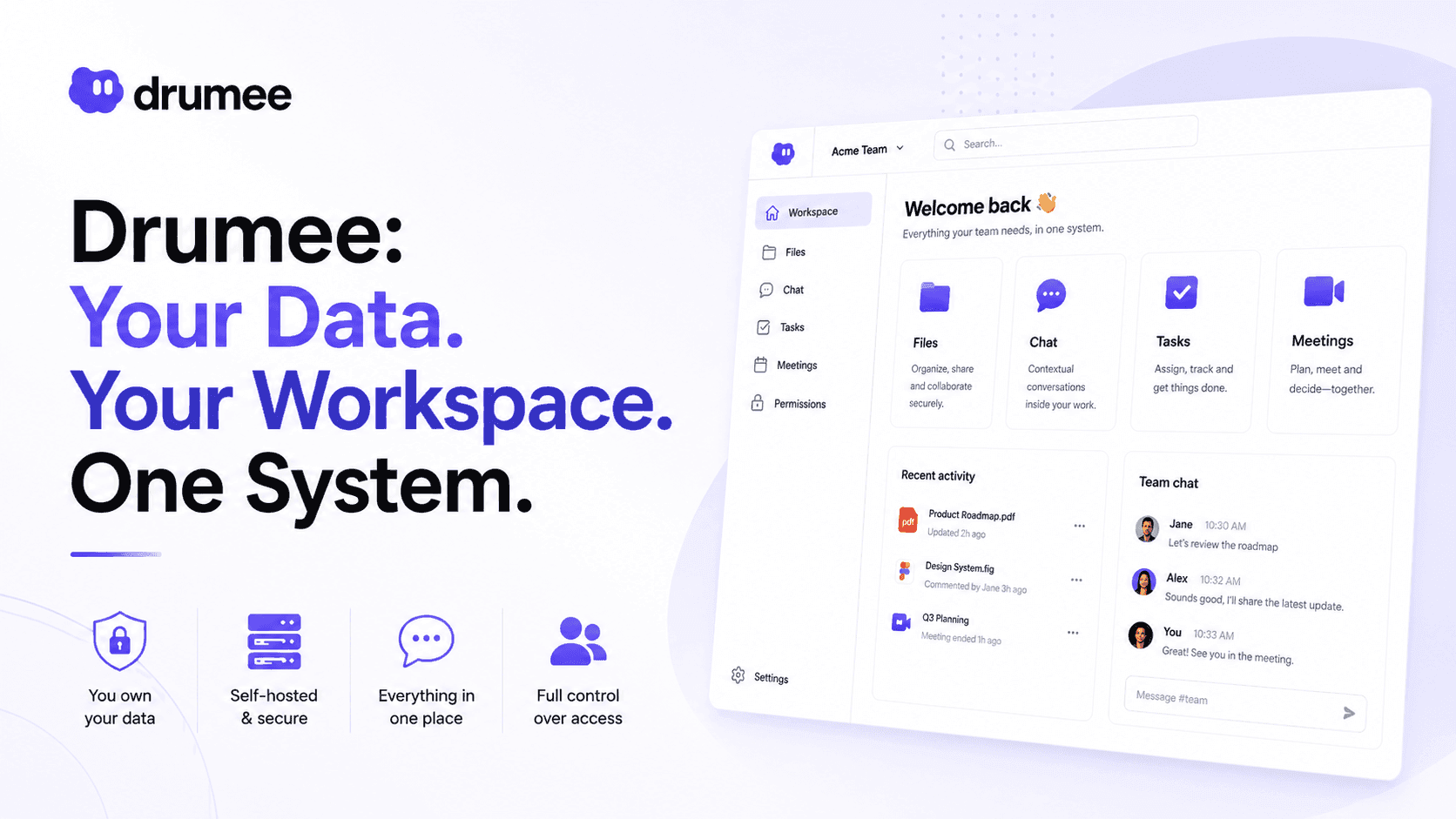
Drumee: Your Data. Your Workspace. One System
Drumee is a self-hosted, sovereign data workspace where files, chat, tasks, and permissions live in one place on infrastructure you own. Learn what Drumee is, what it stands for, and how to get started.
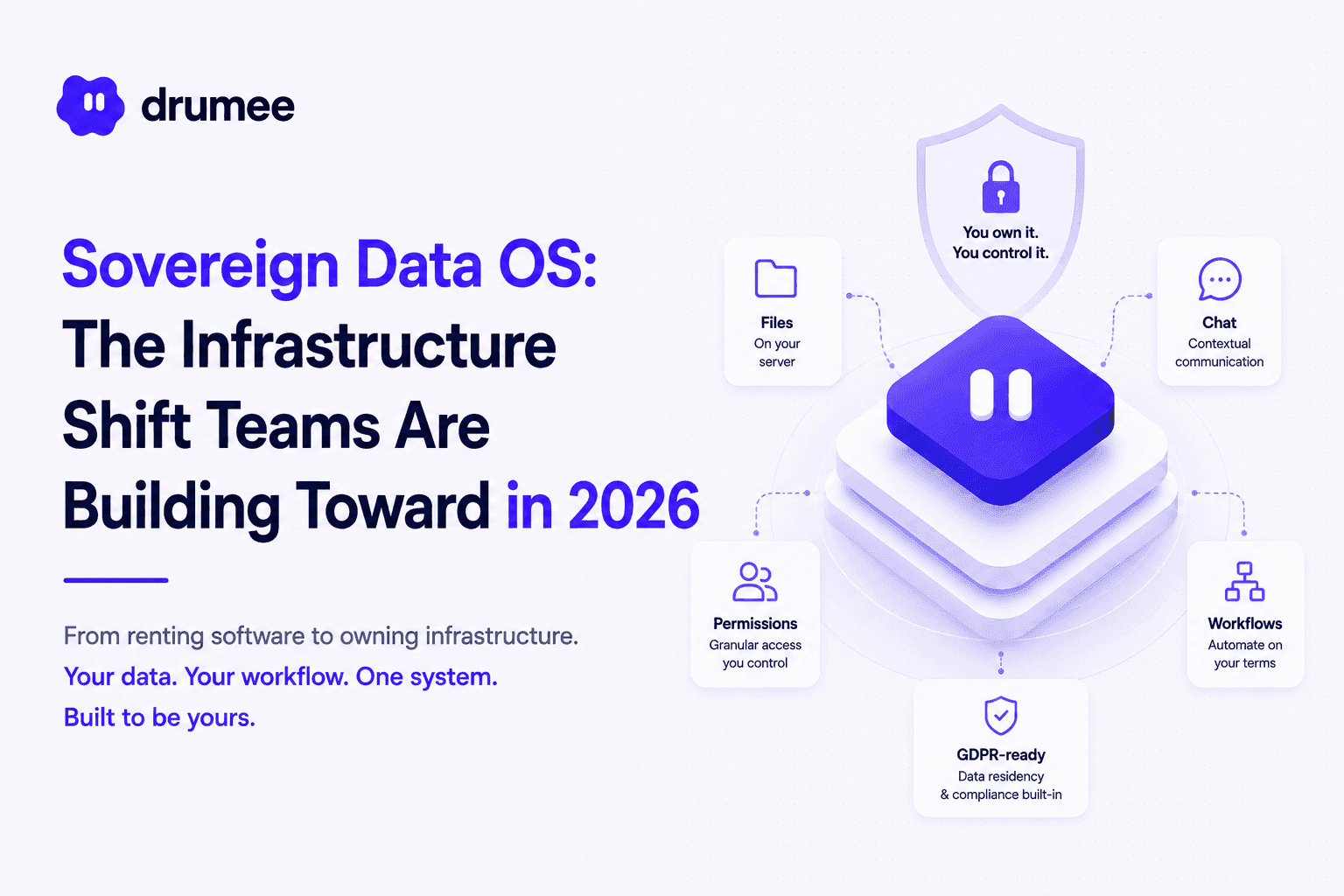
What Is a Sovereign Data OS? The Infrastructure Shift Teams Are Building Toward in 2026
What is a sovereign data OS? Learn how Drumee's unified self-hosted infrastructure replaces fragmented SaaS stacks with a single governable environment for files, chat, permissions, and workflows in 2026.
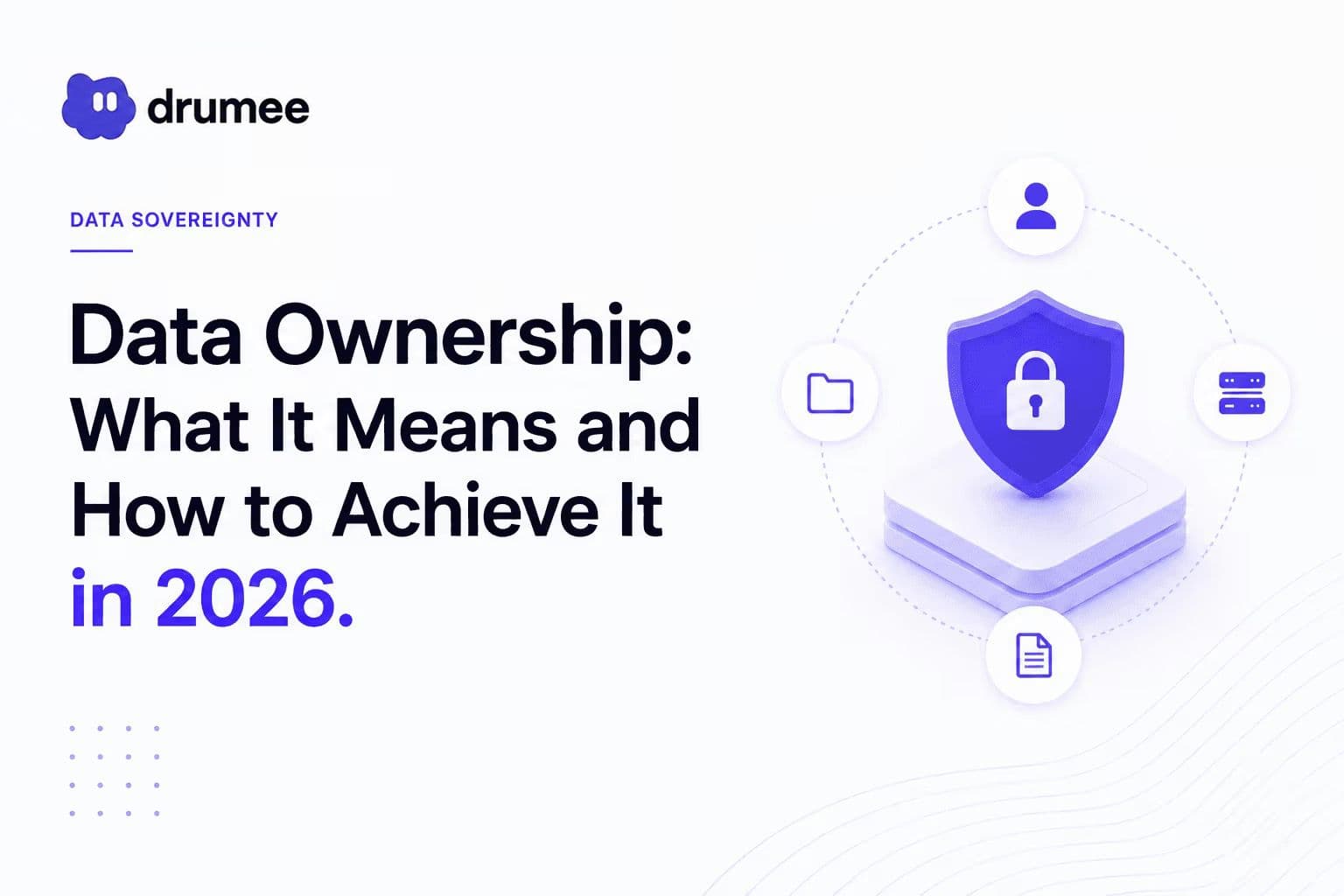
Data Ownership: What It Means and How to Achieve It in 2026
What is data ownership and how do you actually achieve it? Learn the three layers of data control, why AI changes the stakes, and how self-hosted infrastructure gives teams genuine ownership in 2026.