
The GitHub Source Code Breach: What the TeamPCP Attack Tells Us About Infrastructure You Don't Control
The reported GitHub source code breach affecting 4,000 private repos raises a bigger question: how much operational risk now sits inside centralized developer infrastructure? This analysis explores the CI/CD supply chain implications and the rise of data sovereignty in 2026.
The GitHub Source Code Breach: What the TeamPCP Attack Tells Us About Infrastructure You Don't Control
On May 20, 2026, a threat actor operating under the alias TeamPCP claimed to have breached GitHub's internal systems, allegedly exfiltrating data from approximately 4,000 private repositories tied directly to GitHub's main platform. The group posted claims on underground cybercrime forums, published a file list and screenshots of repository archive names as proof of access, and offered the alleged dataset for sale at a starting price exceeding $50,000. GitHub confirmed it was investigating unauthorized access to its internal repositories, stating it had no current evidence of impact to customer data stored outside GitHub's internal systems, while simultaneously committing to notify customers through established incident response channels if impact was discovered.
The incident is still under investigation as of this writing. Whether the breach claim is fully verified or partially exaggerated, the event is already analytically significant. TeamPCP is not an unknown actor. It is formally tracked by the Google Threat Intelligence Group as UNC6780 and has a documented 2026 campaign history that includes the successful compromise of the Trivy vulnerability scanner through CVE-2026-33634, which led to breaches at over 1,000 organizations including Cisco, coordinated attacks on Checkmarx and LiteLLM targeting credential harvesting within CI/CD pipelines; and the leak of its own Shai-Hulud malware source code directly onto GitHub using compromised accounts. TeamPCP's operational pattern is consistent: it steals CI/CD credentials and privileged access tokens, then uses those to pivot deeper into target infrastructure. Applied to GitHub, whose infrastructure sits at the center of the global software supply chain, that pattern becomes systemically dangerous in a way that most individual platform breaches are not.
Most data breaches are consequential within a defined perimeter. Credentials are stolen, data is exfiltrated, affected users are notified, and the damage is bounded. A GitHub internal breach operates at a different scale because GitHub is not a data store. It is the pipeline through which a significant portion of the world's deployed software passes. It is the repository host, the CI/CD trigger point, the secrets store, the dependency registry, and the code signing authority for millions of production systems simultaneously.
According to Bastion's 2026 Supply Chain Security Report, TeamPCP's earlier Shai-Hulud campaign in November 2025 affected over 25,000 GitHub repositories, pushing trojanized versions of legitimate packages to millions of downstream users. That campaign operated by scanning environments for GitHub Personal Access Tokens and cloud service API keys, then using those credentials to authenticate as compromised developers and inject malicious code into packages that downstream users and organizations installed as trusted dependencies. The mechanism is identical to the pattern TeamPCP is alleged to have applied to GitHub's own internal infrastructure in the May 2026 incident.
The supply chain risk this pattern creates is qualitatively different from a conventional data breach because it exploits the trust architecture of software delivery itself. When a package is published to npm, a Docker image is pushed to a registry, or a GitHub Action is updated, the downstream consumers of those artifacts operate under an implicit assumption that the code is what it claims to be. CI/CD credentials that are stolen and then used to publish malicious artifacts do not break the trust model visibly. They poison it silently, and the poisoned output propagates to production systems at the exact speed that automated deployment pipelines allow, which is fast.
According to LinuxSecurity's 2026 analysis of CI/CD pipeline targeting, modern CI/CD environments accumulate credentials tied to cloud infrastructure, repositories, package registries, container orchestration systems, and production deployments. Teams add access over time because deployments fail without it, and the pipeline ends up holding broader operational reach than many individual administrators. Attackers noticed this years ago. When a tool operating inside a CI/CD runner environment is compromised, it can scrape GitHub tokens, AWS credentials, SSH material, and deployment secrets from memory during normal workflow execution, while the workflows continue running normally and generate no obvious alerts. The early 2026 Pipe-Psiphon campaign demonstrated exactly this mechanism at scale.
The Numbers That Frame the Risk
The breach claim's credibility is not the primary analytical concern. The broader supply chain attack landscape in which it occurs provides the necessary context for understanding why the GitHub incident deserves more than incident-specific analysis.
According to Cyberdesserts' retrospective on Gartner's 2025 supply chain security predictions, Gartner's 2021 prediction that 45% of organizations worldwide would experience software supply chain attacks by 2025 was significantly exceeded. By 2024, 75% of organizations had already experienced such attacks. Third-party breaches doubled to 30% of all data breaches. Supply chain attacks doubled in frequency from April through September 2025, averaging 26 incidents per month. And the average cost of a supply chain breach reached $4.91 million globally, with US organizations facing costs of $10.22 million per incident according to the IBM Cost of a Data Breach Report 2025. Supply chain incidents cost 17 times more to remediate than first-party breaches, according to integrate.io's B2B data sharing security statistics for 2026.
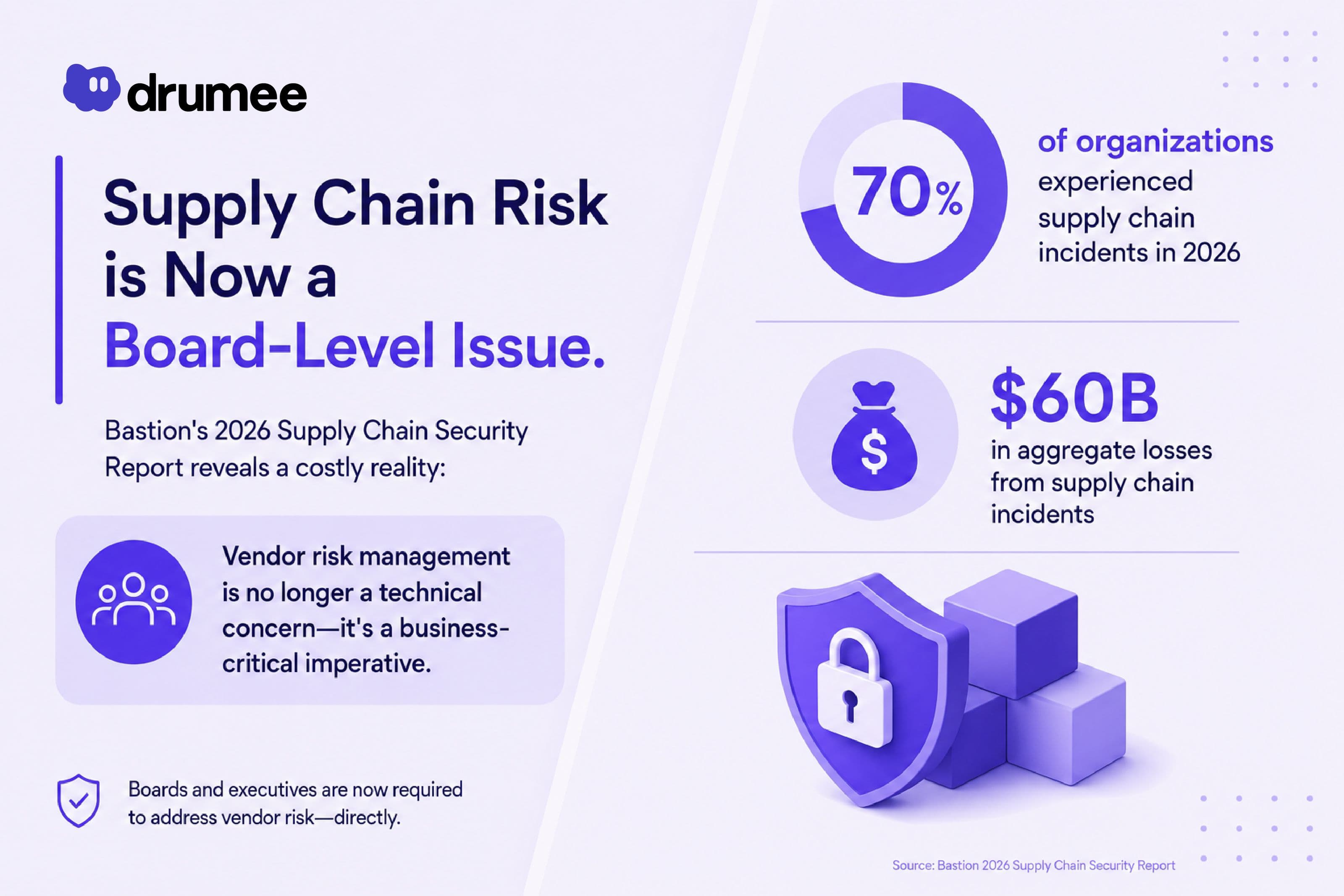
ReversingLabs' 4th Annual Software Supply Chain Security Report, published April 2026, found that malware targeting open-source platforms increased 73% in 2025, with attacks increasingly targeting developer tooling and AI development pipelines as the use of AI in software development introduces new dependency and integration attack surfaces. Bastion's 2026 Supply Chain Security Report adds the aggregate financial figure: with 70% of organizations experiencing supply chain incidents and losses reaching $60 billion, vendor risk management has moved from a technical concern to a business-critical function that boards and executives are now required to address directly.
These figures do not describe edge-case risk. They describe the baseline operating environment of any organization that uses software developed, distributed, or deployed through infrastructure it does not directly control.
The Deeper Governance Question
The GitHub breach claim surfaces a governance question that is distinct from, and arguably more important than, the immediate forensic question of what was accessed and by whom. It is the question of what an organization's actual security posture looks like when critical infrastructure dependencies sit on platforms it does not administer.
Most development teams store proprietary code in GitHub's cloud-hosted repositories. Most CI/CD pipelines authenticate using tokens issued by and stored within GitHub's infrastructure. Most deployment workflows trigger on events managed by GitHub's systems. When the security posture of any of those functions is affected by an incident at GitHub, the affected organizations have no administrative recourse and no visibility into the investigation timeline, because the infrastructure is GitHub's, not theirs.
This is the same structural condition that Drumee's sovereign data OS model is built to address in the collaboration and file sharing layer, and that the broader self-hosted sovereignty movement is addressing at the code and CI/CD layer. The governance boundary of your organization's operational data is only as strong as your administrative authority over the infrastructure that holds it. When that infrastructure belongs to a third party, every security incident affecting that third party becomes your security incident by inheritance, regardless of whether your specific data was in scope.
Silobreaker's 2025 supply chain attack review frames the systemic risk precisely: the global software supply chain has become a target precisely because its fragility is a feature of its architecture, not an oversight. A single poisoned package, a compromised vendor, or a cloud misconfiguration at a central infrastructure provider can trigger widespread operational disruption at a scale that no individual organization's security team can independently prevent or contain.
What Organizations Should Take From This Incident
The GitHub breach claim is a prompt for an infrastructure audit that most development teams have deferred. The audit questions are specific and actionable.
First: where does your proprietary code live, and under whose administrative authority does that infrastructure operate? For organizations that have stored source code exclusively in cloud-hosted repositories without maintaining self-hosted or locally administered copies, a breach of the hosting provider creates immediate exposure regardless of whether their specific repositories were in scope of the incident.
Second: what credentials are stored in or accessible to your CI/CD pipelines, and how are those credentials governed? The TeamPCP attack pattern specifically targets the credentials that CI/CD environments accumulate over time, precisely because those credentials carry production-level access to infrastructure that is far more valuable than the pipeline tool itself. Least-privilege credential management, regular rotation, and runtime secrets management that does not store credentials in environment variables or configuration files are the structural defenses against this attack class.
Third: what is your dependency audit cadence, and how quickly would you detect a compromised package in your build pipeline? According to Deepstrike's 2026 supply chain cybersecurity statistics, 47% of third-party breaches stem from unauthorized network access through stolen or misused vendor credentials. The defense is not just credential hygiene at the CI/CD layer. It is visibility into the software bill of materials for every build, continuous software composition analysis of dependencies, and the ability to detect anomalous package versions before they reach production.
The GitHub incident is ongoing and its full scope is not yet established. What is already clear, from TeamPCP's documented campaign history, from the structural vulnerability of CI/CD environments, and from the supply chain attack statistics that define the 2025 to 2026 security landscape, is that centralized infrastructure dependencies are the primary attack surface of the current era. The organizations that will be best positioned to navigate this environment are not necessarily the ones with the most sophisticated perimeter defenses. They are the ones that have reduced their administrative dependency on third-party infrastructure for the systems and data that matter most, and that treat infrastructure sovereignty not as an ideological preference but as a practical security requirement.
FAQ
1/ What is the GitHub TeamPCP breach?
On May 20, 2026, threat actor TeamPCP claimed to have breached GitHub's internal systems and exfiltrated data from approximately 4,000 private repositories, offering the alleged dataset for sale at over $50,000. GitHub confirmed it was investigating unauthorized access to its internal repositories while stating it had no current evidence of impact to customer data outside those systems.
2/ Who is TeamPCP?
TeamPCP, formally tracked by the Google Threat Intelligence Group as UNC6780, is a financially motivated threat actor known for supply chain attacks. In 2026 it successfully compromised the Trivy vulnerability scanner affecting over 1,000 organizations including Cisco, targeted Checkmarx and LiteLLM for CI/CD credential harvesting, and deployed the Shai-Hulud malware through compromised GitHub accounts affecting over 25,000 repositories.
3/ Why are CI/CD pipelines a primary target for supply chain attacks?
CI/CD environments accumulate credentials tied to cloud infrastructure, repositories, package registries, and production deployment systems. Attackers who compromise a tool operating inside a CI/CD runner can scrape GitHub tokens, AWS credentials, and deployment secrets from memory during normal workflow execution, without generating obvious alerts. Stolen credentials can then be used to publish malicious artifacts into the software supply chain under the identity of trusted developers.
4/ What is the financial cost of a supply chain breach?
According to the IBM Cost of a Data Breach Report 2025, the average cost of a supply chain breach reached $4.91 million globally, with US organizations facing costs of $10.22 million per incident. Supply chain incidents cost 17 times more to remediate than first-party breaches. With 70% of organizations experiencing supply chain incidents, total annual losses have reached $60 billion.
5/ What does the GitHub breach mean for data sovereignty?
The incident reinforces the governance principle behind data sovereignty: when critical infrastructure dependencies sit on platforms you do not administer, security incidents affecting those platforms become your security incidents by inheritance. Organizations that maintain self-hosted or locally administered copies of critical infrastructure, including source code repositories and CI/CD pipelines, reduce their administrative dependency on third-party platforms whose security posture they cannot directly control.
Related article: Digital Sharecropping: How SaaS Makes Your Team a Tenant in Someone Else's Data Farm
------------------------------
About Drumee
Drumee is the world’s first unified sovereign data infrastructure: a self-hosted, OS-like workspace that turns your own filesystem into a private collaborative environment.
Fully under your control, Drumee combines files, chat, tasks, and workflows with enterprise-grade permissions built directly into the infrastructure layer. No cloud vendors. No fragmented SaaS stack. No operational dependency.
Instead of renting your workspace from external providers, Drumee allows organizations to own the environment where operational knowledge lives.
Your Data. Your Workflow. One system. Built to be yours!
Follow us at: Website | X | LinkedIn | Drumee Founder X | Drumee Founder LinkedIn
Keep reading
Drumee: Your Data. Your Workspace. One System
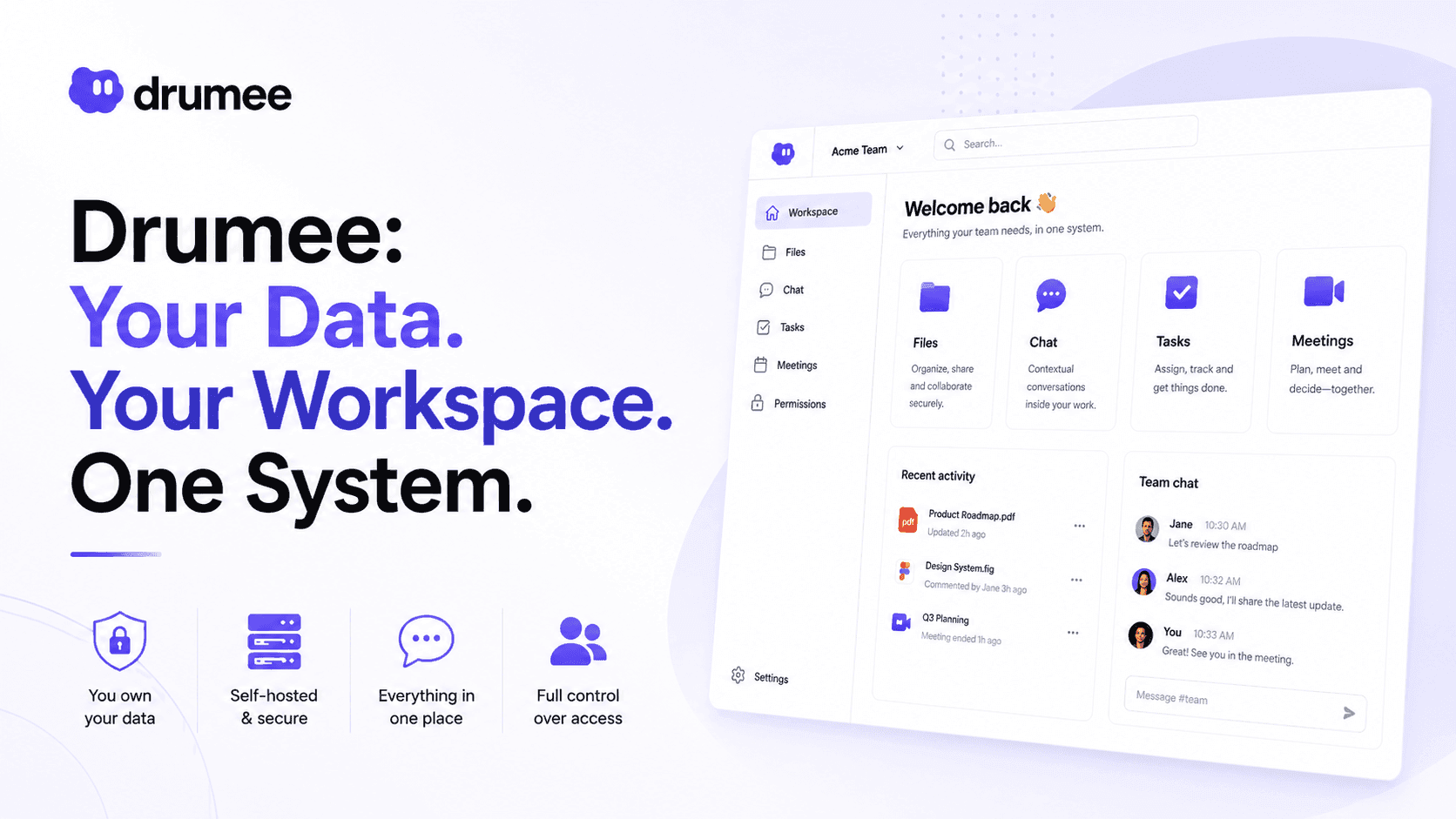
Drumee is a self-hosted, sovereign data workspace where files, chat, tasks, and permissions live in one place on infrastructure you own. Learn what Drumee is, what it stands for, and how to get started.
What Is a Sovereign Data OS? The Infrastructure Shift Teams Are Building Toward in 2026
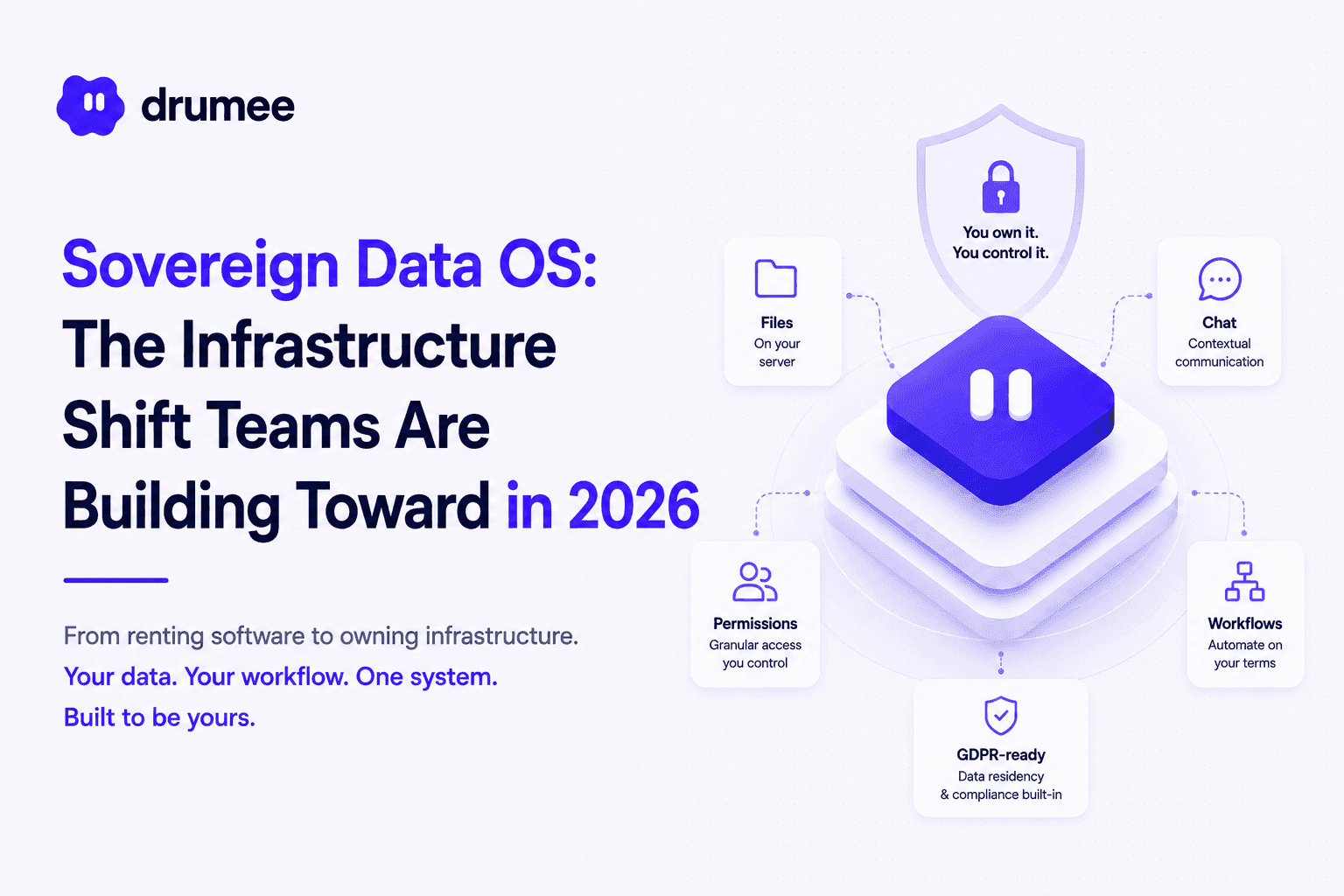
What is a sovereign data OS? Learn how Drumee's unified self-hosted infrastructure replaces fragmented SaaS stacks with a single governable environment for files, chat, permissions, and workflows in 2026.
Data Ownership: What It Means and How to Achieve It in 2026
What is data ownership and how do you actually achieve it? Learn the three layers of data control, why AI changes the stakes, and how self-hosted infrastructure gives teams genuine ownership in 2026.