
Digital Sharecropping: How SaaS Makes Your Team a Tenant in Someone Else's Data Farm
Digital sharecropping is the SaaS model: your team does the work, builds the knowledge, and deposits it all in infrastructure someone else controls. This is what self-hosted sovereignty looks like instead.
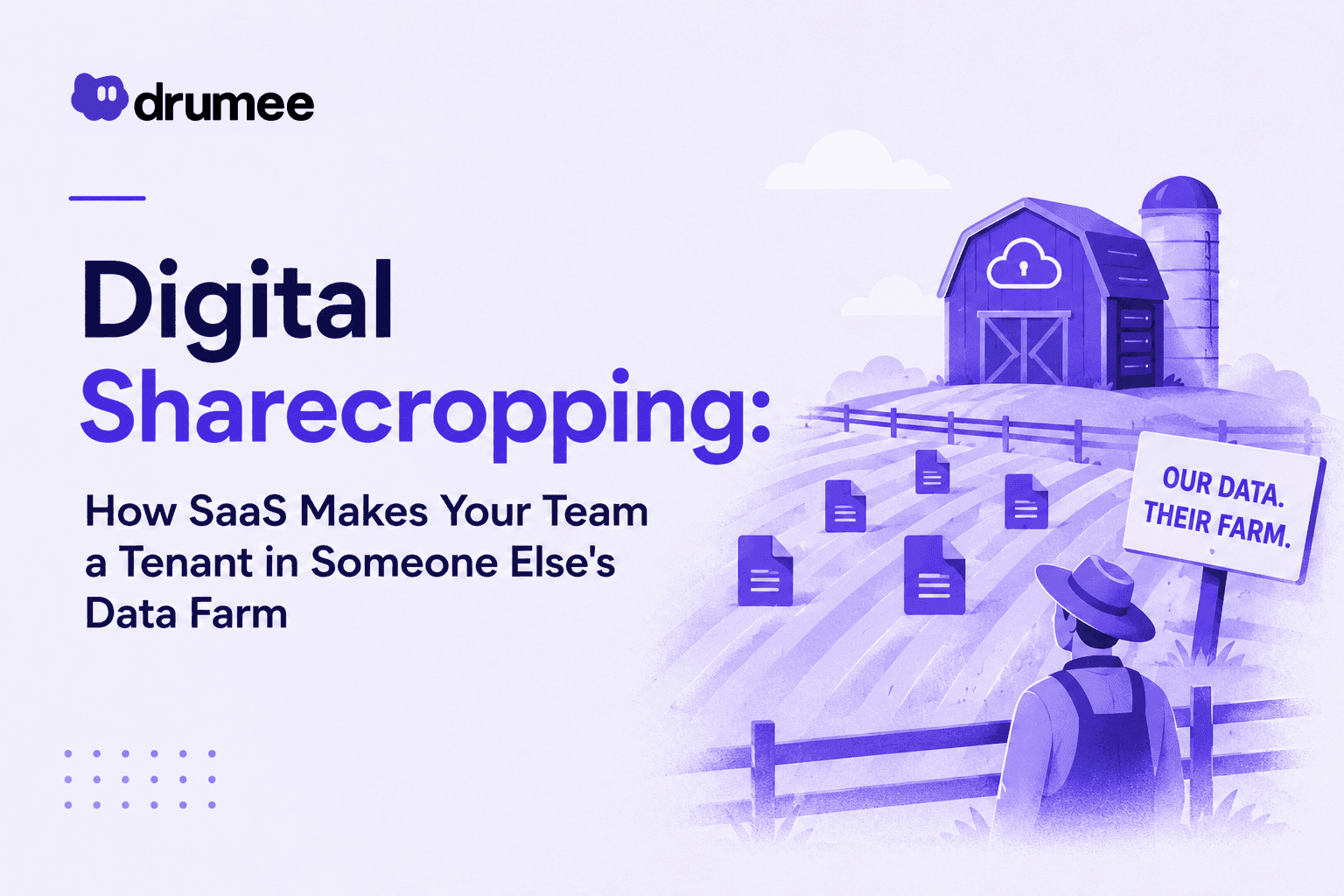
Digital Sharecropping: How SaaS Makes Your Team a Tenant in Someone Else's Data Farm
After the American Civil War, a system emerged across the rural South that looked, from a distance, like an arrangement of mutual benefit. Landowners provided the land, the tools, and the seed. Farmers did the work, planted the crops, and tended the harvest. At the end of each season, the crop was split, in theory. In practice, the accounting was controlled by the landowner, the debt accumulated on the farmer's side, and the cycle of dependency deepened with every year of work invested. Sharecroppers rarely owned anything. They worked the land, produced the yield, and remained tenants indefinitely. The harder they worked, the more deeply they belonged to the arrangement.
The Scale of the Tenancy
The scope of the dependency that most organizations have accumulated inside SaaS infrastructure is not intuitive until the numbers are stated plainly. According to Quantumrun's 2026 SaaS industry growth statistics, the average enterprise now manages 291 SaaS applications, up from 110 just six years ago. The average SaaS spend per employee has reached $5,607 annually. Enterprise SaaS spending averages $52 million per year. And roughly 51% of enterprise SaaS licenses go unused, costing the average enterprise approximately $18 million per year in wasted spending that never produces a corresponding improvement in data ownership or operational control. The global SaaS market reached $408.21 billion in 2025 and is projected at $465.03 billion for 2026.
These are not abstract industry metrics. They are a description of organizational dependency at a scale that has never existed before in the history of business infrastructure. No previous generation of businesses outsourced this much of its operational context, its communications, its documents, its decision history, its client data, its institutional knowledge, to third-party landlords whose contractual terms govern what the tenant can and cannot do with their own work product. The sharecropping metaphor is apt not because it is dramatic but because it is structurally accurate: the tenant does the productive work, the landlord controls the land.
The Rules That Change Without Your Vote
The defining characteristic of the sharecropping arrangement, the condition that makes it a dependency rather than a partnership, is that the landlord sets the rules, and can change them without the tenant's consent or input. This is precisely what distinguishes a SaaS subscription from genuinely owned infrastructure, and it operates concretely in ways that organizations experience regularly.
Pricing changes are the most visible expression. According to SaaStr's 2025 analysis of the SaaS pricing surge, Gartner reports that corporate IT budgets grow at just 2.8% annually while SaaS vendors are raising prices by 9–25%. The tenant's cost increases. The landlord's terms have changed. The tenant absorbs it, because leaving would cost more than staying, not because the arrangement is fair. Notion eliminated its standalone AI add-on in May 2025, forcing teams that wanted AI features to upgrade to Business tier. The decision was Notion's. The cost was the tenant's.
Terms of service modifications are the less visible but more consequential version of the same dynamic. When Google enables Gemini AI to process Drive files by default, when Dropbox introduces scanning algorithms whose scope its privacy policy declines to specify, when Slack changes its data retention defaults, none of these decisions require tenant consent. They are announced, often in updated terms, that most organizations do not read until a compliance inquiry makes it necessary. According to IndieWeb's documentation of the digital sharecropping concept, the clearest sign that a company thinks you are a sharecropper is that it will not let you move your data where you want it to go. The inability to move data freely is not an oversight in the SaaS model. It is a design feature. Data gravity, the accumulation of content in proprietary formats on vendor-controlled infrastructure, is the mechanism through which tenant dependency is maintained even when the tenant becomes unhappy with the terms.
What the Crop Actually Is?
In traditional sharecropping, the crop was cotton, tobacco, rice, tangible, measurable, and depleted by harvest. In digital sharecropping, the crop is more valuable and regenerates continuously: it is your team's institutional knowledge. Every document created in Notion, every conversation in Slack, every file stored in Google Drive, every decision recorded in a cloud-based project management tool adds to a body of organizational knowledge that accumulates inside vendor-controlled infrastructure and becomes more difficult to move with every passing month.
This is the dimension of digital sharecropping that most cost-benefit analyses of SaaS miss. The conversation is usually framed as subscription cost versus self-hosted infrastructure cost, and at that level, the comparison sometimes favors SaaS for small teams in the early stages of their operational development. But the real calculation is not subscription cost versus infrastructure cost. It is the compounding cost of never owning what your team's work produces, the knowledge, the workflows, the permission architecture, the AI-processed operational context, versus the one-time cost of building on infrastructure you own.
According to BetterCloud's 2026 SaaS statistics compilation, the average global cost of an insider threat incident has reached $17.4 million in 2025, a 109% increase since 2018. Critically, 55% of incidents are caused by negligence or mistakes, not malicious actors, in environments where data access is poorly governed precisely because the infrastructure is controlled by a vendor. The tenant cannot fully audit the land. The tenant cannot directly administer the access controls. The tenant can configure the options the landlord has chosen to expose, and no others.
"Digital sharecropping is what happens when your team builds something real - real knowledge, real workflows, real institutional context, and deposits it all into an environment someone else controls. You pay to use it. They set the terms. The harder you work and the more you build, the harder it becomes to leave. Self-hosted sovereignty is the alternative: infrastructure your team actually owns, where the work you do stays in your hands." - Somanos Sar, Founder, Drumee
The AI Inflection That Changed the Crop's Value
The sharecropping metaphor has been available for years. What has changed in 2025 and 2026 is that the crop, your team's operational data, has become dramatically more valuable, precisely because it is now raw material for AI systems. Before generative AI became embedded in SaaS platforms, your documents and conversations were stored in vendor-controlled infrastructure but largely passive. They were accessed when you accessed them. They were searched when you searched them. The vendor processed them for content moderation and platform improvement, but the scope of that processing was bounded and largely stable.
Generative AI embedded in collaboration platforms has changed the nature of the crop. Your documents, communications, and decision history are no longer passive storage. They are active training and inference material for AI systems operating on vendor infrastructure under vendor governance terms. When Notion AI queries your workspace to answer a question, it is performing a harvest, extracting structured insight from the institutional knowledge your team has accumulated in the platform. When Google Gemini summarizes your Drive files, it is processing the crop. According to Gartner's projection cited across multiple 2026 analyses, more than 80% of companies are expected to have AI-enabled applications deployed by the end of 2026, up from just 5% in 2023. The platforms that hold your operational data are the ones deploying those applications, on your data, under their terms.
Self-Hosted Sovereignty: What Owning the Land Looks Like
The resolution to digital sharecropping is self-hosted sovereignty, the condition in which your team's operational infrastructure runs on servers your organization administers, under code your organization can audit, in an environment where the rules are yours to set. This is not a rejection of technology or collaboration. It is the recognition that infrastructure and tenancy are different things, and that organizations that have accumulated substantial operational knowledge should be building on land they own rather than land they rent.
Self-hosted sovereignty in 2026 is practically accessible for teams that have the technical maturity to deploy a Docker containerized application and manage a standard VPS. The open source collaboration ecosystem has matured substantially, and unified sovereign workspace platforms, rather than collections of disconnected self-hosted tools, are now available for organizations that want to address the sharecropping problem at the infrastructure layer rather than tool by tool.
Drumee is built specifically for this architectural position. As a sovereign data OS, Drumee unifies files, chat, tasks, and permissions inside a single self-hosted environment that your organization controls from deployment day one. The institutional knowledge your team builds inside Drumee, the decisions, the documents, the workflows, the permission architecture accumulates on your infrastructure rather than on a vendor's. The AI systems that interact with your operational content do so within a boundary you configure and govern. There are no pricing changes made without your input, because the infrastructure cost is determined by your own hosting decisions. The crop belongs to you.
The digital sharecropping era in software is a consequence of how convenient the SaaS model was during the period when organizations were building their digital capabilities from scratch. That convenience was real and the productivity gains were genuine. But for organizations that have now spent years building institutional knowledge inside vendor-controlled platforms, the question is not whether the arrangement was convenient to enter. It is whether the arrangement, at the terms it is now operating under the pricing escalations, the AI processing defaults, the data portability limitations, the governance terms set unilaterally by the landlord, is still worth the tenancy. For a growing number of teams in 2026, the answer is no. And the alternative is infrastructure they own.
FAQ
1/ What is digital sharecropping in SaaS?
Digital sharecropping is the condition in which a team does the productive work, creating documents, building workflows, accumulating institutional knowledge, inside platforms it does not own, where the vendor controls the infrastructure, sets the pricing, governs the AI processing, and can change the terms of the arrangement without the tenant's consent.
2/ What is self-hosted sovereignty?
Self-hosted sovereignty is the condition in which your team's operational infrastructure, files, communication, permissions, workflows, runs on servers your organization administers, under code you can audit, with AI systems you select and configure. It is the architectural alternative to cloud SaaS tenancy.
3/ How much does SaaS dependency cost in 2026?
According to Quantumrun's 2026 SaaS industry statistics, enterprise SaaS spending averages $52 million per year, with SaaS spend per employee reaching $5,607 annually. Approximately 51% of enterprise SaaS licenses go unused, costing the average enterprise roughly $18 million per year in wasted spending.
4/ Why does AI make digital sharecropping more expensive?
Generative AI embedded in SaaS collaboration platforms turns your team's operational data, documents, communications, workflows, into active training and inference material for AI systems operating on vendor infrastructure under vendor governance terms. The crop your team has built becomes more valuable, but it is harvested by systems you do not control.
5/ How does Drumee represent self-hosted sovereignty?
Drumee is a sovereign data OS that unifies files, chat, tasks, and permissions in a single self-hosted environment running on infrastructure the organization controls. The institutional knowledge your team builds accumulates on your servers, not a vendor's. Licensed under AGPLv3, deployable via Docker, GDPR-ready by architecture.
Related article: The Self-Hosted Workspace for Teams: Control, Compliance, Collaboration
------------------------------
About Drumee
Drumee is the world’s first unified sovereign data infrastructure: a self-hosted, OS-like workspace that turns your own filesystem into a private collaborative environment.
Fully under your control, Drumee combines files, chat, tasks, and workflows with enterprise-grade permissions built directly into the infrastructure layer. No cloud vendors. No fragmented SaaS stack. No operational dependency.
Instead of renting your workspace from external providers, Drumee allows organizations to own the environment where operational knowledge lives.
Your Data. Your Workflow. One system. Built to be yours!
Follow us at: Website | X | LinkedIn | Drumee Founder X | Drumee Founder LinkedIn
Keep reading
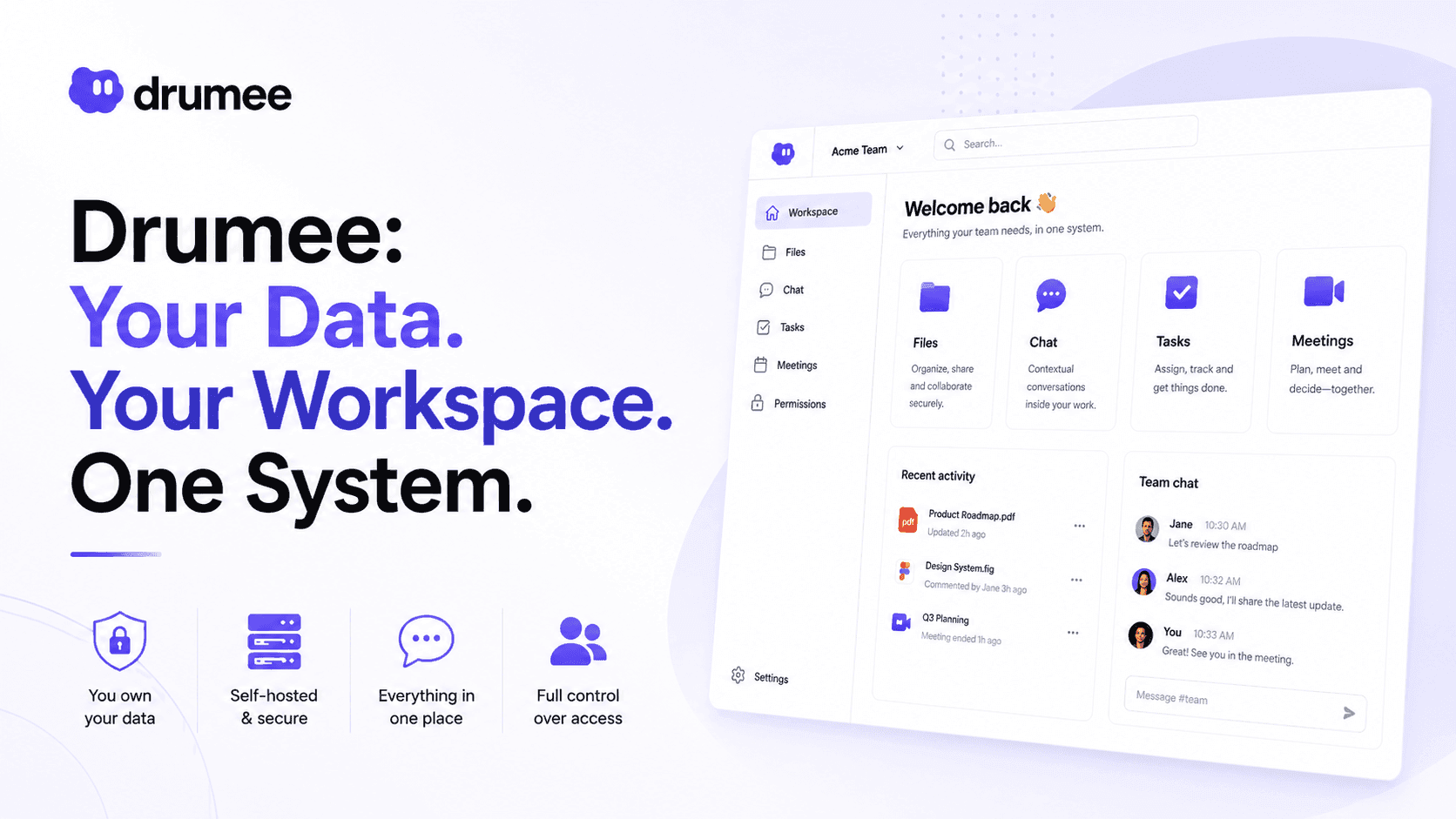
Drumee: Your Data. Your Workspace. One System
Drumee is a self-hosted, sovereign data workspace where files, chat, tasks, and permissions live in one place on infrastructure you own. Learn what Drumee is, what it stands for, and how to get started.
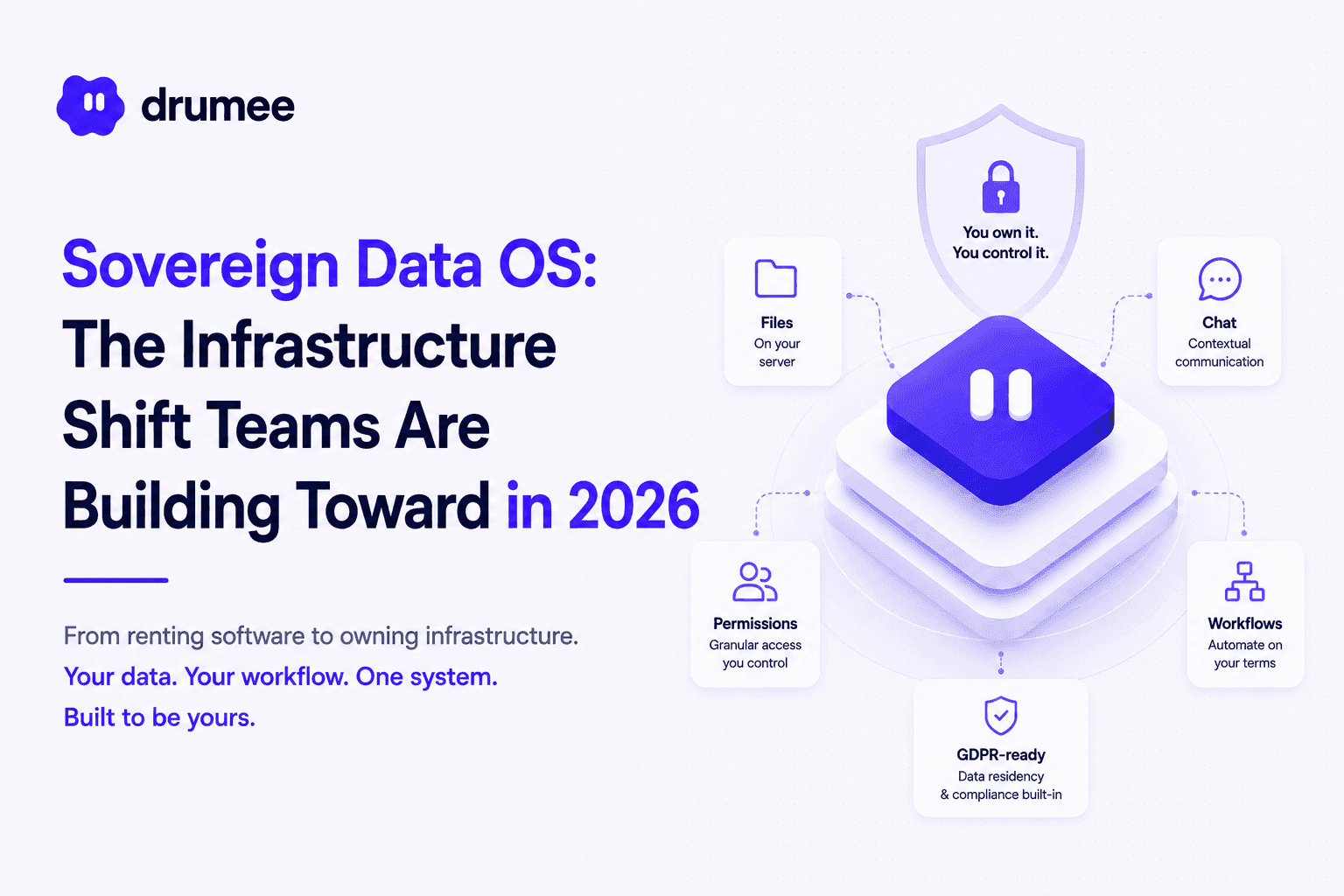
What Is a Sovereign Data OS? The Infrastructure Shift Teams Are Building Toward in 2026
What is a sovereign data OS? Learn how Drumee's unified self-hosted infrastructure replaces fragmented SaaS stacks with a single governable environment for files, chat, permissions, and workflows in 2026.
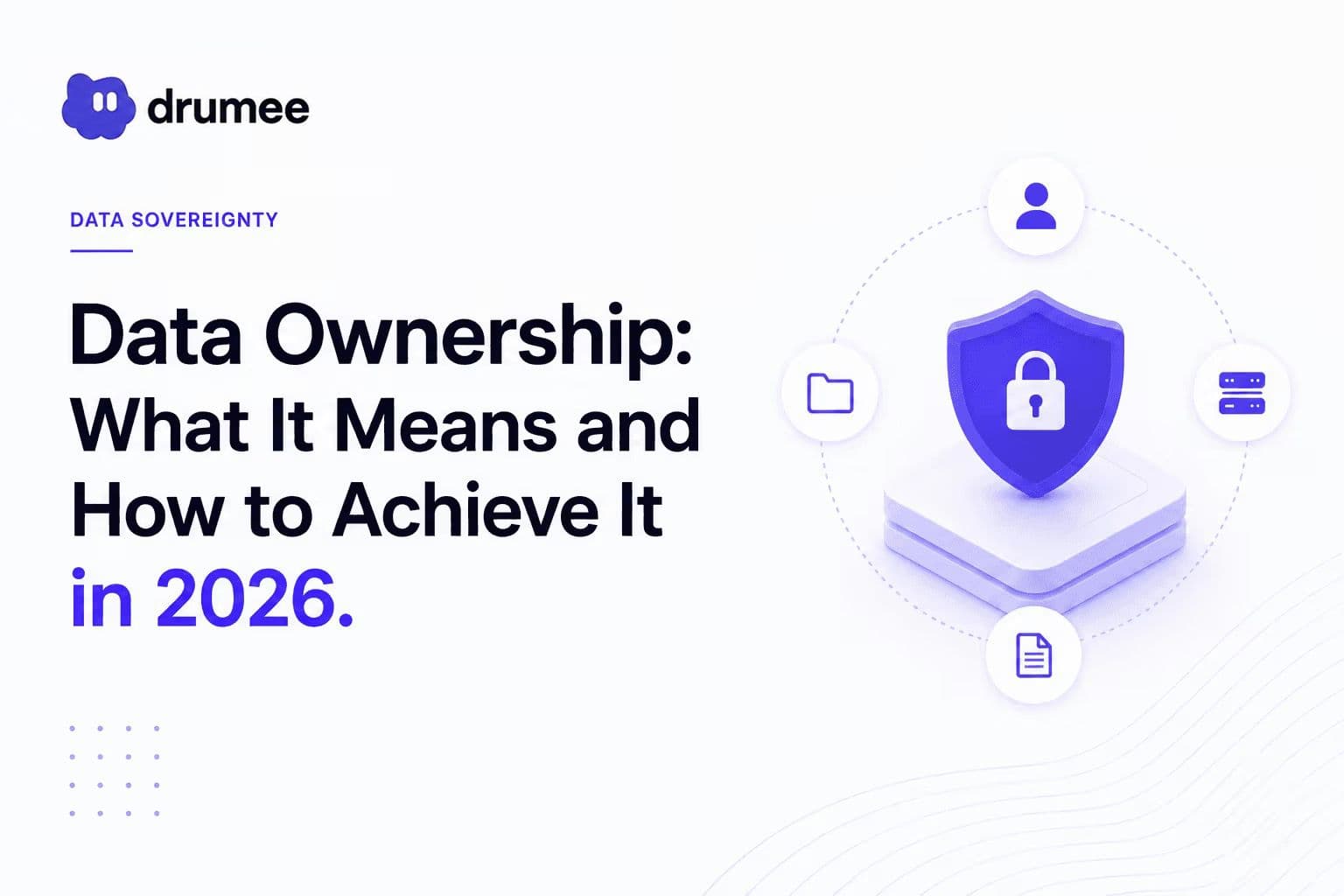
Data Ownership: What It Means and How to Achieve It in 2026
What is data ownership and how do you actually achieve it? Learn the three layers of data control, why AI changes the stakes, and how self-hosted infrastructure gives teams genuine ownership in 2026.