
Nextcloud Alternatives in 2026: Which Self-Hosted Option Is Actually Modern?
Nextcloud is the benchmark, but it is not the only option in 2026. Here is a clear comparison of Seafile, ownCloud Infinite Scale, Syncthing, Pydio, and Drumee for teams asking which self-hosted alternative is actually modern and which fits their specific requirements.
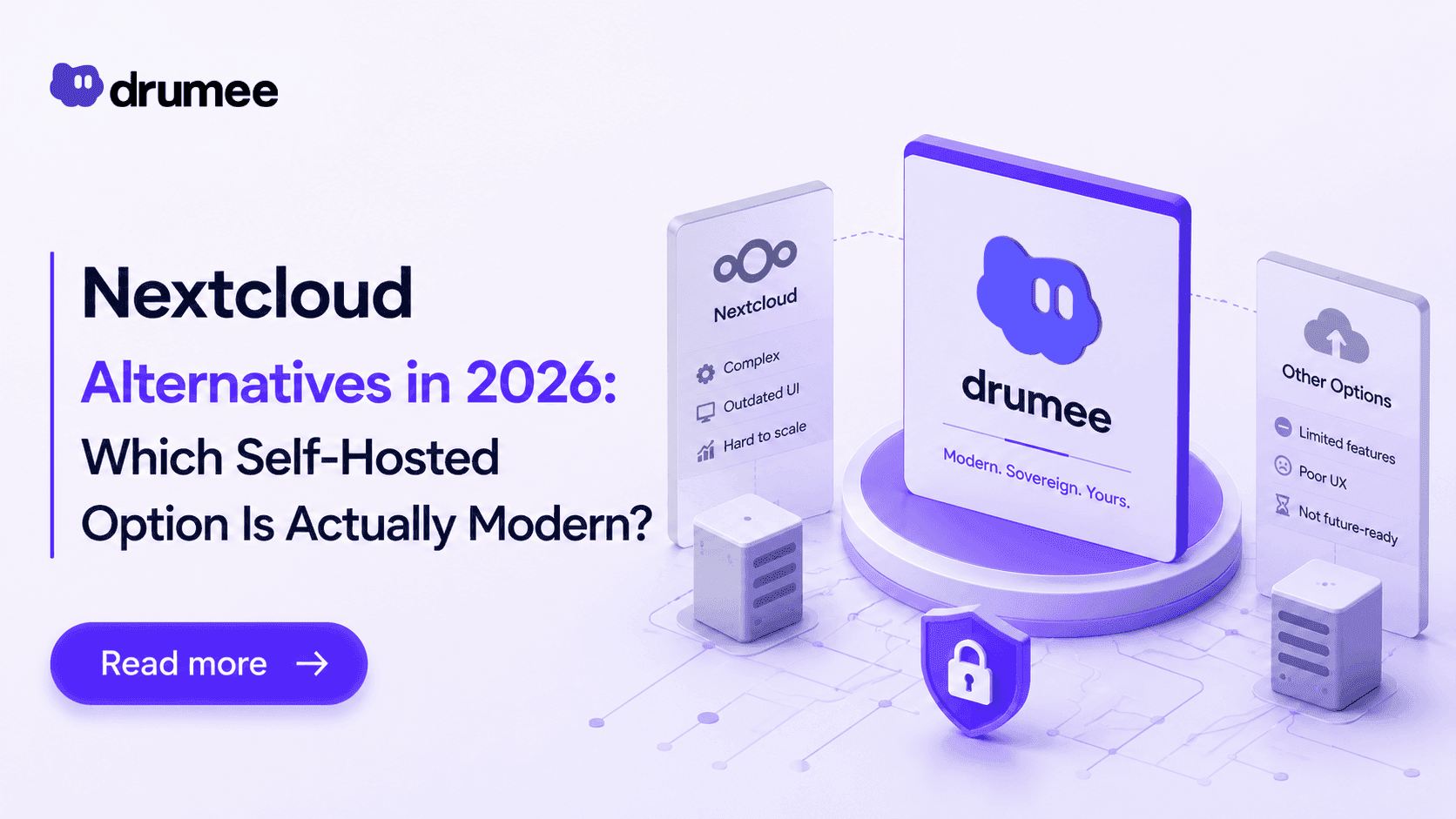
Nextcloud Alternatives in 2026: Which Self-Hosted Option Is Actually Modern?
Nextcloud is the benchmark against which every self-hosted collaboration platform is measured, and for good reason. With over 500,000 active deployments globally, a Stuttgart-based corporate structure that satisfies EU data sovereignty requirements better than any US-headquartered provider, and a feature set that has genuinely expanded to compete with Google Workspace and Microsoft 365, Nextcloud Hub represents the most mature and battle-tested self-hosted collaboration option currently available. For many teams, it is the right answer. For others, it is an answer that comes with resource overhead, administrative complexity, and architectural assumptions about what a collaboration platform should be that do not match their actual operational requirements. The question that organizations should be asking in 2026 is not "is Nextcloud good?", it is but "is Nextcloud the right fit for our specific needs, and what are the genuine modern alternatives if it is not?" According to MassiveGRID's 2026 enterprise comparison of self-hosted collaboration platforms, in 2026 the differences between the major platforms have grown sharper, and the choice between them is inseparable from decisions about infrastructure requirements, sovereignty implications, and long-term platform viability.
Why Do Teams Start Looking for Nextcloud Alternatives?
Nextcloud's breadth is both its strength and the primary source of friction for teams that discover they need a narrower solution. The platform's evolution from a file sync tool into a full collaboration suite, covering file storage, document editing through Collabora Online or OnlyOffice, team chat via Nextcloud Talk, calendar, contacts, and an extensive app ecosystem, means that a full Nextcloud deployment carries the resource profile of an integrated workspace suite rather than a file storage server.
According to Sesame Disk's February 2026 head-to-head analysis of Nextcloud, Seafile, and ownCloud, Nextcloud brings Google Workspace-level collaboration at the cost of greater resource and administrative overhead. For teams that need Nextcloud's full capability, this trade-off is worthwhile. For teams whose primary requirement is efficient, reliable file sync and sharing without the overhead of an all-in-one collaboration suite, Nextcloud may be significantly more platform than the use case requires. The analysis specifically identifies engineering and research environments, where raw file sync performance and minimal administrative maintenance matter more than collaborative editing and communication features, as contexts where Nextcloud's alternatives are meaningfully superior.
The sovereignty dimension has also become more complex in 2026, specifically because of what happened to one of Nextcloud's closest competitors. MassiveGRID's analysis documents that ownCloud's acquisition by US-based Kiteworks in late 2024 fundamentally altered its sovereignty profile. For teams evaluating alternatives that had previously considered ownCloud as a stable, mature Nextcloud alternative with similar sovereignty characteristics, that acquisition is a structurally significant change. As a US-headquartered company now controls ownCloud's development and commercial direction, the CLOUD Act exposure that disqualifies US-headquartered cloud providers from certain GDPR-sensitive deployments applies to ownCloud in a way it did not before 2024.
Seafile: The Modern Choice for Performance-First Teams
The most consistently recommended Nextcloud alternative in 2026 for teams whose primary requirement is fast, reliable, efficient file synchronization is Seafile. The technical architecture that produces Seafile's performance advantage is specific and worth understanding: Seafile uses block-level delta synchronization, meaning only the changed portions of a file are transferred during sync operations rather than the entire file. For teams handling large files, including design assets, video, research data, and engineering artifacts, this architecture produces sync performance that is two to three times faster than Nextcloud in independent benchmarks.
SSD Nodes' March 2026 Nextcloud alternatives guide positions Seafile as the clear recommendation for performance-focused teams, noting its block-level sync and deduplication handles multi-gigabyte files more efficiently than Nextcloud or ownCloud. The platform's resource efficiency is equally significant: Seafile's minimal resource requirements mean lower hosting costs for equivalent user counts compared to Nextcloud's full deployment. For teams that have evaluated the total cost of self-hosted infrastructure and are optimizing the balance between performance and hosting spend, Seafile's architecture allows a smaller VPS to handle a larger user base at better performance levels.
Seafile also provides client-side encryption capabilities that exceed what Nextcloud offers by default. Selfhosting.sh's February 2026 comparison notes that Seafile's block-level sync and client-side encryption are features that differentiate it within the self-hosted file storage category. For teams in regulated industries or handling sensitive data where end-to-end encryption at the client layer is a compliance requirement rather than an optional feature, Seafile's encryption architecture provides this more natively than a standard Nextcloud deployment.
The limitation of Seafile is the limitation that its performance-focused architecture creates: it is a file sync and sharing platform, not a full collaboration suite. Teams that need collaborative document editing, team chat, calendar management, and task tracking alongside file storage will either need to supplement Seafile with additional self-hosted tools or accept that their collaboration workflow spans multiple systems. For teams with straightforward file storage and sharing requirements where that breadth is unnecessary overhead, this limitation is precisely the reason Seafile is a better fit.
ownCloud Infinite Scale: Architecturally Modern, Sovereignty Uncertain
ownCloud Infinite Scale, the complete rewrite of ownCloud from its original PHP architecture to a Go-based system, represents a genuine architectural modernization. SSD Nodes' 2026 analysis describes ownCloud Infinite Scale as eliminating the need for complex database management and significantly boosting performance, offering a set-and-forget experience that is both lighter on resources and more stable for large-scale enterprise environments than its predecessor. The ground-up rewrite addresses the primary technical criticism of the original ownCloud architecture and positions Infinite Scale as a genuinely modern infrastructure platform.
The recommendation challenge for new deployments in 2026 is precisely what MassiveGRID's analysis states directly: the Kiteworks acquisition means that for organizations where sovereignty requires a non-US-controlled infrastructure chain, ownCloud Infinite Scale creates the same CLOUD Act exposure that disqualifies US-headquartered cloud providers. Organizations already running ownCloud may have valid reasons to remain and evaluate whether the acquisition materially changes their compliance posture. For organizations beginning a new evaluation, the sovereignty profile of an ownCloud-Kiteworks platform deserves explicit assessment rather than the assumption that prior ownCloud's independence characteristics still apply.
Syncthing: The Decentralized Option for Maximum Privacy
Syncthing occupies a meaningfully different position in the Nextcloud alternatives landscape because it is architecturally decentralized rather than client-server. ReviewAITool's April 2026 expert analysis describes Syncthing as a masterpiece of engineering for its specific use case: pure, decentralized, private file syncing between devices without any central server. Unlike Nextcloud, Seafile, and ownCloud, which all require a central server that all clients connect to, Syncthing creates encrypted peer-to-peer connections between devices that synchronize files without any data ever passing through a third party's infrastructure.
For individuals and small teams whose primary requirement is that files exist on multiple devices without any central point of failure or administrative overhead, Syncthing's model is technically elegant. The governance property is absolute: there is no server to administer, no central data store to secure, and no infrastructure dependency beyond the devices in the sync network. However, this also means Syncthing provides no web interface for file access from arbitrary devices, no team sharing model that extends beyond device-level sync, and no collaboration features that depend on a shared central repository.
For teams that need a shared file repository accessible to multiple users from multiple devices without requiring those users to set up individual sync relationships, Syncthing's decentralized model does not translate. The use case it serves extremely well is backup, personal file sovereignty, and synchronization between a small number of trusted devices. The use case it does not serve is team collaboration with shared access permissions, version control, and administrative oversight.
Pydio: The Compliance-First Enterprise Alternative
Pydio Cells represents a different alternative positioning than Seafile or ownCloud Infinite Scale. SSD Nodes' alternatives guide identifies Pydio's compliance features as its primary differentiation from Nextcloud, specifically targeting regulated industries where GDPR, HIPAA, and sector-specific data governance requirements are non-negotiable. Pydio Cells is a Go-based platform with a microservices architecture that provides granular audit logging, fine-grained permission controls, and enterprise identity provider integrations that are more mature in their compliance tooling than comparable Nextcloud features.
For legal agencies, healthcare organizations, and financial services firms whose compliance requirements extend beyond GDPR's baseline to sector-specific frameworks with audit depth requirements, Pydio's compliance architecture represents meaningful differentiation. Its limitation is the limitation of its narrower focus: it has a smaller community than Nextcloud, fewer third-party integrations, and less development velocity on collaboration features beyond the compliance infrastructure that defines its positioning.
Drumee: The Sovereign Data OS Alternative
Every alternative covered so far, Seafile, ownCloud Infinite Scale, Syncthing, Pydio, shares one architectural assumption with Nextcloud itself: the platform exists primarily to solve file storage, and collaboration features are added on top of that foundation. Drumee starts from a different premise. It is built as a sovereign data OS, where files, team chat, task management, and permissions are not separate modules bolted onto a storage layer, but four surfaces of a single governed environment running on infrastructure the organization controls directly.
That distinction matters operationally, not just architecturally. In a typical Nextcloud, Seafile, or Pydio deployment, the file storage layer is sovereign and self-hosted, but the team’s conversations about those files still happen in Slack, the documentation referencing them lives in Notion, and the task tracking connected to delivering on them sits in a third vendor-controlled tool. Each of those adjacent systems has its own permission model, its own retention policy, and its own AI processing terms, none of which the organization directly governs. Drumee closes that gap by design: when a file is shared inside Drumee, the permission grant, the conversation about it, and the task connected to its delivery exist within the same self-hosted environment, under the same audit trail, with no API boundary between the storage layer and the collaboration layer.
Drumee is open source under AGPLv3, which means the codebase governing every layer of the environment, not just the file storage component, is auditable and modifiable without restriction. Deployment follows the same Docker-based model that has made Nextcloud and Seafile accessible to teams without dedicated infrastructure engineers, and the GDPR-readiness that Nextcloud achieves through its zero-access architecture extends in Drumee across the full operational surface: communications and task data carry the same sovereignty guarantee as the files they reference, rather than that guarantee stopping at the storage layer.
The trade-off is the inverse of Seafile’s: where Seafile is the better choice for teams that want fast file sync without collaboration overhead, Drumee is the better choice for teams whose governance requirement extends beyond storage into the full context surrounding their files, legal agencies tracking client communications alongside documents, healthcare-adjacent teams whose compliance exposure spans chat and task data as much as files, or any organization that has concluded file storage sovereignty alone no longer satisfies its audit or regulatory posture. For teams in that position, Drumee is not a Nextcloud alternative in the narrow sense of replacing the file sync component. It replaces the architectural assumption that collaboration tools should be assembled from separately governed parts.
Where Do These Alternatives Leave the Governance Gap Unclosed?
The limitation that applies to every platform in the Nextcloud alternatives landscape, including Nextcloud itself, is the governance gap that persists when file storage is addressed in isolation from the operational context that surrounds it. This is not a criticism specific to any platform. It is a structural characteristic of the file-storage-first category architecture.
Teams that deploy Seafile for fast file sync, or ownCloud Infinite Scale for enterprise stability, or Pydio for compliance depth, are solving the file storage governance question. They are not solving the governance question for the communication about those files, the documentation referencing them, the task workflows connected to them, or the permission model that should extend coherently across all of these operational layers. In most real deployments, the file storage layer is sovereign while the communication layer remains in Slack, the documentation layer in Notion, and the task management layer in a third vendor-controlled tool.
The organizational governance posture that results from this partial sovereignty is precisely what regulators are increasingly evaluating during breach investigations and compliance audits: an organization whose file storage is self-hosted but whose communication about those files is in vendor-controlled infrastructure has addressed one compliance layer while leaving adjacent layers ungoverned.
Drumee's position in this landscape is architecturally different from every platform described above, including Nextcloud. Drumee is not primarily a file storage platform that has added collaboration features. It is a sovereign data OS that treats files, communication, tasks, and permissions as layers of a single governed operational environment rather than separate tools requiring integration. The sovereignty condition extends across the full workspace, the audit trail is coherent across all operational layers, and the governance boundary is defined by the organization's own infrastructure rather than the intersection of several independently-deployed tools.
For teams whose evaluation of Nextcloud alternatives has reached the point where file storage sovereignty alone is no longer sufficient for their compliance or operational governance requirements, the relevant question is not which file storage platform is most modern. It is which architecture governs the full operational context where sensitive work actually happens.
FAQ
1/ What is the best Nextcloud alternative in 2026?
The best alternative depends on what Nextcloud does not fit about your requirements. Seafile is the leading choice for performance-first teams needing fast file sync with minimal overhead. ownCloud Infinite Scale provides modern Go-based architecture with enterprise stability, though its acquisition by US-based Kiteworks in 2024 creates sovereignty considerations for GDPR-sensitive deployments. Pydio Cells leads on compliance depth for regulated industries. Drumee provides a unified self-hosted environment covering files, communication, permissions, and tasks beyond the file-storage-only category.
2/ Is ownCloud still a good Nextcloud alternative after the Kiteworks acquisition?
For organizations already running ownCloud with established workflows, the Infinite Scale rewrite is a technically impressive modernization and may remain appropriate depending on the organization's specific CLOUD Act and sovereignty assessment. For new deployments in 2026, MassiveGRID's analysis recommends against ownCloud for organizations where sovereignty requires a non-US-controlled infrastructure chain, because the Kiteworks acquisition means the platform now falls under US corporate governance and CLOUD Act jurisdiction.
3/ How does Seafile compare to Nextcloud for enterprise file storage?
Seafile delivers two to three times faster file sync than Nextcloud in benchmarks through block-level delta synchronization, with lower resource requirements for equivalent user counts. Its limitation is scope: Seafile is a file sync and sharing platform without Nextcloud's breadth of collaboration features. For teams whose primary requirement is efficient file sync rather than full-suite collaboration, Seafile is the stronger technical choice.
4/ Does Syncthing work as a team collaboration platform?
Syncthing is engineered for decentralized peer-to-peer file synchronization between trusted devices, with no central server. It provides absolute data sovereignty for individuals and very small teams synchronizing files between their own devices. It does not provide a shared file repository with team permission models, web-based access for arbitrary users, or collaboration features dependent on a central data store. It is not a functional alternative to Nextcloud for team collaboration use cases.
5/ What does Drumee offer that Nextcloud and its alternatives do not?
Drumee is a sovereign data OS that unifies files, communication, tasks, and permissions in a single self-hosted environment rather than addressing only the file storage layer. Where Nextcloud and its alternatives are file-first platforms that have added collaboration features, Drumee treats the full operational context, conversations about files, tasks connected to documents, permissions spanning all layers, as a single governed environment. The sovereignty condition extends across the complete workspace rather than only the storage layer.
Related article:
------------------------------
About Drumee
Drumee is the world’s first unified sovereign data infrastructure: a self-hosted, OS-like workspace that turns your own filesystem into a private collaborative environment.
Fully under your control, Drumee combines files, chat, tasks, and workflows with enterprise-grade permissions built directly into the infrastructure layer. No cloud vendors. No fragmented SaaS stack. No operational dependency.
Instead of renting your workspace from external providers, Drumee allows organizations to own the environment where operational knowledge lives.
Your Data. Your Workflow. One system. Built to be yours!
Follow us at: Website | X | LinkedIn | Drumee Founder X | Drumee Founder LinkedIn
Keep reading
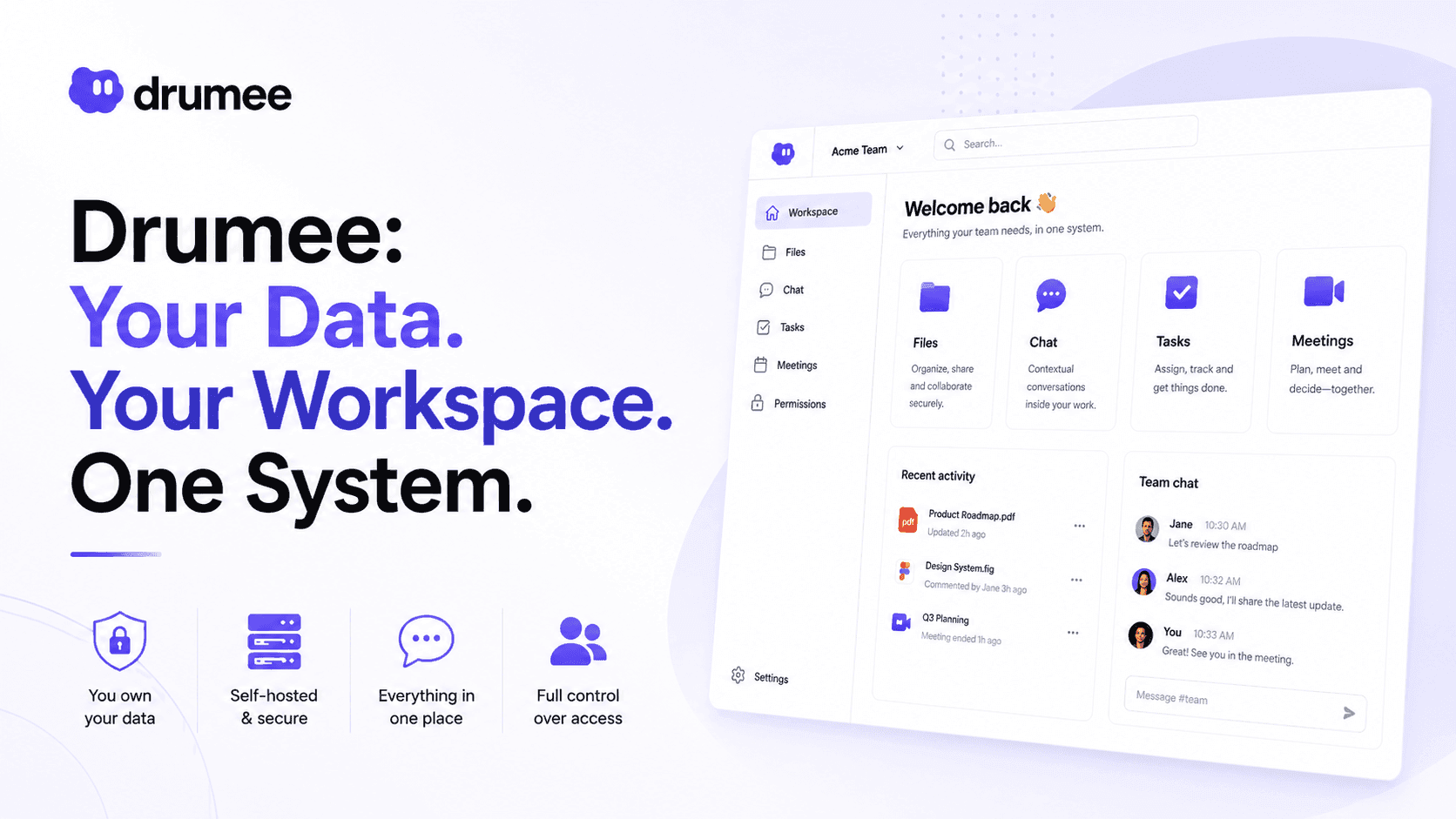
Drumee: Your Data. Your Workspace. One System
Drumee is a self-hosted, sovereign data workspace where files, chat, tasks, and permissions live in one place on infrastructure you own. Learn what Drumee is, what it stands for, and how to get started.
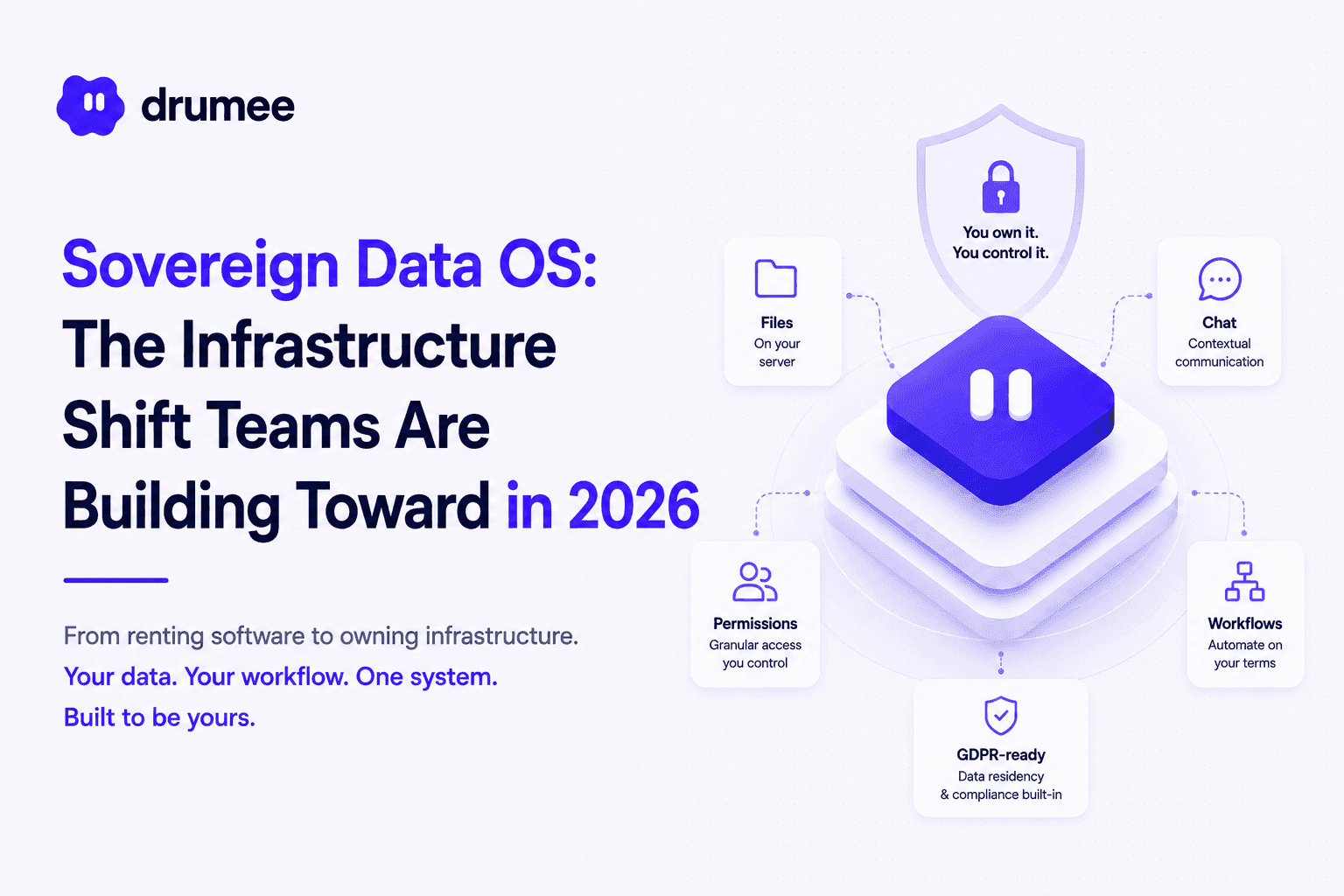
What Is a Sovereign Data OS? The Infrastructure Shift Teams Are Building Toward in 2026
What is a sovereign data OS? Learn how Drumee's unified self-hosted infrastructure replaces fragmented SaaS stacks with a single governable environment for files, chat, permissions, and workflows in 2026.
Data Ownership: What It Means and How to Achieve It in 2026
What is data ownership and how do you actually achieve it? Learn the three layers of data control, why AI changes the stakes, and how self-hosted infrastructure gives teams genuine ownership in 2026.