
Open Source Self-Hosted Collaboration: Why AGPL Guarantees Sovereignty
AGPL-licensed self-hosted collaboration platforms are the only architecture that provides verifiable, legally enforceable governance guarantees over collaboration infrastructure. Here is why the license structure matters as much as the deployment model in 2026.
Open Source Self-Hosted Collaboration: Why AGPL Guarantees Sovereignty
A self-hosted collaboration platform built on open source software licensed under the GNU Affero General Public License is the only architecture that provides organizations with verifiable, legally enforceable guarantees over the infrastructure they run and the code that governs it. This is a stronger claim than it first appears, and understanding why it holds requires understanding what most collaboration platforms actually offer and where the governance guarantees of those platforms stop. In 2026, as the open source software market reached $48.54 billion and is projected to grow to $56.57 billion at a 16.5% CAGR according to The Business Research Company's 2026 open source software market report, organizations are not adopting open source collaboration platforms primarily because they are cheaper than commercial alternatives. They are adopting them because the legal and technical structure of open source licensing provides guarantees about how software behaves that proprietary SaaS agreements simply cannot replicate at the infrastructure layer.
What Does AGPL Mean in Plain Language?
The GNU Affero General Public License is the strongest copyleft license in the open source ecosystem. To understand what it guarantees for organizations using AGPL-licensed collaboration platforms, it helps to understand what it was specifically designed to prevent.
Standard open source licenses, including the MIT license and Apache 2.0, allow any organization to take the code, modify it, deploy it as a cloud service, and never share their modifications with anyone. This is how Amazon Web Services, Google Cloud, and Microsoft Azure have built commercially dominant managed services on top of open source code without contributing those modifications back to the communities that produced them. The original developers and their communities receive nothing from deployments that generate enormous commercial value. More importantly for organizations evaluating collaboration infrastructure, the modifications that cloud providers make to the software they deploy as managed services are never visible to the customers using those services. The code governing your data is proprietary, even when the base software was open source.
According to DEV Community's February 2026 open source license guide, the AGPL was designed specifically to close this gap. If you make AGPL-licensed software available over a network, you must also publish the source code of your modifications, including any changes made to the codebase. The guide frames this as the anti-cloud-giant shield: with AGPL, any organization offering AGPL-licensed software as a service is required to publish its modifications. Without this requirement, as MongoDB discovered when AWS launched DocumentDB as a managed service on top of MongoDB's open source code, the permissive license had allowed the entire commercial value of the software to be captured by a cloud provider without any obligation to contribute back.
For organizations deploying a self-hosted collaboration platform licensed under AGPL, this has a specific and practical implication. Revenera's AGPL compliance analysis specifies that the AGPL's Network Interaction Clause requires any modified version of the software that is accessed over a network to be made available to users under the same license. This means that the code governing every user's interaction with the collaboration platform is auditable. There are no hidden proprietary modifications. If the organization deploys a customized version of an AGPL-licensed collaboration platform, any user of that platform is entitled to see the source code of the customizations. That guarantee applies in both directions: the organization can audit the original developer's code, and any modifications the organization makes are subject to the same transparency requirement.
The Vendor Lock-In Concern AGPL Structurally Resolves
The organizational motivation for adopting open source self-hosted collaboration platforms has shifted substantially in 2026, and the direction of that shift is directly relevant to understanding why AGPL matters.
OpenLogic's 2026 State of Open Source Report, produced in collaboration with the Open Source Initiative and the Eclipse Foundation, surveyed organizations globally on their open source adoption drivers. The report found that avoiding vendor lock-in surged by 22 percentage points compared to 2025, now cited by 55% of respondents as a primary motivation, representing a 68% year-over-year increase in the prominence of this concern. In Europe and the UK, nearly two-thirds of organizations cite vendor lock-in as a primary driver, reflecting the regulatory and geopolitical pressures that have made infrastructure dependency on non-EU vendors an active compliance and governance concern.
AGPL licensing addresses vendor lock-in at the structural level rather than the contractual one. When a collaboration platform is AGPL-licensed, the organization's right to run, modify, and self-host the software is guaranteed by the license itself, not by the vendor's current good intentions or commercial interests. This is what Nextcloud's analysis of AGPL for business users describes as the license being designed to protect the recipient of the code rather than the vendor. The license explicitly protects the organization's operational rights, including the right to connect with the software through well-defined APIs with no restrictions on time, number of users, or functionality. If the organization running the platform goes out of business, changes its pricing model, or decides to add usage restrictions to a future version, the organization using the AGPL-licensed software retains the right to continue using the version it has deployed, to fork it, to modify it, and to share those modifications with others.
According to Instaclustr's 2026 open source software statistics, 98% of organizations increased or maintained their use of open source software in the past year, with 96% of commercial codebases including open source components. The statistics reflect the practical reality that open source software is no longer a cost-reduction tactic. It is the foundational layer of most organizational software infrastructure. For collaboration platforms specifically, where the data accumulation dynamics create the deepest long-term lock-in risk, choosing an AGPL-licensed self-hosted platform is the specific combination of properties that prevents that lock-in from occurring at all.
What Auditability Actually Provides That SaaS Cannot
The property of open source software that most discussions emphasize is the ability to audit the code. For organizations evaluating collaboration infrastructure, this property has a specific and non-obvious value that goes beyond the abstract principle of transparency.
When you deploy a SaaS collaboration platform, the code governing how your data is stored, how AI systems access it, how permissions are enforced, and how audit logs are generated is proprietary. You cannot verify it independently. You can read the vendor's documentation, request their compliance certifications, and review their audit reports. You cannot look at the code to determine whether the access log shows every access event or only the events the vendor chose to include. You cannot verify independently that encryption is implemented as described or that the AI feature's access scope is limited to what the privacy policy states.
When you deploy an AGPL-licensed self-hosted collaboration platform, all of these properties are verifiable from source. The access logging implementation is in the code. The encryption architecture is in the code. The permission enforcement logic is in the code. If a security researcher identifies a vulnerability in the implementation, the community can assess it directly from the published code rather than depending on the vendor's disclosure process and timeline. The DEV Community's April 2026 analysis of the Euro-Office and OnlyOffice AGPL dispute describes this dimension precisely: EU governments pushing hard for digital sovereignty have found AGPL-licensed office solutions to be the obvious foundation, because the combination of self-hosting and auditable code is exactly the architecture that sovereignty requirements demand. The dispute the article documents, about what AGPL requires when a project is forked and wrapped in a commercial offering, reflects how seriously the license is being taken as an actual governance instrument rather than a marketing label.
For regulated industries, the auditability property of AGPL-licensed collaboration platforms also has a direct compliance application. HIPAA, GDPR, DORA, and other frameworks increasingly require organizations to demonstrate not just what their data governance policies say but how their technical systems actually implement those policies. An organization that can point to audited source code as evidence of its permission model and access control implementation is in a meaningfully different compliance posture than one that can only cite a vendor's attestation.
The Practical Difference Between Open Source and Open Source Under AGPL
Not all open source collaboration platforms provide equal sovereignty guarantees, and for CTOs making infrastructure decisions based on sovereignty requirements, the distinction between licenses matters.
A platform licensed under MIT or Apache 2.0 is open source in the sense that its source code is publicly available. But the MIT license permits anyone, including the original developer, to take that code, add proprietary modifications, and deploy a commercial service that uses the open source code as its foundation while adding a closed proprietary layer on top. Many SaaS platforms are built on MIT-licensed open source components in exactly this way. The base code is visible; the proprietary modifications that govern the actual service are not.
AGPL-licensed platforms do not permit this. The copyleft requirement that runs through all versions and derivatives, including network-deployed versions, means that the sovereignty guarantee extends through the full deployment lifecycle. Even if the original developer were to add a commercial layer or change its business model, the AGPL-licensed version of the codebase the organization has deployed retains all the rights the license confers, including the right to fork, modify, and redistribute. This is the structural guarantee that distinguishes AGPL collaboration platforms from their more permissively licensed alternatives in terms of organizational sovereignty.
This distinction is what makes Drumee's positioning as an AGPL-licensed sovereign data OS architecturally coherent rather than merely descriptive. The AGPL license is not a marketing claim about openness. It is a legally enforceable commitment that the code governing every user's interaction with the platform is auditable, that the organization deploying it can modify it without restriction, that those modifications must be shared under the same terms, and that no future commercial decision by the developer can retroactively restrict the rights the license currently confers. Combined with self-hosted infrastructure that gives the organization direct administrative authority over the servers the software runs on, the AGPL license provides the governance layer that completes the sovereignty condition.
The Market Reality That Makes This Timing Critical
The market forces that are making AGPL self-hosted collaboration platforms strategically important in 2026 are not primarily about software philosophy. They are about the regulatory and commercial environment in which organizations are making infrastructure decisions.
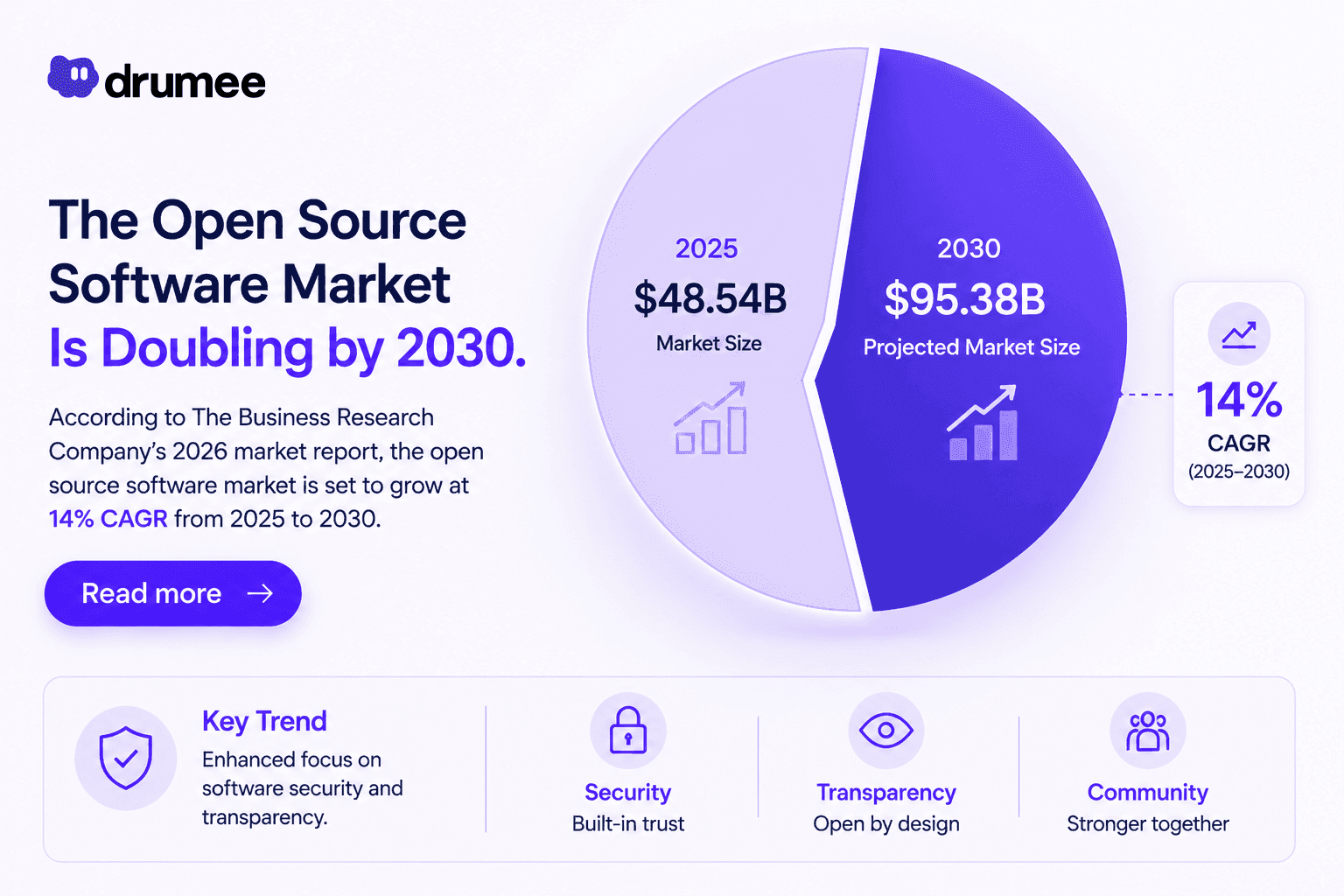
The EU AI Act's full enforcement from August 2, 2026 creates an explicit requirement for high-risk AI systems to have documented data governance and auditable AI decision-making. For organizations using collaboration platforms with embedded AI features, the AGPL-licensed self-hosted model provides exactly the audit trail that the AI Act requires: the code governing AI processing is in the repository, accessible to any user under the license terms. A proprietary SaaS platform's AI implementation is not. The Business Research Company's 2026 market report identifies open source software market growth from $48.54 billion in 2025 to a projected $95.38 billion by 2030 at a 14% CAGR, with major trends including enhanced focus on software security and transparency. That growth is the market's response to an environment where transparency is becoming a legal requirement rather than a preference.
For teams evaluating self-hosted collaboration platforms in 2026, the AGPL license is the property that converts the open source value proposition from a cost argument into a sovereignty guarantee. The code is auditable. The rights are permanent. The infrastructure is yours. And the legal framework that governs all three is designed explicitly to protect the organization using the software rather than the vendor distributing it.
FAQ
1/ What is a self-hosted collaboration platform with open source licensing?
A self-hosted collaboration platform with open source licensing is a collaborative workspace, covering files, communication, tasks, and permissions, that runs on infrastructure the organization administers directly, using software whose source code is publicly available and modifiable under an open source license. AGPL-licensed platforms additionally guarantee that all modifications, including those made to network-deployed versions, must remain publicly accessible.
2/ What does AGPL mean for organizations using self-hosted collaboration software?
AGPL means the organization can audit the source code governing every aspect of the platform's behavior, modify the software without restriction, and self-host it with full rights intact. Any modified version deployed over a network must publish its source code under the same terms. This closes the loophole that allowed cloud providers to take open source code, add proprietary modifications, and deploy a commercial service with no obligation to publish those modifications.
3/ Why does the AGPL license matter more than other open source licenses for sovereignty?
MIT and Apache 2.0 licenses permit proprietary modifications and closed-source commercial services built on open source foundations. AGPL does not. Every version of an AGPL-licensed collaboration platform, including all modifications and network-deployed variants, must remain open and auditable. This makes sovereignty a legally enforceable guarantee rather than a preference that vendors can choose to honor or not honor over time.
4/ What do the 2026 open source adoption statistics show about self-hosted collaboration?
OpenLogic's 2026 State of Open Source Report found that 98% of organizations increased or maintained OSS usage in the past year, with avoiding vendor lock-in cited by 55% of respondents as a primary motivator, a 68% year-over-year increase. In Europe and the UK, nearly two-thirds of organizations cite vendor lock-in concerns as a primary driver. The open source software market reached $48.54 billion in 2025 and is projected to reach $95.38 billion by 2030.
5/ How does Drumee use AGPL licensing to guarantee sovereignty?
Drumee is licensed under AGPLv3, meaning its full source code is auditable, the organization deploying it can modify it without restriction, and no future commercial decision by Drumee's developers can retroactively restrict the rights the license currently confers. Combined with self-hosted infrastructure, this makes Drumee's sovereignty guarantee legally enforceable through the license itself rather than dependent on contractual commitments from a vendor.
Related article: Enterprise Data Residency Requirements: A Plain-Language Guide for CTOs
------------------------------
About Drumee
Drumee is the world’s first unified sovereign data infrastructure: a self-hosted, OS-like workspace that turns your own filesystem into a private collaborative environment.
Fully under your control, Drumee combines files, chat, tasks, and workflows with enterprise-grade permissions built directly into the infrastructure layer. No cloud vendors. No fragmented SaaS stack. No operational dependency.
Instead of renting your workspace from external providers, Drumee allows organizations to own the environment where operational knowledge lives.
Your Data. Your Workflow. One system. Built to be yours!
Follow us at: Website | X | LinkedIn | Drumee Founder X | Drumee Founder LinkedIn
Keep reading
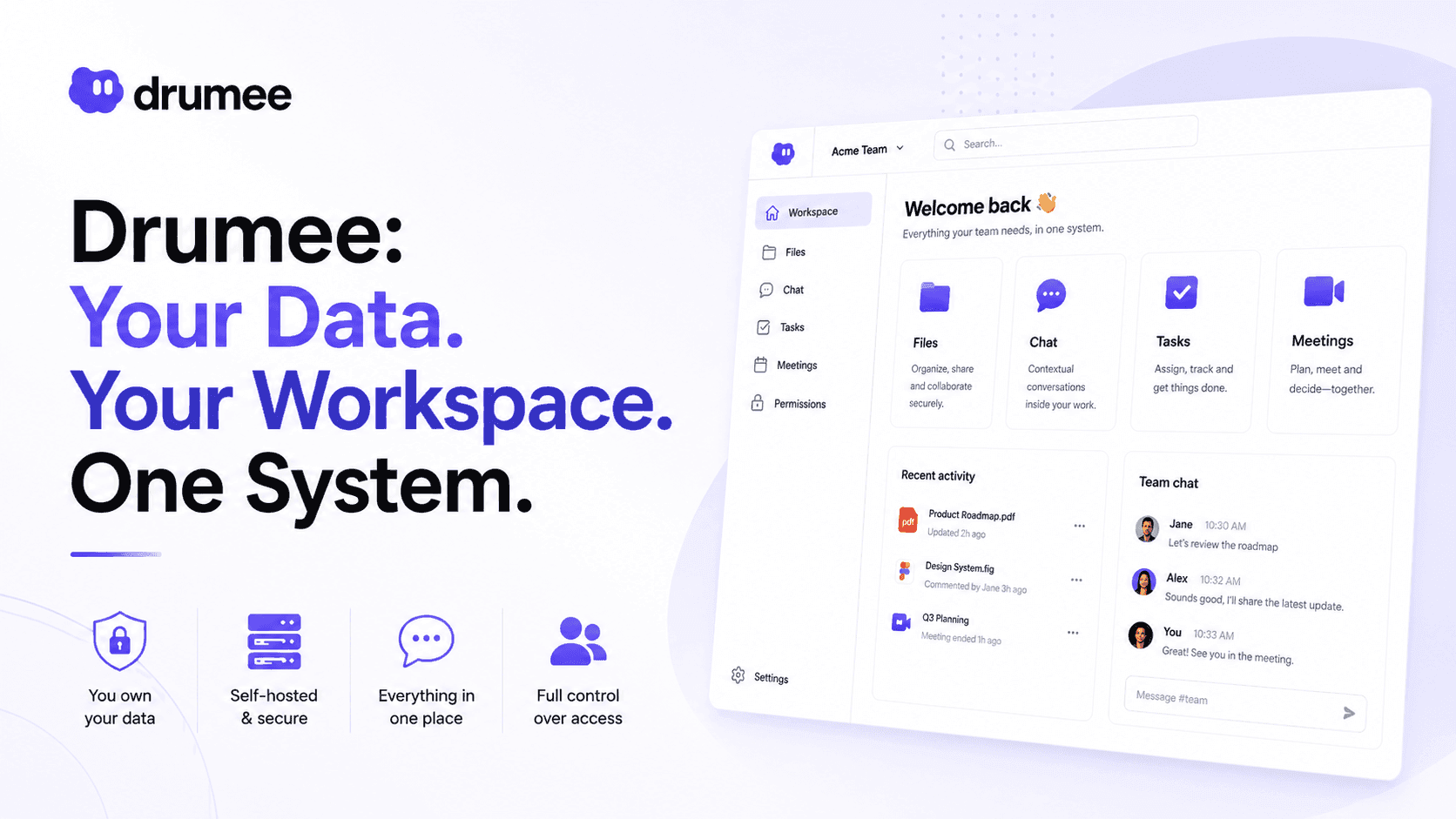
Drumee: Your Data. Your Workspace. One System
Drumee is a self-hosted, sovereign data workspace where files, chat, tasks, and permissions live in one place on infrastructure you own. Learn what Drumee is, what it stands for, and how to get started.
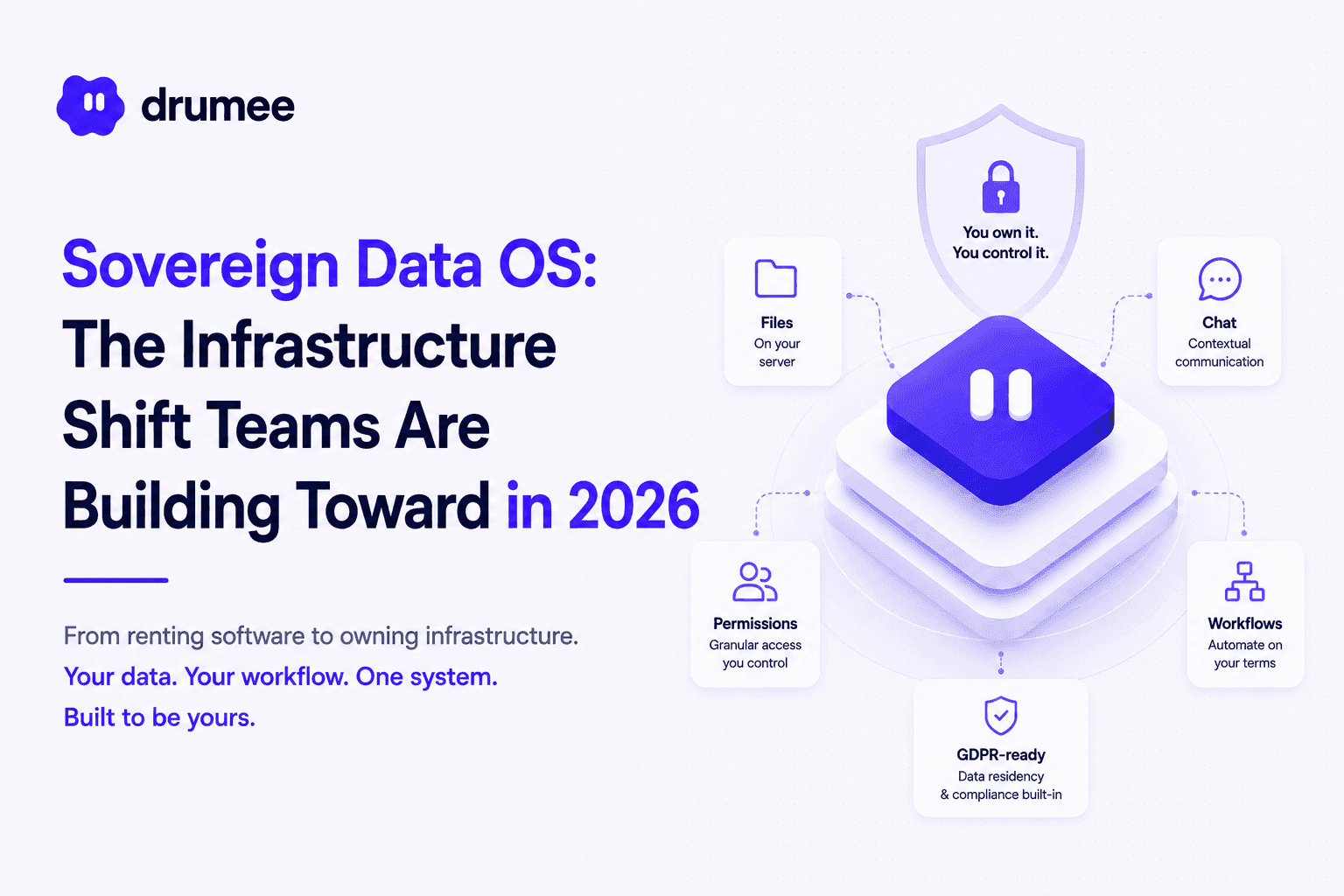
What Is a Sovereign Data OS? The Infrastructure Shift Teams Are Building Toward in 2026
What is a sovereign data OS? Learn how Drumee's unified self-hosted infrastructure replaces fragmented SaaS stacks with a single governable environment for files, chat, permissions, and workflows in 2026.
Data Ownership: What It Means and How to Achieve It in 2026
What is data ownership and how do you actually achieve it? Learn the three layers of data control, why AI changes the stakes, and how self-hosted infrastructure gives teams genuine ownership in 2026.