
Enterprise Data Residency Requirements: A Plain-Language Guide for CTOs
Enterprise data residency requirements in 2026 go beyond choosing a EU cloud region. With the CLOUD Act creating sovereignty gaps and AI processing extending residency obligations, here is the plain-language framework CTOs need.
Enterprise Data Residency Requirements: A Plain-Language Guide for CTOs
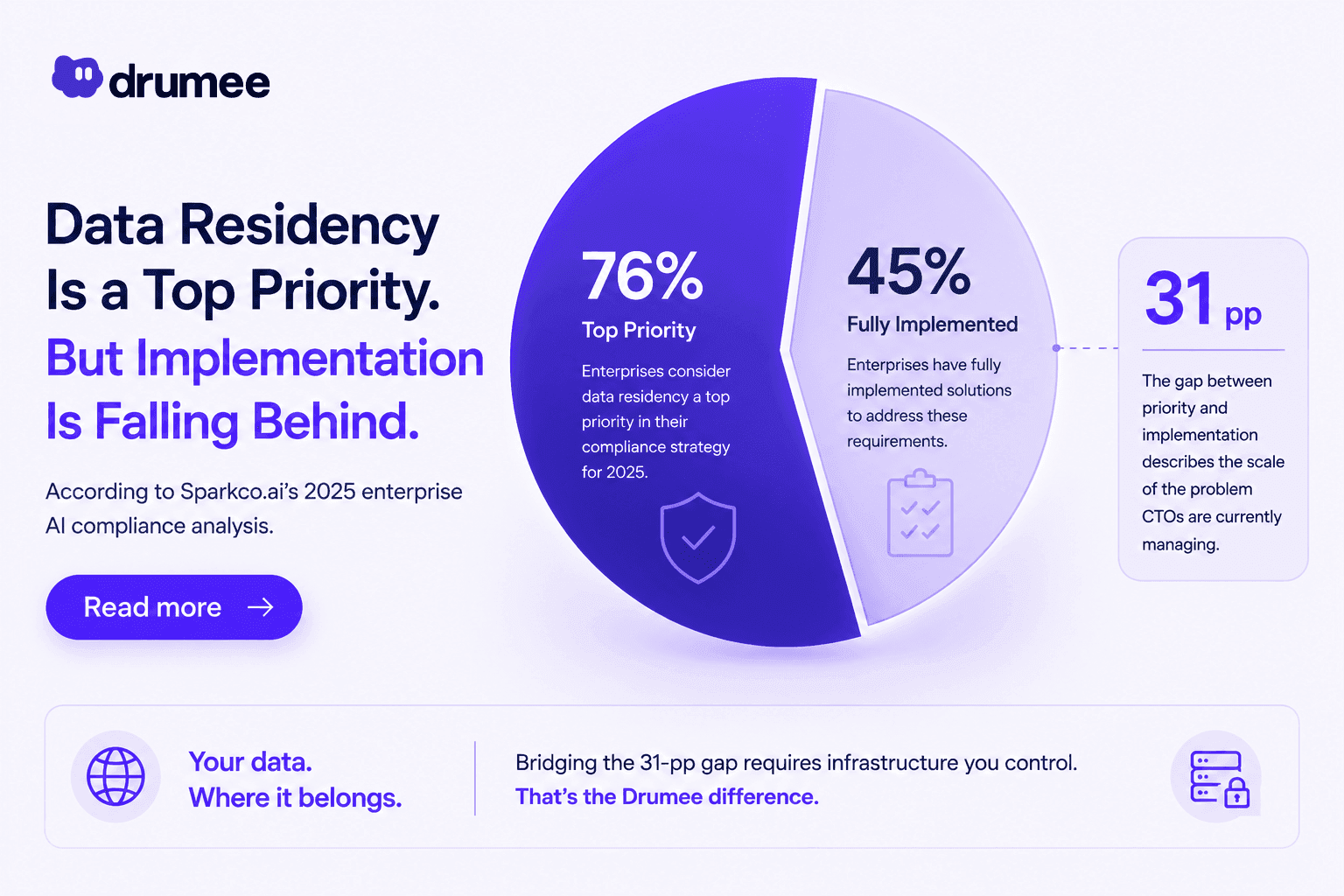
Enterprise data residency requirements are the legal, regulatory, and contractual obligations that specify where an organization's data must be physically stored and processed, which jurisdictions govern that storage and processing, and what infrastructure controls are necessary to demonstrate that those conditions are met in practice rather than in policy documents alone. For CTOs, the data residency question has evolved from a compliance checkbox into a strategic infrastructure decision, because the gap between formal compliance with data residency requirements and genuine sovereignty over the infrastructure where that data lives has become the precise dimension that regulators and enterprise customers are now evaluating under scrutiny. According to Sparkco.ai's enterprise AI compliance analysis, 76% of enterprises consider data residency a top priority in their compliance strategy for 2025, but only 45% have fully implemented solutions to address these requirements. That 31-percentage-point gap between priority and implementation describes the scale of the problem CTOs are currently managing.
The Distinction That Most Teams Miss: Residency vs Sovereignty
The single most important concept for CTOs to understand about enterprise data residency requirements in 2026 is the distinction between data residency and data sovereignty. Most organizations conflate the two. Regulators, increasingly, do not.
Data residency is a geographic condition: your data is stored on servers physically located within a specific jurisdiction. A EU-region bucket in AWS, a Frankfurt datacenter choice in Google Workspace, a German-region selection in Microsoft 365. These are residency configurations. They specify where the bytes sit on disk. They do not specify who holds the authority to access those bytes, under which legal framework that access occurs, or whether a foreign government can compel the infrastructure operator to produce data that crosses a jurisdictional boundary.
Lyceum Technology's February 2026 guide to EU data residency for AI infrastructure identifies the most common and consequential misconception among CTOs and AI leads: many assume that using a European region of a US-based hyperscaler satisfies residency requirements. It does not. The US CLOUD Act allows US law enforcement to compel American companies to provide access to data stored abroad. If your provider is headquartered in the United States, your data is subject to US jurisdiction, even if the servers are in Frankfurt or Zurich. The analysis calls this the Sovereignty Gap, and notes it can lead to catastrophic compliance failures. According to a 2025 Fortune Business Insights report cited in the same analysis, the global sovereign cloud market is projected to reach $195.35 billion in 2026, with Europe leading adoption. That market growth reflects the scale of organizational reckoning with the Sovereignty Gap.
Lyceum's analysis also documents the Gartner finding from late 2025 that 61% of Western European CIOs are now prioritizing local cloud providers specifically to mitigate these geopolitical risks. The shift is framed precisely: moving from data residency, where the data sits, to technical sovereignty who controls the stack. That shift in framing is the lens through which CTOs need to evaluate every infrastructure decision in 2026.
The Regulatory Framework CTOs Need to Map
The regulatory landscape governing enterprise data residency requirements in 2026 is the most complex and rapidly expanding in the history of cloud infrastructure governance. CTOs who are making infrastructure decisions today need to understand four overlapping regulatory dimensions simultaneously.
The first dimension is GDPR and its cross-border transfer framework. PreMai's comprehensive regional compliance guide documents the current state: GDPR cross-border transfers require Standard Contractual Clauses, Binding Corporate Rules, or adequacy decisions. The EU-US Data Privacy Framework currently allows transfers to certified US companies, but legal challenges are expected under what practitioners are already calling Schrems III. The EU AI Act became fully applicable for high-risk systems on August 2, 2026, with penalties reaching 7% of global annual turnover, exceeding the maximum GDPR penalty level. For CTOs whose organizations use AI systems in any capacity that touches EU personal data, this is the regulatory ceiling that now governs infrastructure decisions.
The second dimension is the expanding global data localization landscape. Security Boulevard's December 2025 analysis of the global data residency crisis maps the accelerating trend: India's DPDPA is expanding local storage requirements; Indonesia mandates local data centers for specific data categories; Vietnam's Cybersecurity Law requires local storage of user data; Saudi Arabia's PDPL from September 2024 includes data residency provisions. The report's operational implication for CTOs is direct: organizations need architectural flexibility to add new regions within 6 to 12 months of regulatory changes. Static architectures become compliance liabilities. A cloud infrastructure configuration that satisfied residency requirements in 2023 may not satisfy them in 2026 for a specific data category or jurisdiction, and the organization's ability to adapt depends entirely on whether it has direct administrative authority over its infrastructure or is dependent on a vendor's roadmap for new regional configurations.
The third dimension is sector-specific frameworks. QuestSys's March 2026 data residency compliance guide identifies the trend of countries like China, Russia, India, and Saudi Arabia enforcing data localization laws that go beyond residency to require that specific types of data, including financial records, personal identifiers, and biometric data, be stored and processed only within national borders. For CTOs in financial services, healthcare, or any sector processing regulated data categories, these sector-specific localizations create nested compliance obligations that stack on top of general data protection frameworks.
The fourth dimension is the AI processing complication. The intersection of AI and data residency presents what Security Boulevard describes as unprecedented challenges: ML models trained on EU user authentication patterns raise the question of whether training data must remain in the EU. Fraud detection models that learn from global patterns cannot legally aggregate cross-border data. EU AI Act explainability requirements for automated decisions create documentation obligations that are difficult to satisfy when the model training data has moved across jurisdictional boundaries. For CTOs, the AI dimension means that data residency is no longer a question about where storage buckets are located. It is a question about where every stage of AI data processing occurs and which legal framework governs that processing.
Why Cloud Vendor Residency Options Are Not the Complete Answer
Major cloud providers have invested significantly in sovereign cloud and regional data residency offerings in response to the regulatory environment. AWS launched its European Sovereign Cloud through a German-incorporated entity (AWS European Sovereign Cloud GmbH) in January 2026. Microsoft 365 offers Advanced Data Residency as an enterprise add-on covering expanded data categories. Google Workspace provides data residency configuration for EU-based storage. These offerings are genuine improvements over default configurations, and for organizations with limited technical capacity to manage self-hosted infrastructure, they represent meaningful compliance investments.
However, they carry a structural limitation that CTOs need to understand before treating them as a complete residency solution. As Stratokey's analysis of the data residency versus data sovereignty distinction notes, the EU-US Data Privacy Framework survived its first legal challenge in September 2025, but a broader challenge is expected, and Schrems II established that Standard Contractual Clauses require a case-by-case assessment of whether US law provides equivalent protections. Even AWS's European Sovereign Cloud, while structured as a German legal entity, still operates within a hyperscaler ecosystem where the ultimate corporate ownership, legal jurisdiction over the parent company, and terms of service are defined by a US-headquartered organization.
The vendor residency configuration controls where your data is stored. It does not control whether a legal proceeding in a non-EU jurisdiction can compel the vendor to produce that data. For CTOs in regulated industries, this is not a theoretical risk to discount. It is a specific and identifiable compliance gap that auditors are increasingly asking organizations to address in their technical documentation rather than their contractual arrangements.
The Architecture Decisions That Actually Resolve Enterprise Data Residency
For CTOs who have completed an honest analysis of their organization's data residency requirements and the infrastructure conditions those requirements actually impose, three architectural approaches represent genuine resolution rather than partial compliance.
The first is single-tenant dedicated cloud infrastructure hosted within a specific jurisdiction and operated by a local entity not subject to foreign government access demands. This is the architecture that AWS's European Sovereign Cloud attempts to provide, and it is the strongest residency solution within the hyperscaler ecosystem, though its CLOUD Act exposure remains a subject of legal uncertainty. For CTOs who need the strongest available contractual assurance within the managed cloud model, this represents the current ceiling.
The second is self-hosted infrastructure deployed in jurisdiction-specific data centers, where the organization operates the full stack directly. This eliminates the CLOUD Act exposure entirely because there is no US-headquartered vendor in the processing chain. It provides the organizational control over encryption key management, access audit trails, AI processing governance, and residency evidence that cloud configurations approximate through contractual coverage. The operational trade-off is internal infrastructure management, which in 2026 has become substantially more accessible through Docker containerization, managed VPS providers with EU jurisdiction guarantees, and open source collaboration infrastructure like Nextcloud.
The third is sovereign workspace platforms that unify file storage, communication, permissions, and workflows inside a self-hosted environment the organization directly administers. This approach addresses the governance gap that arises when cloud residency configurations for storage coexist with communication and workflow tools that have no data residency guarantees. According to Secure Privacy's 2026 data residency requirements analysis, European data protection authorities are averaging 443 personal data breach notifications per day in 2026, a 22% year-over-year increase, with violations involving special category data as a leading driver of maximum penalties. The organizations contributing to that figure are not primarily organizations that had no data residency policy. They are organizations whose data residency configuration did not extend to the full operational context where sensitive data was actually processed.
The CTO Decision Frameork
For CTOs making enterprise data residency decisions in 2026, a practical decision framework requires answers to five specific questions before selecting infrastructure architecture.
First: what data categories does your organization process, and which jurisdictions impose mandatory localization requirements for those categories? Financial data, personal identifiers, health data, and biometric data each trigger different residency requirements in different jurisdictions. The answer to this question determines which regulatory frameworks govern your infrastructure.
Second: are your current cloud providers US-headquartered? If yes, the CLOUD Act creates a jurisdictional exposure for EU-stored data that no data processing agreement resolves. CTOs responsible for EU personal data need to document this exposure and either accept it with appropriate legal analysis or address it through non-US infrastructure.
Third: does your AI processing pipeline touch data subject to localization requirements? If yes, the AI processing location, training data jurisdiction, and model inference environment all fall within the data residency analysis. Residency configuration at the storage layer does not automatically extend to the AI processing layer.
Fourth: can your organization produce independent evidence of data residency compliance without vendor cooperation? If your residency evidence depends on your vendor's audit logs, compliance reports, and data center attestations, your evidence chain includes a dependency that regulators may scrutinize. Organizations that administer their own infrastructure can produce that evidence independently.
Fifth: is your residency architecture static or adaptable? The jurisdictions adding data localization requirements in 2026 include India, Indonesia, Vietnam, and Saudi Arabia, and more will follow. A configuration that satisfies 2026 requirements may not satisfy 2028 requirements for organizations expanding into new markets. Self-hosted infrastructure can adapt to new residency requirements through hosting choices the organization makes directly. Vendor-hosted infrastructure adapts on the vendor's roadmap timeline.
Drumee's sovereign data OS architecture addresses each of these questions at the infrastructure layer rather than the contractual one: files, communications, permissions, and task context exist in a single self-hosted environment the organization administers, with data residency determined by the organization's hosting choices, compliance evidence producible from organizational systems, and AI processing governance defined by the organization's own infrastructure boundary rather than a vendor's terms of service.
FAQ
1/ What are enterprise data residency requirements?
Enterprise data residency requirements are legal, regulatory, and contractual obligations specifying where an organization's data must be physically stored and processed, which jurisdictions govern that data, and what infrastructure controls demonstrate those conditions are met. They arise from frameworks including GDPR, the EU AI Act, sector-specific regulations like DORA and HIPAA, and national data localization laws in jurisdictions including India, Indonesia, Vietnam, and Saudi Arabia.
2/ What is the difference between data residency and data sovereignty?
Data residency specifies where data is physically stored. Data sovereignty specifies who controls the infrastructure and under which legal jurisdiction access is governed. A US-headquartered cloud provider can host data in EU data centers satisfying residency, while the US CLOUD Act still allows US law enforcement to compel that provider to produce EU-stored data, creating a Sovereignty Gap that residency configuration alone cannot close.
3/ Does choosing a European AWS or Google Cloud region satisfy GDPR data residency?
It satisfies the geographic storage requirement. It does not resolve the CLOUD Act exposure, because AWS and Google are US-headquartered companies subject to US government access demands regardless of where servers are located. EU regulators and Gartner have documented this gap, with 61% of Western European CIOs now prioritizing local cloud providers specifically to mitigate it.
4/ Why do AI systems complicate data residency requirements in 2026?
The EU AI Act, fully applicable August 2, 2026, requires documented data governance for high-risk AI systems with penalties reaching 7% of global annual turnover. AI processing introduces residency questions beyond storage: training data location, inference environment jurisdiction, and explainability documentation for cross-border federated models. Residency configuration at the storage layer does not automatically cover the AI processing layer.
5/ How does Drumee address enterprise data residency requirements?
Drumee is a sovereign data OS deployed on infrastructure the organization administers directly, with data residency determined by the organization's choice of hosting provider and jurisdiction. Files, communications, and workflow data exist in a single self-hosted environment with no US-headquartered vendor in the processing chain, eliminating CLOUD Act exposure. Compliance evidence is organizationally produced rather than vendor-dependent.
Related article: Own Your Data Workspace: What Real Ownership Looks Like
------------------------------
About Drumee
Drumee is the world’s first unified sovereign data infrastructure: a self-hosted, OS-like workspace that turns your own filesystem into a private collaborative environment.
Fully under your control, Drumee combines files, chat, tasks, and workflows with enterprise-grade permissions built directly into the infrastructure layer. No cloud vendors. No fragmented SaaS stack. No operational dependency.
Instead of renting your workspace from external providers, Drumee allows organizations to own the environment where operational knowledge lives.
Your Data. Your Workflow. One system. Built to be yours!
Follow us at: Website | X | LinkedIn | Drumee Founder X | Drumee Founder LinkedIn
Keep reading
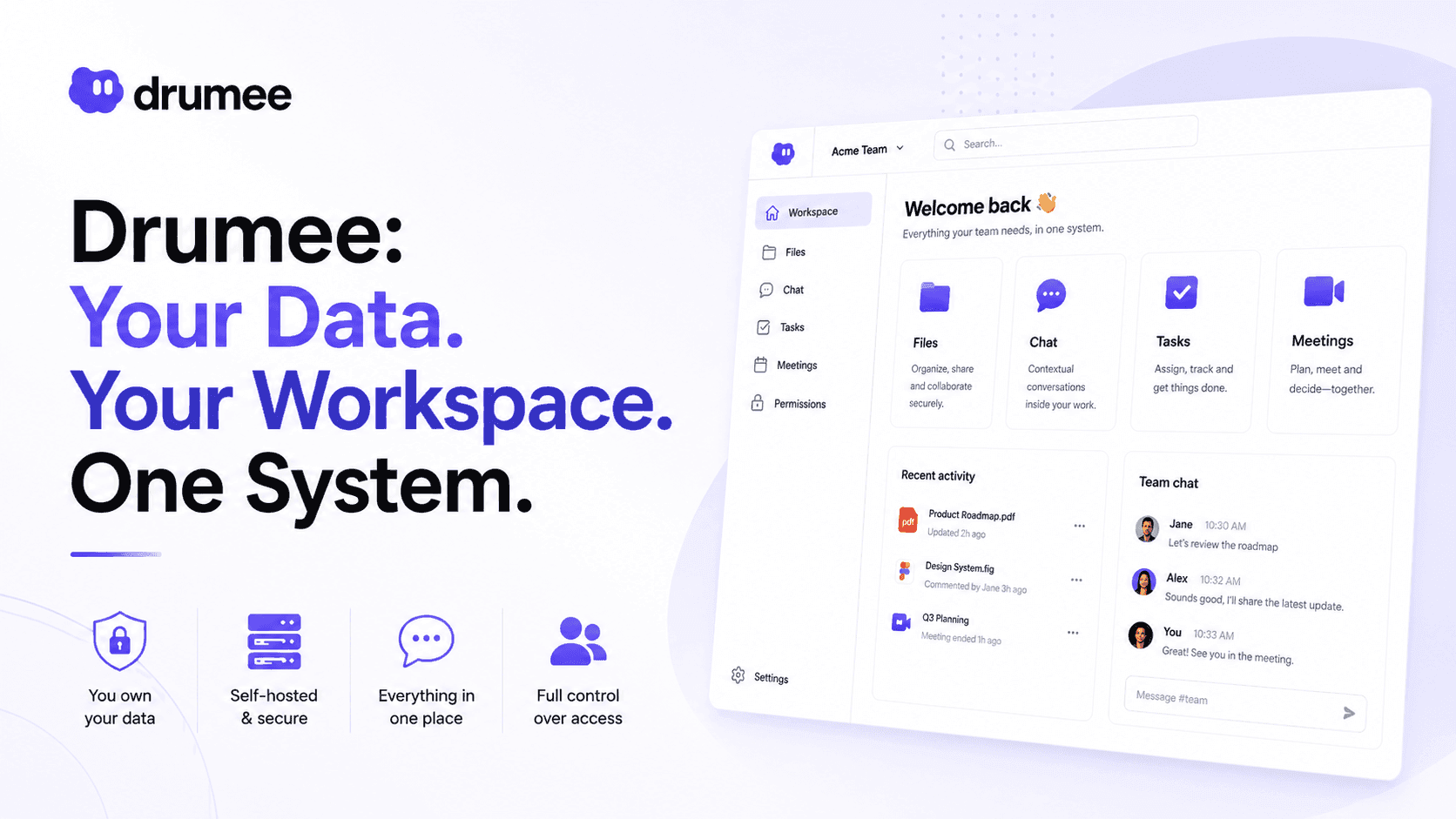
Drumee: Your Data. Your Workspace. One System
Drumee is a self-hosted, sovereign data workspace where files, chat, tasks, and permissions live in one place on infrastructure you own. Learn what Drumee is, what it stands for, and how to get started.
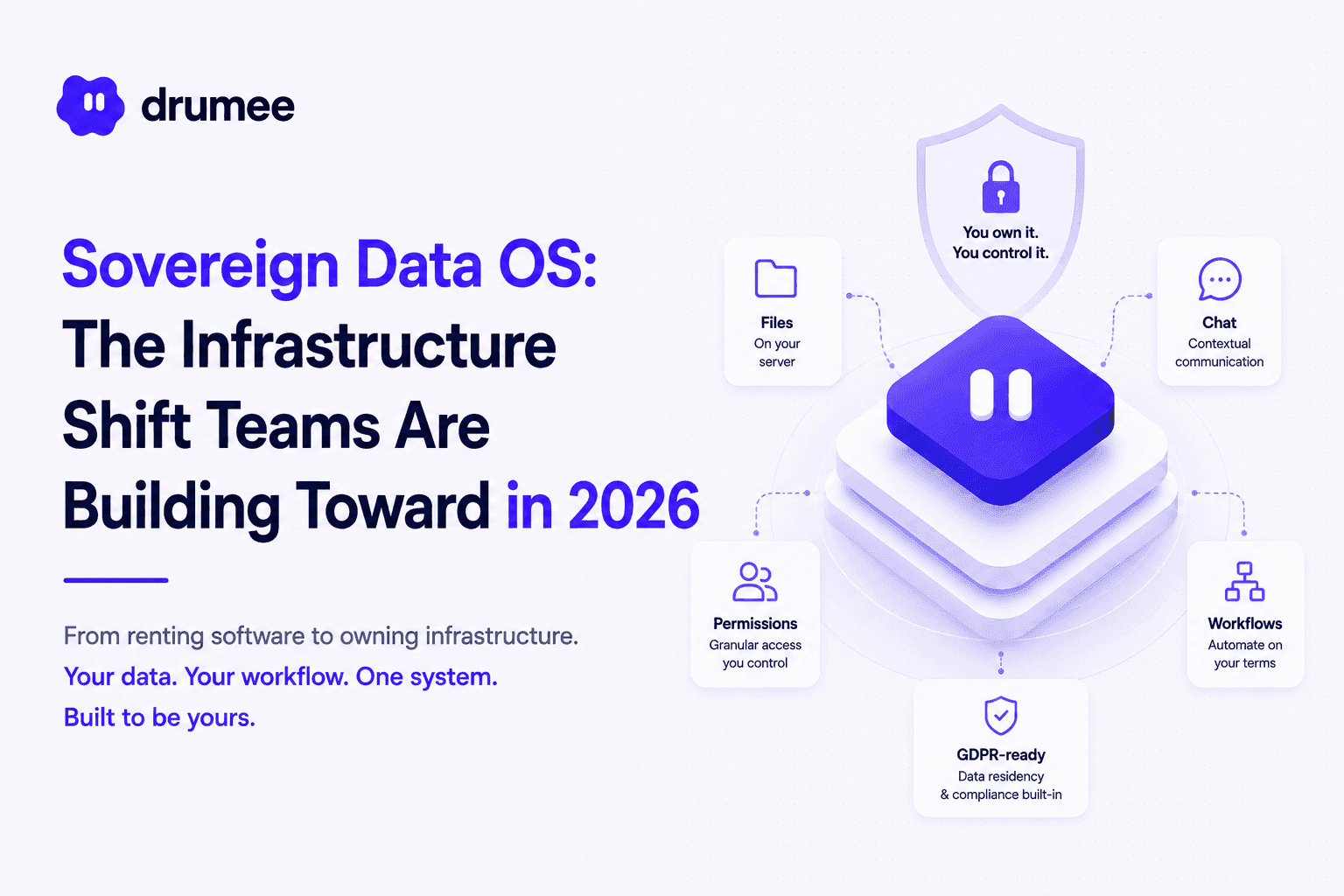
What Is a Sovereign Data OS? The Infrastructure Shift Teams Are Building Toward in 2026
What is a sovereign data OS? Learn how Drumee's unified self-hosted infrastructure replaces fragmented SaaS stacks with a single governable environment for files, chat, permissions, and workflows in 2026.
Data Ownership: What It Means and How to Achieve It in 2026
What is data ownership and how do you actually achieve it? Learn the three layers of data control, why AI changes the stakes, and how self-hosted infrastructure gives teams genuine ownership in 2026.