
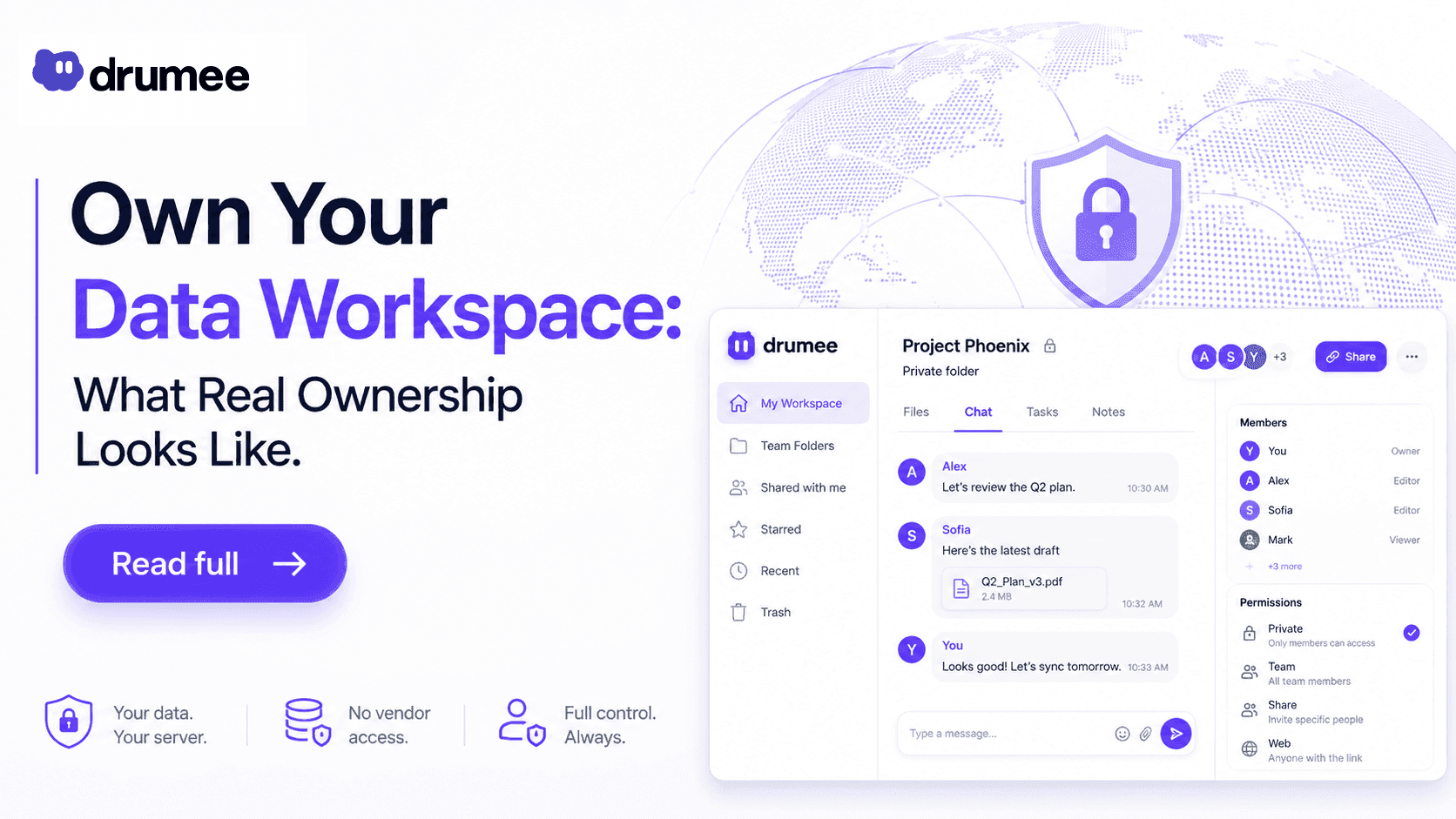
Own Your Data Workspace: What Real Ownership Looks Like
Own your data workspace means more than good SaaS terms. In 2026, with Nextcloud on 500,000 servers and self-hosting growing at 18.5% annually, here is what real operational ownership of your team's workspace actually looks like.
Own Your Data Workspace: What Real Ownership Looks Like
Owning your data workspace means operating a collaborative environment where your team's files, conversations, tasks, and permissions exist on infrastructure your organization directly administers, where the pricing model is determined by your hosting choices rather than a vendor's roadmap, and where the governance boundary of your operational data is defined by your own administrative decisions rather than a third party's terms of service. It is a different condition from what most organizations currently have, which is access to a workspace on infrastructure a vendor administers. The gap between those two conditions, between owning a workspace and accessing one, is exactly the gap that is widening in 2026 as SaaS pricing escalates, AI processing deepens, and regulatory frameworks begin demanding that organizations demonstrate actual infrastructure control rather than contractual coverage. According to Elestio's 2026 analysis of the SaaS exodus, Nextcloud alone now runs on over 500,000 servers worldwide, with customer interest tripling in the first five months of 2025, and the self-hosting market is projected to reach $85.2 billion by 2034 growing at 18.5% annually. That trajectory is not driven by teams who enjoy managing servers. It is driven by organizations that have made a clear-eyed comparison between what they were told they owned and what they actually controlled.
The Access Illusion in Most Team Workspaces
The most important conceptual shift in understanding what it means to own your data workspace is recognizing that the legal assurances cloud platforms provide about content ownership are not the same as the operational conditions that make ownership meaningful in practice.
Every major SaaS workspace platform, whether Google Workspace, Notion, Slack, or Microsoft 365, grants the customer nominal ownership of uploaded content. The terms of service typically state that the customer's data is the customer's data, that the vendor does not claim intellectual property rights over it, and that the customer can export it. Those assurances are genuine as far as they go. They do not describe infrastructure control. They describe content license.
According to DEV Community's April 2026 self-hosting analysis, when you self-host your workspace, your data is never trapped behind a company's pricing model or policy changes. You decide when to upgrade, migrate, or shut things down. The author's framing is precise: it feels less like renting a digital apartment and more like owning your own place. That analogy captures the ownership gap exactly. A renter has legal rights to use a space and is protected by contract. An owner has administrative authority over the space itself. The distinction is not primarily financial. It is about who makes the decisions. A renter absorbs the decisions of a landlord they did not choose and cannot replace. An organization using cloud workspace infrastructure absorbs the decisions of a vendor in the same way: pricing changes, AI feature rollouts, terms of service updates, API deprecations, and data processing policy modifications all affect the organization's operational environment without the organization's input or consent.
Robin Hossain's January 2026 analysis of the shift toward self-hosted workspaces puts the fragmentation cost in quantifiable terms: in 2026, the average small agency or startup uses between 10 and 15 different SaaS tools daily, paying $300 per month for a 10-person team, or $3,600 per year, just to maintain the operational stack. That cost is the subscription fee alone. It does not include the productivity cost of context switching between disconnected systems, the governance cost of managing compliance evidence across multiple vendor-controlled environments, or the strategic cost of institutional knowledge accumulating in proprietary formats that become progressively more difficult to migrate.
The Four Conditions That Define Real Ownership
Owning your data workspace in the operational sense that matters in 2026 requires four conditions to be in place simultaneously, and they are conditions that SaaS platforms structurally cannot provide regardless of their contractual terms.
The first condition is infrastructure administration. Your team must be able to administer the servers, databases, and network configuration that the workspace runs on directly, not through a vendor's admin console that exposes a subset of configuration options the vendor has decided to surface. When the underlying infrastructure is yours, you can audit it, modify it, migrate it, and decommission it on your own timeline without vendor cooperation or approval.
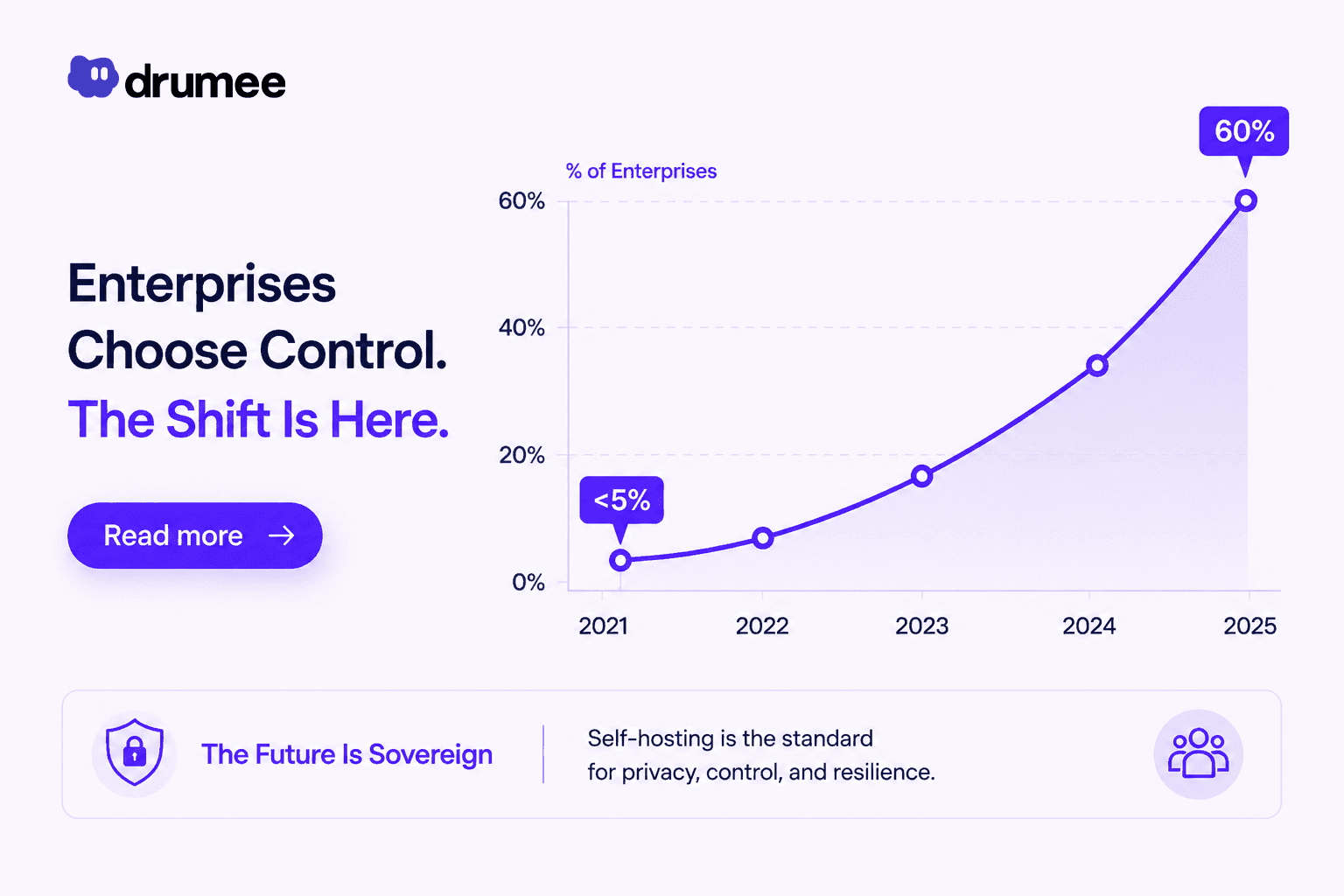
The second condition is pricing autonomy. The cost of your workspace should be determined by the infrastructure resources it consumes, which you select and provision, rather than by per-seat models that escalate with headcount, AI feature bundles that apply regardless of whether your team uses them, and pricing decisions made by a vendor whose incentives at renewal time are specifically misaligned with your cost-minimization interests. According to Gartner's research cited in AppFlowy's 2025 self-hosting guide, by 2025 60% of enterprises were predicted to adopt self-hosting for privacy-enhancing computing, up from under 5% in 2021, reflecting the mainstream recognition that vendor pricing leverage compounds in ways that become organizationally significant over multi-year time horizons.
The third condition is AI governance boundary. As AI systems become embedded in productivity platforms, your organization must be able to define which AI systems access which operational content, under what governance, and with what retention policy. In self-hosted workspace infrastructure, this boundary is yours to define because the infrastructure is yours. In cloud-hosted workspace infrastructure, the AI governance boundary is the vendor's to define because the infrastructure is theirs. According to Mentiko's March 2026 self-hosted AI agents guide, three forces converged in 2025 and 2026 that made self-hosting shift from "nice to have" to "necessary" for growing numbers of teams: data sovereignty regulations gained enforcement teeth, the EU AI Act entered full enforcement, and the Brazil LGPD and India DPDP Act expanded the geographic scope of the mandate. The guide's observation is precise: "somewhere in us-east-1 on a shared cluster" no longer satisfies auditors.
The fourth condition is governance evidence portability. When a regulator, client, or internal audit asks your organization to demonstrate who accessed which data, when, and under what authorization, the evidence must come from systems your organization administers. In cloud-hosted workspaces, audit logs are available through the vendor's interface and backed by the vendor's systems. The evidence's completeness and integrity are functions of the vendor's implementation. In self-hosted workspaces, audit logs are in your infrastructure. The evidence is yours to produce, verify, and present without requiring vendor intermediation.
What the Regulatory Environment Is Now Demanding
The regulatory pressure reinforcing these four ownership conditions in 2026 is not hypothetical. It is enforcement-level and financially consequential.
IOMETE's January 2026 analysis of the enterprise shift to self-hosted infrastructure frames the regulatory convergence precisely: the EU Digital Operational Resilience Act became enforceable in January 2025 and demands proof that organizations control operational resilience and that third-party ICT providers are contractually bound with demonstrated service continuity capability. The EU AI Act reaches full enforcement in August 2026, with penalties up to 7% of global annual turnover for violations. The analysis notes directly that SaaS platforms, by design, do not give organizations the operational control that 2026 regulations now demand.
PHPFox's April 2026 analysis of data ownership stakes identifies the practical meaning of this regulatory direction: true ownership means an organization is not restricted by platform limitations, is not at risk of losing access due to policy changes, and is not forced to operate within rules that do not align with how it wants to build and grow. When an organization has full data control, its workspace stops being just a place where work happens and starts becoming a real operational asset, something the organization can understand deeply, optimize continuously, and govern on its own terms.
The operational risk of not having this is no longer diffuse. According to DEV Community's self-hosting guide, when organizations use SaaS products they agree to terms that give the provider broad rights to access and analyze data, and in 2026 AI companies increasingly train models on user data by default. Self-hosting eliminates this exposure entirely. For businesses under GDPR, HIPAA, or data sovereignty laws, self-hosting simplifies compliance by resolving it at the architecture level rather than managing it through a chain of vendor agreements whose enforceability in all circumstances is not guaranteed.
What Real Workspace Ownership Looks Like on Day One and Year Three
The practical difference between owning a workspace and accessing one becomes most visible at two specific points in an organization's operational timeline: the day a governance event occurs, and the three-year mark when compounding costs and dependencies reach the scale that makes the comparison concrete.
On the day a governance event occurs, a GDPR data subject request, a HIPAA audit, a client data security inquiry, a legal discovery request, an organization that owns its workspace can respond from its own infrastructure. Audit logs are pulled from systems the organization administers. Data access records are complete and organizationally verifiable. Deletion confirmations, including from backup systems, are actions the organization takes directly rather than requests the organization makes to a vendor.
An organization accessing cloud workspace infrastructure faces the same governance event from a fundamentally different position. The evidence is in the vendor's systems. Accessing it requires the vendor's interface. Its completeness is the vendor's implementation. Deletion confirmations for backup systems require the vendor's confirmation. The organizational response to the governance event is mediated by a third party whose cooperation is necessary but not guaranteed to be unconditional.
At the three-year mark, the cost comparison between owned and accessed workspace infrastructure has compounded in ways that early-stage assessments typically do not capture. Elestio's 2026 SaaS exodus analysis cites infrastructure starting at $16 per month for managed self-hosted deployments covering the full collaboration stack. The equivalent capability in commercial SaaS, covering file storage, team messaging, documentation, and task management for a growing team, has compounded through Google's 17 to 22% price increases in 2025, Notion's AI tier restructuring, and Slack's Enterprise Grid lock-in dynamics to a point where the three-year cost comparison is not marginal. It is decisive for any organization that has done the arithmetic.
The Unified Infrastructure That Completes the Ownership Condition
The limitation of owning individual self-hosted tools is the same limitation that applies to owning disconnected cloud tools: governance fragmentation. A team that self-hosts Nextcloud for file storage, Mattermost for communication, and a separate project management platform for task workflow has resolved the ownership question for each layer individually without resolving it for the operational environment as a whole. Audit trails across these systems are separate. Permission models are inconsistent. Compliance evidence requires reconciliation across multiple systems that were not designed to produce a unified record.
Drumee's sovereign data OS architecture addresses this by unifying files, communications, permissions, and task context inside a single self-hosted environment where the ownership condition extends across the full operational surface. There is no governance gap between the file storage layer and the communication layer. The audit trail is coherent because the infrastructure is coherent. The AI processing boundary is consistent because there is one infrastructure boundary, not three or four.
For organizations asking what real ownership of their data workspace looks like, the answer has become specific enough in 2026 to describe precisely. It looks like infrastructure you administer, costs you determine, AI governance you define, and evidence you produce, from systems that are yours, on servers you operate, under policies you set. Everything else is access with a favorable license agreement.
FAQ
1/ What does it mean to own your data workspace?
Owning your data workspace means operating a collaborative environment on infrastructure your organization directly administers, with pricing determined by your hosting choices, AI governance boundaries defined by your own policies, and compliance evidence producible from your own systems without vendor intermediation. It is distinct from accessing a workspace on vendor-hosted infrastructure where the vendor makes the administrative decisions.
2/ Why is owning your workspace different from having good SaaS terms of service?
SaaS terms of service grant content license, not infrastructure control. A vendor can acknowledge your ownership of uploaded content while retaining administrative authority over the servers where it lives, the AI systems that process it, the pricing model that governs access, and the governance terms that change when the vendor updates its policies. Operational ownership requires controlling the infrastructure, not just the content rights.
3/ How much does it cost to own your workspace infrastructure in 2026?
Managed self-hosted infrastructure covering the full collaboration stack starts at approximately $16 per month according to Elestio's 2026 analysis, versus $300 per month or more for equivalent SaaS tools for a 10-person team on per-seat pricing. Nextcloud runs on over 500,000 servers worldwide with the self-hosting market projected to reach $85.2 billion by 2034.
4/ Why do regulatory frameworks make workspace ownership more urgent in 2026?
The EU Digital Operational Resilience Act (enforceable January 2025), EU AI Act (full enforcement August 2026), and equivalent data sovereignty regulations globally now require organizations to demonstrate direct operational control over their data processing environments. The fines for violations reach 7% of global annual turnover for AI Act breaches. SaaS platforms, by design, do not provide the operational control these frameworks now require.
5/ How does Drumee represent genuine workspace ownership?
Drumee is a sovereign data OS that unifies files, communications, permissions, and task context in a single self-hosted environment the organization administers directly. Audit logs, encryption configuration, AI processing governance, and compliance evidence are all organizational properties rather than vendor-mediated assurances. The cost structure is determined by infrastructure choices rather than per-seat licensing.
Related article: HIPAA-Compliant File Collaboration: Why Self-Hosted Is the Only Certain Option.
------------------------------
About Drumee
Drumee is the world’s first unified sovereign data infrastructure: a self-hosted, OS-like workspace that turns your own filesystem into a private collaborative environment.
Fully under your control, Drumee combines files, chat, tasks, and workflows with enterprise-grade permissions built directly into the infrastructure layer. No cloud vendors. No fragmented SaaS stack. No operational dependency.
Instead of renting your workspace from external providers, Drumee allows organizations to own the environment where operational knowledge lives.
Your Data. Your Workflow. One system. Built to be yours!
Follow us at: Website | X | LinkedIn | Drumee Founder X | Drumee Founder LinkedIn
Keep reading
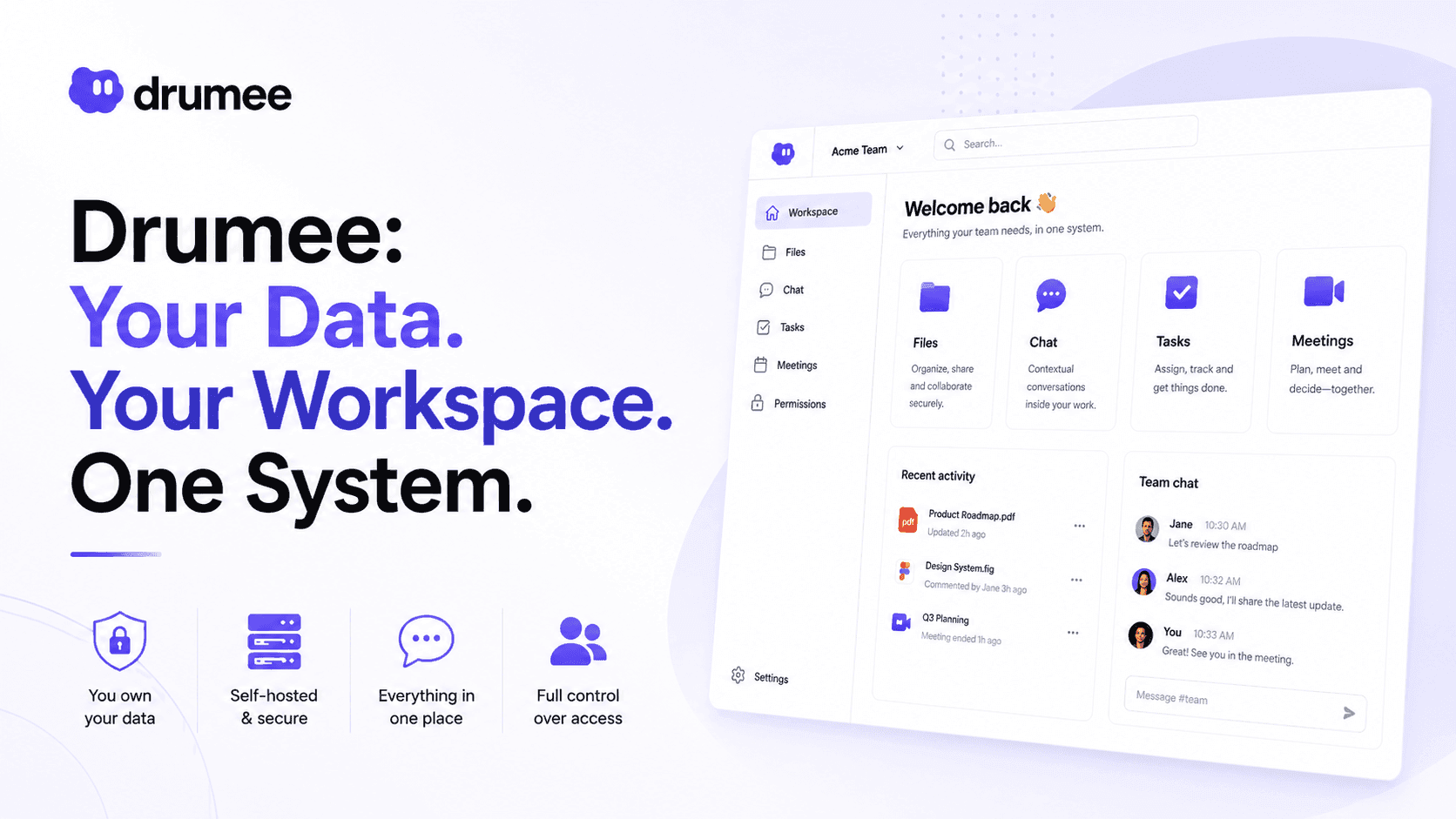
Drumee: Your Data. Your Workspace. One System
Drumee is a self-hosted, sovereign data workspace where files, chat, tasks, and permissions live in one place on infrastructure you own. Learn what Drumee is, what it stands for, and how to get started.
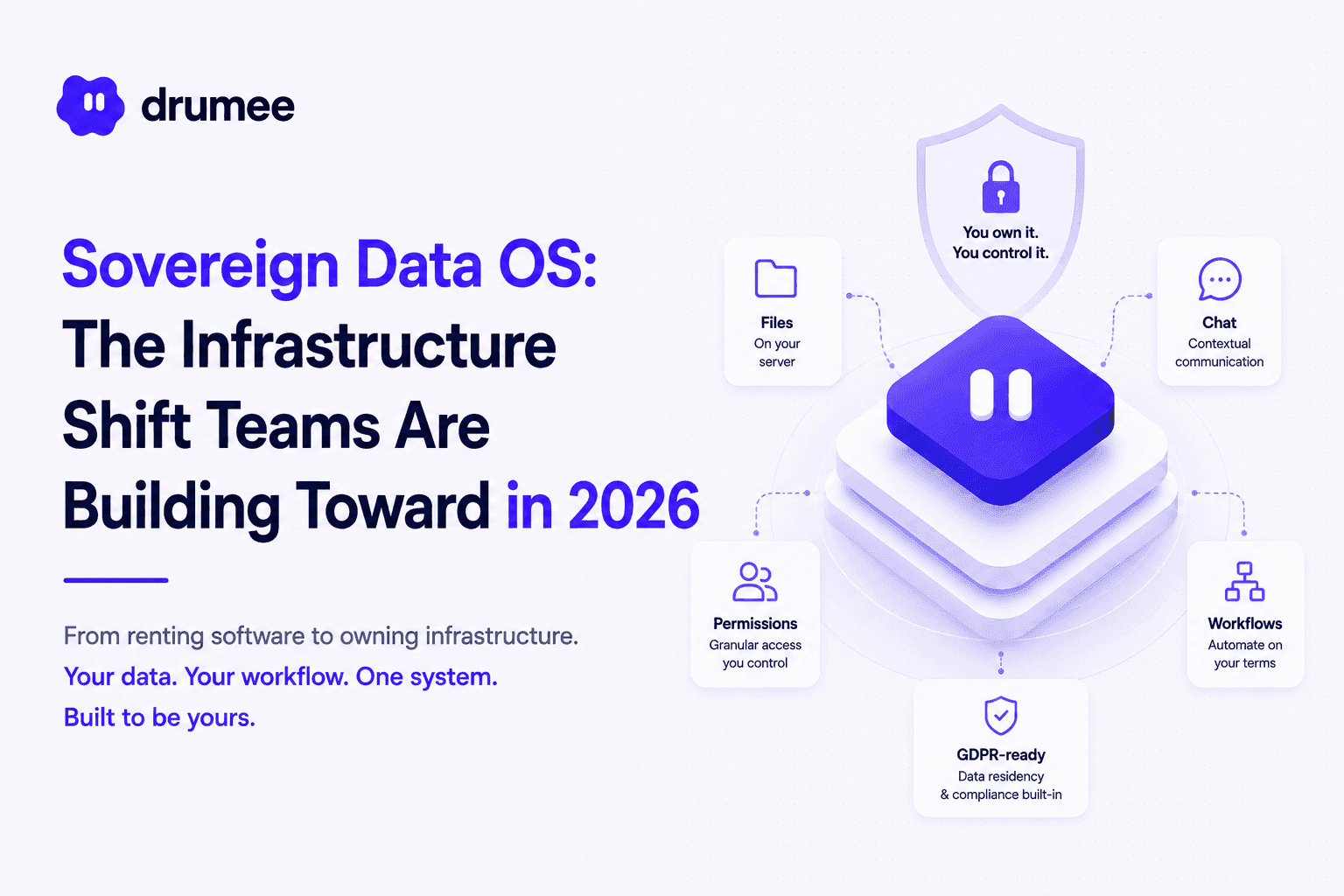
What Is a Sovereign Data OS? The Infrastructure Shift Teams Are Building Toward in 2026
What is a sovereign data OS? Learn how Drumee's unified self-hosted infrastructure replaces fragmented SaaS stacks with a single governable environment for files, chat, permissions, and workflows in 2026.
Data Ownership: What It Means and How to Achieve It in 2026
What is data ownership and how do you actually achieve it? Learn the three layers of data control, why AI changes the stakes, and how self-hosted infrastructure gives teams genuine ownership in 2026.