
HIPAA-Compliant File Collaboration: Why Self-Hosted Is the Only Certain Option.
HIPAA-compliant file collaboration in 2026 requires mandatory encryption, MFA, 72-hour breach reporting, and validated BAA oversight. Here is why self-hosted infrastructure is the only option that satisfies each requirement through direct evidence rather than vendor assurance.
HIPAA-Compliant File Collaboration: Why Self-Hosted Is the Only Certain Option.
HIPAA-compliant file collaboration means sharing, accessing, and editing files containing protected health information through an infrastructure environment that satisfies the HIPAA Security Rule's administrative, physical, and technical safeguard requirements and that enables the organization to demonstrate those requirements are met through direct evidence rather than vendor representations. In 2026, with the most significant HIPAA Security Rule update in over a decade entering its enforcement window, the difference between cloud-hosted platforms that offer HIPAA tooling and self-hosted infrastructure that gives organizations direct administrative authority over every compliance dimension has become the operative question for every healthcare organization, health-adjacent technology company, and business associate handling electronic protected health information. According to Hivenet's comprehensive analysis of healthcare file sharing requirements, healthcare data breaches affected over 116 million individuals in 2024 alone, and a single compliance violation can trigger HIPAA fines ranging from $137 to $2 million per incident, with maximum penalties reaching $1.5 million per violation category. These figures establish the financial stakes. The question of whether your file collaboration infrastructure can produce independent evidence of compliance, or only vendor assurances, determines whether you are positioned to avoid them.
What Does the 2026 HIPAA Security Rule Update Change?
The 2026 HIPAA Security Rule update represents the most significant revision to HIPAA security requirements since the original Security Rule took effect in 2005, and its implications for file collaboration infrastructure are direct and specific.
According to Medcurity's 2026 HIPAA Security Rule update analysis, the update introduces mandatory encryption of ePHI at rest and in transit, removing the "addressable" designation that previously allowed organizations to defer encryption if they implemented equivalent alternatives. Multi-factor authentication becomes required for all systems accessing ePHI, including file sharing platforms. A 72-hour incident reporting requirement replaces the previous 60-day window for breach notification. Annual penetration testing becomes mandatory. And enhanced business associate oversight obligations require covered entities to actively verify that their cloud providers and file sharing vendors maintain the security posture their Business Associate Agreements claim. These changes, proposed by HHS in late 2025, are expected to reach final rule publication by May 2026 with enforcement beginning as early as late 2026.
MedicalITG's 2026 analysis of the new HIPAA rules makes the BAA implication explicit: the new rules significantly strengthen BAA requirements, and agreements with vendors, cloud providers, and third-party services must clearly define shared security responsibilities and include validated compliance assessments from business associates, 24-hour breach notification requirements, specific MFA and encryption standards, and regular security auditing provisions. The critical phrase here is "validated compliance assessments." Under the strengthened BAA requirements, a covered entity that accepts a cloud vendor's self-certification of HIPAA compliance without independent validation is no longer operating in the same compliance posture as one that can demonstrate direct verification. The regulatory direction is unmistakably toward organizational accountability for vendor posture, not merely vendor accountability for its own systems.
The financial context makes the urgency concrete. MedicalITG's HIPAA compliant cloud storage analysis documents that healthcare data breaches now cost an average of $10.93 million per incident, and that the 2026 updates represent the most substantial change to HIPAA security requirements since the original HITECH Act. The 240-day compliance window will pass quickly, especially for practices with legacy systems requiring significant upgrades.
Why Are BAAs Necessary but Not Sufficient?
The most common misunderstanding about HIPAA-compliant file collaboration is the belief that executing a Business Associate Agreement with a cloud storage vendor satisfies the HIPAA Security Rule's requirements for that file sharing function. BAAs are necessary. They are not sufficient. Understanding why requires understanding what a BAA actually establishes and what it does not.
A BAA establishes that the cloud vendor acknowledges its status as a business associate under HIPAA, agrees to implement appropriate safeguards to protect ePHI, and accepts liability for breaches caused by its own failures. It does not transfer the covered entity's compliance obligation to the vendor. It does not eliminate the covered entity's responsibility to verify that the vendor's technical safeguards actually meet the requirements the BAA describes. And it does not change the fundamental condition that the vendor administers the infrastructure through which the covered entity's ePHI flows.
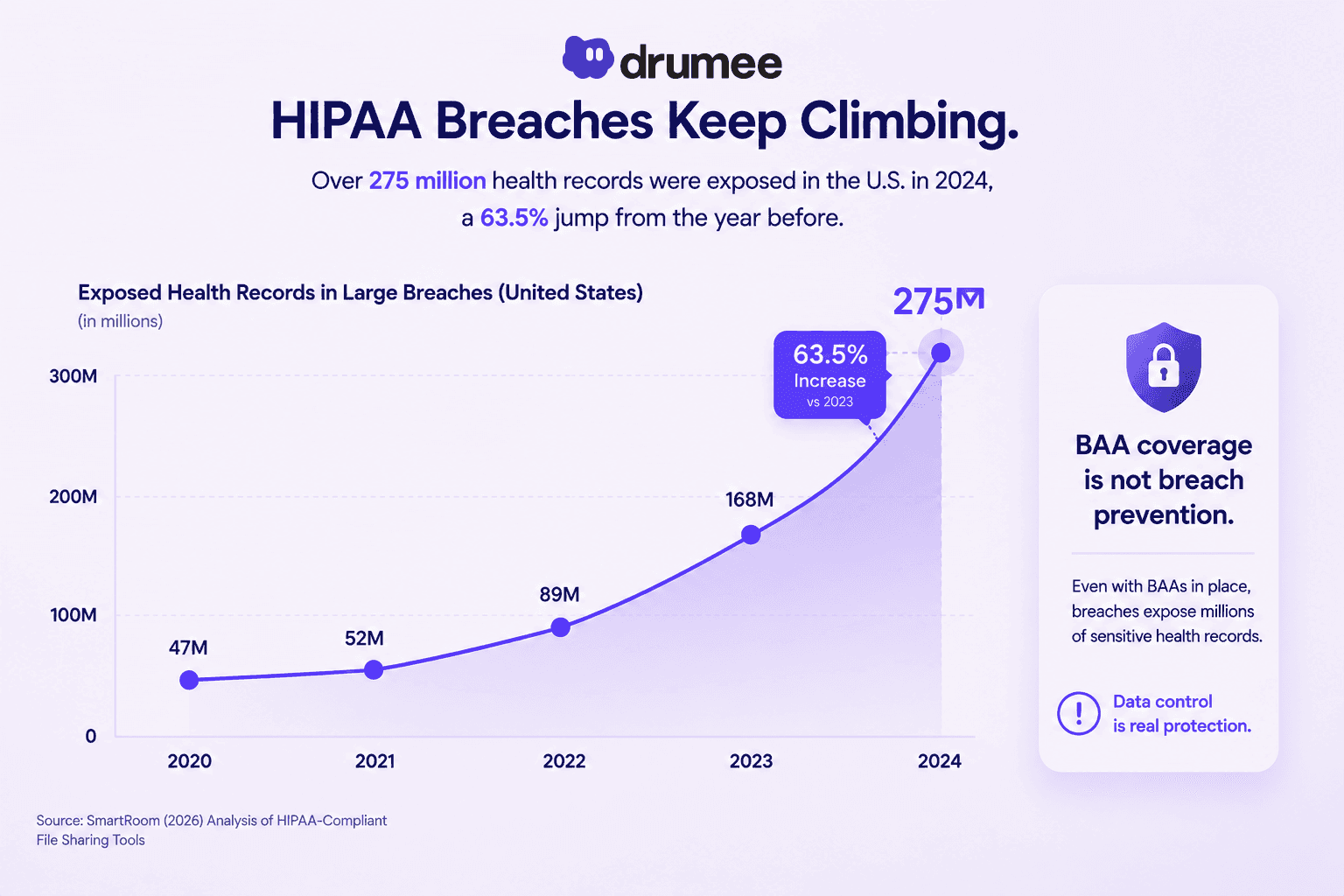
SmartRoom's 2026 analysis of HIPAA-compliant file sharing tools provides the breach scale that illustrates what BAA coverage alone does not prevent: in 2024 alone, over 275 million health records were exposed in large data breaches in the United States, a 63.5% jump from the year before. The organizations whose patient records appear in that figure had BAAs with their vendors. The BAAs did not prevent the breaches. They did not prevent the regulatory investigations. They did not prevent the settlement costs. What they establish is the contractual framework within which liability is allocated after a breach occurs. They do not establish the technical controls that prevent breaches from occurring in the first place.
HIPAA Journal's analysis of 2025 enforcement actions found that noncompliance with the HIPAA Breach Notification Rule was the second most common reason for financial penalty in 2025, after risk analysis failures. OCR closed 21 HIPAA cases with settlements or civil monetary penalties in 2025, 5 of which included penalties for breach notification failures. These enforcement outcomes do not distinguish between organizations that had BAAs with their vendors and those that did not. They reflect the covered entity's failure to meet the Security Rule's requirements, regardless of the contractual arrangements surrounding the infrastructure where ePHI lived.
The Technical Controls That Cloud Hosting Cannot Guarantee
The specific technical controls that the 2026 HIPAA Security Rule requires for file collaboration, and that the updated BAA requirements demand organizations verify in their vendors, are precisely the controls that are most difficult to independently verify in cloud-hosted environments and most directly achievable in self-hosted ones.
Mandatory encryption of ePHI at rest and in transit, with the addressable designation removed, requires the organization to ensure that encryption is implemented at the storage layer of its file collaboration infrastructure. In cloud-hosted environments, the encryption implementation is the vendor's. The organization can review the vendor's documentation and request evidence of encryption standards. It cannot independently audit the encryption implementation, cannot verify that encryption keys are protected against vendor-side access, and cannot ensure that AI features embedded in the collaboration platform do not operate on decrypted ePHI as part of feature delivery. As MyAIFrontdesk's 2026 encryption analysis documents, AI tools often conflict with encryption methods because they require access to plaintext data, which means the mandatory encryption requirement and the AI feature layer of cloud collaboration platforms exist in structural tension for healthcare organizations that have enabled both.
MFA requirements for all systems accessing ePHI place an obligation on the organization to verify that every access point to its file collaboration infrastructure enforces multi-factor authentication. In self-hosted environments, the authentication configuration is the organization's to implement and audit directly. In cloud-hosted environments, MFA configuration is the vendor's implementation, available to the organization through the vendor's admin interface, but not independently verifiable at the infrastructure layer.
Annual penetration testing requirements, introduced in the 2026 update, require the organization to conduct testing of the systems where ePHI is processed. For cloud-hosted platforms, penetration testing scope is defined and constrained by the vendor's testing policies. Organizations cannot conduct unrestricted penetration testing of vendor-hosted infrastructure. They can review vendor penetration test results, but they cannot commission independent tests of the storage and processing systems where their patients' data actually lives. For self-hosted infrastructure, penetration testing scope is entirely within the organization's control. The organization commissions the test, defines the scope, receives the results directly, and implements remediation on its own timeline.
The Self-Hosted Architecture That Satisfies Each Requirement
The technical case for self-hosted infrastructure as the only certain option for HIPAA-compliant file collaboration is not that cloud providers fail to offer HIPAA tooling. Many do offer genuine compliance infrastructure. The case is that self-hosted infrastructure allows the organization to satisfy each new 2026 requirement through direct administrative control rather than vendor-mediated assurance.
Kiteworks' 2026 analysis of secure on-premises collaboration options identifies the specific properties that on-premises and private cloud deployments provide for healthcare organizations: true on-premises deployment, rigorous compliance and zero-trust controls, clearly documented data residency, and the ability to localize storage, processing, and encryption keys. Nextcloud specifically is identified as supporting true on-premises and private cloud deployment so organizations can localize storage, processing, and encryption keys, with admins able to enforce data residency policies and apply client-side encryption for highly sensitive content.
For a healthcare organization running a self-hosted file collaboration environment, the HIPAA compliance evidence chain is organizational rather than vendor-dependent at each critical point. Encryption at rest and in transit is configured and auditable by the organization's own systems administrators. MFA is enforced through the organization's own authentication infrastructure. Penetration testing is conducted by testers the organization commissions against scope the organization defines. Audit logs covering every file access, every permission change, and every sharing action are in systems the organization controls directly. Breach detection and 72-hour notification timelines are achievable because the monitoring infrastructure is under the organization's administration.
The business associate chain is also simplified. When file collaboration infrastructure is self-hosted, the organization is the operator of the ePHI storage environment. The BAA question applies to any third-party services the self-hosted platform integrates with, but the core file collaboration layer is not a vendor relationship requiring a BAA. The covered entity's compliance obligation and its infrastructure authority are aligned rather than distributed across a vendor relationship.
Kuse.ai's 2026 secure collaboration analysis frames the regulatory tolerance limit directly: HIPAA does not care that your team finds Slack convenient, and GDPR does not make exceptions because Google Chat is already installed. The regulations impose strict requirements on how sensitive data moves, where it lives, who can access it, and how long it persists. Using non-compliant tools exposes organizations to fines that can reach millions, plus the reputational cost of a public breach disclosure.
Where Does Drumee Sit in This Architecture?
Drumee's sovereign data OS architecture addresses HIPAA-compliant file collaboration at the infrastructure layer rather than the feature layer. Files, communications, permissions, and task context exist within a single self-hosted environment the organization administers, with no vendor holding administrative authority over any layer of the ePHI processing environment.
The governance property this creates for HIPAA-adjacent organizations is that compliance evidence is organizationally produced. The audit trail covering who accessed which file, when, and under what permission context is in the organization's own infrastructure. Encryption at rest is configured by the organization's administrators using standards the organization selects and audits. AI processing of file content occurs only through systems the organization has explicitly deployed within its own infrastructure boundary, not through vendor-embedded AI features operating on plaintext ePHI under terms the organization accepted in a cloud service agreement. Penetration testing can be scoped to cover the full file collaboration environment because that environment runs on the organization's own servers.
For healthcare organizations, health-adjacent technology companies, and business associates processing ePHI that have completed an honest assessment of whether their current cloud-hosted file collaboration infrastructure can independently evidence compliance with each 2026 HIPAA Security Rule requirement, the answer is almost uniformly the same: the evidence is vendor-dependent rather than organizationally controlled. The 2026 update's strengthened BAA requirements, validated compliance assessment obligations, and mandatory technical controls have made that gap consequential in ways that accepting a vendor's HIPAA compliance assurances at face value no longer adequately addresses.
FAQ
1/ What is HIPAA-compliant file collaboration?
HIPAA-compliant file collaboration is the sharing, editing, and accessing of files containing protected health information through infrastructure that satisfies the HIPAA Security Rule's encryption, access control, audit logging, and business associate requirements, and that enables the organization to demonstrate compliance through direct evidence rather than vendor assurances.
2/ What does the 2026 HIPAA Security Rule update require for file sharing?
The 2026 update introduces mandatory encryption of ePHI at rest and in transit (removing the addressable designation), required MFA for all systems accessing ePHI including file sharing platforms, a 72-hour incident reporting requirement, annual penetration testing, and enhanced BAA requirements mandating validated compliance assessments from business associates rather than self-certification.
3/ Does a Business Associate Agreement make a cloud file sharing platform HIPAA compliant?
A BAA is necessary but not sufficient. BAAs establish contractual liability allocation. They do not transfer the covered entity's compliance obligation to the vendor, do not eliminate the organization's responsibility to verify the vendor's technical safeguards, and do not prevent breaches. In 2024, over 275 million health records were exposed in US healthcare breaches despite widespread BAA coverage across the affected organizations.
4/ Why is self-hosted infrastructure more certain for HIPAA compliance than cloud hosting?
Self-hosted infrastructure allows organizations to satisfy HIPAA requirements through direct administrative control: encryption configuration is organizationally auditable, MFA is enforced through organizational authentication systems, penetration testing can cover the full ePHI environment without vendor-imposed scope constraints, and audit logs are in organizational systems rather than vendor dashboards. Compliance evidence is produced by the organization rather than depending on vendor cooperation.
5/ How does Drumee support HIPAA-compliant file collaboration?
Drumee is a sovereign data OS deployed on infrastructure the organization administers. Files, communications, permissions, and task context exist in a single self-hosted environment with no vendor holding administrative authority over any ePHI processing layer. Audit trails, encryption configuration, and MFA enforcement are all organizationally controlled. AI processing of file content occurs only within the organization's own infrastructure boundary, eliminating the plaintext access conflict that cloud-embedded AI features create for encrypted ePHI.
Related article: End-to-End Encrypted Workspaces: What It Means to Own the Server
------------------------------
About Drumee
Drumee is the world’s first unified sovereign data infrastructure: a self-hosted, OS-like workspace that turns your own filesystem into a private collaborative environment.
Fully under your control, Drumee combines files, chat, tasks, and workflows with enterprise-grade permissions built directly into the infrastructure layer. No cloud vendors. No fragmented SaaS stack. No operational dependency.
Instead of renting your workspace from external providers, Drumee allows organizations to own the environment where operational knowledge lives.
Your Data. Your Workflow. One system. Built to be yours!
Follow us at: Website | X | LinkedIn | Drumee Founder X | Drumee Founder LinkedIn
Keep reading
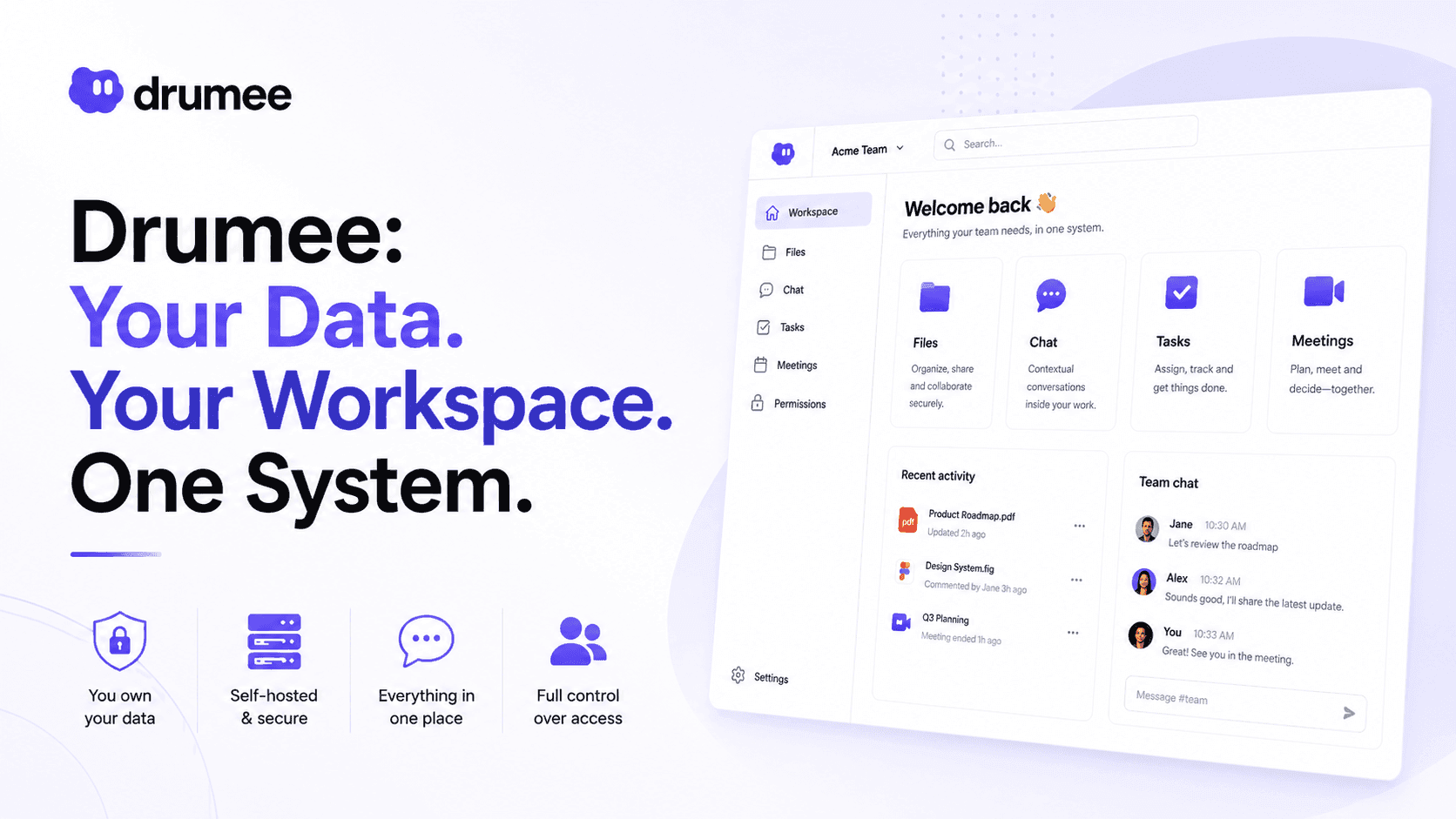
Drumee: Your Data. Your Workspace. One System
Drumee is a self-hosted, sovereign data workspace where files, chat, tasks, and permissions live in one place on infrastructure you own. Learn what Drumee is, what it stands for, and how to get started.
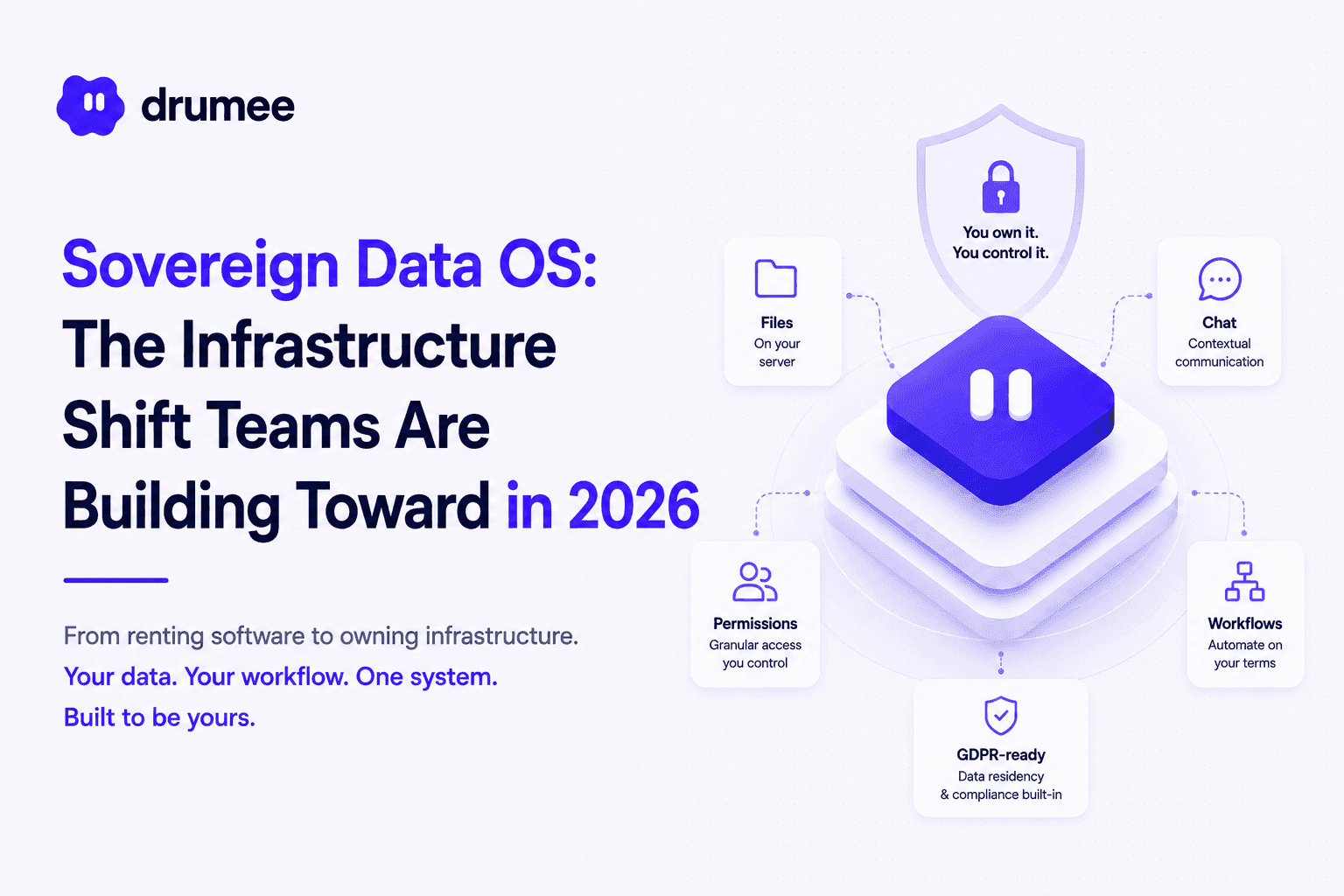
What Is a Sovereign Data OS? The Infrastructure Shift Teams Are Building Toward in 2026
What is a sovereign data OS? Learn how Drumee's unified self-hosted infrastructure replaces fragmented SaaS stacks with a single governable environment for files, chat, permissions, and workflows in 2026.
Data Ownership: What It Means and How to Achieve It in 2026
What is data ownership and how do you actually achieve it? Learn the three layers of data control, why AI changes the stakes, and how self-hosted infrastructure gives teams genuine ownership in 2026.