
End-to-End Encrypted Workspaces: What It Means to Own the Server
An end-to-end encrypted workspace protects data from the server itself, not just from external attackers. When you own the server, you control the keys. Here is what that means for compliance, AI governance, and breach cost reduction in 2026.
End-to-End Encrypted Workspaces: What It Means to Own the Server
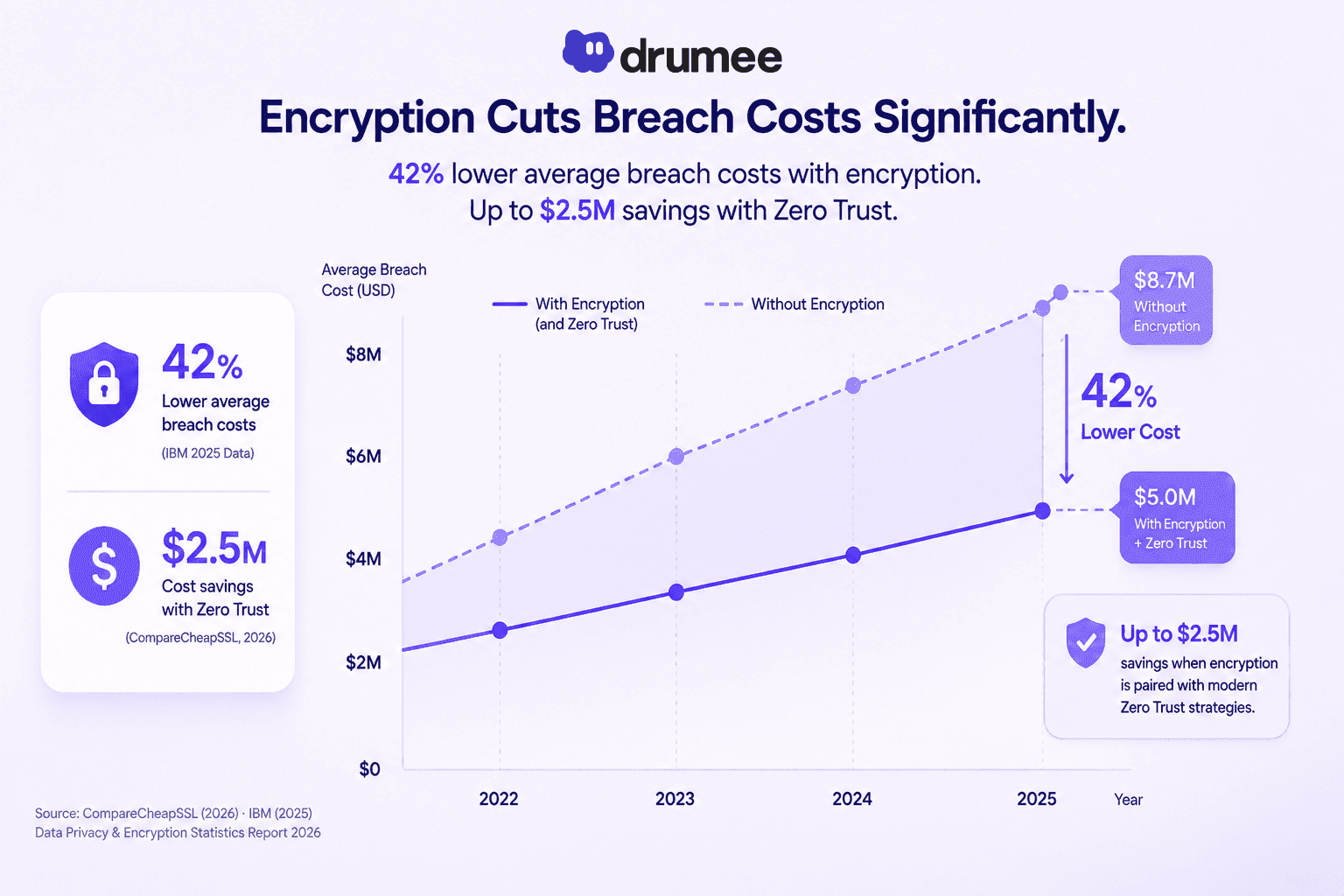
An end-to-end encrypted workspace is a collaborative environment where data is encrypted at the point it is created, remains encrypted as it moves between systems, and can only be decrypted by the organization or individuals holding the encryption keys, never by the platform's servers, the vendor's operations team, or a third-party AI system processing content to deliver features. It is a fundamentally different security model from the standard encryption that most cloud platforms advertise, and understanding the difference between the two is increasingly consequential in 2026 as breach costs rise and regulators raise the standard for what adequate data protection actually requires. According to CompareCheapSSL's 2026 data privacy and encryption statistics report, organizations using encryption experience 42% lower average breach costs than those that do not, per IBM's 2025 breach data, and encryption can reduce breach-related costs by up to $2.5 million when paired with modern Zero Trust strategies. Those figures describe encryption as a financial instrument, not just a technical one. The teams that have understood this are no longer asking whether to encrypt. They are asking who holds the keys.
The Encryption Gap Most Teams Have Not Noticed
The encryption that most cloud workspace providers describe in their marketing and compliance documentation is not end-to-end encryption. It is encryption in transit and encryption at rest, which are the two conditions that prevent unauthorized external parties from intercepting data during transmission or accessing raw storage volumes without authentication. Both conditions are genuine security improvements over unencrypted data. Neither condition protects your data from the platform itself.
According to MyAIFrontdesk's 2026 analysis of cloud encryption versus end-to-end encryption, major cloud providers use TLS/SSL protocols to secure data during transit and AES encryption for data at rest, but this centralization introduces risks including breaches, insider access, or legal demands for data. In contrast, genuine end-to-end encryption means only the organization holds the encryption keys, ensuring no one else including the provider can access the data. The analysis makes the AI dimension explicit and critical: AI tools often conflict with encryption methods because they require access to plaintext data, raising significant privacy concerns in the age of AI. That sentence contains the most important practical implication for any team evaluating workspace security in 2026. The moment a cloud platform embeds AI features that process your documents, conversations, or workflows, those systems require access to plaintext content. That requirement is incompatible with genuine end-to-end encryption at the platform level.
Kuse.ai's 2026 secure collaboration tools analysis describes the practical security architecture that genuine end-to-end encryption requires: a secure collaboration platform encrypts data end-to-end so servers never see plaintext content, logs every action for audit trails and compliance reporting, and supports self-hosting for complete control over where data lives. IBM's Cost of a Data Breach Report puts the average breach at $4.88 million globally, and that number climbs higher in regulated industries. The combination of those facts establishes the financial case for end-to-end encryption that goes beyond compliance checkbox behavior. A collaboration platform without proper encryption is not just a productivity tool. It is an attack surface.
What Does Self-Hosting Change About Encryption?
The question of who holds encryption keys is inseparable from the question of who administers the infrastructure. For teams using cloud-hosted workspaces, the encryption key management architecture is controlled by the vendor. The vendor generates keys, manages key rotation, stores key material, and makes decisions about which systems have access to decrypted data as part of platform operations. When a cloud vendor embeds AI features that process document content, those systems operate on decrypted data by necessity, within the vendor's infrastructure, under the vendor's governance terms. The organization's nominal encryption does not prevent this processing because the vendor holds the keys that enable it.
When a team owns the server, the encryption key management architecture is under the organization's direct administrative control. Kiteworks' 2026 analysis of secure collaboration tools with on-premises and regional deployment options identifies the conditions that genuine on-premises and self-hosted deployments provide that cloud alternatives cannot: true on-premises deployment, private cloud, and clearly documented regional data residency, plus rigorous compliance and zero-trust controls. For self-hosted platforms like Nextcloud specifically, the analysis notes that organizations can localize storage, processing, and encryption keys, with admins able to enforce data residency policies, apply granular sharing controls, and enable client-side encryption options for highly sensitive content. Client-side encryption, where keys are generated and held by the organization rather than the platform, is the property that makes end-to-end encryption operationally real rather than marketing-compliant.
The encryption architecture matters not only for what it protects against but for what it enables. Deepstrike.io's 2026 data breach statistics analysis identifies properly encrypted data as a structural defense against credential theft and misconfiguration breaches: when stolen credentials or misconfiguration lead to data capture, properly encrypted data may thwart exposure entirely. In the context of cloud storage, where DataStackHub's 2025-2026 analysis found compromised credentials were the leading cause of cloud-based breaches at 37%, encryption key ownership represents the difference between a credential breach that exposes readable plaintext and one that produces encrypted data the attacker cannot use.
The Compliance Architecture That Only Self-Hosted E2EE Provides
The regulatory environment that has developed around encryption in 2025 and 2026 has made the distinction between vendor-managed encryption and organization-controlled end-to-end encryption legally significant, not just technically meaningful.
Paperclip's 2026 analysis of data encryption requirements identifies the scope of the mandate: DORA, effective January 17, 2025, requires financial services organizations to demonstrate future-resilient encryption as part of operational resilience requirements. Federal contracts now require quantum-ready encryption systems by 2026. Healthcare organizations face sustained regulatory pressure to protect data that must remain confidential for extended periods. The common thread across these frameworks is that encryption is no longer treated as a best practice. It is treated as a baseline requirement, and the adequacy of encryption implementations is being assessed at a level of specificity that distinguishes vendor-managed AES-256 at rest from organizational control over key generation, storage, and access.
The HIPAA safe harbor provision makes the practical consequence of encryption key ownership directly quantifiable. According to HIPAA encryption requirements analysis from 2026, encrypted data qualifies for the breach notification safe harbor under 164.402, eliminating reporting obligations for lost or stolen devices. The logic is that encrypted data is unusable, unreadable, or indecipherable to unauthorized individuals. Under the safe harbor, a breach of encrypted data is not a reportable breach. Under the current rule's enforcement patterns, the January 2025 NPRM proposes eliminating the addressable designation and making encryption mandatory, treating non-implementation as willful neglect. For healthcare organizations evaluating workspace security, the financial difference between a breach that triggers mandatory notification and regulatory investigation versus one that qualifies for safe harbor treatment can run to seven figures based on documented settlement precedents.
The safe harbor protection is only fully available to organizations that can demonstrate independent control over encryption key management. When a vendor manages encryption keys on the organization's behalf, the vendor's access to decrypted data creates an additional exposure pathway that the safe harbor does not cleanly address, because the vendor's authorized access to plaintext content is not the same condition as unauthorized external access to encrypted data.
The AI Processing Conflict That Makes E2EE Urgent in 2026
The most significant development making end-to-end encrypted workspace architecture urgent rather than aspirational in 2026 is the conflict between AI feature delivery and genuine encryption. This conflict is not a theoretical future concern. It is an operational reality in every major cloud workspace platform that has embedded generative AI.
DualMedia's 2026 analysis of cloud workspace evolution describes the distributed cloud market where security and encryption are structural foundations growing at a CAGR of 30%, projected to reach $21 billion by 2029. The growth reflects an organizational recognition that the encryption architecture of cloud workspaces must evolve to address AI processing as a distinct governance layer rather than treating standard AES-256 at rest as an adequate response to AI-era data risks. As Kuse.ai's secure collaboration analysis notes, GDPR does not make exceptions because Google Chat is already installed, and HIPAA does not bend because switching platforms feels disruptive. The same reasoning applies to AI processing: regulatory frameworks for data protection do not include exemptions for features that require plaintext access to deliver AI outputs.
For teams that have enabled Gemini in Google Workspace, Copilot in Microsoft 365, or AI features in Notion or Slack, the practical consequence is that the encryption protecting their stored documents does not extend to the AI processing of those documents. The AI systems operate on plaintext content within the vendor's infrastructure, and the governance of that processing is the vendor's rather than the organization's. End-to-end encryption in a self-hosted workspace addresses this because AI processing occurs only within the organization's own infrastructure boundary, using systems the organization has explicitly deployed and configured. The encryption architecture and the AI governance boundary are coextensive because they are both properties of infrastructure the organization controls.
What Does a Genuine End-to-End Encrypted Workspace Look Like in 2026?
The platforms that provide genuine end-to-end encryption for collaborative workspaces in 2026 share a structural property: the server never sees plaintext content because encryption and decryption occur on the client side, with keys held by the organization rather than the platform. Labnify's 2025 analysis of end-to-end encryption compliance systems identifies Nextcloud Hub as a self-hosted alternative to Google Workspace with end-to-end encryption capabilities, noting that the security model depends on the hosting environment and benefits from team members capable of managing servers and security configurations properly. CryptPad provides browser-based collaboration with real-time encryption for documents, spreadsheets, and presentations. PrivMX offers a unified encrypted workspace covering chat, files, and task management with end-to-end encryption across all data types.
Each of these platforms addresses the encryption layer for specific functional categories. What none of them individually provides, and what the broader self-hosted workspace architecture must address, is the coherence of the encryption and governance boundary across all operational layers where sensitive data is created and exchanged. A team that deploys Nextcloud for encrypted file storage while continuing to communicate about those files in Slack has achieved encrypted storage with unencrypted communications. The operational context that is most sensitive, the conversation about which files to share, with whom, and why, exists in a plaintext system.
Drumee's sovereign data OS architecture is designed to make the end-to-end encrypted workspace boundary coherent rather than piecemeal. Files, conversations, permissions, and task context exist within a single self-hosted environment where the encryption configuration, the key management architecture, and the AI governance boundary are all properties of infrastructure the organization controls. There is no plaintext API boundary between the file layer and the communication layer, because they are not separate systems. The governance completeness of end-to-end encryption in the deepest sense, where the server never processes content the organization has not explicitly authorized it to access, is achievable as a whole-workspace property rather than a per-tool configuration.
For teams that have been treating encryption as a compliance checkbox and discovering through breach cost statistics and regulatory enforcement that encryption key ownership is the operative variable, the path forward is not finding a cloud workspace with better encryption marketing. It is moving to infrastructure where the encryption architecture is the organization's to define, administer, and audit directly, because the server it runs on is the organization's own.
FAQ
1/ What is an end-to-end encrypted workspace?
An end-to-end encrypted workspace is a collaborative environment where data is encrypted at creation, remains encrypted in transit and at rest, and can only be decrypted by the organization holding the encryption keys. Unlike standard cloud encryption where vendors hold and manage keys, genuine E2EE means the server never sees plaintext content, eliminating vendor access, AI processing exposure, and legal demands for data from outside parties.
2/ What is the difference between encryption at rest and end-to-end encryption?
Encryption at rest protects data stored on a server from unauthorized external access to storage volumes. End-to-end encryption means only the organization holds the decryption keys, so the server itself cannot read the content it stores. Cloud platforms that advertise encryption at rest can still access your data through their own systems. Genuine E2EE prevents this because key generation and management remain with the organization.
3/ How does owning your own server change encryption for your workspace?
When your organization administers the server, you control key generation, key storage, key rotation, and which systems have access to decrypted content. This means AI processing only occurs within systems you have explicitly deployed. Audit logs of who decrypted what and when are in your infrastructure. Compliance evidence is producible independently without vendor cooperation, and legal demands for your data must come to your organization directly rather than being fulfilled by a vendor under orders the organization never sees.
4/ Does end-to-end encryption conflict with AI features in cloud workspaces?
Yes, directly. AI features in cloud workspaces require access to plaintext content to generate summaries, answers, and recommendations. This requirement is incompatible with genuine E2EE at the platform level, because the AI systems must be able to read content the encryption would otherwise protect. This is why cloud platforms with embedded AI and self-declared encryption have vendor-managed keys: the vendor's AI needs access to plaintext, and vendor-controlled keys make that access possible.
5/ How does Drumee approach end-to-end encryption for team workspaces?
Drumee is a sovereign data OS deployed on infrastructure the organization administers. Files, communications, tasks, and permissions exist within a single self-hosted environment where the encryption configuration and key management architecture are organizational properties. AI processing occurs only within the organization's own infrastructure boundary using explicitly deployed systems. The server that handles your team's content is your server, which is the structural condition that makes genuine E2EE governance achievable across the entire workspace rather than within individual tools.
Related article: Private Cloud for Small Teams: Own Your Data Without Enterprise Budget
------------------------------
About Drumee
Drumee is the world’s first unified sovereign data infrastructure: a self-hosted, OS-like workspace that turns your own filesystem into a private collaborative environment.
Fully under your control, Drumee combines files, chat, tasks, and workflows with enterprise-grade permissions built directly into the infrastructure layer. No cloud vendors. No fragmented SaaS stack. No operational dependency.
Instead of renting your workspace from external providers, Drumee allows organizations to own the environment where operational knowledge lives.
Your Data. Your Workflow. One system. Built to be yours!
Follow us at: Website | X | LinkedIn | Drumee Founder X | Drumee Founder LinkedIn
Keep reading
Drumee: Your Data. Your Workspace. One System
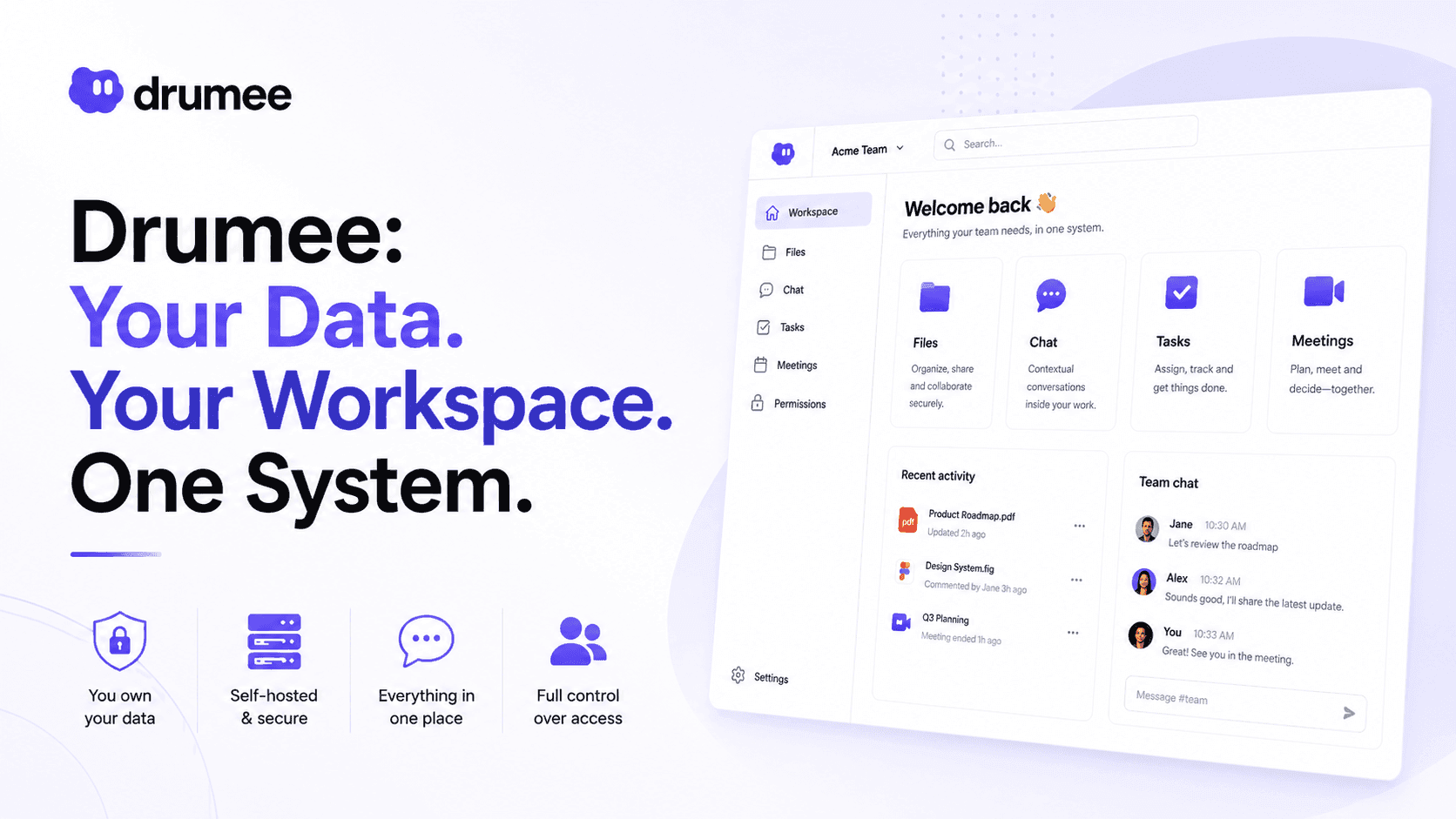
Drumee is a self-hosted, sovereign data workspace where files, chat, tasks, and permissions live in one place on infrastructure you own. Learn what Drumee is, what it stands for, and how to get started.
What Is a Sovereign Data OS? The Infrastructure Shift Teams Are Building Toward in 2026
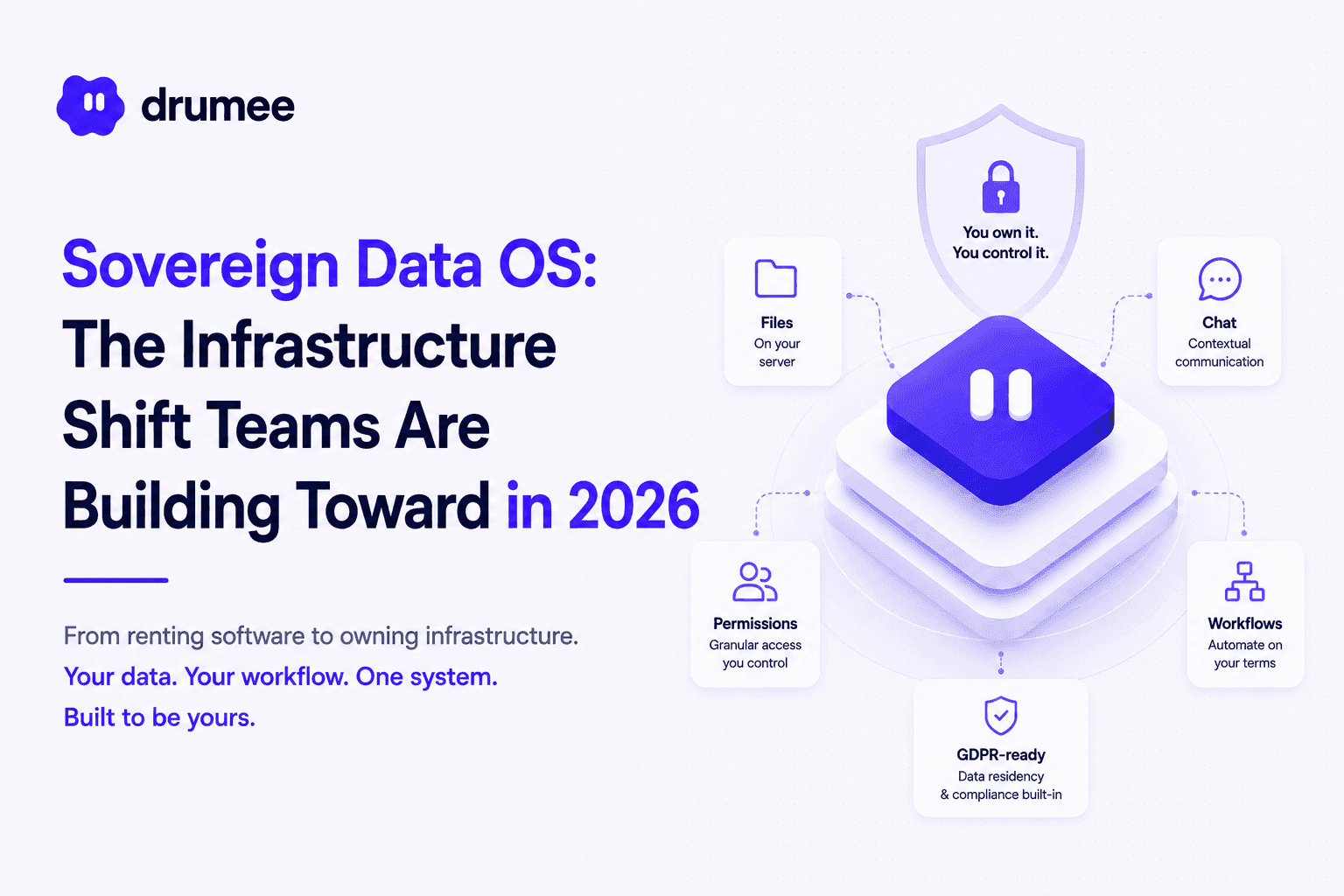
What is a sovereign data OS? Learn how Drumee's unified self-hosted infrastructure replaces fragmented SaaS stacks with a single governable environment for files, chat, permissions, and workflows in 2026.
Data Ownership: What It Means and How to Achieve It in 2026
What is data ownership and how do you actually achieve it? Learn the three layers of data control, why AI changes the stakes, and how self-hosted infrastructure gives teams genuine ownership in 2026.