
What Is a Sovereign Workspace? Why Are Teams Moving Beyond SaaS in 2026?
Own your data with Drumee - the sovereign workspace OS for teams. Learn how self-hosted collaboration, data sovereignty, and privacy-first infrastructure eliminate SaaS lock-in, reduce compliance risks, and give full control over your files, workflows, and team operations.
What Is a Sovereign Workspace? Why Are Teams Moving Beyond SaaS in 2026?
A sovereign workspace is a collaborative environment where files, conversations, and permissions run on infrastructure you own instead of a third-party cloud provider. Unlike fragmented SaaS stacks spread across Slack, Google Drive, Notion, and dozens of APIs, sovereign workspaces unify operational context inside infrastructure governed directly by the organization itself.
What Is a Sovereign Workspace?
For more than a decade, modern software optimized primarily for convenience. Slack accelerated communication, Google Drive simplified file sharing, Notion centralized documentation, Linear streamlined product management, and Zapier connected workflows between applications that were never originally designed to work together. Individually, each product improved operational efficiency. Collectively, however, these systems created something most organizations never intentionally designed: fragmented infrastructure.
Today, a typical startup or agency operates across 15-40 separate SaaS products, while Okta’s Businesses at Work Report found that large enterprises now use more than 200 SaaS applications internally. What organizations underestimated was how quickly operational knowledge would become distributed across disconnected systems. Conversations exist in one platform, files live somewhere else, permissions operate separately, and workflows become increasingly dependent on APIs nobody fully audits anymore.
This is where sovereign workspaces emerge.
A sovereign workspace is not merely a self-hosted alternative to Slack or Google Drive. It is an infrastructure model where collaboration, files, workflows, governance, and operational continuity exist inside systems controlled directly by the organization itself. The important distinction is that sovereign workspaces optimize continuity instead of isolated feature convenience. Rather than scattering operational context across vendors, sovereign infrastructure attempts to preserve workflows, communication, permissions, and institutional knowledge inside one governed environment.
Sovereign Infrastructure Is Emerging
The rise of sovereign collaboration infrastructure is being driven by several shifts happening simultaneously across modern organizations. AI transformed operational data from passive storage into strategic infrastructure, SaaS dependency became economically expensive at scale, and workflow fragmentation started slowing execution inside increasingly distributed teams. During the early cloud era, companies willingly traded infrastructure control for convenience because deployment speed mattered more than governance. In 2026, however, organizations are beginning to realize that operational continuity itself has become infrastructure-critical.
According to IBM’s 2024 Cost of a Data Breach Report, the average global data breach cost reached $4.88 million, the highest figure recorded to date. At the same time, AI systems increasingly process operational workflows, internal documentation, customer conversations, onboarding systems, and behavioral data as intelligence layers rather than passive storage. Infrastructure is no longer simply where information sits. It increasingly determines how organizations govern operational knowledge itself.
This shift fundamentally changes procurement logic. Organizations are no longer only asking whether software improves productivity or integrates efficiently. They are increasingly asking who controls the environment where operational intelligence lives, how workflows remain portable, whether AI systems can process sensitive information, and how dependent the organization becomes on infrastructure it does not directly govern.
Cloud concentration also amplified this concern. A significant percentage of global operational infrastructure now depends on a small number of providers including AWS, Microsoft Azure, and Google Cloud. The CrowdStrike outage in 2024 demonstrated how centralized dependency can disrupt operational continuity globally within hours across airlines, healthcare systems, financial services, and enterprise collaboration environments simultaneously. The issue was not merely technical downtime. It was concentration fragility.
This is why concepts like sovereign workspace, sovereign collaboration, and sovereign data OS are increasingly gaining traction across infrastructure, cybersecurity, DevOps, and privacy-focused communities.
The Hidden Cost of SaaS Fragmentation
Most organizations assume operational risk comes primarily from cybersecurity incidents or infrastructure outages. Increasingly, however, a growing percentage of execution failure comes from context fragmentation between systems.
In many organizations, operational failures no longer happen because individual tools fail technically. They happen because context becomes fragmented between platforms. A client approval lives in Slack, the latest file version exists in Google Drive, the implementation task sits in Linear, while documentation remains outdated somewhere inside Notion. Everything technically exists, yet nothing is operationally unified.
Research from Harvard Business Review found that employees in digitally fragmented environments switch between applications more than 1,200 times per day, losing nearly four hours per week reconstructing context between systems. The productivity cost is not merely distraction. It is operational reconstruction (Harvard Business Review – The Cost of Context Switching).
This problem compounds dramatically as organizations scale. A 10-person startup can tolerate fragmented workflows because communication remains highly contextual and organizational memory still exists informally. At 100 employees, fragmented collaboration becomes invisible operational drag. At enterprise scale, it becomes infrastructure risk.
One European creative agency internally audited a failed delivery incident in 2025 after shipping an outdated client asset version. The breakdown was not caused by technical failure. The client approval existed inside Slack, the updated asset existed in Google Drive, and the implementation task existed elsewhere in project management software. Nobody reconstructed the operational continuity correctly. The result was approximately 14 hours of rework, a missed deployment window, and more than €4,200 in direct operational loss.
Every tool technically worked. The infrastructure failed between tools.
This is one of the core ideas behind sovereign workspace architecture: operational continuity matters more than isolated feature optimization. Instead of optimizing communication, files, permissions, workflows, and governance separately, sovereign systems attempt to preserve operational context directly inside the infrastructure layer itself.
Sovereign Workspace vs Traditional SaaS
The difference between traditional SaaS collaboration and sovereign infrastructure is not simply where software is hosted. The deeper difference is governance ownership.
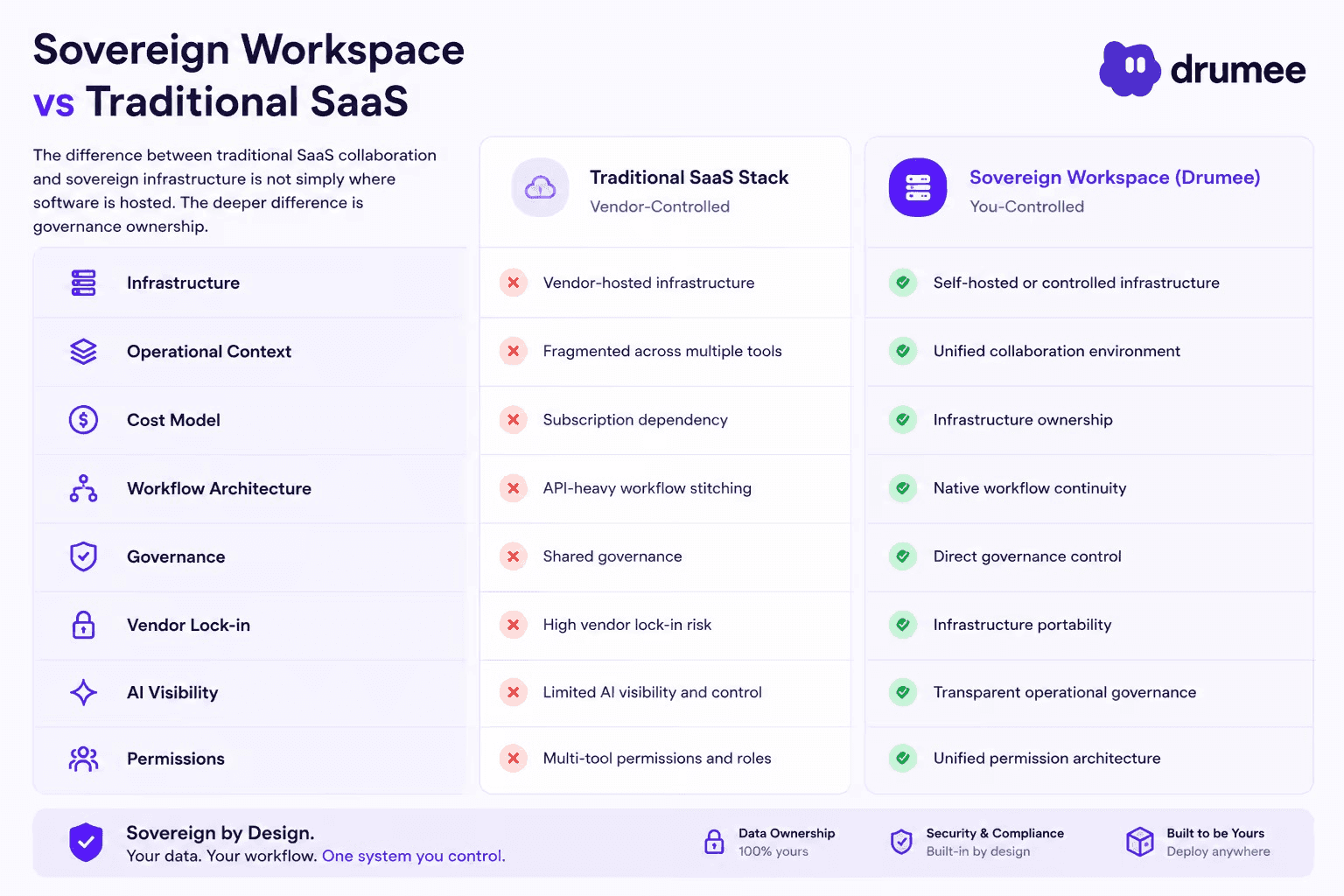
Traditional SaaS platforms optimize software distribution while sovereign workspaces optimize operational resilience.
That distinction becomes increasingly important as organizations depend more heavily on AI-assisted workflows, distributed teams, and long-term operational continuity. Before generative AI, most organizations treated collaboration software as neutral productivity utilities. Today, internal documents, onboarding systems, workflows, conversations, and collaboration patterns increasingly function as AI training material, automation layers, and operational intelligence systems.
According to Cisco’s 2024 Data Privacy Benchmark Study, 94% of organizations say customers would not buy from them if data protections were insufficient, while 48% of organizations already restrict generative AI usage because of governance concerns.
This changes the economics of collaboration infrastructure entirely. Infrastructure control is no longer purely a compliance discussion. It is increasingly an operational and commercial discussion.
When Does Sovereignty Start Mattering?
One of the biggest misconceptions about sovereign workspaces is that organizations must abandon cloud infrastructure entirely. In reality, many sovereign systems still operate through cloud environments using private deployments and controlled governance layers. Another misconception is that self-hosted collaboration only works for large enterprises with dedicated DevOps teams. Modern Docker tooling, lightweight orchestration systems, and private cloud infrastructure dramatically reduced operational complexity over the last several years.
The most interesting misconception, however, is the assumption that sovereignty slows execution. Increasingly, fragmented SaaS environments slow organizations down more because teams spend operational energy reconstructing context between disconnected systems instead of executing work directly.
Not every company should self-host immediately. Infrastructure maturity still matters. For early-stage startups validating product-market fit, SaaS often remains the fastest operational path because deployment speed outweighs governance complexity. However, sovereignty becomes strategically important once organizations begin depending heavily on operational continuity. This usually happens when AI governance starts affecting procurement decisions, SaaS pricing compounds aggressively across departments, workflow fragmentation slows execution, compliance pressure increases, or migration risk starts feeling operationally dangerous rather than merely inconvenient.
This transition point usually occurs when infrastructure resilience becomes more valuable than onboarding convenience.
That is the exact category sovereign workspace platforms like Drumee are designed for. Rather than functioning as another fragmented productivity layer, Drumee positions itself as a sovereign data OS where files, workflows, permissions, communication, and collaboration operate together inside infrastructure controlled directly by the organization itself.
The Future of Collaboration Infrastructure
The next generation of collaboration software will likely divide into two categories. The first category will continue optimizing for centralized SaaS convenience, rapid onboarding, and managed cloud simplicity. The second category will optimize for infrastructure ownership, operational resilience, workflow continuity, AI governance, deployment portability, and sovereign collaboration.
This is why sovereign workspace infrastructure matters strategically. It reframes collaboration software from applications organizations rent into systems organizations control.
The companies adapting fastest are not necessarily abandoning SaaS entirely. They are becoming more intentional about where operational context lives, how workflows remain portable, who governs infrastructure underneath operational knowledge, and how dependent the organization becomes on centralized providers over time.
The deeper shift is not technological alone. It is philosophical.
Organizations are beginning to realize that operational continuity itself has become strategic infrastructure.
Final Thoughts
A sovereign workspace is not simply a self-hosted alternative to Slack or Google Drive. It represents a different philosophy of operational infrastructure.
Traditional SaaS stacks optimize convenience through fragmentation. Sovereign workspaces optimize continuity through operational control.
As AI systems become increasingly integrated into collaboration infrastructure, organizations are realizing the real risk is not storage itself. The real risk is dependency on environments they do not control.
That is the deeper shift behind sovereign infrastructure.
And it is why platforms like Drumee are positioning themselves not as another productivity application, but as infrastructure for organizations that no longer want execution continuity dependent on fragmented SaaS ecosystems.
FAQ
1/ What is a sovereign workspace?
A sovereign workspace is a self-hosted or privately controlled collaboration environment where organizations govern their own infrastructure, operational data, workflows, permissions, and communication systems.
2/ How is a sovereign workspace different from SaaS?
Traditional SaaS platforms are vendor-controlled and fragmented across multiple tools, while sovereign workspaces unify collaboration inside infrastructure controlled directly by the organization.
3/ Why are companies moving away from SaaS dependency?
Organizations increasingly worry about workflow fragmentation, AI governance, SaaS vendor lock-in, rising subscription costs, and operational dependency on centralized cloud providers.
4/ Is a sovereign workspace the same as private cloud?
No. A private cloud focuses primarily on infrastructure hosting, while a sovereign workspace focuses on governance ownership, workflow continuity, collaboration, and infrastructure control together.
5/ Can sovereign workspaces still use cloud infrastructure?
Yes. Many sovereign systems still operate through private cloud deployments while maintaining direct governance ownership and operational control.
6/ Is Google Drive a sovereign workspace?
No. Google Drive remains a vendor-controlled SaaS platform where Google governs the infrastructure environment even if organizations legally own uploaded content.
7/ What industries benefit most from sovereign workspaces?
Legal firms, healthcare organizations, fintech companies, agencies, cybersecurity teams, and government-adjacent operations benefit strongly because they manage sensitive workflows and compliance-heavy infrastructure.
8/ Is Drumee a sovereign workspace?
Yes. Drumee positions itself as a sovereign workspace and sovereign data OS designed to unify collaboration, workflows, files, permissions, and operational continuity inside infrastructure controlled directly by organizations.
------------------------------
About Drumee
Drumee is the world’s first unified sovereign data infrastructure: a self-hosted, OS-like workspace that turns your own filesystem into a private collaborative environment.
Fully under your control, Drumee combines files, chat, tasks, and workflows with enterprise-grade permissions built directly into the infrastructure layer. No cloud vendors. No fragmented SaaS stack. No operational dependency.
Instead of renting your workspace from external providers, Drumee allows organizations to own the environment where operational knowledge lives.
Your Data. Your Workflow. One system. Built to be yours!
Follow us at: X | LinkedIn | Drumee Founder X | Drumee Founder LinkedIn