
Self-Hosted vs SaaS: What Every Startup Should Know Before Choosing
Every startup makes the self-hosted vs SaaS decision, usually without noticing. The first tool someone signs up for with a company card becomes the default, and three years later the team is renting a dozen per-seat products it never consciously c...
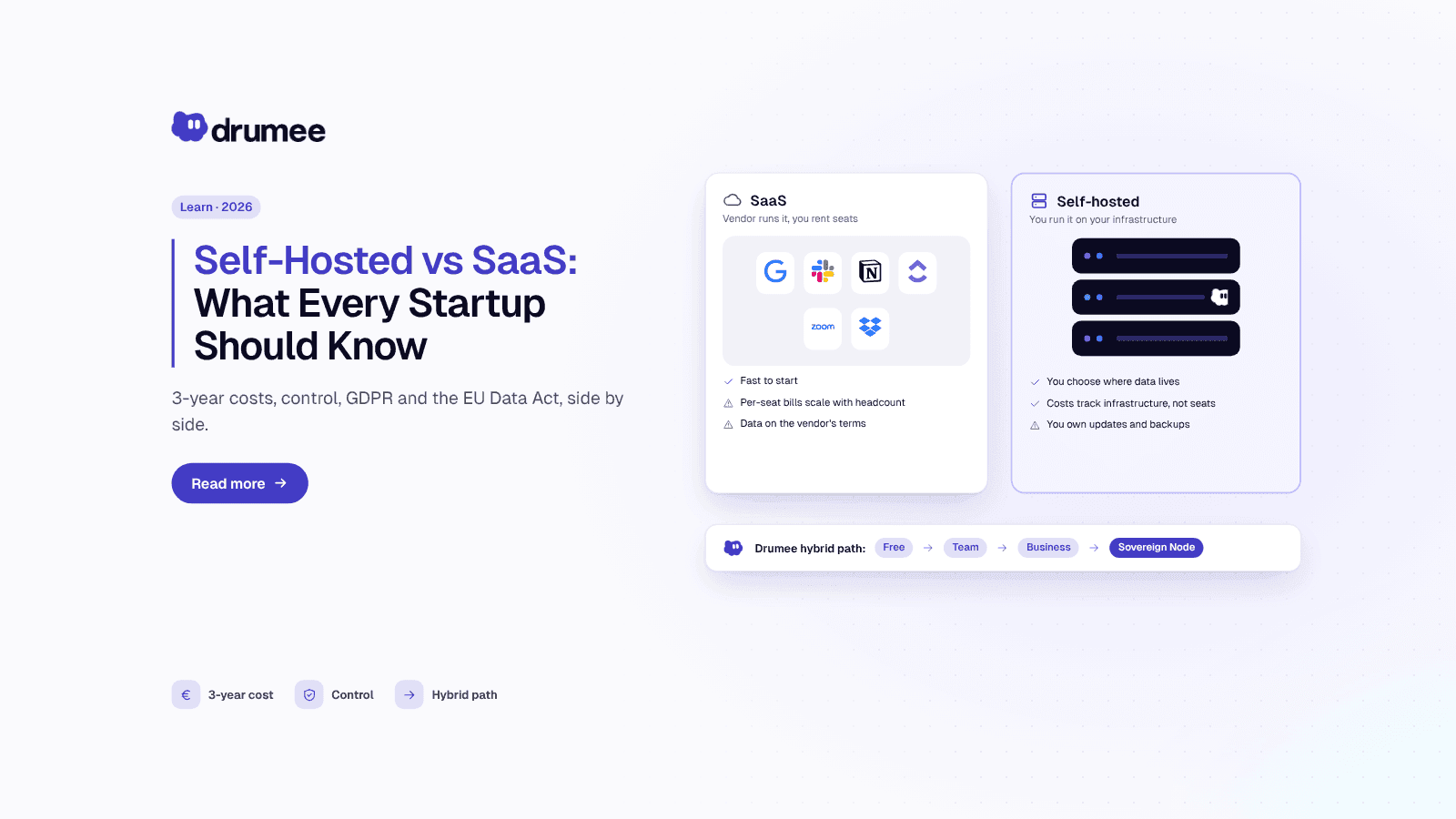
Over three years, a 10-person team pays about $17,118 for a per-seat SaaS stack versus about $13,140 to self-host an open-source stack under illustrative…
Every startup makes the self-hosted vs SaaS decision, usually without noticing. The first tool someone signs up for with a company card becomes the default, and three years later the team is renting a dozen per-seat products it never consciously chose.
This guide treats the choice deliberately. It defines both models, runs a three-year cost comparison that includes the costs self-hosting advocates tend to skip, compares control and GDPR compliance, and explains the EU Data Act rules that change the cost of switching.
The honest answer is that neither model wins everywhere. For most startups, the right question is not "self-hosted or SaaS?" but "which layers should we own, and when?"
What is the difference between self-hosted and SaaS?
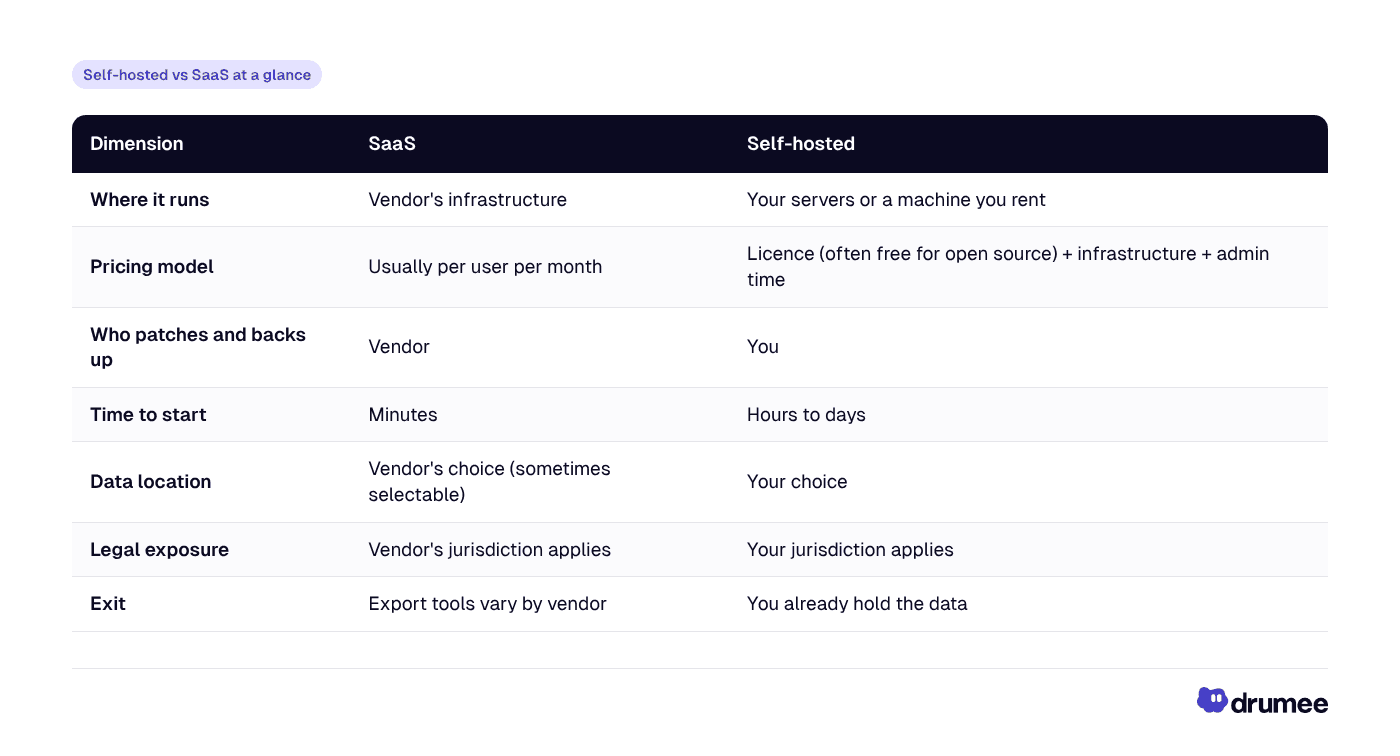
Definition: SaaS (software as a service) is software you rent from a vendor who runs it on the vendor's infrastructure, usually priced per user per month. Self-hosted software runs on infrastructure you control, such as your own servers or a rented machine, so you manage updates, backups and access, and your data stays where you put it.
The practical difference is who holds the keys. With SaaS, the vendor operates the system and holds your data under its terms. With self-hosting, you operate it, and you carry the work that comes with that.
Where Drumee fits: Drumee is a sovereign workspace (files, chat, meetings, task boards and admin in one system) that runs in either model. Teams can start on Drumee-hosted managed plans, from Free to Business at $99/month for unlimited users, and later move to a self-hosted Sovereign Node on their own infrastructure without switching products.
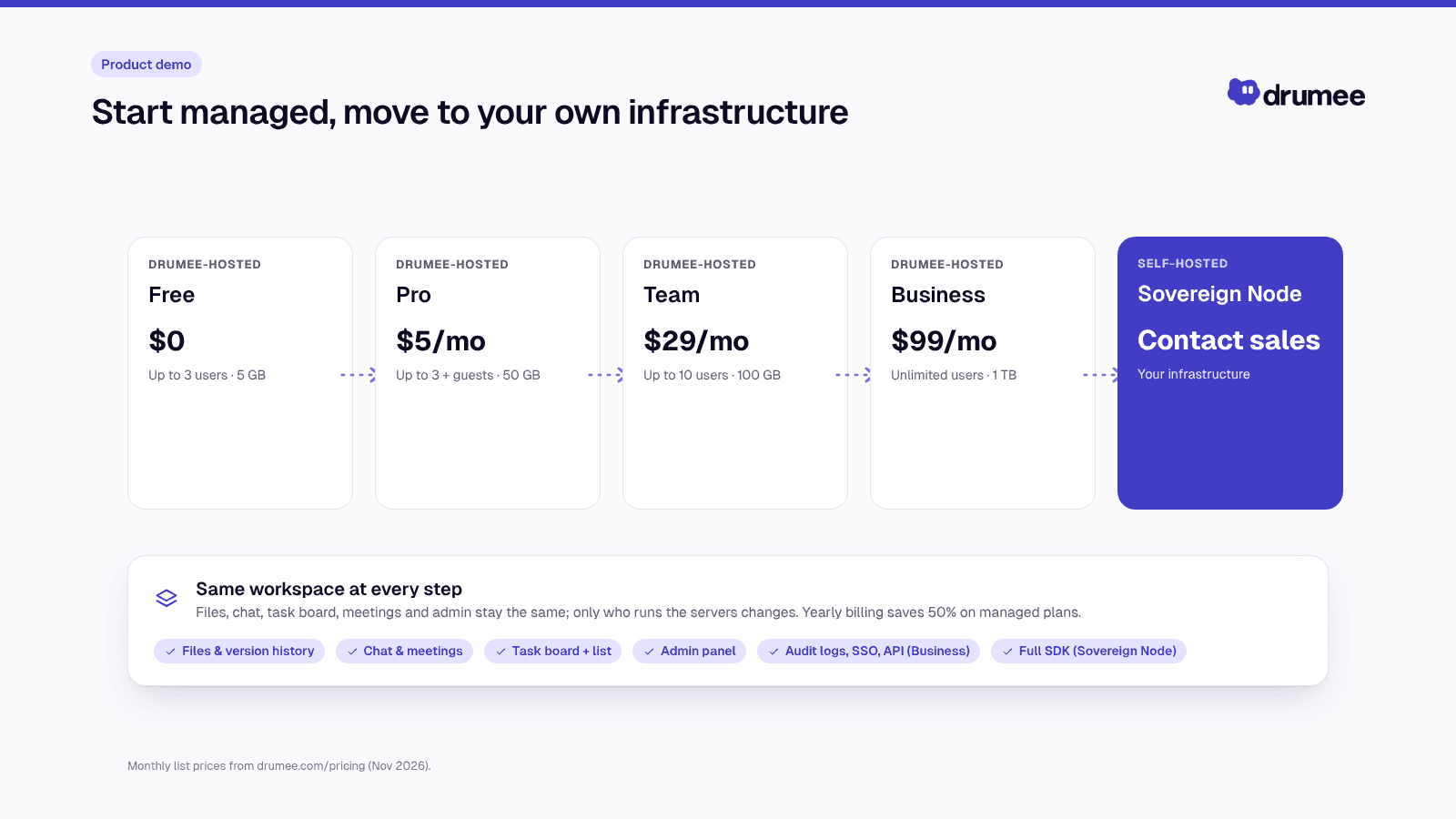
Start managed, move to your own infrastructure.
Self-hosted vs SaaS at a glance
A third category sits between them: managed hosting of software you could also self-host. You get SaaS-like convenience now and the option to bring it in-house later. We return to this hybrid path near the end.
Why the decision matters more in 2026
Three trends have pushed this question from the server room into the founder's inbox.
First, per-seat software keeps getting more expensive. Vendors have raised list prices as they bundle AI features; Google Workspace's flexible Business Standard plan now lists at $16.80 per user per month, per Google Workspace Admin Help.
Second, European buyers are rethinking dependence on global providers. A Gartner survey published 12 November 2025 found 61% of Western European CIOs and IT leaders expect geopolitics to increase their reliance on local or regional cloud providers. Gartner also predicts that by 2030 more than 75% of non-US enterprises will have a digital sovereignty strategy.
Third, GDPR enforcement is not slowing down. The DLA Piper GDPR Fines and Data Breach Survey (January 2026) counts €7.1 billion in cumulative GDPR fines since May 2018, with roughly €1.2 billion issued in 2025 alone.
For a startup selling to European customers, "where does our data live and who can reach it?" is now a sales question, not just a legal one.
How each model works in practice
How SaaS works
You sign up, invite your team and pay per seat. The vendor runs the servers, applies security patches, handles backups and ships new features on its own schedule.
That is a genuine advantage. A three-person team does not need anyone to know what a reverse proxy is. The trade-off is that costs scale with every hire, features and prices change when the vendor decides, and your data sits under the vendor's contracts and jurisdiction.
Under GDPR, each SaaS vendor that handles personal data is a processor, and Article 28 requires a written processing agreement with each one. Five tools means five agreements and five sub-processor lists to track.
How self-hosting works
You (or a contractor) provision a server, install the software, configure authentication, set up backups and monitoring, and keep everything patched. Many self-hosted tools are open source and free to download; you pay in infrastructure and time instead of per-seat licences.
The data stays on systems you control, in a location you chose. You decide when to upgrade. And when you want to leave, you already hold everything.
The cost is operational responsibility. If backups fail or a patch is missed, there is no vendor to blame.
The 3-year cost comparison: seats × price vs. the real cost of self-hosting
Most self-hosted vs SaaS cost comparisons cheat in one of two directions. SaaS fans ignore per-seat growth; self-hosting fans ignore admin time. Here is a comparison that shows both, with every assumption visible.
SaaS side: seats × list price × 36 months
We use the four-tool stack many startups run, at monthly list prices as of November 2026 (check vendor pages before budgeting):
- Google Workspace Business Standard: $16.80
- Slack Pro: $8.75
- Notion Plus: $12.00
- ClickUp Unlimited: $10.00
That is $47.55 per user per month. For 10 users: $47.55 × 10 × 36 = $17,118 over three years. For 25 users: $47.55 × 25 × 36 = $42,795. Our guide to reducing SaaS costs for EU startups breaks these numbers down further.
Self-hosted side: the hidden costs
Self-hosting an open-source stack has no seat fees, but it is not free. The figures below are illustrative assumptions, not statistics. Replace them with your own quotes and salary rates.
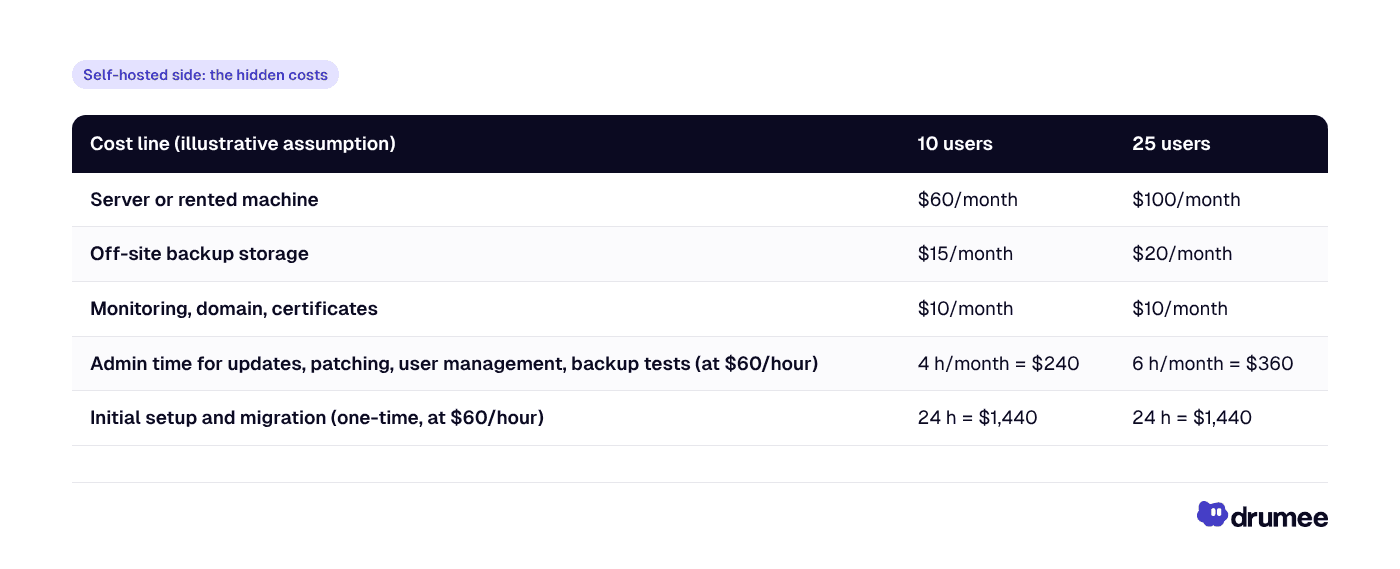
Note what dominates: admin time. In both scenarios, people cost more than hardware. That is why self-hosting looks expensive for tiny teams and cheap for larger ones: the costs are mostly fixed, while SaaS costs grow with every seat.
Three-year totals
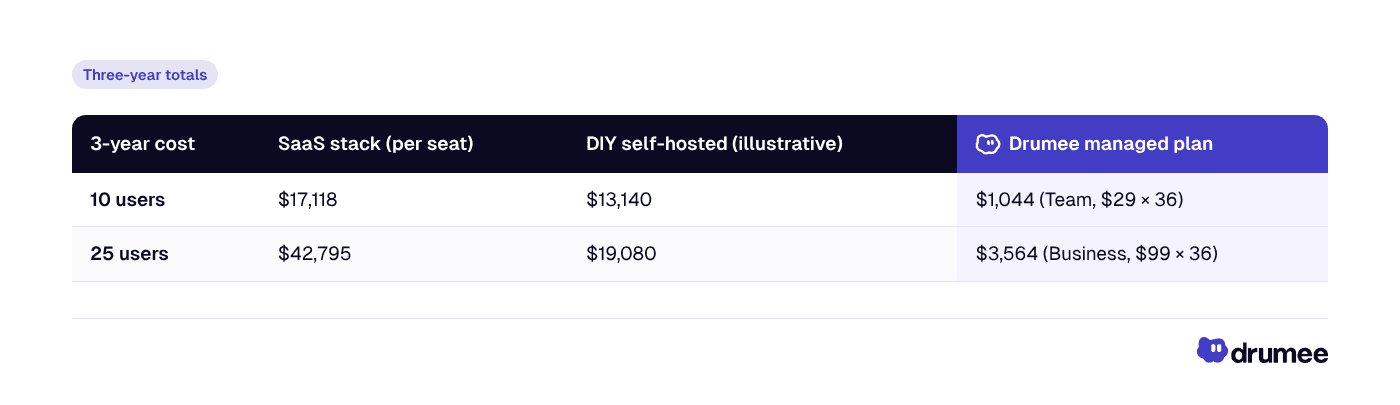
How the self-hosted totals are built: for 10 users, ($60 + $15 + $10 + $240) × 36 + $1,440 = $13,140. For 25 users, ($100 + $20 + $10 + $360) × 36 + $1,440 = $19,080.
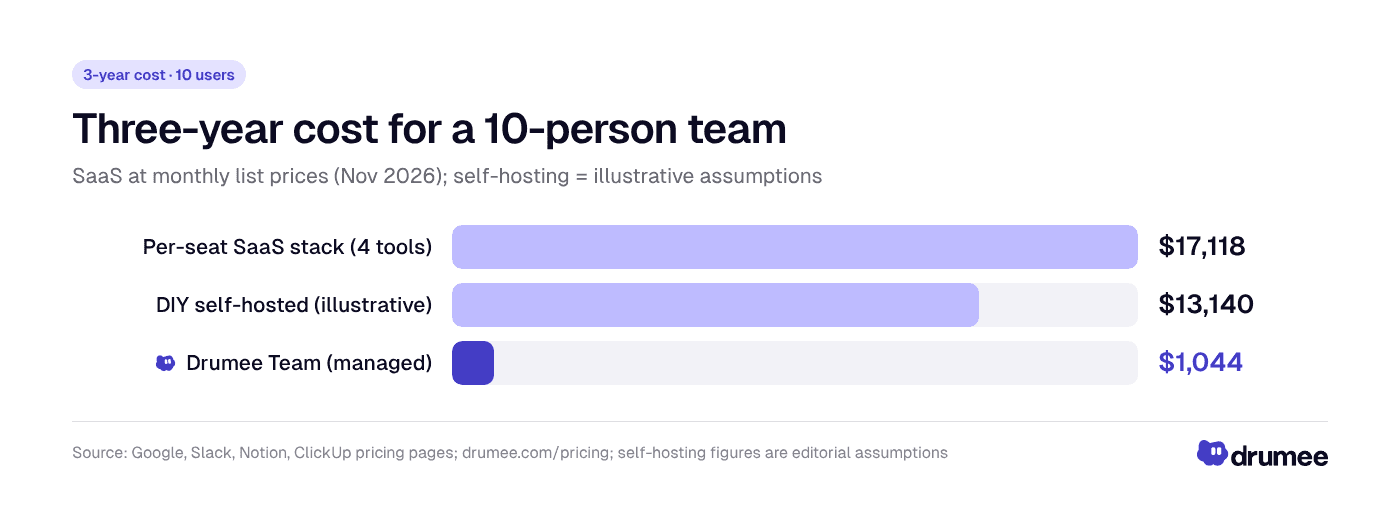
Over three years, a 10-person team saves about $4,000 by self-hosting versus a four-tool per-seat stack under illustrative assumptions, while a flat-priced Drumee Team plan costs $1,044 for the workspace layer it covers.
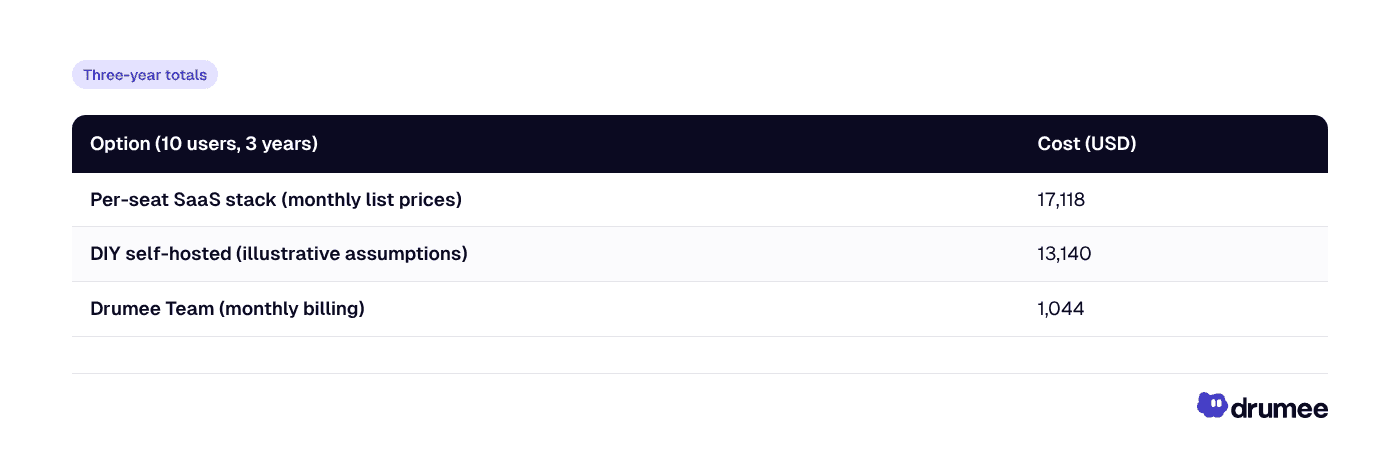
Two caveats keep this honest. First, Drumee does not replace business email or real-time document co-editing, so most teams keep an email provider; adding Google Business Starter at $8.40 per user per month adds $3,024 over three years for 10 users. Second, a Drumee Sovereign Node is priced through sales, and self-hosting it still carries the infrastructure and admin lines above. Yearly billing halves the managed plan prices.
Control and compliance: what you actually gain by self-hosting
Cost is the easiest dimension to model. Control and compliance are usually the reason teams actually move.
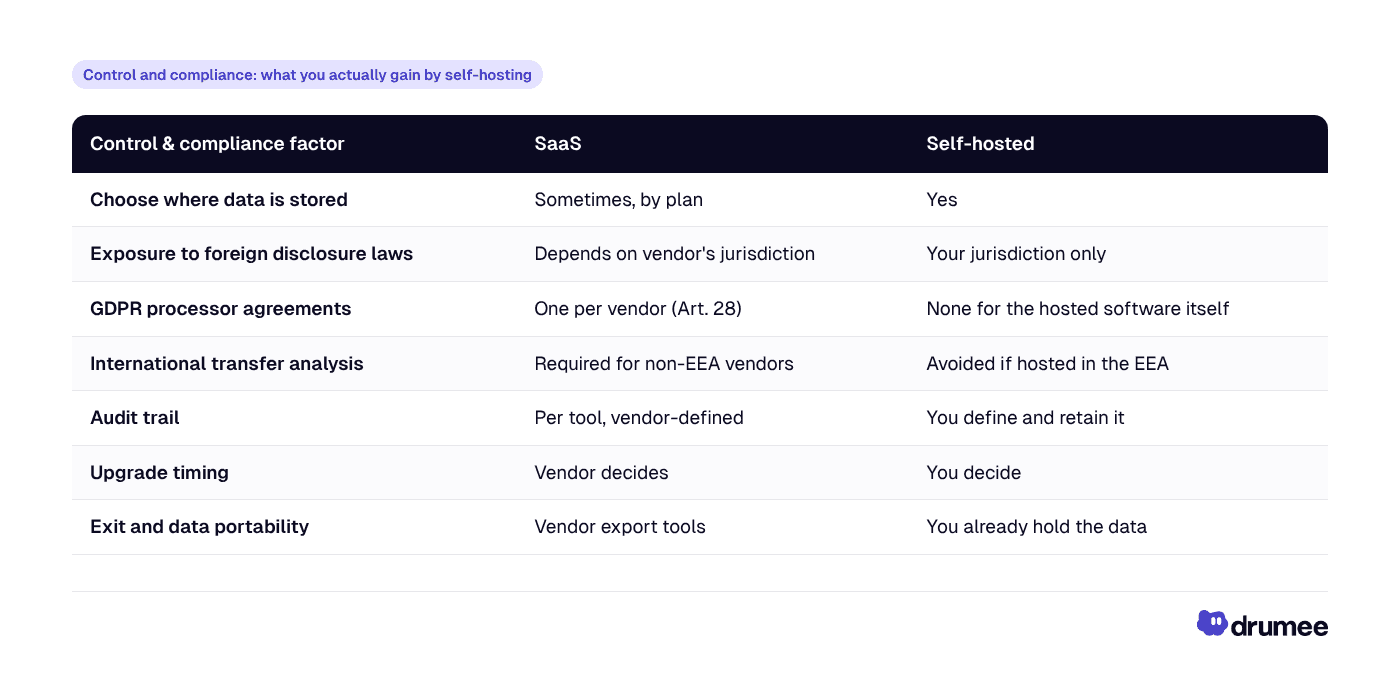
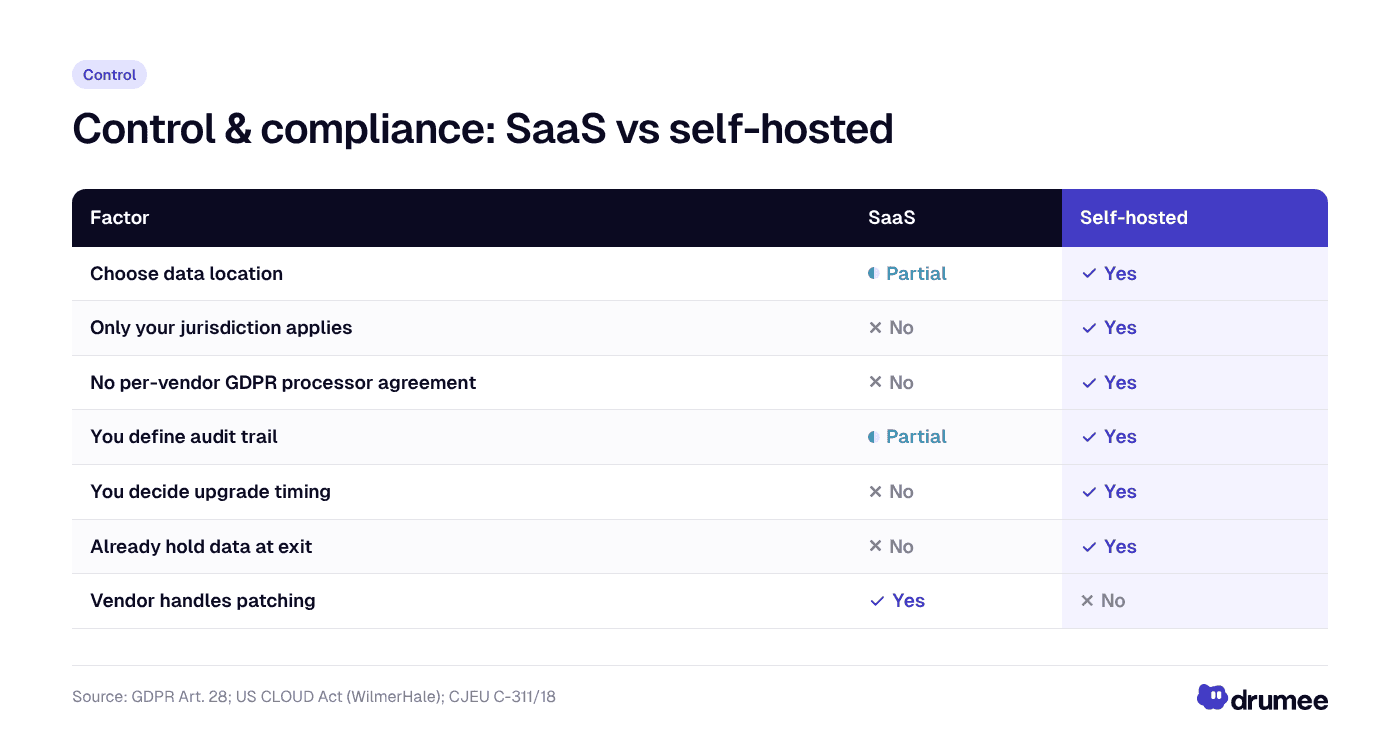
Self-hosting shifts control of data location, legal jurisdiction, audit logs and upgrade timing from the vendor to your team, at the price of running the system yourself.
Jurisdiction is the part most startups underestimate
The US CLOUD Act, signed in March 2018, requires US providers to disclose data in their "possession, custody, or control" regardless of where that data is stored. An EU data centre does not change who controls the provider.
Transfers also carry history. In Schrems II (C-311/18), the Court of Justice of the EU invalidated the EU-US Privacy Shield in July 2020 and required supplementary measures for standard contractual clauses. Its successor, the EU-US Data Privacy Framework, currently stands, but European teams have watched two transfer frameworks fall in a decade.
Self-hosting in the EEA does not make you GDPR-compliant by itself. It removes an entire category of questions, such as third-country transfers and foreign disclosure orders, from your compliance work.
For a deeper look at how this applies to a workspace, see our guide to GDPR compliance with Drumee.
The EU Data Act: switching is getting cheaper
One argument for staying on SaaS has been switching cost: leaving means egress fees and migration pain. EU regulation is now chipping away at that.
According to Travers Smith's analysis of the EU Data Act, most of the Act's provisions have applied since 12 September 2025. Switching charges for cloud and data-processing services, including egress fees tied to switching, are capped at direct cost until 12 January 2027, when they are banned outright.
What this means for a startup choosing today:
- Lower lock-in risk on SaaS. Starting on a managed service is less risky when providers cannot charge you to leave.
- Easier moves to self-hosting. If you outgrow a provider, the Act strengthens your hand on getting your data out.
- Contracts still matter. Read exit and portability clauses; the Act sets a floor, not a full migration plan.
When SaaS makes sense
SaaS is the right default in plenty of situations. Be honest with yourself about whether you are in one of them.
- You have no one to run infrastructure. If nobody on the team can own patching and backups, self-hosting creates risk instead of reducing it.
- You are pre-product-market-fit with 1–5 people. Speed matters more than ownership, and per-seat costs are still small.
- You need a best-in-class specialist tool. Google's real-time docs collaboration, Notion's docs and wiki experience and ClickUp's deep project management are hard to match. Keeping a specialist tool where it is clearly better is a sensible choice.
- Your data is low-sensitivity. If you handle little personal data and no regulated data, jurisdiction is a smaller concern.
When self-hosted makes sense
Self-hosting starts to win as teams grow, regulation tightens or customers start asking hard questions.
- You are past roughly 15–25 people. Fixed self-hosting costs stop growing while per-seat costs keep climbing, as the 25-user column above shows.
- You sell into regulated sectors. Financial services, legal, public sector, defence and critical infrastructure buyers increasingly ask where data lives and which jurisdiction applies.
- You have someone who can own operations. A part-time DevOps owner or a reliable contractor makes the admin-time line manageable.
- You want to own your exit. If you never want to negotiate with a vendor to get your own data back, self-hosting is the cleanest answer.
A real-world analogy: 37signals and the cloud exit
The most cited example of leaving the cloud is 37signals, the company behind Basecamp and HEY. Its co-founder David Heinemeier Hansson reports that the company cut its cloud bill from a $3.2 million annual run-rate to $1.3 million in 2024, roughly $2 million a year saved, after moving to its own hardware, per DHH's cloud exit FAQ.
Be careful with this example. 37signals left infrastructure as a service (IaaS), meaning rented servers and storage, not SaaS productivity tools. It is a large company with an experienced operations team.
What transfers to a startup is the principle, not the scale. Rented capacity that is convenient at the start can become expensive once usage is steady and predictable. The same logic applies to per-seat workspace tools when headcount is stable and growing.
Can a startup use self-hosted software instead of SaaS?
Standalone answer: Yes. A startup can replace most SaaS collaboration tools with self-hosted software if someone can own updates, backups and access. The economics favour self-hosting as headcount grows, because costs are mostly fixed. Many teams start on a managed plan and move to their own infrastructure once they reach 15–25 people or face customer data-residency questions.
In practice, most startups end up hybrid. They self-host or use a sovereign workspace for files, chat and tasks, where data sensitivity is highest, and keep a specialist SaaS tool where it is clearly better, such as email or real-time document editing.
Is self-hosting your workspace worth it in 2026?
It depends on three numbers: your headcount, your admin capacity and your data sensitivity. Use this quick test.
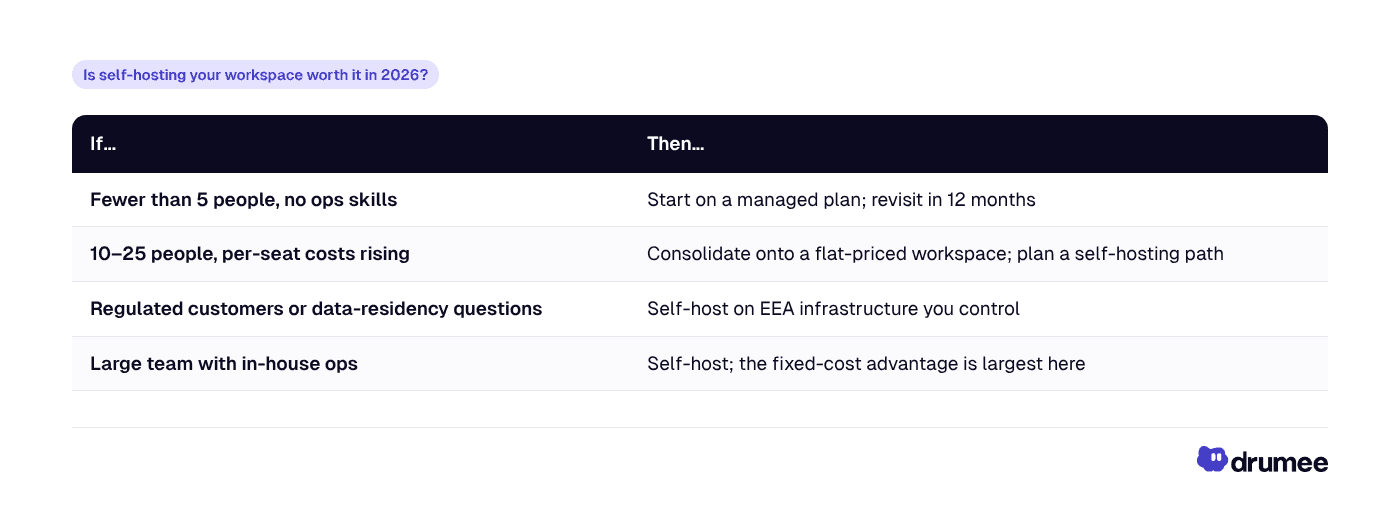
For a 10-person team, our illustrative model shows DIY self-hosting saving about $4,000 over three years against a four-tool per-seat stack. That saving is real, but modest; the stronger reasons are control and compliance. At 25 people, the illustrative saving grows to about $23,700.
Is there a free self-hosted workspace?
Yes, there are free self-hosted options, with caveats. Nextcloud offers a free Community edition under the AGPL licence, with a large community and a mature app ecosystem; its Enterprise subscriptions are priced per user per year on request. Free software still carries the server and admin costs shown above.
Drumee's Free plan costs $0 for up to 3 users with 5 GB of storage, but it is a Drumee-hosted managed plan, not a self-hosted one. Self-hosting Drumee means a Sovereign Node, which is priced through sales and includes full SDK access and a dedicated SLA.
For a full comparison of the two products, read Drumee vs. Nextcloud.
Drumee as the hybrid path: managed plan first, Sovereign Node later
The biggest risk in the self-hosted vs SaaS decision is choosing too early. Commit to self-hosting at three people and you spend founder time on servers. Commit to per-seat SaaS and you face a painful migration at 30 people.
Drumee is designed to avoid that fork. The same sovereign workspace runs as a Drumee-hosted managed plan or as a self-hosted Sovereign Node.
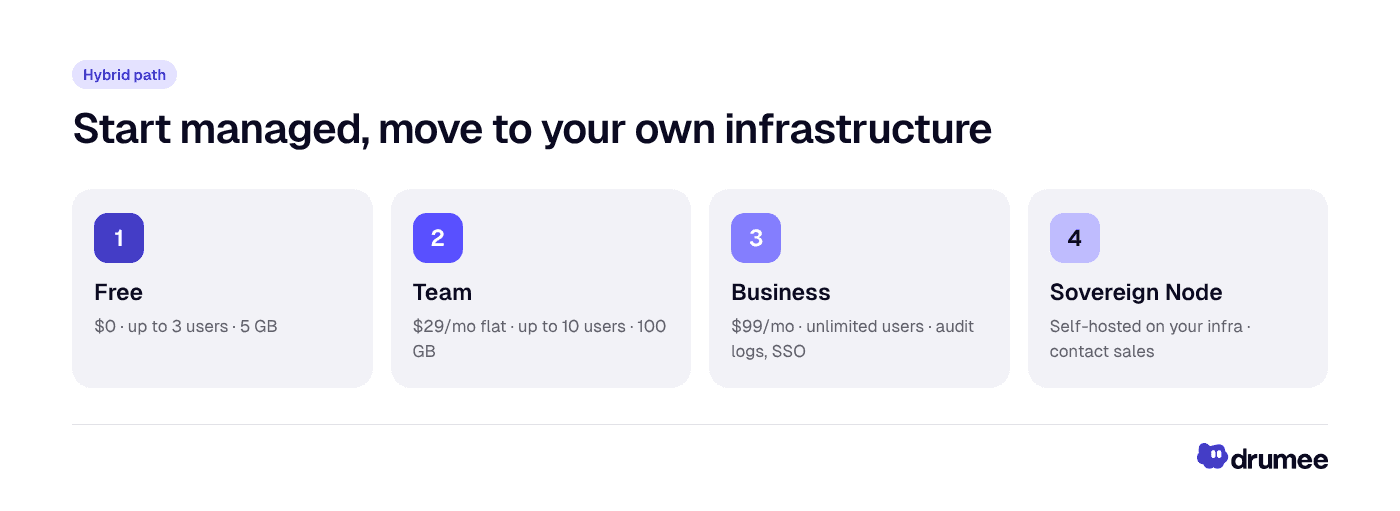
Drumee lets a startup move from a free managed plan to a self-hosted Sovereign Node in four stages without changing workspace products.
- Free ($0, up to 3 users, 5 GB): try files, chat and tasks with founders.
- Team ($29/month flat, up to 10 users, 100 GB): admin panel and 30-day version history as the team forms.
- Business ($99/month, unlimited users, 1 TB): audit logs, SSO/SAML and API access as you sell to larger customers.
- Sovereign Node (contact sales): run it on your own infrastructure with full SDK access and a dedicated SLA.
This path delivers the triple value prop at each stage. Cost: flat pricing instead of seats × tools. Control: one admin panel, and audit logs on Business. Sovereignty: a clear route to running everything on your infrastructure under your jurisdiction. On the managed plans, ask Drumee sales for the current hosting region and data processing agreement.
If you are new to the concept, start with what a sovereign workspace is. If you are replacing Google today, see our self-hosted Google Workspace alternative guide.
Examples: how three startups might choose
- Two-founder SaaS startup, pre-revenue: no ops capacity, little personal data → stays on managed plans, including Drumee Free for files and tasks → revisits at 10 people.
- 18-person EU product studio: per-seat costs climbing, clients asking where files live → consolidates onto Drumee Business ($99/month) → plans a Sovereign Node when its first enterprise client requires data residency.
- 12-person fintech startup: regulated customers from day one, one experienced DevOps engineer → self-hosts on EEA infrastructure via a Sovereign Node → answers data-location questions with one system, not five.
FAQ
Is self-hosting your workspace worth it in 2026?
It is worth it once you have someone to own operations and either a growing team or customers asking about data location. Under illustrative assumptions, self-hosting saves a 10-person team about $4,000 over three years against a four-tool per-seat stack, and about $23,700 at 25 people. The stronger benefits are control and GDPR simplicity.
Can a startup use self-hosted software instead of SaaS?
Yes. Startups can self-host files, chat, task management and meetings if someone handles updates, backups and access. Many choose a hybrid: a managed plan at first, then their own infrastructure as headcount and compliance demands grow, while keeping specialist SaaS tools such as email.
Is there a free self-hosted workspace?
Nextcloud's Community edition is free to self-host under the AGPL licence, though you still pay for servers and admin time. Drumee's Free plan is $0 for up to 3 users, but it is a Drumee-hosted managed plan; self-hosting Drumee requires a Sovereign Node, priced through sales.
What are the hidden costs of self-hosting?
The main hidden cost is admin time: updates, security patches, user management and testing backups. Add server rental, off-site backups, monitoring and a one-time setup and migration effort. In our illustrative model, admin time is the largest single line, larger than hardware.
Does the EU Data Act make it easier to leave a SaaS provider?
Yes. Most Data Act provisions have applied since 12 September 2025. Switching charges, including switching-related egress fees, are capped at direct cost until 12 January 2027, after which they are banned. You still need a practical migration plan.
Conclusion: own the layers that matter
SaaS gets a startup moving in minutes; self-hosting gives it control over cost, data location and exit. The three-year math shows per-seat costs climbing with every hire, while self-hosting costs are mostly fixed and dominated by admin time, so the balance tips as you grow.
With €7.1 billion in cumulative GDPR fines on record and switching charges banned from January 2027, EU startups have more reason, and more freedom, to own their core workspace. The practical answer is often hybrid: start managed, keep specialist tools where they are clearly better, and move your core workspace onto your own infrastructure when the time is right.
Next step: compare Drumee's managed plans and book a Sovereign Node call on the pricing page.
Keep reading
Self-Hosted Alternatives to Google Workspace: 2026 Guide for EU Teams
Google Workspace is the default office stack for most European startups. It is also a US-controlled service whose list price went up in January 2025, whose data sits under US legal reach, and whose exit path takes days of admin work. For a growing...
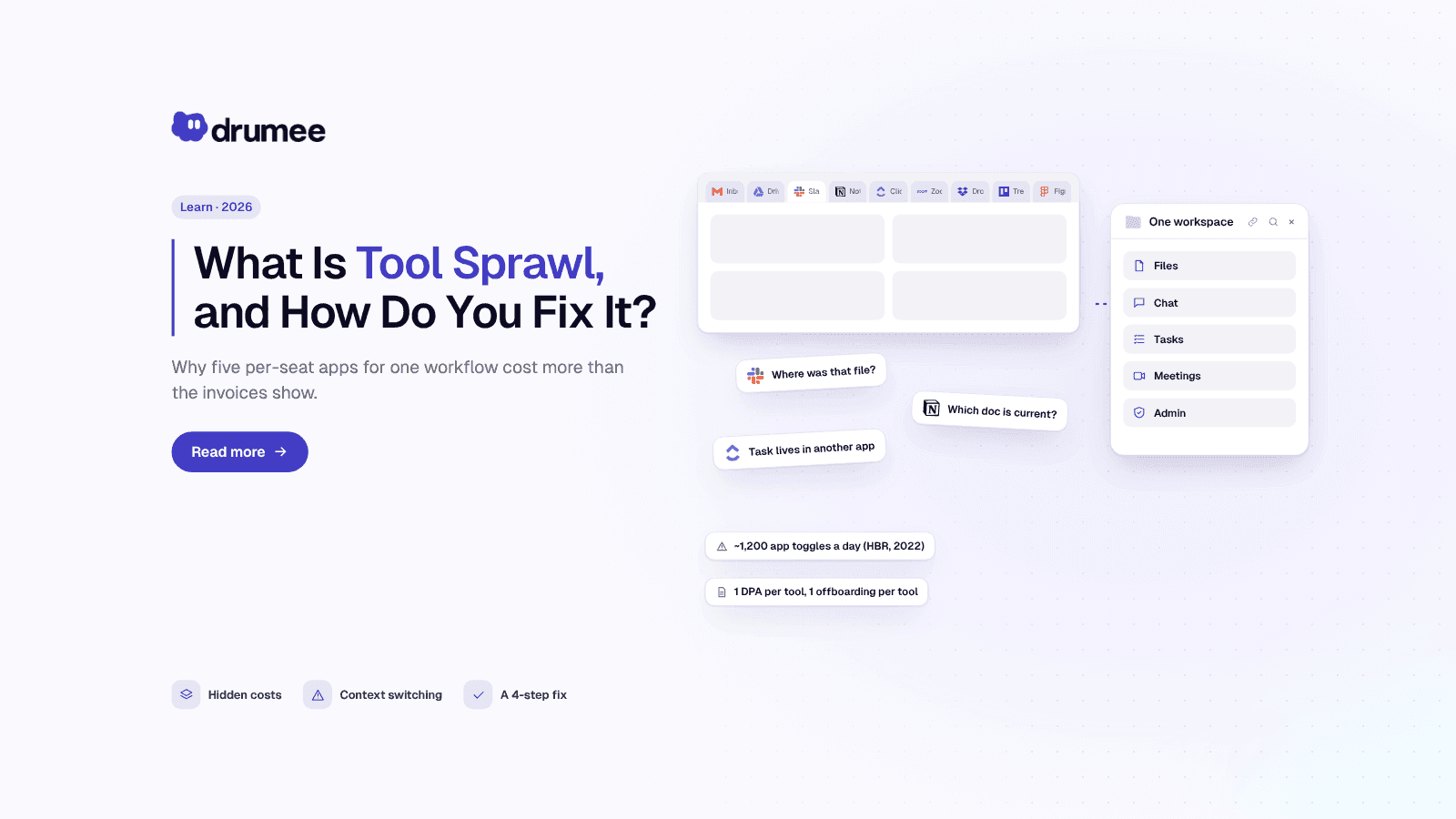
What Is Tool Sprawl and How to Fix It in 2026
Nobody decides to build a messy stack. A startup adds Slack on day one, Google Drive on day two, Notion when the wiki gets real and ClickUp when the roadmap stops fitting in a spreadsheet. Two years later, a simple question like "where did we deci...
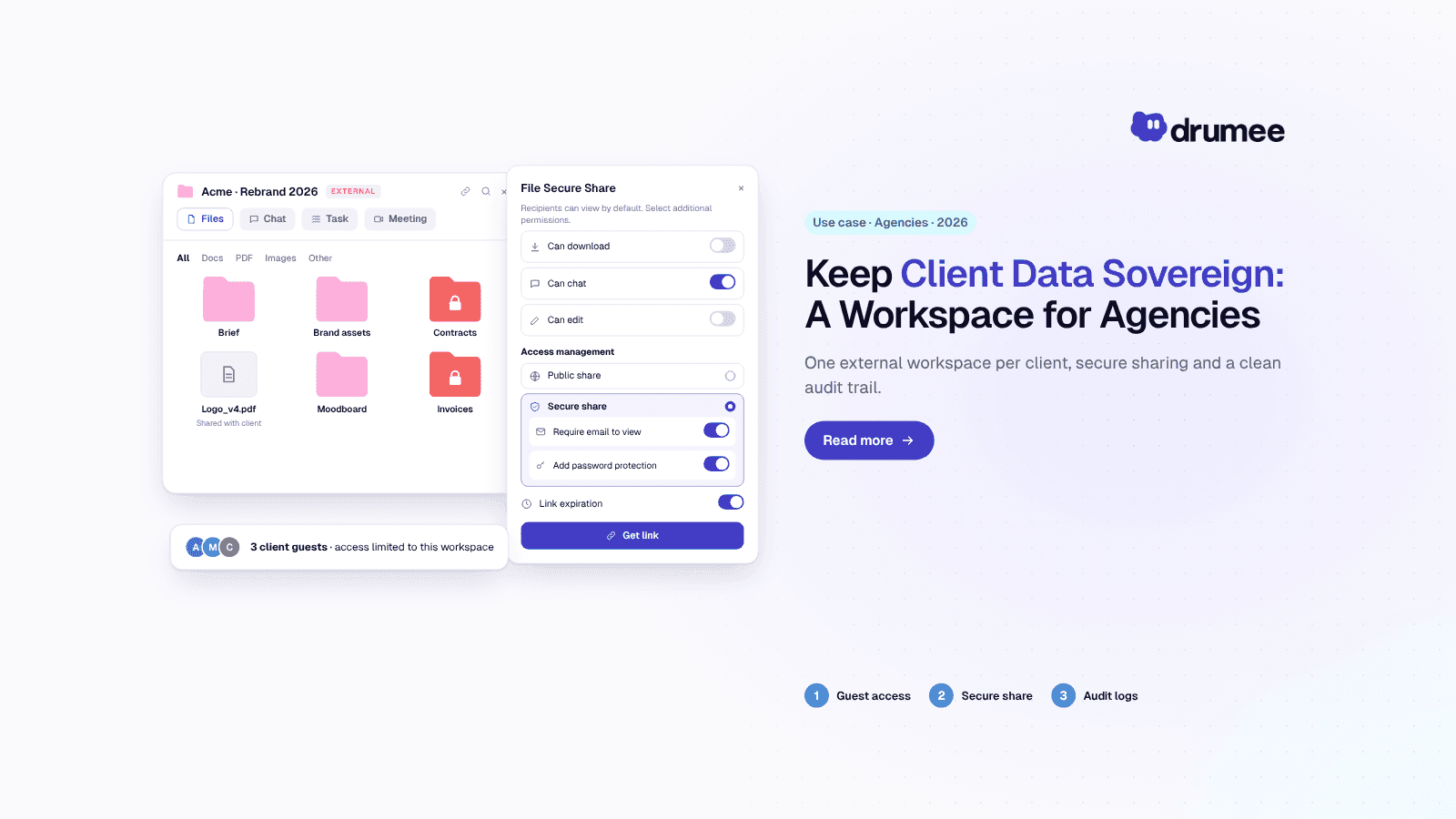
Self-Hosted Workspace for Agencies: How to Keep Client Data Sovereign
An agency's real product is trust. Clients hand over unreleased campaigns, product roadmaps, customer lists and source files, usually under an NDA, and expect them to stay exactly where they were promised. Then the work spreads across a shared dri...