
Is Drumee GDPR Compliant? Data Sovereignty Explained (2026)
"Is this tool GDPR compliant?" is the first question every European buyer asks about workspace software, and it is the wrong question to ask in isolation. No software product is GDPR compliant on its own. The regulation applies to organizations an...
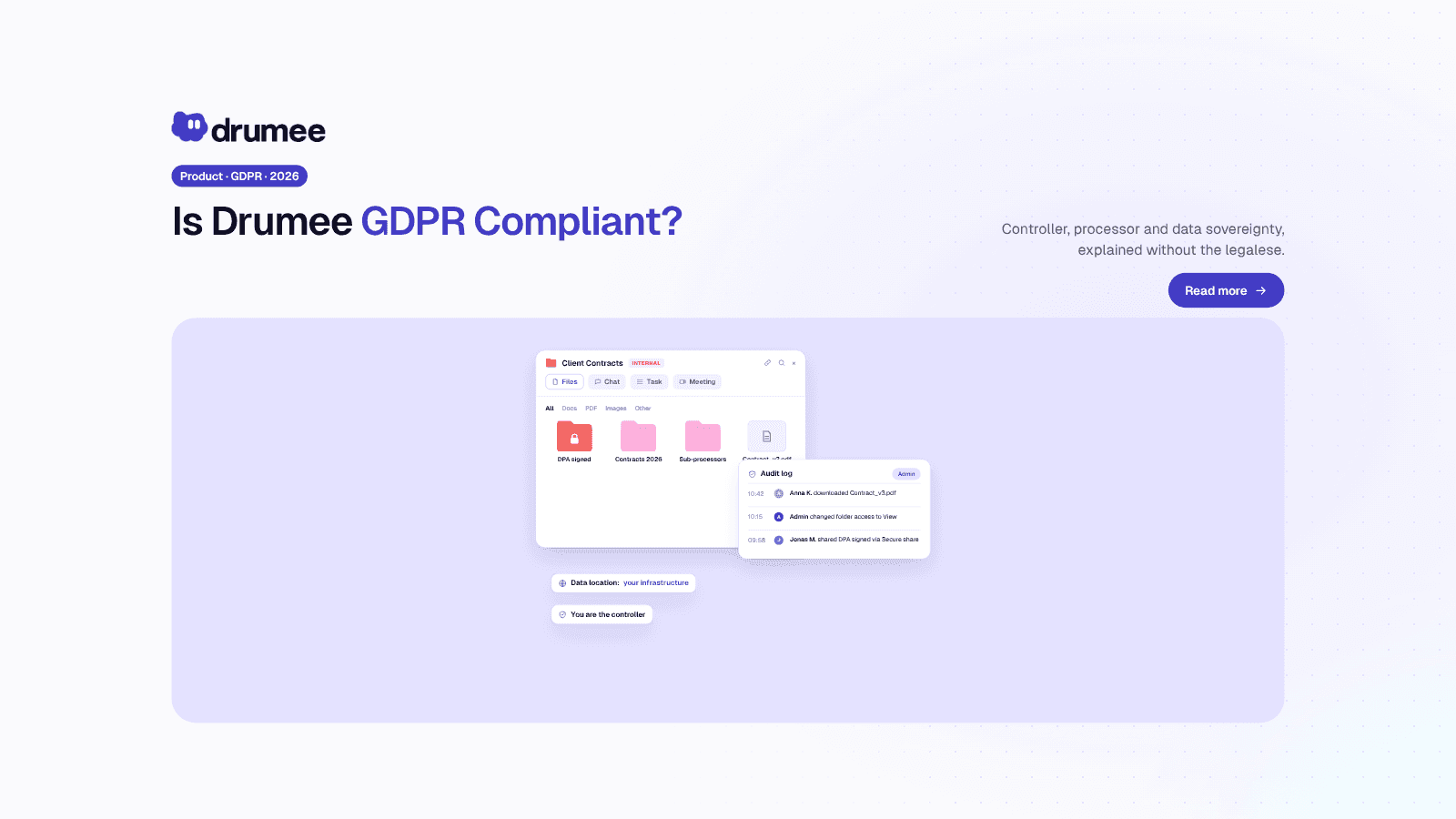
Under GDPR, running Drumee as a Sovereign Node on your own infrastructure removes the third-party hosting processor from your compliance chain
"Is this tool GDPR compliant?" is the first question every European buyer asks about workspace software, and it is the wrong question to ask in isolation. No software product is GDPR compliant on its own. The regulation applies to organizations and to how they process personal data, so compliance is always shared between you and every vendor in your stack.
The better question is: does this tool make it easier or harder for you to comply? That depends on who operates the infrastructure, where the data goes, which laws can reach it, and how much evidence you can produce when a regulator or client asks. A GDPR compliant workspace is one whose architecture reduces those risks rather than adding to them.
This page answers the question for Drumee precisely and without overclaiming. It explains the controller and processor roles, what changes when you run Drumee as a self-hosted Sovereign Node, why US cloud providers carry CLOUD Act exposure, where the EU-US Data Privacy Framework stands in late 2026, and what to ask any vendor before you sign.
Is Drumee GDPR compliant? The direct answer
Drumee is built to help organizations meet GDPR obligations, but compliance is a shared responsibility. On a self-hosted Drumee Sovereign Node, data stays on infrastructure you control, so you act as the controller with no third-party processor for hosting. On Drumee-hosted plans, Drumee's operator acts as a processor, and you should review its data processing agreement.
Three facts frame the rest of this page:
- Drumee does not claim to make you compliant. You still need lawful bases, records of processing, security measures and processes for data-subject rights.
- Deployment mode changes your risk profile. A Sovereign Node removes the hosting vendor from your processor list; Drumee-hosted managed plans (Free → Business) add one processor in place of several.
- Jurisdiction matters. Drumee is developed by Thidima SA, a company registered in Switzerland (CHE-336.437.933), a country the EU recognizes as providing adequate data protection.
Drumee does not publicly list third-party certifications such as ISO 27001, and this page does not claim any. If certification evidence is a procurement requirement for you, ask Drumee sales directly.
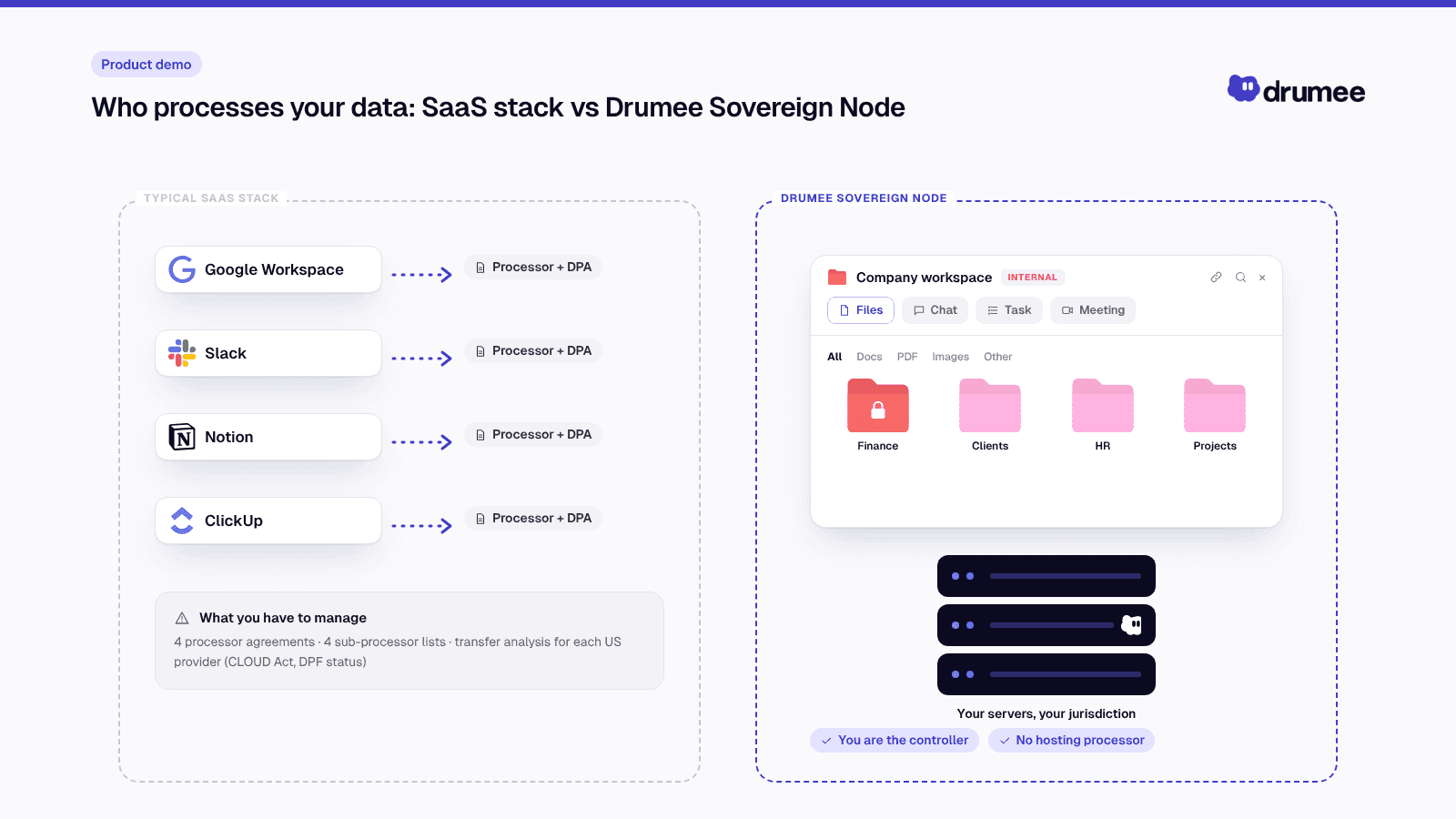
Who processes your data: SaaS stack vs Drumee Sovereign Node.
What GDPR actually requires from workspace software
GDPR does not certify tools. It assigns duties to the parties that process personal data, and your workspace holds plenty of it: employee names and emails, client files, meeting recordings, chat logs and task comments that mention real people.
Controller vs processor
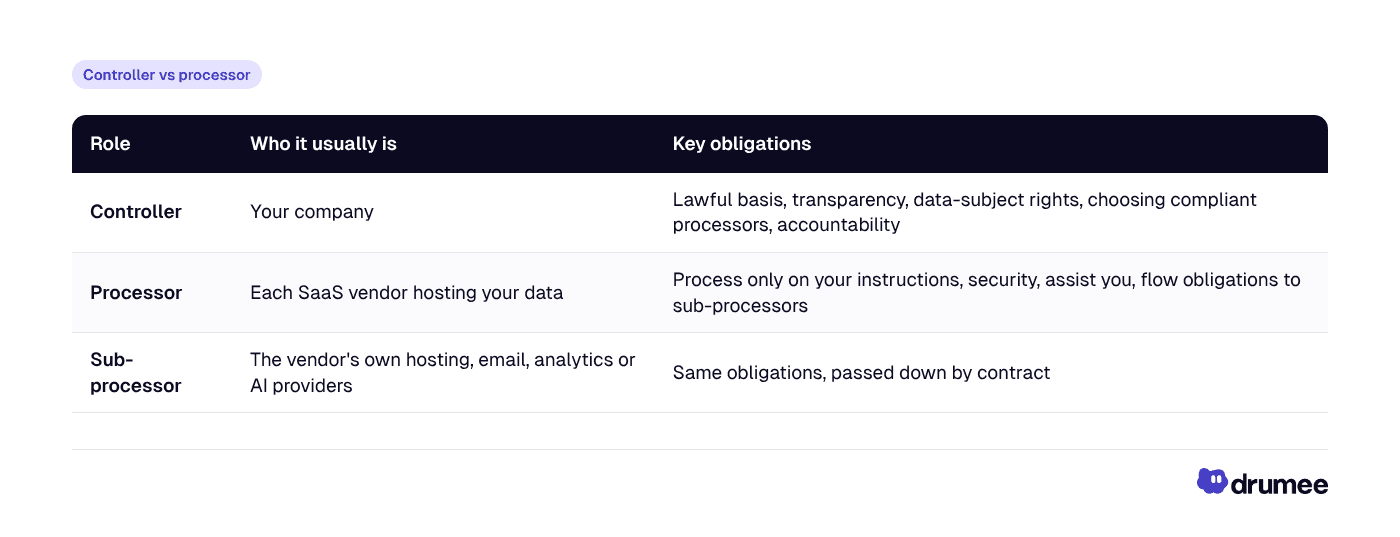
The EDPB's Guidelines 07/2020 on controller and processor set out how these roles work in practice. The controller decides why and how personal data is processed. The processor processes data on the controller's behalf and on its instructions.
When your startup uses a SaaS workspace, you are almost always the controller and the vendor is your processor. Article 28 then requires a written contract (the data processing agreement, or DPA), sufficient guarantees from the processor, and your approval of its sub-processors.
Security and transfers
Article 32 requires "appropriate technical and organisational measures" for security, assessed against risk. Articles 44 to 49 restrict transfers of personal data outside the EEA unless there is an adequacy decision or another safeguard, such as standard contractual clauses (SCCs) backed by a transfer impact assessment.
What failure costs
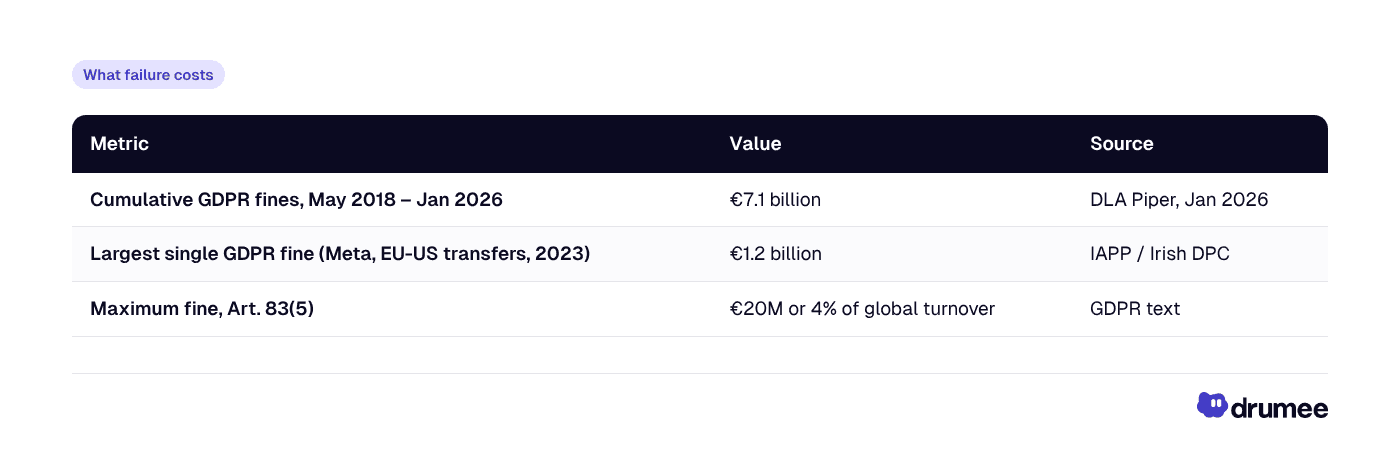
Fines for the most serious infringements reach €20 million or 4% of worldwide annual turnover, whichever is higher, under Article 83(5). Processor and security obligations fall under a €10 million or 2% tier. According to DLA Piper's January 2026 survey, regulators have issued €7.1 billion in GDPR fines since May 2018, around €1.2 billion of it in 2025.
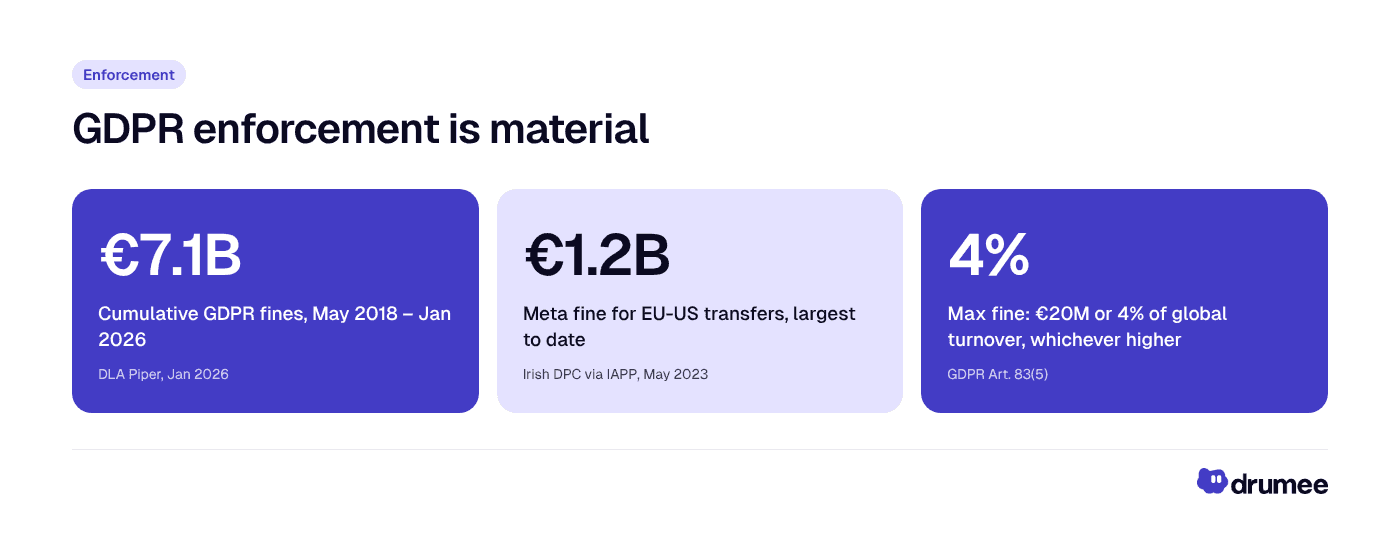
GDPR enforcement is material, and the largest single fine to date was about international data transfers, the exact risk that workspace tool choice controls.
How SaaS tools create GDPR risk
Most SaaS workspaces are perfectly usable under GDPR with the right contracts. The risk is not that they are illegal; it is that each one adds obligations, dependencies and legal exposure you have to manage.
1. Processor sprawl
A typical startup stack of Drive, Slack, Notion and ClickUp means four processors, four DPAs and four sub-processor lists that change over time. Each vendor's sub-processors become yours by extension, and you are accountable for approving them.
2. International transfers
If a vendor or any of its sub-processors stores or accesses data outside the EEA, Chapter V of GDPR applies. Since the CJEU's Schrems II judgment (C-311/18, 16 July 2020) invalidated the EU-US Privacy Shield, controllers relying on SCCs must assess whether the destination country's law undermines them and add supplementary measures where it does.
The consequences are real. The Irish Data Protection Commission fined Meta €1.2 billion in May 2023 for continuing EU-to-US transfers under SCCs after Schrems II, still the largest GDPR fine on record.
3. CLOUD Act exposure
The US CLOUD Act (18 U.S.C. §2713, signed 23 March 2018) requires US providers to disclose data within their "possession, custody, or control" in response to valid US legal process, regardless of where the data is stored. A US company's EU data centre therefore gives you data residency, but not immunity from US legal process.
This is not a hypothetical reading. In June 2025, Microsoft France's legal director told a French Senate inquiry under oath that he could not guarantee French customer data would never be handed to US authorities without French authorization.
4. Opaque operations
With a multi-tenant SaaS product, you cannot inspect how access is logged, how backups are handled, or who among the vendor's staff can reach your tenant. You rely on contractual assurances and the vendor's own reports.
How do EU startups stay GDPR compliant with their tools? They keep a short list of processors with signed DPAs, prefer infrastructure in the EEA or an adequate country beyond foreign access laws, minimize what each tool stores, and centralize access logs. Consolidating onto one operator-controlled workspace shrinks the processor list and the transfer analysis together.
Where the EU-US Data Privacy Framework stands in 2026
US vendors will usually point to the EU-US Data Privacy Framework (DPF) as their transfer mechanism. It is a legitimate tool, but you should understand its status.
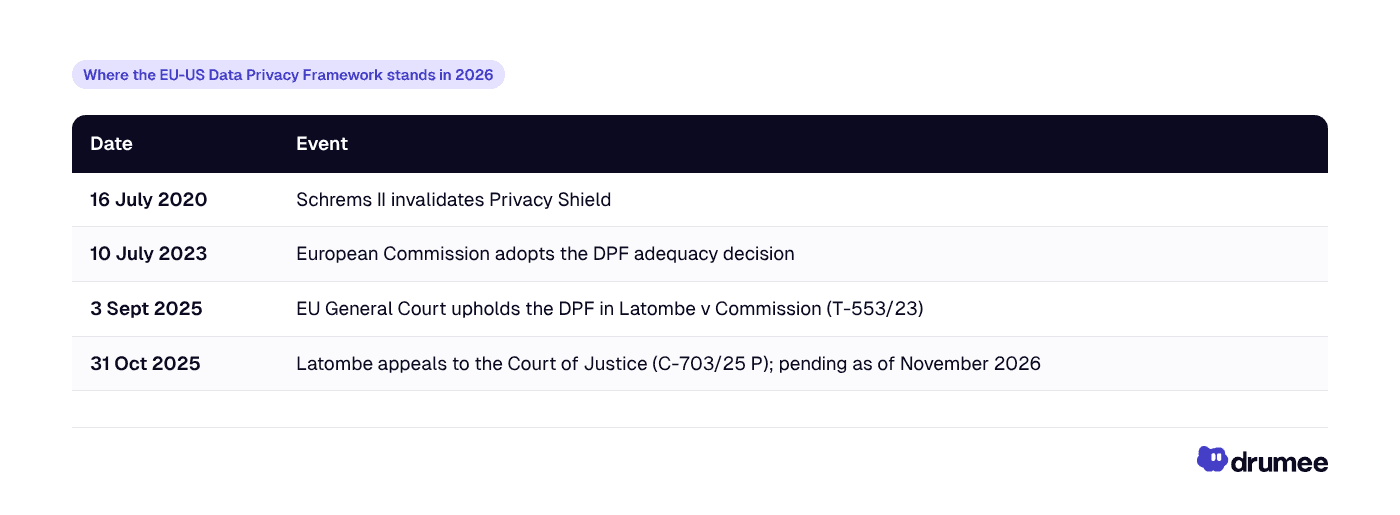
As of November 2026, the DPF is valid, and transfers to US companies that self-certify under it do not need SCCs. The pending appeal means the framework could, in principle, face the same fate as Safe Harbor and Privacy Shield, both of which were struck down by the Court of Justice.
The DPF also addresses transfers, not the CLOUD Act directly. It relies on US commitments about how intelligence agencies access data and on a redress mechanism. Whether that is enough is precisely what the appeal will test. For risk-averse teams, the simplest hedge is architecture: if personal data never leaves infrastructure you control, there is no transfer to justify.
How Drumee's architecture addresses each risk
Drumee offers two deployment modes with the same product: Drumee-hosted managed plans and the self-hosted Sovereign Node. They change your GDPR position in different ways.
Sovereign Node: data stays on your infrastructure
With a Sovereign Node, Drumee runs entirely on infrastructure you choose and operate. Files, chats, meeting data, tasks and audit logs live on your servers.
In GDPR terms, this means you are the controller operating your own processing system. There is no third-party processor for hosting the workspace, so there is no hosting DPA to negotiate, no vendor sub-processor list to monitor for that layer, and no international transfer created by the workspace itself.
Two precise caveats apply:
- If you rent the servers, the provider is your processor. Running a Sovereign Node on a rented VPS or IaaS platform makes that provider a processor (or sub-processor). Choose an EEA or Swiss provider not subject to foreign access laws if sovereignty is the goal; with your own hardware or colocation where you control access, that layer disappears.
- Vendor support access may count as processing. If Drumee staff access your node under the dedicated SLA for support, that access should be covered contractually.
Drumee-hosted plans: one processor instead of several
On the Free, Pro, Team and Business plans, Drumee operates the infrastructure. That makes Drumee's operator your processor under Article 28, and you should request its DPA and sub-processor list as you would for any vendor.
The compliance benefit here is consolidation. Files, chat, meetings, tasks and admin sit with one processor rather than four or five, which shortens your records of processing and your transfer analysis.
Swiss registration and EU data handling
Thidima SA is registered in Switzerland. Switzerland is not an EU member, but the European Commission confirmed in January 2024 that Switzerland continues to provide an adequate level of data protection, based on its revised Federal Act on Data Protection in force since 1 September 2023. Personal data can flow from the EU to Switzerland without additional transfer tools.
Being a Swiss-registered company also means Drumee is not a US-incorporated provider of the kind the CLOUD Act was written for. That is a statement about jurisdiction, not a certification. US reach can also arise through US parents, subsidiaries or sub-processors, which is why the vendor checklist below asks about them for every tool, Drumee included.
Built-in controls that support accountability
Drumee's feature set maps to several GDPR obligations. These features help you comply; they do not do it for you.
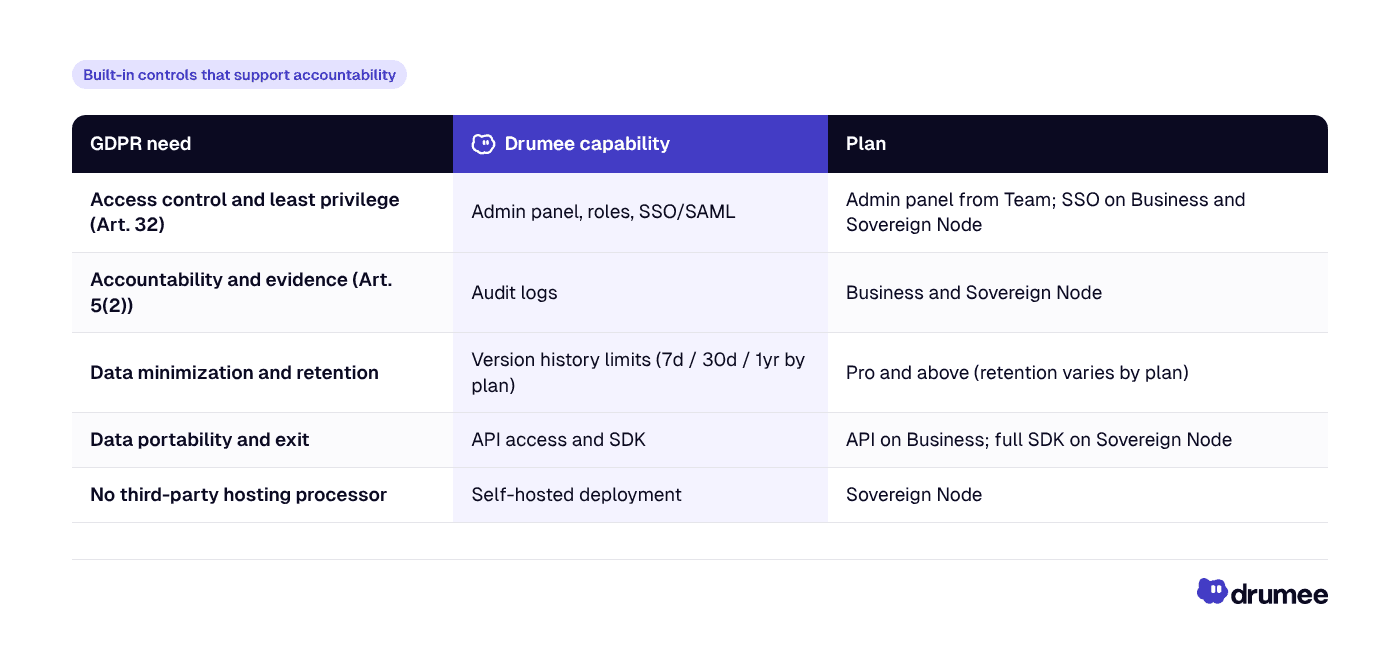
Sovereign Node feature scope is agreed with Drumee sales; confirm SSO and audit logging for your deployment.
Brightlane Studio's CTO Lucas Meyer reports a 65% reduction in audit time after moving to Drumee, attributed to better data traceability (customer-reported, not an independent study).
Comparing deployment models for GDPR risk
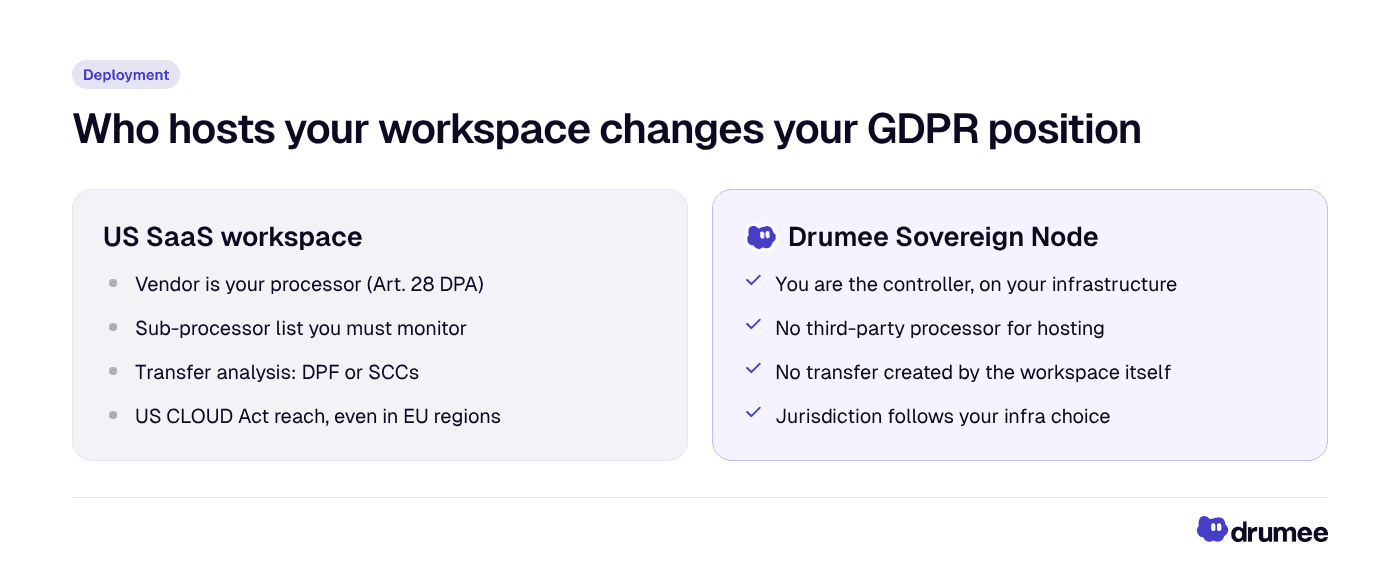
The biggest GDPR difference between workspace options is not features but who operates the infrastructure and which law can compel access to it.
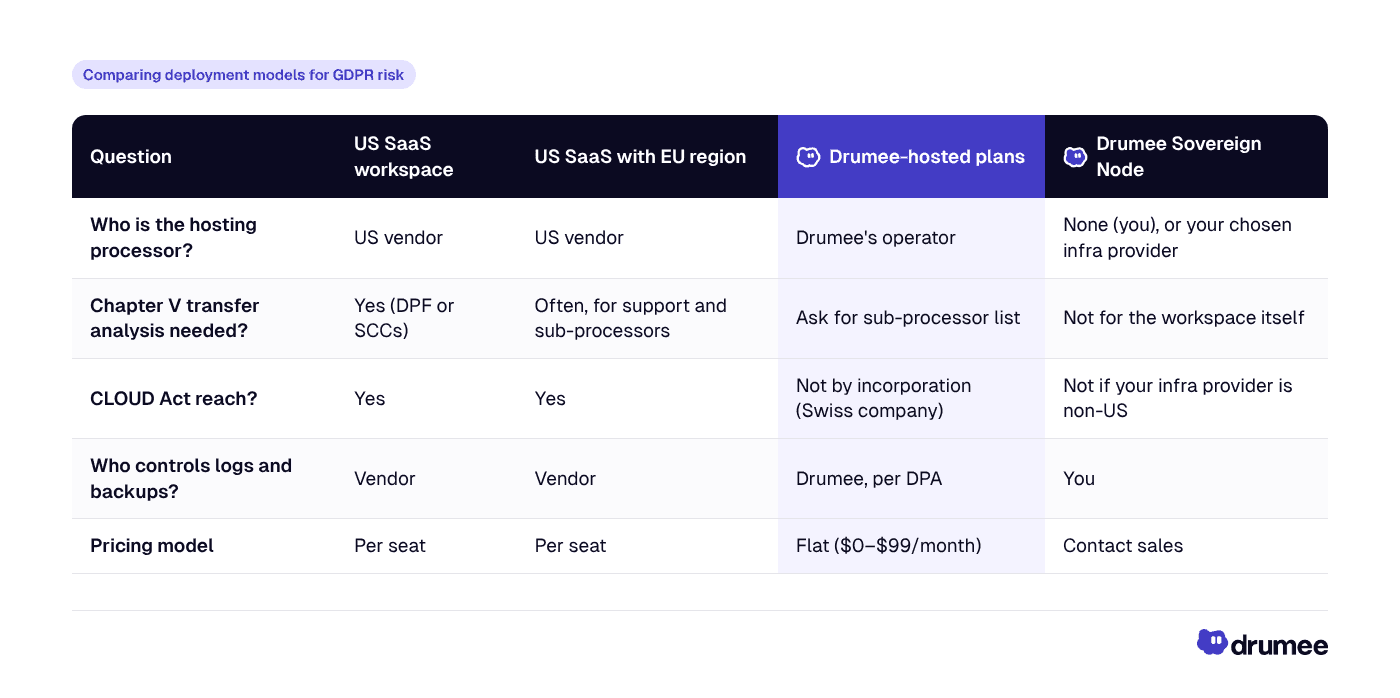
Google Workspace, Notion, Slack and ClickUp are mature products with established DPAs and transfer mechanisms, and many EU companies use them lawfully. The difference is the amount of contractual and legal reliance involved. Lark, operated by Singapore-based Lark Technologies (a ByteDance company), states its own GDPR programme and DPF certification; buyers concerned about jurisdiction should review those claims directly, as we discuss in Drumee vs Lark.
Among self-hosted options, Nextcloud is a strong, mature open-source alternative with a large community, and it delivers the same "no hosting processor" benefit when you run it yourself. The trade-off is IT effort and assembling the workflow from apps; see Drumee vs Nextcloud for the detail.
What GDPR responsibilities you keep, whatever tool you choose
Sovereignty removes a category of risk. It does not remove your role as controller. Whichever workspace you run, these stay on your list:
- Lawful basis and transparency. Document why you process employee and client data in the workspace and tell people in your privacy notices.
- Records of processing (Art. 30). List the workspace as a processing activity, with categories of data and retention periods.
- Security measures (Art. 32). Patching, backups, access reviews and incident response, especially on a self-hosted node where these are yours to run.
- Data-subject rights. Be able to find, export and delete a person's data across files, chats and tasks.
- Breach notification (Art. 33). Notify your supervisory authority within 72 hours of becoming aware of a qualifying breach.
- Processor management. DPAs for every processor that remains, including server providers and email relays.
Self-hosting shifts operational security onto you. If your team has no capacity to patch and monitor servers, Drumee-hosted plans or a managed provider for the node may be the safer compliance choice. Our guide on self-hosted vs SaaS for startups covers this trade-off.
What to ask any vendor: a GDPR checklist
Use these questions for Drumee and for every other workspace vendor you evaluate. Good vendors answer them in writing.
Roles and contracts
- [ ] Do you act as processor, and will you sign an Article 28 DPA?
- [ ] Can I see your current sub-processor list, and how do you notify changes?
- [ ] Is a self-hosted option available, so no hosting processor is needed?
Location and jurisdiction
- [ ] In which countries is my data stored, backed up and accessed for support?
- [ ] Is your company, or any parent or sub-processor, subject to the US CLOUD Act or other foreign access laws?
- [ ] Which transfer mechanism do you rely on (adequacy, DPF, SCCs), and do you provide a transfer impact assessment?
Security and evidence
- [ ] Which certifications or independent audit reports do you hold, and can I see them?
- [ ] What audit logs are available to me, and for how long are they kept?
- [ ] How is data encrypted in transit and at rest, and who manages the keys?
Rights and exit
- [ ] How do I export all data in open formats, and are there fees?
- [ ] How do I delete a specific person's data across all modules?
- [ ] What happens to my data, and within what timeframe, when I cancel?
The EU Data Act context matters for that last group: from 12 January 2027, cloud switching charges are banned, so exit costs should be falling, not rising.
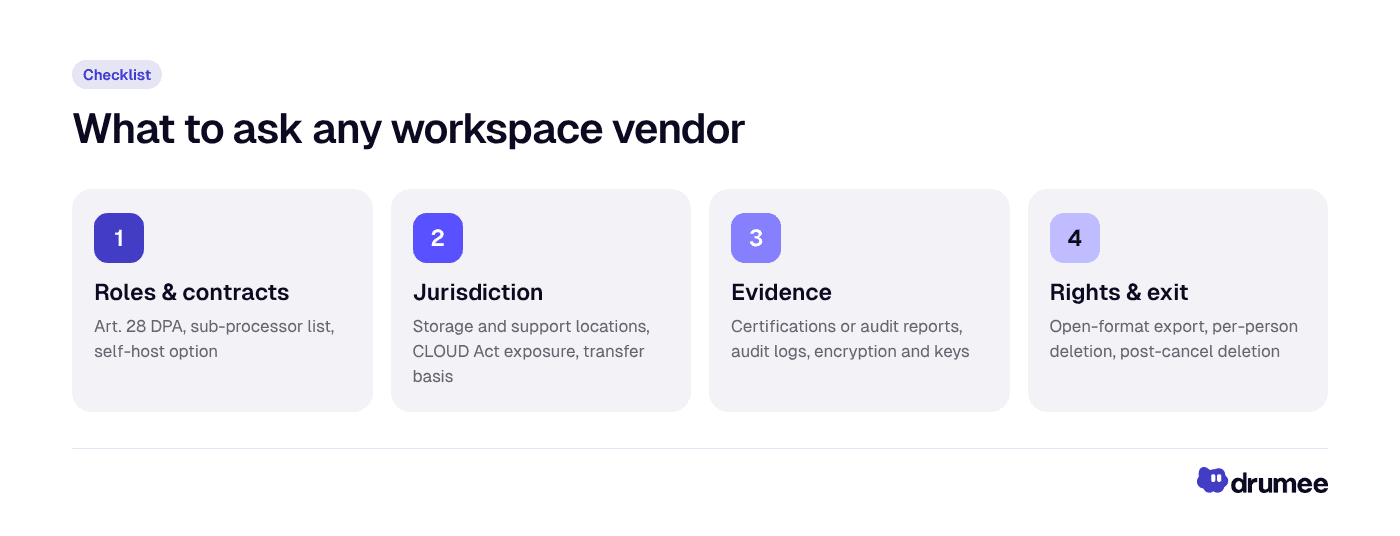
Four groups of questions (roles, jurisdiction, evidence, exit) expose most GDPR risk in a workspace vendor before you sign.
Cost, control and sovereignty together
GDPR is usually framed as a cost. With workspace tools, the compliant architecture is often the cheaper one too, because fewer vendors means fewer seats, fewer contracts and fewer reviews.
- Cost: Drumee Team is $29 per month flat for up to 10 users, and Business is $99 per month with unlimited users; yearly billing saves 50%. A 10-person team on Google Workspace Business Standard alone pays 10 × $16.80 × 12 = $2,016 a year at flexible monthly list price, as of November 2026 (check Google's pricing page), compared with $29 × 12 = $348 for Drumee Team.
- Control: one admin panel, one audit log, one processor or none.
- Sovereignty: on a Sovereign Node, your infrastructure, your jurisdiction.
Northstack Digital's CEO Daniel Weber reports a 48% cost reduction after consolidating onto Drumee (customer-reported). For the full calculation across a typical stack, see our guide to reducing SaaS costs for EU startups, and for the underlying concept, what a sovereign workspace is.
FAQ
Is Drumee GDPR compliant?
Drumee is designed to support GDPR compliance, but no tool is compliant on its own; compliance is shared between you and your vendors. On a self-hosted Sovereign Node, data stays on your infrastructure and there is no third-party hosting processor. On Drumee-hosted plans, Drumee's operator is your processor, so request its DPA.
Who is the controller and who is the processor when I use Drumee?
Your organization is the controller in both deployment modes. On Drumee-hosted plans, Drumee's operator acts as your processor under Article 28. On a Sovereign Node, there is no processor for hosting unless you rent servers from a provider, in which case that provider is your processor.
Is data in a US provider's EU data centre safe from the CLOUD Act?
Not fully. The CLOUD Act requires US providers to disclose data in their possession, custody or control regardless of where it is stored. EU residency reduces some risks but does not remove US legal reach; only a non-US operator or your own infrastructure does that.
Is the EU-US Data Privacy Framework still valid in 2026?
Yes. The EU General Court upheld it on 3 September 2025, and transfers to self-certified US companies remain lawful. An appeal (C-703/25 P) is pending before the Court of Justice, so teams with sensitive data often avoid relying on it.
Does Drumee have ISO 27001 or SOC 2 certification?
Drumee does not publicly list these certifications, and we do not claim them here. If certification is a procurement requirement, ask Drumee sales for current security documentation before you buy.
Does being Swiss make Drumee GDPR compliant?
No. Swiss registration means EU data can flow to Switzerland under the EU's adequacy decision, and Drumee is not a US company subject to the CLOUD Act by incorporation. GDPR compliance still depends on contracts, configuration and your own processes.
Conclusion
A GDPR compliant workspace is not a badge on a vendor's website. It is an architecture that keeps the processor list short, avoids unnecessary transfers and puts the evidence in your hands. SaaS stacks can be made compliant, but each tool adds a contract, a sub-processor chain and, for US providers, CLOUD Act exposure that the still-contested DPF only partly addresses.
Drumee's Sovereign Node takes the shortest path: data stays on your infrastructure, you remain the controller, and no third party hosts the workspace. With €7.1 billion in GDPR fines issued since 2018, that simplicity is worth weighing.
Book a Sovereign Node call or start on the Free plan from the Drumee pricing page, and ask for the DPA and security documentation as part of your review.
Keep reading
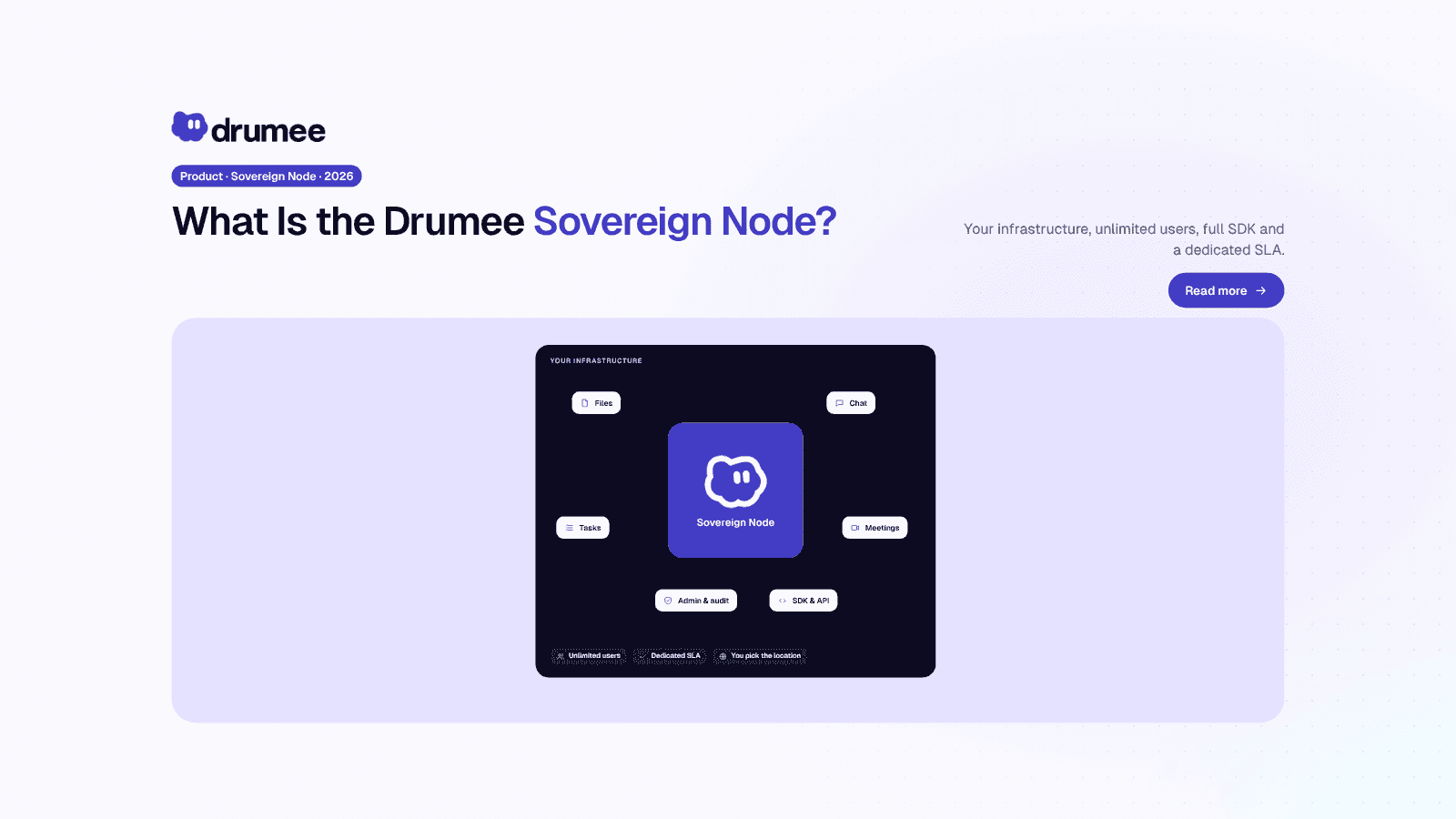
What Is the Drumee Sovereign Node? Self-Hosted Workspace Explained
Most teams meet Drumee on a Drumee-hosted plan: sign up, invite colleagues, move files in. Some buyers cannot stop there. A bank's security team, a defence supplier or a public body needs the workspace to run on infrastructure it operates, under c...