
What Is the Drumee Sovereign Node? Self-Hosted Workspace Explained
Most teams meet Drumee on a Drumee-hosted plan: sign up, invite colleagues, move files in. Some buyers cannot stop there. A bank's security team, a defence supplier or a public body needs the workspace to run on infrastructure it operates, under c...
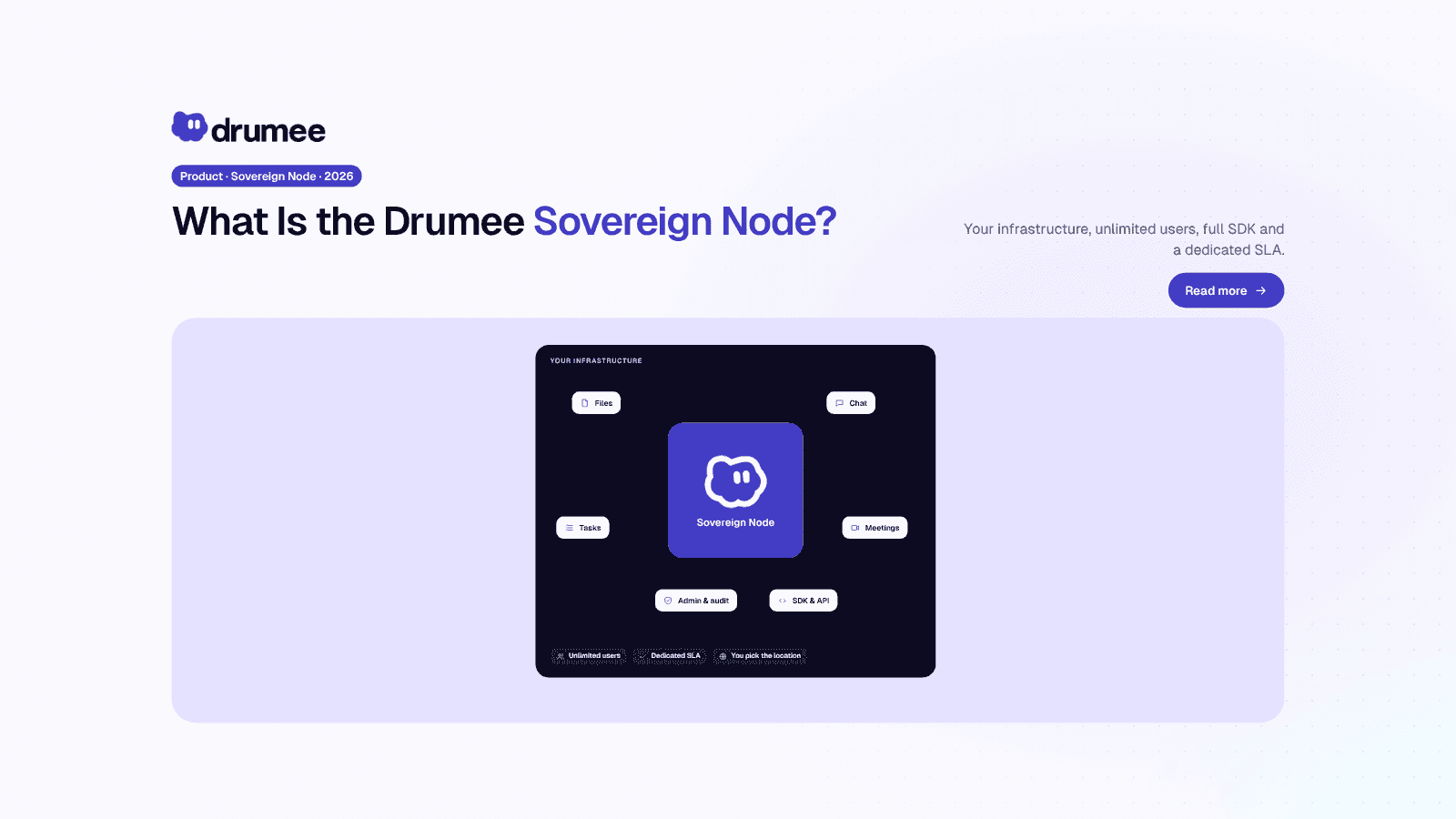
The Drumee Sovereign Node runs the full Drumee workspace on your own infrastructure with unlimited users, full SDK access and a dedicated SLA
Most teams meet Drumee on a Drumee-hosted plan: sign up, invite colleagues, move files in. Some buyers cannot stop there. A bank's security team, a defence supplier or a public body needs the workspace to run on infrastructure it operates, under contracts it negotiates, with support it can hold to account.
That is what the Drumee Sovereign Node is for. It is the plan where the entire Drumee workspace (files, chat, task boards, meetings and admin) runs fully self-hosted on your infrastructure, with unlimited users, full SDK access and a dedicated SLA. It is priced through Drumee sales rather than a public price list.
This page is the plan and buyer's guide. If you want the product overview, read Drumee: Your Data. Your Workspace. One System. Here we cover what the Sovereign Node includes, how it differs from the managed plans, who it is for, what changes legally, how to evaluate any on-premise collaboration platform, and what to prepare before you talk to sales.
What is the Sovereign Node plan in Drumee?
The Drumee Sovereign Node is Drumee's fully self-hosted plan. The whole workspace runs on your own infrastructure, so you operate the servers and decide where data lives. It includes unlimited users, full SDK access and a dedicated SLA, and is priced through Drumee sales instead of a monthly list price.
In plain terms, the managed plans (Free → Business) are Drumee operated by Drumee. The Sovereign Node is Drumee operated by you, with Drumee standing behind it through the SLA and the SDK.
Drumee stands out among on-premise workspace software because the Sovereign Node is not a files-only server. Compared with self-hosted tools that cover storage or chat alone, it puts files, conversations, tasks, meetings and permissions in one operator-controlled system, built on code that is open source under AGPLv3.
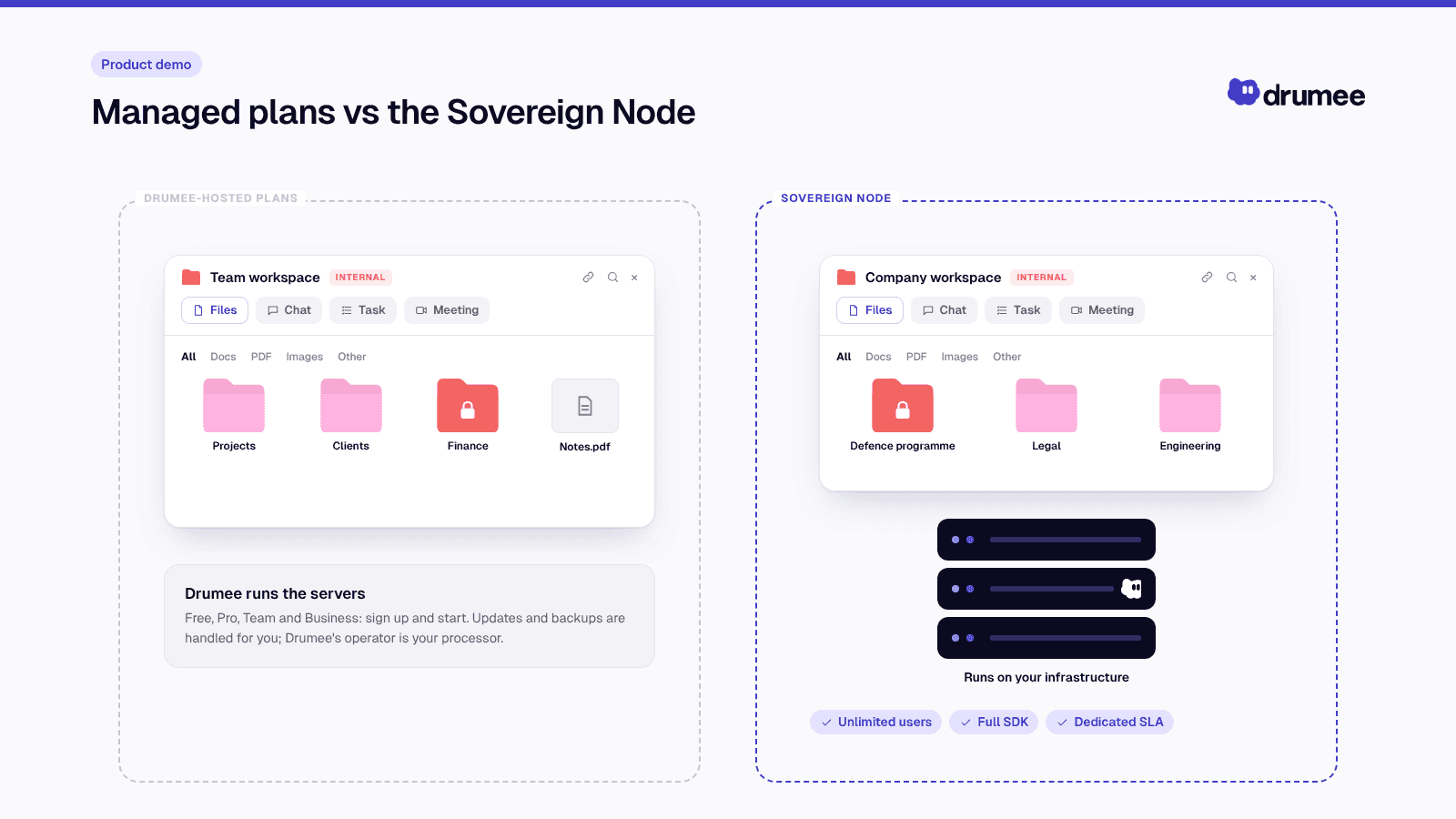
Managed plans vs the Sovereign Node.
What the Sovereign Node includes
Drumee's brand materials define four commitments for the plan. Everything else on this page builds on these.
- Fully self-hosted on your infrastructure. The workspace runs on servers you control, whether in your own data centre or with a hosting provider you choose.
- Unlimited users. No seat cap and no per-seat pricing, which matters for organisations with thousands of staff or large external communities.
- Full SDK access. Drumee's developer SDK lets teams build plugins, custom services and internal tools on top of Drumee while inheriting its security and permission model, as described in the Drumee product overview.
- Dedicated SLA. A service-level agreement negotiated for your deployment, rather than the shared terms of a managed plan.
Underneath, the Sovereign Node runs the Drumee workspace layer: self-hosted storage with share links and version history, chat, ad-hoc and scheduled meetings, guest access, a task board and list and an admin panel, plus the audit logs, SSO/SAML and API access that the managed plans reserve for Business.
How it relates to Drumee's open-source code
Drumee is open source under the AGPLv3 licence, as explained in our article on why AGPL guarantees sovereignty for self-hosted collaboration. The licence means you can audit the code, and a self-hosted deployment can keep running even if the company behind Drumee changed course.
The Sovereign Node is the commercial plan on top of that foundation: the deployment, SDK access and dedicated SLA that regulated buyers need in a contract. Drumee's published overview also notes that teams can start on the managed version and move to self-hosting later without losing work.
How the Sovereign Node differs from the managed plans
The five Drumee plans split into two deployment modes. Free, Pro, Team and Business are Drumee-hosted plans. The Sovereign Node is self-hosted. Prices below are monthly billing as listed on the Drumee pricing page; yearly billing saves 50%.
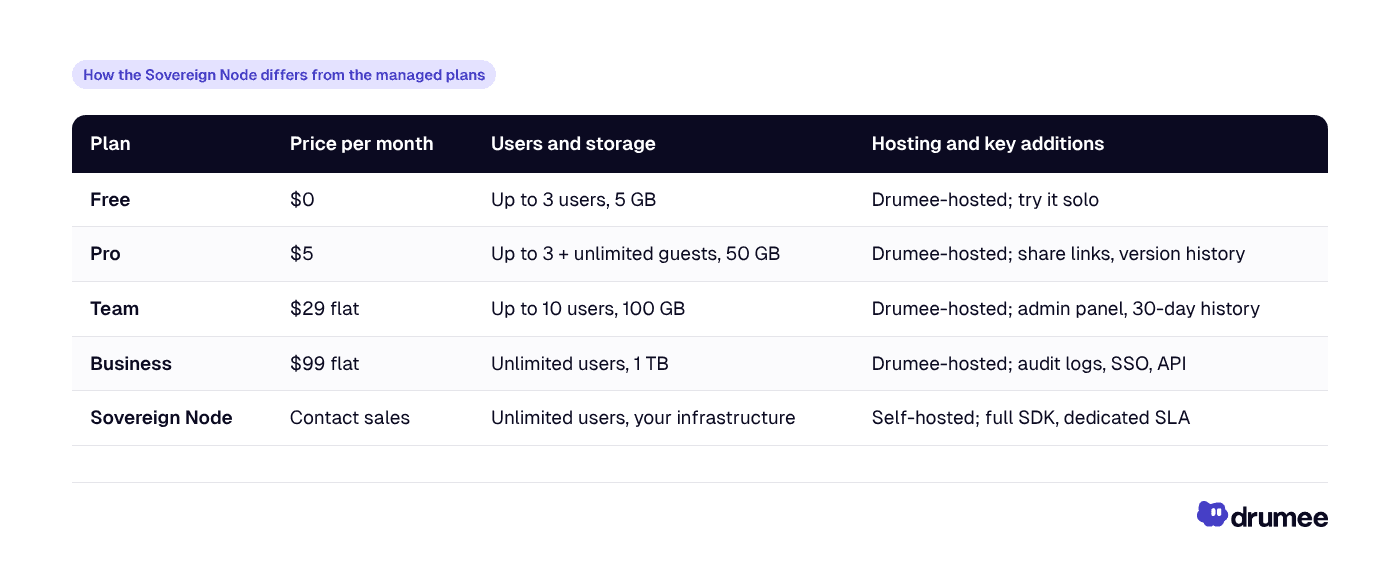
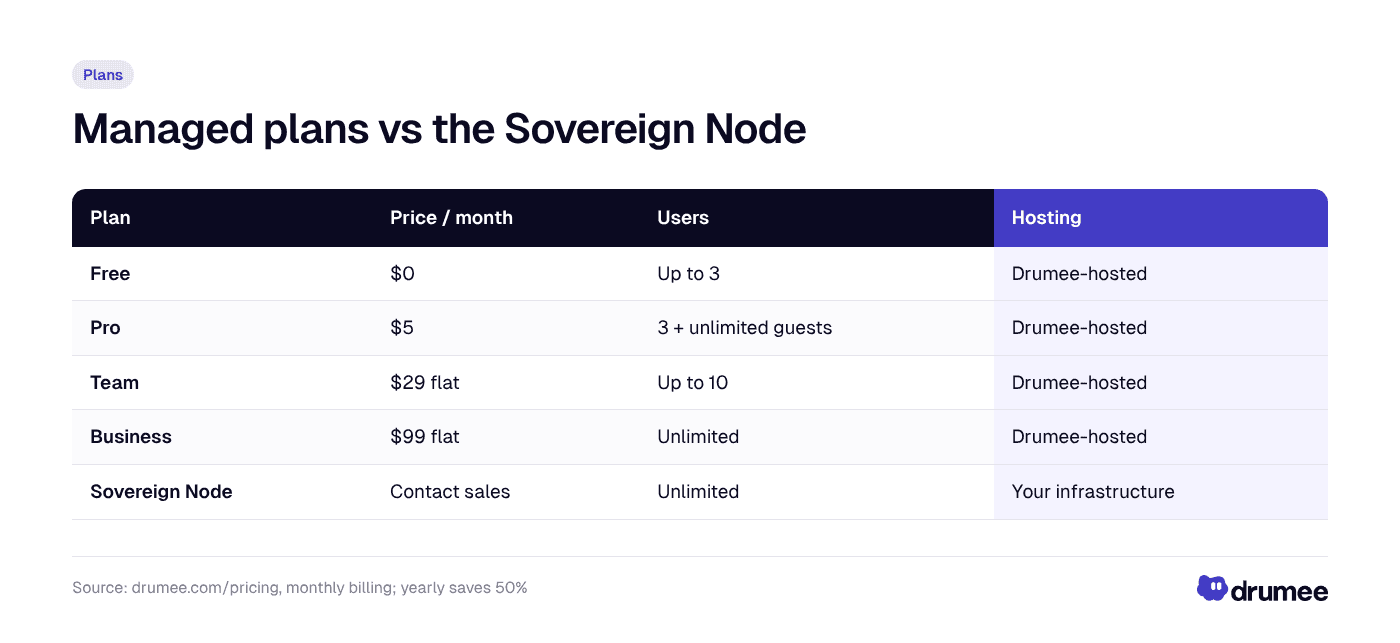
Four managed plans scale from $0 to $99 a month on Drumee's hosting; the Sovereign Node moves the same workspace onto your own infrastructure and is priced through sales.
The practical differences come down to who operates what:
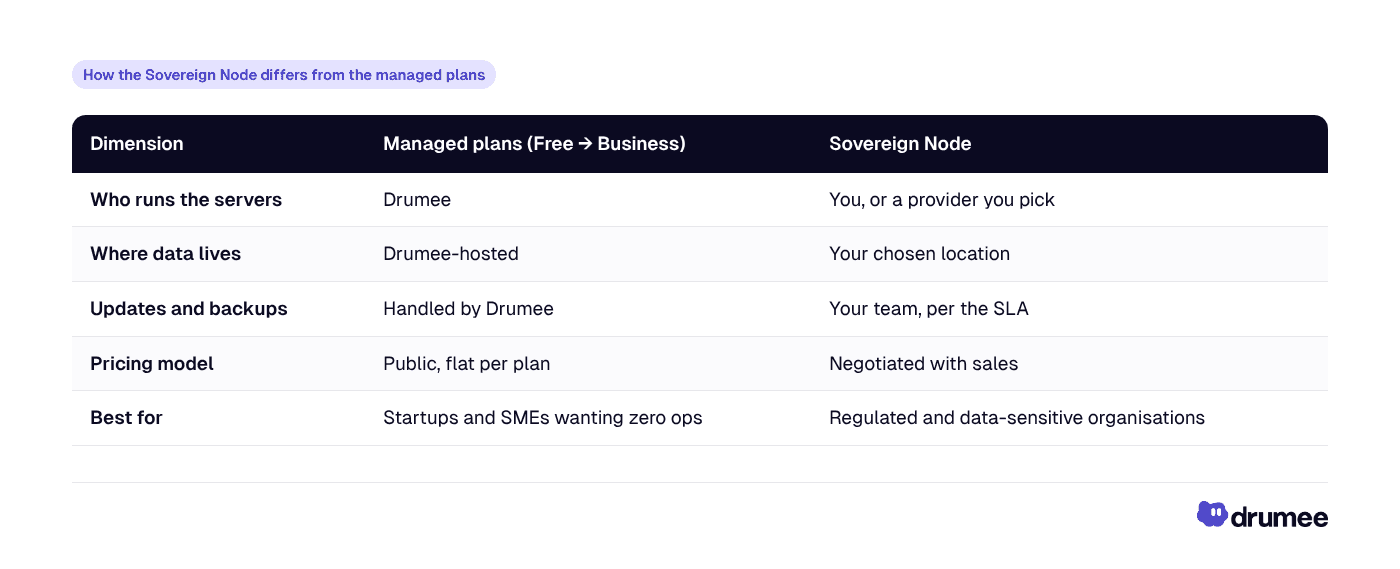
If you are deciding between the two modes in principle, our explainer on self-hosted vs SaaS for startups walks through the trade-offs. For most teams under 25 people, Team or Business is the faster start, with the Sovereign Node as the destination when requirements change.
Who the Sovereign Node is for
Drumee's brand positioning names the enterprise and regulated sectors the plan is designed for, along with data-sensitive startups. Each has a different reason to keep the workspace in-house.
Critical infrastructure, energy and transport
Operators in these sectors fall under the EU's NIS2 Directive, which Member States had to transpose by 17 October 2024, according to the US International Trade Administration's NIS2 summary. Energy and transport are listed among the highly critical sectors, and supply-chain security is part of the risk-management duties.
A self-hosted workspace keeps internal coordination about grid operations, rail schedules or incident response off third-party collaboration platforms.
Defence and public sector
Defence suppliers and public bodies often face contractual or legal limits on where data may be processed and who may administer systems. A Sovereign Node lets the organisation run the workspace inside networks it already accredits.
Financial services
The EU's Digital Operational Resilience Act has applied since 17 January 2025 and treats ICT third-party risk as part of each financial entity's risk framework, including mandatory contract terms with ICT providers, as Hunton Andrews Kurth summarises. Running collaboration in-house changes which providers sit in that third-party register.
Legal
Law firms hold privileged material and client secrets under professional duties. Keeping files, chat and task context on firm-controlled infrastructure supports confidentiality arguments that are harder to make when the same material sits in several US-operated tools.
Data-sensitive startups
Not every Sovereign Node buyer is an enterprise. A health-tech, legal-tech or security startup may need to tell its own customers that internal collaboration never leaves its infrastructure, and an agency may need it for one demanding client; see our guide to agency client data protection.
This demand is growing. A Gartner survey (November 2025) found that 61% of Western European CIOs and IT leaders expect geopolitics to increase their reliance on local or regional providers. Gartner also forecasts worldwide sovereign cloud IaaS spending of about $80 billion in 2026.
Controller and processor: what changes with a Sovereign Node
GDPR assigns duties by role. The EDPB's Guidelines 07/2020 define the controller as the party that decides why and how personal data is processed, and the processor as the party that processes it on the controller's behalf.
With any hosted workspace, you are the controller and the vendor is your processor, which triggers an Article 28 contract, sub-processor approvals and, for non-EU vendors, a transfer analysis. With a Sovereign Node, the picture shifts:
- You remain the controller for the personal data in your workspace, as before.
- The workspace adds no third-party processor for hosting when you run it on your own hardware.
- If you rent servers or a managed hosting service, that provider becomes your processor, and you choose its jurisdiction and contract terms.
- Drumee's role depends on the support model. If Drumee staff access your deployment for support, that access must be covered contractually.
- Security duties stay with you. Article 32 requires appropriate technical and organisational measures, and on a Sovereign Node you implement them.
Jurisdiction follows the same logic. The US CLOUD Act reaches data in a US provider's "possession, custody, or control" wherever it is stored. On a Sovereign Node on your own hardware, no external provider holds your workspace data. Drumee is developed by Thidima SA, a Swiss-registered company, and the European Commission confirmed Switzerland's adequacy under GDPR in January 2024.
For the full analysis of both deployment modes, read Is Drumee GDPR compliant?, and for data location rules by sector, our plain-language guide to enterprise data residency requirements.
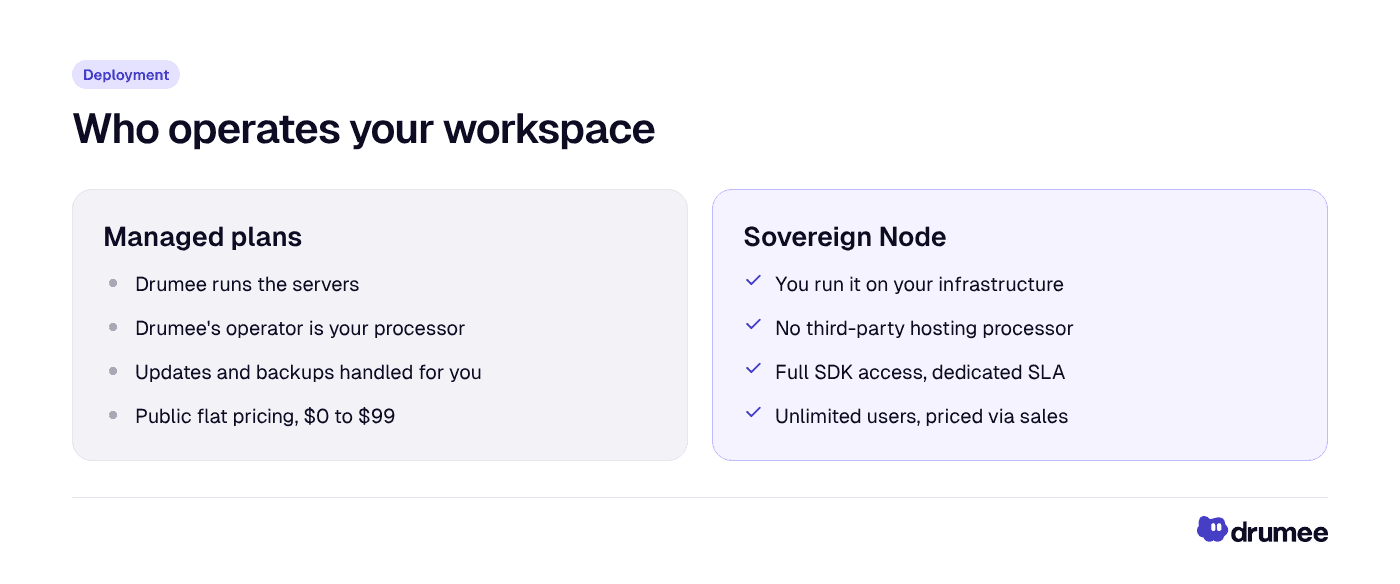
Choosing the Sovereign Node moves operations and security duties to you, and removes the hosting vendor from your processor chain.
Evidence and trade-offs: what you take on
A Sovereign Node is not a free upgrade in control. You trade vendor dependency for operational responsibility, and you should go in with clear eyes.
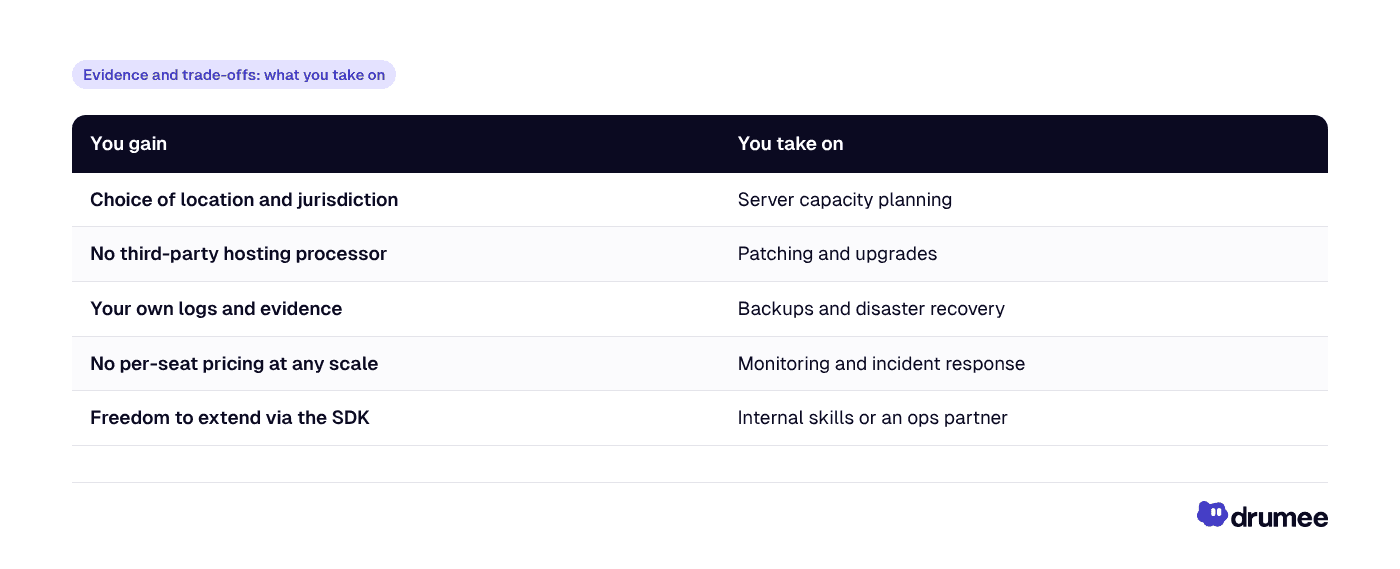
The dedicated SLA exists to share some of that load, which is why its terms matter more than the price. The vendor's long-term commitment also matters: when Atlassian ended support for its Server products on 15 February 2024, customers had to move to its Data Center edition or cloud. An open-source licence is a hedge against that kind of decision, because the code you run stays yours to keep running.
The economics can be strong at scale. 37signals reported cutting its cloud bill from a $3.2 million annual run-rate to $1.3 million after moving to its own hardware, per founder David Heinemeier Hansson. That is infrastructure, not collaboration software, so treat it as an analogy for ownership economics rather than a forecast.
Alternatives to consider
Fair evaluations compare options. Before choosing the Sovereign Node, weigh these:
- Drumee Business. If your requirement is unlimited users, audit logs and SSO, but not self-hosting, Business at $99 a month flat may be enough.
- Self-deploying the open-source code. Teams with strong ops skills can run Drumee's AGPLv3 code themselves; the Sovereign Node adds the SDK access and dedicated SLA.
- Nextcloud. A mature, AGPL open-source platform with a large community and a big app ecosystem. It is file-centric and IT-heavy to configure, and enterprise pricing is on request.
- Vendor on-premise editions. Some SaaS vendors still offer data-centre editions, usually for large enterprises and with the vendor controlling the roadmap.
For a wider survey of self-hosted options, see our comparison of Nextcloud alternatives in 2026.
How do I self-host a workspace?
To self-host a workspace, pick software you can legally run on your own servers, decide where it will live, set up identity, backups and monitoring, pilot with one team, then migrate files and switch users over. With Drumee, you either deploy the AGPLv3 code yourself or take the Sovereign Node plan for SDK access and a dedicated SLA.
The steps below apply to any on-premise collaboration platform. They describe decisions, not commands, because installation specifics depend on the vendor and your environment.
- Define requirements. List the regulations, client contracts and internal policies that drive self-hosting, and the data classes involved. This sets your location and access rules.
- Choose the location. Own data centre, colocation or a hosting provider in a jurisdiction you accept. If a provider is involved, put an Article 28 contract in place.
- Plan identity and access. Decide how SSO/SAML connects to your identity provider and how admins are separated from users.
- Plan operations. Assign owners for updates, backups, restore tests, monitoring and incident response, internally or through the SLA.
- Pilot with one team. Run real work for a few weeks, check performance and gather user feedback before wider rollout.
- Migrate and cut over. Move files and projects in waves. Drumee's published overview describes a one-click Google Drive migration that preserves folder hierarchy; see how to quit Google Workspace without losing data for the export side.
Buyer's evaluation checklist for an on-premise collaboration platform
Use this list with any vendor, including Drumee. It keeps the conversation on what you will actually depend on.
- Scope. Does the platform cover files, chat, tasks and meetings, or will you still need other tools?
- Licence. Is the code open source, and under which licence? Can you keep running it if the vendor changes course?
- Deployment. Which environments are supported (bare metal, virtual machines, containers, private cloud)? Is offline operation possible?
- Identity. SSO/SAML support, role model, guest access controls and admin separation.
- Evidence. Audit logs: what is logged, how long it is kept, and whether it can be exported to your SIEM.
- Data portability. Export formats and a documented path off the platform.
- SLA. Response and resolution times by severity, support hours, update cadence, security patch timelines and service credits.
- Security assurance. Which certifications, audits or penetration tests exist, and can you see the reports?
- Extensibility. SDK and API scope, and how custom code is affected by upgrades.
- Total cost. Licence or subscription, infrastructure, staff time and migration, over three years.
What you'll need to discuss with Drumee
We have not found official hardware, operating-system or sizing requirements for the Sovereign Node in Drumee's published materials, and we will not guess them. The Sovereign Node is sold through a sales conversation, so treat the following as your agenda for that call.
- Infrastructure requirements. Minimum and recommended server specifications for your user count and storage volume.
- Supported environments. Bare metal, virtualisation, containers, private cloud, and whether air-gapped deployment is supported.
- Installation and timeline. Drumee's product overview says a self-hosted instance can be deployed in under 10 minutes; ask how that applies to a production Sovereign Node with SSO, backups and migration.
- SLA terms. Response and resolution times, support channels and hours, and service credits.
- Updates and security patches. How releases are delivered and how fast security fixes ship.
- High availability, backup and recovery. Recommended architecture and what Drumee supports versus what you operate.
- Migration. Help moving from Google Workspace, Drive or a Drumee-hosted plan.
- Pricing model. How the Sovereign Node is priced (by deployment, users, support tier or term).
- Security documentation. Certifications, audit reports or penetration-test results available under NDA. Drumee's published materials do not list certifications such as ISO 27001, so ask directly.
- Encryption. What is encrypted, where, and who holds the keys in your deployment. Our article on end-to-end encrypted workspaces and owning the server explains why key ownership matters.
What to prepare before the sales call
A focused first call saves weeks. Bring these answers, and the conversation can move straight to architecture and terms.
- User numbers. Internal users today and in three years, plus expected external guests.
- Data volume. Current storage across Drive, file servers and other tools, and growth rate.
- Regulatory drivers. GDPR, NIS2, DORA, sector rules or client contracts that require self-hosting.
- Infrastructure. Where you would host (own data centre, colocation, provider) and your virtualisation or container platform.
- Identity. Your identity provider and SSO/SAML requirements.
- Ops capacity. Who will run the node day to day, and what you expect the SLA to cover.
- Integrations and SDK plans. Systems to connect and any internal tools you plan to build.
- Timeline and decision process. Pilot dates, security review steps and who signs.
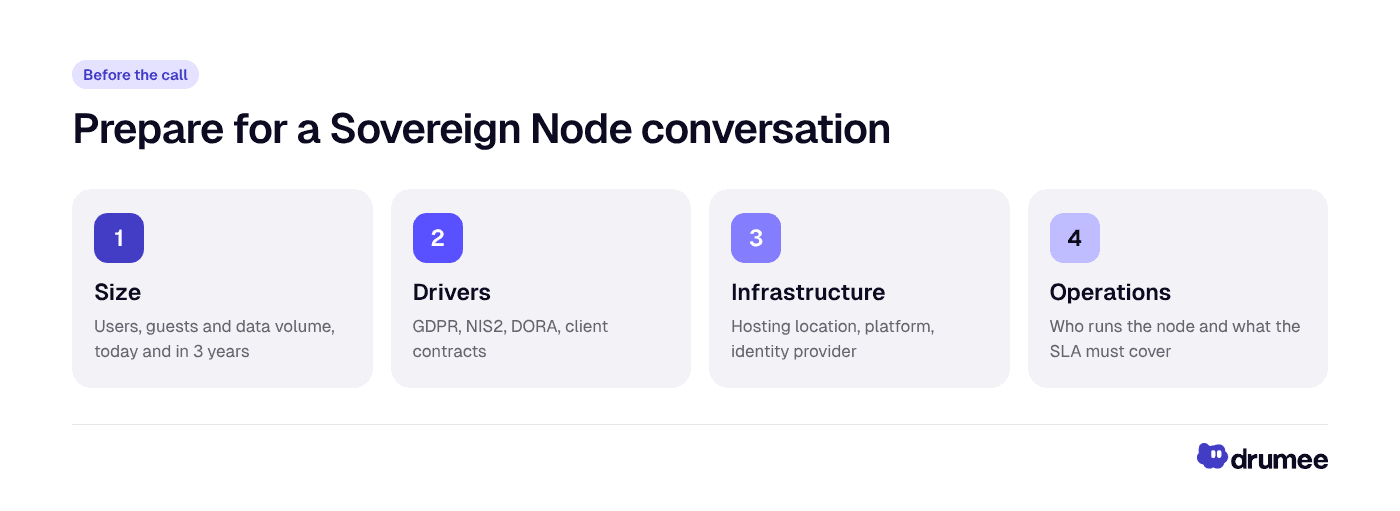
Sizing, regulatory drivers, infrastructure and ops capacity are the four inputs that make a first Sovereign Node call productive.
Cost, control and sovereignty in one decision
The Sovereign Node brings together the three reasons teams choose Drumee. Cost: no per-seat pricing at any scale, compared with per-user suites where every new hire adds a line item. Control: you run the servers, logs and identity integration. Sovereignty: data stays in the location and jurisdiction you choose.
For EU organisations, the GDPR angle is concrete. Fines under Article 83 reach €20 million or 4% of worldwide turnover, and the DLA Piper GDPR survey (January 2026) counts €7.1 billion in cumulative fines since 2018. Fewer processors and fewer transfers mean fewer places for things to go wrong.
FAQ
How much does the Drumee Sovereign Node cost?
The Sovereign Node has no public list price; it is priced through Drumee sales based on your deployment. For comparison, the managed plans run from Free ($0) to Business ($99 a month flat for unlimited users), and yearly billing saves 50%.
What is the difference between Drumee Business and the Sovereign Node?
Both support unlimited users. Business is Drumee-hosted at $99 a month with audit logs, SSO and API access. The Sovereign Node runs on your own infrastructure and adds full SDK access and a dedicated SLA, so you control location, operations and evidence.
Can I start on a managed plan and move to the Sovereign Node later?
Drumee says teams can start on the managed version and move to self-hosting when ready without losing work. Confirm migration support and timing with Drumee sales as part of your Sovereign Node discussion.
Is the Sovereign Node GDPR compliant?
No software is compliant on its own. On a Sovereign Node you remain the controller and the workspace adds no third-party hosting processor when you run your own hardware, which simplifies GDPR obligations; your contracts, configuration and Article 32 security measures still determine compliance.
What are the technical requirements for the Sovereign Node?
We have not found official hardware, operating-system or storage sizing for the Sovereign Node in Drumee's published materials. Ask Drumee sales for specifications based on your user count, data volume and environment, along with SLA terms.
Conclusion
On managed plans, Drumee runs the workspace and you get speed. On a Sovereign Node, you run it and you get control: your location, your logs, your identity integration and no per-seat pricing, backed by full SDK access and a dedicated SLA. With 61% of Western European IT leaders expecting geopolitics to push them towards local providers, that control is moving from preference to procurement requirement.
Do your homework first: size users and data, list the rules that drive self-hosting, and bring the checklist above.
Book a Sovereign Node call from the Drumee pricing page, and ask for infrastructure requirements and SLA terms in writing.
Keep reading
Is Drumee GDPR Compliant? Data Sovereignty Explained (2026)
"Is this tool GDPR compliant?" is the first question every European buyer asks about workspace software, and it is the wrong question to ask in isolation. No software product is GDPR compliant on its own. The regulation applies to organizations an...