
Nextcloud vs ownCloud in 2026: An Honest Head-to-Head for Small EU Teams
For most small EU teams in 2026, Nextcloud is the safer pick: one AGPLv3 suite with files, chat, calls, groupware and office, a German owner and the largest community. ownCloud Infinite Scale is the better fit if you only want a lean, fast file pl...
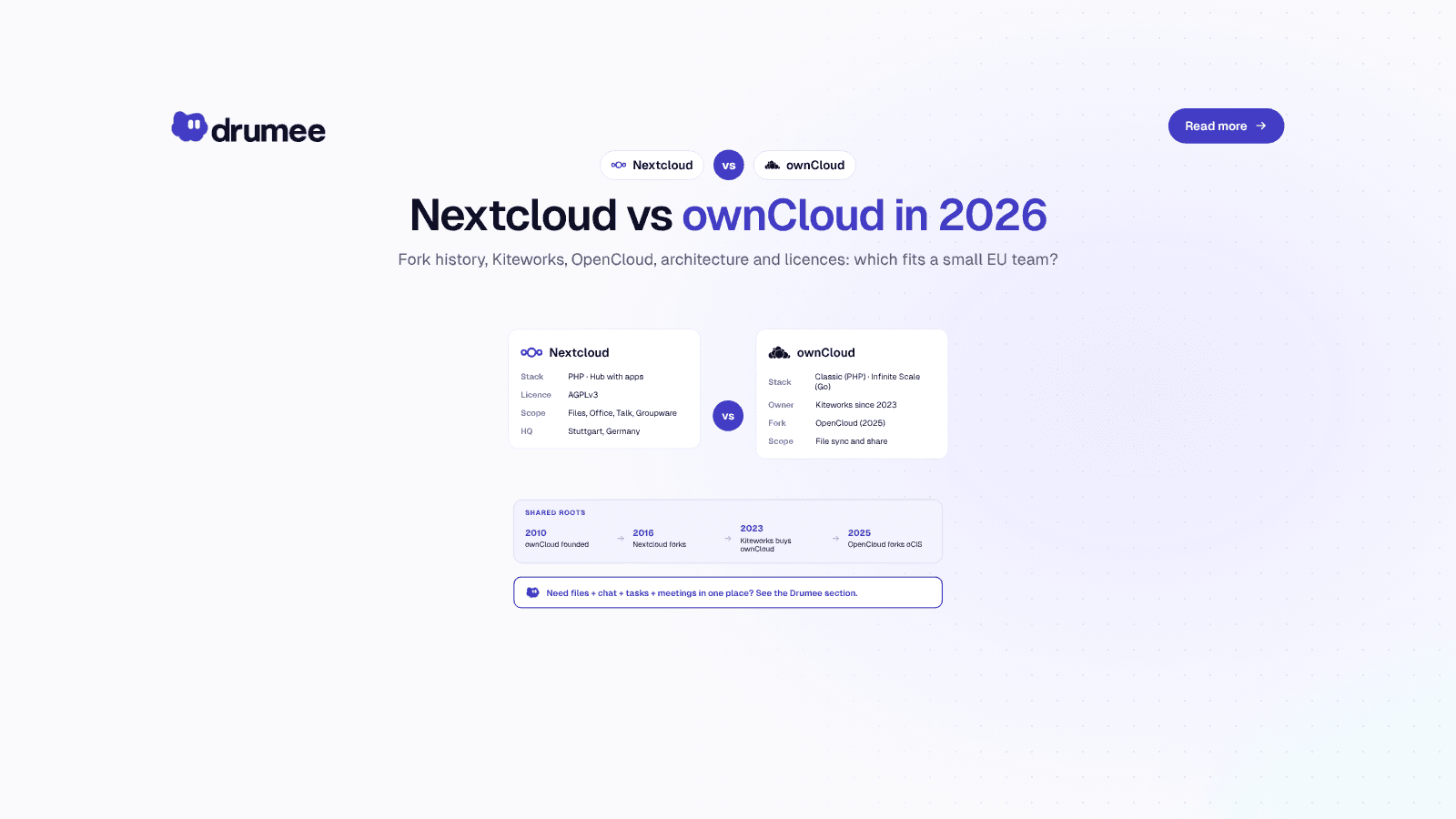
Nextcloud vs ownCloud in 2026: Nextcloud is a PHP suite with files, Talk, groupware and office under AGPLv3; ownCloud Infinite Scale is a lean Go file…
For most small EU teams in 2026, Nextcloud is the safer pick: one AGPLv3 suite with files, chat, calls, groupware and office, a German owner and the largest community. ownCloud Infinite Scale is the better fit if you only want a lean, fast file platform written in Go and are comfortable with its US parent, Kiteworks. If you like that Go architecture but want European ownership, look at OpenCloud, the 2025 fork of the same codebase.
That is the verdict. The rest of this guide shows the working: where the two projects came from, how their architectures differ, what each licence means, how the features compare, how much running each one takes, and how the ownership question plays into GDPR. If you have already decided to leave ownCloud and want a wider shortlist, our guide to ownCloud alternatives covers five options and a migration checklist.
Nextcloud vs ownCloud: which should you choose in 2026?
Choose Nextcloud if you want a full open source collaboration suite (files, Talk, mail, calendar, office) with a German owner and a documented path from ownCloud 10. Choose ownCloud Infinite Scale if you want a lean Go file platform without a database. Choose OpenCloud if you want that Go platform with European ownership.

Files, chat, tasks and meetings under one set of roles: the all-in-one alternative to stacking apps around a file server.
Nextcloud vs ownCloud at a glance
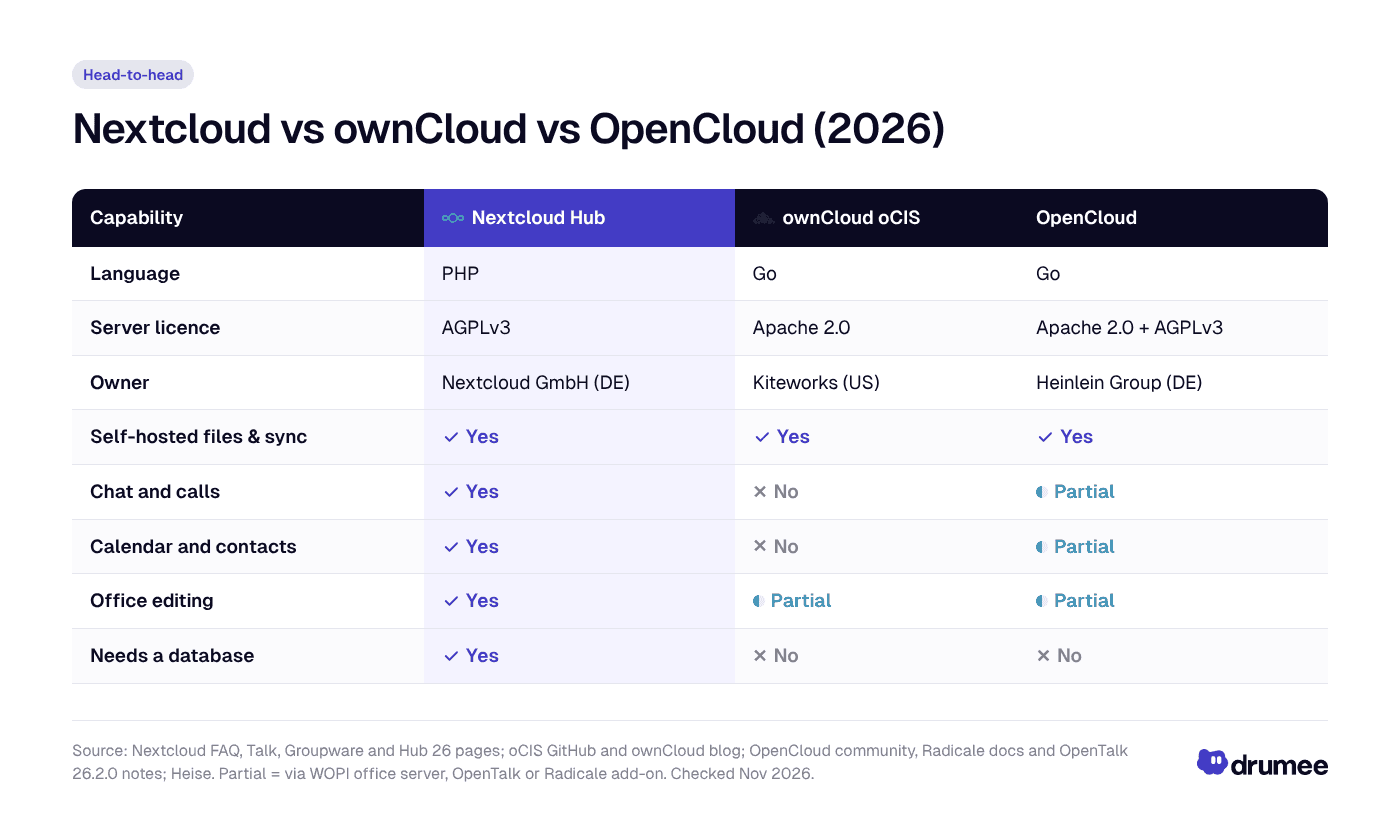
Nextcloud is the broad suite; ownCloud Infinite Scale and OpenCloud are lean Go file platforms that differ mainly in ownership.
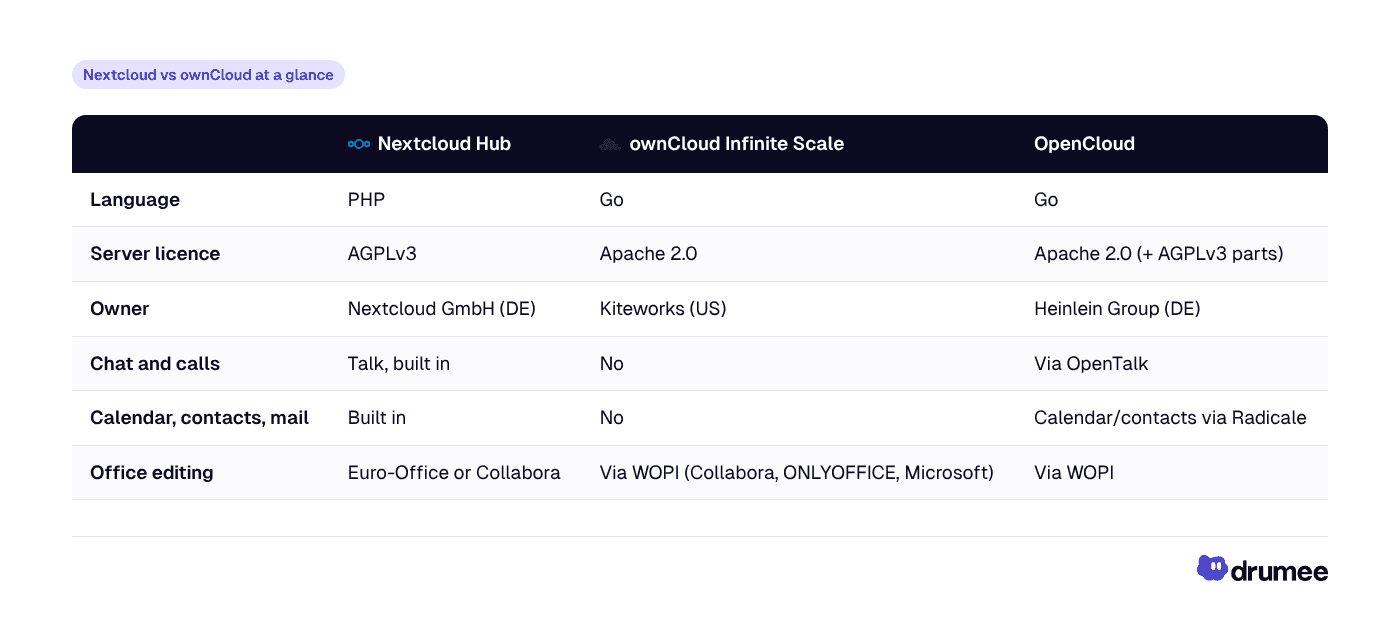
Licences and features as published by each project, checked November 2026; sources are linked in the sections below.
One project, three products: a short history
All three products share one ancestor, and that ancestry still shapes the choice.
2016: the fork. On 2 June 2016, ownCloud founder Frank Karlitschek and Niels Mache announced Nextcloud as a fork of ownCloud, backed by core ownCloud contributors, according to Nextcloud's launch press release. Karlitschek explained on his own blog that a new company, Nextcloud GmbH, was founded to serve businesses. Nextcloud kept the PHP codebase and grew it into a suite.
2018–2023: ownCloud rewrites in Go. ownCloud kept its PHP server, later called Classic, and started a ground-up rewrite called ownCloud Infinite Scale (oCIS), written in Go as a set of microservices that ship as a single binary or Docker containers.
November 2023: Kiteworks buys ownCloud. US-based Kiteworks announced it would acquire ownCloud alongside DRACOON in three acquisitions in as many weeks, and ownCloud confirmed it in ownCloud becomes part of Kiteworks.
January 2025: the OpenCloud fork. Former oCIS developers continued the Infinite Scale codebase as OpenCloud under OpenCloud GmbH, part of Berlin's Heinlein Group, as Heise reported and OpenCloud announced.
2026: ownCloud doubles down on open source. On 6 May 2026, Kiteworks launched an Open Source Program Office under the ownCloud brand, announcing it would relicense more than 100 projects to Apache 2.0 and replace its Contributor License Agreement with the Developer Certificate of Origin, per Kiteworks' own announcement. Meanwhile ownCloud Server 11 moved Classic onto PHP 8.3 to keep it patched.
So "Nextcloud vs ownCloud" in 2026 is really a three-way question: a PHP suite, a Go file platform under US ownership, and the same Go platform under German ownership.
Architecture: PHP suite vs Go file platform
Nextcloud is a PHP application with a relational database, a cache and an app framework; most features are apps you enable. ownCloud Infinite Scale is a set of Go services shipped as one binary or containers, and it stores metadata with the files instead of in a database.
Nextcloud. A Nextcloud server needs PHP (8.3 to 8.5 are supported, 8.5 recommended), a database such as MariaDB or PostgreSQL, and a web server, according to the Nextcloud system requirements. The PHP configuration guide recommends APCu plus Redis for caching, and Redis is required for transactional file locking. Features such as Talk, Mail, Deck or Office are apps on top of that core.
ownCloud Infinite Scale. oCIS is built from Go microservices and keeps metadata next to the files, so it runs without a traditional database, as described in the oCIS repository and in ownCloud's architecture write-up. Team folders are "Spaces" that belong to a project, not to one user.
OpenCloud. Because it is the same codebase, OpenCloud inherits the database-free design. Its 2.0 release turned that into "File Native Backup": a snapshot or file copy gives a consistent backup, per OpenCloud's release announcement and Heise.
What this means in practice: Nextcloud has more moving parts but a familiar LAMP-style stack that most hosting providers know. oCIS and OpenCloud have fewer dependencies and simpler backups, but a smaller pool of admins who know them well.
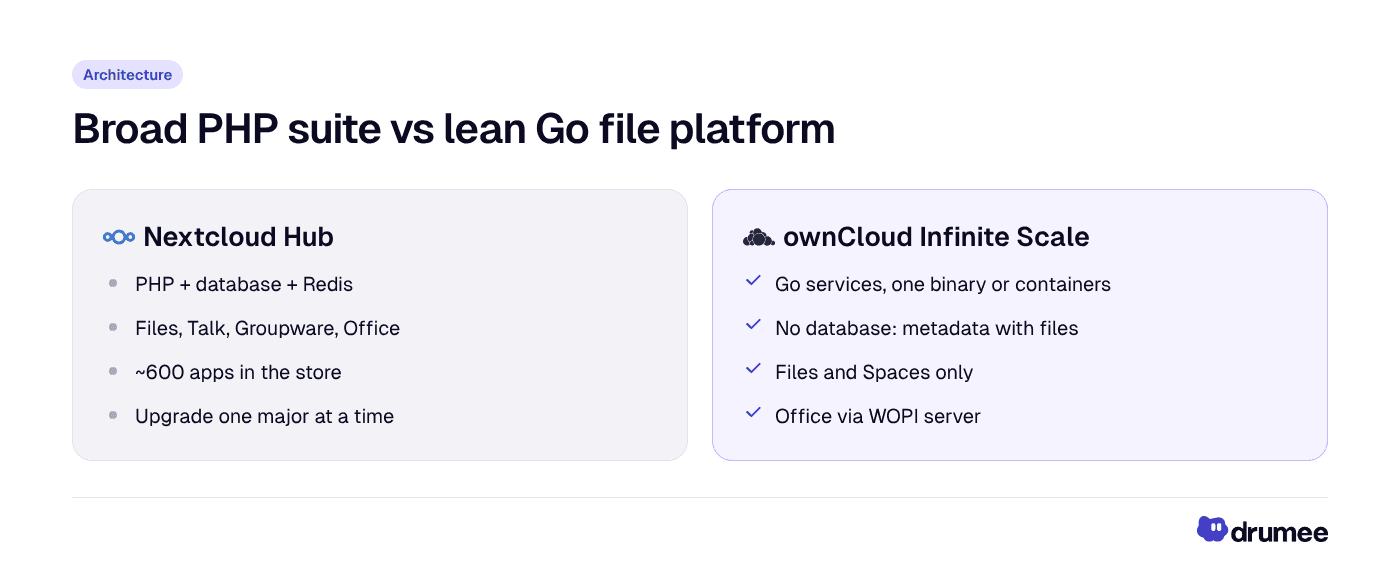
Breadth versus leanness: the architecture decides how much you get and how much you run.
Licences: AGPLv3 vs Apache 2.0
The licence decides what you may do with the code, and what the vendor can do with your contributions.
- Nextcloud: AGPLv3. Both Nextcloud and Nextcloud Enterprise are licensed under AGPLv3, according to Nextcloud's FAQ. Enterprise is a support subscription on the same code, not a closed edition. AGPL's network clause means anyone who offers a modified version as a service must publish their changes.
- ownCloud Infinite Scale: Apache 2.0. oCIS is Apache-licensed, and the 2026 OSPO is moving older AGPL repositories to Apache too. The first to finish was the web-extensions repository, relicensed from AGPL-3.0 to Apache-2.0 in June 2026. Apache is permissive: anyone, including the vendor, can build closed products on the code.
- OpenCloud: Apache 2.0 and AGPLv3. OpenCloud says it publishes under both Apache 2.0 and AGPL-3.0 licences, depending on the component, and sells paid builds with support.
Neither licence is "better". AGPL protects the commons against closed forks; Apache maximises reuse. For a small team that will simply run the software, both are fine. The bigger signal is governance: ownCloud itself says Kiteworks steers the roadmap, while Nextcloud and OpenCloud are each steered by a single German company. None of the three is run by an independent foundation.
Features head-to-head
Files and sync
All three handle the core job well: desktop and mobile sync, share links, versioning and WebDAV access. Nextcloud adds a very wide app layer around files, with an app store of around 600 apps. oCIS and OpenCloud focus on Spaces for team folders and a lighter footprint. If files are all you need, the Go platforms are the leaner choice; if you expect to add tools, Nextcloud's ecosystem is far ahead.
Office editing
Nextcloud Office now offers Euro-Office alongside Collabora, since Hub 26 Spring in June 2026, and Hub 26 Summer brought Office to the desktop. Note that Euro-Office is a fork of ONLYOFFICE, and ONLYOFFICE disputes its licence terms. ownCloud Infinite Scale includes a WOPI server and, per the oCIS repository, works with Collabora, ONLYOFFICE and Microsoft's online Office. Either way, you run and update a separate document server.
Chat and calls
This is the clearest gap. Nextcloud Talk combines chat, video calls and webinars with file sharing, including threaded conversations, screen sharing, scheduling and call recording, and federated chat between Talk instances since Hub 8. Hub 26 Summer added channels, announcements and restricted conversations, as AlternativeTo summarised. ownCloud has no built-in chat or calls. OpenCloud also has none of its own, but its sister product OpenTalk can now use OpenCloud as the provider for shared meeting folders.
Groupware: mail, calendar, contacts
Nextcloud Groupware bundles Mail, Calendar, Contacts and the Deck kanban app, with CalDAV and CardDAV servers documented in the user manual. ownCloud Infinite Scale has no native groupware. OpenCloud added optional calendar and contacts based on Radicale in 2025; its admin docs say there is no built-in web UI, users connect third-party clients, and support is best-effort. OpenCloud announced a full groupware module for 2026 and presented a JMAP-based groupware client at FOSDEM 2026; we could not confirm a general release as of November 2026.
Hosting and operations effort
Self-hosting any of the three means your team owns patching, backups, monitoring and upgrades. The difference is how much there is to own.
- Nextcloud is the most components: PHP, database, Redis, web server, plus Talk's High Performance Backend and a TURN server if you want reliable group calls, and an office server. The official Nextcloud All-in-One Docker setup bundles much of this, including optional Talk backend and office containers. The Talk documentation says the High Performance Backend already helps in calls with three participants. Upgrades go one major version at a time.
- ownCloud Infinite Scale is one Go binary or a set of containers with no database, plus an office server if you need editing. ownCloud ships regular security patches; the 8.0 "Curie" series got two patch releases in mid-2026, both for high-severity Go CVEs.
- OpenCloud has the same lean footprint as oCIS, and the file-native backup model makes restores easier to reason about.
Rule of thumb for small teams: if nobody on the team wants to own a server, the ops gap matters more than the feature gap. A lean Go file platform is easier to keep healthy; a full Nextcloud suite rewards teams with a part-time admin or a managed hosting partner.
Support and editions
Nextcloud sells Enterprise subscriptions on the same AGPLv3 code, priced per user per year. We do not quote figures because published third-party numbers conflict; ask Nextcloud for current terms. Many EU hosting providers also offer managed Nextcloud.
ownCloud support now runs through Kiteworks. A Kiteworks customer mailing set end-of-life for ownCloud 10.14 and earlier at 31 December 2025 and offered Kiteworks licences at renewal. Ask how long your oCIS or Classic version will be supported and on what terms.
OpenCloud launched enterprise support with its 2.0 release, with deployment in your own data centre or through partners.
The GDPR and sovereignty angle
For EU teams, the vendor's ownership matters less than where the software runs, but it still matters.
Self-hosting removes the vendor as a processor of your files. If Nextcloud, ownCloud or OpenCloud runs on servers you control, the vendor does not process your files, so you need no Article 28 processor contract with it for that data. You still own your Article 32 security duties.
Ownership enters through support, hosting and updates. Buy a hosted service, give a support engineer remote access, or depend on a vendor's update channel, and the vendor's jurisdiction becomes part of your risk assessment. The US CLOUD Act lets US authorities require US providers to disclose data in their possession, custody or control, wherever it is stored. That makes a US parent such as Kiteworks a different assessment from a German owner. It is not proof of any wrongdoing; it is a factor to document.
Large EU institutions have voted with their feet. The German university service Sciebo reported moving roughly 230,000 users from ownCloud 10 to Nextcloud, and the University of Göttingen announced it would shut its ownCloud systems in favour of a sync and share service built on Nextcloud. For more on data-location rules, see our guide to data residency requirements and our review of GDPR-compliant file storage for teams.
OpenCloud vs Nextcloud: the third option
OpenCloud vs Nextcloud comes down to scope. OpenCloud is a lean Go file platform with calendar and contacts add-ons, German ownership and simple backups. Nextcloud is a full suite with chat, calls, mail and office. Pick OpenCloud for files done simply, Nextcloud for one open source collaboration platform.
OpenCloud is the obvious move for teams already on oCIS who want European ownership, because the data model and admin concepts are the same. It is a young company with a smaller ecosystem, and its groupware is still catching up. Nextcloud is the natural move from ownCloud Classic, because it shares ancestry with ownCloud 10 and documents an official migration path through a bridge version.
Who should pick which
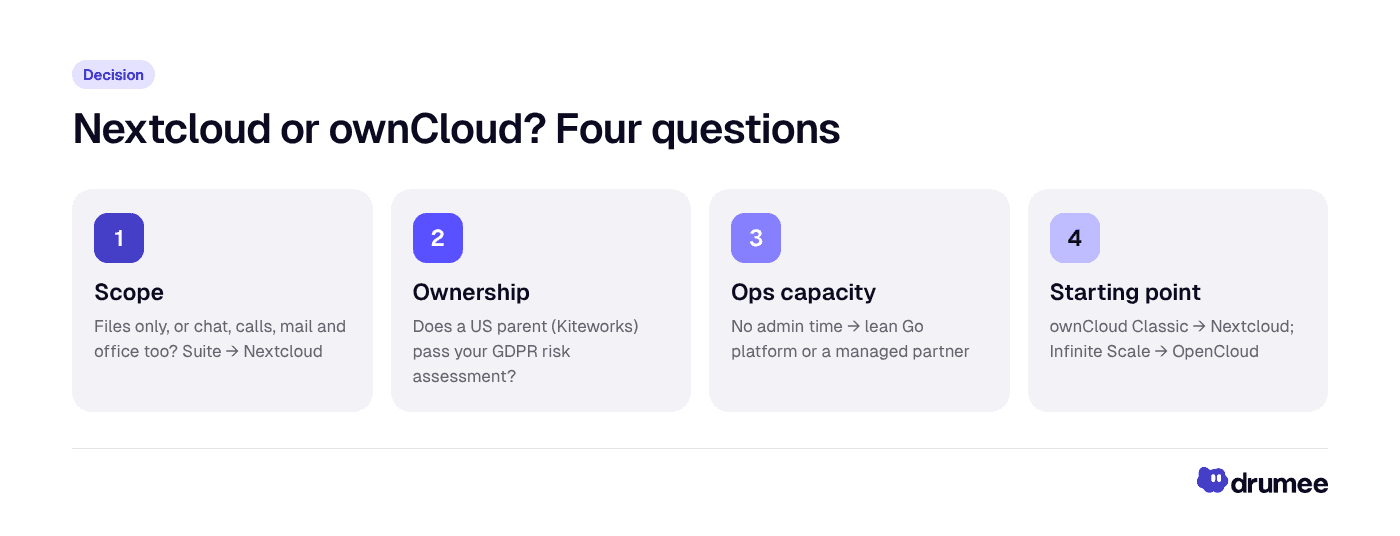
Four questions settle most Nextcloud vs ownCloud decisions for a small team.
- Pick Nextcloud if you want files, chat, calls, calendar, mail and office from one open source project, you run ownCloud Classic today, or you value the largest community and app ecosystem.
- Pick ownCloud Infinite Scale if you only need fast, lean file sync and sharing, you like the database-free Go design, and Kiteworks ownership passes your risk assessment.
- Pick OpenCloud if you want the Infinite Scale architecture with German ownership and a mixed Apache/AGPL licence.
- Look further if your real problem is the number of tools around the files, not the file server itself.
When an all-in-one sovereign workspace like Drumee is worth a look
Nextcloud, ownCloud and OpenCloud all start from file sync and add collaboration around it, as apps or sister products. For a small team, that can still mean several services to configure and several permission models to keep aligned.
Drumee starts from the other end. A Drumee workspace holds files, folder-native chat, tasks, calendar and meetings under one permission model, and documents are edited in Drumee's own Office engine rather than a third-party document server, as the Drumee roadmap describes. Our overview of what's new in Drumee walks through the current product.
Two ways to run Drumee: Drumee Cloud is the hosted workspace at app.drumee.com: sign up and start in minutes (your team's first month is $1). Drumee Sovereign Node runs Drumee on your own infrastructure, with unlimited users, SDK access and a dedicated SLA; contact sales.
Be clear about where it stands today:
- Sovereign Node is a sales-led deployment, not a download. There is no free self-serve package; setup and pricing go through contact sales. Most small teams start on Drumee Cloud at app.drumee.com.
- It is not a drop-in file server. If you need on-premises file sync today, Nextcloud, ownCloud or OpenCloud is the right tool.
- It suits teams whose pain is tool sprawl: files in one place, chat in another, tasks in a third. One workspace and one set of roles reduces both cost and the number of places personal data lives, which is the idea behind a sovereign workspace.
If you are weighing a self-hosted suite against a simpler setup, our Nextcloud alternatives comparison and our guide to avoiding vendor lock-in help frame the trade-off.
FAQ
Is Nextcloud better than ownCloud?
For most small teams, yes, if you want a full suite. Nextcloud covers files, Talk chat and calls, mail, calendar, contacts and office under AGPLv3. ownCloud Infinite Scale is better if you only want a lean, database-free file platform and accept Kiteworks ownership.
Is ownCloud still open source after Kiteworks?
Yes. ownCloud Infinite Scale is Apache 2.0, and in May 2026 Kiteworks launched an Open Source Program Office that is relicensing more than 100 projects to Apache 2.0 and dropped the Contributor License Agreement. Kiteworks still steers the roadmap.
What is the difference between ownCloud Infinite Scale and Nextcloud Hub?
Infinite Scale is a Go file platform that stores metadata with the files and ships as one binary or containers. Nextcloud Hub is a PHP suite with a database that bundles Files, Talk, Groupware, Office and an AI assistant, plus around 600 apps in its store.
OpenCloud vs Nextcloud: which should a small team choose?
Choose OpenCloud if you want simple, fast file sharing with German ownership and easy backups, especially if you run Infinite Scale today. Choose Nextcloud if you want chat, calls, mail and office in the same open source platform.
Can I migrate from ownCloud to Nextcloud?
From ownCloud 10, yes: Nextcloud documents an upgrade through a matching bridge version, then one major version at a time. From Infinite Scale there is no in-place path, so plan a data copy and recreate shares, or consider OpenCloud, which shares the codebase.
Conclusion
Nextcloud and ownCloud stopped being two flavours of the same product years ago. Nextcloud is a broad AGPLv3 suite with a German owner and the biggest community. ownCloud Infinite Scale is a lean Go file platform under Apache 2.0 and US ownership, and OpenCloud offers that same platform from Germany. Match the scope you need, the ops time you have and the ownership chain your GDPR assessment accepts, and the choice usually makes itself.
If your team's real problem is the stack of tools around the file server, compare the options on cost, control and sovereignty together, and look at an all-in-one workspace alongside them.
Try Drumee with your team: your first month is $1. Start your team for $1
Keep reading
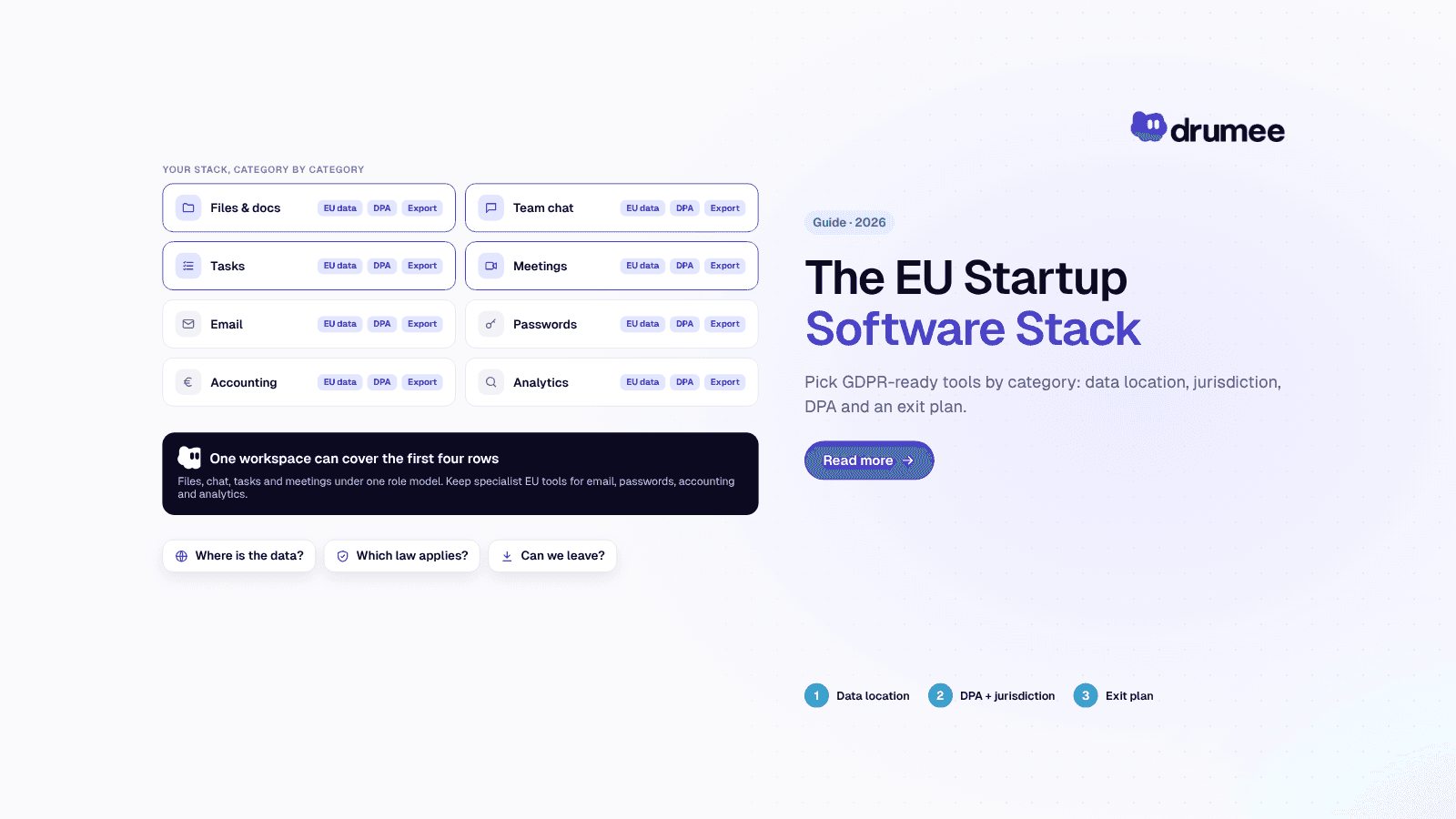
EU Startup Software Stack: How to Pick GDPR-Ready Tools in 2026
A GDPR-ready EU startup software stack is a set of tools, one per job, where each vendor stores your data in a known location, operates under a jurisdiction you can live with, signs a data processing agreement, lets you export everything, and supp...
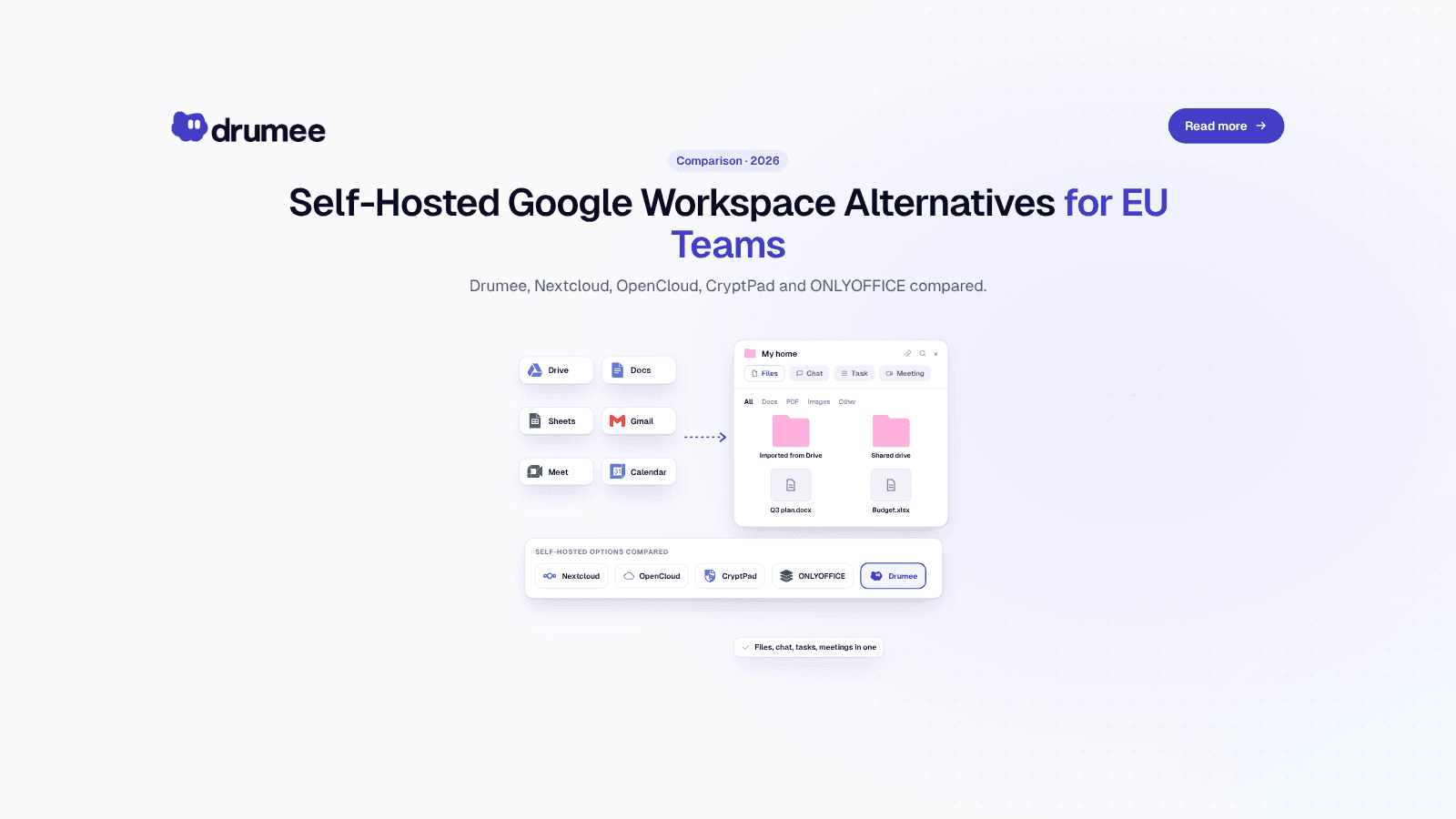
Self-Hosted Alternatives to Google Workspace: 2026 Guide for EU Teams
Google Workspace is the default office stack for most European startups. It is also a US-controlled service whose list price went up in January 2025, whose data sits under US legal reach, and whose exit path takes days of admin work. For a growing...
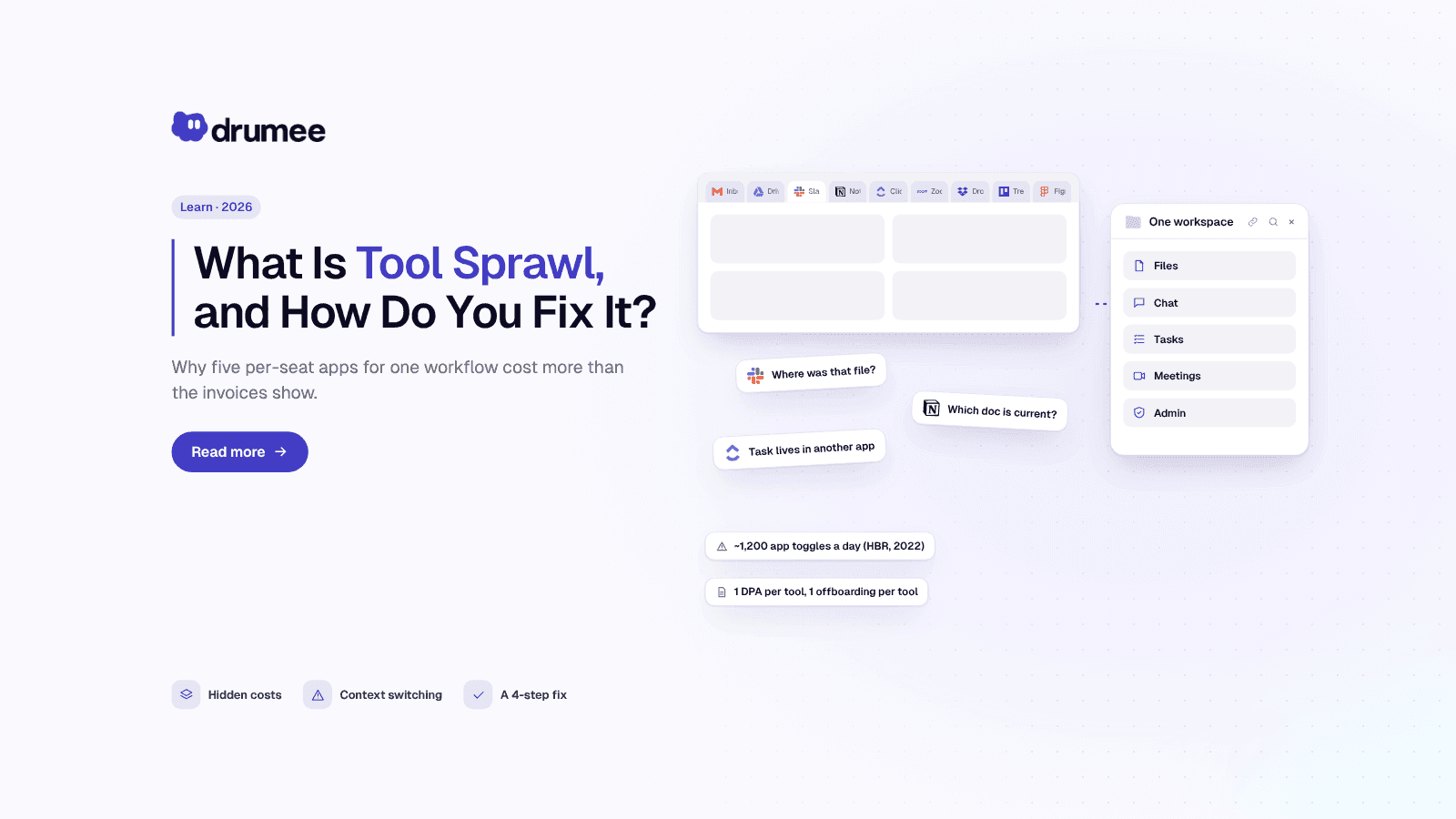
What Is Tool Sprawl and How to Fix It in 2026
Nobody decides to build a messy stack. A startup adds Slack on day one, Google Drive on day two, Notion when the wiki gets real and ClickUp when the roadmap stops fitting in a spreadsheet. Two years later, a simple question like "where did we deci...