
GDPR-Compliant File Storage for Teams: What Works in 2026
GDPR-compliant file storage for teams in 2026 requires more than a DPA and EU data centers. With €1.2 billion in fines in 2025 and regulators targeting processor oversight failures, here is what actually works.
GDPR-Compliant File Storage for Teams: What Works in 2026
GDPR-compliant file storage for teams means more than choosing a cloud provider that offers EU data centers and a data processing agreement. It means operating a file storage and sharing environment where your organization can demonstrate, under direct audit, that personal data is stored within a defined geographic boundary, accessed only by authorized personnel under documented controls, retained no longer than necessary, and governed through an infrastructure layer your organization administers rather than one a vendor administers on your behalf. In 2026, with €1.2 billion in GDPR fines issued in the prior year and daily breach notifications averaging 443 for the first time since 2018, the distinction between contractual compliance and genuine infrastructure control has become the central question regulators ask when they investigate whether a team's file storage posture was adequate before a breach occurred.
What Does GDPR Require From File Storage in 2026?
GDPR's requirements for file storage are more specific than most teams realize, and the enforcement record from 2025 into 2026 has made several previously ambiguous obligations concrete. Legiscope's 2026 GDPR data storage compliance guide identifies a specific regulatory development that teams storing personal data in any system must understand: the EDPB's 2025 Coordinated Enforcement Framework report on the right to erasure, adopted on 10 February 2026, involved 32 supervisory authorities auditing 764 controllers across Europe and revealed that half of the responding data protection authorities reported that many controllers have no specific procedures for erasure in backup systems, with some controllers not deleting data from backups at all. The report also flagged that many anonymization techniques deployed as a substitute for permanent deletion were weak and amounted to mere pseudonymization. For teams using cloud file storage, this finding is directly relevant: if your vendor's backup infrastructure retains data that should have been erased, the compliance failure is yours, not the vendor's.
The Legiscope guide also notes a new obligation introduced from September 12, 2025, when the EU Data Act imposed additional requirements on cloud storage providers, mandating interoperable data formats and the elimination of switching fees by September 2027. For teams currently locked into a specific cloud file storage provider because data export is complex or expensive, this regulation matters: it establishes a legal right to portability that strengthens the negotiating position of organizations evaluating migration away from platforms that have made departure operationally difficult.
Beyond erasure and portability, GDPR requires that file storage for teams satisfy five technical and organizational conditions simultaneously. Data must be encrypted in transit and at rest. Access must follow least-privilege principles with documented controls. Breach notifications must be producible within 72 hours of discovery. Processing activities must be documented with an accurate record of where personal data is stored and who can access it. And third-party processors must operate under binding agreements that include documented security measures, audit rights, and sub-processor controls. Each of these conditions requires active administration, not passive acceptance of a vendor's default settings.
How Does the Enforcement Record Shape What Teams Must Actually Do?
The enforcement record from 2025 and 2026 is the most instructive guide to what GDPR-compliant file storage requires in practice, because it reveals the specific failure modes that regulators are identifying and penalizing at scale.
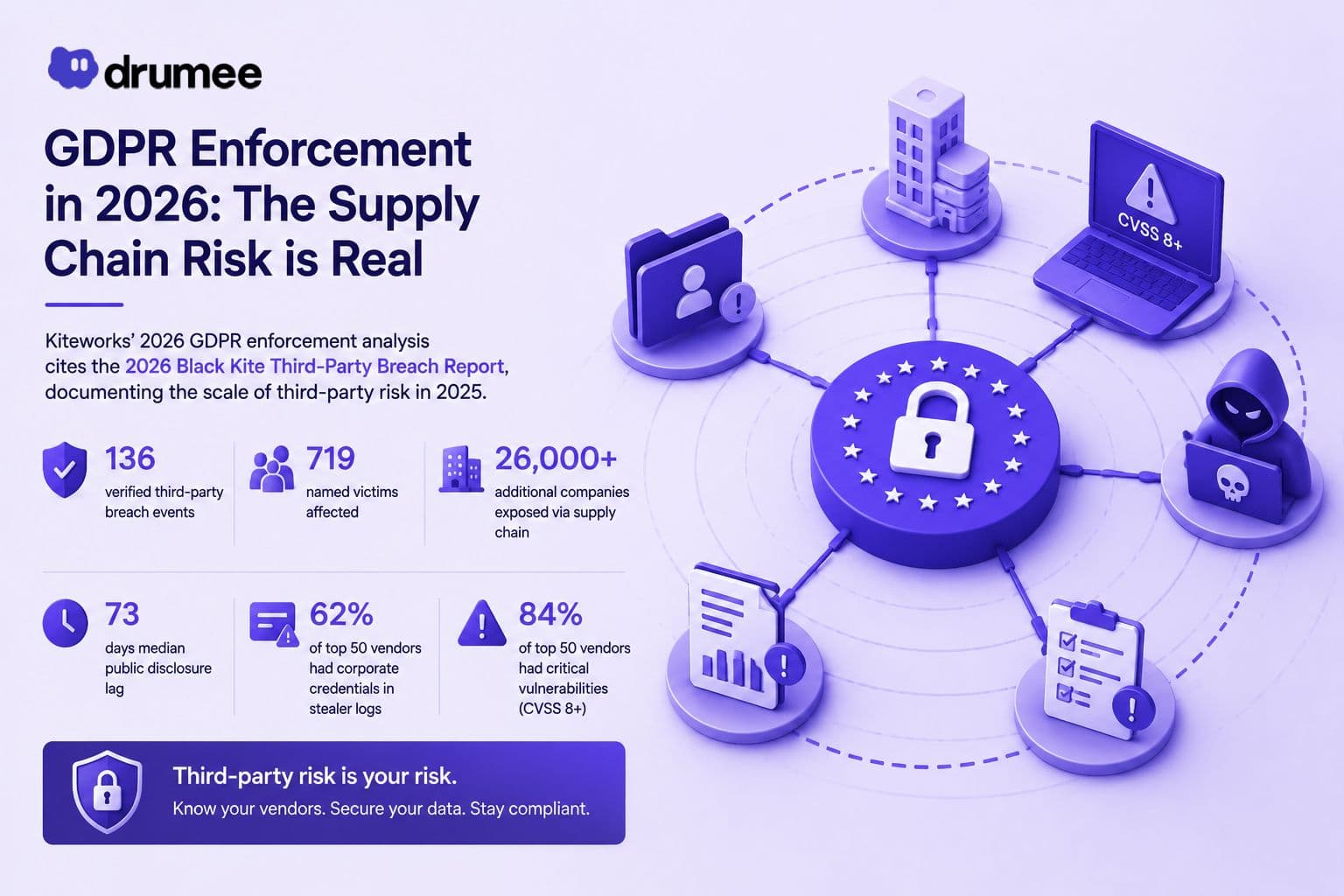
Kiteworks' 2026 GDPR enforcement analysis cites the 2026 Black Kite Third-Party Breach Report, which documented 136 verified third-party breach events in 2025, affecting 719 named victims and an estimated 26,000 additional companies through supply chain exposure. The median public disclosure lag was 73 days. Among the top 50 most-connected vendors, 62% had corporate credentials circulating in stealer logs and 84% had critical vulnerabilities rated CVSS 8 or higher. The compliance consequence for organizations affected by a vendor-side breach is not relief. Under GDPR Articles 28 and 29, data protection authorities now evaluate whether controllers actively monitored their processors, verified compliance claims, and maintained technical controls to detect anomalous processor behavior. Weak processor oversight is treated as an aggravating factor in fine calculation, not a mitigating one.
The ACSMI compliance analysis for 2025 provides the concrete example that illustrates this principle. A fintech startup used an offshore analytics provider without verifying their technical and organizational measures. When the provider's cloud storage buckets were exposed, the startup faced a €6.5 million fine despite having no direct hand in the breach. The regulator's finding was that the controller remained liable because it had failed to verify that its processor's security measures were adequate. The lesson for any team storing files through a cloud provider is direct: the DPA you signed with your vendor does not transfer liability. It documents your intent. The substantive compliance question is whether you have verified and can prove that your processor's actual technical posture meets the standard the DPA claims.
The Security Wall GDPR Fines Tracker adds the broader context: regulators now explicitly require identification of each specific third-country recipient of personal data, not generic categories like "US cloud providers." Transfer Impact Assessments are expected for every transfer mechanism, and Standard Contractual Clauses alone are insufficient without documented analysis of the receiving country's legal framework. Supply chain exposure is particularly acute for US-headquartered SaaS platforms, cloud providers, and support services that process European personal data. Each one requires documented safeguards that go beyond the DPA boilerplate.
The AI Processing Layer That Changed the Compliance Surface in 2026
Before generative AI became a standard feature of cloud file storage platforms, the GDPR compliance question for teams was primarily about where data was stored and who could access it. In 2026, a third and more difficult question has emerged: which AI systems process your team's files, under whose governance, and under what legal basis.
According to Secure Privacy's 2026 data residency requirements analysis, European data protection authorities are now averaging 443 personal data breach notifications per day, a 22% year-over-year increase, with violations involving special category data as a leading driver of maximum penalties. The EU AI Act's full compliance deadline of August 2, 2026 creates dual obligations for organizations deploying high-risk AI systems, and the EDPB's April 2025 guidance clarified that large language models rarely achieve anonymization standards. That guidance means that when cloud file storage platforms embed AI tools that process document content to generate summaries, answer queries, or suggest related files, those AI operations require their own legal basis documentation under GDPR, separate from the consent or contractual necessity basis that covers the file storage function itself.
For teams using Google Workspace, Microsoft 365, or Dropbox AI features, this means that the compliance surface for file storage now extends to the AI processing layer. Deloitte's State of AI in the Enterprise report from August-September 2025, cited in the PreMai AI data residency analysis, found that 73% of enterprises now cite data privacy and security as their top AI risk concern. The teams that do not yet cite this as a concern are typically the ones that have not yet mapped which AI systems access which file contents and under what legal basis that access is authorized.
What Does GDPR-Compliant File Storage Look Like for Teams in 2026?
For teams that have completed an honest assessment of their compliance posture, the gap between contractual coverage and genuine infrastructure control tends to become visible at three specific points.
The first is the data residency audit. When a data protection authority or enterprise client asks your team to demonstrate that personal data in your file storage system has never left a specific jurisdiction, the answer either comes from infrastructure you directly administer or from a vendor's compliance portal. The difference between these two answers is the difference between a fact your organization can verify independently and a representation your vendor makes on its own behalf. According to Expanso's enterprise GDPR data storage guide, organizations must have complete visibility into their data's physical and logical location at all times, because under GDPR the data controller is responsible for the personal data it controls, even if handled by a third-party vendor stored in a different country. Complete visibility requires administering the storage environment directly, or maintaining a level of continuous monitoring that most organizations using commercial cloud storage do not actually conduct.
The second point is the erasure audit. When a data subject makes a right to erasure request, your team's ability to comply completely, including from backup systems, depends on whether you control the backup infrastructure. In cloud storage, backups are managed by the vendor on a schedule and with retention logic the vendor defines. Confirming that data has been erased from backup systems requires either the vendor's representation or access to infrastructure you control. The EDPB's 2026 enforcement findings make clear that vendor representation is no longer sufficient for regulators assessing whether erasure was genuinely complete.
The third point is the third-party AI processing disclosure. When a data subject asks what automated processing their data has been subject to, your answer needs to cover not just who has accessed the files but what AI systems have processed the content of those files and under what legal basis. For teams using cloud storage with embedded AI features, that answer requires documentation of which AI models the vendor employs, what data those models accessed, and what retention policies apply to AI-generated outputs. That documentation is available through vendor transparency reports and DPAs, but it cannot be independently verified because the AI infrastructure is the vendor's, not yours.
The Infrastructure Position That Resolves These Points
The teams that navigate each of these audit points most cleanly in 2026 are the ones that have moved their file storage environment onto infrastructure they directly administer. This is not a universal recommendation for every organization. For teams processing low-sensitivity data with limited regulatory exposure, commercial cloud storage with properly configured DPAs and active vendor monitoring may represent an adequate compliance posture. For teams in legal, healthcare, financial services, and government-adjacent sectors, or for any team that has received a regulatory inquiry and discovered the gap between its contractual coverage and its demonstrable control, the compliance ceiling of vendor-hosted cloud storage has become the decisive factor in infrastructure decisions.
Self-hosted file storage platforms like Nextcloud provide the technical foundation for this position. Nextcloud's compliance documentation states that the platform is designed so that Nextcloud GmbH has no access to customer data, removing the need for a data processor or controller agreement under GDPR. Compliance features include terms of service review tracking, data export and deletion request workflows, and auditing capabilities covering GDPR, HIPAA, CCPA, and several ISO certifications. The absence of a vendor access layer is the property that makes the compliance evidence producible by the organization rather than dependent on the vendor's cooperation.
Drumee extends this architectural position beyond file storage into the broader operational environment where compliance exposure actually lives. As a sovereign data OS, Drumee places files, communications, permissions, and task context in a single self-hosted environment the organization administers, with a unified audit trail and a consistent permission model across all operational layers. For teams whose regulatory exposure extends beyond the storage layer into the communications and workflow context surrounding their files, the governance completeness of a unified self-hosted environment is the compliance condition that fragmented cloud stacks cannot replicate through DPAs alone.
The honest answer for teams asking what works for GDPR-compliant file storage in 2026 is that contractual compliance is the minimum, not the destination. Regulators are measuring technical controls, backup erasure, processor monitoring, and AI processing governance at a level of specificity that vendor agreements cover on paper and that direct infrastructure control makes demonstrable in practice.
FAQ
1/ What does GDPR require for team file storage in 2026?
GDPR requires that personal data in file storage systems be encrypted in transit and at rest, accessed only under documented least-privilege controls, erasable from backup systems upon request, processed only by verified third-party processors with binding security commitments, and governed through a documented record of processing activities. The EDPB's February 2026 enforcement report found that half of audited controllers had no specific erasure procedures for backup systems.
2/ Is cloud file storage GDPR compliant?
Commercial cloud file storage can be configured to satisfy baseline GDPR obligations through data processing agreements, EU data residency options, and encryption. However, cloud storage vendors retain administrative authority over the infrastructure, backup systems, and AI processing layer, meaning the organization's ability to demonstrate complete compliance depends on the vendor's cooperation rather than its own direct administration of the storage environment.
3/ What is the biggest GDPR risk for teams using cloud file storage in 2026?
Third-party processor liability is the most acute risk. According to the 2026 Black Kite Third-Party Breach Report, 136 verified third-party breach events in 2025 affected 719 named victims and an estimated 26,000 additional companies. Under GDPR Articles 28 and 29, controllers remain liable for processor breaches unless they can demonstrate active monitoring and verification of their processors' technical security posture.
4/ How does self-hosted file storage improve GDPR compliance for teams?
Self-hosted file storage gives the organization direct administrative authority over the storage infrastructure, backup systems, encryption keys, and access logs. This makes compliance evidence producible by the organization independently, without requiring vendor cooperation for audit responses, erasure confirmations, or AI processing disclosures. It also eliminates the US CLOUD Act exposure that applies to US-headquartered cloud providers regardless of where data is physically stored.
5/ How does Drumee address GDPR compliance for teams?
Drumee is a self-hosted sovereign data OS that unifies file storage, communication, tasks, and permissions in a single environment the organization directly administers. There is no vendor access layer, no third-party AI processing of file content under external governance terms, and no dependency on vendor cooperation for compliance evidence. The audit trail covering files, conversations, and permissions is unified and organizationally controlled.
Related article: Is Google Drive GDPR Compliant? The 2026 Honest Answer
------------------------------
About Drumee
Drumee is the world’s first unified sovereign data infrastructure: a self-hosted, OS-like workspace that turns your own filesystem into a private collaborative environment.
Fully under your control, Drumee combines files, chat, tasks, and workflows with enterprise-grade permissions built directly into the infrastructure layer. No cloud vendors. No fragmented SaaS stack. No operational dependency.
Instead of renting your workspace from external providers, Drumee allows organizations to own the environment where operational knowledge lives.
Your Data. Your Workflow. One system. Built to be yours!
Follow us at: Website | X | LinkedIn | Drumee Founder X | Drumee Founder LinkedIn
Keep reading
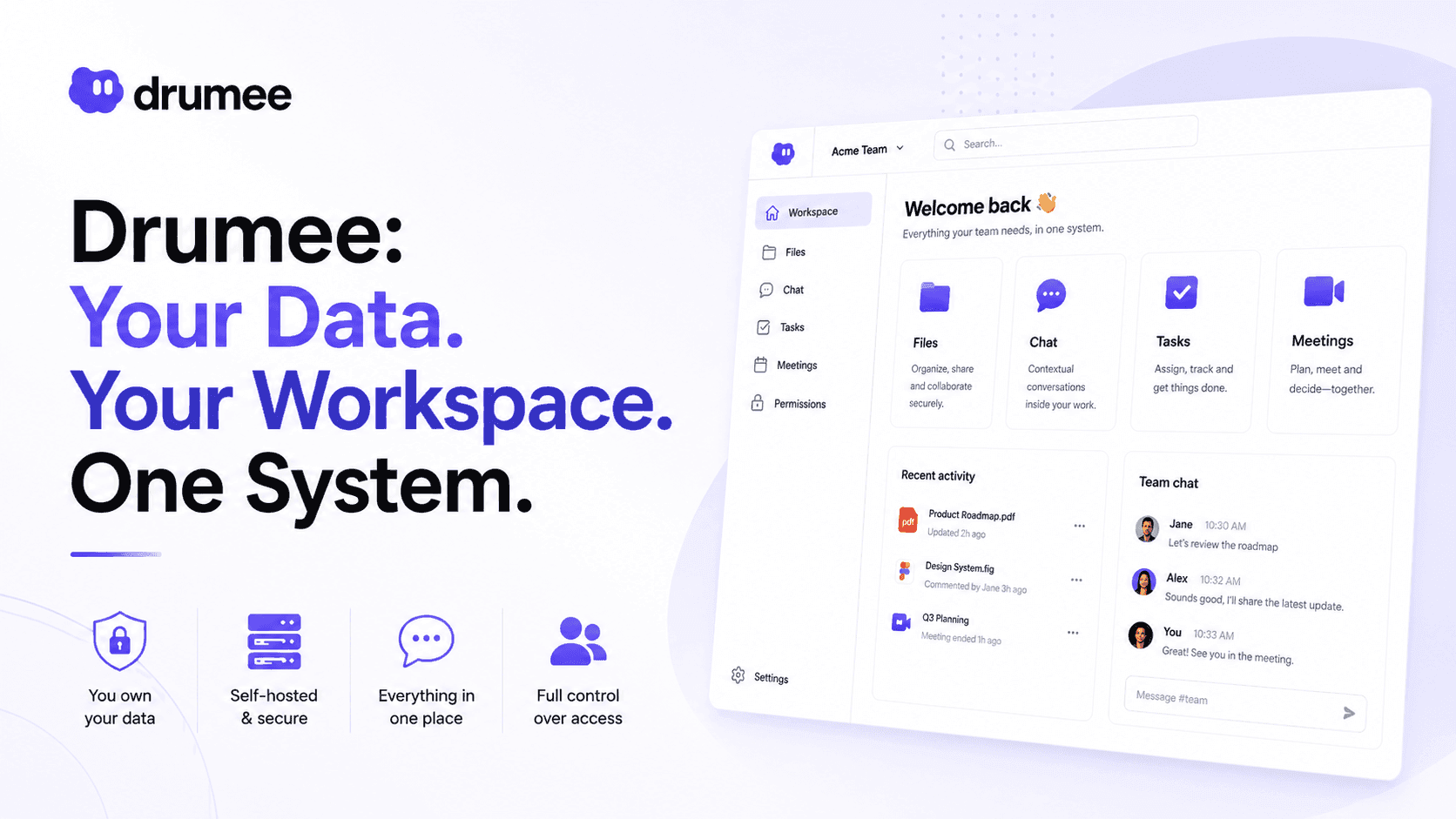
Drumee: Your Data. Your Workspace. One System
Drumee is a self-hosted, sovereign data workspace where files, chat, tasks, and permissions live in one place on infrastructure you own. Learn what Drumee is, what it stands for, and how to get started.
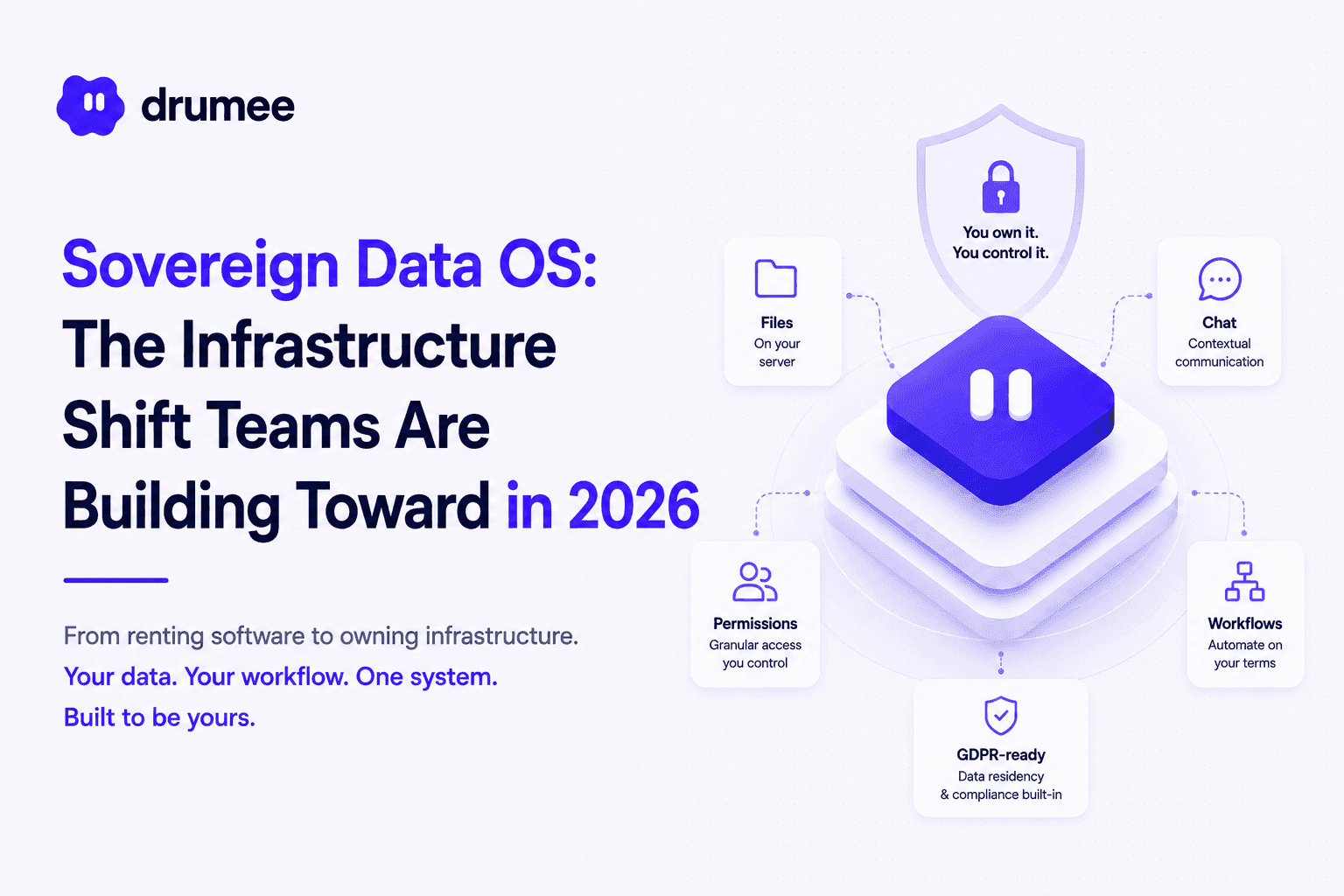
What Is a Sovereign Data OS? The Infrastructure Shift Teams Are Building Toward in 2026
What is a sovereign data OS? Learn how Drumee's unified self-hosted infrastructure replaces fragmented SaaS stacks with a single governable environment for files, chat, permissions, and workflows in 2026.
Data Ownership: What It Means and How to Achieve It in 2026
What is data ownership and how do you actually achieve it? Learn the three layers of data control, why AI changes the stakes, and how self-hosted infrastructure gives teams genuine ownership in 2026.