
Secure Self-Hosted File Sharing: The Complete Guide
Secure self-hosted file sharing gives your organization the infrastructure control that cloud storage cannot deliver: your encryption keys, your permission model, your audit trail. A complete guide to architecture, platforms, and compliance in 2026.
Secure Self-Hosted File Sharing: The Complete Guide
Secure self-hosted file sharing is the practice of storing, syncing, and distributing files through infrastructure your organization administers directly, on servers you own, under a permission model you define, with encryption keys that never leave your operational boundary. It is the architectural opposite of uploading files to Google Drive, Dropbox, or OneDrive and trusting that the platform's security posture, terms of service, and AI processing layer will remain aligned with your governance requirements. In 2026, the evidence that cloud file sharing carries systemic risk has accumulated to a point that makes the self-hosted alternative worth understanding in concrete operational terms, not just philosophical ones.
Why Has the Risk Calculation Shifted?
The breach statistics that define 2025 and 2026 are not background noise. They are a precise description of what happens when organizations build their file sharing infrastructure on systems they do not administer. According to DataStackHub's 2025-2026 data breach statistics report, over 3,200 publicly disclosed breaches were recorded worldwide in 2025, affecting billions of records. Roughly 46% of those breaches originated in cloud-hosted environments, and organizations took an average of 197 days to identify and 74 days to contain a breach. The 197-day detection window is the number that deserves the most attention, because it describes the period during which sensitive files, client documents, and confidential operational data exist in a compromised state without the organization's knowledge, on infrastructure the organization does not directly monitor.
The causes driving those breaches are not primarily sophisticated external attacks. They are governance failures at the infrastructure layer. CoreStream GRC's 2026 data breach trend analysis found that over 40% of cyber incidents reported to the FCA in 2025 involved a third party, and a 2025 Data Breach Investigations Report found third-party involvement in 30% of breaches, up from roughly 15% the year before. Exploitation of vulnerabilities surged by 34%. The Abu Dhabi Finance Week incident that same year is the most instructive illustration of this pattern: its exposed cloud storage server was accessible through "a simple web browser," according to the Financial Times story. That is not a sophisticated intrusion story. It is a basic exposure story, and some of the worst trust damage still comes from preventable configuration and ownership failures.
That distinction is operationally significant. When file storage infrastructure sits on your own server, the configuration is yours to audit. The access logs are yours to review. The permission model is yours to enforce. When it sits on a cloud platform, the configuration is yours to set within the options the vendor exposes, and the audit trail is accessible through the vendor's dashboard, which means the vendor's systems are also the primary record of what happened to your data.
What Does Secure Self-Hosted File Sharing Require?
Secure self-hosted file sharing is not a feature. It is a condition, and the condition is met when four specific layers of the infrastructure are under organizational control simultaneously.
The first layer is physical data residency. Your files must live on servers your organization selects and administers, whether on-premises hardware, a VPS hosted in a jurisdiction your compliance framework requires, or a private cloud node with no dependency on a US hyperscaler's governance terms. According to vboxx.eu's 2026 self-hosted cloud storage guide, self-hosted solutions like Seafile or ownCloud provide complete control over data location, whilst commercial services vary significantly in their hosting options. European providers frequently emphasise GDPR compliance and EU data hosting as competitive advantages, and for organisations handling sensitive information or operating in regulated industries, these jurisdictional considerations may override other platform features in importance.
The second layer is encryption key management. Encryption in transit and at rest protects your files from external attackers who access the storage layer without authorization. It does not protect your files from the platform's own scanning, indexing, and AI processing systems, which operate on the decrypted content as a built-in feature of the service. Client-side encryption, where keys are generated and held by the organization rather than the platform, is the condition that genuinely resolves this exposure. It is available in self-hosted deployments and absent by default in most commercial cloud storage.
The third layer is permission model administration. In cloud storage environments, the permission model operates within the vendor's product architecture. Access grants, sharing settings, and inheritance rules are all configurable within the options the vendor exposes, and the vendor retains the ability to modify what those options are. In a self-hosted environment, the permission model is enforced by systems your organization runs. If an access control decision is wrong, it is wrong because of your configuration, not because a vendor updated their sharing defaults without notification.
The fourth layer is audit log ownership. When a regulatory authority, legal discovery request, or internal security review requires complete records of who accessed which files and when, the organization's ability to produce those records depends entirely on where the logs live. In cloud storage, logs are available through the vendor's interface. In a self-hosted deployment, the logs are in your infrastructure, complete, unmediated, and accessible on your own timeline without vendor intermediation.
The Platform Landscape in 2026
The self-hosted file sharing ecosystem has matured substantially, and the three platforms that define the serious enterprise options are Nextcloud, Seafile, and the recently repositioned ownCloud. MassiveGRID's 2026 enterprise comparison of self-hosted platforms notes that ownCloud's acquisition by US-based Kiteworks in late 2024 has fundamentally altered its sovereignty profile, that Seafile remains a lean file-focused tool that excels in narrow use cases, and that Nextcloud has evolved into a full collaboration suite competing not just with other EFSS platforms but with Microsoft 365 and Google Workspace themselves.
Nextcloud's governance credentials are among the strongest in the category. Nextcloud's own compliance documentation states that the platform is fundamentally designed so that Nextcloud GmbH does not have any access to customer data, removing the need for a data processor or controller agreement under the GDPR or similar legislation. Compliance features include terms of service review tracking, data export and deletion requests, imprint and privacy links, and auditing capabilities, with support for GDPR, CCPA, HIPAA, FERPA, COPPA, and several ISO certifications.
Seafile occupies a different but complementary position. Sesame Disk's April 2026 analysis of self-hosted cloud storage trends notes that real-world deployments now often require not just file sync, but GDPR-compliant data sovereignty, AI-powered monitoring, and seamless scalability from a single Raspberry Pi to clustered enterprise nodes. Seafile's lightweight architecture means it handles large file workloads and high-concurrency environments with minimal resource overhead, making it the platform of choice for engineering and research organizations where raw transfer performance matters more than the breadth of integrated collaboration features.
For European enterprises bound by GDPR, for government agencies with strict sovereignty mandates, and for organizations in regulated industries, the choice between these platforms is less about features and more about the infrastructure posture they enable. Both Nextcloud and Seafile are meaningfully differentiated from cloud alternatives by the fact that neither requires the organization to trust a third party with administrative authority over its file infrastructure.
Where Do Standalone File Tools Leave the Governance Problem Incomplete?
The limitation that every serious evaluation of secure self-hosted file sharing must confront is this: file storage sovereignty alone does not create a coherent governance posture if the operational context surrounding those files remains in vendor-controlled systems.
Consider a legal agency that deploys Nextcloud for client file storage. The files are sovereign. But the conversation about those files happens in Slack, on Slack's servers, under Slack's terms. The internal task assignments connected to those client matters are in a separate project management tool. The documentation about how those matters are handled lives in a cloud-hosted knowledge base. The permission model in Nextcloud is not aware of the permission model in any of those systems. A complete audit of who accessed sensitive client information requires records from multiple separate vendor-controlled environments, each with its own data retention policies, none of which can be cross-referenced automatically.
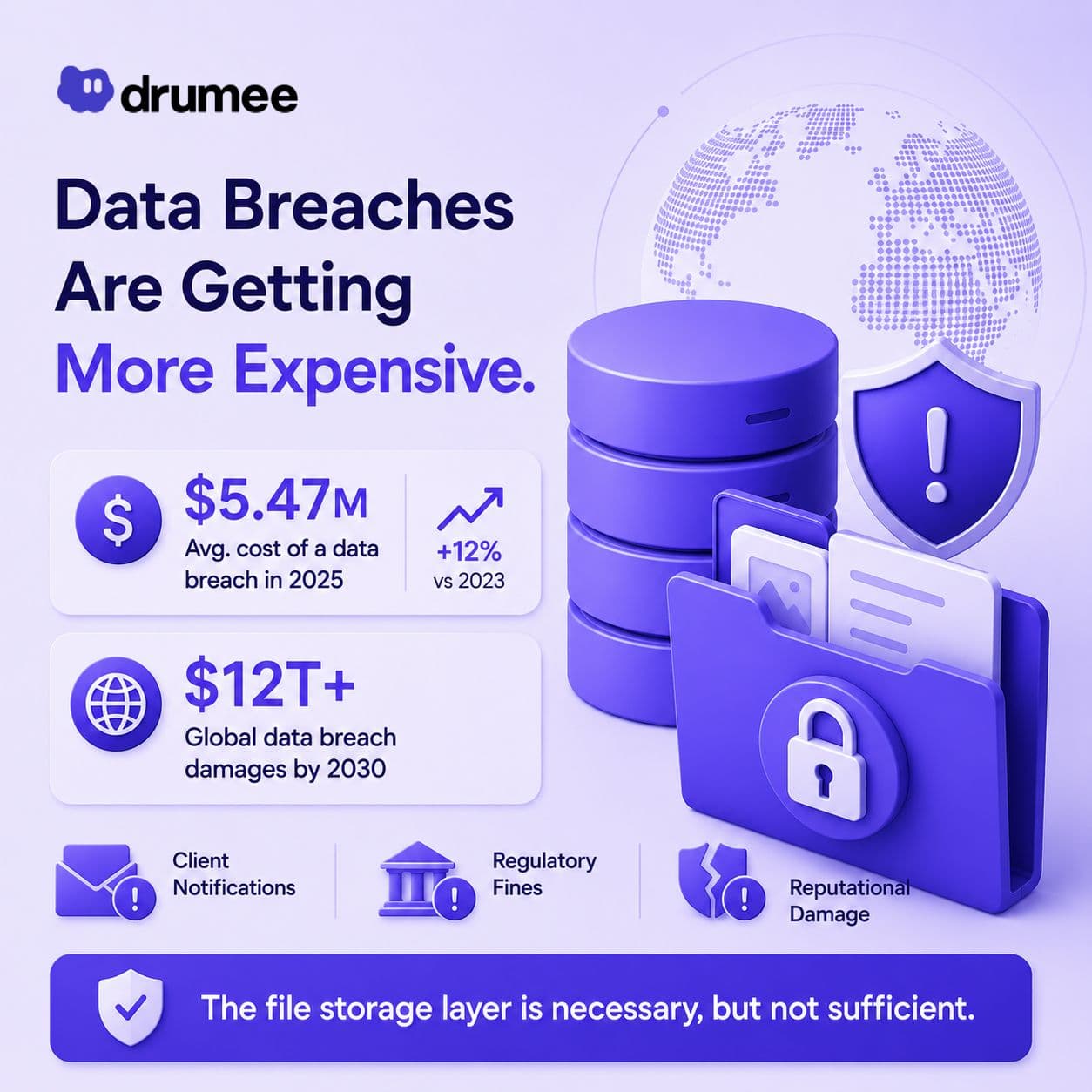
This is the governance gap that file-only self-hosted deployments do not close, because they address the storage layer in isolation without addressing the full operational context where file sharing actually occurs. The regulatory consequence of this gap is not theoretical. DataStackHub's 2025-2026 breach statistics confirm that the global average cost of a data breach reached USD 5.47 million in 2025, up 12% from 2023, and global data breach damages are projected to exceed USD 12 trillion annually by 2030. For organizations in industries where data exposure triggers client notification requirements, regulatory fines, and reputational damage, the file storage layer is necessary but not sufficient.
The architectural resolution is a unified self-hosted environment where files, communication, permissions, and task context exist inside the same governed infrastructure layer, with a consistent audit trail across all operational layers rather than separate trails requiring manual reconciliation. This is the positioning that Drumee occupies as a sovereign data OS: not a replacement for Nextcloud or Seafile at the storage layer, but an environment where file sharing is one surface of a unified operational system that the organization administers from a single governance boundary.
The Implementation Starting Point
For organizations ready to move secure self-hosted file sharing from consideration to deployment in 2026, the practical entry point is simpler than it was three years ago. Logicweb's 2025 comparison of self-hosted Dropbox alternatives confirms that Docker containerization and automation now enable deployment in minutes rather than hours, making self-hosted infrastructure accessible to teams with a basic technical lead rather than a dedicated operations team.
The organizational discipline that self-hosted file sharing requires is not primarily technical. It is operational: explicit configuration of encryption settings, regular audit log reviews, consistent permission model governance, and backup infrastructure that is independent of the primary file serving environment. Each of these practices is available in cloud storage environments in attenuated form, managed partly by the organization and partly by the vendor. In a self-hosted deployment, they are entirely the organization's responsibility, which is precisely the condition that makes the governance posture auditable, demonstrable, and not contingent on a vendor's current policy page or platform response to a regulatory inquiry the organization never directly participated in.
Secure self-hosted file sharing is not a security strategy in the narrow sense of defending against external attackers. It is an infrastructure strategy for organizations that have recognized the difference between storing files in a system someone else governs and storing files in a system they govern themselves. In 2026, that distinction is measurable in breach costs, regulatory exposure, and the speed at which an organization can produce complete, unaltered governance evidence when it is asked to.
FAQ
1/ What is secure self-hosted file sharing?
Secure self-hosted file sharing is the practice of storing and distributing files on servers your organization directly administers, with encryption keys, permission models, and audit logs under your own governance, rather than on vendor-hosted cloud infrastructure where those layers are controlled by a third party.
2/ Why is self-hosted file sharing more secure than cloud storage?
Cloud storage platforms have inherent technical access to your files through scanning, AI processing, and platform operations. Self-hosted file sharing eliminates this vendor access layer. Your files are processed only by systems you have specifically deployed. Audit trails, permission models, and encryption keys are all administered by your organization without vendor intermediation.
3/ What are the best self-hosted file sharing platforms in 2026?
The leading open source options are Nextcloud, with its all-in-one collaboration focus and strong GDPR compliance architecture; Seafile, optimized for high-performance file sync with minimal resource overhead; and Drumee, which unifies file sharing with communication, tasks, and permissions in a single self-hosted sovereign environment.
4/ Does self-hosted file sharing satisfy GDPR requirements?
Self-hosted file sharing provides the infrastructure control necessary for genuine GDPR compliance, including data residency on servers your organization selects, audit logging in your own systems, and no dependency on a third-party vendor's data processing agreements. Nextcloud specifically is designed so that Nextcloud GmbH has no access to customer data, removing the need for a standard data processor agreement.
5/ How is Drumee different from Nextcloud for file sharing?
Nextcloud solves the file storage and sync layer comprehensively. Drumee is a sovereign data OS that unifies file sharing, communication, tasks, and permissions in a single self-hosted environment, so that the governance boundary and audit trail covering your files also covers the conversations, decisions, and workflows connected to those files, rather than leaving those adjacent layers in separate vendor-controlled systems.
Related article: The GitHub Source Code Breach: What the TeamPCP Attack Tells Us About Infrastructure You Don't Control
------------------------------
About Drumee
Drumee is the world’s first unified sovereign data infrastructure: a self-hosted, OS-like workspace that turns your own filesystem into a private collaborative environment.
Fully under your control, Drumee combines files, chat, tasks, and workflows with enterprise-grade permissions built directly into the infrastructure layer. No cloud vendors. No fragmented SaaS stack. No operational dependency.
Instead of renting your workspace from external providers, Drumee allows organizations to own the environment where operational knowledge lives.
Your Data. Your Workflow. One system. Built to be yours!
Follow us at: Website | X | LinkedIn | Drumee Founder X | Drumee Founder LinkedIn
Keep reading
Drumee: Your Data. Your Workspace. One System
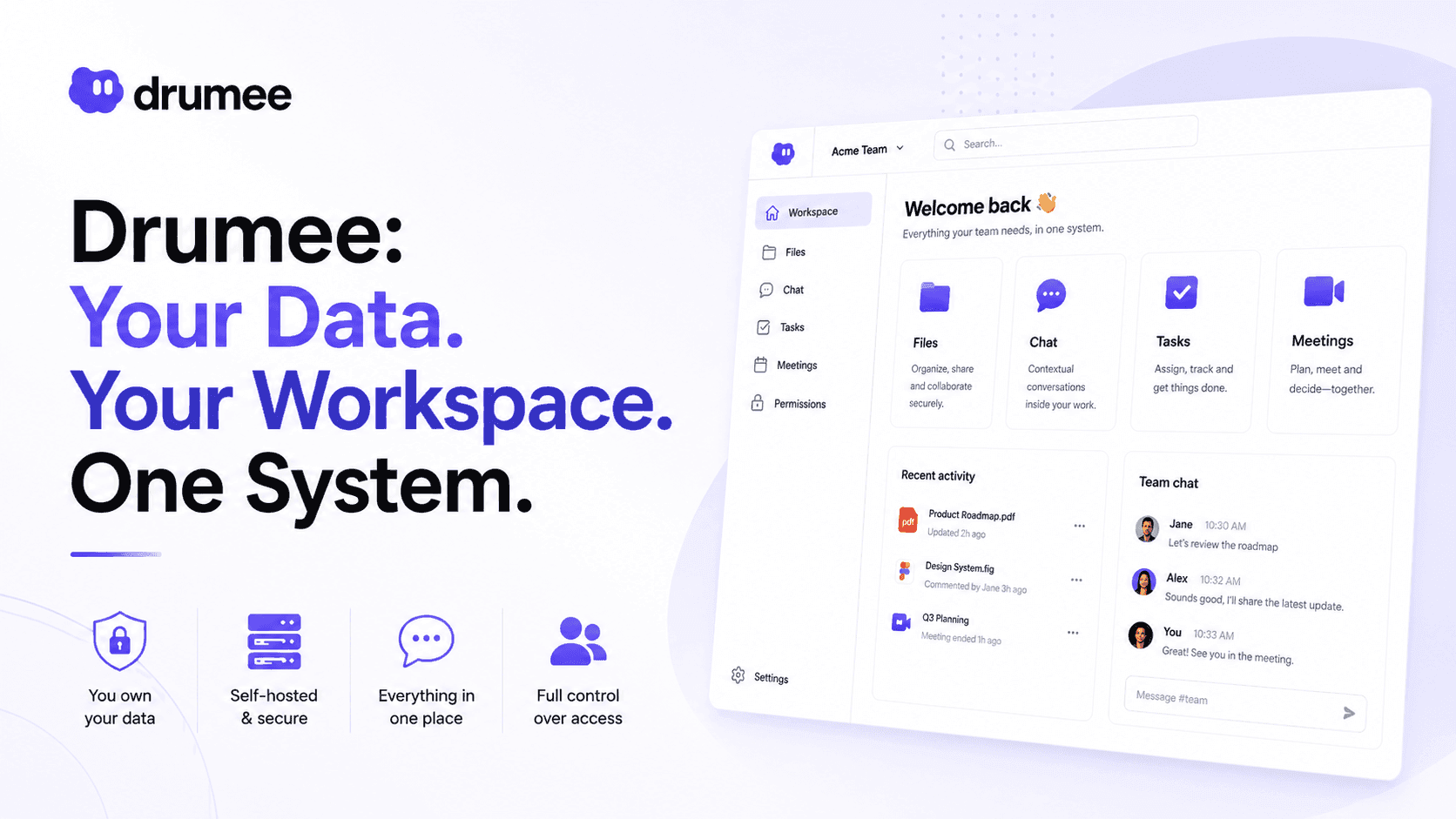
Drumee is a self-hosted, sovereign data workspace where files, chat, tasks, and permissions live in one place on infrastructure you own. Learn what Drumee is, what it stands for, and how to get started.
What Is a Sovereign Data OS? The Infrastructure Shift Teams Are Building Toward in 2026
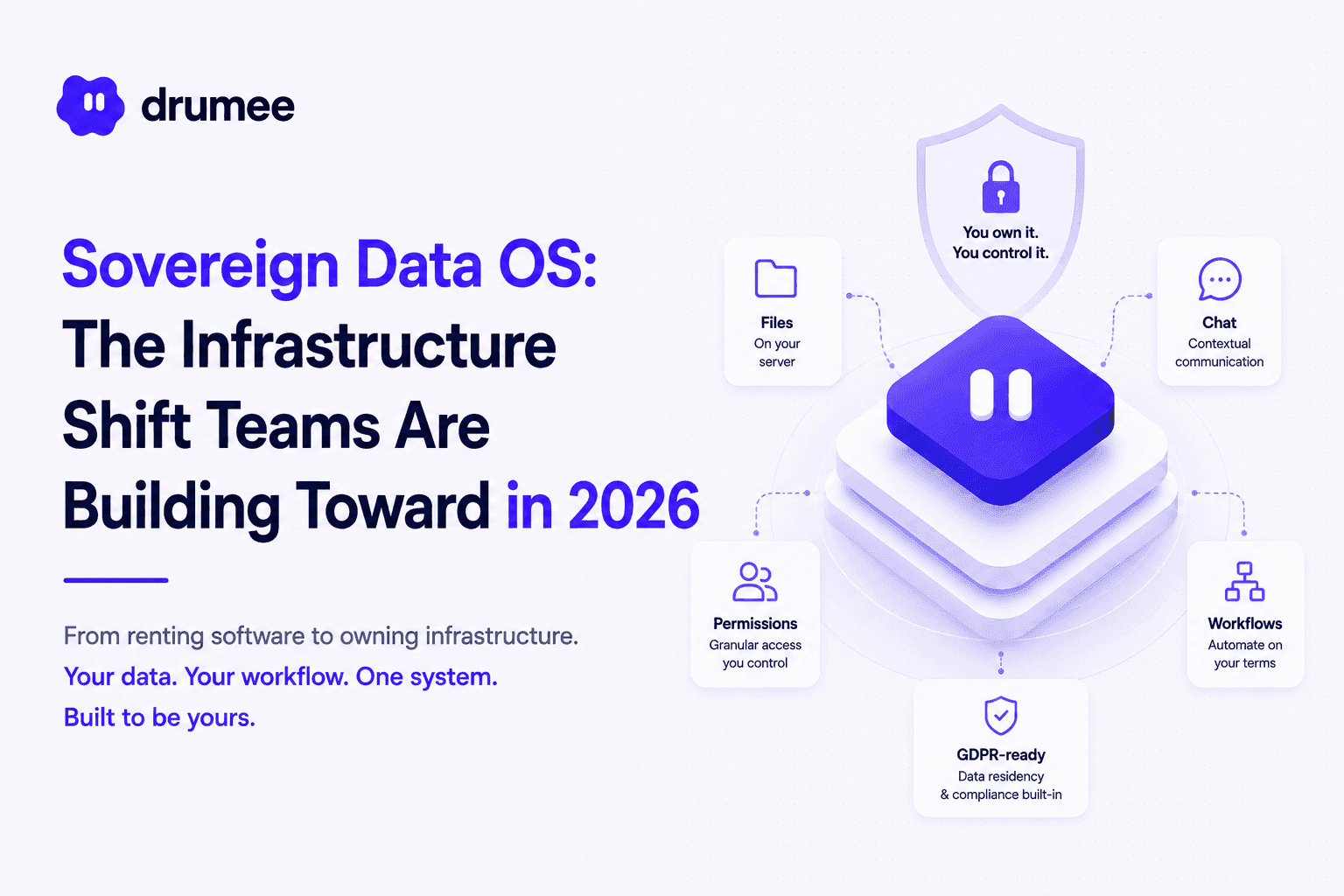
What is a sovereign data OS? Learn how Drumee's unified self-hosted infrastructure replaces fragmented SaaS stacks with a single governable environment for files, chat, permissions, and workflows in 2026.
Data Ownership: What It Means and How to Achieve It in 2026
What is data ownership and how do you actually achieve it? Learn the three layers of data control, why AI changes the stakes, and how self-hosted infrastructure gives teams genuine ownership in 2026.