
Is Google Drive GDPR Compliant? The 2026 Honest Answer
Is Google Drive GDPR compliant in 2026? Google provides the DPA, SCCs, and EU data centers. But the CLOUD Act, the €325M CNIL fine, and the AI processing layer mean the honest answer is more complicated than a yes.
Is Google Drive GDPR Compliant? The 2026 Honest Answer
Google Drive is GDPR compliant in the sense that Google provides a Data Processing Agreement, stores data in EU-based data centers on request, and operates Standard Contractual Clauses to legitimize cross-border data transfers. For organizations processing low-sensitivity data with limited regulatory exposure, that contractual coverage may be sufficient. For organizations that handle HR data, client communications, legal documents, regulated financial records, or anything subject to sector-specific compliance frameworks, the honest answer in 2026 is more complicated. The question of whether Google Drive is GDPR compliant cannot be answered with a single yes or no, because GDPR compliance is not a certificate Google earns and passes on to its customers. It is a set of ongoing obligations about where data is processed, who controls it, and under what legal authority access decisions are made, and those obligations are distributed between Google and the organizations that use it in ways that most teams never fully audit.
What Does Google Actually Provide?
Starting from what Google does offer: the compliance infrastructure is real and it is substantial. Google's own GDPR documentation confirms that Google Cloud and Google Workspace customers have access to a Data Processing Agreement that covers GDPR requirements, Standard Contractual Clauses for international data transfers, and EU-specific data center deployment options. Google has updated these terms over the years based on feedback from customers and regulators, and its team of lawyers, regulatory compliance experts, and public policy specialists works with supervisory authorities across Europe. Since September 2024, Google has also adopted the UK Extension to the EU-US Data Privacy Framework and the Swiss-US Data Privacy Framework as alternative transfer mechanisms for data subject to UK GDPR and Swiss data protection law.
According to Sprintlaw's analysis of Google Drive for UK businesses, the DPA is the governing instrument for how Google processes and protects data stored in Drive for business purposes, covering responsibilities under the controller and processor framework. The DPA is real. The European data centers are real. The SCCs are real. For many organizations, accepting these terms and maintaining proper internal data governance policies is what GDPR compliance around Google Drive looks like in practice.
The critical issue is not whether these instruments exist. It is what they do not cover, and where the structural exposure lies regardless of which agreements have been signed.
The CLOUD Act Problem That a DPA Cannot Fix
The most significant and least discussed dimension of the Google Drive GDPR compliance question is not about Google's policies. It is about US law. InfoPeak's 2025 analysis of Google Workspace compliance for EU businesses states the condition clearly: Google can store your data on servers in Frankfurt or Dublin, but Google LLC, a US company, remains the infrastructure operator. The US CLOUD Act (2018) requires American technology companies to produce data when served with a valid US government order, regardless of where that data is physically stored. A Google server in Ireland does not change Google's obligations under US law.
This creates a structural tension that no data processing agreement resolves, because the DPA governs Google's behavior under normal operating conditions. It does not govern Google's obligations under a US government order that operates independently of the GDPR framework. For EU organizations processing personal data in categories that regulators and courts have held to require high protection, including health data, legal communications, financial records, and data about public officials, the CLOUD Act exposure is a real governance gap, not a theoretical one.
According to the OWOX analysis of GDPR and EU-US data transfers, the European Data Protection Board published its first report in 2025 urging the Commission to re-evaluate the adequacy decision within three years, amid mounting legal challenges. The Court of Justice of the European Union is expected to review the EU-US Data Privacy Framework's validity by 2026. Multiple NGOs including NOYB have filed challenges against the DPF specifically targeting Google services. That regulatory trajectory is relevant to any organization making long-term infrastructure decisions based on the current adequacy decision. Organizations should maintain Standard Contractual Clauses as a backup despite the DPF's current legal validity, because the legal landscape is actively contested.
What Does the Enforcement Record Reveal?
The enforcement record around Google and GDPR in 2025 and 2026 provides the most concrete signal of where the regulatory direction of travel is heading, and it is not toward more permissive interpretation.
According to Goodwin Law's analysis of the September 2025 CNIL decision, the French data protection authority fined Google €325 million on September 1, 2025, split between €200 million against Google LLC and €125 million against Google Ireland. The decision covered two practices: advertisements displayed between user emails in Gmail's Promotions and Social tabs without prior consent, and invalid consent collection during Google account creation. The CNIL's finding was precise: the GDPR one-stop-shop mechanism does not shield Google from ePrivacy enforcement by national authorities, meaning that Ireland's role as Google's lead supervisory authority does not immunize Google from direct enforcement actions by other EU regulators on specific practices.
The Security Wall GDPR Fines Tracker notes that Google has now been fined by the CNIL three separate times for cookie-related issues, each time for a larger amount. The tracker also records that €1.2 billion in GDPR fines were issued in 2025 alone, with daily breach notifications exceeding 400 for the first time since 2018.
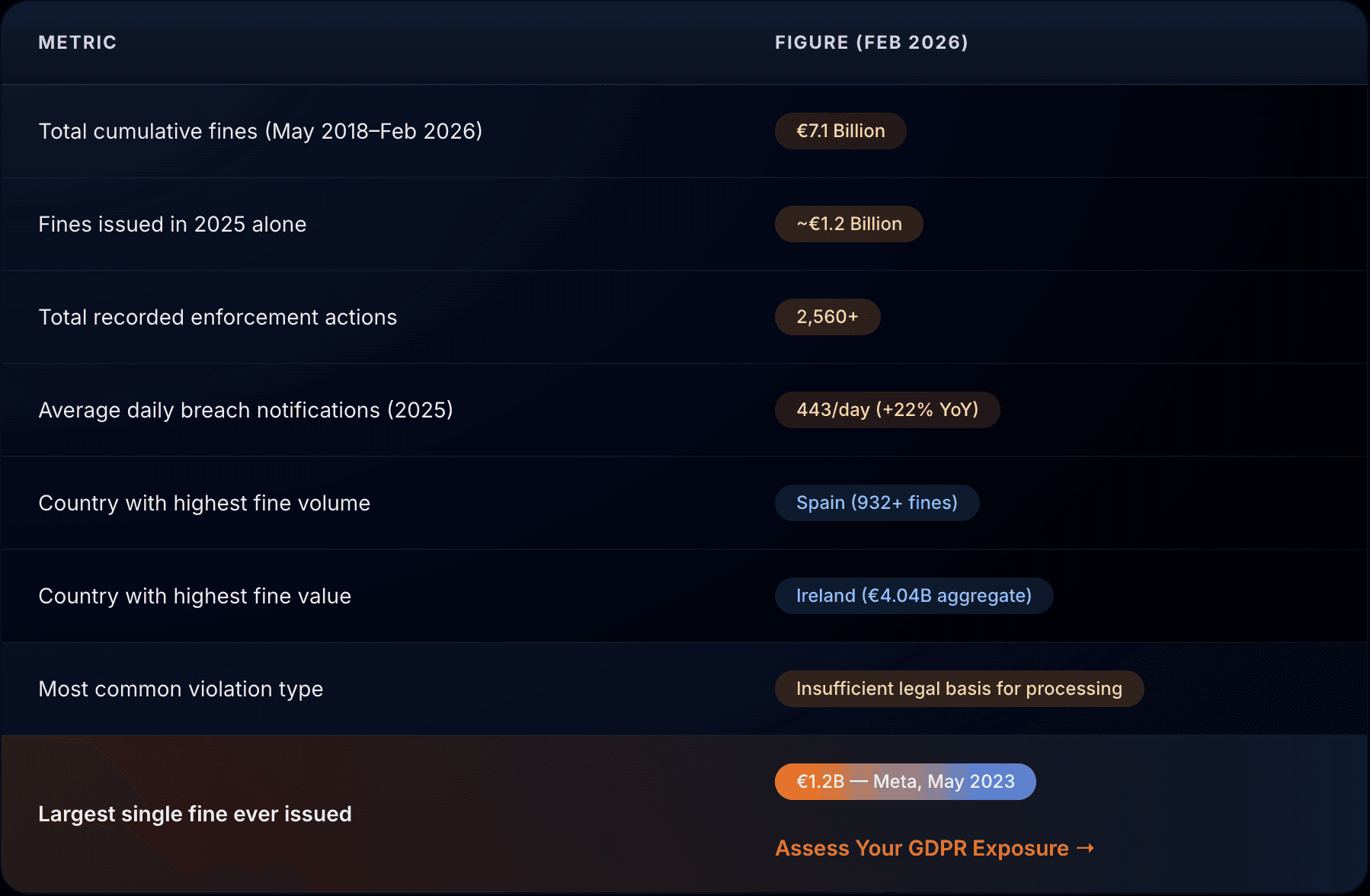
These enforcement actions are directly relevant to the Google Drive GDPR compliance question, not because they concern file storage specifically, but because they establish the pattern of how regulators assess Google's relationship with its users' data across its product ecosystem. The CNIL's finding that ads mimicking private communications constitute direct marketing requiring prior consent, a holding based on the November 2021 CJEU ruling, reflects a regulatory posture that treats the entire Google product surface as an interconnected data processing system. Organizations that store sensitive operational documents in Google Drive while also using Gmail and Google Meet are participating in that integrated system in its entirety.
What Does GDPR Compliance Around Google Drive Require From Your Organization?
GDPR compliance for organizations using Google Drive is a shared responsibility model, and the organization's side of that model is more demanding than most teams realize. Sprintlaw's compliance checklist for UK businesses identifies the organizational obligations that accompany any cloud storage deployment: identifying and auditing all personal data stored in Drive, accepting and maintaining the Google Workspace DPA, restricting access to only staff who need it, configuring data sharing settings to prevent unauthorized external access, ensuring data subject requests for access, rectification, and erasure can be fulfilled using Drive's functionality, and maintaining records of processing activities that include Drive as a processing location.
Each of these obligations requires active, ongoing administration by the organization. Google provides the tools. The compliance posture depends entirely on how those tools are configured and maintained. The default settings for Google Workspace are not GDPR-optimized. External sharing permissions, guest access configurations, and third-party application integrations with Drive are all areas where the default state creates data exposure that requires deliberate remediation.
Secure Privacy's 2026 GDPR compliance guide notes that the EU AI Act's August 2026 compliance deadline creates dual obligations for organizations deploying high-risk AI systems, and that the EDPB's April 2025 report clarifies that large language models rarely achieve anonymization standards. For organizations that have enabled Gemini AI features on their Google Workspace, the AI processing layer embedded in Drive represents an additional compliance surface that requires its own assessment. Gemini can access, summarize, and process Drive files to provide AI-powered responses, and that processing occurs on Google's infrastructure under Google's governance terms, not under the organization's direct administrative authority.
The Structural Gap That Contractual Compliance Can Not Close
The most important framing for any organization making a long-term decision about Google Drive and GDPR is the distinction between contractual compliance and infrastructure sovereignty. Signing Google's DPA satisfies one GDPR obligation. It does not satisfy all of them, and specifically it does not satisfy the obligation that requires the organization to be able to demonstrate, upon audit or regulatory inquiry, that its processing of personal data occurs under its own control and governance rather than under the terms of a vendor whose legal obligations to the US government may, in specific circumstances, override the protections its contractual agreements extend to EU data subjects.
InfoPeak's assessment summarizes the condition accurately: for businesses processing HR data, client communications, financial records, or anything touching regulated sectors, the CLOUD Act exposure is real, the SCC gap is real, and the regulatory direction of travel is clearly toward stricter interpretation, not more permissive. The organizations best positioned to navigate the 2026 GDPR enforcement environment are not necessarily the ones with the most comprehensive Google DPA configuration. They are the ones that have moved their highest-sensitivity operational data onto infrastructure they directly administer, where the answer to a data protection authority's inquiry about who controls the processing environment is not a vendor agreement but a direct organizational fact.
This is the condition that self-hosted infrastructure creates and vendor-hosted cloud storage, regardless of its GDPR tooling, structurally cannot. Drumee's sovereign data OS architecture places files on servers the organization controls directly, under a permission model the organization defines, with no third-party infrastructure operator whose legal obligations to a foreign government create exposure that cannot be contractually excluded. For organizations that have reached the point where contractual GDPR coverage is insufficient and genuine infrastructure sovereignty is required, that architectural difference is not a preference. It is the compliance condition itself.
FAQ
1/ Is Google Drive GDPR compliant in 2026?
Google Drive provides GDPR compliance tooling including a Data Processing Agreement, Standard Contractual Clauses, and EU data residency options for Google Workspace customers. These instruments satisfy baseline GDPR obligations for organizations processing low-sensitivity data. For organizations handling regulated data categories, the US CLOUD Act creates structural exposure that no DPA resolves, because it requires Google as a US company to comply with valid US government data requests regardless of where data is physically stored.
2/ What is the CLOUD Act and why does it matter for Google Drive GDPR compliance?
The US CLOUD Act (2018) requires American technology companies to produce stored data when served with a valid US government order, regardless of whether that data is stored on EU servers. For EU organizations using Google Drive, this means that storing data on Google's Frankfurt or Dublin servers does not eliminate the possibility of US government access, which creates a compliance gap that Google's GDPR DPA does not and cannot address.
3/ What did the CNIL fine Google for in September 2025?
France's CNIL fined Google €325 million in September 2025, split between €200 million against Google LLC and €125 million against Google Ireland, for displaying advertisements in Gmail without prior user consent and for invalid consent collection during Google account creation. It was Google's third CNIL fine for cookie and consent violations, each larger than the last.
4/ What does GDPR compliance for Google Drive actually require from organizations?
Organizations must accept and maintain the Google Workspace DPA, audit all personal data stored in Drive, restrict staff access to what is necessary, configure sharing settings to prevent unauthorized external access, fulfill data subject rights requests using Drive's tools, and maintain records of processing activities. Google provides the compliance infrastructure. The organization is responsible for configuring and maintaining it. Default settings are not GDPR-optimized.
5/ What is the alternative to Google Drive for organizations that need genuine GDPR compliance?
Self-hosted file storage and collaboration infrastructure, such as Drumee's sovereign data OS, places files on servers the organization directly administers with no third-party infrastructure operator. This eliminates the CLOUD Act exposure, the shared responsibility gap, and the AI processing governance questions that arise when Gemini is enabled on Google Workspace. The organization controls the processing environment entirely, rather than relying on a vendor's contractual commitments.
Related article: Secure Self-Hosted File Sharing: The Complete Guide
------------------------------
About Drumee
Drumee is the world’s first unified sovereign data infrastructure: a self-hosted, OS-like workspace that turns your own filesystem into a private collaborative environment.
Fully under your control, Drumee combines files, chat, tasks, and workflows with enterprise-grade permissions built directly into the infrastructure layer. No cloud vendors. No fragmented SaaS stack. No operational dependency.
Instead of renting your workspace from external providers, Drumee allows organizations to own the environment where operational knowledge lives.
Your Data. Your Workflow. One system. Built to be yours!
Follow us at: Website | X | LinkedIn | Drumee Founder X | Drumee Founder LinkedIn
Keep reading
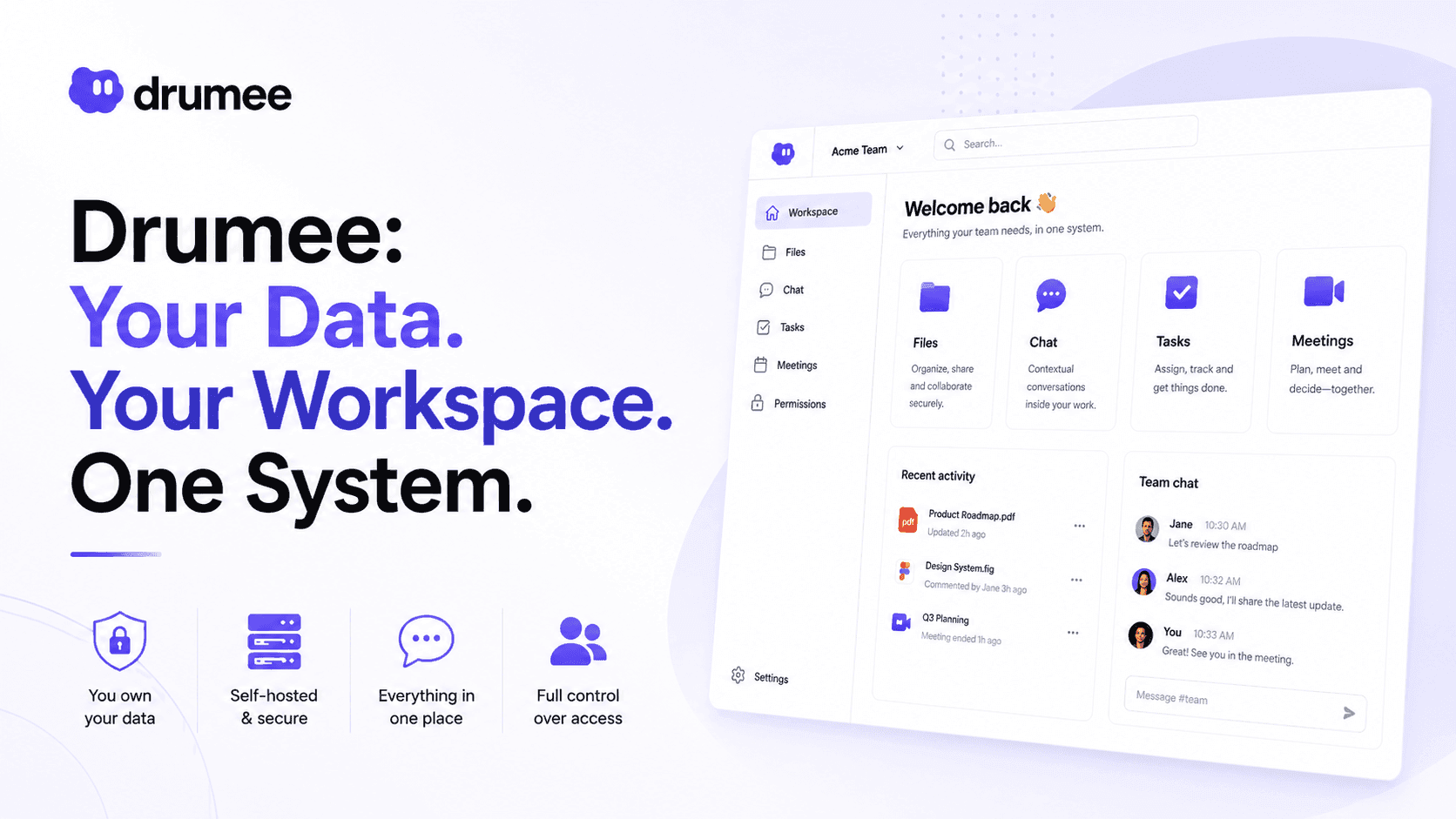
Drumee: Your Data. Your Workspace. One System
Drumee is a self-hosted, sovereign data workspace where files, chat, tasks, and permissions live in one place on infrastructure you own. Learn what Drumee is, what it stands for, and how to get started.
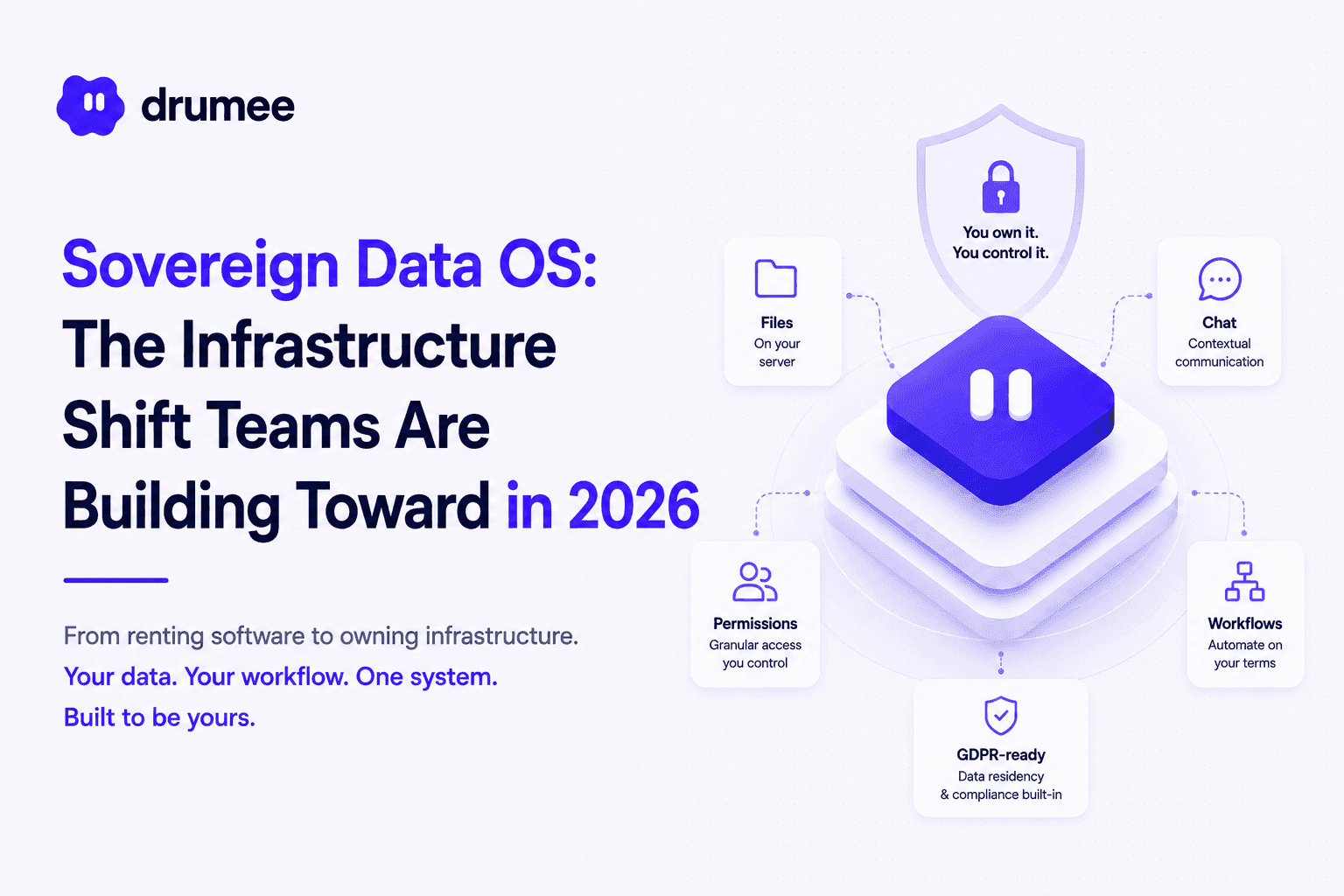
What Is a Sovereign Data OS? The Infrastructure Shift Teams Are Building Toward in 2026
What is a sovereign data OS? Learn how Drumee's unified self-hosted infrastructure replaces fragmented SaaS stacks with a single governable environment for files, chat, permissions, and workflows in 2026.
Data Ownership: What It Means and How to Achieve It in 2026
What is data ownership and how do you actually achieve it? Learn the three layers of data control, why AI changes the stakes, and how self-hosted infrastructure gives teams genuine ownership in 2026.