
ownCloud Alternative: 5 Options for Teams After Kiteworks and OpenCloud (2026)
If your team still runs ownCloud, the last three years have handed you a lot of news to process. Kiteworks announced it was buying ownCloud in November 2023. Many of the developers behind ownCloud Infinite Scale left in early 2025 and started a fo...
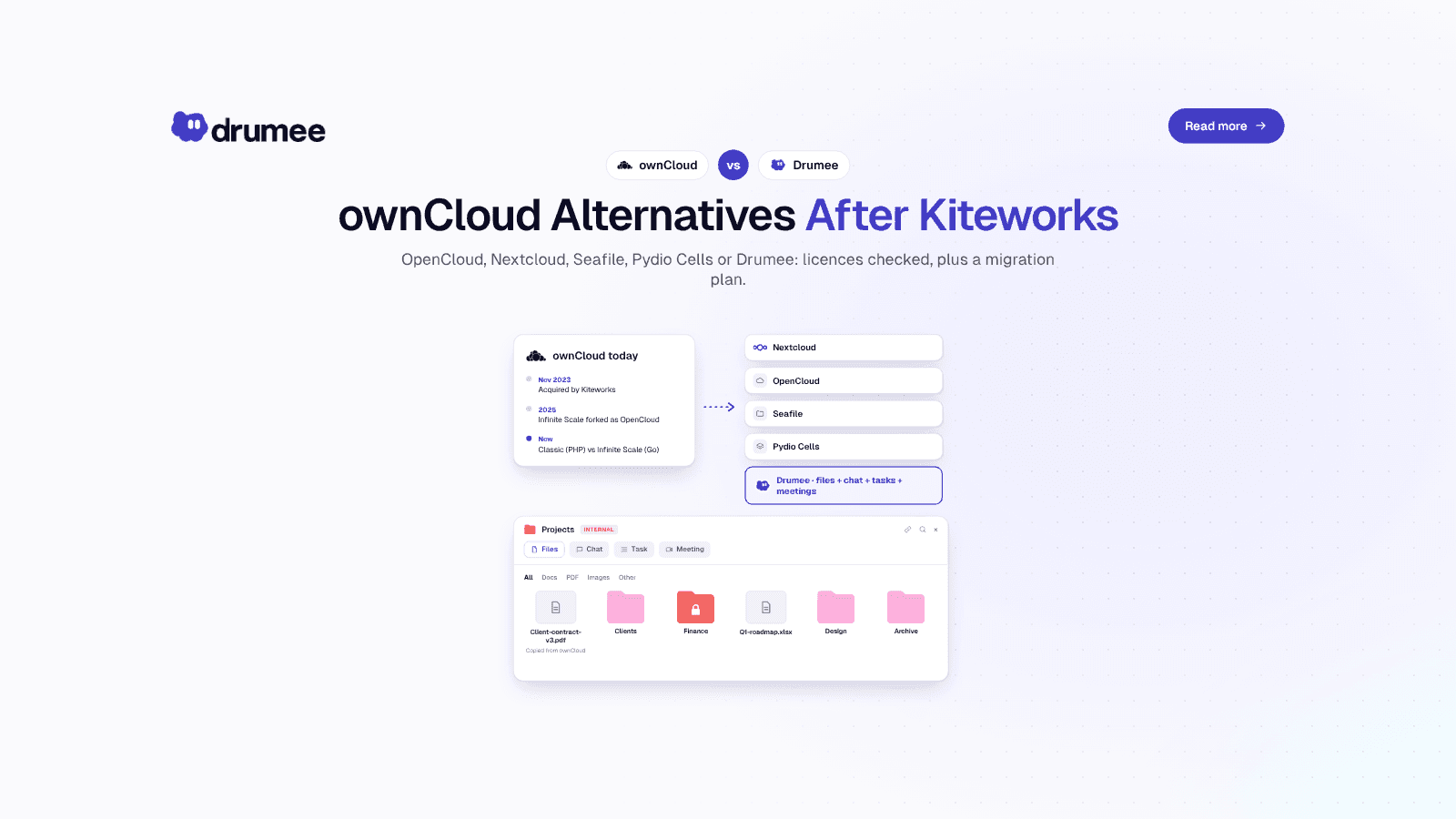
ownCloud alternatives compared for 2026: OpenCloud, Nextcloud, Seafile and Pydio Cells replace the file server, Drumee replaces the file server plus chat…
If your team still runs ownCloud, the last three years have handed you a lot of news to process. Kiteworks announced it was buying ownCloud in November 2023. Many of the developers behind ownCloud Infinite Scale left in early 2025 and started a fork called OpenCloud. And the PHP-based ownCloud Classic line has been through an end-of-life notice, a PHP 8.3 rebuild and a new major version.
None of that means ownCloud has stopped working. It does mean the question "are we staying?" is now on the agenda for many IT leads, and it deserves a sober answer rather than a panic migration. This guide is written for the people who have to answer it: CTOs, sysadmins and ops leads at small and mid-sized teams, most of them in the EU.
We cover where ownCloud Classic and ownCloud Infinite Scale stand today, five realistic ownCloud alternatives with their licences, a migration checklist, and a fair verdict. If you are coming from Nextcloud rather than ownCloud, our separate guide to Nextcloud alternatives in 2026 is the better starting point.
What are the best ownCloud alternatives?
The best ownCloud alternatives in 2026 are OpenCloud (the Infinite Scale fork, Apache 2.0), Nextcloud (AGPLv3, the broadest suite), Seafile (AGPLv3 community server, efficient block-level sync), Pydio Cells (AGPLv3, compliance-focused) and Drumee (AGPLv3, files plus chat, tasks and meetings). Pick by what you need to replace: a file server, or a whole workspace.
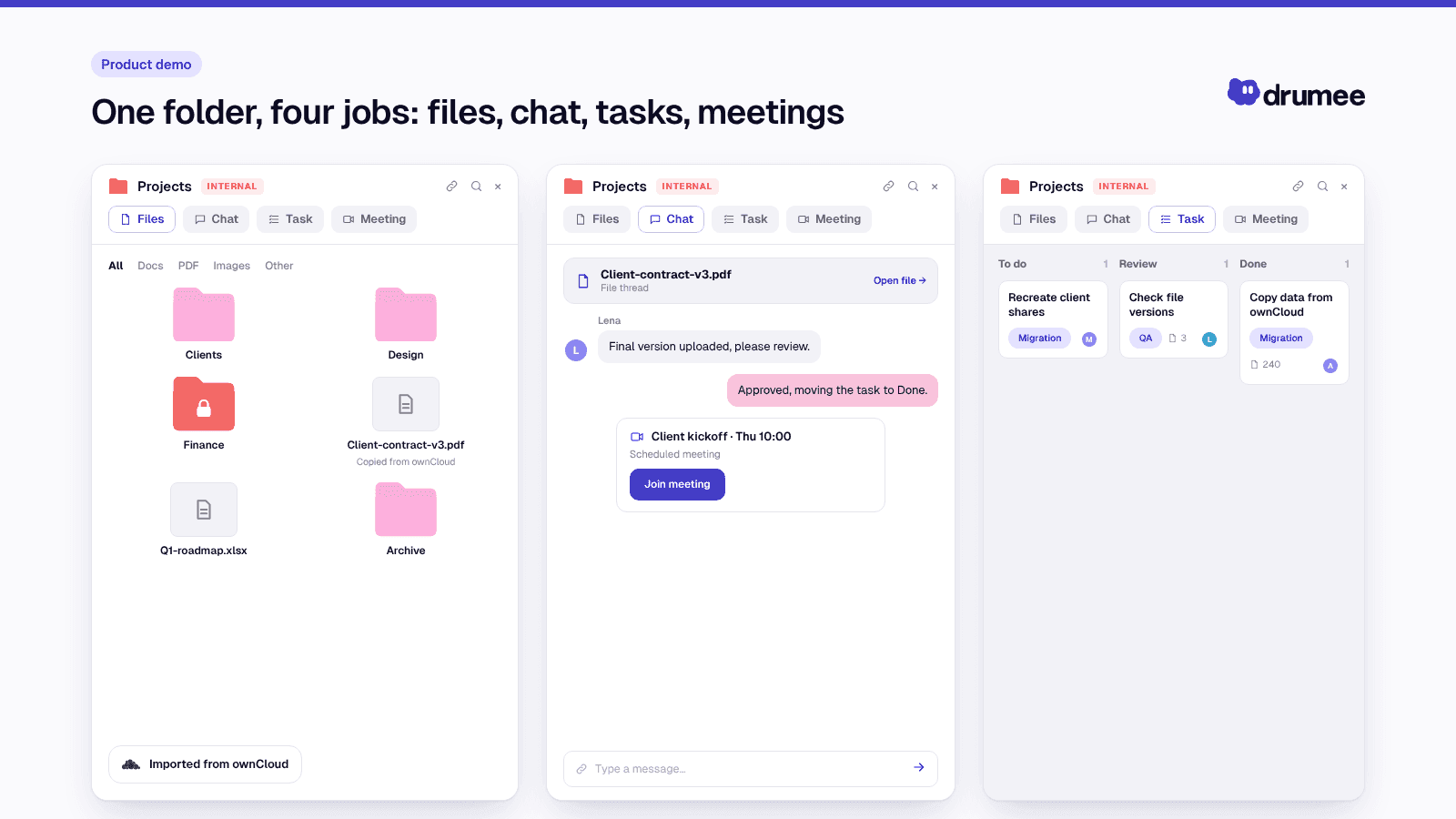
One folder, four jobs: files, chat, tasks and meetings in a Drumee workspace.
Nextcloud vs ownCloud: what's the difference?
Nextcloud forked from ownCloud in 2016 and kept growing the PHP codebase into a full suite: files, Talk chat and calls, groupware, office and kanban, under AGPLv3. ownCloud kept a files focus, rewrote its server in Go as Infinite Scale under Apache 2.0, and has belonged to US-based Kiteworks since the 2023 acquisition.
That is the short version. The longer version matters because it decides which migration path is easiest for you. Nextcloud was founded by ownCloud's own founder, Frank Karlitschek, as Heise reports, and it still shares ancestry with ownCloud 10. That shared history is why Nextcloud publishes an official guide to migrating from ownCloud.
ownCloud Infinite Scale (oCIS) is a different animal. It is a ground-up rewrite in Go that stores metadata without a traditional database, and it is the codebase OpenCloud forked. So if you run oCIS, OpenCloud is your closest relative. If you run Classic, Nextcloud is.
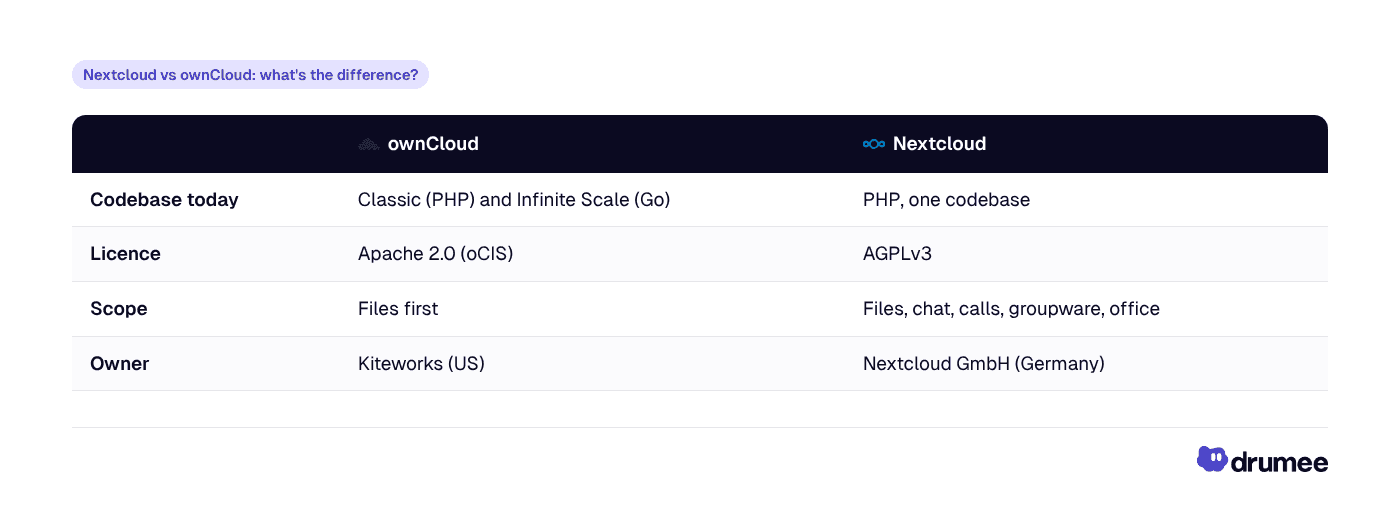
ownCloud and Nextcloud share a 2016 origin but have diverged in codebase, licence, scope and ownership.
Why teams are asking where to go next
Three events, in order, explain why "ownCloud alternative" has become a common search for teams that were happy with ownCloud for years.
November 2023: Kiteworks buys ownCloud
Kiteworks announced a definitive agreement to merge with ownCloud and the German file-sharing company DRACOON in November 2023, as part of three acquisitions in as many weeks. ownCloud confirmed the move on its own site in a post titled ownCloud becomes part of Kiteworks, and AlternativeTo covered the deal alongside the UK's Maytech. Financial terms were not disclosed.
ownCloud said at the time that its open source position would remain the same. For many customers the product did keep working. The change that mattered was ownership: a German open source vendor became part of a US-headquartered secure content company. For EU teams that chose ownCloud partly because it kept their file platform out of US corporate reach, that is a material change to their risk assessment, not a cosmetic one.
January 2025: the Infinite Scale team forks OpenCloud
In January 2025, the Berlin-based Heinlein Group announced that former ownCloud Infinite Scale developers would continue the oCIS codebase as OpenCloud, under OpenCloud GmbH, founded in September 2024. Heise reported that Kiteworks threatened legal action, even though oCIS is open source. ownCloud's own blog later acknowledged the situation in a post about forking twice, getting acquired and shipping anyway.
The practical effect is that the Go codebase now has two maintainers: ownCloud under Kiteworks, and OpenCloud under Heinlein, which also runs mailbox.org and OpenTalk according to OpenCloud's founding announcement.
2025–2026: ownCloud Classic's support timeline
The PHP line, ownCloud 10, is where most long-time installations still sit. A Kiteworks customer mailing stated that ownCloud 10.14 and earlier versions would reach end-of-life on 31 December 2025, cited PHP 7.4's limited remaining updates as a reason for rising maintenance cost, and offered customers a Kiteworks licence at renewal with a migration tool.
Then ownCloud changed course for Classic. It shipped a first release candidate for ownCloud Server 11, and the tagged 11.0.0 release in July 2026 requires PHP 8.3 or newer. ownCloud framed this as keeping Classic secure while customers plan a migration, not as a new feature roadmap. The ownCloud admin manual notes that Classic 11 ships only as a Docker image that bundles PHP 8.
The ownCloud Classic vs Infinite Scale situation, in plain terms
This is the decision most ownCloud admins actually face, and it comes before any vendor shortlist. Here is where each line stands as of November 2026.
ownCloud Classic (10.x / 11.x). Mature, PHP-based, familiar to every ownCloud admin. It is in maintenance mode: version 11 moves it onto PHP 8.3 so it can stay patched, but ownCloud has said it is not building major new features on Classic. Staying on it buys time. It does not buy a long-term roadmap.
ownCloud Infinite Scale (oCIS). Modern Go architecture, no external database for metadata, Spaces for team folders, and an Apache 2.0 licence. ownCloud has been consolidating its web UI and oCIS into one codebase. It is the actively developed product, but many of the developers who built it left in 2025, and the Classic-to-oCIS migrator was still described as in the pipeline in ownCloud's spring 2026 posts.
The trap. Moving Classic to oCIS is itself a migration: new architecture, new storage layout, new admin model. If you are going to migrate anyway, it is worth asking whether oCIS under Kiteworks is the destination you would choose from a blank sheet. For some teams the answer is yes. For others, the same effort gets them to OpenCloud, Nextcloud or a wider workspace.
Should we stay on ownCloud? Staying is reasonable if your contract, compliance assessment and roadmap are all comfortable with Kiteworks ownership, and you have a funded plan to leave Classic. It is risky if you are on ownCloud 10 with PHP 7.4, have no migration budget, or need a non-US ownership chain for sovereignty reasons.
Several large European institutions have already made their call. The German university service Sciebo reported in March 2025 that it was migrating roughly 230,000 users across about 45 instances from ownCloud 10 to Nextcloud, and the University of Göttingen announced it would take its ownCloud systems offline in favour of a sync and share service built on Nextcloud.
How we evaluated these ownCloud alternatives
We looked at each option from the seat of an ownCloud admin, not a greenfield buyer. Five criteria:
- Licence and ownership. What licence the server ships under, who controls the roadmap and which jurisdiction the owner sits in.
- Migration distance. How close the product is to your current ownCloud line, and whether there is documented tooling.
- Scope. Does it replace only the file server, or also the chat, tasks and meetings that usually live in other tools?
- Operations. What it takes to run, back up and upgrade.
- Sovereignty and GDPR. Whether you can run it on infrastructure you control, so no third-party processor touches the data.
We verified licences and company facts against at least two sources each and give no prices for third-party products. Vendor pricing changes often and is frequently quote-based, so check each vendor's own page.
ownCloud alternatives at a glance
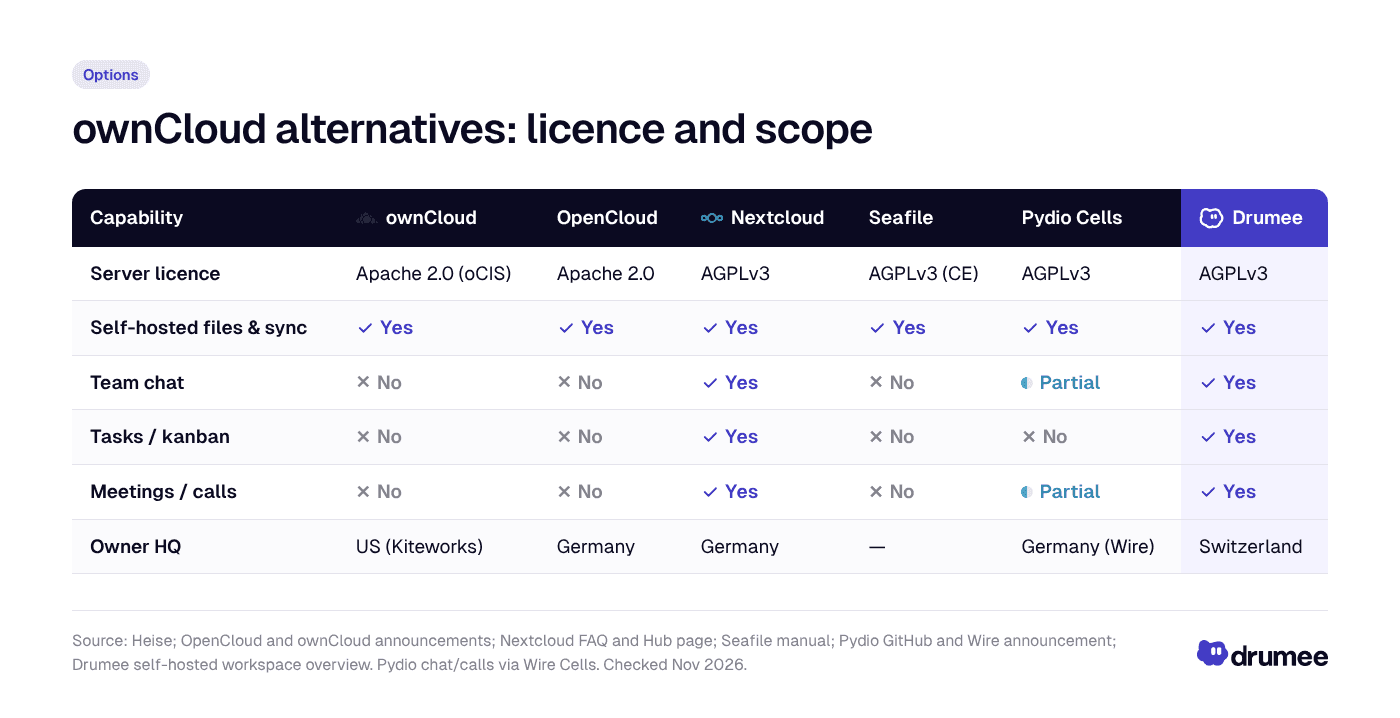
OpenCloud, Seafile and Pydio Cells replace the file server; Nextcloud and Drumee also replace the chat, task and meeting tools around it.
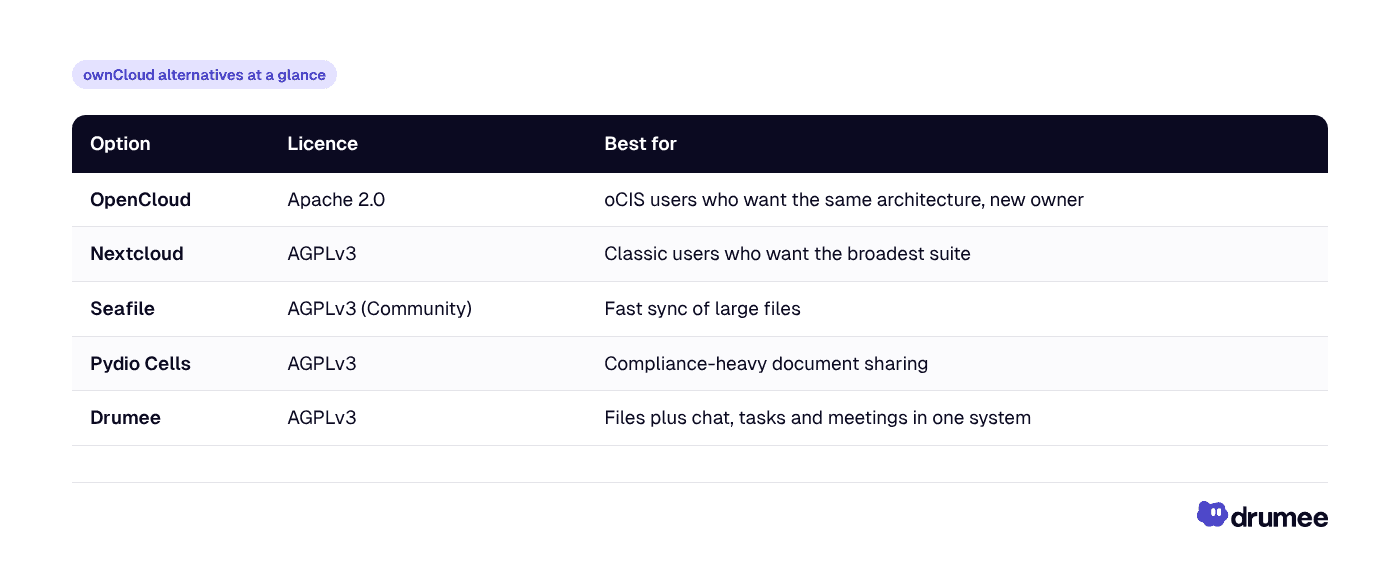
Licences as published by each project; check each repository's LICENSE file before deploying.
1. OpenCloud: the closest path for Infinite Scale users
What it is. OpenCloud is the continuation of the ownCloud Infinite Scale codebase by many of the developers who wrote it. It is developed by OpenCloud GmbH, part of Berlin's Heinlein Group, and launched publicly in January 2025, per Heise and OpenCloud's announcement.
Licence. The OpenCloud server is released under Apache 2.0, the same licence as upstream oCIS. Some components, such as the web front end and desktop client, carry other open source licences, so check each repository.
What stands out. OpenCloud 2.0, released in March 2025, introduced what the company calls "File Native Backup". Metadata is not kept in a database, so a single snapshot or file copy produces a consistent backup, according to OpenCloud's release announcement and Heise's coverage. The same release started paid enterprise support, with deployment in your own data centre or through partners.
Strengths. Shortest conceptual migration for oCIS users, German ownership, lean operations, a straightforward backup story and a permissive licence.
Trade-offs. It is a young company and a young brand, so the partner and app ecosystem is smaller than Nextcloud's. Like ownCloud, it is a file platform: chat, tasks and meetings still need other tools. If you run Classic rather than oCIS, moving to OpenCloud is a full migration, not an upgrade.
2. Nextcloud: the broadest suite, and the natural home for Classic users
What it is. Nextcloud is the 2016 fork of ownCloud, built by Nextcloud GmbH in Stuttgart. Nextcloud Hub bundles Files, Talk (chat and calls), Groupware (mail, calendar, contacts and the Deck kanban app), Office and Assistant, as described on the Nextcloud Hub page and by Heise.
Licence. Nextcloud and Nextcloud Enterprise are licensed under AGPLv3, according to Nextcloud's FAQ. Enterprise is a support subscription on the same code, priced per user per year. We do not quote a figure here; ask Nextcloud for current terms.
Migration from ownCloud. This is Nextcloud's big practical advantage for Classic users. The official migration guide maps ownCloud 10 releases to a specific Nextcloud "bridge" version, after which you upgrade one major version at a time. The version map changes between manual editions, so read the live page for your exact ownCloud release before you start, and back up config, database and data first.
Strengths. A large community, a mature product, an app store of around 600 apps, a documented path from ownCloud 10 and proven deployments at the scale of entire university systems.
Trade-offs. Breadth comes with weight. A full Hub deployment is a suite to run, tune and upgrade, and much of the collaboration experience depends on which apps you enable and how well they are maintained together. Teams that wanted ownCloud's narrower scope sometimes find Nextcloud more platform than they need. For a deeper look at those trade-offs, see our Nextcloud alternatives comparison.
3. Seafile: the performance choice for file sync
What it is. Seafile is a file sync and share platform built around libraries, block-level storage and deduplication. Only changed blocks travel during sync, which helps with large design, media and research files. Its built-in SeaDoc editor and wiki module cover lightweight notes and documentation, as described in Hetzner's Seafile overview.
Licence. Seafile's server manual lists the Community Edition server core as AGPLv3 and the Seahub web interface under Apache 2.0, with the desktop client under GPLv2. A Professional Edition adds features under a proprietary licence. Older sources that say "GPLv2" for the server are out of date.
What stands out. Encrypted libraries let users protect a library with a password before upload, so the server operator cannot read the content, per Seafile's feature page. That is a meaningful option for sensitive data. The trade-off is that a lost library password cannot be recovered and some server-side features, such as online editing and full-text search, are not available for encrypted libraries.
Strengths. Fast, efficient sync, lower resource use than a full suite, client-side encryption per library.
Trade-offs. Scope. Seafile is a file platform with light documents, not a team workspace. There is no official ownCloud migration path, so plan to move data by copying files and recreating shares.
4. Pydio Cells: compliance-first document sharing
What it is. Pydio Cells is a Go-based document sharing platform developed by Abstrium, a Paris company founded in 2012. It organises content into workspaces and "cells", sandboxed shared spaces that users can open to colleagues and external partners, as described in Pydio's edition comparison.
Licence. The Cells source code on GitHub is AGPLv3, confirmed by Wikipedia's entry. A free Cells Home distribution sits alongside a commercially licensed Enterprise distribution, and features such as exportable audit logs and share auditing are listed for the paid tiers.
Ownership change. Pydio has its own acquisition story. In January 2025 the Berlin-based secure messenger Wire announced it had acquired Pydio, with plans to combine messaging, video calls and document collaboration as Wire Cells, as also reported by FinSMEs. If you evaluate Pydio, ask how the standalone Cells product and the Wire Cells offer relate today.
Strengths. Granular permissions, governance features aimed at regulated industries, a modern Go architecture and a European owner.
Trade-offs. Smaller community than Nextcloud, key compliance features sit in the paid edition, and its roadmap is now tied to Wire's product strategy. No official ownCloud migration path.
5. Drumee: the full-workflow option
What it is. Every option above replaces the ownCloud file server. Drumee replaces the file server and the tools that usually sit next to it. A shared folder in Drumee holds the files, the conversations about them, the tasks connected to them, meeting scheduling and access controls, as described in our overview of the Drumee self-hosted workspace.
Licence and deployment. Drumee is open source under AGPLv3, per that same overview. You can run it two ways:
- Drumee-hosted managed plans (Free → Pro → Team → Business), for teams that do not want to run servers.
- Sovereign Node, fully self-hosted on your own infrastructure with full SDK access. See what a Drumee Sovereign Node includes.
What it covers. Self-hosted files with share links and version history, team chat, ad-hoc and scheduled meetings, guest access, task boards and lists, an admin panel, audit logs, SSO/SAML and API access on the higher plans.
Cost, as published. Drumee's managed plans run from $0 (Free, up to 3 users) to $29/month flat for up to 10 users (Team) and $99/month for unlimited users (Business), as of November 2026; yearly billing saves 50%. Sovereign Node pricing is on request. Check the Drumee pricing page for current terms.
Strengths. One system and one audit trail for files, chat, tasks and meetings, an AGPLv3 codebase, and a choice between managed and fully self-hosted deployment without changing products.
Where others win. Be clear-eyed. If all you need is a file server, OpenCloud or Seafile is lighter. If you depend on a large app ecosystem or a documented in-place path from ownCloud 10, Nextcloud is ahead. We cannot confirm an ownCloud-specific migrator for Drumee, so ask Drumee sales what import options and support are available for your data before you plan the move.
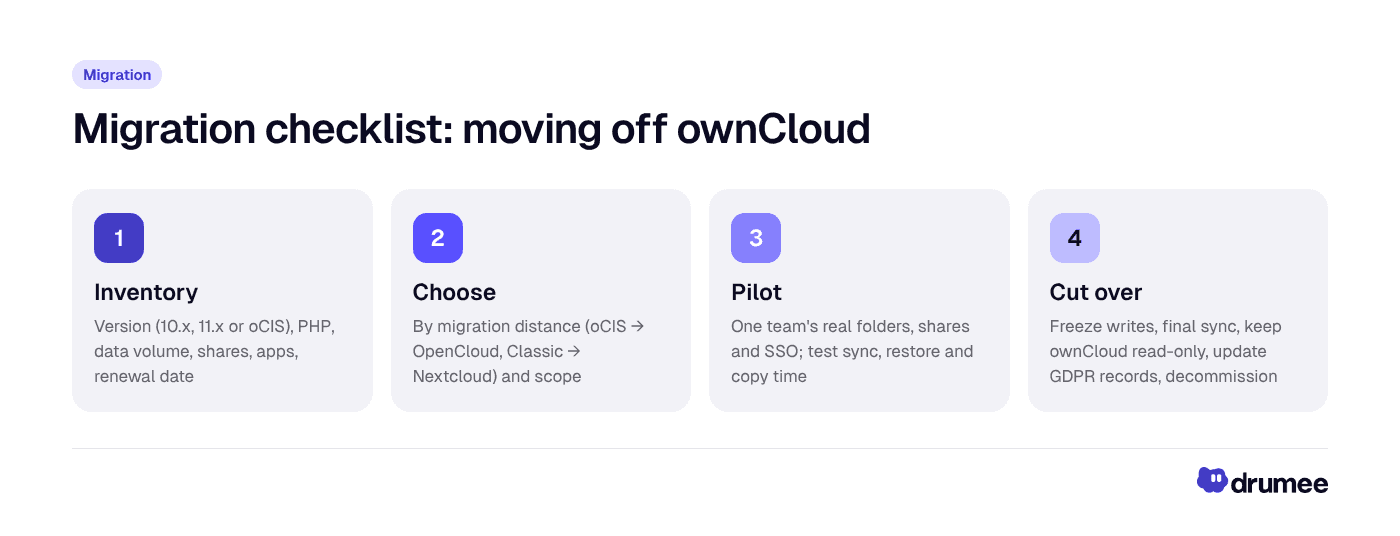
Four steps take a team from "are we staying?" to a clean cutover, whichever alternative it picks.
Migration checklist: moving off ownCloud
Whichever destination you choose, the work looks broadly the same. Use this checklist to plan it and to size the effort honestly.
Step 1: Inventory what you actually run
- Version and stack. Record your exact ownCloud version (10.x, 11.x or oCIS), PHP version, database and storage backend. This decides your migration options more than anything else.
- Data volume. Total storage, number of users, largest folders and file counts. Many small files migrate slower than a few large ones.
- Shares. Export a list of internal shares, public links and federated shares. Shares are the part of a migration users notice first when they break.
- Apps and integrations. List enabled apps (office editing, external storage, LDAP/AD, SSO) and anything that calls the ownCloud API or WebDAV.
- Contracts. Check your ownCloud or Kiteworks renewal date and any multi-year terms, which the Kiteworks mailing says are handled case by case.
Step 2: Choose by migration distance and scope
- On oCIS and happy with files-only? Evaluate OpenCloud first.
- On Classic and want the broadest suite? Evaluate Nextcloud and its bridge-version path.
- Need fast sync for big files? Evaluate Seafile.
- Compliance-heavy document sharing? Evaluate Pydio Cells.
- Want to retire the chat, task and meeting tools too? Evaluate Drumee.
Step 3: Pilot with real work
- Stand up the target on the infrastructure you plan to use in production, not a laptop.
- Move one team's real folders, recreate its shares and connect SSO.
- Test desktop and mobile sync, large-file uploads, version restore and a full backup-and-restore cycle.
- Time the data copy so you can extrapolate the cutover window.
Step 4: Cut over and decommission
- Freeze writes on ownCloud, run a final sync and switch DNS or client configuration.
- Keep ownCloud read-only for an agreed period so users can check nothing is missing.
- Update your GDPR record of processing activities and any data processing agreements.
- Wipe and decommission the old servers and backups according to your retention policy.
Rule of thumb: the file copy is rarely the hard part. Shares, links, SSO and the habits built around them are. Budget most of your effort for the pilot and the first two weeks after cutover.
Self-hosted means you run it: the operational picture
Every option in this guide can keep your data on infrastructure you control. That is the point, and it is also a commitment. Self-hosting moves responsibility for patching, backups, monitoring and upgrades to your team, which is exactly what many ownCloud admins already know well.
The difference between options is how much there is to run:
- OpenCloud and oCIS run without an external metadata database, which simplifies backups and restores.
- Seafile is comparatively light for a file platform, with its block store as the main thing to protect.
- Nextcloud runs as a PHP application with a database, cache and whichever apps you enable, and needs upgrading one major version at a time.
- Pydio Cells is a Go platform with its own services, with enterprise support available for the paid edition.
- Drumee can be self-hosted as a Sovereign Node or run as managed plans by Drumee, so a team without ops capacity can start managed and move in-house later. Ask Drumee sales for current Sovereign Node infrastructure requirements.
If your team is small and has no one who wants to own a server, that last point matters. The cost of self-hosting is mostly people's time, and an honest look at that time is part of a good migration plan. Our guide to avoiding SaaS vendor lock-in covers how to keep an exit open whichever model you pick.
The GDPR and sovereignty angle for EU teams
For EU teams, the ownership changes of 2023–2025 are a GDPR and sovereignty question, not only a product question.
Self-hosted software you run removes the vendor as a processor of your files. If ownCloud, OpenCloud, Nextcloud, Seafile, Pydio Cells or a Drumee Sovereign Node runs on servers you control, the software vendor does not process the files themselves. Your obligations, such as security, access control, retention and records of processing, stay with you.
Ownership still matters for support, updates and hosted offers. If you buy a hosted service, a support contract with remote access, or rely on a vendor's update channel, the vendor's jurisdiction becomes part of your assessment. That is where a US parent company such as Kiteworks can raise questions that a German or French owner may not. We are not saying any vendor mishandles data; we are saying the assessment changed, and you should redo it.
Scope matters too. Moving your files to a sovereign platform while client conversations stay in a US chat tool and project plans in a US task tool leaves most of your personal data where it was. That gap is why we argue for treating the workspace, not just the file store, as the unit of sovereignty, as explained in what a sovereign workspace is. For data-location rules specifically, see our plain-language guide to data residency requirements and our review of GDPR-compliant file storage for teams.
Verdict: which ownCloud alternative should you choose?
There is no single winner, and anyone who tells you otherwise is selling something. Here is how we would decide.
- Choose OpenCloud if you already run ownCloud Infinite Scale, like its architecture, and want the same codebase with German ownership and a permissive licence.
- Choose Nextcloud if you run ownCloud Classic and want the broadest open source suite, a documented migration path and the largest community.
- Choose Seafile if fast, efficient file sync is the job, especially for large files, and you do not need a wider workspace.
- Choose Pydio Cells if compliance-grade document sharing with granular permissions is the priority and you are comfortable with its paid-edition features and Wire ownership.
- Choose Drumee if leaving ownCloud is your chance to stop stitching together files, chat, tasks and meetings from different vendors, and you want one AGPLv3 system you can run managed or self-hosted.
Best like-for-like replacement: OpenCloud for oCIS, Nextcloud for Classic. Best for raw sync: Seafile. Best for governed sharing: Pydio Cells. Best for replacing the whole stack around your files: Drumee.
FAQ
What are the best ownCloud alternatives?
The five strongest options in 2026 are OpenCloud, Nextcloud, Seafile, Pydio Cells and Drumee. OpenCloud and Nextcloud are the closest relatives of ownCloud's two codebases. Seafile stands out for efficient sync, Pydio Cells on governed sharing, and Drumee on covering files, chat, tasks and meetings in one self-hosted system.
Nextcloud vs ownCloud: what's the difference?
Nextcloud forked from ownCloud in 2016 and grew into a full AGPLv3 suite with files, chat, calls, groupware and office. ownCloud stayed files-first, rewrote its server in Go as Infinite Scale under Apache 2.0, and has been owned by US-based Kiteworks since the deal announced in November 2023.
What is OpenCloud?
OpenCloud is a fork of ownCloud Infinite Scale, continued by former oCIS developers at OpenCloud GmbH, part of Berlin's Heinlein Group. It launched publicly in January 2025, ships its server under Apache 2.0 and stores metadata without a database, so backups can be taken by copying files or snapshots.
Is ownCloud Classic end of life?
Not entirely. Kiteworks told customers that ownCloud 10.14 and earlier would reach end-of-life on 31 December 2025. ownCloud then released ownCloud Server 11, which requires PHP 8.3, to keep Classic secure while customers migrate. It is in maintenance mode, without a major feature roadmap.
What is the best ownCloud Infinite Scale alternative?
OpenCloud is the closest, because it is the same codebase maintained by many of its original developers. If you want more than a file platform, Nextcloud adds chat, calls and groupware, and Drumee adds chat, tasks and meetings in one AGPLv3 workspace you can run yourself.
Can I migrate from ownCloud to Nextcloud directly?
From ownCloud 10, yes, through a documented "bridge" Nextcloud version, followed by one-major-version-at-a-time upgrades. Check the live Nextcloud migration guide for your exact ownCloud release. From Infinite Scale there is no in-place path, so plan a data copy and recreate shares.
Conclusion: leave for a destination, not just away from a vendor
The Kiteworks acquisition and the OpenCloud fork did not break ownCloud overnight. They did end the assumption that ownCloud would always be a German open source file platform with a clear roadmap. That makes now a good moment to decide deliberately rather than wait for a renewal letter to decide for you.
If you only need a file server, OpenCloud, Nextcloud, Seafile and Pydio Cells are all credible, and the right one depends mostly on which ownCloud you run today. If the migration is also a chance to stop paying for and governing separate chat, task and meeting tools, put all of it under your control in one place: cost, control and sovereignty together.
Next step: compare Drumee's managed plans and the Sovereign Node on the Drumee pricing page, then pilot one team's folders, chat and tasks in a single workspace before you commit.
Keep reading
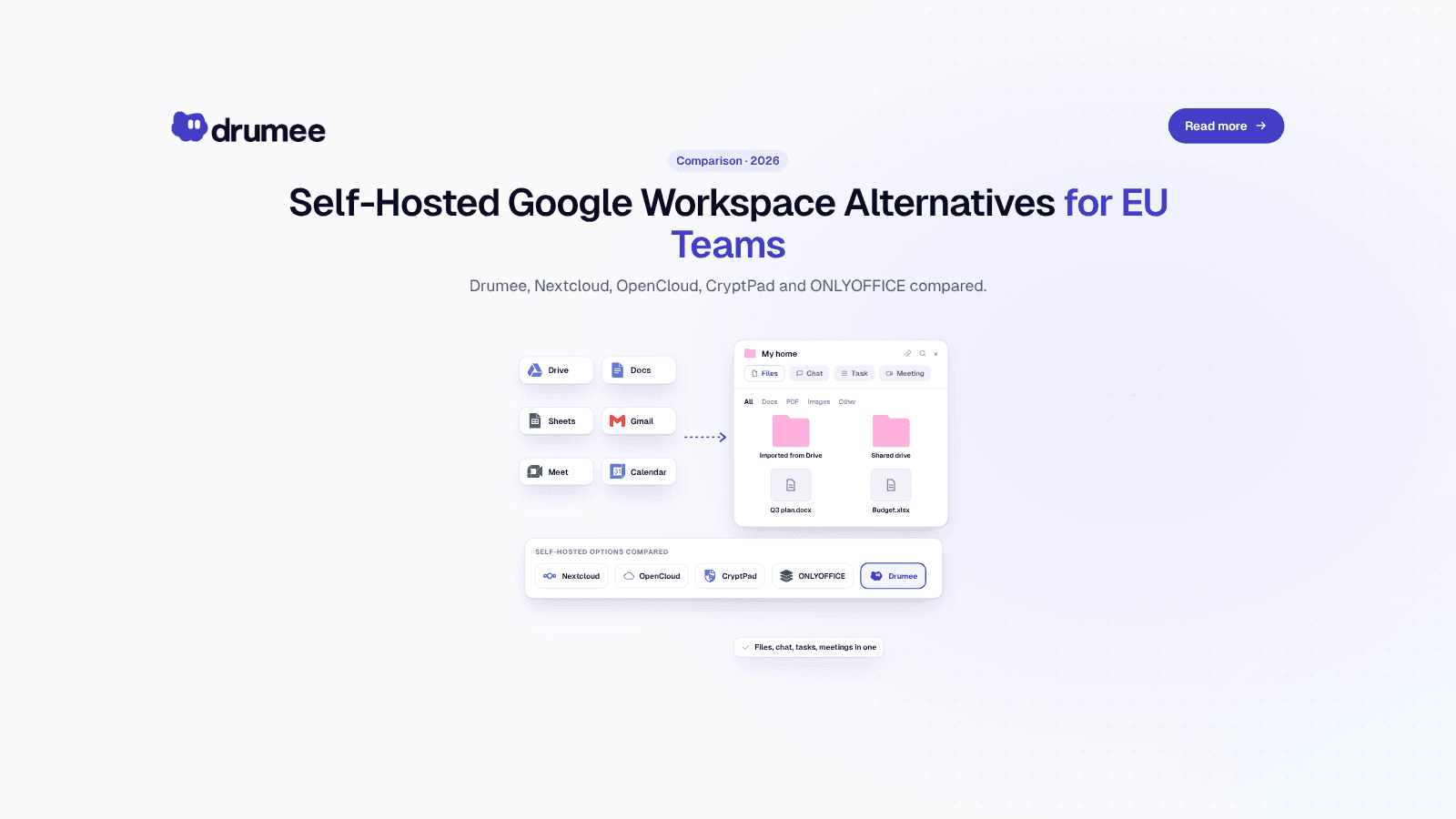
Self-Hosted Alternatives to Google Workspace: 2026 Guide for EU Teams
Google Workspace is the default office stack for most European startups. It is also a US-controlled service whose list price went up in January 2025, whose data sits under US legal reach, and whose exit path takes days of admin work. For a growing...
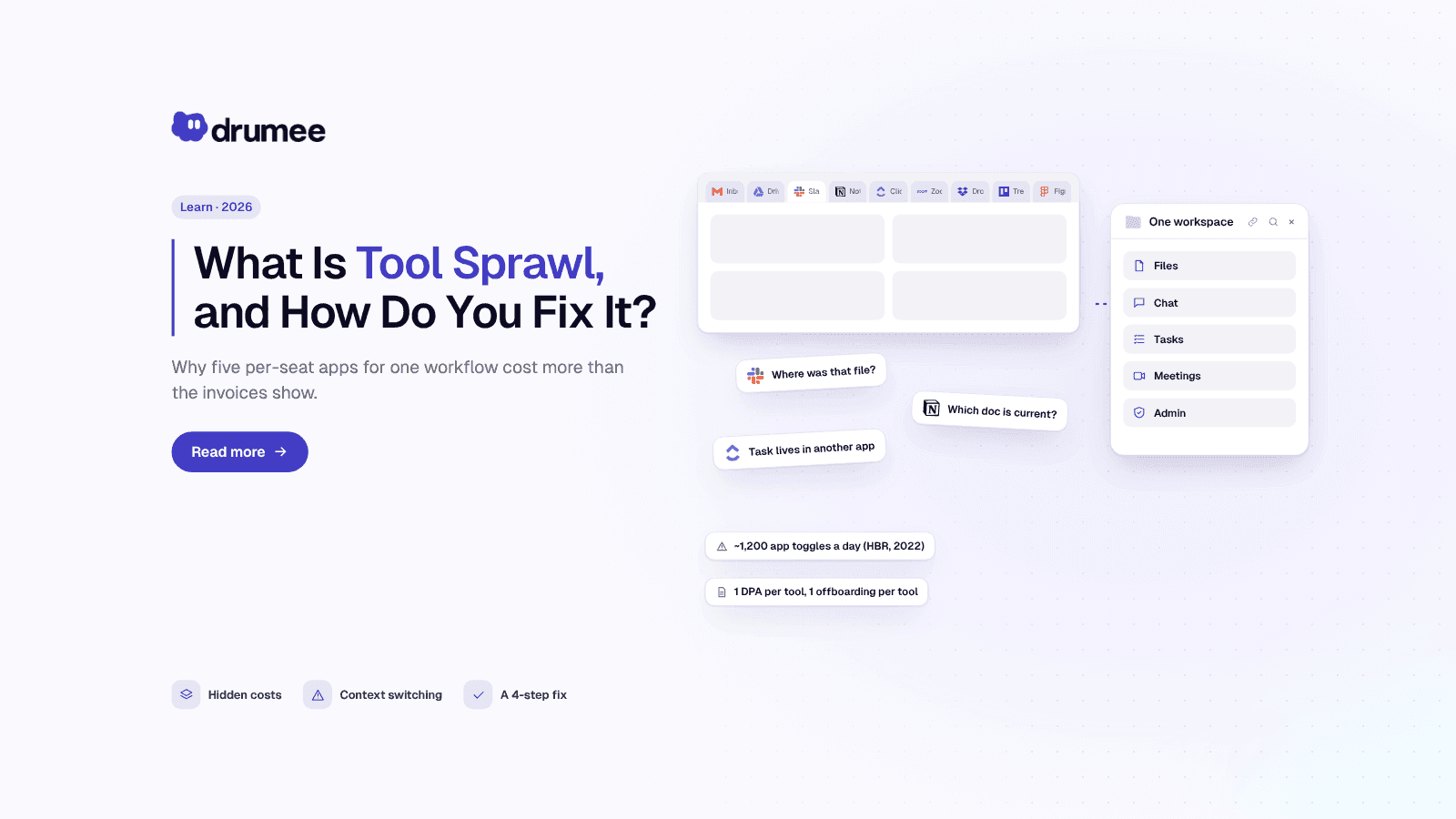
What Is Tool Sprawl and How to Fix It in 2026
Nobody decides to build a messy stack. A startup adds Slack on day one, Google Drive on day two, Notion when the wiki gets real and ClickUp when the roadmap stops fitting in a spreadsheet. Two years later, a simple question like "where did we deci...
Self-Hosted vs SaaS: What Every Startup Should Know Before Choosing
Every startup makes the self-hosted vs SaaS decision, usually without noticing. The first tool someone signs up for with a company card becomes the default, and three years later the team is renting a dozen per-seat products it never consciously c...