
Best Self-Hosted Project Management Tools in 2026
Project data is some of the most sensitive data a team creates. Roadmaps, client deadlines, bug reports with customer details, hiring plans: all of it lives in the task tool. When that tool is a hosted service, it lives on a vendor's servers, unde...
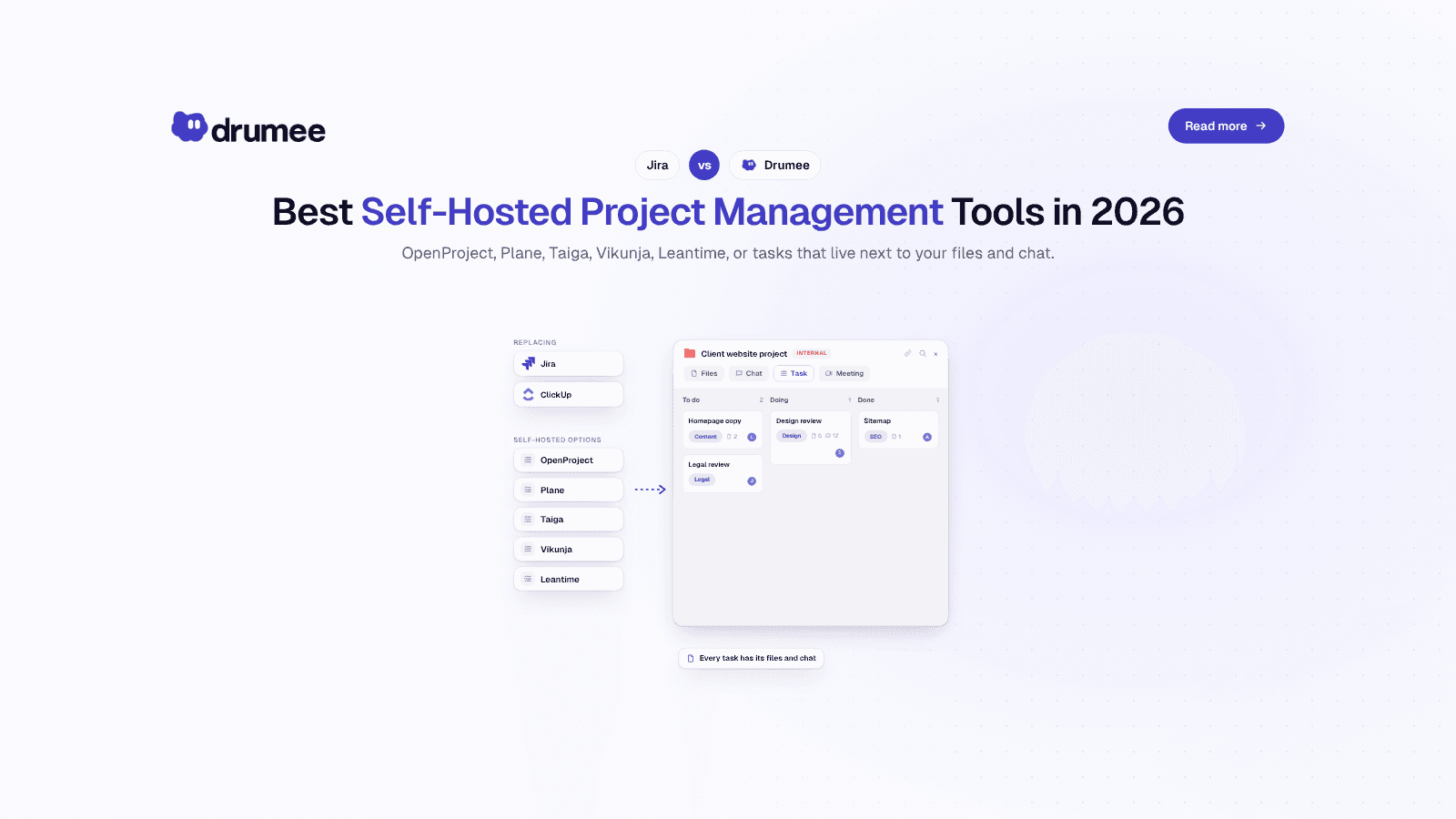
Self-hosted project management tools compared: OpenProject, Plane, Taiga, Vikunja and Leantime go deeper on project management, Drumee keeps tasks next to…
Project data is some of the most sensitive data a team creates. Roadmaps, client deadlines, bug reports with customer details, hiring plans: all of it lives in the task tool. When that tool is a hosted service, it lives on a vendor's servers, under the vendor's terms and on the vendor's upgrade schedule.
Self-hosted project management moves that data onto infrastructure you control. The open source field is strong in 2026. OpenProject, Plane, Taiga, Vikunja, Leantime and Redmine all run on your own servers, and Atlassian's retreat from on-premise Jira has pushed many teams to look at them seriously.
This guide is for founders, CTOs and ops leads at teams of 5–50 people. We checked each tool's licence, self-host method, standout features, real limits and 2026 maintenance status against at least two sources. We also explain where Drumee fits: it is not a dedicated PM tool, but a sovereign workspace where a task board and list sit next to files, chat and meetings. Dedicated PM tools go deeper on Gantt charts, sprints and integrations, and we say so throughout.
What is the best self-hosted project management tool?
The best self-hosted project management tool depends on how you plan work. OpenProject suits classic, Gantt-driven projects; Plane suits agile software teams; Leantime suits non-specialist teams; Vikunja suits lightweight task lists. If your tasks need files, chat and meetings in the same self-hosted system, Drumee is the better fit.
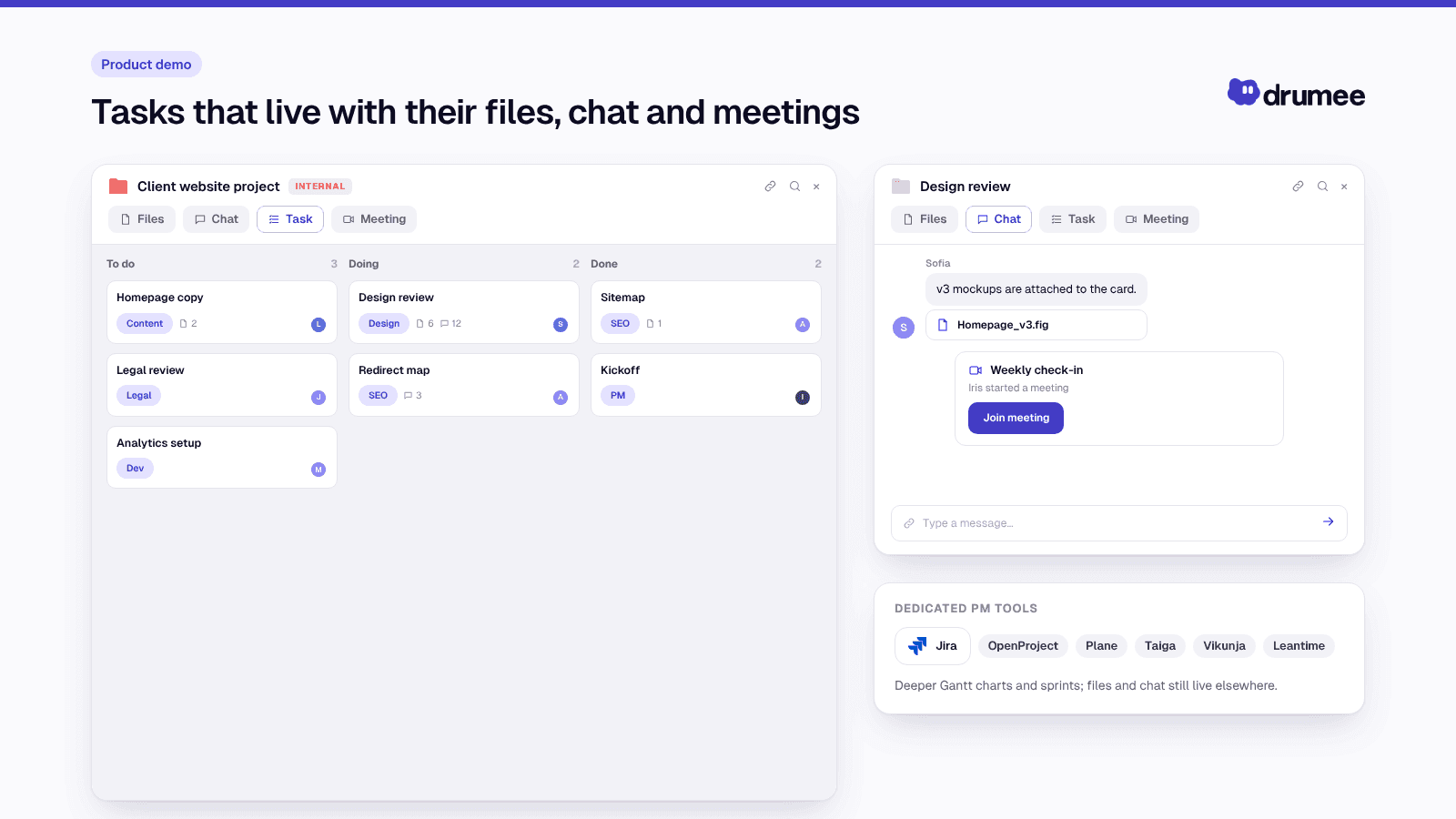
Tasks that live with the work: a Drumee task board with files, chat and meetings in one place.
Is there an open source alternative to Jira or ClickUp?
Yes. Plane is the closest open source match for Jira's issue tracking, OpenProject covers Jira-style work packages plus Gantt charts, and Taiga covers Scrum and Kanban. ClickUp has no self-hosted edition, so teams wanting its scope usually pair an open source PM tool with chat and file tools, or choose a workspace like Drumee.
We compared Drumee and ClickUp head to head, including per-seat cost math, in our Drumee vs ClickUp comparison. This page goes wider: it covers the dedicated open source PM tools in depth and helps you decide whether you need one of them, a workspace, or both.
Why teams want self-hosted project management in 2026
Three pressures push teams toward self-hosting their project tool. None of them is new, but all of them got sharper this year.
- On-premise Jira is ending. Atlassian ended support for its Server products on 15 February 2024, and its Data Center end-of-life page sets 28 March 2029 as the date impacted Data Center products reach end of life. Teams that kept Jira on their own servers for control now have a fixed deadline to pick a cloud plan or a self-hosted alternative.
- Data control and GDPR. Task tickets carry personal data: customer names in bug reports, candidate notes in hiring boards, client details in project plans. A hosted PM tool is a processor you have to list, contract with and audit.
- Vendor dependence. Plan limits, feature tiers and export formats change on the vendor's schedule. Self-hosting does not remove change, but it puts upgrades and data exports under your control.
There is a fourth, quieter driver: tool sprawl. The PM tool is rarely alone. Tasks reference files in a drive, decisions happen in chat, and status updates happen in meetings. Our explainer on what tool sprawl is and how to fix it covers that wider pattern, and it shapes the last part of this comparison.
How we evaluated the tools
We used the same five questions for every option and checked each answer against at least two sources, preferring vendor documentation, official repositories and changelogs. Where sources conflicted, we say so or leave the claim out.
- Licence. Which open source licence covers the self-hosted edition, and are features held back in a paid edition?
- Self-host method. How do you deploy it: Docker Compose, a single binary, OS packages, or Kubernetes?
- Standout features. What does it do better than the others?
- Notable limits. What will a growing team run into?
- Maintenance in 2026. Has the project shipped releases this year, and who maintains it?
We do not quote prices for the open source tools' paid tiers. They change often, several are per-user and some are quote-based. Check each vendor's pricing page directly.
Self-hosted project management tools at a glance
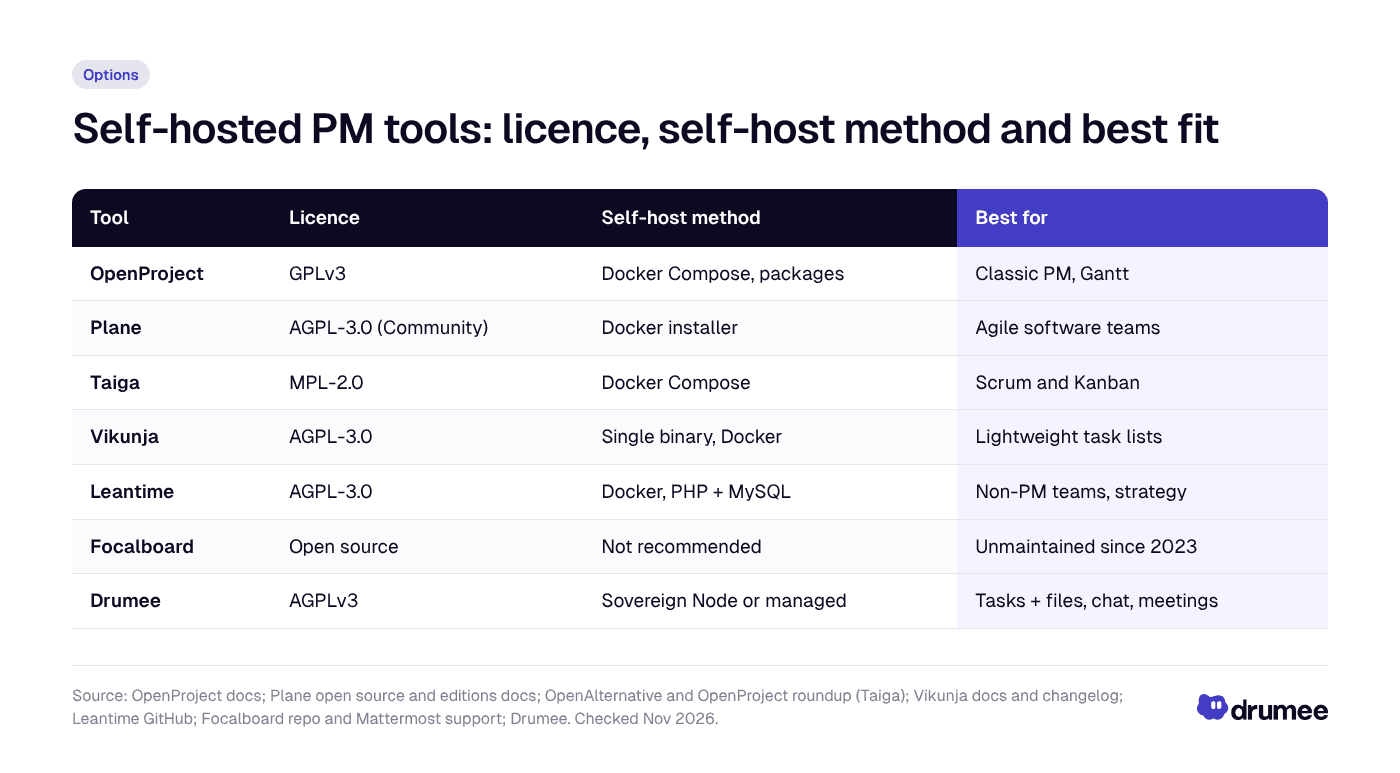
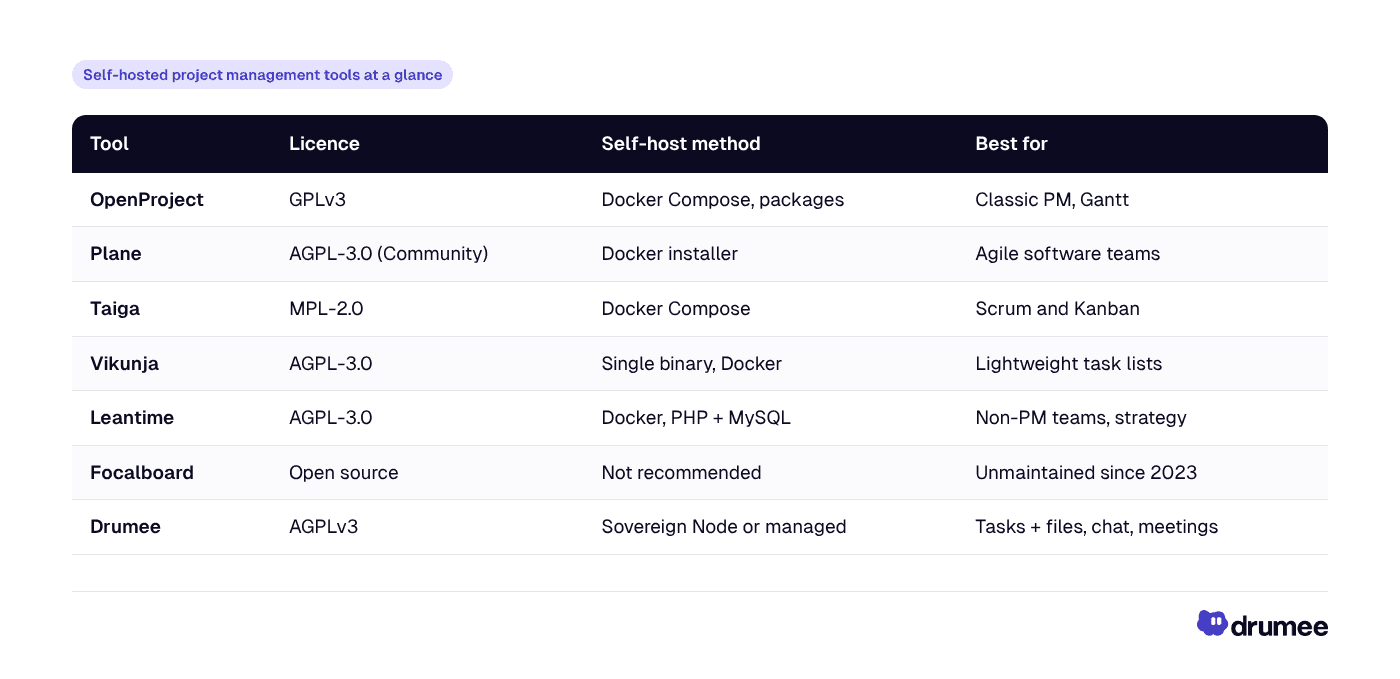
Five dedicated PM tools are actively maintained in 2026; Focalboard is not, and Drumee is the only option that adds files, chat and meetings to tasks.
OpenProject: best for classic, Gantt-driven project management
OpenProject is the most complete traditional project management suite in the open source field. It is licensed under GPLv3, as WZ-IT's comparison of OpenProject, Plane and Vikunja and OpenProject's own materials confirm, and the free Community edition runs on your own servers.
Self-host method. OpenProject publishes Docker images and documents a Docker Compose setup for production. Its Docker installation guide also offers an all-in-one container, but warns it is not recommended for production because it makes upgrading components such as the database harder. Linux packages are available too.
Standout features.
- Gantt charts, work packages, Kanban boards and time tracking in the free Community edition.
- Role-based permissions granular enough for multi-team portfolios.
- A familiar model for teams leaving Jira or MS Project, with work packages that map to issues and tasks.
Notable limits. Some identity and admin features sit in the Enterprise edition, unlocked by a licence key on the same codebase. Reviews disagree on the exact split, but SAML single sign-on, LDAP group sync and two-factor options are commonly listed as Enterprise features, so check OpenProject's current edition comparison before you plan your SSO. The interface is dense, which suits PMOs better than small product teams.
Maintenance in 2026. Active. OpenProject is developed by a commercial company with a regular release cadence, and third-party install guides from March 2026 deploy the 17.x release line.
Choose OpenProject if you run classic projects with dependencies, baselines and Gantt timelines, or you are replacing Jira Data Center or MS Project and need a structured, permission-heavy tool.
Plane: best self-hosted Jira alternative for agile software teams
Plane is a modern issue tracker in the style of Jira and Linear. Its Community Edition is free and self-hostable under AGPL-3.0, with no user limit, according to Plane's open source page and its editions documentation, which lists Community, Commercial and Airgapped self-hosted editions.
Self-host method. Plane ships an installer script and a Docker stack that includes the Plane app, PostgreSQL, Redis and MinIO for file storage. Railway and the DigitalOcean Marketplace offer one-click Community Edition templates.
Standout features.
- Cycles (sprints), modules, intake, estimates and pages in the Community Edition.
- Several layouts over the same issues: list, board, spreadsheet, calendar and Gantt-style timeline.
- A fast, keyboard-friendly interface that developers tend to like.
Notable limits. The open source Community Edition and the proprietary Commercial edition differ. Plane's own Plane vs OpenProject comparison says its Jira importer is available on Plane Cloud and the self-hosted Commercial plans, not the Community Edition. Third-party reviews also place features like advanced automations and SSO in paid editions, so confirm the current boundary on Plane's pricing page. Plan for a multi-container stack, not a single service.
Maintenance in 2026. Very active, with frequent releases throughout 2026. Version numbering differs between Plane's blog and third-party trackers, so check the GitHub releases page before pinning a version.
Choose Plane if you are a software team that thinks in issues, sprints and backlogs, and you want the closest open source experience to Jira or Linear on your own servers.
Taiga: best for Scrum and Kanban purists
Taiga started as a Kaleidos hackathon project in 2013 and is licensed under MPL-2.0, per OpenProject's 2026 roundup of open source PM tools and OpenAlternative's Taiga listing. It is built for cross-functional agile teams.
Self-host method. The official route is the taiga-docker Docker Compose repository, checked out on its stable branch. Self-hosting is free, and Taiga also sells a hosted cloud service.
Standout features.
- Full Scrum support: backlog, sprint planning, user stories, epics and burndown.
- Kanban boards, with teams able to switch between Scrum and Kanban per project.
- Importers from tools such as Trello and Jira.
Notable limits. Taiga is not a Gantt or portfolio tool. Its self-hosted stack has several services (backend, frontend, async workers, events) and the community forum shows recurring topics on email/SMTP setup and async worker load, so budget admin time. Release cadence is slower than Plane's.
Maintenance in 2026. Maintained, at a slower pace. Wikipedia's Taiga entry lists 6.10.1 (May 2026) as a stable release, and third-party reviews report 6.10.2 in July 2026 with recent backend and frontend commits. Check the taigaio repositories before you commit.
Choose Taiga if your team runs textbook Scrum or Kanban and wants a focused agile tool rather than a broad PM suite.
Vikunja: best lightweight self-hosted task management
Vikunja is an open source to-do and task app licensed under AGPL-3.0. It is the simplest tool on this list to run, and the one most likely to suit individuals, households and small teams that want task management self-hosted without a PM suite.
Self-host method. Vikunja runs as a single Go binary with SQLite, or as a single Docker container, with PostgreSQL common in larger Docker Compose setups. Its comparison pages describe it as lightweight to run and maintain.
Standout features.
- List, Kanban, Gantt and Table views over the same project, as described in Vikunja's views documentation.
- CalDAV support, so projects show up as task lists in calendar and to-do apps.
- A tiny footprint compared with every other option here.
Notable limits. Vikunja is a task manager, not a portfolio or agile suite. There are no sprints, resource planning or deep reporting. The Vikunja 2.4.0 changelog introduced Vikunja Pro, an optional add-on behind a licence key, so check which admin features sit there if you need them.
Maintenance in 2026. Very active. Vikunja shipped a run of 2.x releases in 2026, from 2.0.0 in February through 2.4.0 in July, which fixed ten security vulnerabilities, and on to the 2.5 and 2.6 releases.
Choose Vikunja if you want simple, fast task lists with a Gantt view on the side, for yourself or a small team, and minimal server upkeep.
Leantime: best for non-specialist teams that also plan strategy
Leantime describes itself as open source project management for non-project managers, with a design that considers ADHD, dyslexia and autism. It is licensed under AGPL-3.0, according to its GitHub repository and BornCity's coverage of the 3.10.4 release.
Self-host method. Leantime is a PHP application backed by MySQL or MariaDB. The official Docker image bundles everything except the database, which runs as a separate container.
Standout features.
- Strategy tools before tasks: Lean Canvas, SWOT and Business Model Canvas.
- Milestones with a Gantt view, plus Kanban, table, list and calendar views over the same tasks.
- Timesheets that can be exported for billing, plus goals and metric tracking.
Notable limits. Leantime is lighter on agile engineering workflows than Plane or Taiga.
Maintenance in 2026. Active. Leantime released several 3.9.x and 3.10.x versions in 2026, and activity trackers show steady commits through the year.
Choose Leantime if your team includes people who are not trained project managers, you bill time to clients, or you want strategy canvases and tasks in the same tool.
Also considered: Redmine
Redmine is the veteran of self-hosted issue tracking: GPLv2, written in Ruby on Rails, with built-in issue tracking, Gantt and calendar. It is actively maintained; Redmine's download page lists 7.0.1, 6.1.4 and 6.0.11, all dated 26 August 2026. Agile boards and many modern features need plugins, and plugins can lag behind major releases, which can block upgrades. We list it here rather than as a main pick because Leantime covers similar ground with a more modern interface, but Redmine remains a sound choice for teams that already run it.
Focalboard: what happened, and should you still use it?
Focalboard was Mattermost's open source answer to Trello, Notion boards and Asana, and many older "self-hosted project management" lists still recommend it. In 2026, you should not start a new deployment on it.
- The standalone app is community-supported only. The Focalboard repository README says Mattermost stopped maintaining it on 15 September 2023, and an open "Call for Maintainers" issue is still looking for new maintainers.
- The Mattermost plugin is in maintenance mode. Since August 2024 the Boards plugin lives in a separate repository, and Mattermost's support article on Boards maintenance mode says it only fixes bugs reported by Enterprise customers, plus security vulnerabilities as needed.
If you run Focalboard today, plan a migration. Vikunja is the closest lightweight replacement for board-style work, and Plane or Leantime suit teams that outgrew simple boards.
Drumee: best when tasks need files, chat and meetings in the same workspace
Drumee is not a dedicated project management tool, and it would be misleading to rank it against OpenProject on Gantt charts. It is a sovereign workspace: task boards and lists, a task tracker, self-hosted files, chat, meetings and admin in one system, as described in our overview of Drumee as a self-hosted workspace.
Licence. Drumee is open source under the AGPLv3 licence, per Drumee's published materials. Self-hosted deployments can keep running independently of the company.
Self-host method. Two deployment modes: Drumee-hosted managed plans (Free → Pro → Team → Business), or a self-hosted Sovereign Node on your own infrastructure, set up with Drumee's sales team.
Standout features.
- Task board and list views plus a full task tracker, inside the same folder as the files, chat and meetings for that project.
- Permissions and audit logs that cover tasks, files and conversations in one system, with audit logs, SSO/SAML and API access on the Business plan.
- Flat team pricing on managed plans instead of per-seat billing: Team is $29/month for up to 10 users and Business is $99/month for unlimited users, as of November 2026 (see Drumee pricing).
Notable limits. Drumee's published feature set (task board, list and tracker) does not list Gantt charts, sprint planning, story points, goals or dashboards, and it lacks the integration depth of Plane, OpenProject or Jira. If your project work needs those, a dedicated PM tool is the better choice, and Drumee can still hold the files and conversations around it.
Maintenance in 2026. Active. Drumee is developed by Thidima SA, a Swiss-registered company. Pixelcraft Labs' product manager Sofia Laurent reports a 70% reduction in tab switching after consolidating onto Drumee (customer-reported).
Choose Drumee if most of your "project management" is coordinating tasks around files, client conversations and meetings, and you want all of it on infrastructure you control rather than in a PM tool plus a drive plus a chat app.
Dedicated PM tool or sovereign workspace?
This is the decision that matters more than which open source PM tool you pick. A dedicated PM tool solves project management very well and leaves everything else to other tools. A workspace solves less PM but more of the stack.
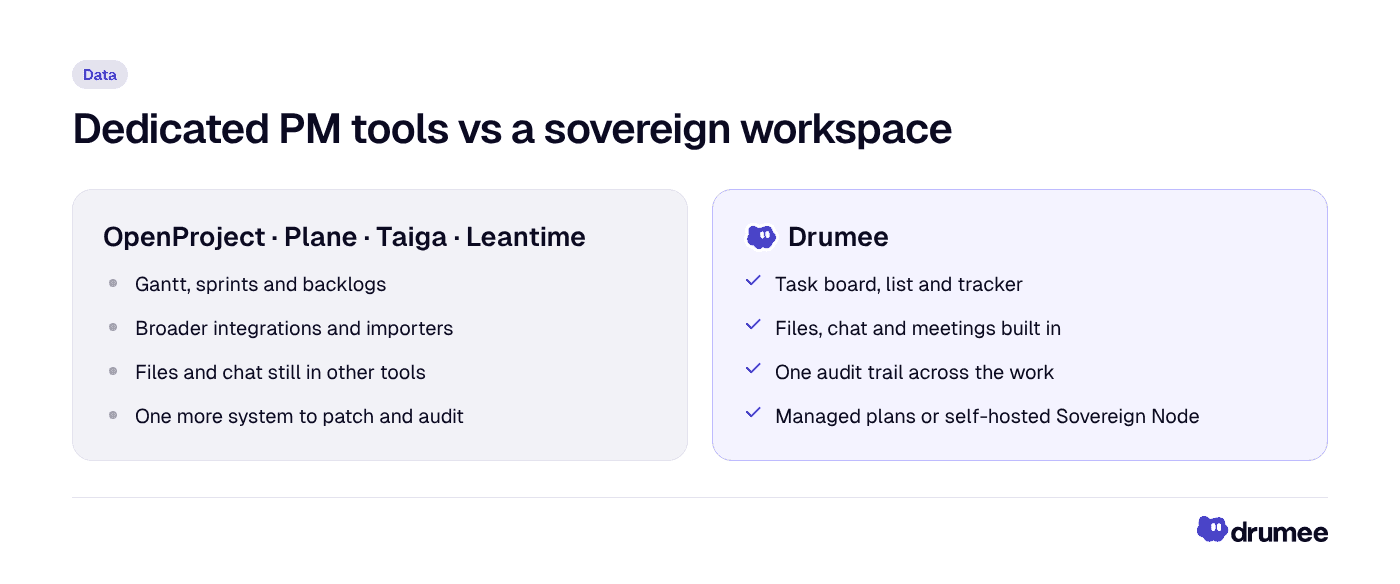
Dedicated PM tools win on planning depth; Drumee wins when tasks, files, chat and meetings need to live in one self-hosted system.
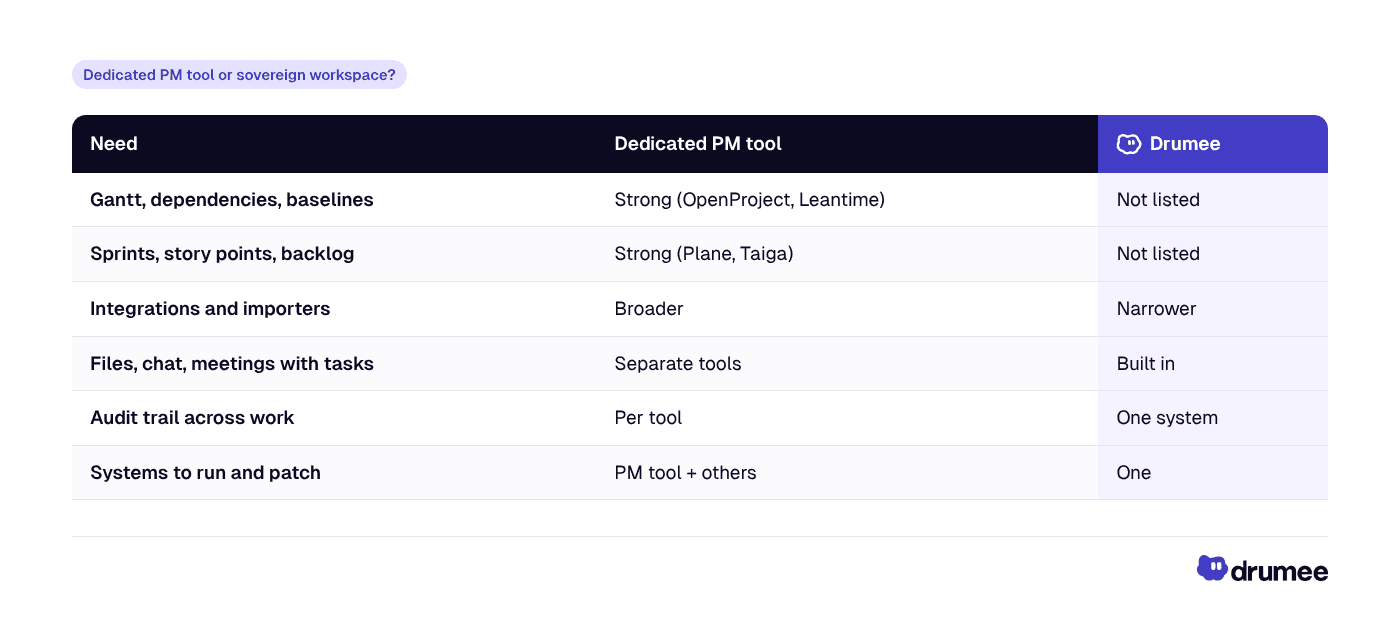
The hidden cost of a self-hosted PM tool is the rest of the stack. A team that self-hosts Plane for privacy but keeps files in a hosted drive and chat in a hosted messenger has moved only part of its work data under its control. For chat specifically, our guide to self-hosted Slack alternatives covers the dedicated options.
Some teams run both: a dedicated PM tool for engineering sprints, and Drumee for client-facing projects, files and communication. That is a legitimate setup, provided you count the extra system in your patching, backup and audit plans.
Self-hosted project management selection checklist
Use this before a pilot. Every "no" or "not sure" is a question for the vendor or your admin.
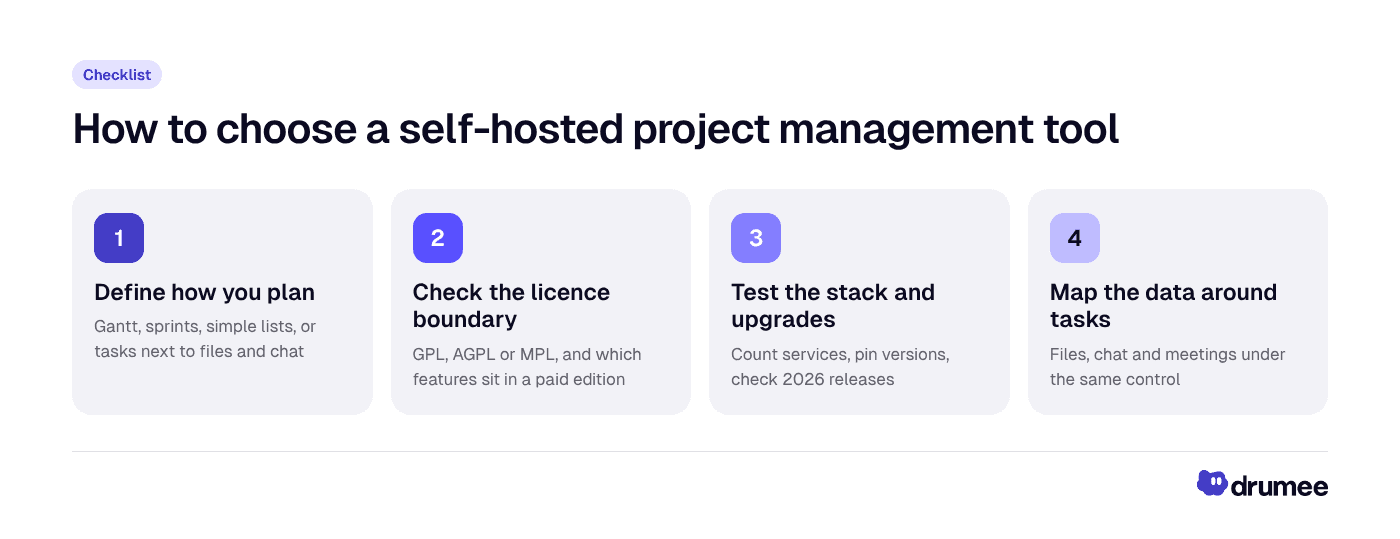
Pick by planning style first, then check licence boundaries, operations effort and where task-related data lives.
- Planning style. Do you need Gantt and dependencies (OpenProject, Leantime), sprints and backlogs (Plane, Taiga), simple lists (Vikunja), or task boards next to files and chat (Drumee)?
- Licence and edition boundary. Is the self-hosted edition GPL, AGPL or MPL, and which features sit in a paid edition? Check SSO, LDAP, importers, automations and audit logs specifically.
- Copyleft obligations. If you modify AGPL software and offer it to users over a network, you must share those modifications. Internal use without modification is usually straightforward; ask your counsel if you plan to customise.
- Deployment stack. Count the services: database, cache, object storage, workers. A single binary and a six-container stack have very different upkeep.
- Upgrade path. Does the project publish release notes, migration steps and security advisories? Pin versions and test upgrades on a staging copy.
- Maintenance signal. Look for releases in the last six months, active maintainers and a response to security reports. Focalboard is the cautionary tale.
- Identity and access. Do you need SSO/SAML, LDAP or two-factor authentication, and in which edition are they?
- Migration in. Is there an importer for your current tool (Jira, Trello, ClickUp), and is it in the free edition?
- Migration out. Can you export tasks, comments and attachments in an open format?
- The data around tasks. Where will the files, chat and meeting notes for each project live, and are they under the same control as the tasks?
For a broader framework on choosing infrastructure you can leave, see our guide on how to avoid SaaS vendor lock-in.
Decision table by team type
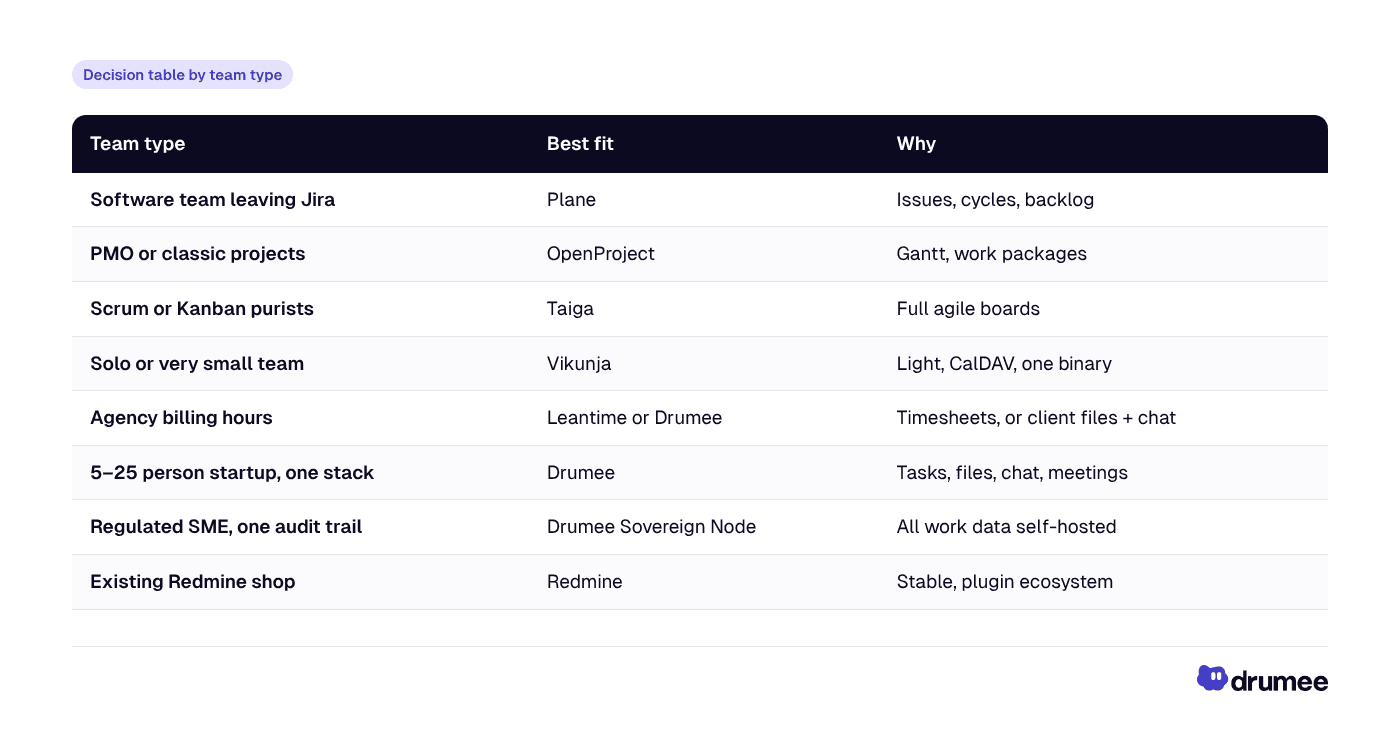
Agencies appear twice for a reason. If your main need is time tracking and billing, Leantime's timesheets are the stronger fit. If your main need is keeping client files, approvals and conversations next to the tasks, Drumee's workspace model fits better; our guide to self-hosted workspaces for agencies goes deeper.
Cost, control and sovereignty: what self-hosting really changes
Self-hosting changes three things, and it is worth being precise about each.
Cost. The open source Community editions above carry no licence fee for the self-hosted software, but you pay in servers, backups and admin time. Paid editions add features and support; check each vendor's current pricing rather than relying on third-party figures. Drumee's managed plans are priced per team rather than per seat, which keeps cost flat as you hire. For a structured way to compare the options, read our analysis of self-hosted vs SaaS for startups.
Control. You decide when to upgrade, how long to retain data and how to export it. That also means you own patching and backups. Pin versions, test upgrades and subscribe to security advisories for every self-hosted tool you run.
Sovereignty and GDPR. For EU teams, self-hosting a PM tool removes a third-party processor for task data, which simplifies contracts and transfer assessments. GDPR Article 30 still requires controllers to keep records of processing activities, including recipients of personal data, and every separate tool adds entries to that record. A workspace where tasks, files and chat share one system means one entry, one access model and one audit trail. Our Drumee GDPR compliance guide covers the details.
Does self-hosting make project management GDPR compliant? Not on its own. Self-hosting removes the external processor and keeps task data on infrastructure you control, but you still need lawful bases, access controls, retention rules, backups and records of processing. It makes compliance simpler to show, especially when tasks, files and chat sit in one system.
Verdict
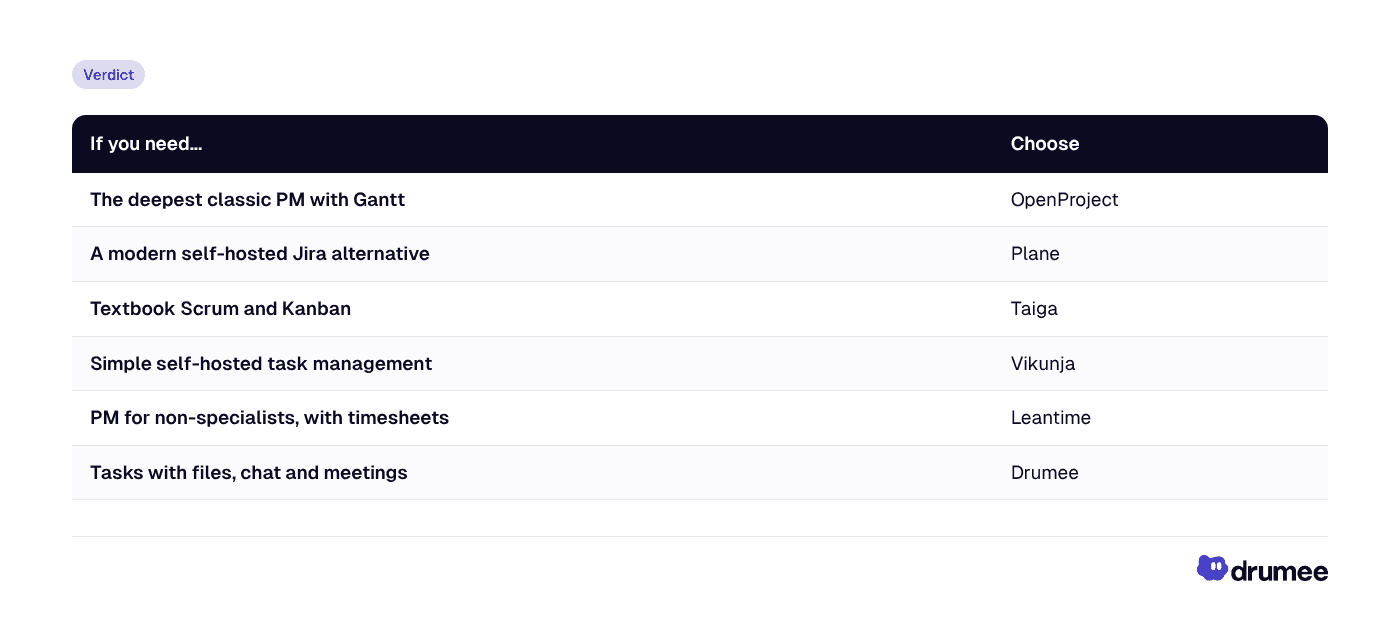
Dedicated PM tools win on project management depth. OpenProject, Plane, Taiga and Leantime are all actively maintained and go further than Drumee on Gantt charts, sprints, reporting and integrations. Vikunja is the light, low-upkeep option, and Focalboard should be retired.
Drumee wins when the work around the tasks matters as much as the tasks. If your projects are coordinated through files, client conversations and meetings, Drumee keeps all of it in one sovereign workspace, on managed plans or your own Sovereign Node.
FAQ
What is the best self-hosted project management tool?
It depends on how you plan work. OpenProject is strongest for classic, Gantt-based projects, Plane for agile software teams, Taiga for Scrum and Kanban, Leantime for non-specialist teams and Vikunja for lightweight task lists. If tasks need files, chat and meetings in the same self-hosted system, Drumee is the better fit.
Is there an open source alternative to Jira?
Yes. Plane is the closest match to Jira's issue tracking and sprint workflow, with an AGPL-3.0 Community Edition you can self-host. OpenProject covers Jira-style work packages plus Gantt charts under GPLv3, and Taiga covers Scrum and Kanban under MPL-2.0. Atlassian's Data Center end of life on 28 March 2029 makes these worth evaluating now.
Is there a self-hosted alternative to ClickUp?
ClickUp has no self-hosted edition. Teams that want its task features on their own servers usually choose Plane, OpenProject or Leantime, then add separate tools for files and chat. Drumee is the option that puts task boards, files, chat and meetings in one self-hosted workspace, though it has less PM depth than ClickUp.
Is Focalboard still maintained?
Not by Mattermost. The standalone Focalboard repository has been community-supported since September 2023 and is looking for maintainers, and the Mattermost Boards plugin is in maintenance mode with fixes limited to Enterprise-reported bugs and security issues. Avoid new deployments and plan a migration if you run it.
What is the easiest project management tool to self-host?
Vikunja is the simplest: it runs as a single Go binary with SQLite or as one Docker container. Leantime needs a PHP app plus a MySQL database, while Plane, Taiga and OpenProject run multi-service Docker Compose stacks with more components to back up and upgrade.
Conclusion
Self-hosted project management is a mature category in 2026. OpenProject, Plane, Taiga, Vikunja and Leantime are all actively maintained, each with a clear strength, and on-premise Jira's end of life gives many teams a reason to move. Pick by planning style, then check licence boundaries, upgrade effort and maintenance signals.
Then look at the data around your tasks. If files, chat and meetings still live in hosted tools, you have secured only part of your work. Drumee puts tasks, files, chat and meetings in one sovereign workspace, with flat team pricing on managed plans and a self-hosted Sovereign Node for full control. Start on Drumee's Free plan or book a Sovereign Node call from the pricing page.
Keep reading
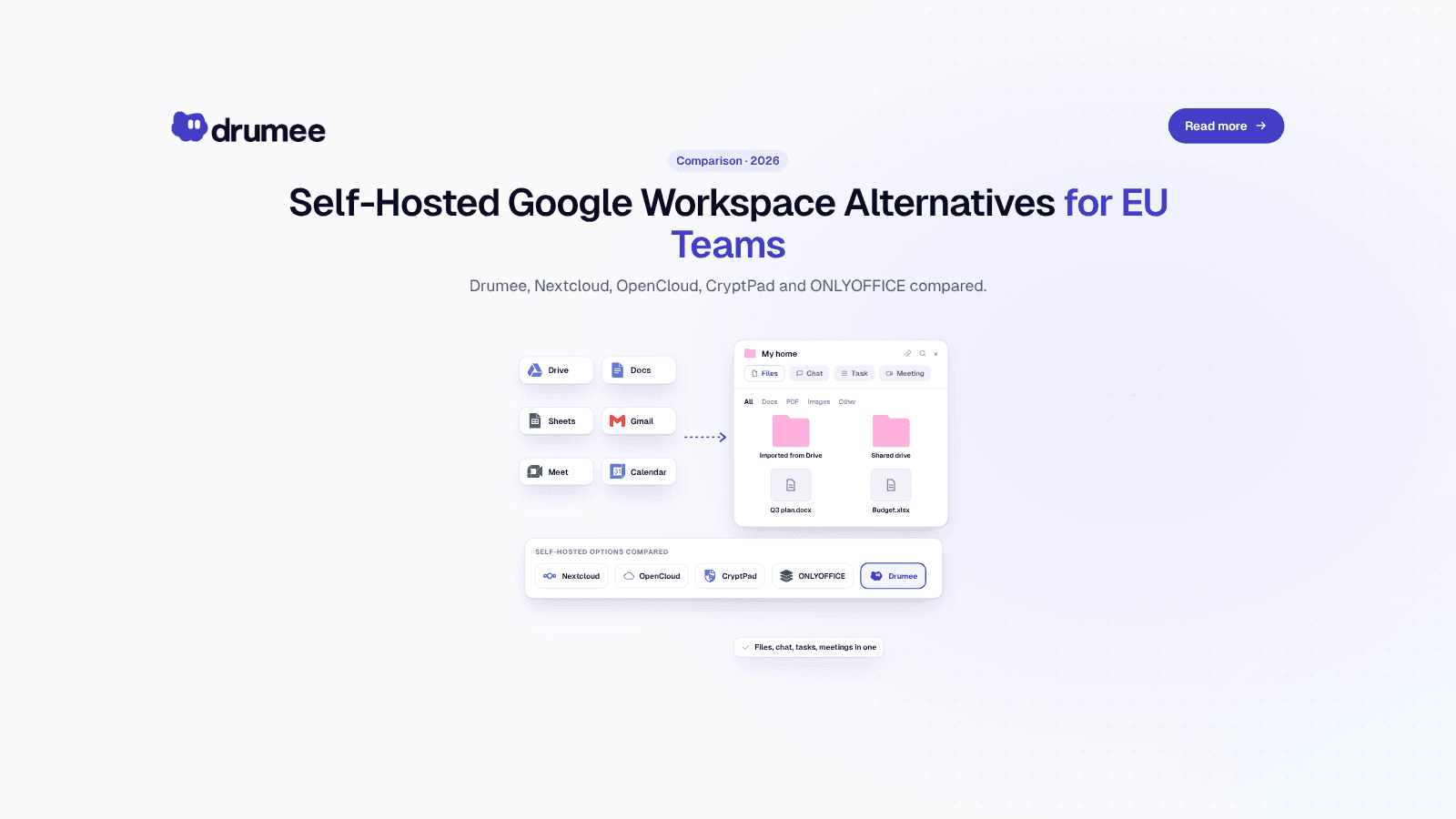
Self-Hosted Alternatives to Google Workspace: 2026 Guide for EU Teams
Google Workspace is the default office stack for most European startups. It is also a US-controlled service whose list price went up in January 2025, whose data sits under US legal reach, and whose exit path takes days of admin work. For a growing...
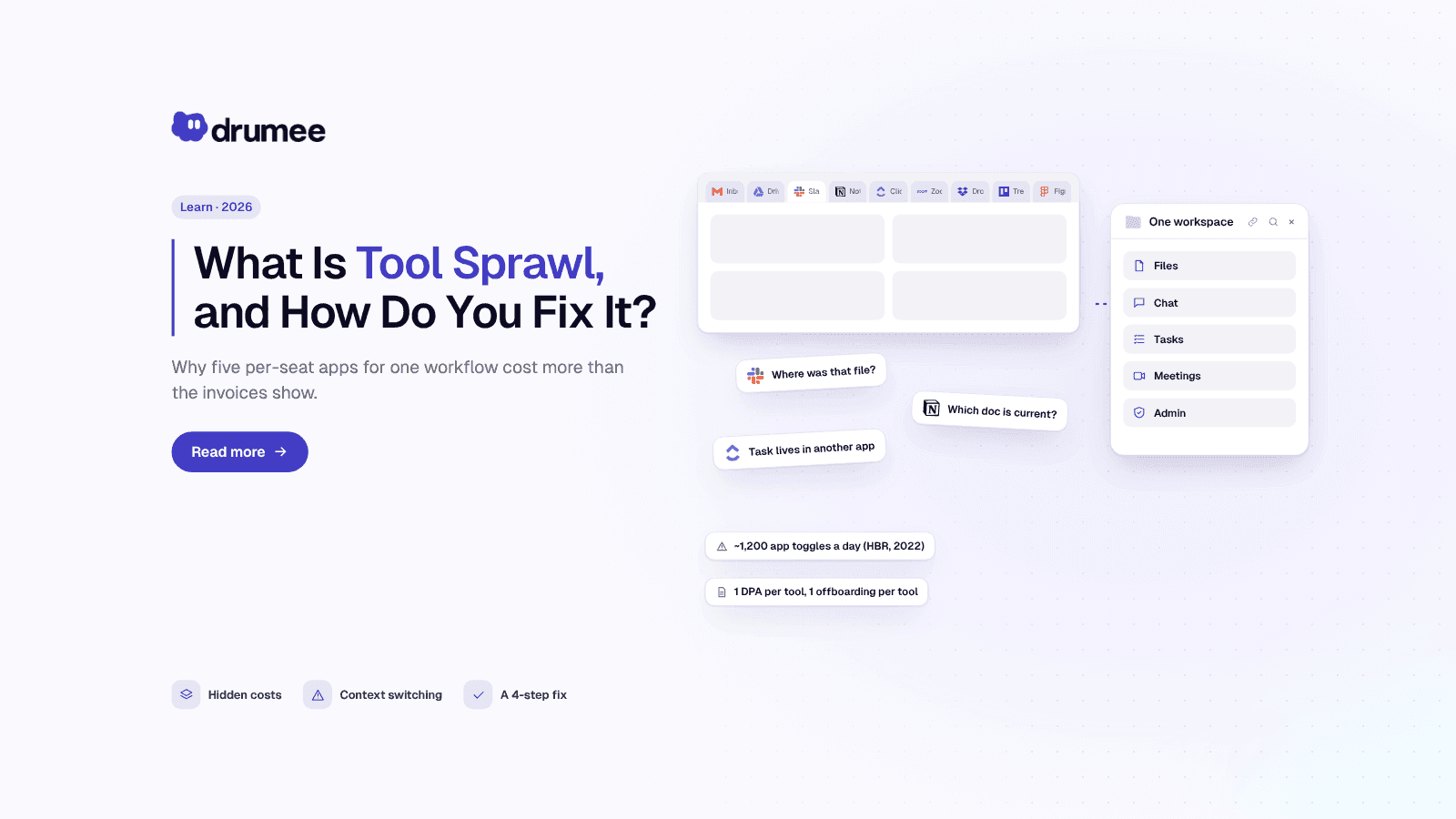
What Is Tool Sprawl and How to Fix It in 2026
Nobody decides to build a messy stack. A startup adds Slack on day one, Google Drive on day two, Notion when the wiki gets real and ClickUp when the roadmap stops fitting in a spreadsheet. Two years later, a simple question like "where did we deci...
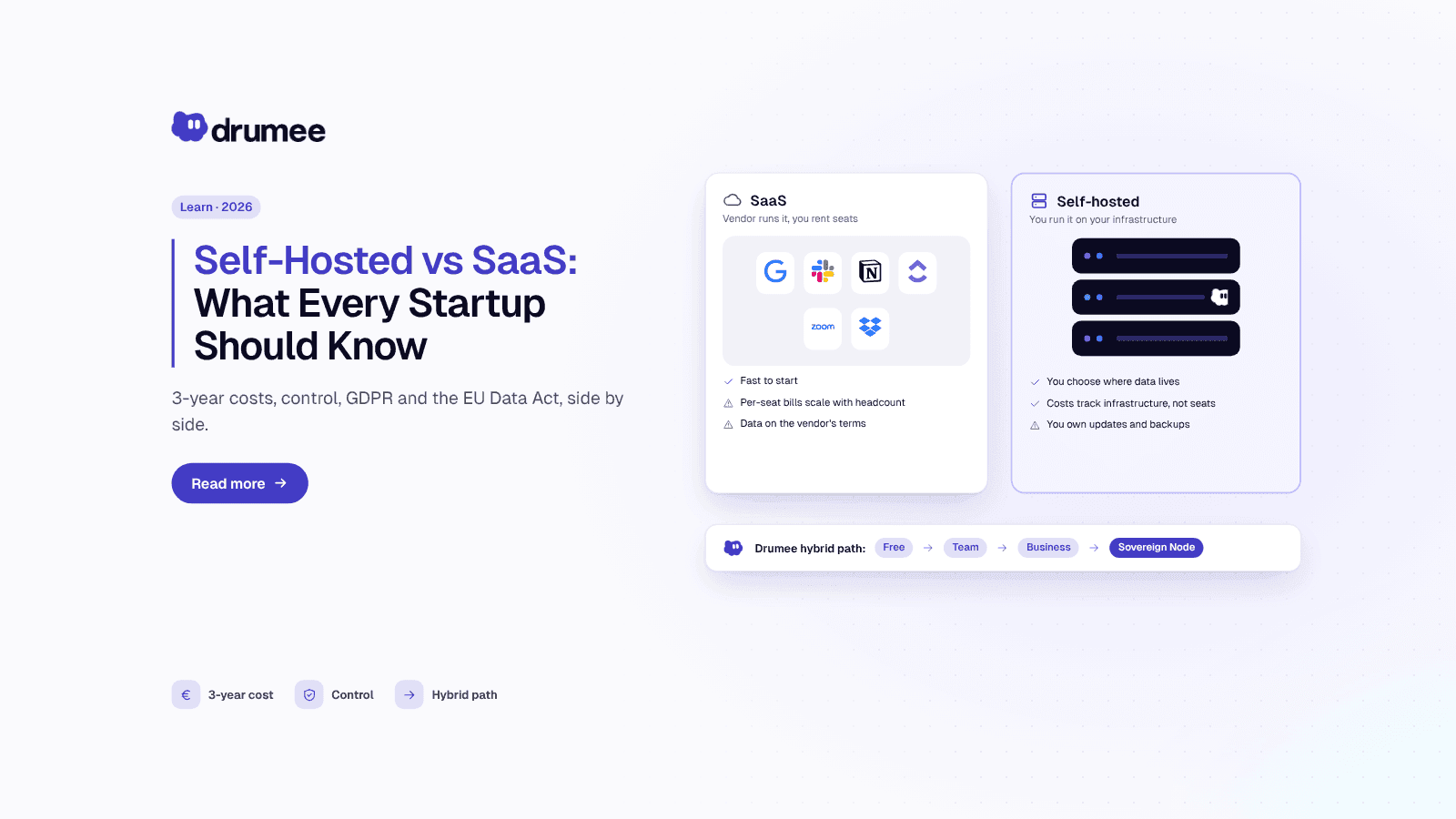
Self-Hosted vs SaaS: What Every Startup Should Know Before Choosing
Every startup makes the self-hosted vs SaaS decision, usually without noticing. The first tool someone signs up for with a company card becomes the default, and three years later the team is renting a dozen per-seat products it never consciously c...