
Facebook Is Not Free, Says CJEU Advocate General: Personal Data as Payment
Published 23 November 2026 · Updated 23 November 2026 · 7 min read TL;DR: On 19 November 2026, Advocate General Laila Medina told the EU Court of Justice that giving personal data and consenting to its commercial use is a form of payment. A servi...
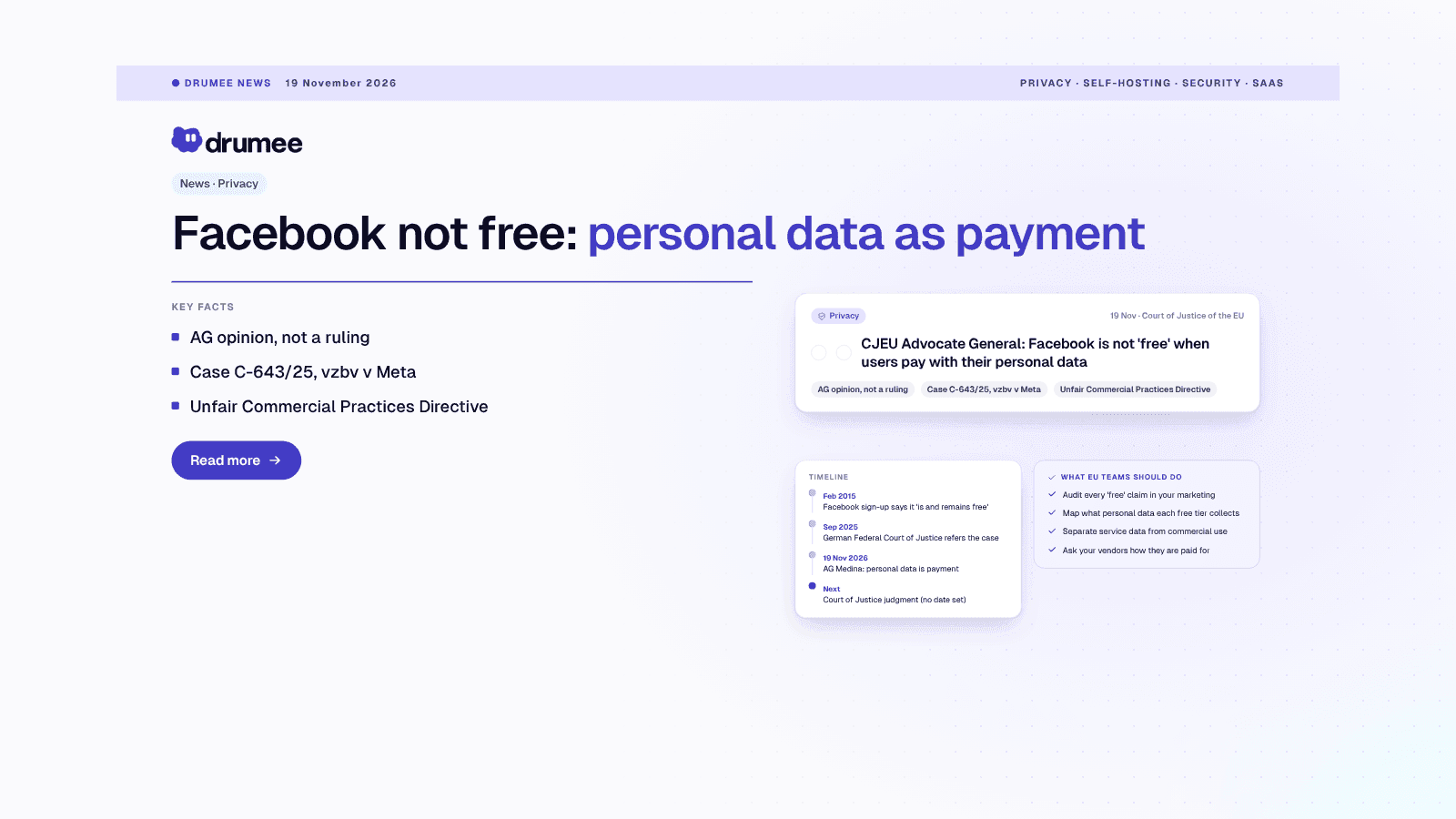
CJEU Advocate General Laila Medina said on 19 November 2026 that handing over personal data for commercial use is a form of payment, so Facebook cannot be…
Published 23 November 2026 · Updated 23 November 2026 · 7 min read
TL;DR: On 19 November 2026, Advocate General Laila Medina told the EU Court of Justice that giving personal data and consenting to its commercial use is a form of payment. A service paid for that way cannot be advertised as "free". This is an opinion, not a ruling: the Court's judgment in case C-643/25 is still to come.
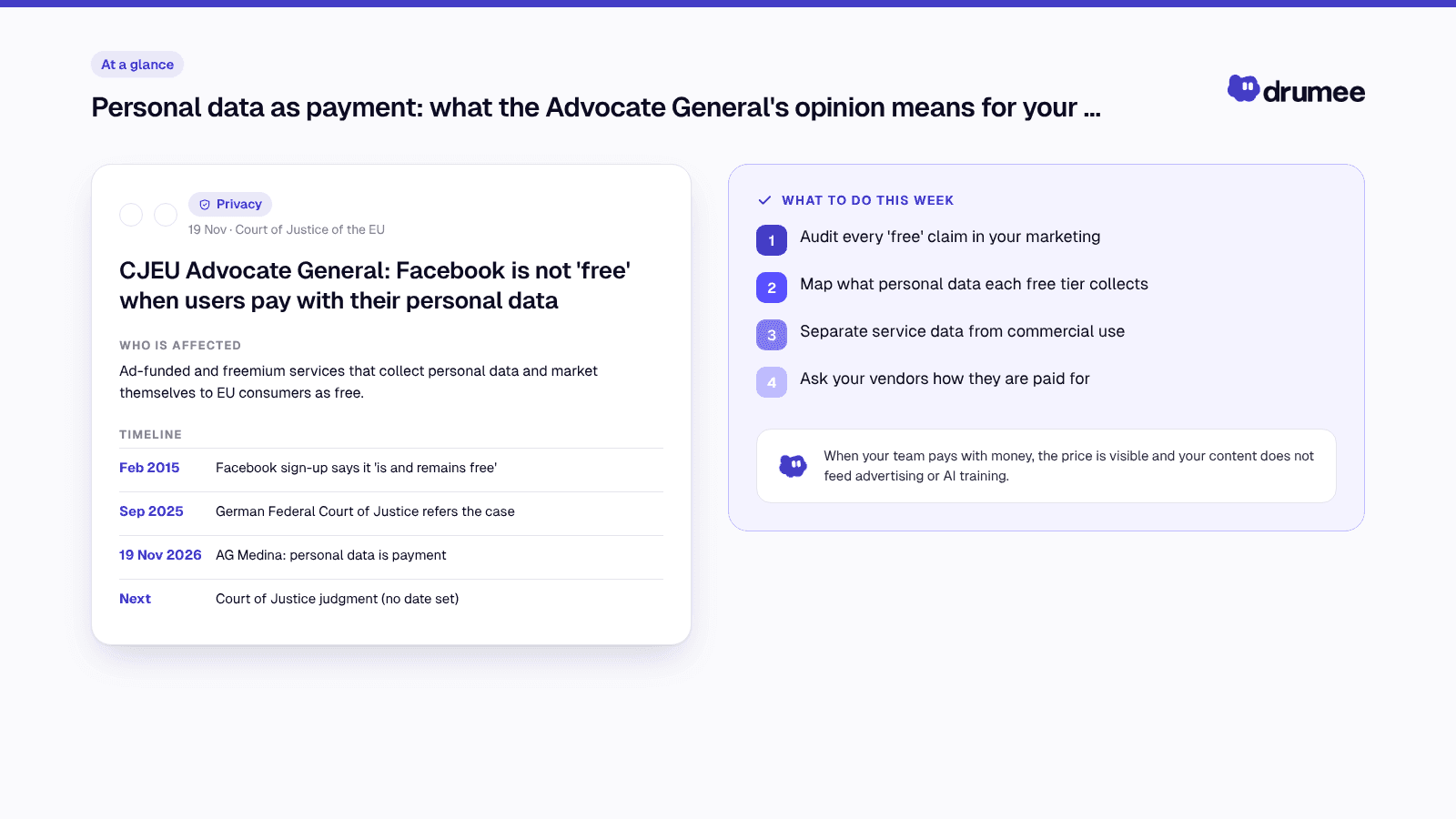
Personal data as payment: what the Advocate General's opinion means for your team.
What happened
On 19 November 2026, Advocate General (AG) Laila Medina delivered her opinion in case C-643/25, Verbraucherzentrale Bundesverband v Meta Platforms Ireland. According to the Court of Justice press release No 169/26, she proposes that the Court rule that the disclosure of personal data and consent to its commercial use constitute a form of payment under the Unfair Commercial Practices Directive (UCPD). The press release headline puts it plainly: a social network is not free when you pay with your data to use it.
The dispute goes back to February 2015, when Facebook's registration page in Germany said the service "is and remains free" ("ist und bleibt kostenlos"). Germany's federation of consumer organisations, vzbv, asked the courts to ban the claim, arguing that users pay by giving up their data. German lower courts did not accept that part of the claim because they read the "free" ban as covering only financial costs, as IT-Recht Kanzlei summarises. The vzbv says the Federal Court of Justice (Bundesgerichtshof) suspended the case in September 2025 and asked the EU Court how to interpret "paying with data".
The legal hook is point 20 of the UCPD's blacklist. It bans describing a product as "gratis", "free" or "without charge" if the consumer has to pay anything other than the unavoidable cost of responding and delivery. Practices on that list are unfair in all circumstances, with no further test.
Medina's reading, as reported by EU Law Live and MLex:
- Personal data that a business can exploit commercially has economic value, so handing it over counts as a cost under point 20.
- A service that requires such data cannot be called "free", unless the data is processed only to provide the service or to meet a legal obligation.
- Businesses may still offer services in exchange for data. They just can't market them as free (Eunews).
- The GDPR does not stop the UCPD from applying. The two regimes apply side by side: the GDPR governs lawful processing, while consumer law governs whether a commercial claim is accurate.
Meta said it respectfully disagrees with the AG and awaits the Court's decision, MLex reported.
The headline in one line: an Advocate General has advised that "free" means free of money and free of commercially used data. The Court has not decided yet.
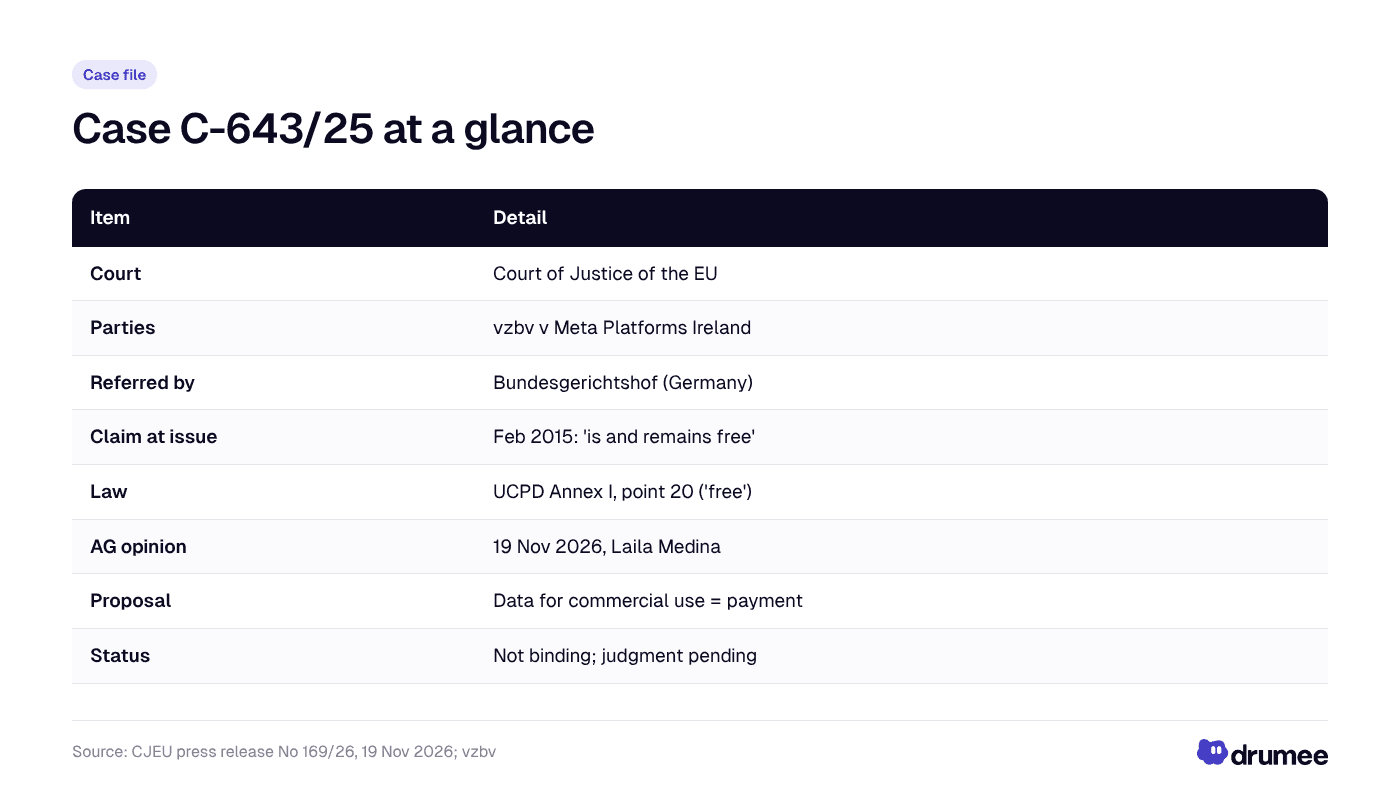
The opinion answers one question from the German court: can personal data count as a "cost" under the EU ban on false "free" claims?
Timeline
- February 2015: Facebook's German sign-up page says the service "is and remains free" (CJEU press release).
- August 2019: Facebook replaces its long-running "It's free and always will be" sign-up slogan with "It's quick and easy" (Yahoo News; Newser).
- September 2025: the Bundesgerichtshof suspends the vzbv case and refers a question to the Court of Justice, registered as C-643/25 (vzbv; InfoCuria).
- 19 November 2026: AG Medina delivers her opinion: personal data for commercial use is payment, so "free" is misleading.
- Next (no date set): the Court of Justice deliberates and delivers its judgment. The Bundesgerichtshof then decides the German case in line with that ruling.
What happens next
An Advocate General's opinion is not binding. AGs are members of the Court who give an independent legal analysis before the judges deliberate. The press release states that the opinion is not binding on the Court, and the judges have only now begun their deliberations (beck-aktuell; PwC Legal blog). The Court often follows its AGs, but not always.
Standalone answer: Did the EU court say Facebook is not free? Not yet. On 19 November 2026, Advocate General Laila Medina advised the Court of Justice that personal data given for commercial use is a form of payment, so such a service cannot be called free. Her opinion is not binding; the Court's judgment in C-643/25 will come later.
Because this is a preliminary reference, the Court will not decide the German dispute itself. It will interpret the UCPD, and that interpretation will bind courts in every member state. The Bundesgerichtshof will then apply it to Meta's 2015 claim.
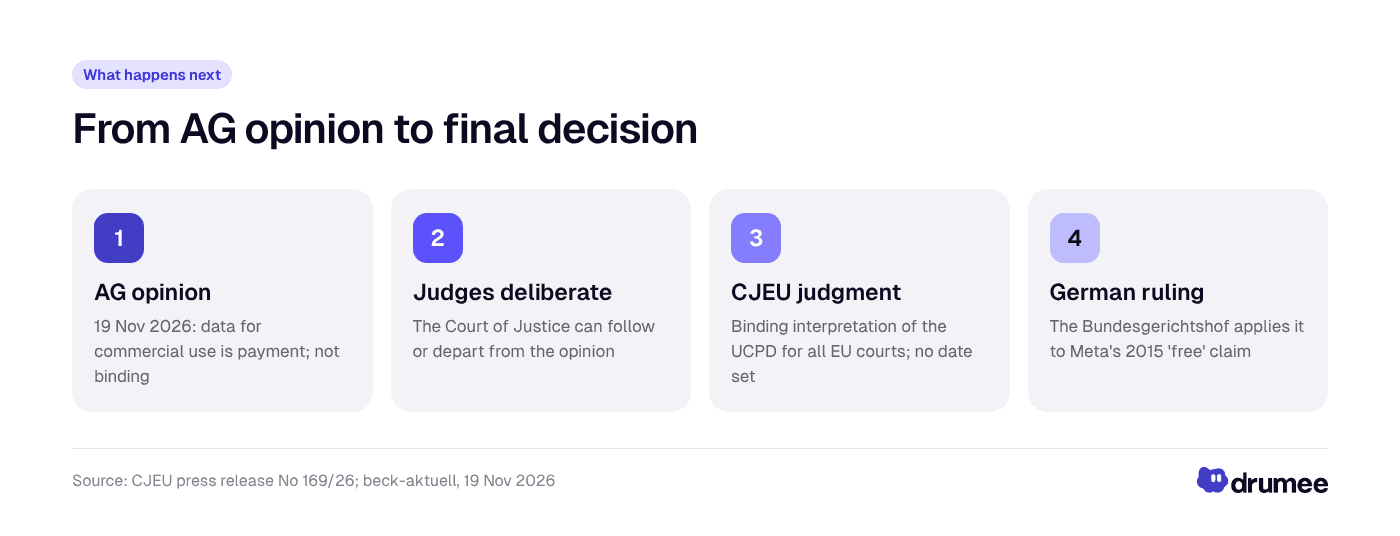
Four steps remain between this opinion and a final answer, and only the CJEU judgment will bind courts across the EU.
Reports note that the opinion does not decide whether any current Meta offer is lawful (Courthouse News).
Who is affected
If the Court agrees with its AG, the reading of "free" changes for any business that markets to EU consumers:
- Ad-funded apps and platforms that collect personal data for targeting or resale and describe themselves as free.
- Freemium products whose free tier is paid for by tracking or data sharing rather than only by upgrades.
- Marketing and growth teams writing landing pages, app-store listings and ad copy with "free", "gratis" or "no cost".
- Consumers who sign up for "free" services, and the consumer groups and authorities that act for them.
The UCPD covers business-to-consumer practices, so pure B2B offers are outside its direct scope. Still, many workplace tools are sold to both consumers and companies on the same sign-up page.
What it means under EU consumer law and the GDPR
The opinion keeps two legal questions apart. The GDPR asks whether processing is lawful: which legal basis applies, and whether consent is freely given. Article 7(4) GDPR already says that when judging free consent, utmost account must be taken of whether a contract is made conditional on consent to processing that the contract doesn't need. Consumer law asks a different question: is what you tell the customer true?
EU law already treats data as something consumers can "provide" in exchange for a service. The Digital Content Directive (EU) 2019/770 extends consumer remedies to contracts where the consumer provides personal data instead of paying a price. Medina's opinion would bring the UCPD's "free" rule into line with that view.
Standalone answer: Is giving personal data a form of payment under EU consumer law? According to AG Medina, yes: disclosing personal data and consenting to its commercial use is a form of payment under the Unfair Commercial Practices Directive. A service that requires it cannot be called free, unless the data only serves to provide the service or meet a legal duty.
None of this bans data-funded services. It targets the label. This is general context, not legal advice; ask your counsel or DPO how it applies to your own offers.
What to do now
A short checklist for EU-facing teams while the judgment is pending:
- Audit every "free" claim. List landing pages, app-store texts, ads and onboarding screens that say free, gratis or no cost.
- Map what the free tier collects. For each free offer, note which personal data you collect and whether any of it is used beyond delivering the service: ads, profiling, sale, sharing or model training.
- Separate service data from commercial data. If the free tier only processes what the service needs, document that. If it monetises data, prepare wording that says so plainly instead of "free".
- Check your GDPR consent design. Make sure refusing optional processing doesn't block the core service without a clear, lawful reason under Art. 7(4).
- Review the vendors you use. For your own workplace tools, ask each provider how it is funded and whether your team's content feeds advertising or AI training.
The bigger picture
The opinion is the latest step in a long argument over Meta's data-for-access model. In November 2023 Meta began offering EU users a paid subscription without ads (Fortune). In April 2025 the European Commission fined Meta €200 million under the Digital Markets Act, finding that its "consent or pay" model did not give users a real choice (Taylor Wessing; The Register). C-643/25 adds consumer law to that picture: even when the deal is lawful, how it is described matters.
For teams, the useful question is not only "is it free?" but "how is this tool paid for?". Our explainer on whether cloud platforms mine your data shows how terms of service let vendors process content, and digital sharecropping explains why teams end up as tenants on platforms they don't control. Last week's Tinder right-of-access fine shows the other side: regulators expect you to know exactly what personal data you hold. Both point to data sovereignty as an operational question, not a slogan.
How a sovereign workspace changes the risk
Standalone answer: When your team pays for a workspace with money, the price is visible and the vendor has no reason to monetise your files. A sovereign workspace adds control: you know where your data lives, who can read it, and that it is not feeding advertising or AI training.
That is the idea behind a sovereign workspace. Drumee runs files, chat, task boards and meetings in one system, hosted as Drumee Cloud at app.drumee.com. The Drumee docs state that your content is not used for advertising or to train AI models and that you can export it at any time. The public roadmap lists advertising and data monetisation of any kind as something Drumee will not build.
Teams that need more control can run Drumee Sovereign Node on their own infrastructure, through contact sales. Either way, the trade is simple: you pay a clear price in money, and your team's data stays yours. For EU teams, that is easier to explain in a GDPR record of processing than an ad-funded "free" tool. See Drumee's plans for what each one includes.
Try Drumee with your team: your first month is $1. Start your team for $1
FAQ
Did the EU court rule that Facebook is not free?
No, not yet. On 19 November 2026 Advocate General Laila Medina gave a non-binding opinion in case C-643/25 saying that personal data given for commercial use is payment, so Facebook's "free" claim was misleading. The Court of Justice will deliver its own judgment later.
What is case C-643/25 about?
It is a reference from Germany's Federal Court of Justice in a lawsuit by the consumer federation vzbv against Meta. The question is whether a 2015 sign-up claim that Facebook "is and remains free" breached the EU ban on false "free" claims, given that users hand over personal data.
Is giving personal data a form of payment under EU law?
According to the AG's opinion, yes, under the Unfair Commercial Practices Directive, when the data is used commercially. The Digital Content Directive already extends consumer remedies to contracts where people provide personal data instead of money.
Can a company still offer a service in exchange for personal data?
Yes. The AG said businesses remain free to offer services in exchange for data. What they cannot do, on her reading, is advertise those services as free, unless the data is only used to provide the service or meet a legal obligation.
What happens after an Advocate General opinion?
The judges deliberate and deliver a judgment, which is binding on national courts. No date has been set. The German Federal Court of Justice will then decide the vzbv case in line with the ruling.
Keep reading
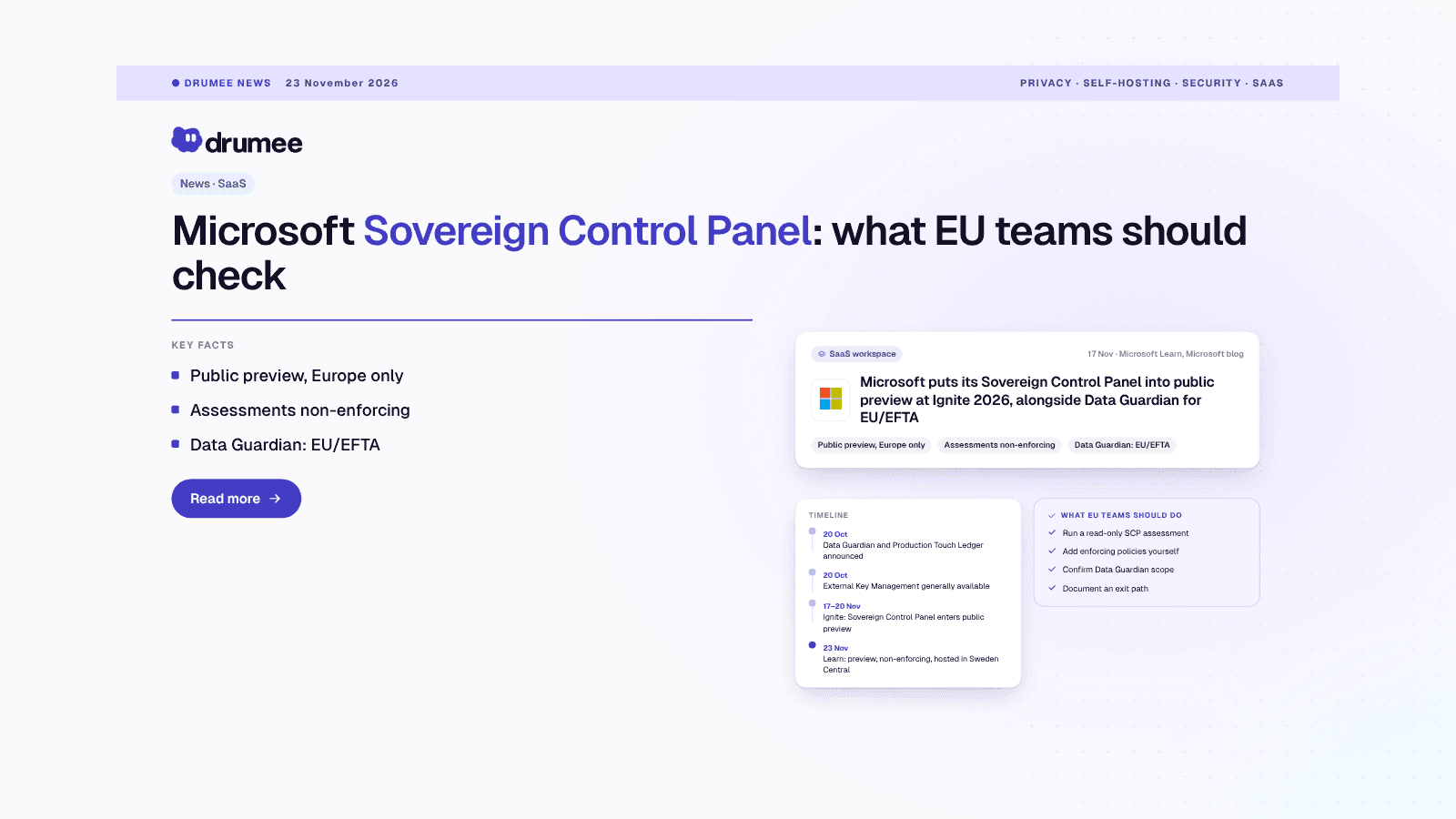
Microsoft Sovereign Control Panel Hits Public Preview: What EU Teams Should Check (Nov 2026)
Published 23 November 2026 · Updated 23 November 2026 · 8 min read Microsoft used Ignite 2026 in San Francisco to move its Sovereign Control Panel into public preview. It is the newest piece of the "Microsoft Sovereign Cloud" programme for Europea...
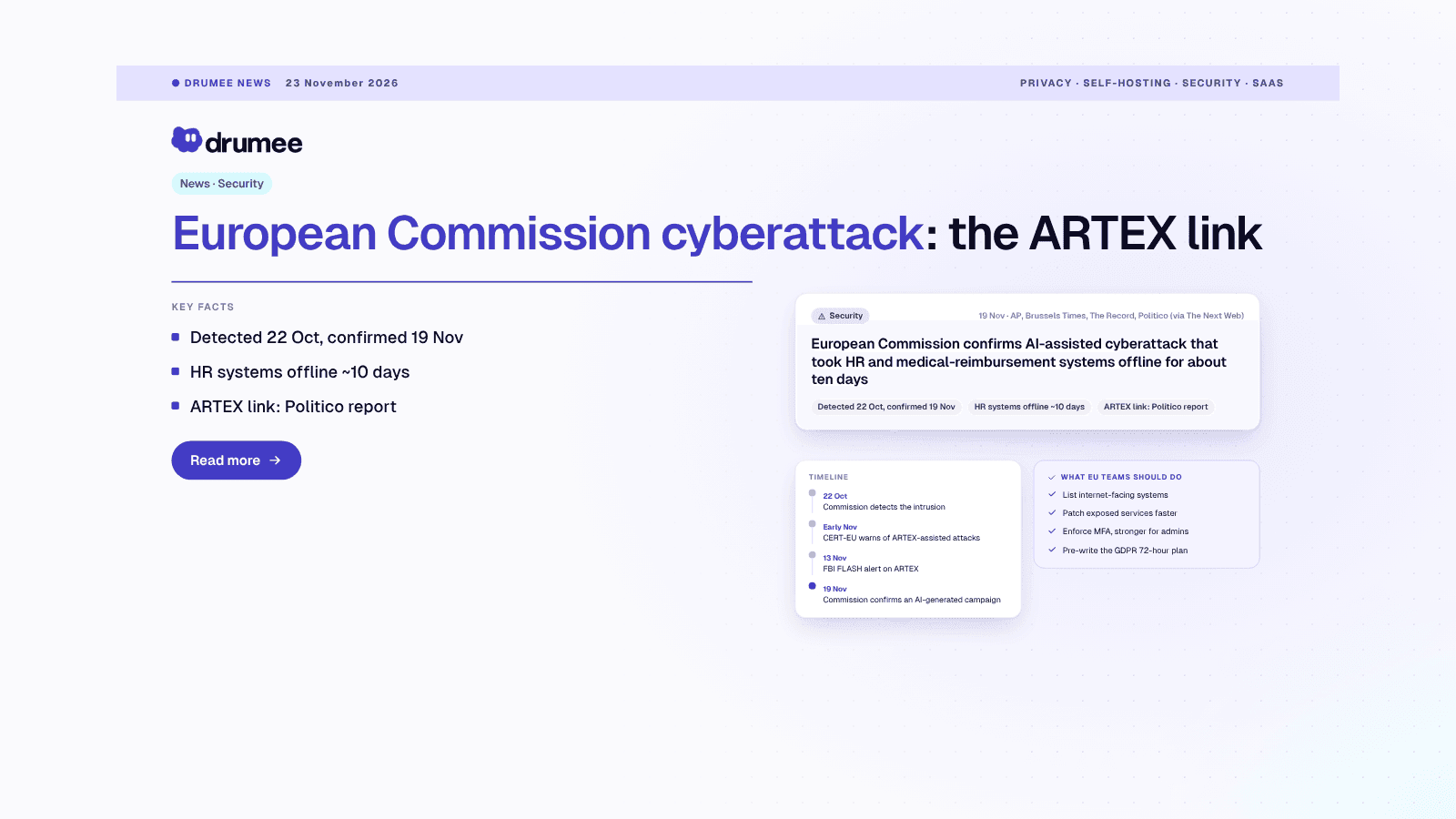
European Commission Cyberattack: What Is Confirmed, the ARTEX Link and What to Do (Nov 2026)
Published 23 November 2026 · Updated 23 November 2026 · 8 min read The European Commission cyberattack confirmed on 19 November 2026 is one of the first incidents that a major public body has openly tied to an AI tool. This post separates what the...
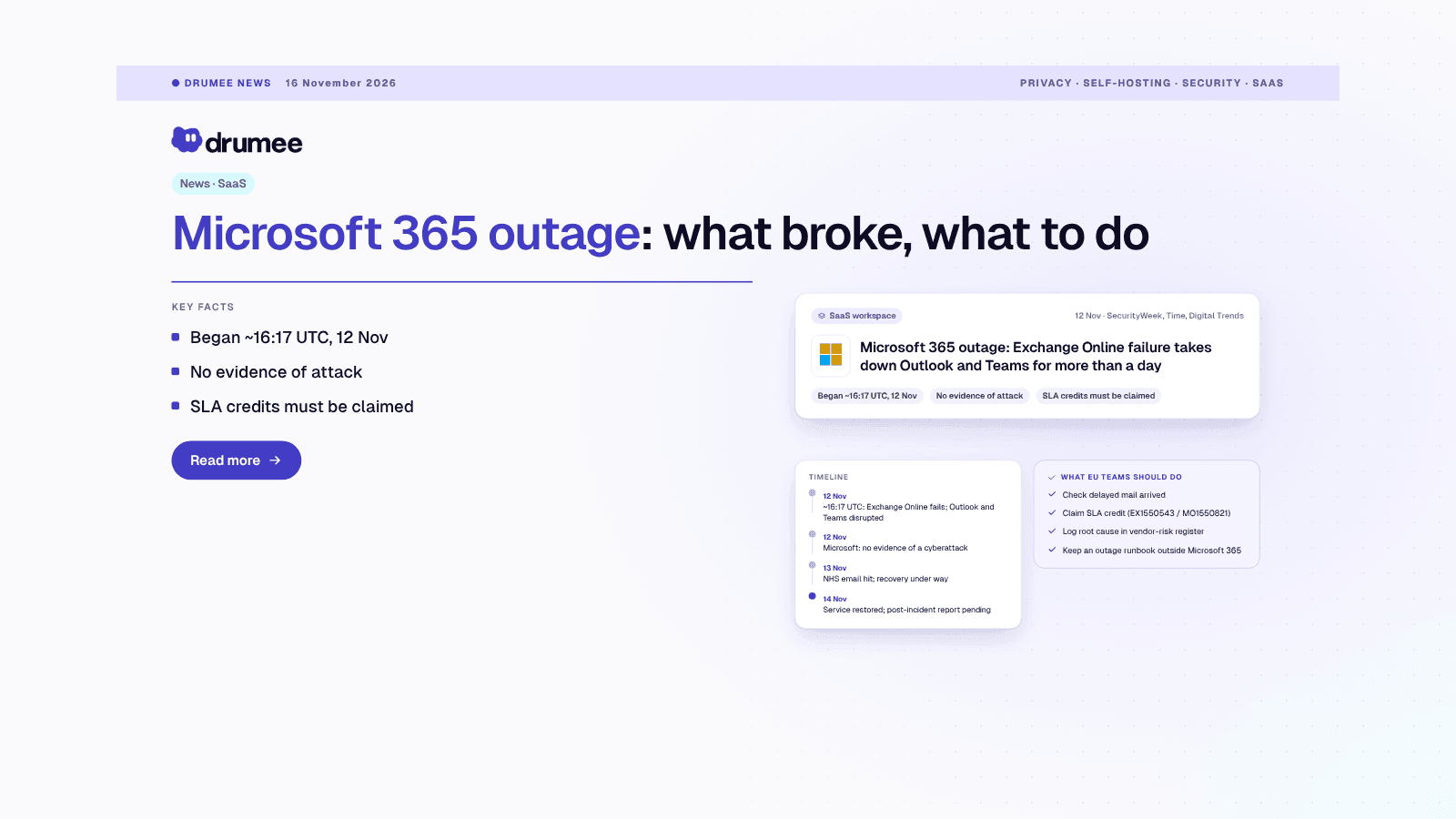
Microsoft 365 Outage (November 2026): What Broke, Who Was Hit and What to Do Now
Published 16 November 2026 · Updated 16 November 2026 · 7 min read The Microsoft 365 outage that started on Thursday 12 November 2026 was one of the longest disruptions of Outlook and Teams in years. This post sets out what is confirmed, what Micr...