
European Commission Cyberattack: What Is Confirmed, the ARTEX Link and What to Do (Nov 2026)
Published 23 November 2026 · Updated 23 November 2026 · 8 min read The European Commission cyberattack confirmed on 19 November 2026 is one of the first incidents that a major public body has openly tied to an AI tool. This post separates what the...
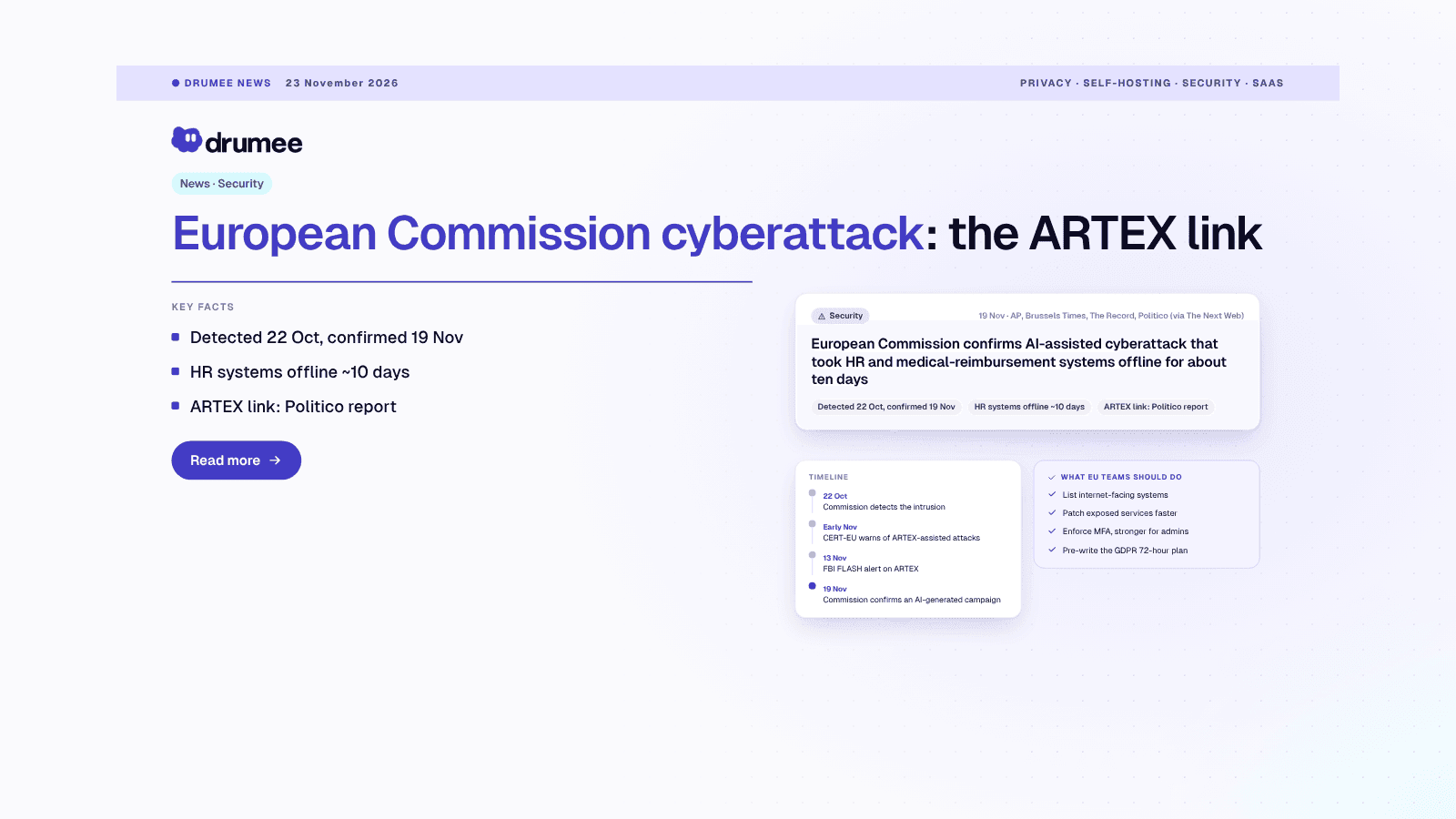
European Commission cyberattack, confirmed 19 November 2026: HR and medical-reimbursement systems were offline for about ten days; Politico reports CERT-EU…
Published 23 November 2026 · Updated 23 November 2026 · 8 min read
The European Commission cyberattack confirmed on 19 November 2026 is one of the first incidents that a major public body has openly tied to an AI tool. This post separates what the Commission has confirmed from what has only been reported, and turns the lessons into a checklist a small EU team can work through this week.
TL;DR
What happened and does it affect me? On 19 November 2026 the European Commission confirmed an "AI-generated" cyber campaign that kept staff HR and medical-reimbursement systems offline for about ten days. Politico, citing unnamed sources, links it to the ARTEX AI tool; the Commission has not named the tool. No outside data is known to be involved, but the method can hit any company.
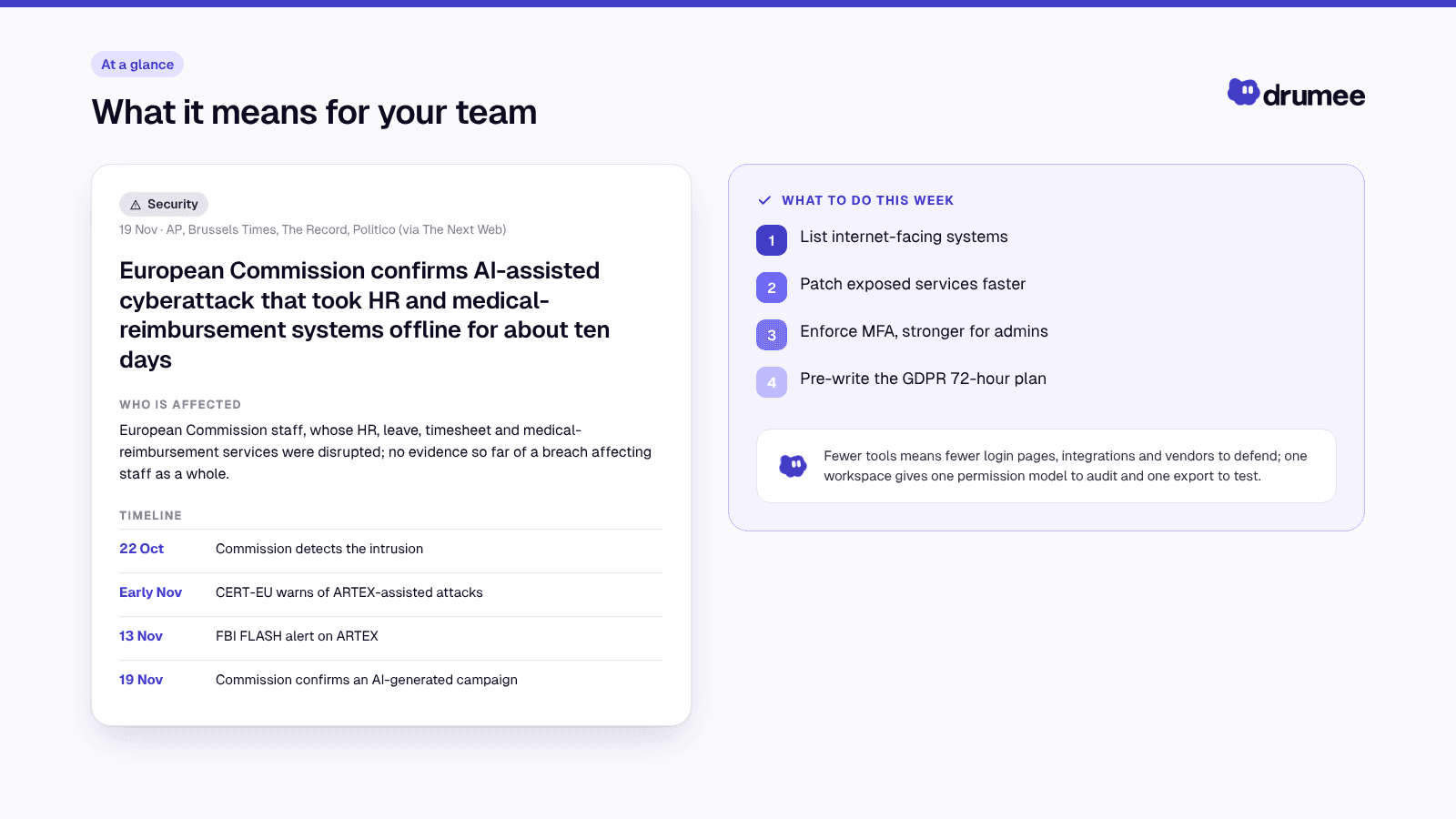
What it means for your team.
What happened
Confirmed by the Commission
Commission spokesperson Thomas Regnier confirmed the incident on Thursday 19 November 2026. He said the intrusion was detected on 22 October and confirmed by an initial investigation on 26 October, after which the Commission opened an investigation and took preventive measures (AP via WSB-TV; Brussels Times). He described it as an "AI-generated" cyber campaign that used a publicly available AI tool, without naming the tool or the attackers (The Record; Newsweek).
Several internal applications were taken offline for about ten days. Coverage names the HR platform Sysper, the medical-reimbursement system MyPMO and translation services; Politico put the disruption at more than ten days and listed payroll access, leave requests and medical reimbursements (The Register; The Next Web; Brussels Times). Salaries were largely paid as usual, but some staff could not submit timesheets or request leave.
The Commission said it had found no evidence of a data breach affecting its staff as a whole, had received no ransom demand, and kept the investigation open, in contact with CERT-EU and the European Data Protection Supervisor (The Record; SecurityWeek).
Note the wording "as a whole". It does not rule out that data on individual employees was exposed, and an EU official told reporters the full extent of any damage remains unclear (Euronews). AP reported that the Council and Parliament had not reported similar incidents (AP via WSB-TV).
Reported, not confirmed: the ARTEX link
Politico, citing unnamed sources, reported that CERT-EU found the attackers had used ARTEX, a publicly available AI-powered penetration-testing framework (The Next Web; Help Net Security). The Commission has not confirmed this. It is also unclear whether ARTEX helped the attackers get in or was only used to hunt for weaknesses once inside (Next; The Register).
Dates also differ across reports. The Commission's detection date is 22 October, while the Politico-sourced reporting says CERT-EU spotted ARTEX use in early November. Both can be true: an intrusion found in October and a tool identified later in the investigation. Treat the attribution as provisional until the Commission or CERT-EU says more.
What ARTEX is
On 13 November 2026 the FBI issued a FLASH alert describing ARTEX as an open-source, LLM-driven agentic platform that threat actors have weaponised for reconnaissance, vulnerability discovery, exploitation and privilege escalation (BleepingComputer; Infosecurity Magazine). Reporting on the alert says some intrusions reached privileged access in under three hours, and that the original GitHub repository was removed on 8 October while forks remain available (Hackread; BleepingComputer). CERT-EU had warned in early November (4 or 5 November, depending on the outlet) of ARTEX-assisted attacks against the EU bodies it protects (Next).
Timeline
- 22 Oct 2026: The Commission detects the intrusion (per its spokesperson).
- 26 Oct: An initial investigation confirms it; services are taken offline as a precaution.
- Early Nov (4–5 Nov): CERT-EU warns of ARTEX-assisted attacks against EU bodies.
- 13 Nov: The FBI issues a FLASH alert on ARTEX.
- 19 Nov: Politico reports the attack and the ARTEX link; the Commission confirms an "AI-generated" campaign, says most systems are back and finds no evidence of a breach affecting staff as a whole. Per Euronews, the JSIS sickness-insurance scheme was still unavailable that day.
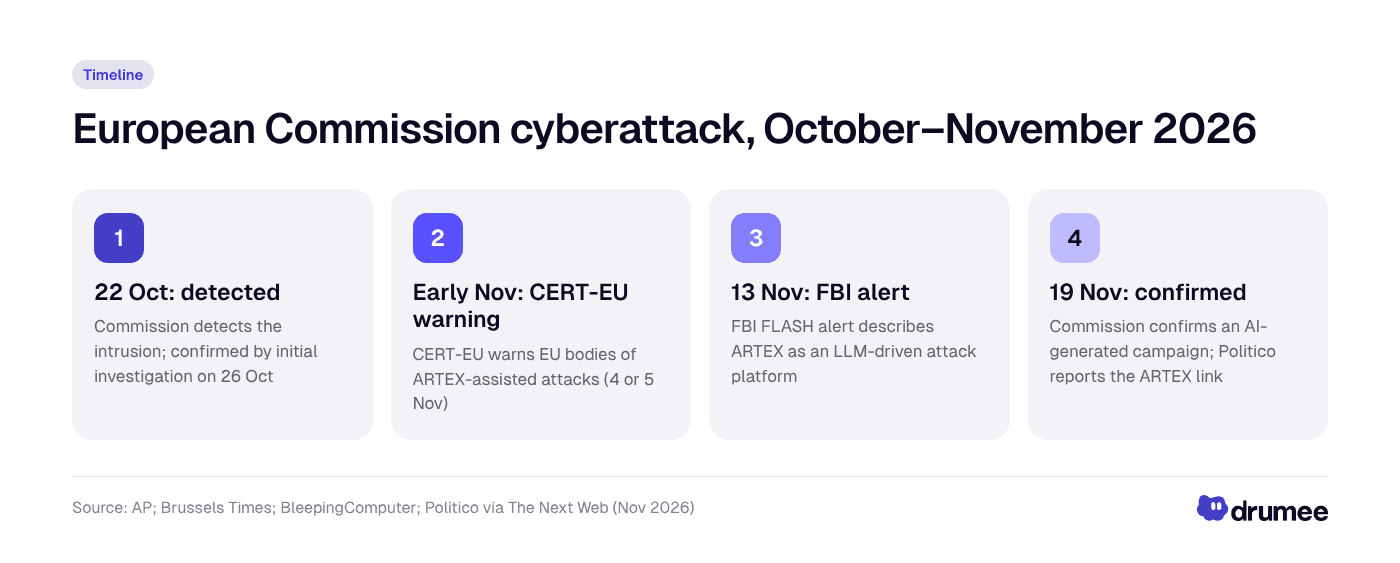
Four weeks passed between detection and public confirmation, and the tool attribution came from press reports rather than the Commission.
Who is affected
- Commission staff are the directly affected group: their HR, timesheet, leave and medical-reimbursement services were disrupted, and whether any individual's data was exposed is still under investigation.
- Other EU bodies are on alert. CERT-EU's early-November warning covered its whole constituency, though AP reported no similar incidents at the Council or Parliament.
- Businesses and citizens dealing with the Commission are not known to be affected; nothing reported so far points to external data.
- Any organisation with internet-facing systems is in scope of the method. The FBI alert names partner portals, legacy applications and third-party integrations as surfaces to review (BleepingComputer). Small EU startups and Philippine outsourcing teams that run client portals are exactly the kind of target automated tooling scans for.
What it means under GDPR and NIS2
This is not legal advice, and one point is easy to get wrong: the Commission itself is not under the GDPR or NIS2. EU institutions follow Regulation (EU) 2018/1725, supervised by the EDPS, which requires personal data breaches to be notified to the EDPS within 72 hours where feasible (EDPS). Their cybersecurity duties sit in Regulation (EU, Euratom) 2023/2841, which makes CERT-EU the reporting point for significant incidents.
For your company, the parallel rules are these:
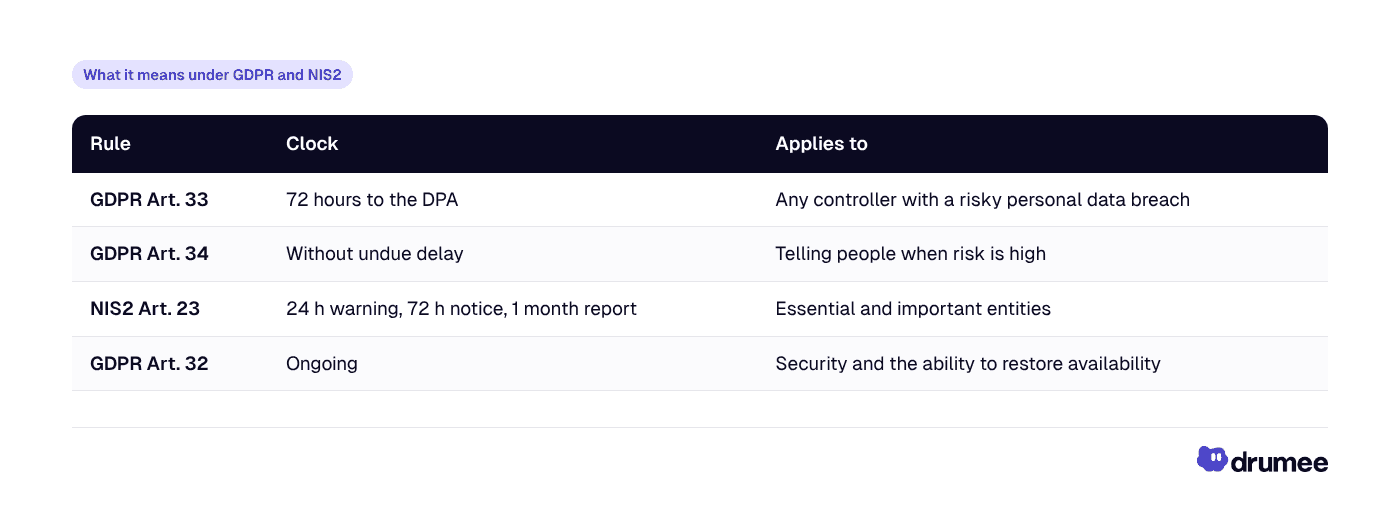
GDPR. Under Article 33 a controller notifies its supervisory authority within 72 hours of becoming aware of a breach that is likely to put people at risk. An HR system holds exactly that kind of data: salaries, bank details, health-related reimbursements. Article 32 also expects you to restore availability "in a timely manner", so ten days without HR is a GDPR question as well as an operational one.
NIS2. If your company is an essential or important entity, Article 23 sets a 24-hour early warning, a 72-hour incident notification and a final report one month later. Article 21 lists business continuity and supply-chain security among the required measures. Many small startups fall outside NIS2's size thresholds, but their larger customers are not, and those customers will push the same expectations down through contracts.
What to do now: a checklist for a 25-person EU startup
- List everything reachable from the internet. Websites, client portals, VPN and remote-access gateways, admin panels, old staging servers and third-party integrations. Automated tools find what you forgot, so start with what you forgot.
- Shrink your patch window. If AI tooling can reach privileged access in hours, a monthly patch routine is too slow for exposed systems. Turn on automatic updates where you can and name one person who checks critical advisories every week.
- Enforce MFA everywhere, and stronger MFA for admins. Remove stale accounts and shared logins, especially for former contractors. Prefer an authenticator app or security key over SMS for anyone with admin rights.
- Pre-write your 72-hour plan. One page: who decides whether a breach is notifiable, how to reach your DPA, who drafts the message to staff and customers, and where the evidence log lives. Store it outside the systems it covers.
- Plan for payroll without HR. Keep an encrypted, recent export of payroll and contact data, test that you can restore it, and agree how to pay people and approve leave if the HR tool is offline for two weeks.
- Ask your vendors three questions. How do you detect intrusions, how fast will you tell us, and can we export all our data if we need to leave? Record the answers in your vendor register.
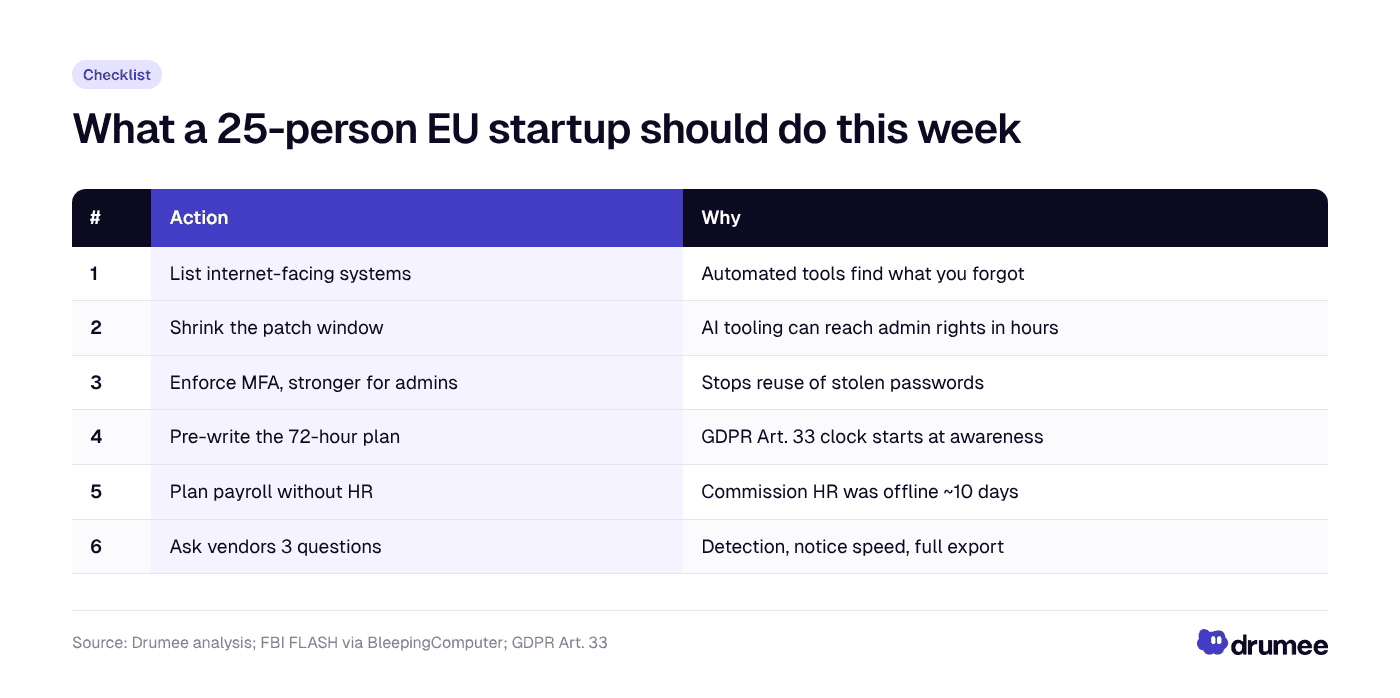
Six actions, most of them a half-day each, cover the gaps this incident exposed: exposure, speed, identity, notification, continuity and suppliers.
The bigger picture: AI-assisted attacks
AI does not invent new categories of attack here. What changes is speed and scale. A framework that chains reconnaissance, exploitation and privilege escalation with little human input lowers the skill needed to run an intrusion and shortens the time defenders have to react. The FBI describing intrusions that reach privileged access in under three hours is the number to remember.
That pressure lands hardest on teams with many small systems and no full-time security staff. Every extra tool is another login page, another integration and another vendor whose incident you inherit, a pattern we covered in the GitHub TeamPCP supply-chain breach. Reducing that surface is the same work as avoiding SaaS vendor lock-in: fewer vendors, clear exports, and knowing where your data sits.
The Commission case also shows that availability is a security outcome. Nobody reported mass data theft, yet Commission staff lost core services for about ten days. For a small company, a ten-day loss of HR, files or chat can cost more than the breach itself.
How a sovereign workspace changes the risk
A sovereign workspace will not stop a determined attacker, and no vendor should claim it does. What it changes is how many systems you have to defend and how much control you keep over your own data.
Drumee Cloud runs as a hosted service at app.drumee.com, with files, folder-native chat, tasks and meetings under one permission model. Its documentation states that traffic uses TLS, passwords are stored only as Argon2id hashes, stored secrets are sealed with AES-256-GCM, and content at rest is encrypted at the storage layer (Drumee docs: data storage and encryption). Each organisation's data carries its tenant ID, the tenant is derived on the server rather than taken from the client, and a build-time check rejects data-access code that skips it.
Two controls map directly to this week's checklist. Organisations can set a security policy that makes two-factor authentication mandatory, and plans that include the audit log keep it for one year (Drumee docs: RBAC system; retention table). Sessions are held on the server, so removing a lost device ends its session at once (Drumee FAQ). End-to-end encryption is in development and will ship in stages; it is not available yet. Teams that want the workspace on infrastructure they run themselves can use Drumee Sovereign Node, sold through contact sales. Our explainer on end-to-end encrypted workspaces covers what that model will and will not protect.
The cost, control and sovereignty case is simple: one workspace means one permission model to audit, one vendor to question and one export to test. For EU teams, that also makes the GDPR records in step 4 and step 6 shorter. See the Drumee pricing page for current plans.
FAQ
What happened in the European Commission cyberattack?
The Commission confirmed on 19 November 2026 that an AI-assisted cyber campaign, detected on 22 October, forced it to take HR, medical-reimbursement and translation systems offline for about ten days. It says it has found no evidence of a breach affecting staff as a whole, and the investigation is still open.
Was ARTEX used in the European Commission attack?
Politico reported, citing unnamed sources, that CERT-EU found the attackers used ARTEX. The Commission has only said a publicly available AI tool was involved and has not named it. It is also unclear whether ARTEX was used to break in or only to search for weaknesses.
What is the ARTEX AI hacking tool?
ARTEX is an open-source, LLM-driven penetration-testing framework. The FBI warned on 13 November 2026 that threat actors use it to automate reconnaissance, vulnerability discovery, exploitation and privilege escalation. Its original GitHub repository was removed in October, but forks remain available.
Was personal data stolen in the Commission cyberattack?
Not according to what is confirmed so far. The Commission says it found no evidence of a breach affecting its staff as a whole and received no ransom demand. That wording leaves open whether data on individual employees was exposed, which investigators are still checking.
How can a small company protect itself from AI-assisted attacks?
Map every internet-facing system, patch exposed services quickly, enforce multi-factor authentication for all accounts and stronger MFA for admins, and prepare a one-page plan for the GDPR 72-hour notification. Keep an offline, tested export of critical data such as payroll.
Conclusion
The European Commission cyberattack is a confirmed, serious disruption with an unconfirmed tool attribution. The safe reading is the one the Commission itself gives: a publicly available AI tool helped attackers, and ten days of downtime followed. For a small EU team, the response is not panic. It is a shorter list of exposed systems, faster patching, MFA everywhere, a written 72-hour plan and a payroll fallback, all of which you can start today.
Try Drumee with your team: your first month is $1. Start your team for $1
Keep reading
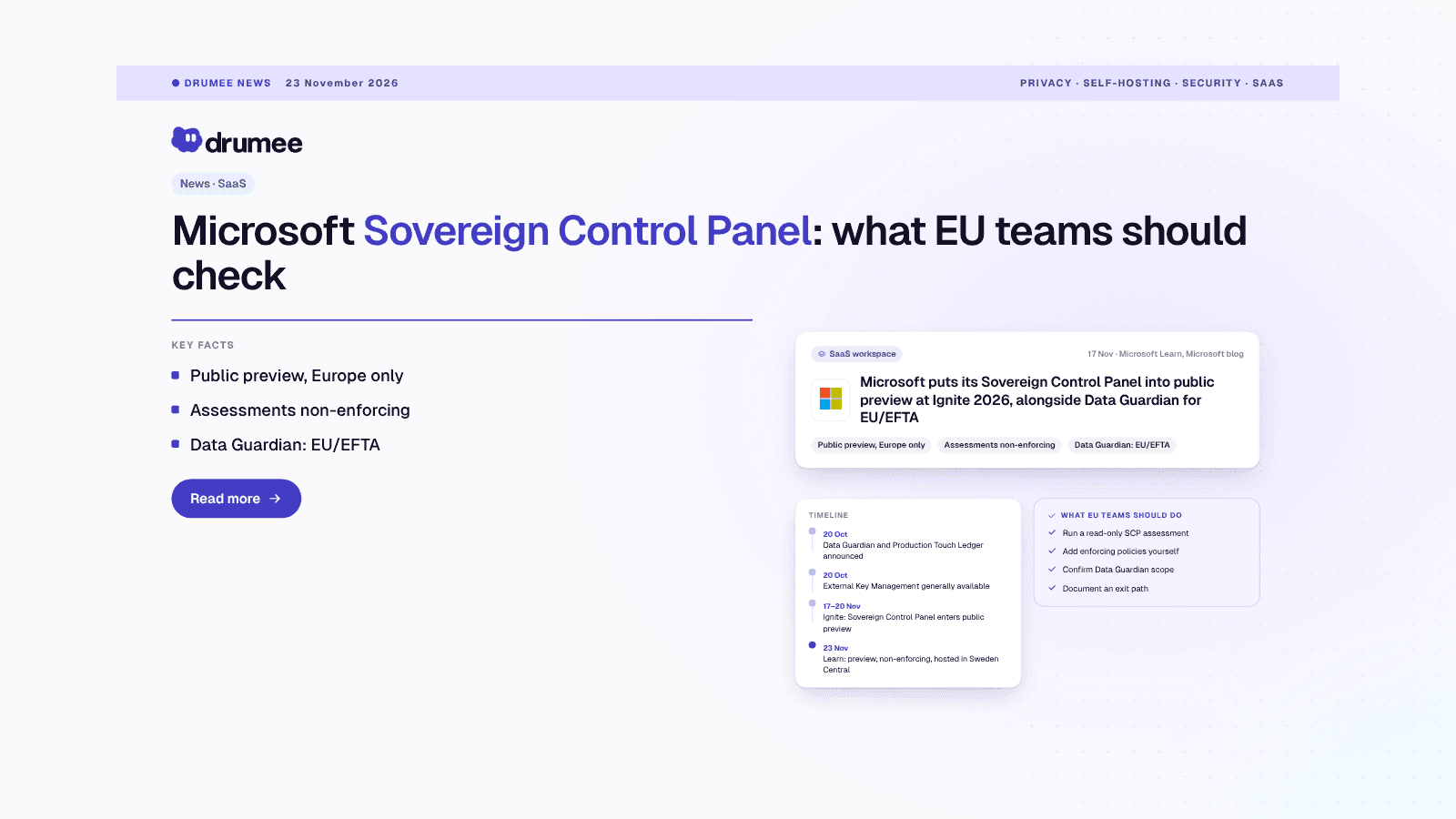
Microsoft Sovereign Control Panel Hits Public Preview: What EU Teams Should Check (Nov 2026)
Published 23 November 2026 · Updated 23 November 2026 · 8 min read Microsoft used Ignite 2026 in San Francisco to move its Sovereign Control Panel into public preview. It is the newest piece of the "Microsoft Sovereign Cloud" programme for Europea...
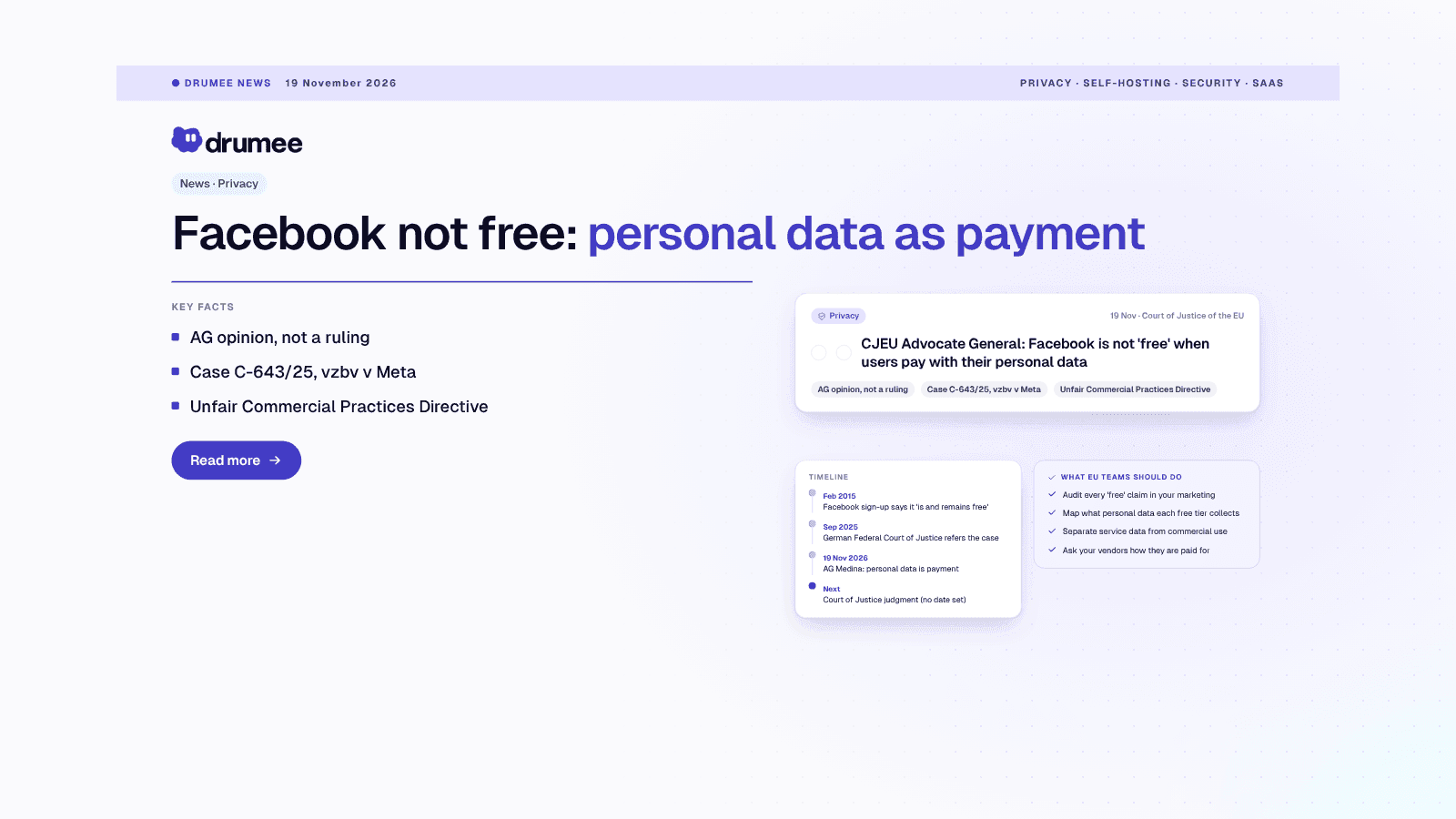
Facebook Is Not Free, Says CJEU Advocate General: Personal Data as Payment
Published 23 November 2026 · Updated 23 November 2026 · 7 min read TL;DR: On 19 November 2026, Advocate General Laila Medina told the EU Court of Justice that giving personal data and consenting to its commercial use is a form of payment. A servi...
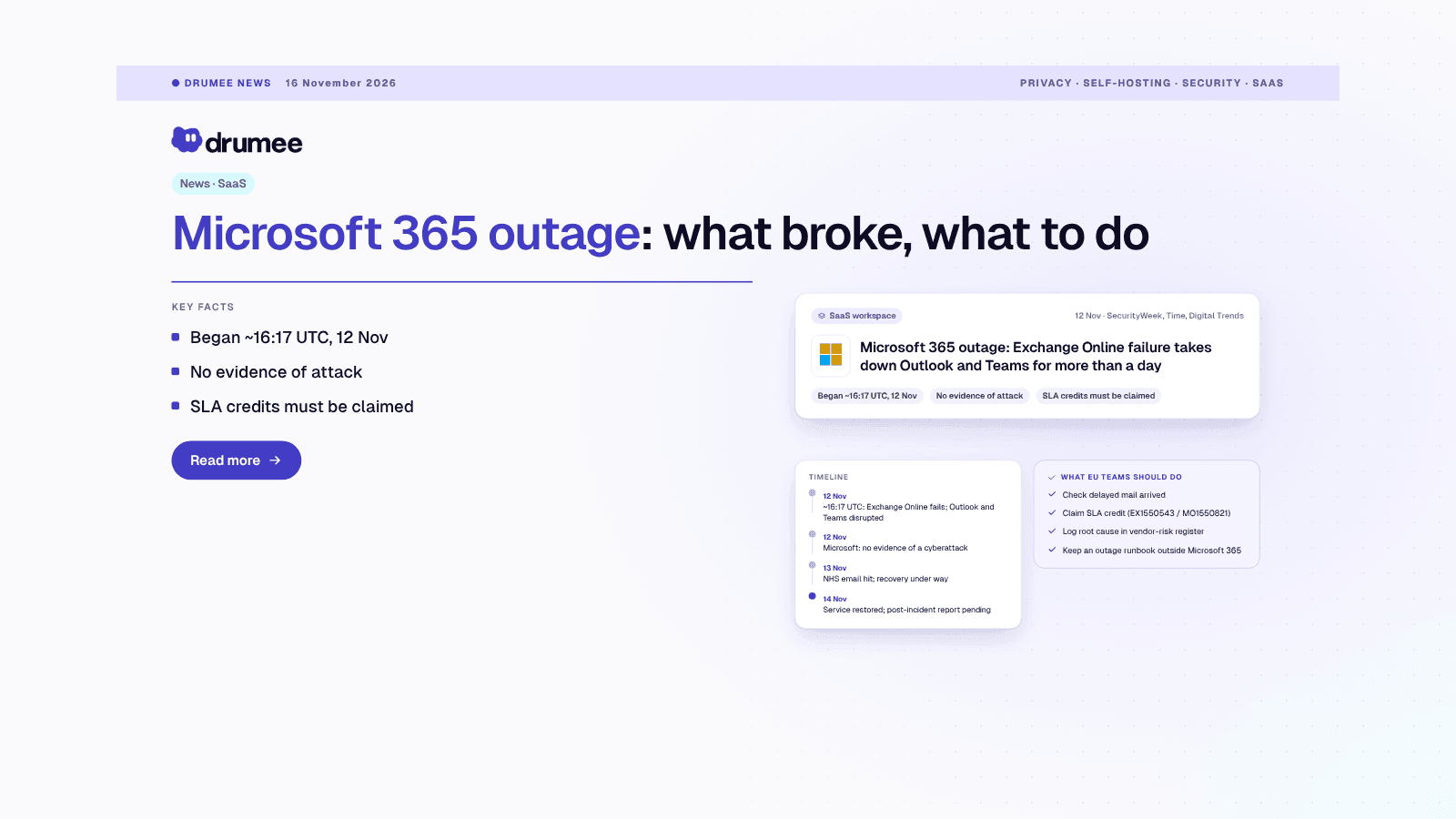
Microsoft 365 Outage (November 2026): What Broke, Who Was Hit and What to Do Now
Published 16 November 2026 · Updated 16 November 2026 · 7 min read The Microsoft 365 outage that started on Thursday 12 November 2026 was one of the longest disruptions of Outlook and Teams in years. This post sets out what is confirmed, what Micr...