
Microsoft Sovereign Control Panel Hits Public Preview: What EU Teams Should Check (Nov 2026)
Published 23 November 2026 · Updated 23 November 2026 · 8 min read Microsoft used Ignite 2026 in San Francisco to move its Sovereign Control Panel into public preview. It is the newest piece of the "Microsoft Sovereign Cloud" programme for Europea...
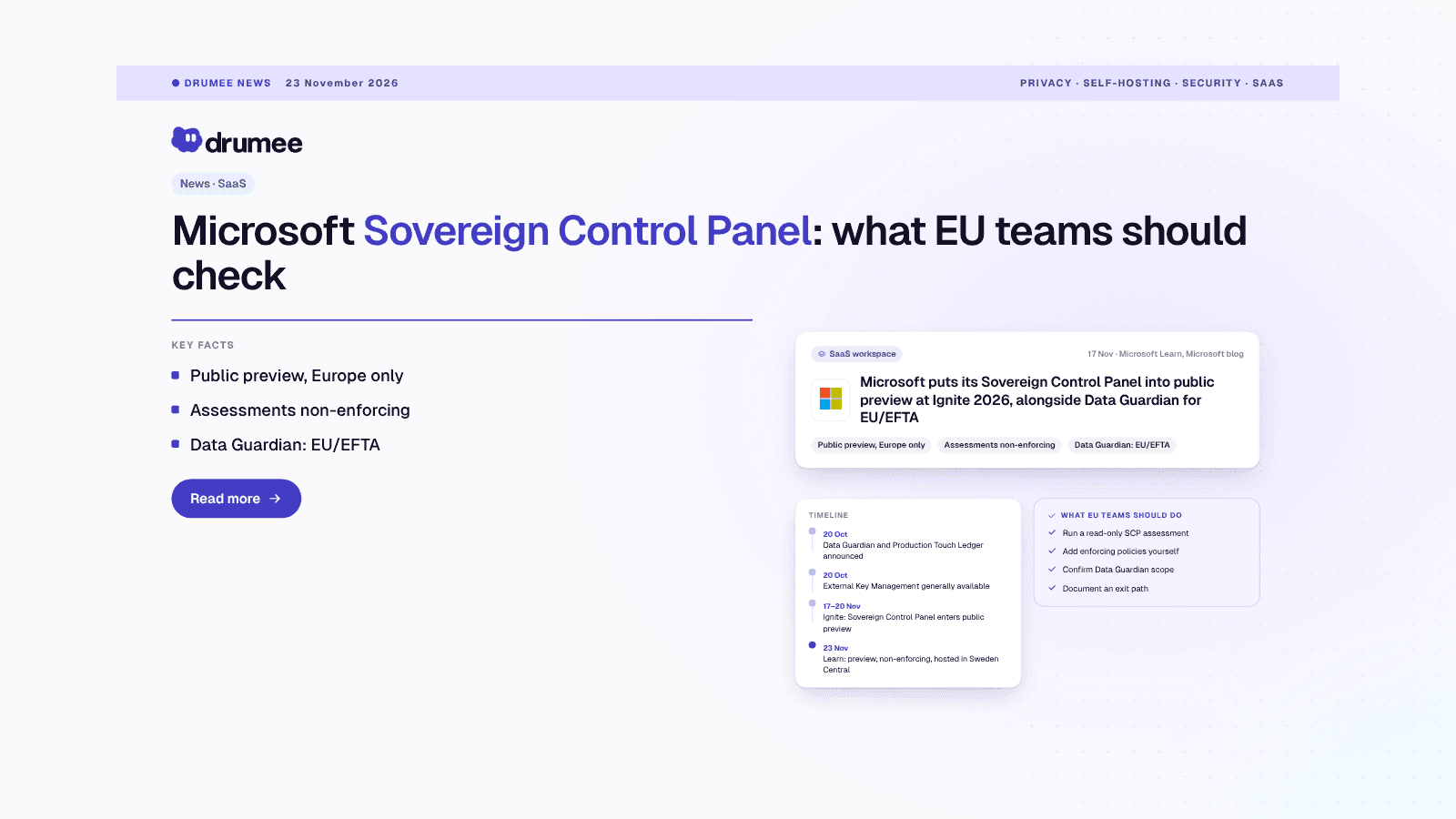
Microsoft Sovereign Control Panel in public preview after Ignite 2026: an Azure portal view that assesses sovereignty posture in European regions but does not…
Published 23 November 2026 · Updated 23 November 2026 · 8 min read
Microsoft used Ignite 2026 in San Francisco to move its Sovereign Control Panel into public preview. It is the newest piece of the "Microsoft Sovereign Cloud" programme for European customers, which also includes Data Guardian, announced in October. This post covers what the tools do, where they stop, and what an EU team should check before relying on them.
TL;DR
What happened and does it affect me? Microsoft's Sovereign Control Panel, an Azure portal view that assesses data residency, encryption, network exposure and continuity, is now in public preview for European regions. It reports on your posture but does not enforce it. If you run on Azure or Microsoft 365 in the EU, it is a useful audit aid, not a legal answer to US jurisdiction.
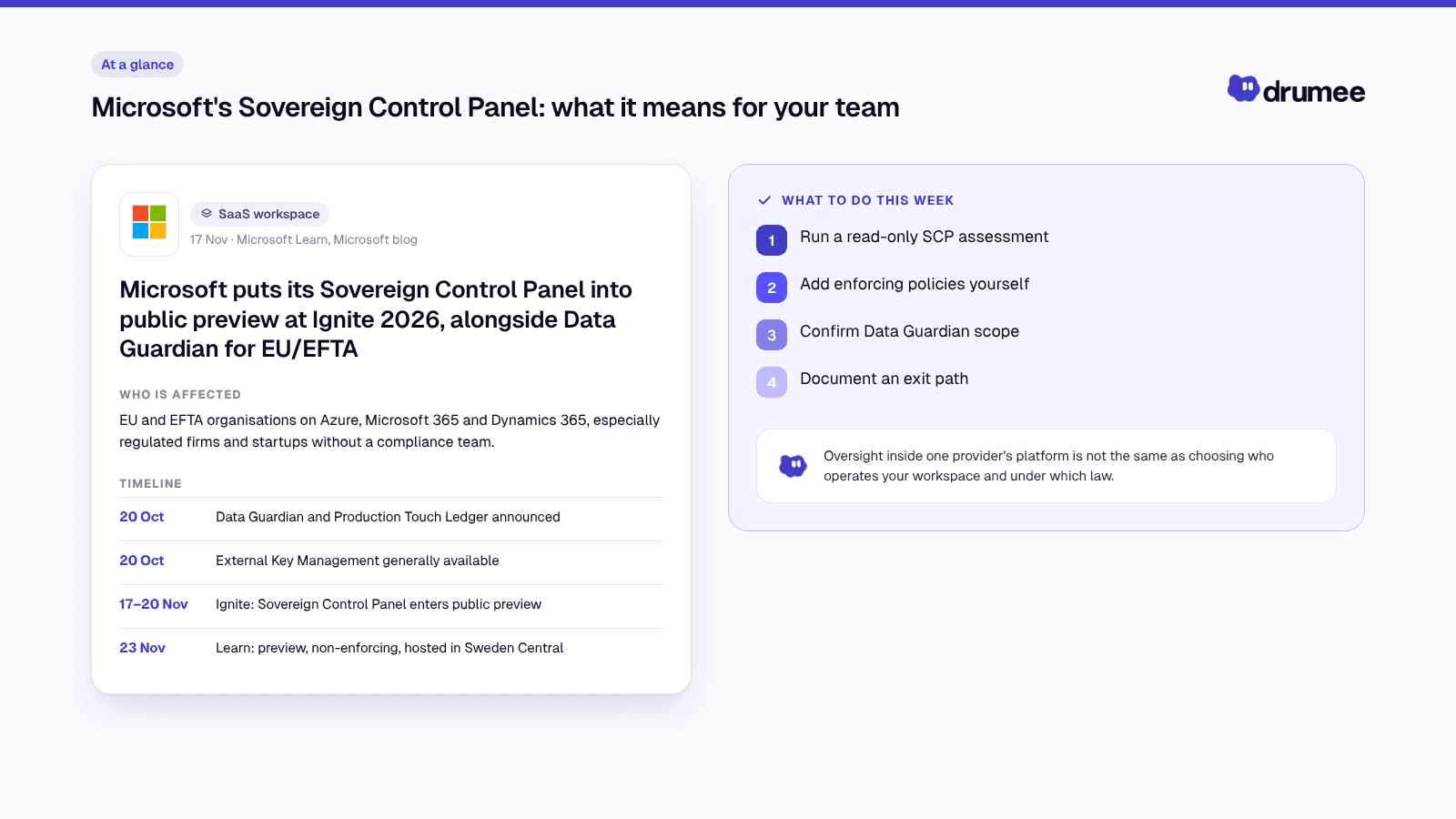
What it means for your team.
What happened
On 20 October 2026, Microsoft announced a package of sovereignty controls for European customers. The official Microsoft blog said the Sovereign Control Panel, then in private preview, would enter public preview at Microsoft Ignite. Computerworld and Campus Technology both reported that demand for these controls is strongest in Europe.
Ignite ran from 17 to 20 November 2026 at the Moscone Center (Moscone Center). Microsoft's own documentation now labels the product "Sovereign Control Panel (SCP) (preview)". Its get-started guide refers to "this public-preview workflow", and the SCP REST API is published as a preview version. Ignite recaps such as Calandor's Book of News summary also list it as public preview since Ignite.
What the Sovereign Control Panel does. According to Microsoft Learn, SCP gives "a unified Azure portal experience for viewing, managing, and evaluating sovereignty posture across tenant resources". It checks selected subscriptions and management groups against four areas: data residency, encryption, network exposure and business continuity. Microsoft frames the workflow as Discover, Control, Act. The product was previously called Regulated Environment Management (REM).
What it does not do. The get-started guide says the policy assignments SCP creates "are non-enforcing" (Microsoft Learn). The same guide says to use Sweden Central as the hosting location for the public-preview workflow, and that the assessment geography is Europe. Ignite recaps add that remediation in the preview covers only data residency on primary resources (Calandor; WindowsForum).
In short: SCP tells you where your Azure estate stands against sovereignty criteria and produces evidence. It does not stop a resource being deployed outside Europe, and it does not change who can legally compel Microsoft.
Data Guardian and the Production Touch Ledger. Data Guardian, announced on 20 October for EU and EFTA regions, puts a trusted partner's EU-resident staff in charge of overseeing remote access by Microsoft engineers to in-scope production systems (Microsoft Learn; Campus Technology). A companion control, the Production Touch Ledger, keeps tamper-evident records of that access and is rolling out in phases. Microsoft's documentation says Data Guardian depends on current availability and supported services, so coverage is not universal yet.
Microsoft also made External Key Management with Azure Managed HSM generally available in October. It lets customers keep root keys on their own hardware or with a third party (ITdaily; Techzine).
Timeline
- 20 Oct 2026: Microsoft announces Data Guardian and the Production Touch Ledger (EU/EFTA), makes External Key Management generally available, and says the Sovereign Control Panel will reach public preview at Ignite.
- 17–20 Nov 2026: Microsoft Ignite, San Francisco. The Sovereign Control Panel moves from private to public preview.
- 23 Nov 2026: Microsoft Learn lists SCP as preview, with non-enforcing assessments, a Sweden Central hosting location and a Europe assessment geography.
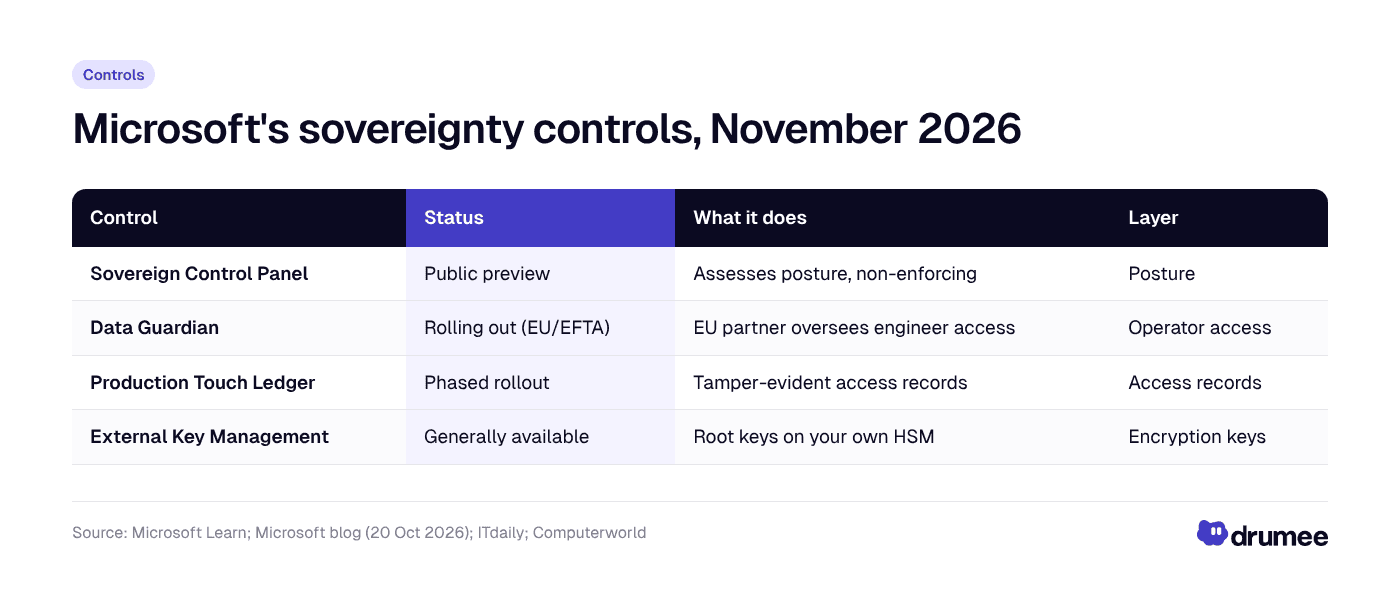
Each control covers one layer, either posture, operator access or keys. None of them answers the jurisdiction question by itself.
Who is affected
- EU and EFTA organisations on Azure get a built-in way to assess their sovereignty posture inside the Azure portal. Public sector bodies and regulated firms that have to produce audit evidence will notice it first.
- Microsoft 365 and Dynamics 365 customers. Microsoft's blog says Data Guardian oversight covers Azure, Microsoft 365 and Dynamics 365 workloads. SCP itself assesses Azure resources.
- EU startups and SMEs often run Microsoft 365 for mail and files without a dedicated compliance team. For them, the important question is what these tools change in their GDPR documentation, and the honest answer is "some evidence, no change in the legal analysis".
- Organisations outside Europe are not covered by the preview, because the assessment geography is Europe.
What it means under GDPR and EU rules
This is not legal advice. Here is how the new tools map to the obligations your DPO will ask about.
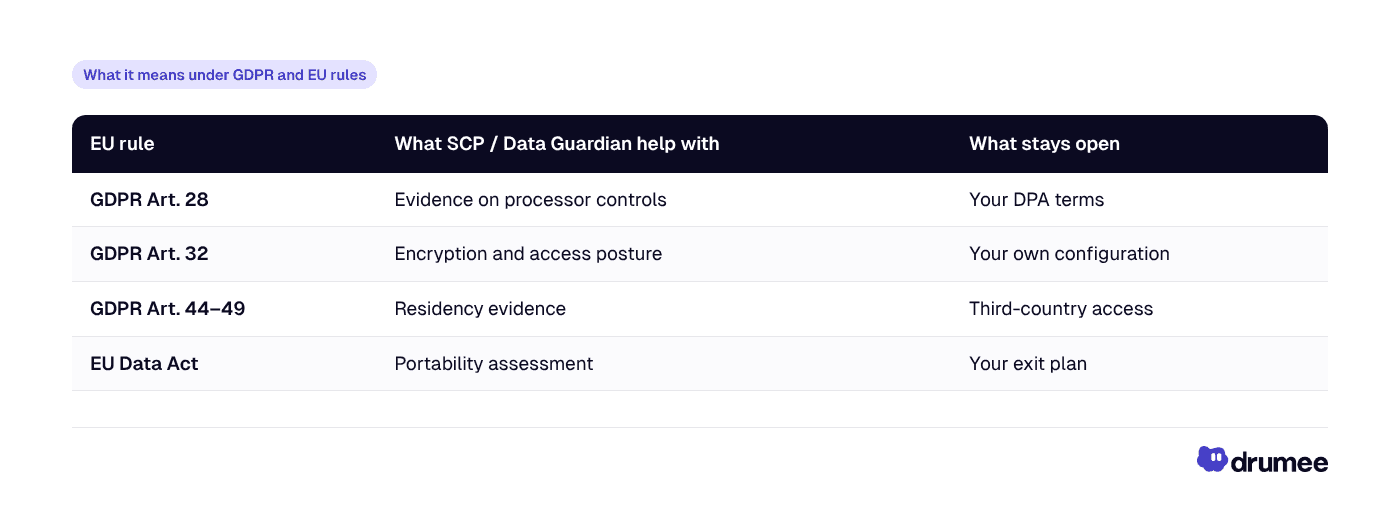
Security of processing. Article 32 asks for appropriate technical and organisational measures. A read-only report on encryption and network exposure is useful evidence that you checked. It does not prove the controls are correctly configured, especially when assignments do not enforce anything.
Transfers and jurisdiction. GDPR's transfer rules (Art. 44–49) concern access from outside the EU as well as storage location. Under the US CLOUD Act, US providers must disclose data in their "possession, custody, or control" regardless of where it is stored (WilmerHale). In June 2025, Microsoft France's legal director told the French Senate under oath that he could not guarantee French data would not reach US authorities without French authorisation (Techzine; heise).
Commentators make the same point about the October package. Ataila notes that it says nothing about exit or jurisdiction, and theCUBE Research argues that oversight is not the same as custody. Analysts quoted by Computerworld say the measures reduce risk but cannot eliminate it. That is a fair summary: oversight of engineer access is a real operational improvement, and it is a different thing from a legal shield.
Exit. Under the EU Data Act, cloud switching charges, including egress fees for switching, are banned from 12 January 2027 and capped at direct cost until then (Travers Smith). SCP's portability assessment can feed into an exit plan, but it does not replace one.
What to do now
- Run a read-only SCP assessment on your main Azure subscriptions and export the results. Treat them as audit evidence for your records of processing and Article 32 file, not as proof of compliance.
- Fix what the report finds yourself. Because assignments are non-enforcing, add enforcing Azure Policy rules for allowed regions and encryption where you need hard guarantees.
- Ask Microsoft or your reseller exactly which services Data Guardian covers today for your tenant, and whether Production Touch Ledger records are available to you.
- Update your transfer impact assessment. Record that operator-access oversight improved, and that US jurisdiction over Microsoft as a US provider is unchanged.
- Write down an exit path for at least your most sensitive workload (files, client documents or HR data), using the Data Act timeline as a deadline.
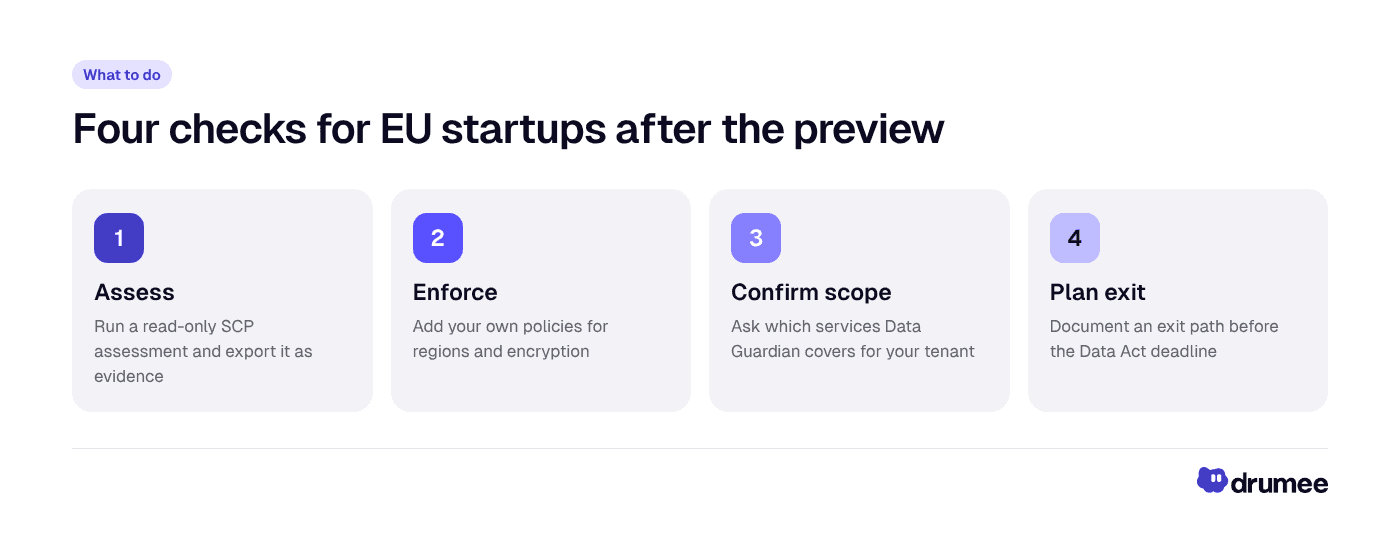
The panel tells you where you stand. Enforcement, contracts and an exit plan are still your responsibility.
The bigger picture
Every large US hyperscaler now sells a European sovereignty offer. AWS opened its European Sovereign Cloud in Brandenburg, Germany, and Help Net Security reported it generally available on 15 January 2026. Google works through partners: S3NS, the Thales venture that runs Google Cloud technology, received France's SecNumCloud qualification for its PREMI3NS offer in December 2025 (Thales).
The money follows the worry. Gartner expects worldwide sovereign cloud IaaS spending to reach about $80 billion in 2026, with Europe overtaking North America in 2027. Microsoft's answer is to give customers more visibility and more oversight inside its own platform. That helps, but the platform and the legal entity stay the same.
For context on the terms, see our guides to what data sovereignty means and enterprise data residency requirements. Residency and sovereignty are related but not identical. The Microsoft 365 outage of November 2026 showed the other side of concentration: when one provider runs mail, chat and files, both your legal exposure and your operational risk sit in one place.
How a sovereign workspace changes the risk
A sovereign workspace starts from a different question. Instead of asking how much oversight the provider allows you, it asks who operates the system and under which law.
Two ways to run Drumee: Drumee Cloud is the hosted workspace at app.drumee.com: sign up and start in minutes (your team's first month is $1). Drumee Sovereign Node runs Drumee on your own infrastructure, with unlimited users, SDK access and a dedicated SLA; contact sales.
- Drumee is built by Thidima SA, a Swiss company. Files, folder-native chat, tasks and meetings live in one workspace under one permission model, so there are fewer vendors to assess in your transfer documentation.
- On Drumee Cloud, ask for the hosting details. Ask the Drumee team for the current hosting provider, region and DPA before you put personal data in it, the same way you would with any vendor.
- On Drumee Sovereign Node, the workspace runs on your own infrastructure. The hosting location is the one you choose, which suits teams that need that level of control.
No workspace removes the need for your own controls. What changes is how many layers of foreign jurisdiction and provider policy sit between your team and its data. Our guide to avoiding SaaS vendor lock-in covers how to keep that choice open. Plans are on the Drumee pricing page.
FAQ
What is the Microsoft Sovereign Control Panel?
It is an Azure portal experience, formerly called Regulated Environment Management, that assesses the sovereignty posture of your Azure resources across data residency, encryption, network exposure and business continuity. It entered public preview at Microsoft Ignite in November 2026 and covers European regions.
Does the Sovereign Control Panel enforce data residency?
No. Microsoft's documentation says the assessment assignments it creates are non-enforcing. It reports gaps and produces evidence. To block deployments outside allowed regions, you still need enforcing Azure Policy rules or equivalent controls.
Does Microsoft Data Guardian protect EU data from the US CLOUD Act?
Data Guardian adds EU-resident partner oversight of Microsoft engineers' remote access in EU and EFTA regions. It is an operational control. The CLOUD Act applies to data in a US provider's possession, custody or control wherever it is stored, and Microsoft's announcement did not say Data Guardian changes that.
Is the Microsoft Sovereign Control Panel free?
Microsoft has not published separate pricing for the preview in the sources we reviewed. Check the Azure portal and your agreement before relying on it in production, because preview features carry no production guarantees.
Conclusion
Microsoft's Sovereign Control Panel is a useful step. It gives EU Azure customers one place to see residency, encryption and continuity gaps, and Data Guardian adds oversight that did not exist before. It assesses rather than enforces, though, and neither tool changes the legal position of a US provider. Use the panel for evidence, enforce your own policies, and keep an exit path for the data that matters most.
Try Drumee with your team: your first month is $1. Start your team for $1
Keep reading
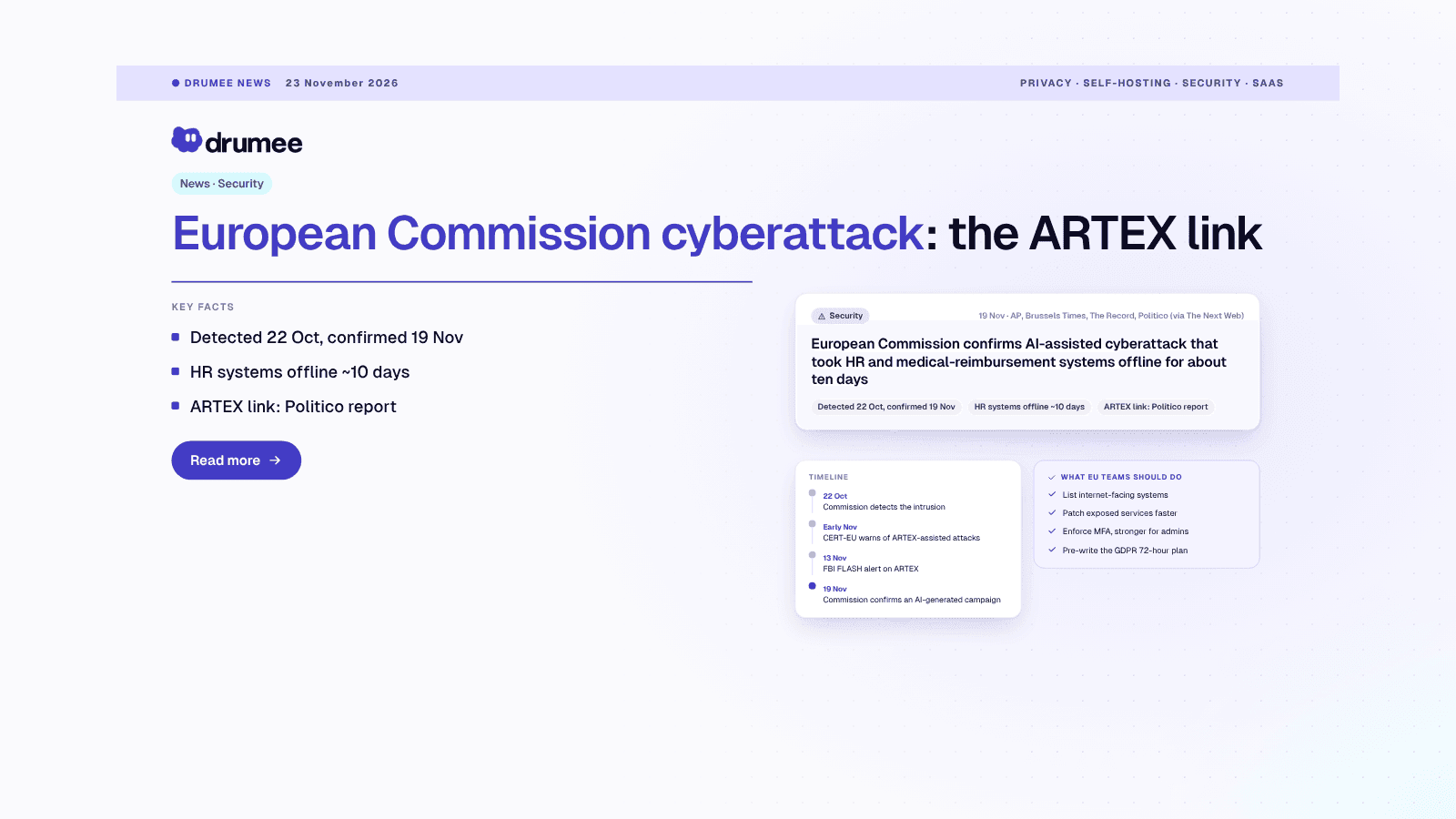
European Commission Cyberattack: What Is Confirmed, the ARTEX Link and What to Do (Nov 2026)
Published 23 November 2026 · Updated 23 November 2026 · 8 min read The European Commission cyberattack confirmed on 19 November 2026 is one of the first incidents that a major public body has openly tied to an AI tool. This post separates what the...
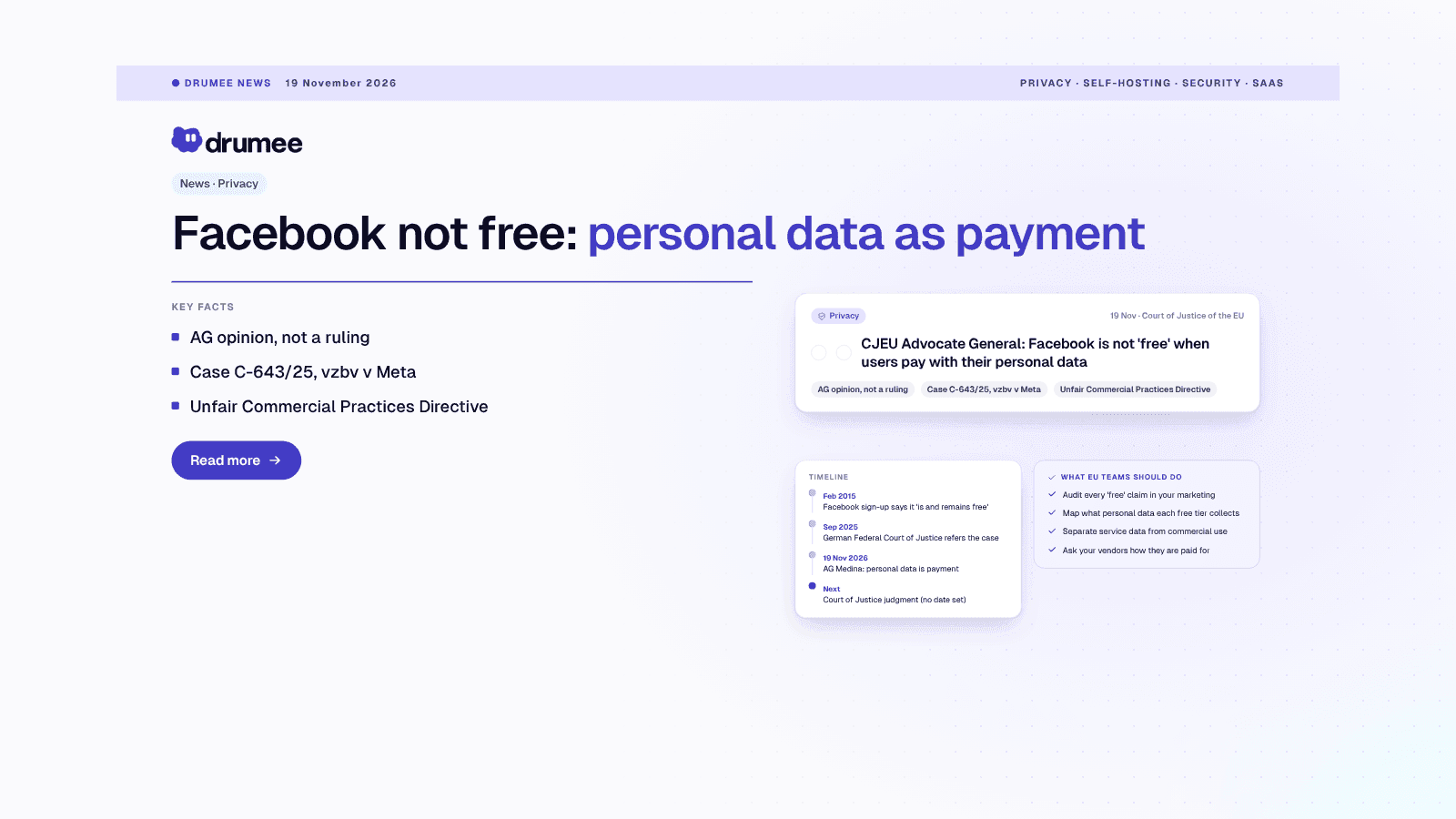
Facebook Is Not Free, Says CJEU Advocate General: Personal Data as Payment
Published 23 November 2026 · Updated 23 November 2026 · 7 min read TL;DR: On 19 November 2026, Advocate General Laila Medina told the EU Court of Justice that giving personal data and consenting to its commercial use is a form of payment. A servi...
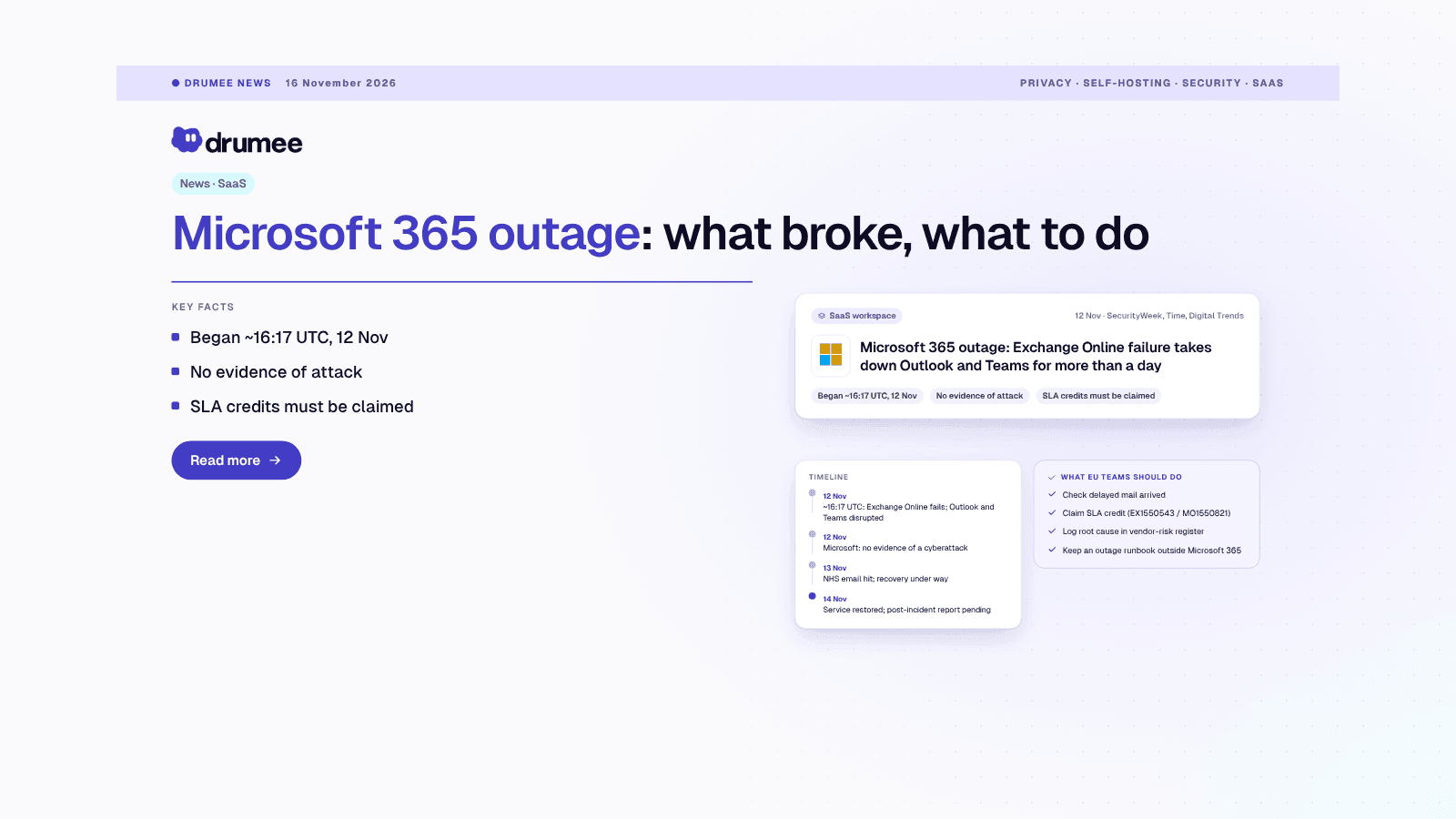
Microsoft 365 Outage (November 2026): What Broke, Who Was Hit and What to Do Now
Published 16 November 2026 · Updated 16 November 2026 · 7 min read The Microsoft 365 outage that started on Thursday 12 November 2026 was one of the longest disruptions of Outlook and Teams in years. This post sets out what is confirmed, what Micr...