
Tinder GDPR Fine: Why the DPC Imposed €11M Over the Right of Access
Published 16 November 2026 · Updated 16 November 2026 · 7 min read TL;DR: On 13 November 2026, Ireland's Data Protection Commission announced an €11 million fine against MTCH Technology Services, the company that runs Tinder in the EU. Its "Downl...
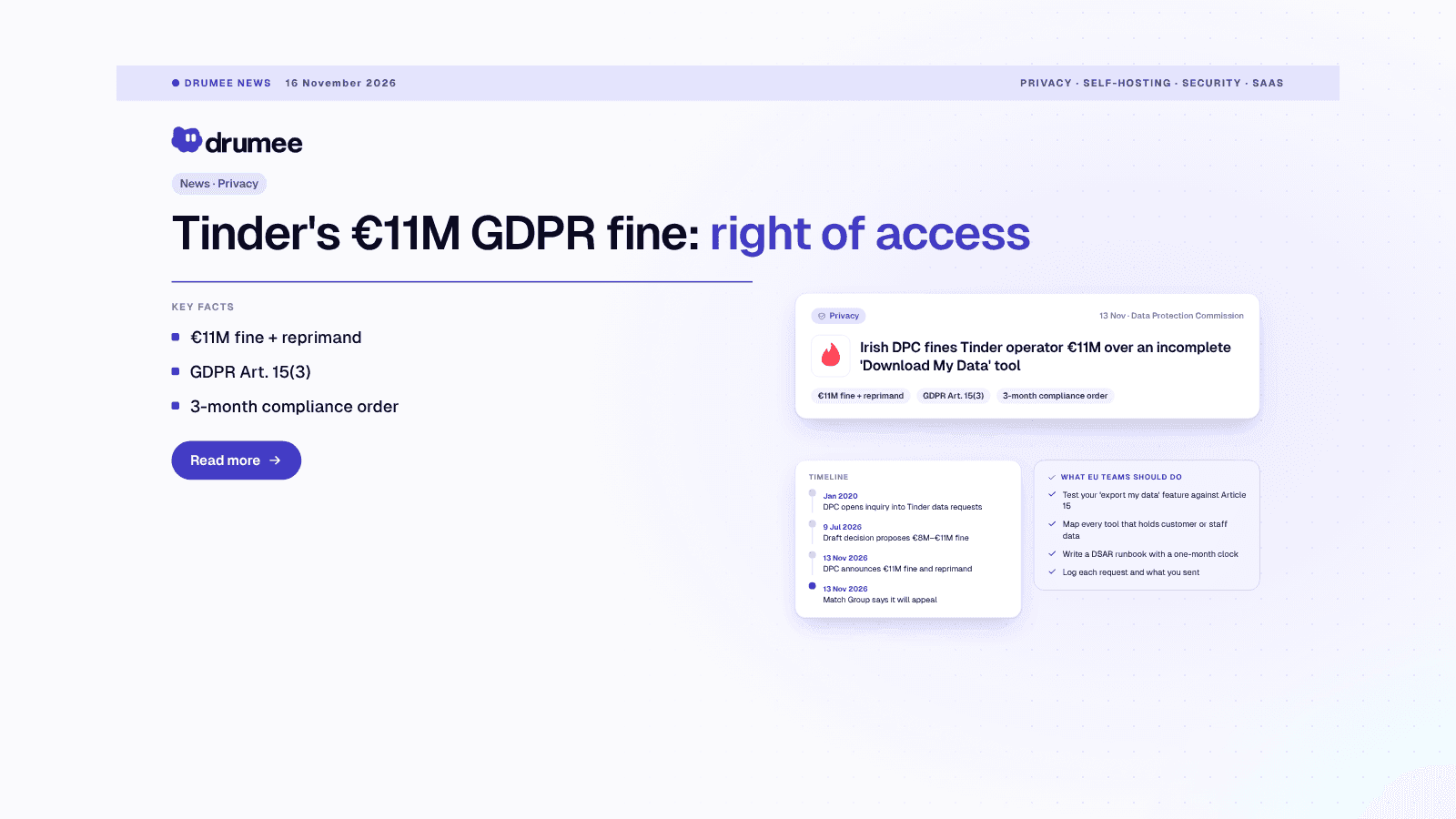
Ireland's DPC announced on 13 November 2026 that it had fined Tinder operator MTCH €11 million because its Download My Data tool did not give users a complete…
Published 16 November 2026 · Updated 16 November 2026 · 7 min read
TL;DR: On 13 November 2026, Ireland's Data Protection Commission announced an €11 million fine against MTCH Technology Services, the company that runs Tinder in the EU. Its "Download My Data" tool left out some data categories and summarised others, breaching the GDPR right to a copy (Art. 15(3)). If your company answers access requests with an automated export, this decision applies to you.
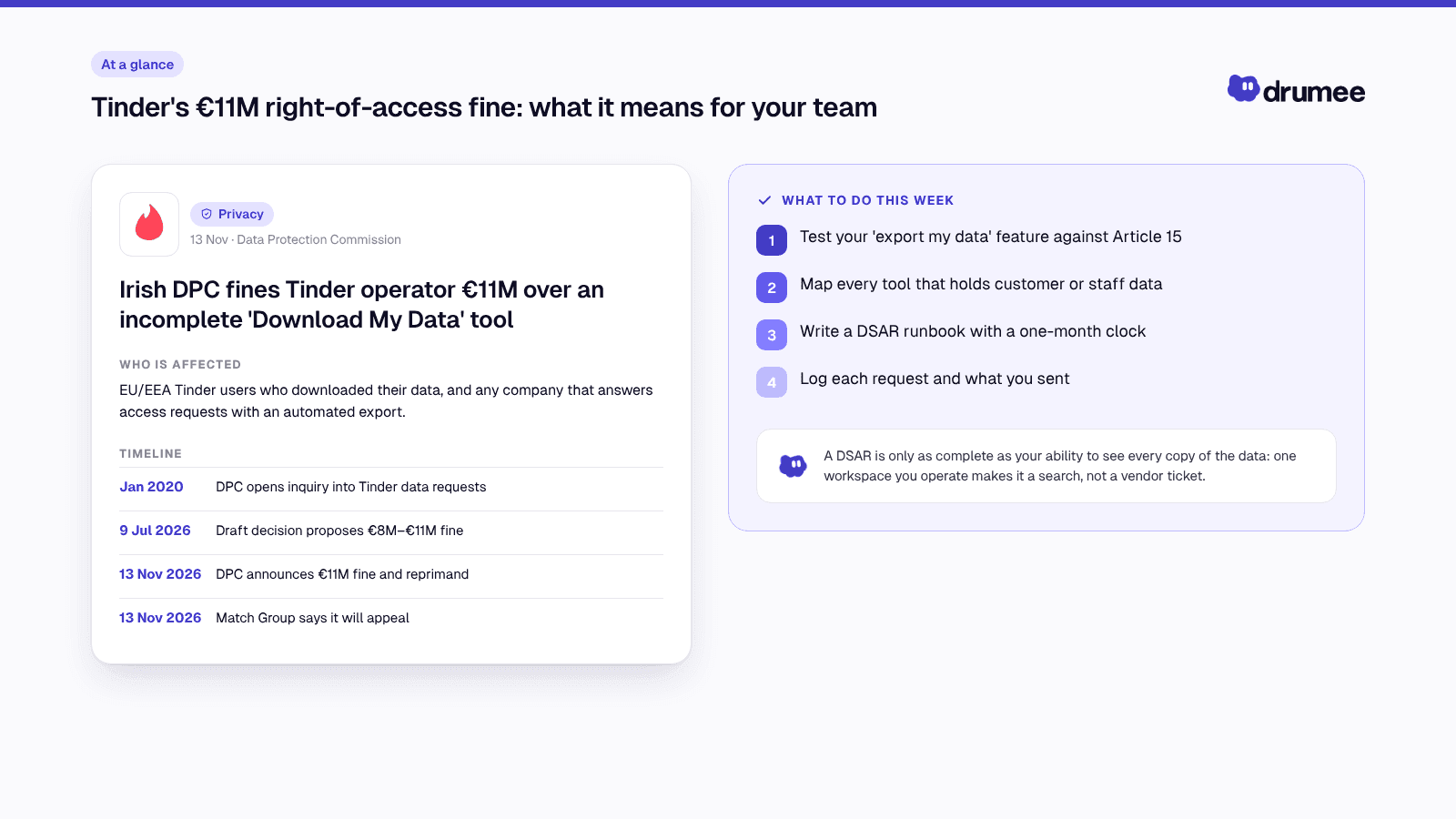
Tinder's €11M right-of-access fine: what it means for your team.
What happened
On 13 November 2026, the Irish Data Protection Commission (DPC) announced an €11 million administrative fine against MTCH Technology Services Limited, the Match Group company that operates Tinder for EU and EEA users. The regulator also issued a reprimand and ordered MTCH to bring its processing into compliance within three months. Match Group's Q3 2026 Form 10-Q dates the final decision itself to 13 October 2026, a month before the public announcement.
The decision is about one specific obligation: giving people a full copy of their personal data when they ask for it. Tinder pointed users to a self-service "Download My Data" tool. The DPC found that the data the tool delivered did not meet Article 15(3) GDPR, because certain categories of personal data were missing and others were only provided in summary form, as GRC Report and PPC Land report.
Deputy Commissioner Graham Doyle said tens of thousands of users used the tool during the period the inquiry assessed, according to TheJournal.ie. His point, as reported, was not that automated tools are banned. They are acceptable, but they must be complete, or be transparent about what they leave out.
The lesson in one line: a "download my data" button is a way to deliver an access request, not proof that you have answered it.
The inquiry is old. The DPC opened it on its own initiative in January 2020, acting as lead supervisory authority for MTCH (Irish Examiner). Match Group disclosed in its Q2 2026 Form 10-Q that the DPC issued a draft decision on 9 July 2026 proposing a fine of €8 million to €11 million. The final figure landed at the top of that range.
Match Group said it will appeal, as reported by TheJournal.ie and Complex Discovery; we found no public record of the appeal filing yet. A spokesperson told reporters that "Tinder engaged with the DPC throughout this investigation, and we stand behind the privacy protections we've built for our users" (Extra.ie; TheJournal.ie). The DPC said it will publish the full decision in due course.
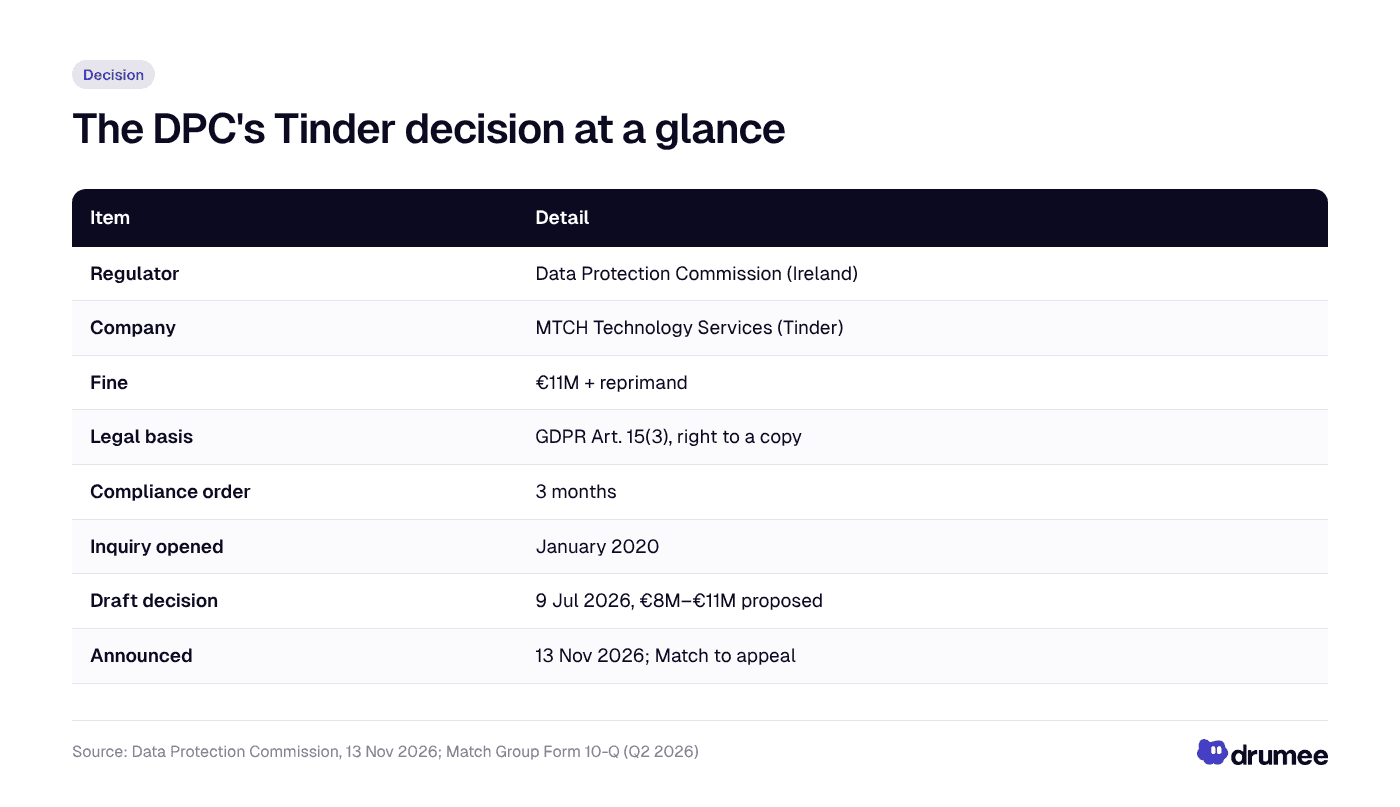
The fine sits at the top of the €8–11M range in the July 2026 draft decision, and it comes with a reprimand and a three-month order to fix the export.
Timeline
- January 2020: DPC opens an own-volition inquiry into MTCH's handling of Tinder users' data requests.
- 9 July 2026: DPC issues its draft decision with a proposed fine of €8M–€11M (Match Group 10-Q).
- 13 October 2026: DPC issues its final decision, per Match Group's Q3 10-Q.
- 13 November 2026: DPC announces the €11M fine, a reprimand and a three-month compliance order.
- 13 November 2026: Match Group says it will appeal (as reported).
- Early 2027: the three-month window for MTCH to bring its processing into compliance runs out; the exact date depends on when the order took effect and on any appeal.
Who is affected
Tinder users in the EU and EEA who requested their data through the tool received incomplete copies. They can ask again in writing once the fix is in place.
The wider audience is every company that answers subject access requests (DSARs) with an automated export. That includes:
- SaaS vendors that offer "export my account" or "download your data" features to EU users.
- Startups and SMEs whose customer, candidate or employee data lives in HR, CRM, chat and file-sharing tools they don't operate.
- DPOs and ops leads who rely on those vendor exports to answer requests on the company's behalf.
For teams outside the EU, including in the Philippines, the rule still bites if you offer services to people in the EU: GDPR applies by who you serve, not where you sit. A clean DSAR process is worth building wherever your users are.
What it means under GDPR
Article 15 GDPR gives every data subject the right to confirmation that their data is processed, access to that data, and context: the purposes, the categories of data, the recipients, the retention period, the source if not collected from them, and whether automated decision-making is used. Article 15(3) adds the right to "a copy of the personal data undergoing processing." That is the paragraph the DPC applied here.
Standalone answer: Is a self-service "download my data" tool enough to comply with Article 15? Only if it is complete. The export must cover every category of personal data you process about the person, not a summary of it. If the tool omits categories, you must say so and provide the rest another way, within the one-month deadline.
The deadline comes from Article 12(3): respond without undue delay and within one month, extendable by two further months for complex or numerous requests if you tell the person why. The first copy must be free.
The fine shows that "access" is not a light-touch right. Fines for breaching data subject rights fall in the higher tier of Article 83(5): up to €20 million or 4% of worldwide annual turnover. This is general context, not legal advice; your DPO or counsel should map it to your own processing.
What to do now
A practical right-of-access checklist for startups and small teams:
- Test your own export against Article 15. Request your own data as a user. Compare the file with your record of processing: profile data, messages, uploaded files, logs, analytics, inferred or derived data. Anything missing or summarised is a gap.
- Map where personal data lives. List every tool that stores customer or staff data (files, chat, tasks, CRM, HR, email) and note how each one exports a single person's data. If a vendor can't, you inherit the problem.
- Write down a DSAR runbook. Cover intake, identity checks, a one-month clock with the extension rule, who searches which system, and a manual fallback when a self-service tool is incomplete.
- Add the context, not just the data. An Art. 15 response also needs purposes, recipients, retention periods and sources. Keep a reusable template so nobody improvises it.
- Keep evidence. Log when each request arrived, what you searched and what you sent. If a regulator asks, the audit trail is your answer.
- As a user: use the in-app download first. If it looks incomplete, send a written Article 15 request, then complain to your national data protection authority if needed.
The bigger picture
GDPR enforcement keeps adding up. The DLA Piper GDPR Fines and Data Breach Survey (January 2026) counts €7.1 billion in cumulative fines between May 2018 and January 2026, about €1.2 billion of it issued in 2025, and roughly 443 breach notifications per day, up 22%.
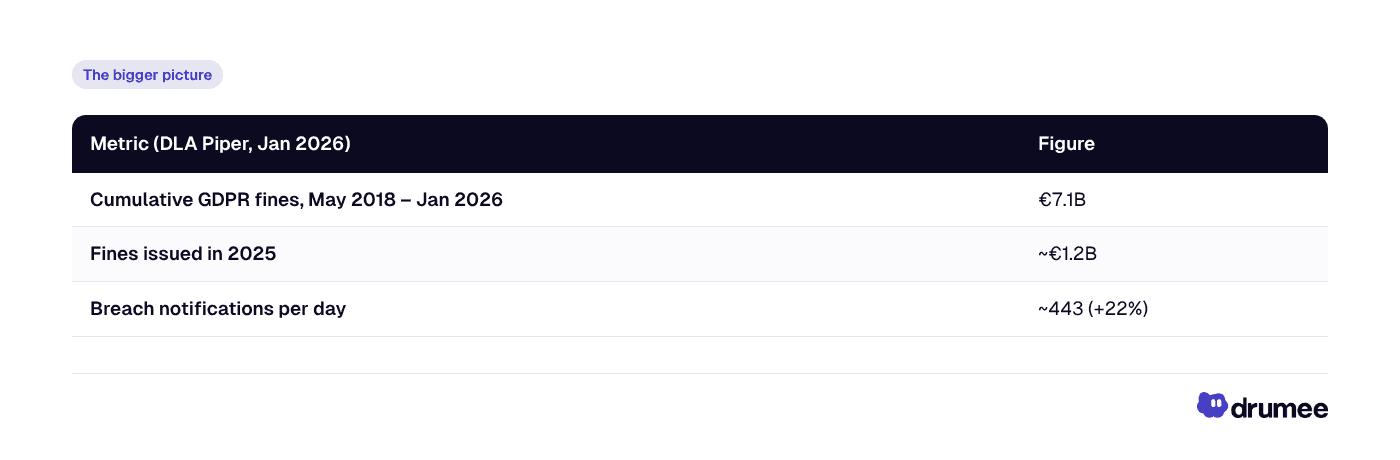
The Tinder fine is small next to Ireland's headline cases, but the subject matters more for small teams. This one is about a basic operational duty that every company with EU users has: knowing what data you hold about a person and handing all of it over.
That duty gets harder as data spreads across more vendors. Each SaaS tool keeps its own copy, its own logs and its own export format, which is why data sovereignty and avoiding vendor lock-in are becoming compliance questions, not only cost questions. For file workflows specifically, our guide to GDPR-compliant file storage for teams covers the vendor checks in more depth.
How a sovereign workspace changes the risk
Standalone answer: A DSAR is only as complete as your ability to see every copy of the data. When files, chat and tasks sit in one workspace you operate, finding everything about one person is a search across one system instead of a support ticket to five vendors, so answering Article 15 on time becomes realistic.
That is the practical case for a sovereign workspace. Drumee runs files, chat, task boards and meetings in one system, either on Drumee-hosted plans (Free → Business) or as a self-hosted Sovereign Node on your own infrastructure. Fewer tools means fewer places for personal data to hide and fewer vendor exports to trust blindly.
On the Business plan, audit logs and API access help you show what happened to a record and pull data programmatically when a request comes in. Our product walkthrough shows how files, chat and tasks sit together in one system. Our Drumee GDPR compliance overview explains how responsibility is shared between you and Drumee.
No tool makes you compliant on its own. But knowing where all personal data lives is the precondition for every Article 15 answer. If you want to try it, start on the Free plan or book a Sovereign Node call.
FAQ
Why was Tinder fined €11 million under GDPR?
Because its "Download My Data" tool did not give users a complete copy of their personal data. The Irish DPC found some categories were omitted and others only summarised, breaching Article 15(3) GDPR. It also issued a reprimand and a three-month compliance order.
Who fined Tinder, and is the decision final?
The Data Protection Commission of Ireland, Tinder's lead EU supervisory authority, announced the fine on 13 November 2026. Match Group said it will appeal, so the outcome could still change.
What does the GDPR right of access require a data export to include?
A copy of all personal data being processed about the person (Art. 15(3)), plus context: purposes, data categories, recipients, retention period, source and any automated decision-making (Art. 15(1)). A summary is not a copy.
How long do you have to respond to a DSAR?
One month from receipt under Article 12(3). You can extend by two further months for complex or numerous requests, but you must tell the person within the first month and explain why.
Keep reading
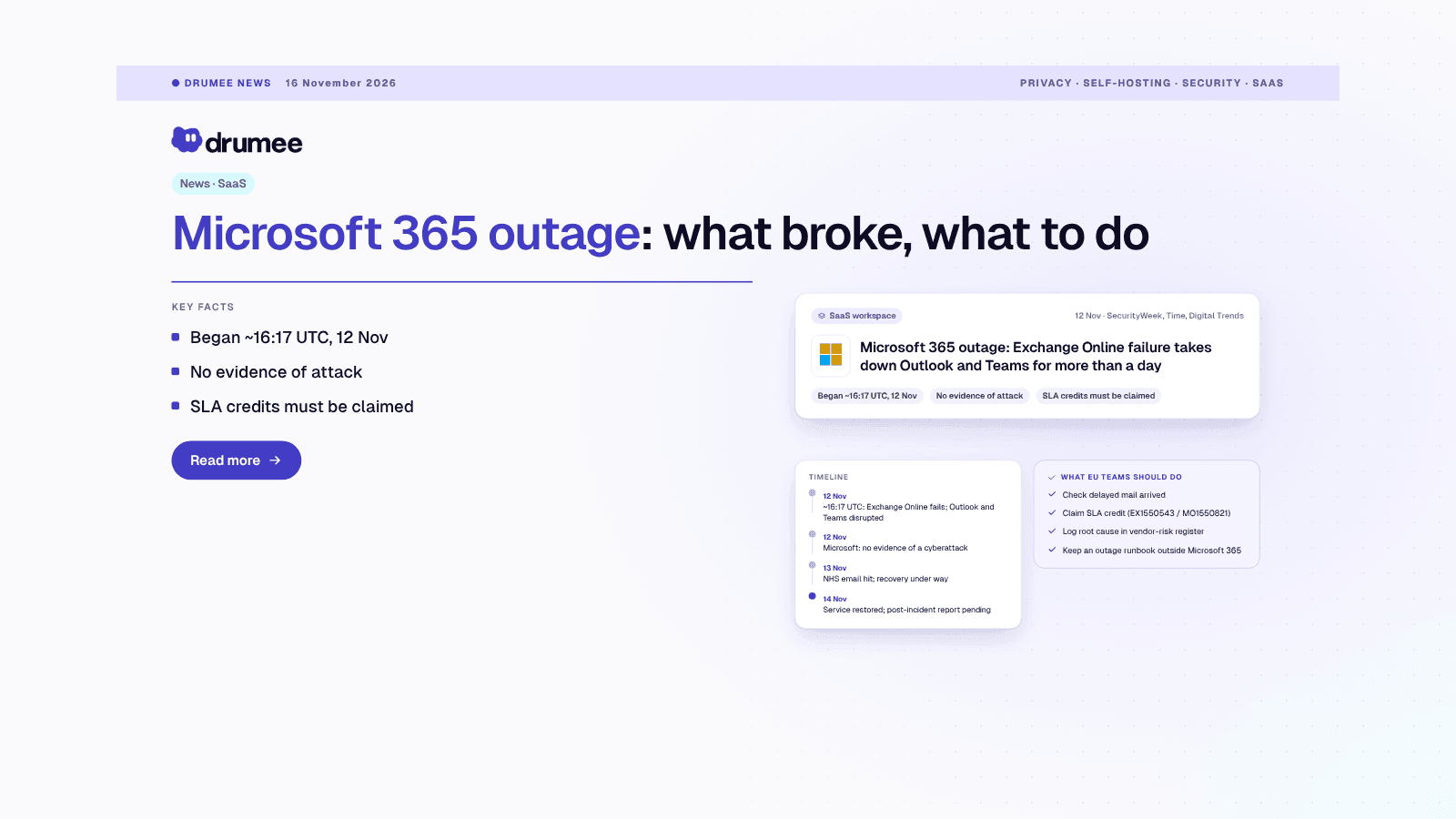
Microsoft 365 Outage (November 2026): What Broke, Who Was Hit and What to Do Now
Published 16 November 2026 · Updated 16 November 2026 · 7 min read The Microsoft 365 outage that started on Thursday 12 November 2026 was one of the longest disruptions of Outlook and Teams in years. This post sets out what is confirmed, what Micr...
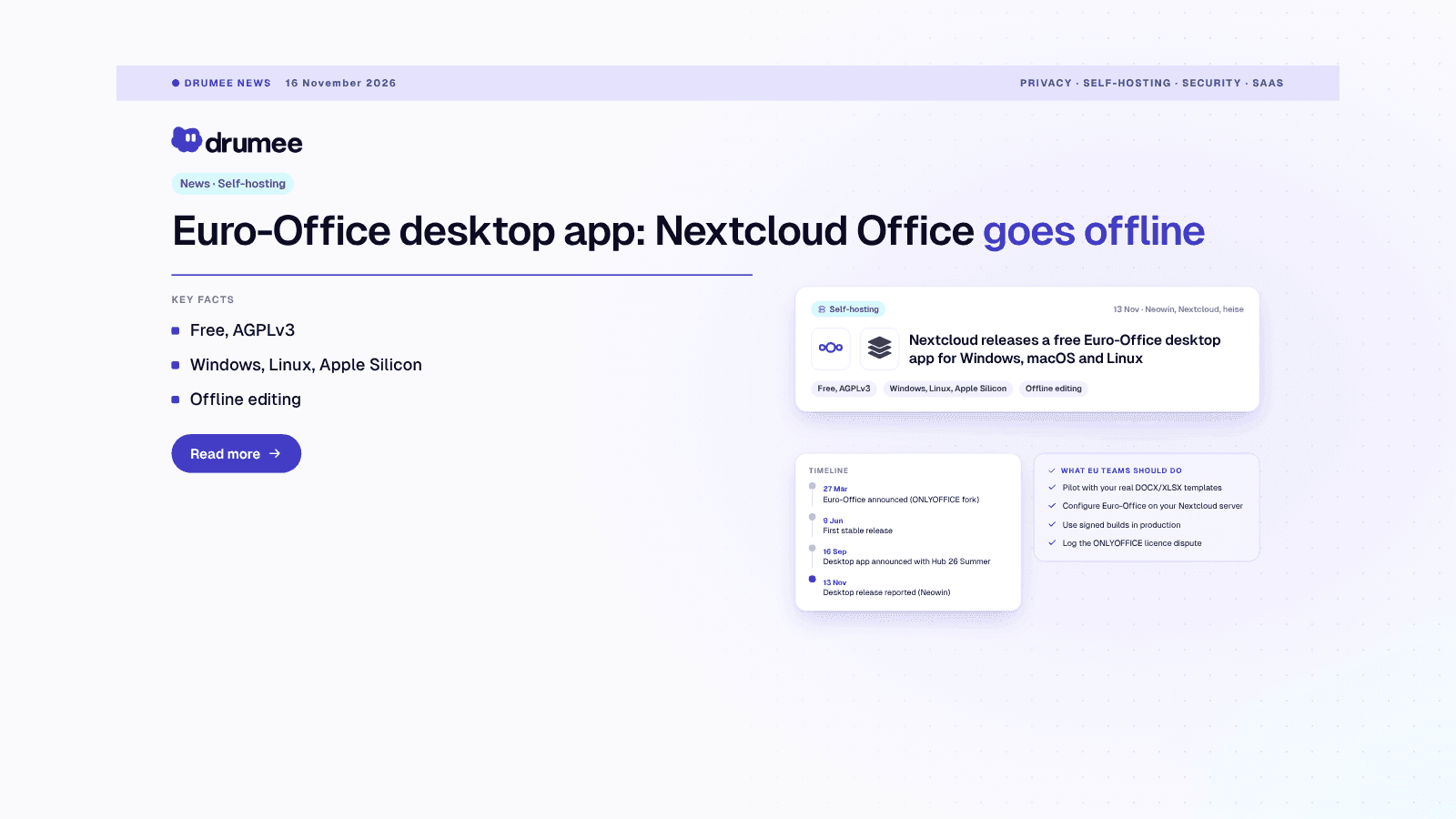
Euro-Office Desktop App: Nextcloud Office Goes Offline on Windows, macOS and Linux
Published 16 November 2026 · Updated 16 November 2026 · 8 min read TL;DR: Nextcloud has released Nextcloud Office Desktop, a free, open source office app built on Euro-Office, for Windows, macOS and Linux. It edits documents, spreadsheets, presen...