
Sovereign Weekly: Privacy, Self-Hosting & Security News (Nov 12, 2026)
Data privacy news for EU teams: Notion's AI vendor breach, an exploited Outlook zero-day, Google's €403M fine appeal and the Digital Fairness Act, with actions.
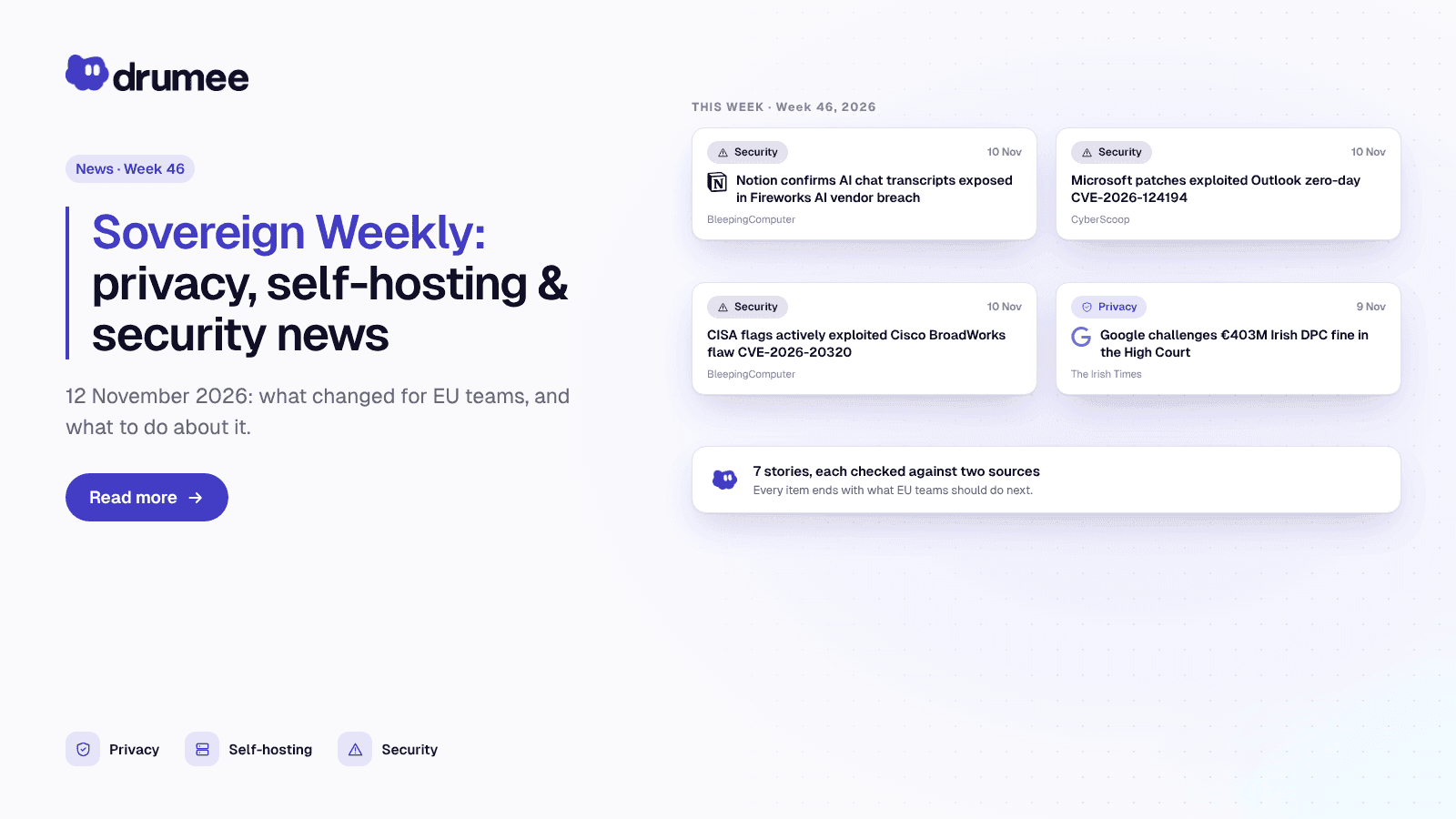
Sovereign Weekly week 46 of 2026: an AI vendor breach at Notion, an exploited Outlook zero-day, Google's appeal of a €403M GDPR fine and the EU Digital…
Updated November 12, 2026 · 10 min read
Sovereign Weekly is Drumee's roundup of the data privacy news, security incidents and SaaS market changes that matter to European teams. Each story gets what happened, why it matters and what to do. This edition covers 2 to 12 November 2026.
TL;DR: the week in data privacy news
This week's data privacy news in 60 words: Notion confirmed that a breach at its AI vendor Fireworks exposed some Notion AI chat transcripts. Microsoft patched an exploited Outlook zero-day, and CISA flagged a Cisco BroadWorks flaw. Google is challenging its €403M Irish GDPR fine in court. Brussels proposed the Digital Fairness Act against dark patterns. Outlook.com wrongly bounced legitimate mail, and Copilot Chat got new usage caps.
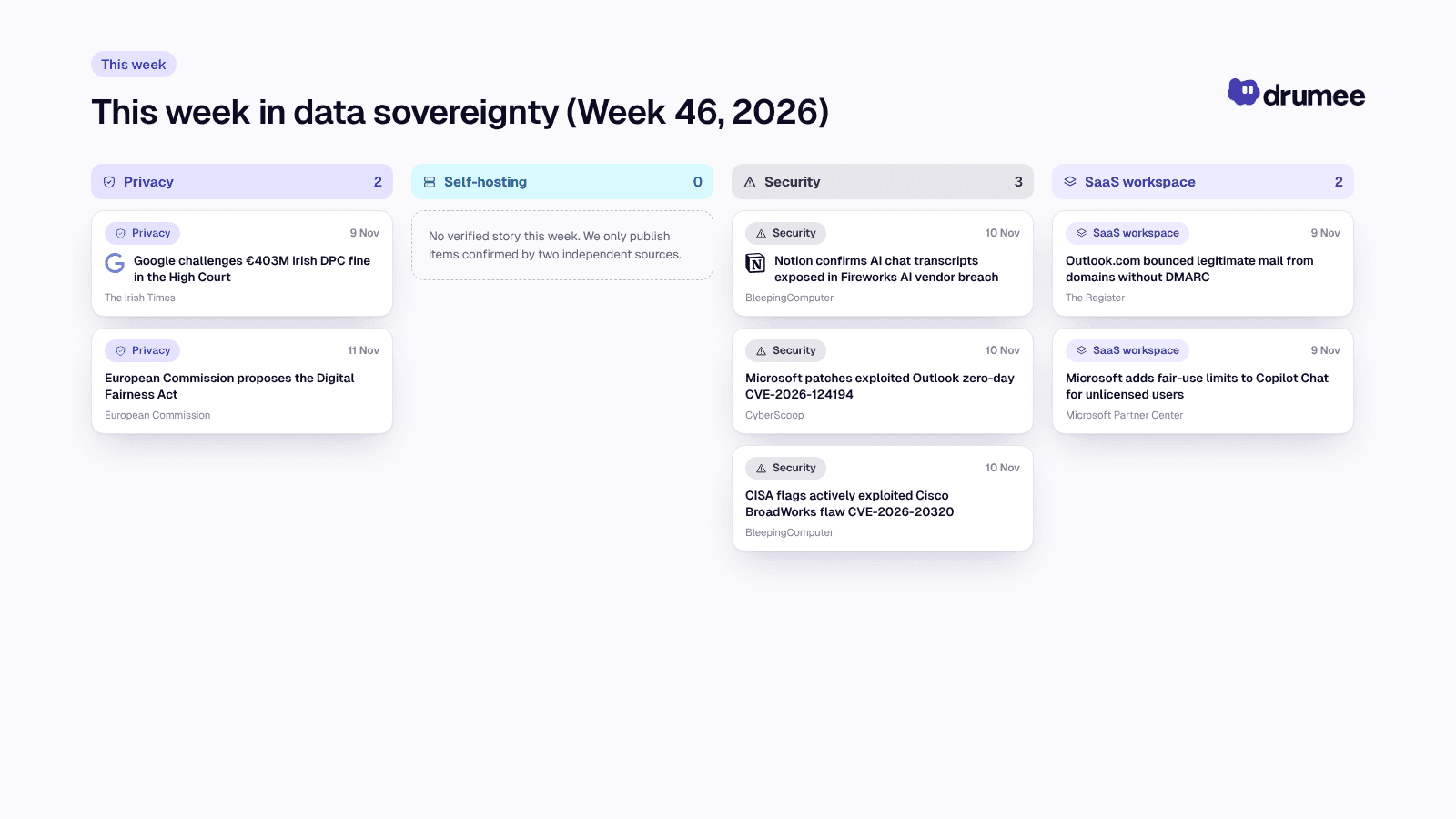
This week in data sovereignty.
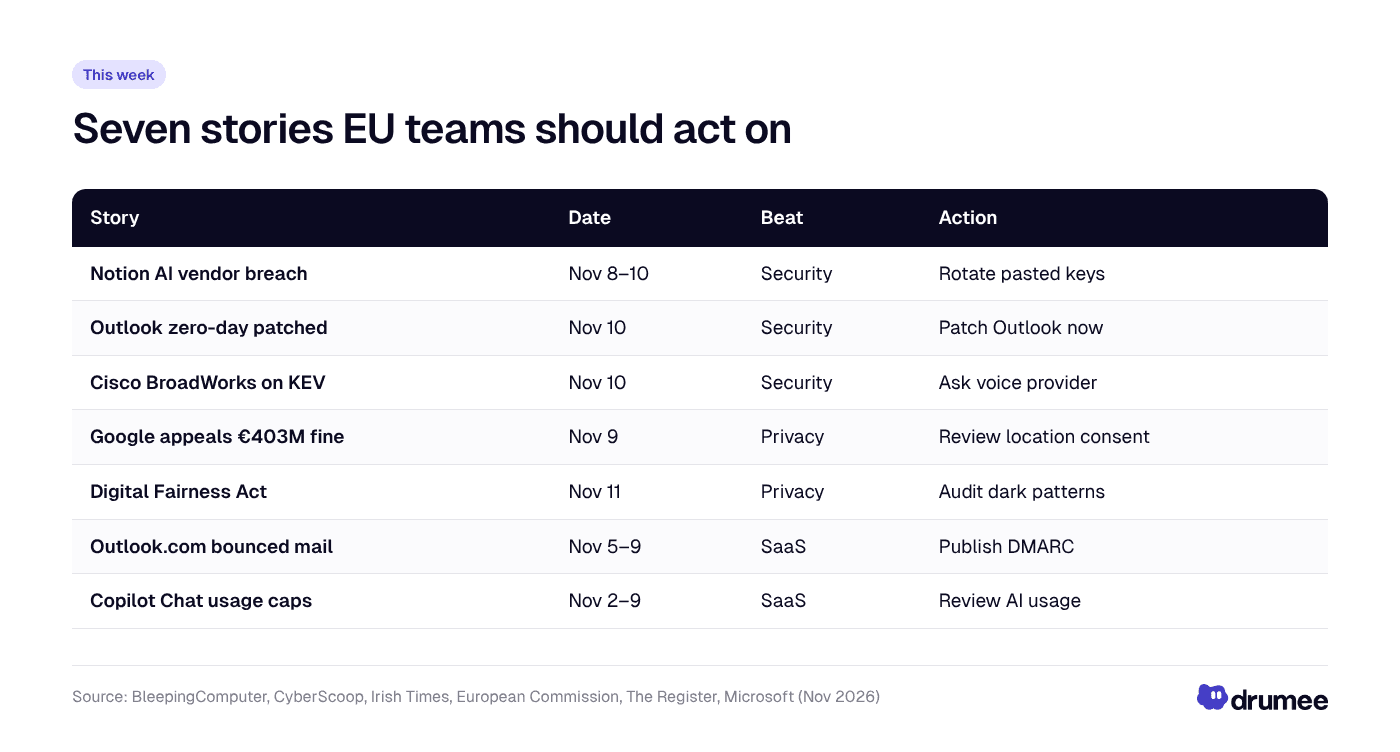
Seven stories made the cut this week: three security, two privacy and policy, two SaaS market; self-hosting had no verifiable news in the window.
1. Notion confirms AI chat transcripts exposed in Fireworks AI vendor breach
What happened. Notion said a security incident at its AI inference vendor Fireworks AI exposed Notion AI chat transcripts tied to fewer than 1% of customer workspaces, BleepingComputer reported. According to VentureBeat's timeline, an attacker reached Fireworks R&D machines on 24 October, Notion disconnected from Fireworks on 3 November, and Fireworks confirmed on 8 November that a stolen dataset contained the transcripts. The Hacker News reports the breach also touched other Fireworks customers' datasets.
Why it matters for EU teams. Notion says its own systems were not breached, and it disabled the affected Insights feature quickly. The lesson is about the supply chain: a workspace you chose for docs passed prompts to an AI subprocessor you may never have assessed. Under GDPR, that subprocessor sits in your processing chain, and anything staff pasted into a prompt went with it.
What to do.
- Rotate any passwords, API keys or tokens that staff pasted into Notion AI during the incident window, as Notion recommends.
- Pull the current AI subprocessor list for every tool in your stack and check it against your Article 30 records.
2. Microsoft patches an exploited Outlook zero-day in November Patch Tuesday
What happened. On 10 November, Microsoft's monthly update fixed CVE-2026-124194, an Outlook spoofing flaw that was already being exploited, CyberScoop reported. A crafted message file can make Outlook connect to an attacker-controlled location without its usual external-content warning, which can expose the user's NTLMv2 hash. Outlets counted more than 1,000 fixes in the release, though totals differ between Redmondmag and TechRepublic.
Why it matters for EU teams. The bug is rated only CVSS 6.5, but leaked NTLM hashes are a classic first step towards account takeover and lateral movement. Organisations in scope of NIS2 are expected to handle known-exploited vulnerabilities quickly, and a breach that starts in a mail client still triggers GDPR's 72-hour notification clock.
What to do.
- Push the November Outlook and Office updates now rather than waiting for your normal patch ring.
- Block outbound SMB (TCP 445) at the perimeter and review whether NTLM can be restricted in your domain.
3. CISA flags an actively exploited Cisco BroadWorks flaw
What happened. The US Cybersecurity and Infrastructure Security Agency added CVE-2026-20320 to its Known Exploited Vulnerabilities catalog on 10 November, BleepingComputer reported. The flaw is an unauthenticated XML external entity (XXE) bug in the Open Client Interface XML parser of Cisco BroadWorks, rated 7.5. US federal agencies must remediate by 24 November, per SC World.
Why it matters for EU teams. BroadWorks is the platform many telecom carriers and managed service providers use to run hosted voice, PBX and collaboration services. Most teams never touch it directly, but their phone system may depend on it. That is the kind of hidden ICT third-party dependency DORA and NIS2 expect you to map.
What to do.
- Ask your telephony or UCaaS provider whether it runs BroadWorks and when Cisco's fix was applied.
- Add hosted voice to your ICT third-party register if it is missing.
4. Google takes its €403M GDPR fine to the Irish High Court
What happened. Google has launched a High Court challenge to the €403 million fine imposed by Ireland's Data Protection Commission, The Irish Times reported on 9 November. The DPC decision covered location processing in Web & App Activity, Location History and Google Location Accuracy, and ordered compliance within six months. According to the Irish Examiner, Google alleges errors of law and fact and also questions the constitutionality of parts of Ireland's Data Protection Act 2018.
Why it matters for EU teams. Appeals like this take years, and Irish DPC fines are only collected once confirmed. The finding itself still stands as the regulator's view of how location data and consent should work. If your product or analytics collects location, the decision is a useful benchmark regardless of how the case ends.
What to do.
- Review any location or activity tracking in your own apps against the consent and transparency points the DPC raised.
- Check which Google account-level activity settings are enabled across your Workspace users.
5. The Commission proposes the Digital Fairness Act
What happened. On 11 November, the European Commission proposed the Digital Fairness Act, a regulation that would ban manipulative "dark pattern" interfaces such as false scarcity claims and let users switch off addictive design features. Freshfields notes that it would apply directly as a regulation, and Quartz reports that the Commission would gain direct fining power of up to 6% of worldwide turnover in large cross-border cases.
Why it matters for EU teams. This is a proposal, not law, and Parliament and the Council will negotiate it first. Still, it signals where enforcement is heading: interface design is becoming a compliance topic, like cookie banners before it. Teams that sell software to consumers should expect sign-up, upgrade and cancellation flows to be examined.
What to do.
- Audit your consumer-facing flows for urgency timers, pre-ticked boxes and hard-to-find cancel buttons.
- Brief product and growth leads on the proposal so new experiments don't create problems you'll have to undo later.
6. Outlook.com bounced legitimate mail for four days
What happened. From 5 to 9 November, consumer Outlook.com, Hotmail and Live addresses rejected some mail from domains without a DMARC record, including legitimate senders, The Register reported. Microsoft attributed the problem to an update to its spam enforcement rules and fixed it on 9 November, according to heise. The Register also reported a separate disruption the same day that broke Outlook on the web for some users in Europe after a service change, which Microsoft reverted.
Why it matters for EU teams. Invoices, password resets and client updates sent to consumer Outlook addresses may have silently failed during that window. The incident also shows how much of your deliverability depends on one provider's rule changes, which you can't see in advance and can't appeal.
What to do.
- Publish a DMARC record for every sending domain, starting with
p=noneand monitoring before tightening, as dmarcian recommends. - Resend critical transactional emails from 5 to 9 November that went to Outlook.com, Hotmail or Live addresses.
7. Microsoft caps Copilot Chat for users without a Copilot licence
What happened. Microsoft began applying "fair use" limits to more Copilot Chat features for commercial users without a Microsoft 365 Copilot licence: from 2 November for tenants with up to 2,000 seats and from 9 November for larger ones, according to Microsoft's Partner Center announcements. ITdaily reports that Microsoft does not publish the caps, which may change, and admins can't view or adjust them.
Why it matters for EU teams. Copilot Chat stays free, but "free" now has invisible ceilings that the vendor can move. Teams that built habits or internal guides around it may find features temporarily unavailable. It is a small, typical example of how the terms of bundled AI features change after adoption.
What to do.
- Find out which teams rely on unlicensed Copilot Chat and decide deliberately whether to license, cap or replace that usage.
- Record AI features and their data flows in your vendor register, since usage terms can change without notice.
Also on the radar (no verifiable news this week)
- Self-hosting and open source: no notable release, licence change or government sovereignty move in the window that we could verify with two independent sources.
- EU-US Data Privacy Framework: the Latombe appeal (C-703/25 P) is still pending at the CJEU, with no hearing date found. Our guide to data sovereignty explains why transfer mechanisms like the DPF matter.
- Digital Omnibus and Data Act: no new step this week; the Council agreed its negotiating mandate on 21 October and Parliament's position is still pending.
The Drumee take
Three of this week's seven stories share one pattern: a change you didn't choose, made by a vendor or one of its vendors, landed on your team. A subprocessor breach exposed AI prompts. A spam rule change bounced legitimate mail. Usage caps appeared on a bundled AI feature. None of these is a scandal on its own, and each vendor responded. Together, they show how little control a team keeps once its work is spread across several SaaS platforms.
The control question is practical. Can you list every subprocessor that touches your files, chats and prompts? Can you see the rules that decide whether your email gets delivered? Our explainer on how to avoid SaaS vendor lock-in covers the exit plans worth having before you need them, and tool sprawl explains why each extra tool adds another chain of processors.
The sovereignty answer is to run fewer systems and to run the critical ones on infrastructure you control. Drumee puts files, chat, task boards and meetings in one workspace, either on Drumee-hosted plans or as a self-hosted Sovereign Node. Our GDPR overview explains what that changes in your processing chain. On cost, the Team plan is $29 a month flat for up to 10 users, and current plans are on the Drumee pricing page.
FAQ
What happened in data privacy this week?
Between 2 and 12 November 2026, Notion confirmed that a breach at its AI vendor Fireworks exposed some Notion AI chat transcripts. Google challenged its €403M Irish GDPR fine in the High Court. The European Commission proposed the Digital Fairness Act to ban dark patterns. Microsoft fixed an exploited Outlook zero-day.
What are the latest GDPR fines in November 2026?
We found no new major GDPR fine announced between 2 and 12 November 2026. The biggest active story is Google's High Court challenge, reported on 9 November, against the €403 million fine issued by Ireland's Data Protection Commission in September 2026 over location data processing.
Was Notion hacked?
Notion says its own systems were not breached. A breach at its AI inference vendor, Fireworks AI, exposed Notion AI chat transcripts from the Insights feature, affecting fewer than 1% of customer workspaces. Notion disabled Insights and recommends rotating any credentials pasted into Notion AI.
Is the Digital Fairness Act already law?
No. The Commission proposed it on 11 November 2026 as a regulation. The European Parliament and the Council must negotiate and adopt it before it applies, so its final scope and fining powers may change.
Keep reading
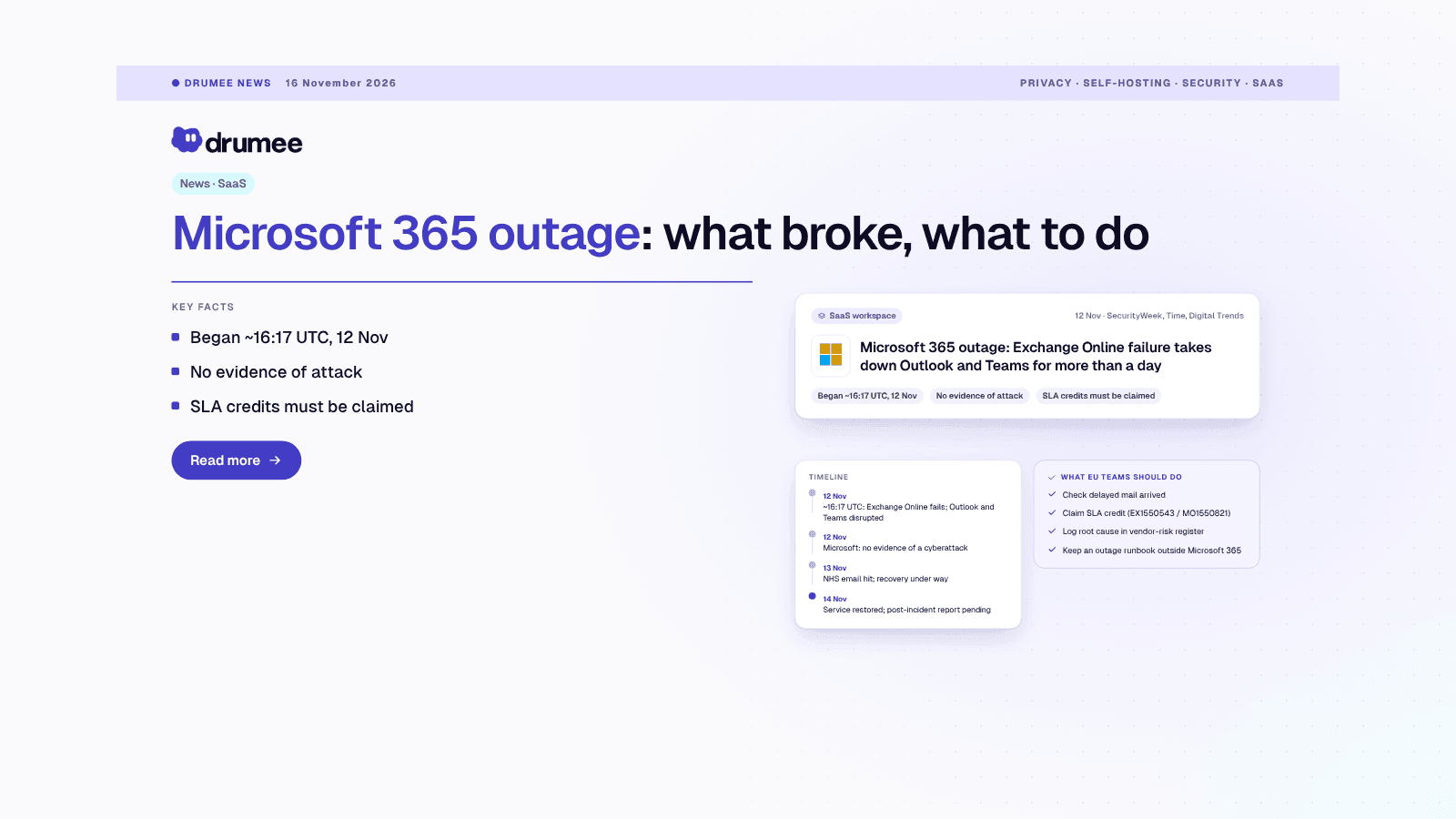
Microsoft 365 Outage (November 2026): What Broke, Who Was Hit and What to Do Now
Published 16 November 2026 · Updated 16 November 2026 · 7 min read The Microsoft 365 outage that started on Thursday 12 November 2026 was one of the longest disruptions of Outlook and Teams in years. This post sets out what is confirmed, what Micr...
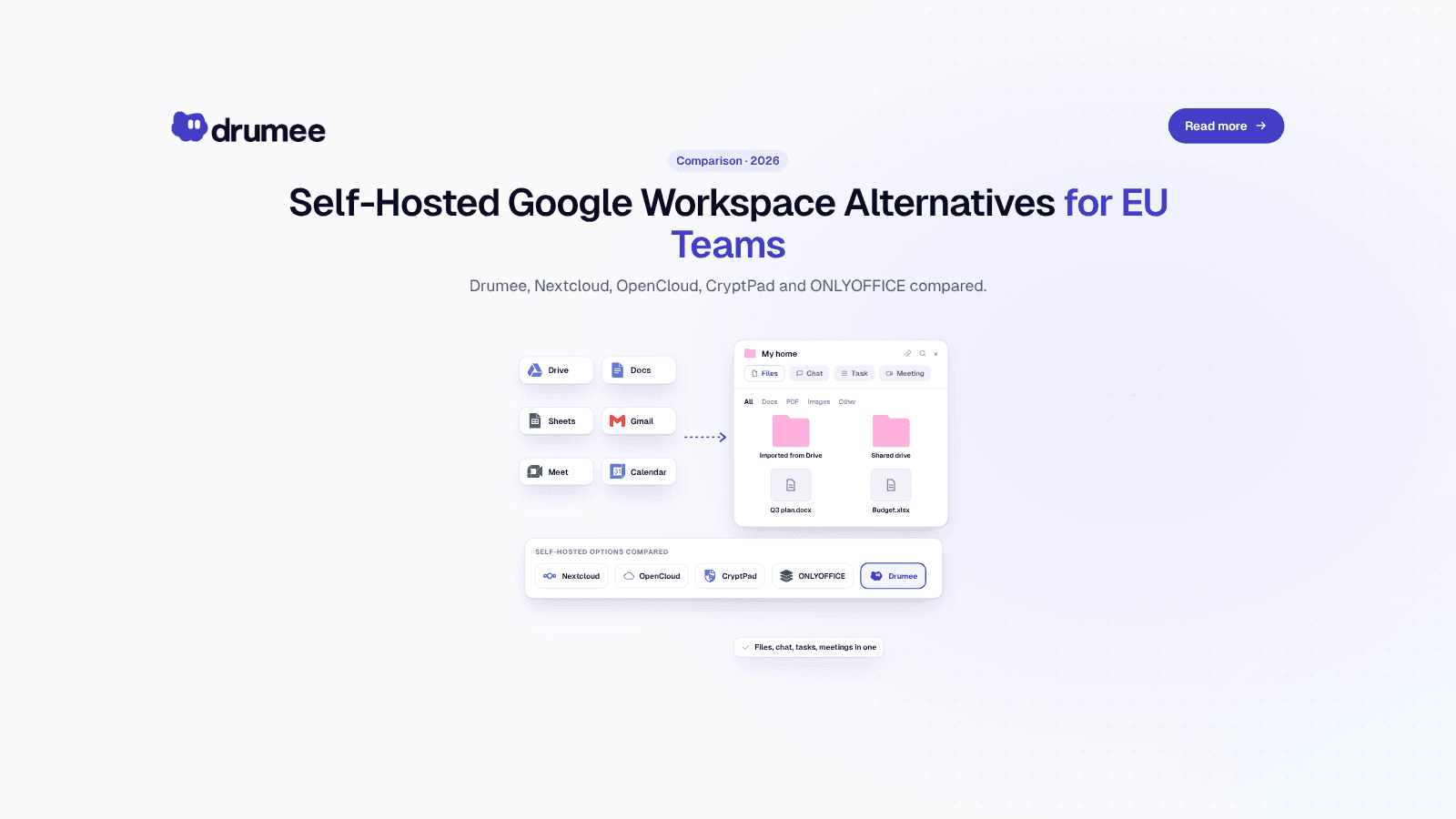
Self-Hosted Alternatives to Google Workspace: 2026 Guide for EU Teams
Google Workspace is the default office stack for most European startups. It is also a US-controlled service whose list price went up in January 2025, whose data sits under US legal reach, and whose exit path takes days of admin work. For a growing...
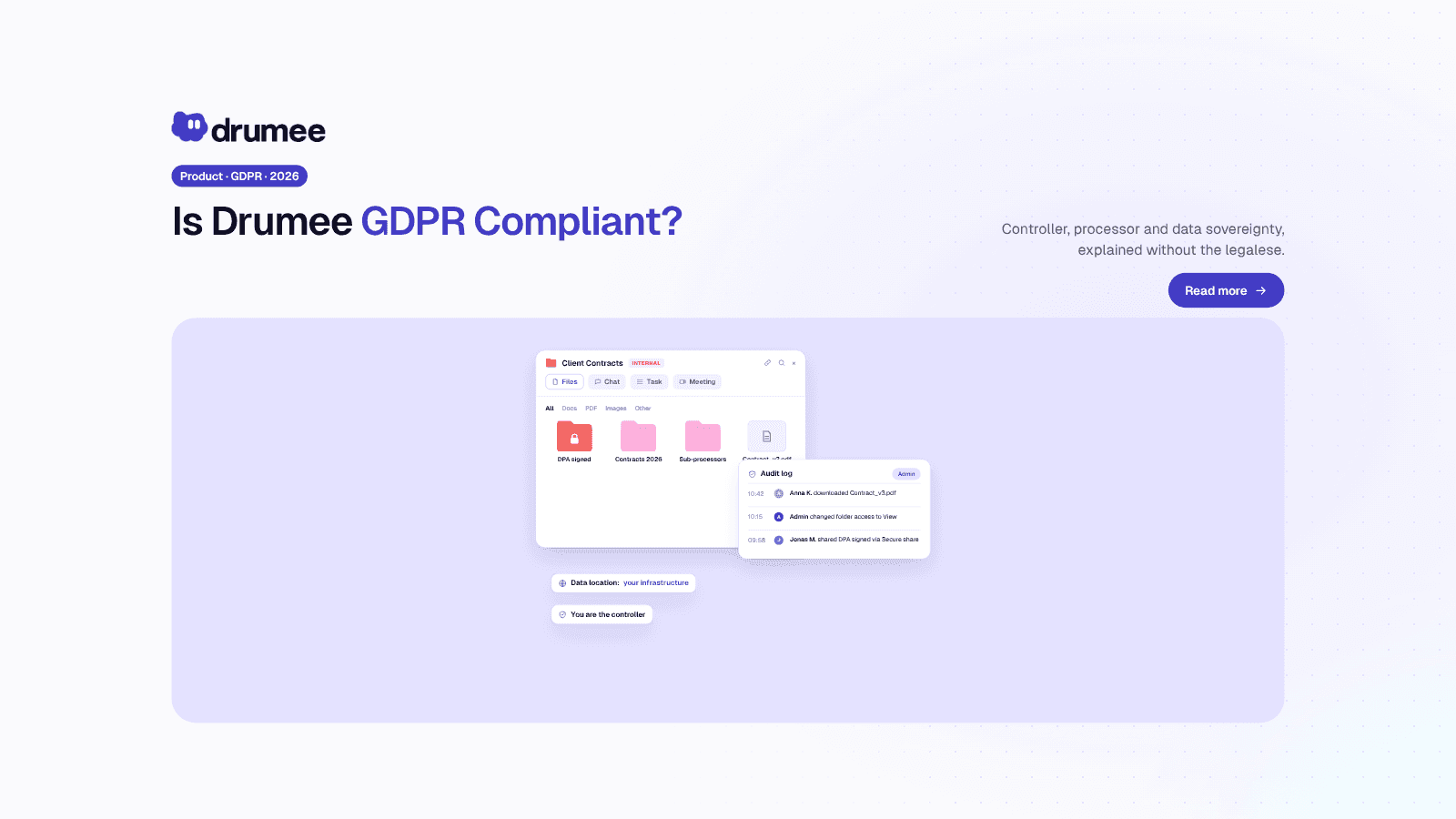
Is Drumee GDPR Compliant? Data Sovereignty Explained (2026)
"Is this tool GDPR compliant?" is the first question every European buyer asks about workspace software, and it is the wrong question to ask in isolation. No software product is GDPR compliant on its own. The regulation applies to organizations an...