
Google Drive Alternative for Privacy-First Teams: What Actually Changes When You Switch Drag
Google Drive gives you a billion-user default and a Gemini AI system scanning your files without asking. This is a practical guide to Google Drive alternatives for privacy-first teams what the governance gap actually is and what resolves it in 2026.
Google Drive Alternative for Privacy-First Teams: What Actually Changes When You Switch Drag
Google Drive is the default. For over a billion users and a market share of approximately 47% of all file hosting and 50% of productivity software globally, it is the infrastructure that modern work is built on. And for the vast majority of that usage, the convenience is real and the friction of switching feels disproportionate to the risk. But a growing segment of teams, legal agencies handling client-sensitive workflows, healthcare organizations managing protected health information, EU-based companies navigating GDPR enforcement, and development teams building products on data they cannot afford to expose, have reached a point where the default is no longer acceptable. For those teams, the search for a Google Drive alternative for privacy is not a theoretical exercise. It is a procurement decision with real governance consequences, and getting it right requires understanding not just which tool is more private, but what kind of privacy architecture actually resolves the problem.
What Changed in 2025 and 2026?
The decision to look beyond Google Drive is rarely abstract. It is almost always triggered by a specific event, a pricing change, a policy update, an AI integration that surfaces content in unexpected ways, or a regulatory inquiry that makes vendor-controlled infrastructure a compliance liability rather than a neutral convenience. In 2025 and 2026, several concrete triggers accelerated the evaluation of Google Drive alternatives among privacy-conscious teams.
According to an independent analysis published by Peony in March 2026, two specific developments created significant inflection points for enterprise Google Drive users. In March 2025, Google raised Workspace prices by 17–22% after bundling Gemini AI into all plans meaning organizations that had no intention of using AI features were compelled to absorb pricing structured around AI access. Then in November 2025, reports emerged that Google's Gemini AI was scanning private PDF files stored on Google Drive and generating unsolicited AI summaries of confidential documents including tax filings without explicit user consent. The Thele v. Google class action was filed alleging this default AI rollout violated California wiretap rules. These were not theoretical data governance concerns. They were operational events that a specific and identifiable set of users experienced firsthand without having opted into the behavior that caused them.
The AI scanning incident crystallizes the distinction that privacy-first teams need to understand clearly: the risk is not primarily that Google misuses your data in an obvious way. The risk is that Google controls the infrastructure layer through which your data exists, and decisions about what that infrastructure does with your content, indexing it, summarizing it, feeding it into AI systems, changing the terms under which any of this occurs, are made unilaterally, often with an opt-out mechanism that requires awareness to exercise and discovery to locate. For teams storing legally privileged communications, client contracts, or sensitive product documentation, the gap between "Google does not sell your data" and "Google's systems process your data in ways your organization does not govern" is the gap where material risk lives.
The Governance Architecture That Most Alternatives Do Not Change
The market for Google Drive alternatives in 2026 is large and mature. Proton Drive offers Swiss jurisdiction and end-to-end encryption. Tresorit and Sync.com provide zero-knowledge encryption, meaning the provider cannot access your files even if legally compelled. Nextcloud offers a fully self-hosted open source platform with complete data sovereignty and over 400,000 active deployments globally. Each of these alternatives addresses specific dimensions of the privacy problem with Google Drive, and each represents a genuine improvement over the default for the specific concern they target.
What most of these alternatives share with Google Drive, however, is a fundamental architectural assumption: that your team's file storage and your team's collaboration infrastructure are separate systems connected through integrations. Proton Drive is a private storage layer. Nextcloud is a file sync and collaboration platform. They handle the file layer of your operational environment. The conversation layer remains in Slack or Teams, the documentation layer remains in Notion or Confluence, the task layer remains in Linear or Jira, each on its own vendor-controlled infrastructure, with its own governance terms, its own AI integration decisions, and its own data processing scope.
This matters because the privacy risk to your organization's operational data is not confined to the file storage layer. DoControl's 2024 analysis of enterprise Google Workspace environments found that the average enterprise has 709,533 publicly exposed Google Drive assets containing sensitive data accessible to anyone with a link. The exposure from insider threats was even more troubling, with organizations averaging 120,000 sensitive assets downloaded and shared to personal email addresses, and 94,000 assets remaining exposed to former employees who had already left the company. These are governance failures at the permission and access management layer, the layer that is most difficult to manage effectively when file storage, communication, and workflow context are fragmented across different vendor-controlled systems with incompatible permission models.
A genuine Google Drive alternative for privacy-first teams does not only replace the file storage layer with something more private. It addresses the permission coherence, operational continuity, and governance architecture problem that fragmented SaaS infrastructure creates across every layer where sensitive data accumulates.
What Privacy-First Actually Requires at the Infrastructure Level?
The teams most seriously evaluating Google Drive alternatives in 2026 are not looking for a prettier interface or more generous free storage. They are working from a set of governance requirements that are specific and non-negotiable. These typically include data residency, the requirement that sensitive operational data not leave a specific jurisdiction. GDPR compliance, not merely a data processing agreement with a US cloud provider, but actual infrastructure control that makes compliance auditable rather than contractual. AI governance, the ability to determine which AI systems access which data, with organizational rather than vendor authority over that boundary. And permission coherence, the ability to enforce a consistent access control model across files, communications, and workflows without manual bridging between incompatible systems.
European Purpose's 2026 analysis of Google Drive alternatives identifies the core problem for EU-based organizations precisely: European alternatives offer protection under GDPR, data stored exclusively in EU data centers, no exposure to US surveillance laws like the CLOUD Act, and support for European digital sovereignty, conditions that a Data Processing Addendum with Google Workspace satisfies on paper but not architecturally. The distinction between formal GDPR compliance and genuine data sovereignty is the same distinction that runs through every serious evaluation of Google Drive privacy: an organization can have legal coverage without having operational control, and for regulated industries, the gap between the two is where audit exposure and reputational risk accumulate.
"The question we ask is not whether Google says your data is protected. The question is whether your organization is in control of the infrastructure where that data lives. Those are different questions with different answers." - Somanos Sar, Founder, Drumee
This framing captures the architectural shift that genuinely privacy-first infrastructure requires. Control is not a feature you configure inside someone else's system. It is a condition that only exists when your organization administers the environment where your operational data resides.
Why Is File Storage Alone Not Enough?
The most common pattern among teams that have successfully moved away from Google Drive is not a single-tool switch. It is a phased recognition that the privacy problem extends beyond the file layer. A team that moves from Google Drive to Nextcloud for file storage, and continues using Gmail for communication, Notion for documentation, and Linear for task management, has addressed one governance layer and left the others exactly as they were. The sensitive client files that were previously on Google's infrastructure are now on infrastructure the organization controls. The sensitive client communications that inform those files are still on Google's infrastructure. The internal documentation about how to handle those clients remains on Notion's servers.
This is not a failure of execution. It is a feature of how SaaS adoption works, each tool is adopted individually, each governance decision is made in isolation, and the cumulative governance posture that results from the collection of those individual decisions is never reviewed as a whole. Liminary's 2026 Google Drive alternatives guide notes that 39% of businesses experienced cloud data breaches last year, a figure that reflects not primarily the failure of any individual tool, but the difficulty of governing operational data that is distributed across multiple vendor-controlled systems with inconsistent permission models and overlapping access controls.
The teams that resolve this problem most completely in 2026 are the ones that address it at the infrastructure layer rather than the tool layer, choosing an architecture where file storage, communication, permissions, and workflow context exist inside a single governed environment rather than coordinated across multiple vendor environments that each require independent governance attention.
What Drumee Provides That File-Only Alternatives Can Not
Drumee is not a Google Drive replacement in the narrow sense of the term. It is a sovereign data OS that resolves the file privacy problem as part of a broader architectural commitment to keeping your team's operational data, files, conversations, tasks, permissions, on infrastructure your organization controls, under an access model your organization defines.
In practical terms, this means that when a sensitive client file lives in Drumee, the conversation that contextualizes that file, the permission model that governs who accesses it, and the task workflow connected to delivering on it exist in the same governed environment. There is no version of the problem where the file is private but the conversation about it lives in Slack, or where the permission model in the file system does not match the permission model in the communication layer. The governance boundary is coherent because the infrastructure is unified.
For privacy-first teams evaluating Google Drive alternatives, Drumee addresses the specific concerns that motivate the switch, data sovereignty, GDPR compliance, AI governance, permission coherence, not as features layered on top of a storage service, but as structural properties of the infrastructure architecture. The files your team stores in Drumee live on your server, not Google's. The AI systems that interact with your content do so within your infrastructure boundary, under your governance, not under terms set by Gemini's product team. The permission model governing your team's files is enforced by systems you administer. If Google changes its pricing, its AI policies, or its terms of service next week, none of that affects your operational data, because your operational data was never on Google's infrastructure to begin with.
Drumee is built on AGPLv3 open source foundations, meaning the codebase is auditable and the governance model is transparent. It deploys via Docker, making the technical barrier to self-hosted infrastructure accessible to teams with a basic technical lead rather than a dedicated operations team. Most Google Drive alternatives solve one problem on where your files are stored while leaving your communications in Slack, your documentation in Notion, and your workflows in other tools, all still running on vendor-controlled infrastructure. Drumee is different because it replaces the entire stack at once. When your team moves to Drumee, files, chat, tasks, and permissions all move to the same self-hosted environment simultaneously. You do not end up with a private file layer sitting on top of the same fragmented, vendor-controlled everything else.
For teams that have reached the point where the privacy risk of vendor-controlled infrastructure is real and operational, where a client inquiry, a regulatory requirement, or a Gemini AI summary of a confidential document has made the governance gap visible and consequential, Drumee is built for exactly that inflection point: the moment when switching to a more private file storage tool is no longer enough, and what the organization actually needs is infrastructure it owns.
FAQ
1/ What are the main privacy concerns with Google Drive?
Google controls the infrastructure where your data is stored, meaning it can scan, process, and apply AI to your files under terms set by its policies rather than your organization's governance decisions. In November 2025, Gemini AI was found scanning private Drive files without explicit consent, prompting a class action lawsuit. Additionally, Google Workspace prices rose 17–22% in March 2025 after bundling AI into all plans.
2/ What should privacy-first teams look for in a Google Drive alternative?
The most important criteria are: data residency control (infrastructure your organization administers), consistent permission architecture across files and communications, AI governance (knowing which systems process your data under whose terms), and GDPR compliance that reflects actual infrastructure control rather than contractual coverage. Zero-knowledge encryption is valuable for storage-layer privacy but does not address the broader governance problem.
3/ Is Nextcloud a good Google Drive alternative for privacy?
Nextcloud is a strong self-hosted open source alternative for teams whose primary concern is file storage sovereignty. With over 400,000 deployments globally, it is operationally mature. Its limitation is that it addresses the file layer in isolation, your communications, task workflows, and documentation remain in other vendor-controlled systems unless you build a broader self-hosted stack around it.
4/ Does GDPR compliance mean your data is private with Google?
Not in the operational sense. Google Workspace provides GDPR tooling including data processing agreements, but your data still resides on Google-controlled infrastructure processed under Google's governance terms. For organizations that require genuine data residency control, where data never leaves their own infrastructure, a Google Data Processing Addendum is insufficient.
5/ How does Drumee address the Google Drive privacy problem?
Drumee is a self-hosted sovereign data OS that unifies file storage, communication, tasks, and permissions in a single infrastructure environment the organization controls. Unlike file-only alternatives, Drumee addresses the privacy problem across every layer where sensitive operational data accumulates, not just the storage layer. Deployed via Docker on infrastructure you own, licensed under AGPLv3, GDPR-ready by architecture rather than by agreement.
Related article: Drumee vs Notion: Who Owns Your Data?
------------------------------
About Drumee
Drumee is the world’s first unified sovereign data infrastructure: a self-hosted, OS-like workspace that turns your own filesystem into a private collaborative environment.
Fully under your control, Drumee combines files, chat, tasks, and workflows with enterprise-grade permissions built directly into the infrastructure layer. No cloud vendors. No fragmented SaaS stack. No operational dependency.
Instead of renting your workspace from external providers, Drumee allows organizations to own the environment where operational knowledge lives.
Your Data. Your Workflow. One system. Built to be yours!
Follow us at: Website | X | LinkedIn | Drumee Founder X | Drumee Founder LinkedIn
Keep reading
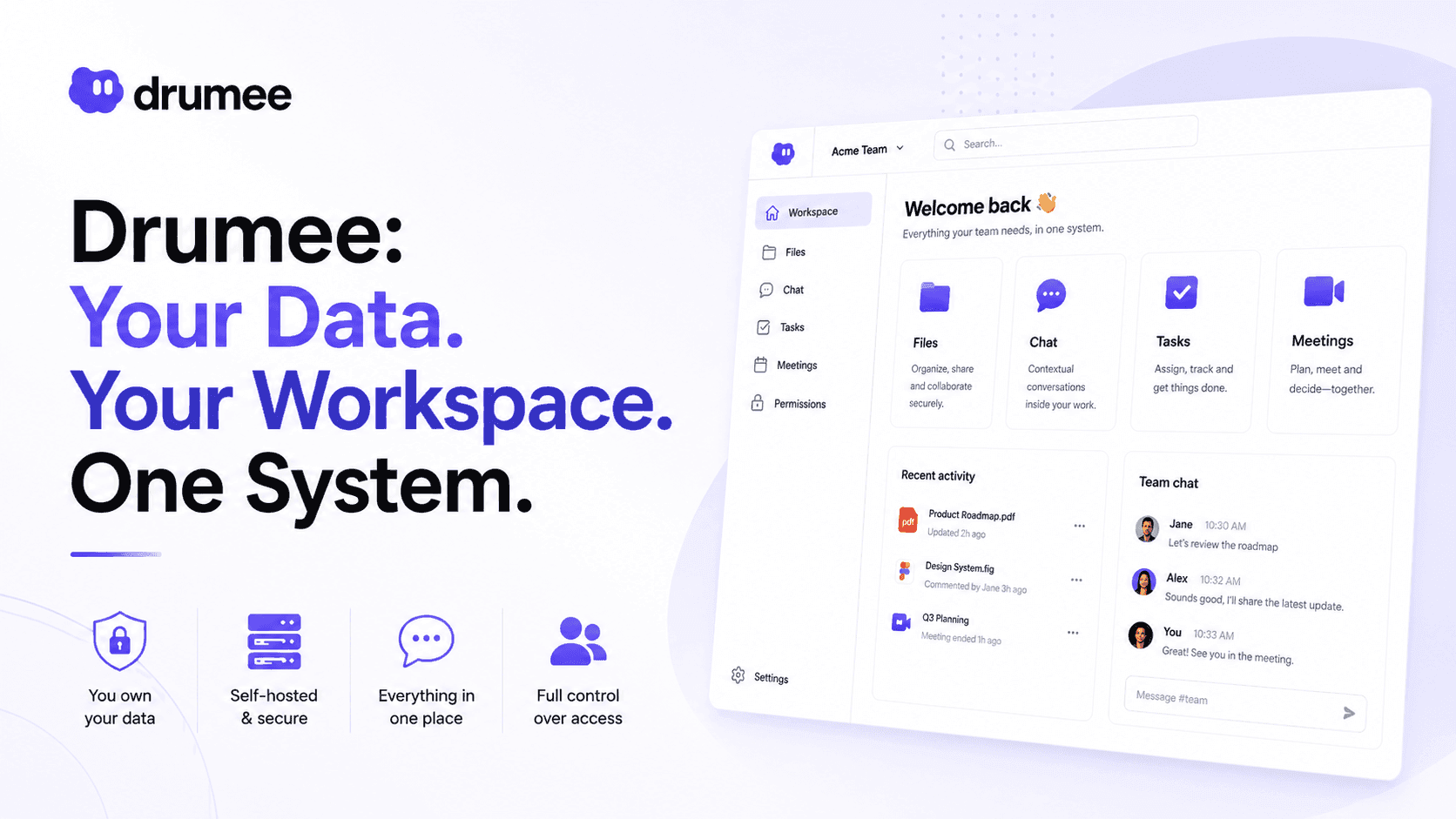
Drumee: Your Data. Your Workspace. One System
Drumee is a self-hosted, sovereign data workspace where files, chat, tasks, and permissions live in one place on infrastructure you own. Learn what Drumee is, what it stands for, and how to get started.
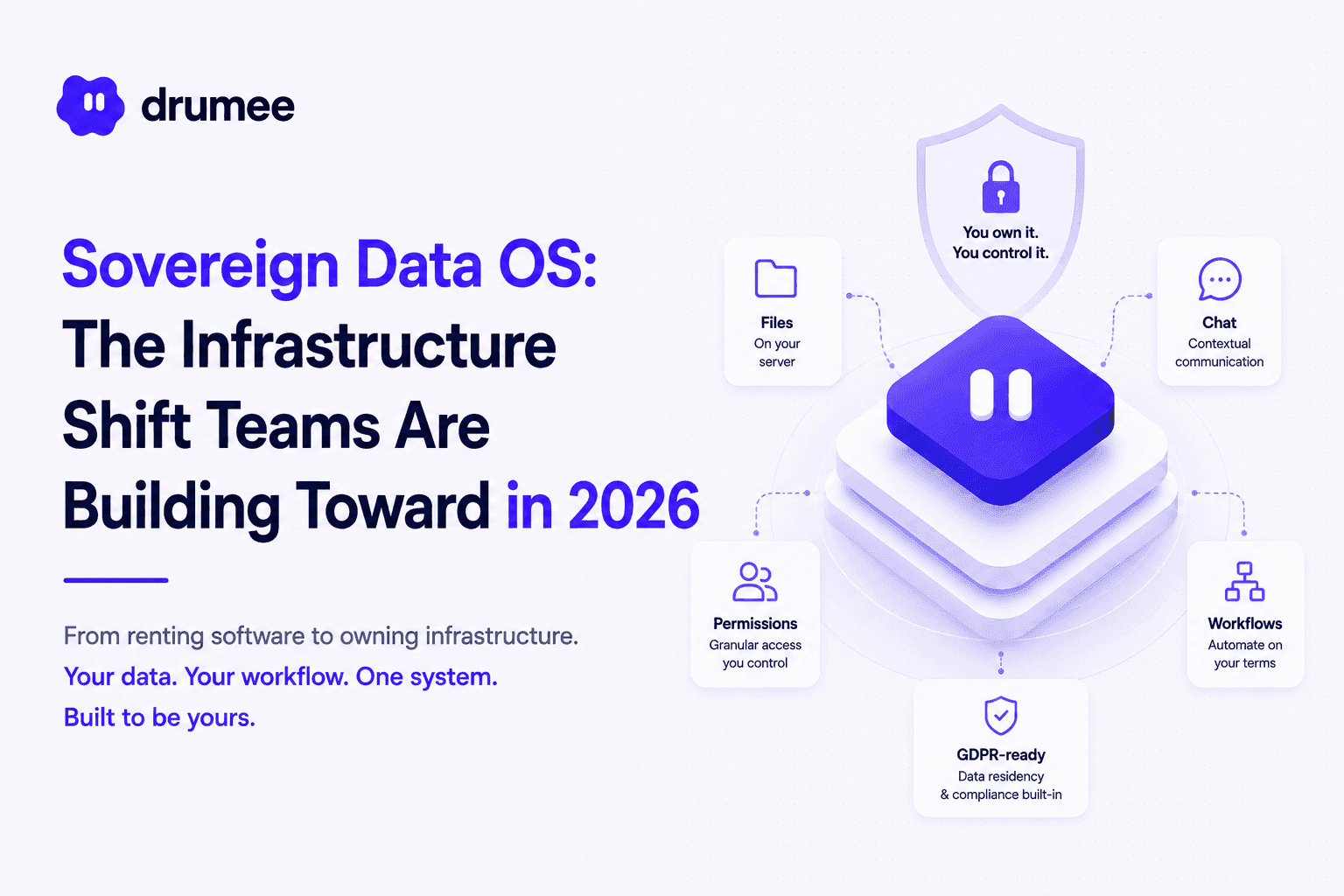
What Is a Sovereign Data OS? The Infrastructure Shift Teams Are Building Toward in 2026
What is a sovereign data OS? Learn how Drumee's unified self-hosted infrastructure replaces fragmented SaaS stacks with a single governable environment for files, chat, permissions, and workflows in 2026.
Data Ownership: What It Means and How to Achieve It in 2026
What is data ownership and how do you actually achieve it? Learn the three layers of data control, why AI changes the stakes, and how self-hosted infrastructure gives teams genuine ownership in 2026.