
Self-Hosted Software: Why Are Forward-Thinking Teams Switching?
Self-hosted software is growing at 14.6% CAGR as teams reach the inflection point where governance authority matters more than SaaS convenience. Here is what is driving the switch and what it looks like in practice in 2026.
Self-Hosted Software: Why Are Forward-Thinking Teams Switching?
Self-hosted software is software your organization installs and runs on infrastructure it directly controls, rather than subscribing to a vendor-hosted platform where the provider manages the underlying servers, data governance, and pricing model. The distinction sounds technical, but in 2026 it has become one of the most consequential strategic decisions a growing team can make. The global self-hosted cloud platform market reached USD 19.7 billion in 2025 and is projected to grow to USD 22.58 billion in 2026, according to The Business Research Company's Self-Hosted Cloud Platform Global Market Report, at a compound annual growth rate of 14.6%. That growth is not driven by developers who prefer complexity. It is driven by organizations that have made a clear-eyed calculation about vendor pricing, data governance, regulatory compliance, and the compounding cost of building critical workflows on infrastructure they do not own.
Why Are Teams Reaching the Inflection Point Now?
The shift toward self-hosted software is not ideological. It is economic and operational, and it is happening at a pace that reflects accumulated organizational experience with the costs of SaaS dependency rather than any single trigger event.
According to KDnuggets' March 2026 analysis of self-hosting trends, the move toward self-hosting core tools is accelerating in 2026, driven not just by cost savings but also by the desire for ultimate customization, data sovereignty, and the empowerment that comes with owning the entire stack. For data-intensive teams, SaaS subscriptions scale with usage in ways that become unpredictable at organizational scale, while self-hosted infrastructure maintains a fixed cost profile regardless of how many users or how much data the system handles.
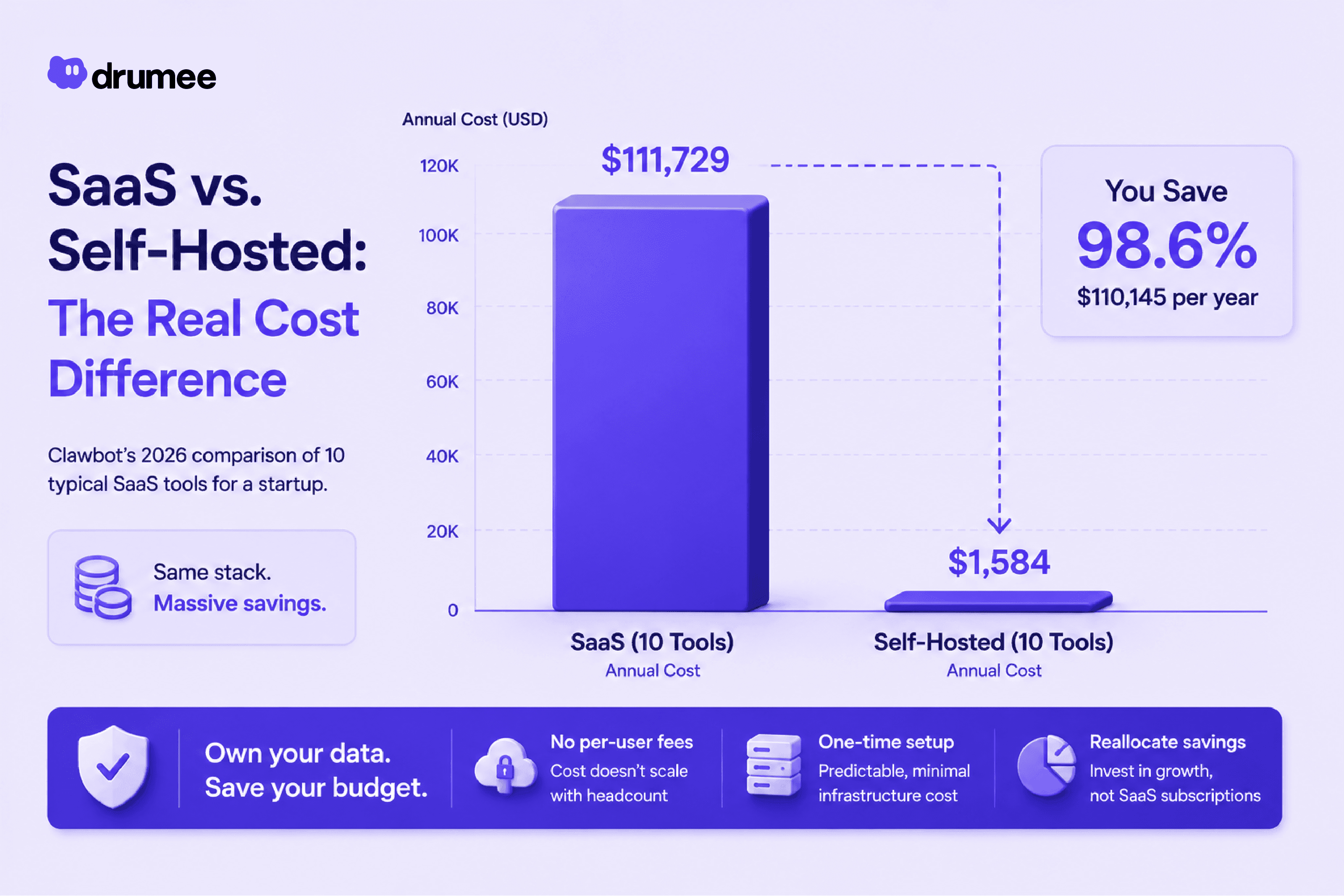
The cost differential has become concrete enough to cite with precision. According to Clawbot's 2026 SaaS versus self-hosted cost comparison, a startup using 10 typical SaaS tools would incur an annual cost of approximately USD 111,729, while the self-hosted alternative for the same stack costs approximately USD 1,584 per year, a savings of 98.6%. Even discounting heavily for the operational overhead that self-hosting introduces, the cost differential is structurally significant. The report notes that SaaS vendors raise prices an average of 5 to 15% per year, meaning the gap compounds over time regardless of whether the organization's usage grows. Self-hosted infrastructure costs stay fixed.
The compliance dimension is equally consequential for teams in regulated industries. DEV Community's April 2026 practical guide to self-hosting notes that when organizations use SaaS products, they agree to terms that give the provider broad rights to access and analyze data, and that in 2026 AI companies increasingly train models on user data by default. Self-hosting eliminates this exposure entirely. For businesses operating under GDPR, HIPAA, or data sovereignty requirements, self-hosted software simplifies compliance at the architecture level rather than through contractual coverage that the vendor controls.
The Market Infrastructure That Makes It Practical
The reason self-hosted software has moved from a specialist discipline to a mainstream organizational strategy in 2026 is not that teams have become more technically sophisticated. It is that the deployment infrastructure has become accessible enough that technical sophistication is no longer the primary barrier.
Docker containerization and orchestration tooling have reduced deployment complexity to a level that a single technically capable team member can manage without dedicated operations engineering. Grand View Research's self-hosted cloud platform market analysis identifies expansion of virtualization, containerization, and software-defined data centers as primary drivers of demand for self-managed cloud platforms, with the global self-hosted cloud platform market estimated at USD 18.48 billion in 2025 and projected to reach USD 46.10 billion by 2033 at a CAGR of 12.2%. The software segment dominated this market with 79.9% of revenue in 2025, driven by demand for cloud orchestration, automation, and management tools that make self-hosted infrastructure operable without specialist overhead.
The open source software ecosystem that underlies most self-hosted deployments has matured alongside the infrastructure tooling. OpenLogic's 2026 State of Open Source Report found that open source is no longer just a cost-saving tactic but critical infrastructure, with organizations leaning on it to reduce dependency on proprietary vendors, meet evolving regulatory demands, and retain strategic control over their software stacks. The report's finding that open source usage has stabilized at high levels reflects a shift from adoption as a growth initiative to adoption as an organizational given. For teams evaluating self-hosted software, this means the open source alternatives to most SaaS categories have reached a level of maturity that makes them viable production choices rather than experimental alternatives.
Regulated industries are leading the organizational adoption curve. Grand View Research's market analysis specifically identifies healthcare, government, defense, and financial services as the segments with the strongest growth in self-hosted deployments, driven by data localization laws, GDPR-equivalent regulations, and compliance frameworks that require organizations to demonstrate jurisdictional control over data storage and processing. Germany held a substantial market share in 2025 specifically because manufacturers operating under Industry 4.0 require secure, low-latency on-premise environments to run automation, robotics, and digital supply chains.
What Does Self-Hosted Software Give Teams That SaaS Cannot?
The benefits that forward-thinking teams report when they describe their reasons for switching to self-hosted software fall consistently into three categories that SaaS platforms structurally cannot replicate.
The first is infrastructure authority. When your team's critical operational software runs on infrastructure you administer, decisions about how it is configured, what data it stores, how long that data is retained, and which AI systems have access to it are yours to make unilaterally. DEV Community's 2026 self-hosted tools guide captures the practical experience accurately: when you self-host, your data is never trapped behind a company's pricing model or policy changes, and you decide when to upgrade, migrate, or change direction. The vendor's product roadmap, the vendor's pricing decisions, and the vendor's terms of service updates do not constrain your operational choices.
The second is cost predictability. SaaS subscriptions carry two cost structures simultaneously: the current price, and the vendor's leverage to change that price based on the dependency your organization has accumulated. As workflows, integrations, and institutional knowledge deepen inside a SaaS platform, the vendor's pricing power grows proportionally. Self-hosted software converts that unpredictable cost trajectory into a fixed infrastructure expense that does not scale with headcount or vendor leverage. For teams at the stage where SaaS costs have become a meaningful budget line, this predictability has real financial value.
The third is governance completeness. Under GDPR and equivalent regulations, demonstrating that personal data is stored, processed, and erasable under the organization's direct administrative authority is substantively different from demonstrating that a vendor has signed a data processing agreement describing how it will handle that data on the organization's behalf. The Kiteworks 2026 Data Sovereignty Report cited in recent GDPR enforcement analyses documented that among European respondents, approximately 15% describe themselves as extremely concerned about GDPR fine exposure, with 21% flagging the US CLOUD Act as a direct threat to their sovereignty posture. Data sovereignty expectations now extend to where data is processed and inferred by AI systems, not just where it is stored. Self-hosted software satisfies this expectation structurally. Vendor DPAs satisfy it contractually, and the difference is exactly what regulators test during enforcement investigations.
The Specific Categories Where Switching Has the Highest Return
Not every SaaS tool is equally worth replacing with a self-hosted alternative. The highest-return switches in 2026 are the categories where vendor pricing power is highest, governance exposure is most acute, and open source maturity is most advanced.
File storage and collaboration infrastructure sits at the top of this list. File storage is the category where institutional knowledge accumulates most persistently, where sensitive client documents and confidential communications live, and where AI integration has made the governance question most urgent. Teams that have replaced Google Drive with Nextcloud, or fragmented SaaS stacks with unified sovereign workspaces like Drumee, report that the operational overhead of managing their own file infrastructure is a one-time setup cost, while the benefits compound continuously as the volume of sensitive operational data inside the environment grows.
Documentation and knowledge management is the second category. The institutional knowledge stored in tools like Notion accumulates in proprietary formats that make migration progressively more expensive as usage grows. Self-hosted alternatives including AppFlowy, Outline, and AFFiNE offer comparable editorial and organizational capabilities with open data formats, auditable codebases, and deployment on infrastructure the organization controls.
Communication infrastructure is the third. Self-hosted messaging platforms like Mattermost and Matrix-based solutions give organizations the same persistent channel-based communication model as Slack while eliminating the governance exposure that comes with storing internal communications on vendor infrastructure.
The pattern across all three categories is the same: the SaaS alternative delivers convenience at the cost of governance authority, while the self-hosted alternative delivers governance authority at the cost of setup investment. In 2026, for teams that have reached the scale where governance authority matters more than frictionless onboarding, the calculation has shifted decisively.
Where Does Drumee Sit in the Self-Hosted Software Landscape?
Drumee occupies a specific and architecturally distinct position in the self-hosted software landscape: not a replacement for any single SaaS tool, but a unified sovereign data OS that replaces the fragmented SaaS stack at the infrastructure layer. Files, chat, permissions, and task context exist inside a single self-hosted environment the organization administers, rather than distributed across vendor-hosted tools with incompatible governance models that require separate compliance evidence for each one.
The architectural advantage of this unified model is that the governance completeness of self-hosted infrastructure extends across the entire operational environment simultaneously. There is no version of the problem where files are sovereign but conversations are in Slack, or where permissions are documented for storage but not for communication. The audit trail is coherent, the permission model is consistent, and the organization's administrative authority covers the full operational context where sensitive work actually happens, not just the isolated tool that stores its outputs.
For forward-thinking teams that have reached the inflection point where the governance cost of SaaS dependency exceeds the convenience benefit, self-hosted software in 2026 is not a technical project. It is an infrastructure decision about which systems your team's institutional knowledge belongs to, and whether that knowledge is building equity in infrastructure you own or accumulating dependency in infrastructure you rent.
FAQ
1/ What is self-hosted software?
Self-hosted software is software an organization installs and runs on its own infrastructure rather than accessing through a vendor's cloud platform. The organization administers the servers, controls the data, manages the configuration, and retains governance authority over how the software operates and what data it stores.
2/ Why are teams switching to self-hosted software in 2026?
The primary drivers are compounding SaaS subscription costs, data sovereignty requirements under GDPR and equivalent regulations, AI governance concerns about vendor platforms processing sensitive operational data, and the maturation of open source alternatives that now offer feature parity with commercial SaaS tools. The self-hosted cloud platform market grew to USD 19.7 billion in 2025, reflecting the scale of organizational adoption.
3/ Is self-hosted software more cost-effective than SaaS?
Over time, yes. According to Clawbot's 2026 cost comparison, a startup using 10 typical SaaS tools pays approximately USD 111,729 annually, while the self-hosted equivalent costs approximately USD 1,584 per year. SaaS vendors raise prices an average of 5 to 15% annually. Self-hosted infrastructure costs remain fixed regardless of headcount growth.
4/ What technical capability does self-hosted software require?
Modern self-hosted software deployment is accessible to teams with one technically capable member. Docker containerization means most applications deploy in a single operation on a standard VPS. The operational overhead is primarily in maintenance and backup management rather than initial setup.
5/ How does Drumee fit into a self-hosted software strategy?
Drumee is a sovereign data OS that unifies files, chat, tasks, and permissions in a single self-hosted environment. Rather than replacing individual SaaS tools one at a time, Drumee replaces the entire fragmented SaaS stack at the infrastructure layer, providing a coherent governance boundary and unified audit trail across all operational contexts simultaneously.
Related article: GDPR-Compliant File Storage for Teams: What Works in 2026
------------------------------
About Drumee
Drumee is the world’s first unified sovereign data infrastructure: a self-hosted, OS-like workspace that turns your own filesystem into a private collaborative environment.
Fully under your control, Drumee combines files, chat, tasks, and workflows with enterprise-grade permissions built directly into the infrastructure layer. No cloud vendors. No fragmented SaaS stack. No operational dependency.
Instead of renting your workspace from external providers, Drumee allows organizations to own the environment where operational knowledge lives.
Your Data. Your Workflow. One system. Built to be yours!
Follow us at: Website | X | LinkedIn | Drumee Founder X | Drumee Founder LinkedIn
Keep reading
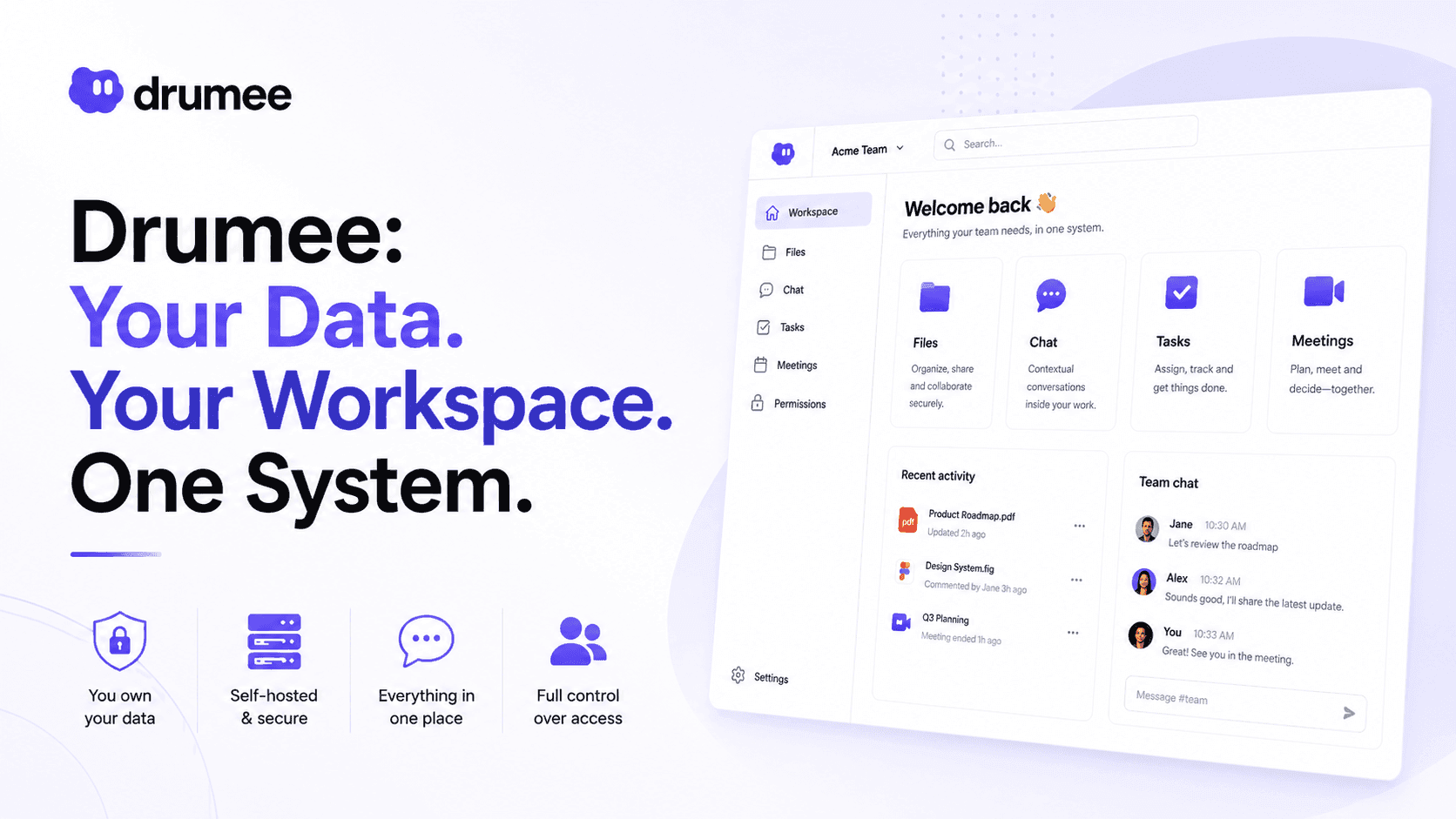
Drumee: Your Data. Your Workspace. One System
Drumee is a self-hosted, sovereign data workspace where files, chat, tasks, and permissions live in one place on infrastructure you own. Learn what Drumee is, what it stands for, and how to get started.
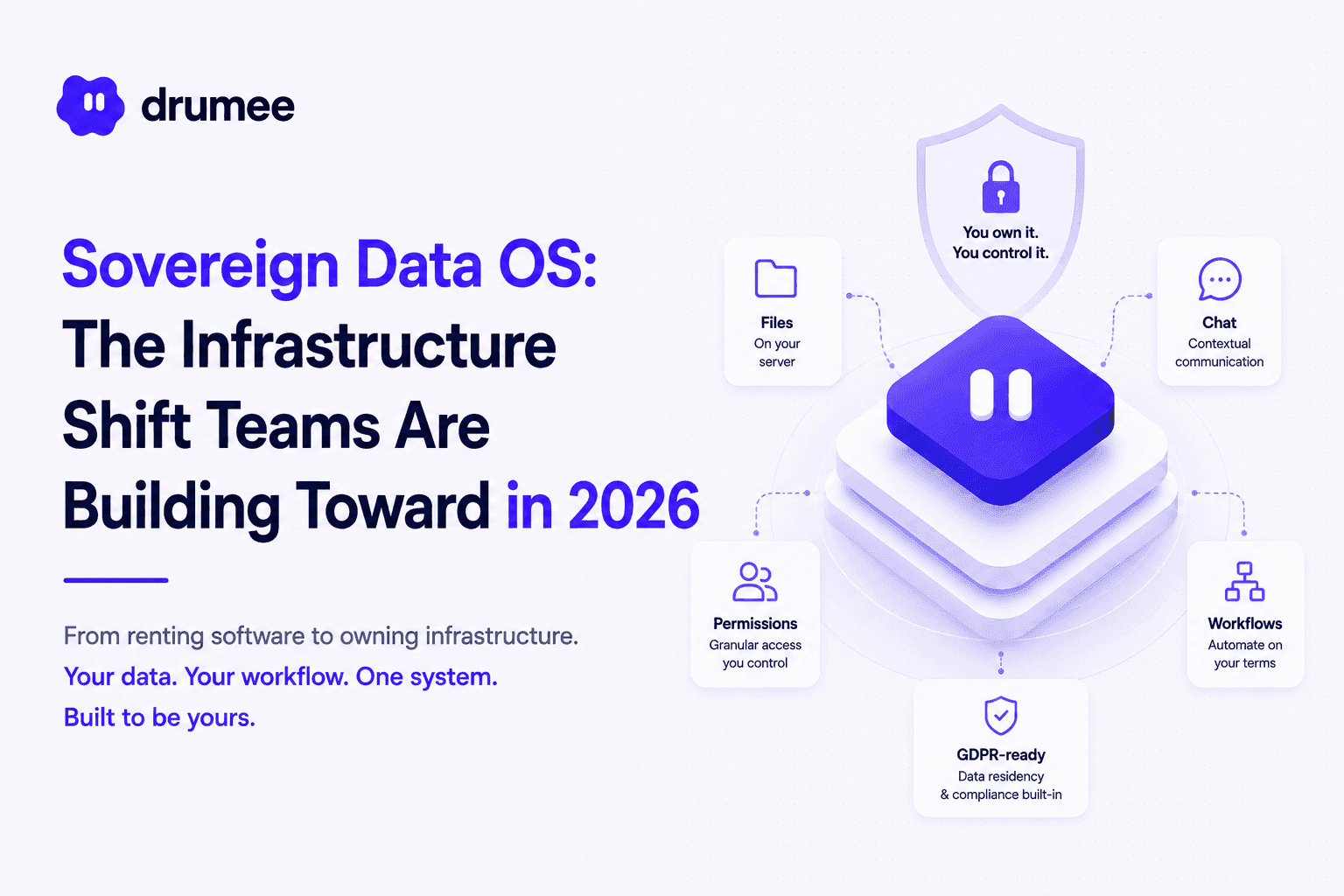
What Is a Sovereign Data OS? The Infrastructure Shift Teams Are Building Toward in 2026
What is a sovereign data OS? Learn how Drumee's unified self-hosted infrastructure replaces fragmented SaaS stacks with a single governable environment for files, chat, permissions, and workflows in 2026.
Data Ownership: What It Means and How to Achieve It in 2026
What is data ownership and how do you actually achieve it? Learn the three layers of data control, why AI changes the stakes, and how self-hosted infrastructure gives teams genuine ownership in 2026.