
File Sharing Without the Cloud: How Are Teams Taking Back Control?
83% of companies experienced a cloud data breach in 2025. File sharing without the cloud gives teams infrastructure control over storage, permissions, and AI processing that vendor-hosted platforms cannot provide. Here is what works in 2026.
File Sharing Without the Cloud: How Are Teams Taking Back Control?
File sharing without the cloud means distributing and accessing files through infrastructure your organization directly administers, without routing that data through a vendor's servers, subject to a vendor's terms of service, processed by AI systems the vendor controls, and priced according to per-seat models the vendor adjusts unilaterally. In 2026, the teams making this shift are not primarily motivated by ideology about software freedom or philosophical commitments to open source. They are motivated by numbers. According to MSP360's 2026 SaaS data protection analysis, 83% of companies reported experiencing a cloud data breach in 2025, while 70% of businesses using SaaS applications have lost data from those apps, and 74% do not have offsite data protection. The picture that emerges from these figures is not of a secure cloud ecosystem with isolated incidents. It is a file sharing infrastructure model that is structurally exposed at the points that matter most to teams whose files contain sensitive operational content.
The Breach Pattern That Cloud File Sharing Creates
Understanding why file sharing without the cloud is gaining traction requires understanding the specific breach pathways that cloud-hosted file systems generate, because they are different from the breach pathways that most teams plan for.
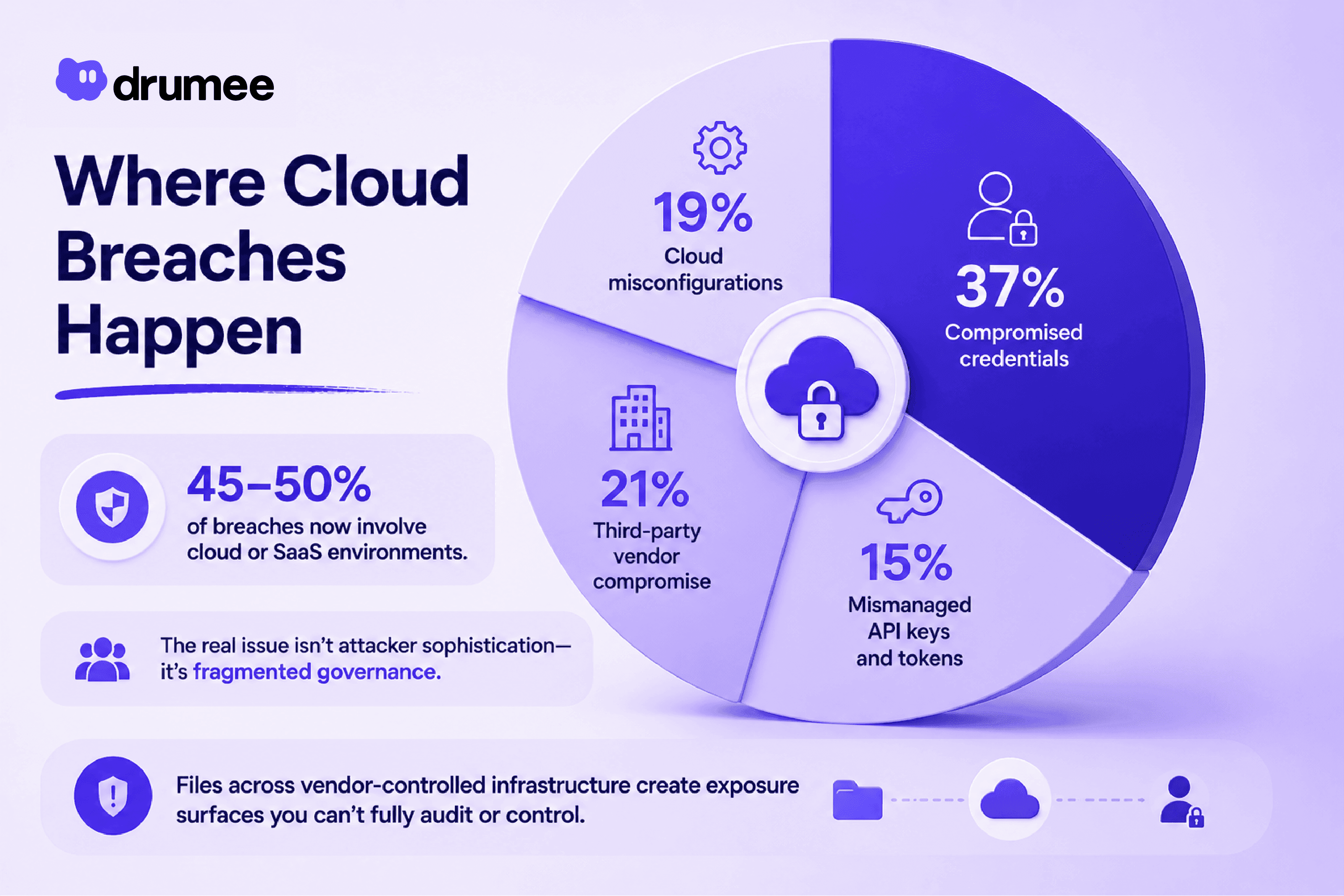
The most commonly assumed threat is external intrusion: a malicious actor gaining unauthorized access to a storage system through stolen credentials or exploited vulnerabilities. This threat is real, but it is not the dominant mode of cloud file sharing exposure in 2026. According to DataStackHub's 2025-2026 data breach statistics report, 45 to 50% of breaches now involve cloud or SaaS environments, but the leading causes inside those environments are not sophisticated external intrusions. Cloud misconfigurations were responsible for 19% of total breaches in 2025. Compromised credentials were the leading cause of cloud-based data breaches at 37%. Mismanaged API keys and tokens contributed to 15% of SaaS data exposure events. Third-party vendor compromise accounted for 21% of cloud-related incidents. The thread connecting all of these is not technical sophistication on the attacker's side. It is governance fragmentation on the defender's side: files distributed across vendor-controlled infrastructure where access configuration, integration permissions, and vendor subprocessor chains create exposure surfaces that the team's own administrators cannot fully audit or control.
The integration exposure is particularly concrete. BetterCloud's 2026 SaaS security analysis documents a June 2025 vulnerability in Microsoft OneDrive's File Picker interface that enabled unauthorized access to entire OneDrive accounts through hundreds of third-party applications including Slack, ChatGPT, Trello, and Zoom. The vulnerability allowed access to an entire OneDrive account when a user only intended to share a single file. The origin was excessive permissions granted during the OAuth consent process, a mechanism that exists in every cloud file sharing platform that supports third-party integrations. When file storage infrastructure is vendor-hosted, the integration permission model is governed by the vendor's architecture and the vendor's consent model. The organization can configure which integrations to enable, but it cannot modify the underlying consent scope that the vendor's platform grants by default.
Kaseya's 2026 SaaS security analysis adds the volume context: in 2024, SaaS Alerts detected more than 15,787 files being shared every hour across monitored environments. Nearly 40% of those sharing events occurred outside the organization. At that velocity, the governance gap between what a team intends to share and what the cloud sharing infrastructure actually makes accessible is not a theoretical compliance concern. It is an operational reality generating thousands of potential exposure events per hour.
What Does Taking Back Control Mean in Practice?
File sharing without the cloud is not the same as file sharing without any infrastructure. It requires infrastructure, and in 2026 the infrastructure options are more accessible and operationally mature than at any prior point in the history of self-hosted software.
The most direct path for teams evaluating this approach is a self-hosted network-attached storage deployment combined with self-hosted collaboration software. Lystr's 2026 cloud storage alternatives guide identifies the primary categories: NAS devices from vendors like Synology and QNAP offer personal cloud storage with remote access and no monthly fees, with a one-time hardware cost and full control over data location and configuration. For teams with higher availability requirements, VPS-hosted self-hosted software provides the same governance properties without physical hardware dependency. A standard VPS with 2 vCPU and 4 GB RAM is sufficient to run a full self-hosted file sharing stack for most small and medium teams.
The open source platforms serving this category have each matured into production-grade alternatives to cloud storage for specific use cases. Zight's August 2025 analysis of open source file sharing for remote teams maps the current landscape: Nextcloud provides a full collaboration suite with document editing, chat, and video conferencing, making it the strongest option for teams that need advanced collaboration tools alongside file sovereignty. Seafile focuses on fast, secure file syncing and sharing and is ideal for handling large datasets with detailed access controls. Syncthing offers peer-to-peer file sharing without central servers, suited for small teams prioritizing simplicity and the elimination of any centralized infrastructure entirely.
The operational overhead that these platforms require is primarily in configuration and maintenance rather than initial deployment. SSD Nodes' January 2026 self-hosting guide notes that Nextcloud-based self-hosted file sharing provides savings nearly twice the server cost when compared to equivalent cloud storage subscriptions, and that one of the biggest advantages is the ability to control data retention policies directly. The organization decides how long files are kept, who can access them, and how they are backed up, with no arbitrary vendor limits or unexpected price changes.
The Teams That Are Making the Switch
The profile of organizations adopting file sharing without the cloud in 2026 is broader than it was three years ago, and the industries driving adoption reflect the compliance and governance pressures that have made cloud file sharing's governance limitations operationally visible.
Regulated industries are moving fastest. Grand View Research's self-hosted cloud platform market analysis identifies healthcare, banking and financial services, government, and defense as the segments with the most significant growth in self-hosted infrastructure deployments, driven by GDPR-equivalent regulations, data localization laws, and compliance frameworks that require demonstrable jurisdictional control over file storage and processing. Healthcare is projected to grow at the highest rate among end-use segments from 2026 to 2033 specifically because healthcare organizations face the intersection of the tightest data residency requirements with the largest volumes of sensitive operational files. Cloud file sharing creates compliance exposure in this context that self-hosted infrastructure resolves structurally.
Legal agencies, professional services firms, and government-adjacent contractors are the second wave. For these teams, the governance requirement is not primarily about regulatory compliance in the formal sense. It is about client trust. When a client asks where their files are stored, the answer that matters is whether the storage infrastructure is under the organization's direct administrative control or under a vendor's terms of service. In an environment where CoreStream GRC's 2026 data breach analysis documents that over 40% of cyber incidents reported to the FCA in 2025 involved a third party and that third-party involvement in breaches has grown from roughly 15% to 30% in a single year, the answer a client receives about their file storage governance has become a procurement and trust question, not just a technical one.
The third wave is developer and engineering teams reacting to the AI processing exposure of cloud file sharing. SentinelOne's 2026 cloud security statistics report that data policy violations associated with generative AI application usage doubled in 2025 and continue growing into 2026, with employees using unmanaged AI services and cloud tools, leaking source code, regulated data, and intellectual property. For engineering teams whose files include source code, API keys, and product documentation, the convergence of cloud storage AI processing and the absence of organizational governance over that processing layer has made the case for file sharing without the cloud decisive rather than theoretical.
The Governance Gap That File-Only Solutions Leave Open
The most important limitation in the file sharing without the cloud conversation is one that most discussions of the topic understate: the governance gap that persists when file storage moves off the cloud but the operational context surrounding those files remains in vendor-controlled infrastructure.
A team that moves its file storage to self-hosted Nextcloud while continuing to discuss those files in Slack, document them in Notion, and assign tasks about them in Linear has achieved file storage sovereignty without achieving operational sovereignty. The conversation in Slack about which files to share with which client, the Notion page documenting how to handle the file classification decision, and the Linear task connecting the file delivery to the project workflow all remain in vendor-controlled environments under vendor-defined governance terms. A complete governance picture of how a specific file was handled requires records from four separate systems, none of which can be cross-referenced automatically, and three of which are outside the organization's direct administrative authority.
This is the architectural gap that Drumee is designed to close. As a sovereign data OS, Drumee places files, communications, permissions, and task context in a single self-hosted environment the organization administers, with a unified audit trail and a consistent permission model across every layer where file-related work actually happens. When a client file is shared, the sharing action, the conversation about the sharing decision, the permission model governing who can see it, and the task workflow connected to its delivery all exist within the same governed infrastructure boundary. File sharing without the cloud, in the complete governance sense, means not just storing files outside vendor infrastructure. It means operating the full context of file-related work inside infrastructure your team controls.
FAQ
1/ What is file sharing without the cloud?
File sharing without the cloud means distributing and accessing files through infrastructure your organization directly administers, rather than routing data through vendor-hosted servers governed by third-party terms of service, pricing models, and AI processing systems. Options include self-hosted software like Nextcloud, network-attached storage devices, peer-to-peer tools like Syncthing, and unified sovereign workspace platforms.
2/ Why are teams moving away from cloud file sharing in 2026?
According to MSP360's 2026 analysis, 83% of companies reported experiencing a cloud data breach in 2025, and 70% of SaaS app users have lost data from those applications. Cloud file sharing creates governance exposure through integration permission models, vendor AI processing, third-party subprocessor chains, and configuration fragmentation that teams cannot fully audit or control.
3/ What tools enable file sharing without the cloud?
The leading open source options are Nextcloud for full-suite collaboration with file sovereignty, Seafile for high-performance file sync with granular access controls, and Syncthing for peer-to-peer sharing without any central server. Synology and QNAP provide NAS hardware with self-hosted remote access. Drumee provides a unified sovereign environment that combines file sharing with communications, tasks, and permissions.
4/ Is self-hosted file sharing GDPR compliant?
Self-hosted file sharing provides the infrastructure control needed for genuine GDPR compliance, including data residency on servers the organization selects, audit logs the organization administers, and no dependency on vendor data processing agreements to demonstrate compliance. It removes the CLOUD Act exposure that applies to US-headquartered cloud providers regardless of where data is physically stored.
5/ What is the difference between self-hosted file sharing and sovereign file sharing?
Self-hosted file sharing resolves the storage layer. Sovereign file sharing extends that governance to the full operational context where files are used, including communications about files, permissions governing file access, and task workflows connected to file delivery. Drumee's unified self-hosted environment provides sovereignty across all of these layers simultaneously, rather than just the storage layer in isolation.
Related article: Self-Hosted Software: Why Are Forward-Thinking Teams Switching?
------------------------------
About Drumee
Drumee is the world’s first unified sovereign data infrastructure: a self-hosted, OS-like workspace that turns your own filesystem into a private collaborative environment.
Fully under your control, Drumee combines files, chat, tasks, and workflows with enterprise-grade permissions built directly into the infrastructure layer. No cloud vendors. No fragmented SaaS stack. No operational dependency.
Instead of renting your workspace from external providers, Drumee allows organizations to own the environment where operational knowledge lives.
Your Data. Your Workflow. One system. Built to be yours!
Follow us at: Website | X | LinkedIn | Drumee Founder X | Drumee Founder LinkedIn
Keep reading
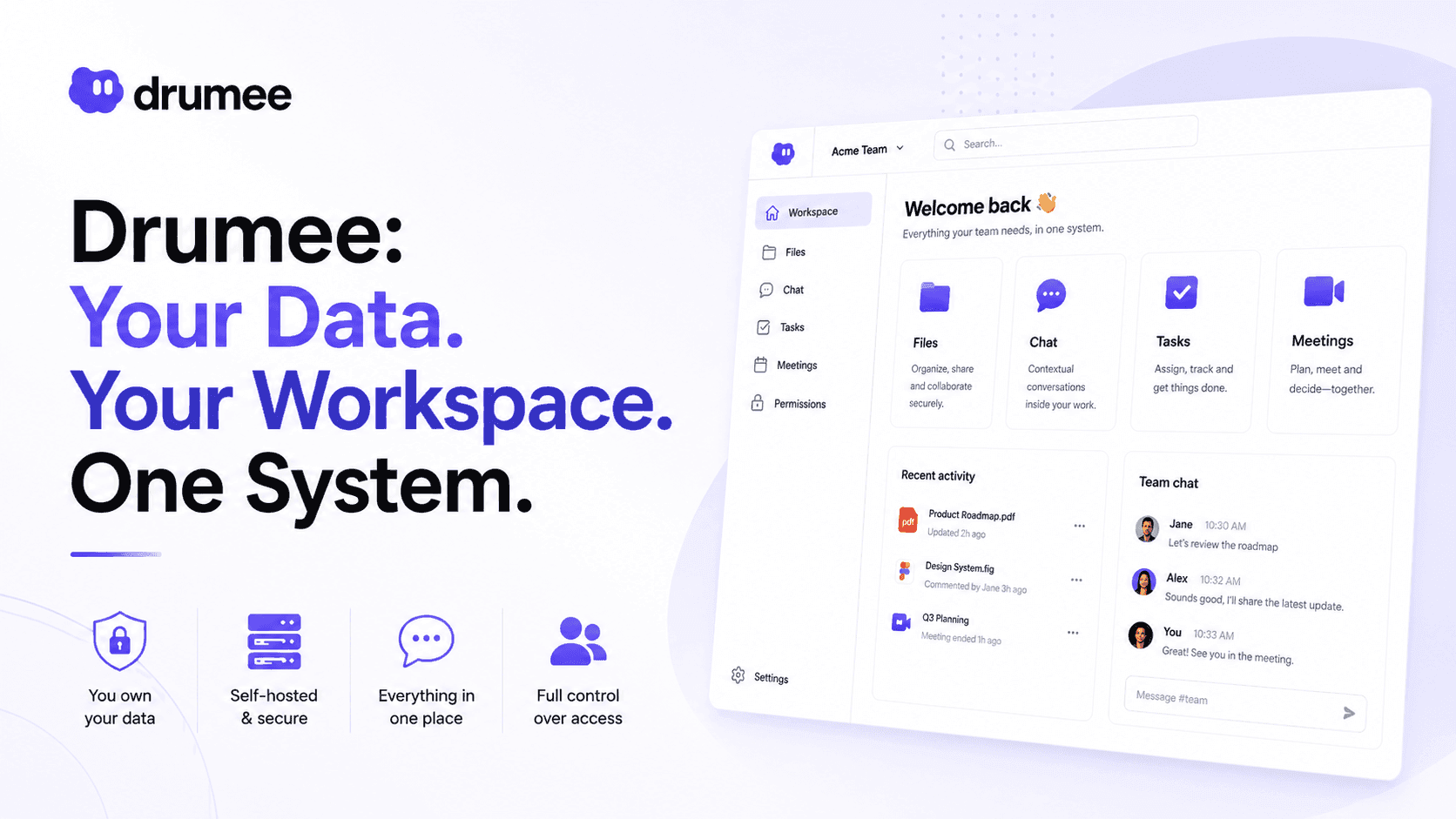
Drumee: Your Data. Your Workspace. One System
Drumee is a self-hosted, sovereign data workspace where files, chat, tasks, and permissions live in one place on infrastructure you own. Learn what Drumee is, what it stands for, and how to get started.
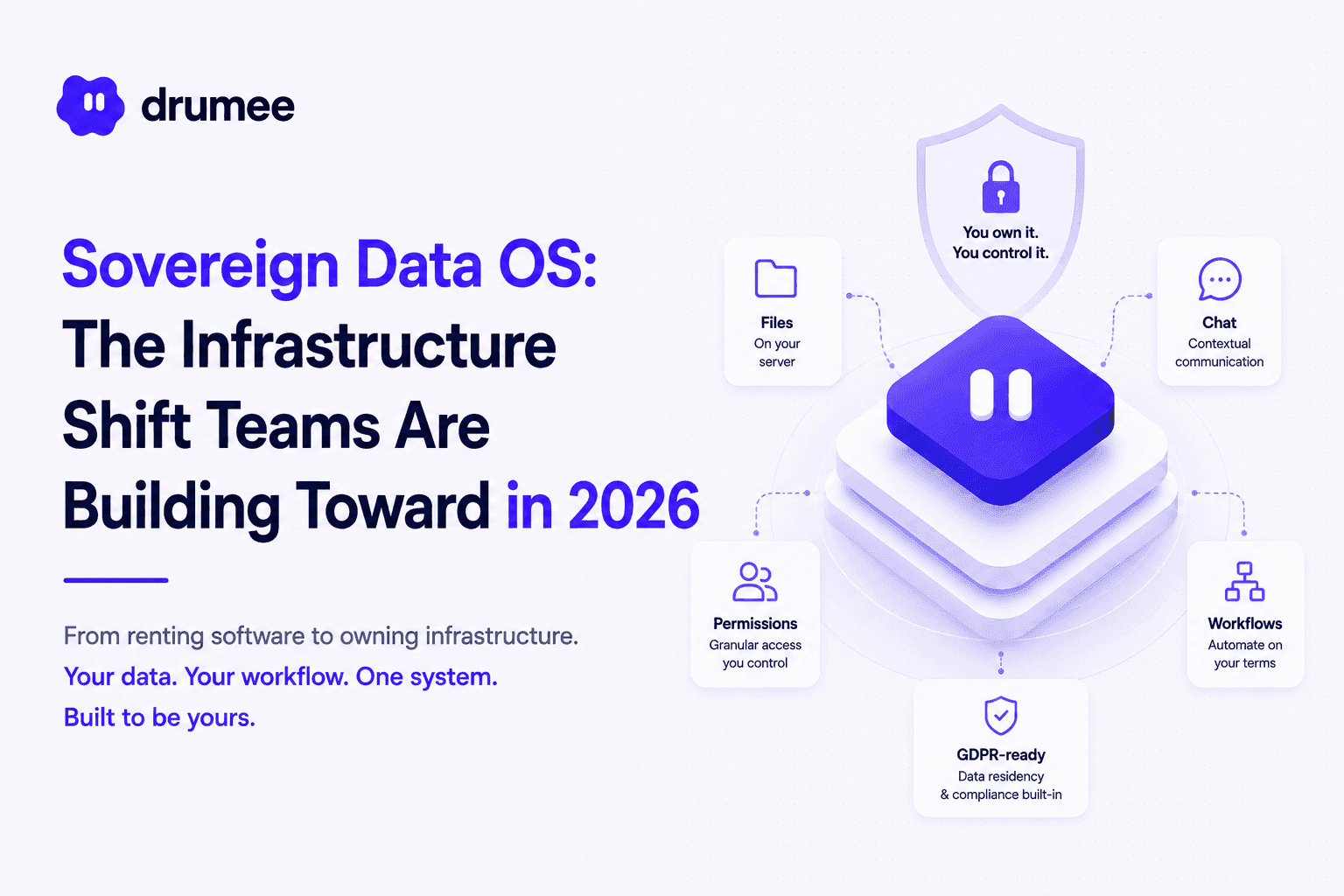
What Is a Sovereign Data OS? The Infrastructure Shift Teams Are Building Toward in 2026
What is a sovereign data OS? Learn how Drumee's unified self-hosted infrastructure replaces fragmented SaaS stacks with a single governable environment for files, chat, permissions, and workflows in 2026.
Data Ownership: What It Means and How to Achieve It in 2026
What is data ownership and how do you actually achieve it? Learn the three layers of data control, why AI changes the stakes, and how self-hosted infrastructure gives teams genuine ownership in 2026.