
Digital Data Ownership Rights: What They Are and Why Most Teams Don't Have Them.
Digital data ownership rights give organizations control over their data. In 2026, with only 55% of organizations requiring clear data ownership contractual terms from AI vendors, most teams hold legal title without operational authority. Here is what genuine ownership requires.
Digital Data Ownership Rights
Digital data ownership rights are the legal and operational entitlements that determine who controls organizational data where it is stored, how it is processed, who can access it, how long it is retained, and whether it can be exported, audited, or deleted without the cooperation of a third party. In 2026, most organizations believe they hold these rights. Most do not, in the sense that matters. They hold nominal content rights, the legal claim that the data they uploaded to a cloud platform belongs to them without the infrastructure authority that would make those rights meaningful in practice. According to the Cisco 2026 Data Privacy Benchmark Study cited by Secureframe, only 55% of organizations require clear contractual terms outlining data ownership, usage rights, and IP parameters when working with AI vendors. That figure means that nearly half of organizations building their operational workflows on third-party platforms have not even established the contractual basis for the ownership rights they assume they already have, let alone the infrastructure conditions that would make those rights exercisable without vendor cooperation.
The Gap Between Legal Ownership and Operational Control
The distinction that most teams miss when they think about digital data ownership rights is the gap between legal title and operational authority. Legal title is what most SaaS agreements acknowledge: your content is yours, the vendor does not claim intellectual property rights over what you store in their platform. Most agreements include language affirming this position, and for most teams, this is where the ownership analysis stops.
Operational authority is different. It is the ability to act on ownership rights directly, without intermediation by the vendor. It covers questions like: can your organization access its own data on demand without routing through the vendor's product interface? Can you produce a complete audit trail of who accessed which records, including system-level access by the vendor's own operations team? Can you delete data from backup systems, not just from the primary interface? Can you migrate to a different platform without the vendor's export tooling functioning correctly? Can you prevent the vendor's AI systems from processing your operational content as part of feature delivery?
JChange Law's analysis of SaaS data ownership disputes frames the structural problem directly: while in most SaaS partnerships the customer reserves ownership rights to their data, the practical reality often differs significantly. Providers control access, export formats, integration capabilities, and transition assistance, creating scenarios where technical ownership becomes meaningless without practical access. Today's businesses operate with an average of 130 SaaS applications, storing critical information across multiple cloud platforms. That dependency creates a fundamental power imbalance. The customer holds legal title. The vendor holds infrastructure authority. And infrastructure authority is where operational decisions are made.
What Does the Regulatory Environment Reveal About Ownership Rights?
The regulatory environment that has emerged around data rights in 2025 and 2026 is the most instructive indicator of where the gap between nominal and genuine digital data ownership rights has become consequential enough to require legal intervention.
According to Usercentrics' 2026 data privacy statistics compilation, the most significant data privacy risks organizations face are not external cyberattacks but structural governance failures: large data volumes that are hard to protect, unclear data ownership creating security gaps, and evolving cyber threats that exploit both. The European Union's response to these risks has been to legislate operational portability rights rather than simply affirming nominal ownership. The EU Data Act, which became applicable on September 12, 2025, established new requirements for data sharing and portability, mandating interoperable data formats and the elimination of vendor-imposed switching fees by September 2027. The Act's premise is that legal ownership without portability is insufficient. The regulation does not question whether customers own their data. It compels vendors to make that ownership exercisable.
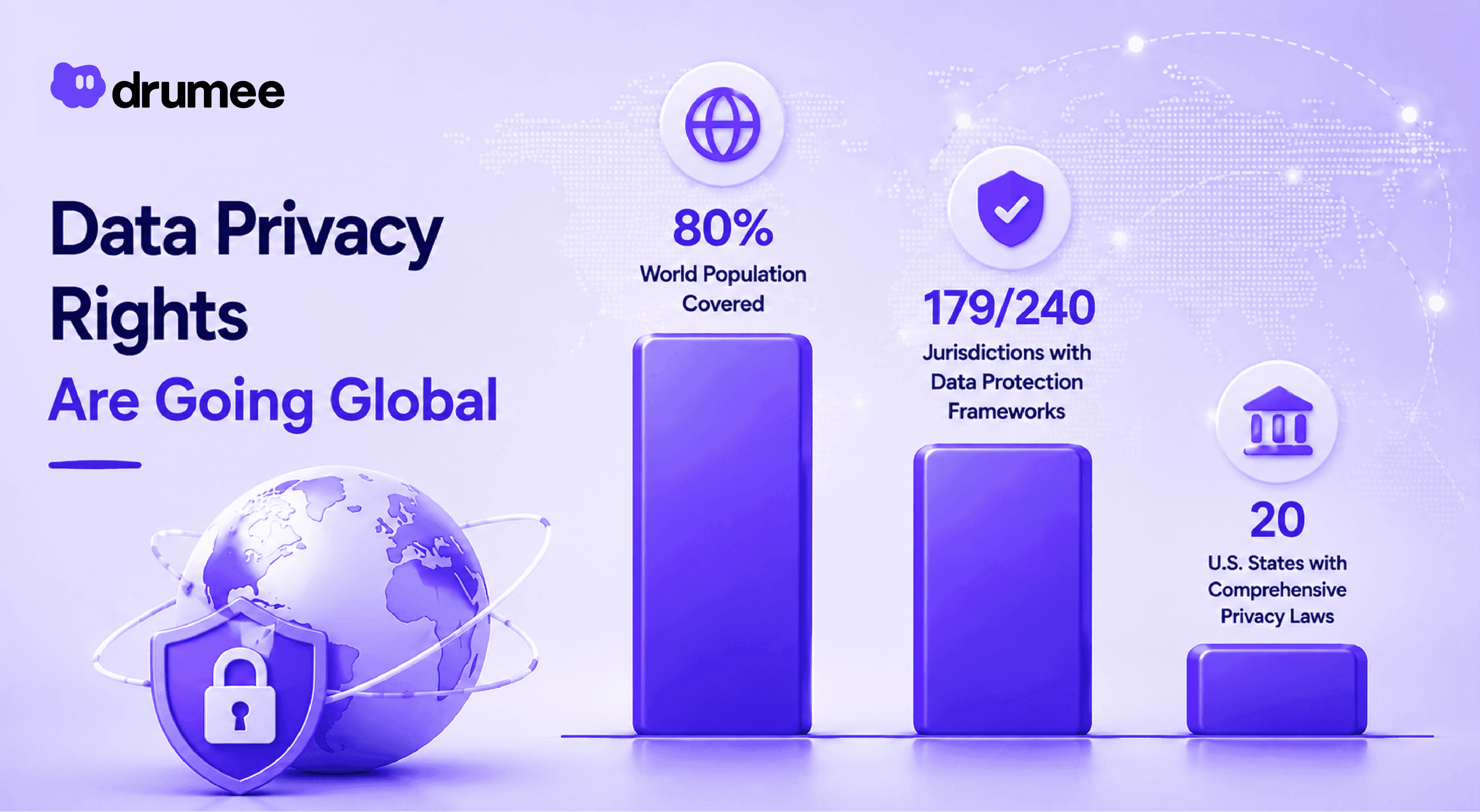
Station X's 2026 data privacy statistics analysis documents the scale of the regulatory expansion surrounding these rights: 179 out of 240 jurisdictions now have data protection frameworks in place, covering approximately 80% of the world's population. In the United States alone, 20 states have enacted comprehensive data privacy laws as of 2026, with Indiana, Kentucky, and Rhode Island taking effect on January 1, 2026. The common thread across these frameworks is the extension of individual and organizational rights over how their data is collected, retained, processed, and deleted, and the imposition of liability on organizations that cannot demonstrate those rights are exercisable in practice.
The enforcement consequence of unclear data ownership is financial and measurable. Secureframe's 2026 data privacy report documents that 38% of companies globally spent five million dollars or more on privacy in the past twelve months, a jump from 14% in early 2025. The privacy budget escalation reflects a compliance environment where organizations are discovering the difference between having privacy policies and having the technical controls to enforce them. According to StationX's analysis, 83% of organizations have no technical controls to prevent employees uploading confidential data to AI tools, meaning that customer personally identifiable information, proprietary information, and regulated data can end up in third-party AI models with no audit trail and no ability to delete it. That is a direct description of a digital data ownership rights failure: the organization legally owns the data that has been deposited in an AI system, but has no mechanism to exercise that ownership.
Why Has AI Made the Ownership Gap Visible?
Before generative AI became a standard feature of workplace software, the digital data ownership rights gap was real but largely latent. Organizations that had uploaded years of documents to Google Drive or stored client communications in Slack were technically without full operational ownership, but the practical consequences were limited to vendor pricing leverage and export friction. The data was passively stored. The vendor was processing it for content moderation and platform improvement, but not extracting structured insight from it in ways that had obvious commercial value.
The emergence of AI embedded in productivity platforms has made the ownership gap active rather than latent. When Notion AI summarizes your internal strategy documents, when Google Gemini generates responses from your Drive files, when Slack AI surfaces information from your team's message history, the vendor's AI systems are extracting structured intelligence from your operational content and processing it within the vendor's infrastructure under the vendor's governance terms. According to Altegon's 2026 sovereign infrastructure analysis, 51% of organizations using AI have already experienced at least one negative consequence, with privacy, regulatory compliance, and explainability among the leading issues. McKinsey's State of AI 2025 data confirms this pattern, cited in the same analysis. The negative consequences organizations report are not primarily external attacks. They are governance failures that emerge when AI systems process operational data in environments the organization does not control.
SoftwareOne's 2026 digital sovereignty guide identifies the scale of institutional awareness around this shift: 81% of organizations now report heightened demand for data localization specifically because of the rise of generative and agentic AI models. Data sovereignty expectations, as the guide frames it, now extend to where data is processed and inferred, not just where it is stored. Organizations that understood their ownership rights in terms of storage location are discovering that AI processing has created a new dimension of the problem that their existing contracts and governance frameworks do not address.
The Three Rights Most Teams Cannot Currently Exercise
Reducing the digital data ownership rights gap to its most actionable components, there are three specific rights that most teams using cloud-hosted SaaS platforms cannot currently exercise without vendor cooperation, and whose absence defines the practical ownership gap.
The first is the right to complete an audit. A genuine owner of operational data can produce a complete record of who accessed it, when, and under what authority, including system-level access by the vendor's operations team, AI processing events, and subprocessor access chains. In cloud-hosted platforms, audit logs are available through the vendor's interface. The completeness and accuracy of those logs is governed by the vendor's implementation. The organization cannot independently verify that the logs are complete, and cannot access them if the vendor's systems are unavailable or if the vendor restricts access.
The second is the right to independent erasure. GDPR Article 17 and equivalent regulations in other jurisdictions give individuals the right to erasure of their personal data. For organizations to honor this right, they must be able to erase data from every system where it exists, including backup infrastructure. In cloud-hosted environments, backup systems are managed by the vendor. The organization can request deletion, but it cannot independently verify that deletion from backup systems occurred. The EDPB's February 2026 enforcement report found that half of audited controllers had no specific procedures for erasure in backup systems, precisely because those systems are under vendor administrative control.
The third is the right to AI processing governance. As AI systems become embedded in productivity software, the organization's legal ownership of its content coexists with the vendor's operational authority over which AI systems process that content and how. Venable LLP's December 2025 analysis of IP rights in SaaS contracts warns that vendors generally include broad ownership terms in SaaS contracts, and that a careful review of these terms is needed to identify overly broad ownership language that may unintentionally capture materials, information, or content the client believes it should retain or own. Without explicit contractual restriction, the vendor's right to process content for service improvement can encompass AI model training and AI feature operation in ways that were not contemplated when the original agreement was signed.
The Infrastructure Condition That Makes Ownership Real
The practical resolution to the digital data ownership rights gap is not primarily legal. Negotiating better DPA terms, requesting audit log access, or specifying AI processing restrictions in vendor contracts all address the gap at the contractual layer. The gap at the infrastructure layer requires an infrastructure response.
When an organization's operational data, files, communications, permissions, and workflows, runs on infrastructure it directly administers, the three rights described above become exercisable by default rather than negotiable by contract. Audit logs are in systems the organization runs and can independently verify. Erasure from backup systems is under the organization's own administrative control. AI processing is limited to systems the organization has explicitly deployed and configured, operating within the infrastructure boundary it governs.
This is the condition that Drumee's sovereign data OS architecture is designed to create. Files, conversations, permissions, and task context exist within a single self-hosted environment the organization administers, with no third-party infrastructure operator whose terms define the outer boundary of the organization's ownership rights. The audit trail is organizationally controlled. The AI processing layer consists only of systems the organization has chosen to integrate. Erasure from every layer of the environment, including backups, is an administrative action the organization can take directly, without requiring vendor cooperation.
For teams that have moved from the contractual question of whether they own their data to the operational question of whether they can exercise that ownership, sovereign self-hosted infrastructure is the only architecture that provides an affirmative answer to both.
FAQ
1/ What are digital data ownership rights?
Digital data ownership rights are the legal and operational entitlements determining who controls organizational data — where it is stored, how it is processed, who can access it, and whether it can be exported, audited, or deleted without third-party cooperation. Most organizations hold nominal legal title to their data but lack the operational authority to exercise these rights without vendor intermediation.
2/ Why don't most teams have genuine digital data ownership rights?
Most teams store operational data in vendor-hosted SaaS platforms where the vendor controls the infrastructure, backup systems, AI processing layer, export tooling, and audit log access. While legal ownership remains with the customer, operational authority belongs to the vendor, creating a fundamental power imbalance that makes ownership rights unexercisable without vendor cooperation.
3/ What did the EU Data Act change about data ownership rights?
The EU Data Act, effective September 12, 2025, mandated interoperable data formats and the elimination of vendor-imposed switching fees by September 2027. It extended data portability rights by compelling vendors to make customer ownership rights exercisable in practice, not just acknowledged in contractual terms.
4/ How does AI embedded in SaaS platforms affect digital data ownership?
When AI is embedded in productivity platforms, the vendor's AI systems process operational content, documents, communications, and workflows, within the vendor's infrastructure under the vendor's governance terms. This makes the ownership gap active rather than latent: the organization legally owns the content, but the vendor's AI systems can extract structured intelligence from it without the organization's explicit authorization or the ability to audit what was processed and retained.
5/ How does Drumee address digital data ownership rights?
Drumee is a sovereign data OS that places files, communications, permissions, and task context on infrastructure the organization directly administers. Audit logs are organizationally controlled, erasure from all infrastructure layers is an administrative action the organization executes directly, and AI processing is limited to systems the organization has explicitly deployed within its own infrastructure boundary. Legal ownership and operational authority are unified in the same governance layer.
Related article: File Sharing Without the Cloud: How Are Teams Taking Back Control?
------------------------------
About Drumee
Drumee is the world’s first unified sovereign data infrastructure: a self-hosted, OS-like workspace that turns your own filesystem into a private collaborative environment.
Fully under your control, Drumee combines files, chat, tasks, and workflows with enterprise-grade permissions built directly into the infrastructure layer. No cloud vendors. No fragmented SaaS stack. No operational dependency.
Instead of renting your workspace from external providers, Drumee allows organizations to own the environment where operational knowledge lives.
Your Data. Your Workflow. One system. Built to be yours!
Follow us at: Website | X | LinkedIn | Drumee Founder X | Drumee Founder LinkedIn
Keep reading
Drumee: Your Data. Your Workspace. One System
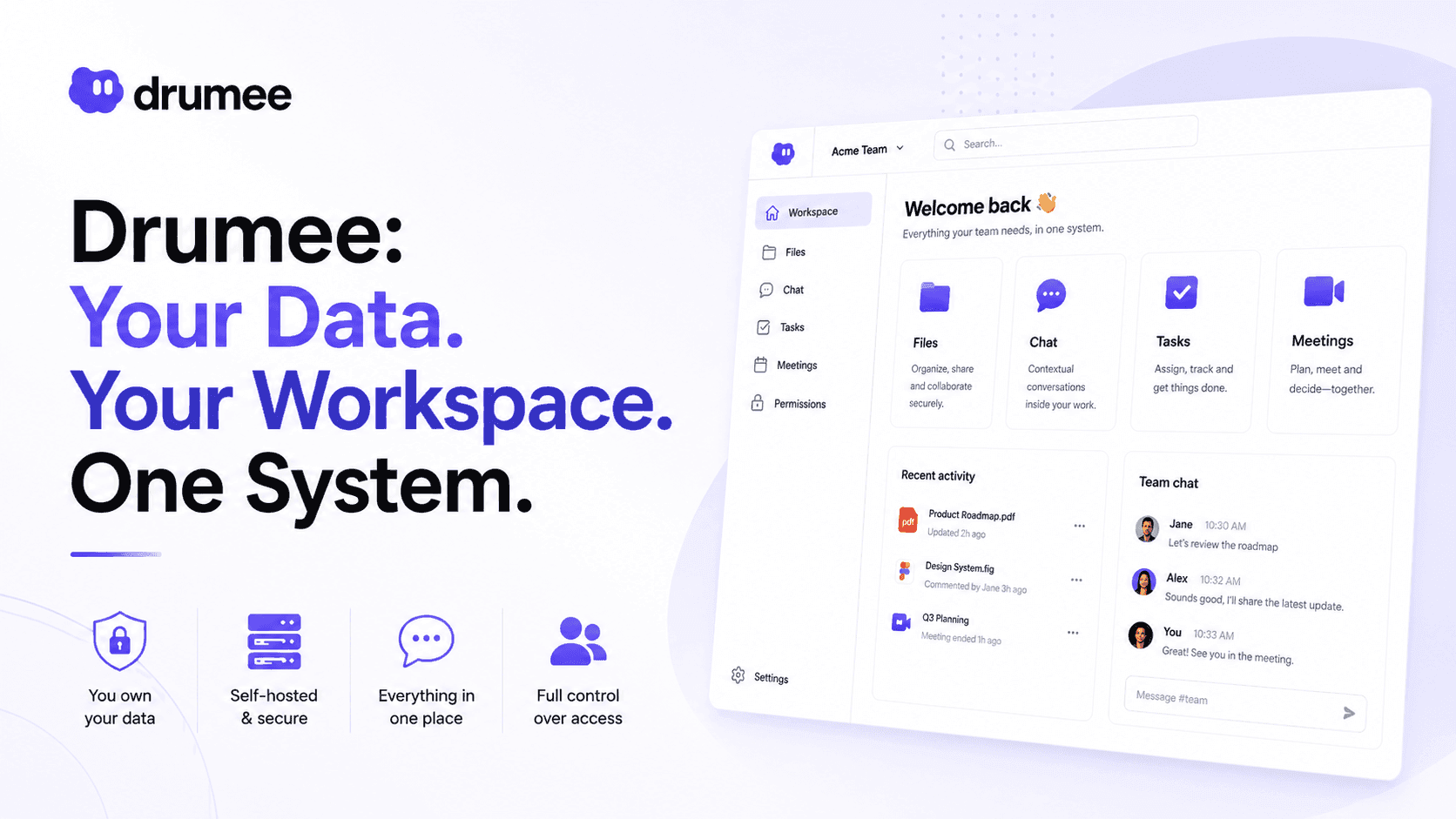
Drumee is a self-hosted, sovereign data workspace where files, chat, tasks, and permissions live in one place on infrastructure you own. Learn what Drumee is, what it stands for, and how to get started.
What Is a Sovereign Data OS? The Infrastructure Shift Teams Are Building Toward in 2026
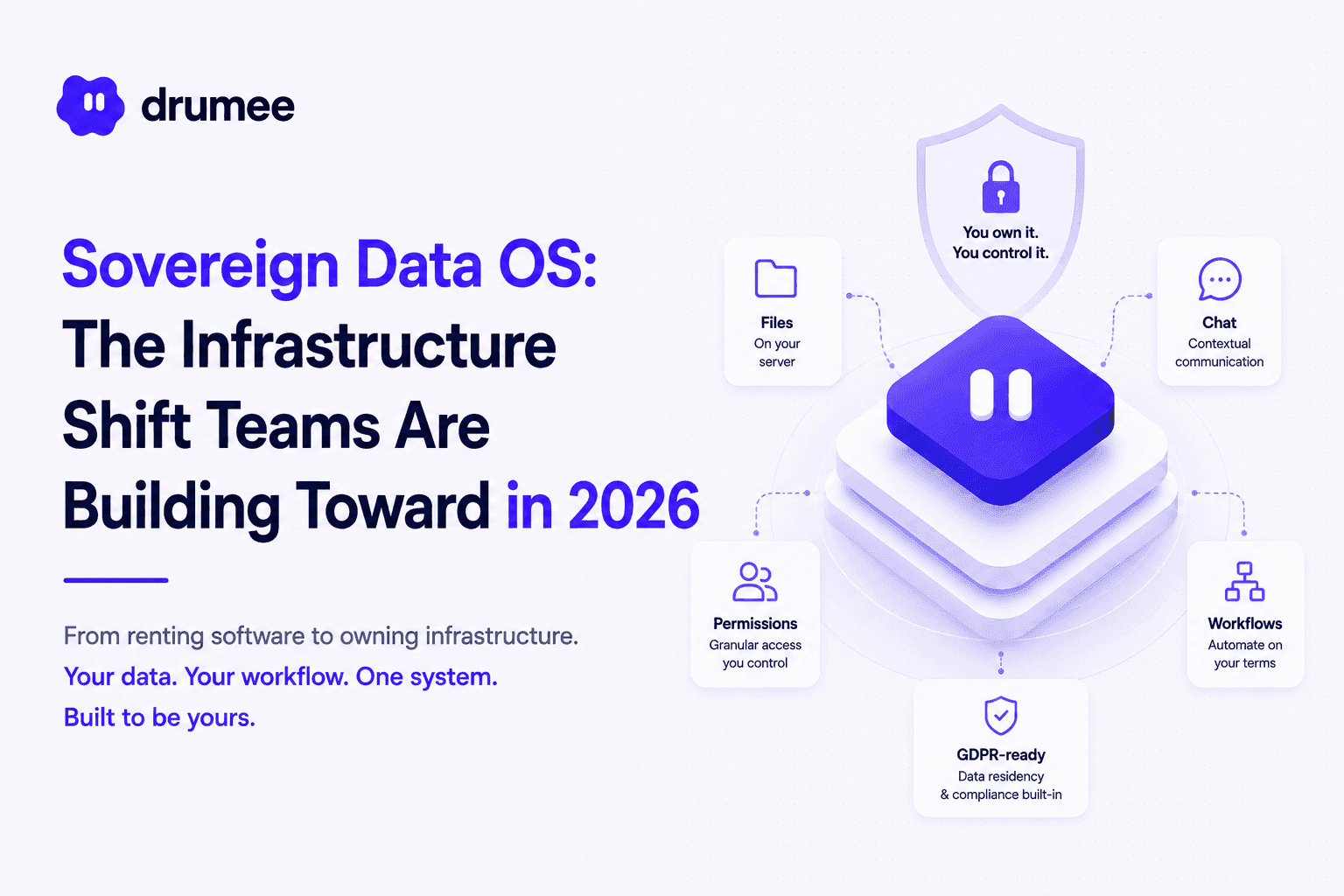
What is a sovereign data OS? Learn how Drumee's unified self-hosted infrastructure replaces fragmented SaaS stacks with a single governable environment for files, chat, permissions, and workflows in 2026.
Data Ownership: What It Means and How to Achieve It in 2026
What is data ownership and how do you actually achieve it? Learn the three layers of data control, why AI changes the stakes, and how self-hosted infrastructure gives teams genuine ownership in 2026.